
2 Samuel 21:9

Hebrew (Westminster Leningrad Codex) 2 Samuel 21:9 appears in the Hebrew Old Testament. The text above is from the Westminster Leningrad Codex. Each word links to its Strong’s number, a concise gloss, and parsing drawn from the Open Scriptures Hebrew Bible morphology. Click any word for its full Brown-Driver-Briggs (BDB) entry.
Download image
Cite this verse

2 Samuel 21:9 (World English Bible). Public Domain. Lemma interlinear Bible study tool, https://lemma.gebible.app/v/2-samuel/21/9.

Show BibTeX & RIS
BibTeX
RIS
English Translation
He delivered them into the hands of the Gibeonites, and they hanged them in the mountain before Yahweh, and they fell [all] seven together. They were put to death in the days of harvest, in the first days, at the beginning of barley harvest.
World English Bible · Public Domain
Download a study sheet

One document with this verse’s original text, its word-by-word gloss line, the meaning frame, cross-references with their text, attributed commentary, and full source and license credits — printable, and it pastes into notes with its structure intact.

This verse Autodidact and up

Study sheet (.html) Plain text (.txt)

A passage Seminary Student

Up to 50 verses in one chapter. A passage sheet keeps up to 6 commentary sources and 12 cross-references per verse, in the order this page ranks them, and says so on the sheet whenever that leaves anything out. Ask for a single verse and you get the Autodidact verse sheet above.

Everything on this page stays free to read, with no account — the sheet is a download of what is already on screen, not access to it.

Want to remove ads? Support Godless Engineer
Compare translations 3

The same verse in 3 English versions, stacked beneath the original-language interlinear above. Click any original word for its lexicon entry.

Each is an independent rendering of the whole verse — the interlinear is not word-aligned to these translations.

Highlighted words mark where these versions differ — a whole-verse word diff, not a word-by-word alignment.

  • World English Bible Public Domain
    He delivered them into the hands of the Gibeonites, and they hanged them in the mountain before Yahweh, and they fell [all] seven together. They were put to death in the days of harvest, in the first days, at the beginning of barley harvest.
  • King James Version Public Domain
    And he delivered them into the hands of the Gibeonites, and they hanged them in the hill before the LORD: and they fell all seven together, and were put to death in the days of harvest, in the first days, in the beginning of barley harvest.
  • unfoldingWord Literal Text CC BY-SA 4.0
    And he gave them into the hand of the Gibeonites, and they hanged them on the hill to the face of Yahweh, and the seven of them fell together. And they, they were killed in the days of the harvest, in the first, at the beginning of the harvest of barley.

unfoldingWord Literal Text — © unfoldingWord, licensed CC BY-SA 4.0. Word-aligned USFM3 via Door43 (git.door43.org/unfoldingWord/en_ult).

Versions to compare (up to 4)

3 of 4 selected

Show all 18 translations

Every available English version of this verse, each an independent rendering of the whole verse.

  • World English Bible Public Domain
    He delivered them into the hands of the Gibeonites, and they hanged them in the mountain before Yahweh, and they fell [all] seven together. They were put to death in the days of harvest, in the first days, at the beginning of barley harvest.
  • Berean Standard Bible Public Domain
    And he delivered them into the hands of the Gibeonites, and they hanged them on the hill before the LORD. So all seven of them fell together; they were put to death in the first days of the harvest, at the beginning of the barley harvest.
  • Majority Standard Bible Public Domain
    And he delivered them into the hands of the Gibeonites, and they hanged them on the hill before the LORD. So all seven of them fell together; they were put to death in the first days of the harvest, at the beginning of the barley harvest.
  • King James Version Public Domain
    And he delivered them into the hands of the Gibeonites, and they hanged them in the hill before the LORD: and they fell all seven together, and were put to death in the days of harvest, in the first days, in the beginning of barley harvest.
  • American Standard Version (1901) Public Domain
    And he delivered them into the hands of the Gibeonites, and they hanged them in the mountain before Jehovah, and they fell `all' seven together. And they were put to death in the days of harvest, in the first days, at the beginning of barley harvest.
  • Revised Version (1885) Public Domain
    And he delivered them into the hands of the Gibeonites, and they hanged them in the mountain before the LORD, and they fell all seven together: and they were put to death in the days of harvest, in the first days, at the beginning of barley harvest.
  • Geneva Bible (1599) Public Domain
    And hee deliuered them vnto the handes of the Gibeonites, which hanged them in the mountaine before the Lord: so they died all seuen together, and they were slaine in the time of haruest: in the first dayes, and in the beginning of barly haruest.
  • Douay-Rheims (1899) Public Domain
    And gave them into the hands of the Gabaonites: and they crucified them on a hill before the Lord: and these seven died together in the first days of the harvest, when the barley began to be reaped.
  • Young's Literal Translation Public Domain
    and giveth them into the hand of the Gibeonites, and they hang them in the hill before Jehovah; and the seven fall together, and they have been put to death in the days of harvest, in the first `days', the commencement of barley-harvest.
  • Literal Standard Version CC BY-SA 4.0
    and gives them into the hand of the Gibeonites, and they hang them in the hill before YHWH; and the seven fall together, and they have been put to death in the days of harvest, in the first [days], the commencement of barley-harvest.
  • Unlocked Literal Bible CC BY-SA 4.0
    He handed them over into the hands of the Gibeonites. They hanged them on the mountain before Yahweh, and they died all seven together. They were put to death during the time of harvest, during the first days at the beginning of barley harvest.
  • unfoldingWord Literal Text CC BY-SA 4.0
    And he gave them into the hand of the Gibeonites, and they hanged them on the hill to the face of Yahweh, and the seven of them fell together. And they, they were killed in the days of the harvest, in the first, at the beginning of the harvest of barley.
  • Darby Bible Public Domain
    and he gave them into the hands of the Gibeonites, and they hanged them on the hill before Jehovah. And they fell all seven together, and were put to death in the first days of the harvest, in the beginning of barley harvest.
  • World Messianic Bible Public Domain
    He delivered them into the hands of the Gibeonites; and they hanged them on the mountain before the LORD, and all seven of them fell together. They were put to death in the days of harvest, in the first days, at the beginning of barley harvest.
  • Webster's Bible Public Domain
    And he delivered them into the hands of the Gibeonites, and they hanged them on the hill before the LORD: and they fell all seven together, and were put to death in the days of harvest, in the first days, in the beginning of barley harvest.
  • Free Bible Version CC BY-SA 4.0
    He handed them over to the Gibeonites, and they hanged them on the hill in the presence of the Lord. All seven of them died at the same time, executed at the beginning of the barley harvest.
  • Bible in Basic English Public Domain
    And he gave them up to the Gibeonites, and they put them to death, hanging them on the mountain before the Lord; all seven came to their end together in the first days of the grain-cutting, at the start of the cutting of the barley.
  • JPS Tanakh (1917) Public Domain
    and he delivered them into the hands of the Gibeonites, and they hanged them in the mountain before the LORD, and they fell all seven together; and they were put to death in the days of harvest, in the first days, at the beginning of barley harvest.

Literal Standard Version (2020), Covenant Press — licensed CC BY-SA 4.0. Text via the HelloAO Bible API (eBible.org). Unlocked Literal Bible (unfoldingWord) — licensed CC BY-SA 4.0. Text via the HelloAO Bible API (eBible.org). unfoldingWord Literal Text — © unfoldingWord, licensed CC BY-SA 4.0. Word-aligned USFM3 via Door43 (git.door43.org/unfoldingWord/en_ult). Free Bible Version, Dr. Jonathan Gallagher — licensed CC BY-SA 4.0. Text via the HelloAO Bible API (eBible.org).

Word by word

More ways to search: Search by grammar → Find every occurrence → Compare this word →

Practice this passage: Drill this verse → Learn its vocabulary →

הַגִּבְעֹנִ֗ים
Gibʻônîy
H1393
“the · Gibeonites”
Particle, Definite Article + Noun, Gentilic, Masculine, Plural, Absolute
Part of Speech
Particle + Noun
Type
Gentilic
Gender
Masculine
Number
Plural
State
Absolute
Full BDB Definition

Origin: patrial from H1391

TWOT: None

Gibeonite = "little hill: hilly" - an inhabitant of Gibeon
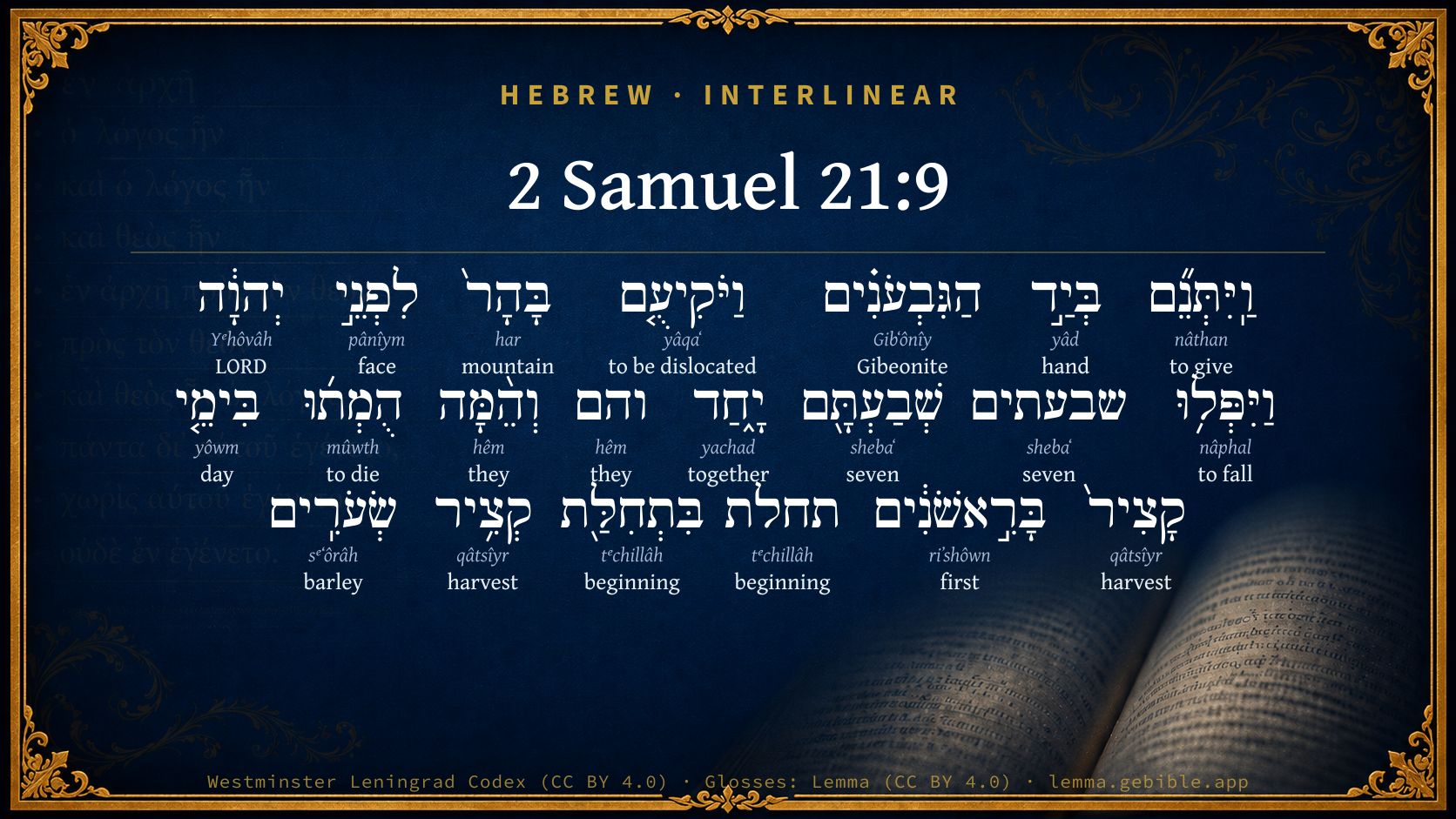
  1. וַֽיִּתְּנֵ֞ם nâthan H5414 “and · to give · them” Conjunction + Verb, Qal, Sequential Imperfect, 3rd Person, Masculine, Singular + Suffix, Personal, 3rd Person, Masculine, Plural
  2. בְּיַ֣ד yâd H3027 “in/at · hand of” Preposition + Noun, Common, Both, Singular, Construct
  3. וַיֹּקִיעֻ֤ם yâqaʻ H3363 “and · to be dislocated · them” Conjunction + Verb, Hiphil, Sequential Imperfect, 3rd Person, Masculine, Plural + Suffix, Personal, 3rd Person, Masculine, Plural
  4. בָּהָר֙ har H2022 “in/at the · mountain” Preposition, Determined + Noun, Common, Masculine, Singular, Absolute
  5. לִפְנֵ֣י pânîym H6440 “to/for · face(s) of” Preposition + Noun, Common, Both, Plural, Construct
  6. יְהוָ֔ה Yᵉhôvâh H3068 “LORD” Noun, Proper
  7. וַיִּפְּל֥וּ nâphal H5307 “and · to fall” Conjunction + Verb, Qal, Sequential Imperfect, 3rd Person, Masculine, Plural
  8. שבעתים shebaʻ H7651 “seven” Adjective, Cardinal number, Feminine, Dual, Absolute
  9. שְׁבַעְתָּ֖ם shebaʻ H7651 “seven · their” Adjective, Cardinal number, Masculine, Singular, Construct + Suffix, Personal, 3rd Person, Masculine, Plural
  10. יָ֑חַד yachad H3162 “together” Noun, Common, Masculine, Singular, Absolute
  11. והם hêm H1992 “and · they” Conjunction + Pronoun, Personal, 3rd Person, Masculine, Plural
  12. וְהֵ֨מָּה hêm H1992 “and · they” Conjunction + Pronoun, Personal, 3rd Person, Masculine, Plural
  13. הֻמְת֜וּ mûwth H4191 “to die” Verb, Hophal, Perfect, 3rd Person, Common, Plural
  14. בִּימֵ֤י yôwm H3117 “in/at · days of” Preposition + Noun, Common, Masculine, Plural, Construct
  15. קָצִיר֙ qâtsîyr H7105 “harvest” Noun, Common, Masculine, Singular, Absolute
  16. בָּרִ֣אשֹׁנִ֔ים riʼshôwn H7223 “in/at the · first” Preposition, Determined + Adjective, Adjective, Masculine, Plural, Absolute
  17. תחלת tᵉchillâh H8462 “beginning of” Noun, Common, Feminine, Singular, Construct
  18. בִּתְחִלַּ֖ת tᵉchillâh H8462 “in/at · beginning of” Preposition + Noun, Common, Feminine, Singular, Construct
  19. קְצִ֥יר qâtsîyr H7105 “harvest of” Noun, Common, Masculine, Singular, Construct
  20. שְׂעֹרִֽים sᵉʻôrâh H8184 “barley” Noun, Common, Feminine, Plural, Absolute

About this verse

These counts appear in no published source. They are computed here, from the morphology-tagged text and Lemma’s own curated glosses. What Lemma adds →

21
words
17
distinct lemmas
Historical
section

Notable vocabulary

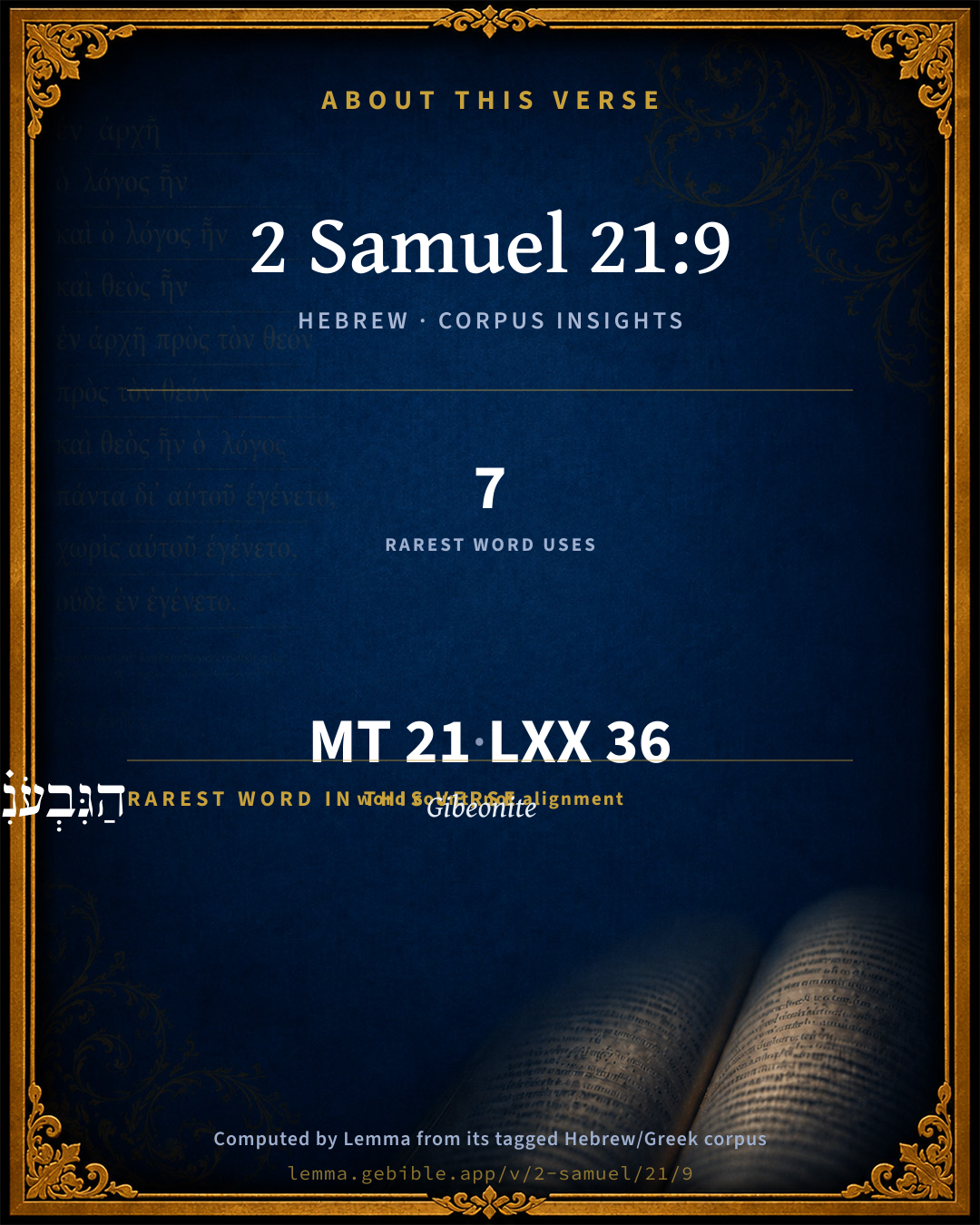
The rarest word here is הַגִּבְעֹנִ֗ים Gibeonite H1393 — appearing just 7 times in the whole Hebrew Bible.

Shared distinctive vocabulary

הַגִּבְעֹנִ֗ים Gibeonite H1393 occurs in 6 verses of the Hebrew Bible. Also found in:

Grammatical profile

  • 4 verbs
  • 12 nouns
  • 3 adjectives
  • 2 pronouns

Verb forms

  • וַֽיִּתְּנֵ֞ם Qal · Sequential Imperfect
  • וַיֹּקִיעֻ֤ם Hiphil · Sequential Imperfect
  • וַיִּפְּל֥וּ Qal · Sequential Imperfect
  • הֻמְת֜וּ Hophal · Perfect

Repetition

Words recur within this verse — often emphatic in Hebrew:

  • שבעתים seven H7651 ×2
  • קָצִיר֙ harvest H7105 ×2
  • תחלת beginning H8462 ×2
  • והם they H1992 ×2

Hebrew & Septuagint length

In English translation the verse runs 44 words from the Hebrew and 51 from the Septuagint (LXX English) — closely comparable.

A rough comparison of the two English renderings, which tokenize alike — not a word-level alignment.

Word counts can differ between the Hebrew and the Greek without any difference in meaning — e.g. the Hebrew direct-object marker אֵת has no separate Greek word, and Greek often adds the article ὁ.

In the original languages it is 21 Hebrew tokens and 36 Greek tokens — but the two are counted differently (Hebrew bundles its prefixes and suffixes into one token; the Greek is in lemma form), so that isn’t a like-for-like length.

Cross-references

9

Topical passages linked to 2 Samuel 21:9 in the Treasury of Scripture Knowledge — connected by theme and wording, ordered by reader-vote popularity; previews shown in the World English Bible.

  • Ruth 1:22 So Naomi returned, and Ruth the Moabitess, her daughter-in-law, with her, who returned out of the country of Moab: and they came to Bethlehem in the beginning of barley harvest.
  • Exodus 20:5 you shall not bow yourself down to them, nor serve them, for I, Yahweh your God, am a jealous God, visiting the iniquity of the fathers on the children, on the third and on the fourth generation of those who hate me,
  • Numbers 35:31–34 Moreover you shall take no ransom for the life of a murderer who is guilty of death; but he shall surely be put to death.
  • Deuteronomy 21:1–9 If one be found slain in the land which Yahweh your God gives you to possess it, lying in the field, and it isn't known who has struck him;
  • 1 Samuel 15:33 Samuel said, As your sword has made women childless, so shall your mother be childless among women. Samuel hewed Agag in pieces before Yahweh in Gilgal.
  • 2 Samuel 6:17 They brought in the ark of Yahweh, and set it in its place, in the midst of the tent that David had pitched for it; and David offered burnt offerings and peace-offerings before Yahweh.
  • 2 Samuel 6:21 David said to Michal, [It was] before Yahweh, who chose me above your father, and above all his house, to appoint me prince over the people of Yahweh, over Israel: therefore will I play before Yahweh.
  • 2 Samuel 21:6 let seven men of his sons be delivered to us, and we will hang them up to Yahweh in Gibeah of Saul, the chosen of Yahweh. The king said, I will give them.
  • 2 Kings 24:3–4 Surely at the commandment of Yahweh came this on Judah, to remove them out of his sight, for the sins of Manasseh, according to all that he did,

Cross-references courtesy of OpenBible.info (CC BY 4.0).

Hebrew and Greek witnesses Masoretic Hebrew ↔ Greek Septuagint

The same verse in the two great witnesses to the Old Testament, shown verse-for-verse.

These are two independent witnesses, not word-aligned to each other, and the Septuagint is shown in lemma (dictionary) form.

Hebrew 2 Samuel 21:9 Masoretic · Westminster Leningrad Codex

וַֽיִּתְּנֵ֞ם בְּיַ֣ד הַגִּבְעֹנִ֗ים וַיֹּקִיעֻ֤ם בָּהָר֙ לִפְנֵ֣י יְהוָ֔ה וַיִּפְּל֥וּ שבעתים שְׁבַעְתָּ֖ם יָ֑חַד והם וְהֵ֨מָּה הֻמְת֜וּ בִּימֵ֤י קָצִיר֙ בָּרִ֣אשֹׁנִ֔ים תחלת בִּתְחִלַּ֖ת קְצִ֥יר שְׂעֹרִֽים

He delivered them into the hands of the Gibeonites, and they hanged them in the mountain before Yahweh, and they fell [all] seven together. They were put to death in the days of harvest, in the first days, at the beginning of barley harvest.

World English Bible · Public Domain

Greek LXX 2 Samuel 21:9 Septuagint · lemma form

καί δίδωμι αὐτός ἐν χείρ ὁ γαβαωνίτης καί ἐξηλίαζω αὐτός ἐν ὁ ὄρος ἔναντι κύριος καί πίπτω ὁ ἑπτά αὐτός ἐπί ὁ αὐτός καί αὐτός δέ θανατόω ἐν ἡμέρα θερισμός ἐν πρῶτος ἐν ἀρχή θερισμός κριθή

And he gave them into the hand of the Gabaonites, and they hanged them up to the sun in the mountain before the lord: and they fell, even the seven together: moreover they were put to death in the days of harvest at the commencement, in the beginning of barley harvest.

LXX2012 (modern English Septuagint) · Public Domain

Hebrew: Westminster Leningrad Codex (CC BY 4.0). Greek: Septuagint (public domain); English from LXX2012 (modern English Septuagint) (Public Domain). How the Septuagint differs from the Hebrew →

Targum (Aramaic paraphrase)

1

The Targum is the ancient Jewish Aramaic paraphrase of the Hebrew Scriptures — an interpretive translation, not the Hebrew text itself. Onkelos (literal) and Pseudo-Jonathan (expansive) render the Torah, and Jonathan the Prophets. Coverage is partial: where no permissively-licensed English translation exists for a verse, only the Aramaic is shown. This is verse-level text, not a word-by-word alignment to the Hebrew.

  1. Targum Jonathan Prophets (Joshua–Malachi)
    וּמַתְרִינוּן בִּידָא דְגִבְעוֹנָאֵי וּצְלוֹבִינוּן בְּטוּרָא קֳדָם יְיָ וּנְפָלוּ שַׁבְעָתְהוֹן כַּחֲדָא וְאִינוּן אִתְקְטָלוּ בְּיוֹמֵי חַצְדָא בְּקַדְמָאִין בִּשְׁרָיוּת חֲצַד סְעוֹרִין:

    (no public-domain English translation for this verse)

    Targum Jonathan — Aramaic: “Mikraot Gedolot” (public domain). English: “Sefaria Community Translation” (CC0 1.0 (public-domain dedication)); “London "Chaldee Paraphrase," 1871” (public domain). Text via Sefaria.

Commentary

Notes on 2 Samuel 21:9 from classic Christian and Jewish commentators (each source and its license shown beneath its notes). The classic Christian expositions comment on the surrounding passage and are grouped to its opening verse, so a note may address several verses; the Jewish commentaries on the Tanakh (Rashi and others) are per-verse, so they appear only where the commentator wrote on this verse.

Lemma curates 59 commentaries, every one of them public domain or Creative Commons licensed, each selected and text-cleaned for this edition rather than reprinted as found. About our sources →

Trapp's Complete Commentary

John Trapp

2Sa 21:9 And he delivered them into the hands of the Gibeonites, and they hanged them in the hill before the LORD: and they fell [all] seven together, and were put to death in the days of harvest, in the first [days], in the beginning of barley harvest.

Ver. 9. And they hanged them in the hill.] In some high hill in Gibeah of Saul, which some make to be the same with Gibeon, and that the Gibeonites were therefore slain by Saul, that he might get their lands and goods for himself and his bloody house.

John Trapp, A Commentary or Exposition upon All the Books of the Old and New Testament (1647–1656) — public domain. Text from a community e-Sword module.

Tyndale Open Study Notes

Tyndale Open Resources

21:9 The beginning of the barley harvest was in April. • Before the Lord means “before the Lord’s altar” (see study note on 21:6).

Tyndale Open Study Notes — © Tyndale Open Resources, licensed CC BY-SA 4.0. Text via the HelloAO Bible API.

Geneva Bible (1599)

Geneva Bible translators

Which was in the month Abib or Nisan, which contained part of March and part of April.

Hebrew, fell.

Geneva Bible (1599) marginal notes — public domain. Text via Bolls.life.

Jamieson, Fausset & Brown

Robert Jamieson, A. R. Fausset & David Brown

they hanged them in the hill before the Lord--Deeming themselves not bound by the criminal law of Israel (Deu 21:22-23), their intention was to let the bodies hang until God, propitiated by this offering, should send rain upon the land, for the want of it had occasioned the famine. It was a heathen practice to gibbet men with a view of appeasing the anger of the gods in seasons of famine, and the Gibeonites, who were a remnant of the Amorites (Sa2 21:2), though brought to the knowledge of the true God, were not, it seems, free from this superstition. God, in His providence, suffered the Gibeonites to ask and inflict so barbarous a retaliation, in order that the oppressed Gibeonites might obtain justice and some reparation of their wrongs, especially that the scandal brought on the name of the true religion by the violation of a solemn national compact might be wiped away from Israel, and that a memorable lesson should be given to respect treaties and oaths.

Jamieson, Fausset & Brown — Commentary Critical and Explanatory on the Whole Bible (1871) — public domain (CC PDM 1.0). Text via the HelloAO Bible API.

Adam Clarke's Commentary

Verse 9. In the beginning of barley harvest.] This happened in Judea about the vernal equinox, or the 21st of March.

Adam Clarke's Commentary on the Bible (1810–1826) — public domain. Text from a community e-Sword/MySword module.

Ellicott's Commentary for English Readers

(9) The beginning of barley harvest.—This was immediately after the Passover (Lev_23:10-11), and therefore about the middle of April. The rains of autumn began in October, so that Rizpah’s watch must have been about six months. She spread the sackcloth as a tent to form a rough shelter during the long watch. For water dropped read water poured, the word being used for melting, flowing, and hence for heavy rain. It was not until these rains began (which may probably have been somewhat earlier than usual) that the people were assured of the Divine forgiveness, and therefore the bodies of the executed were left unburied until then.

A Bible Commentary for English Readers, edited by Charles John Ellicott (1878–1897) — public domain. Text from a community e-Sword module.

The Cambridge Bible for Schools and Colleges

gen. ed. J. J. S. Perowne

9. in the first days] Barley harvest preceded wheat harvest, and began about the middle or end of April. Cp. Exo_9:31-32; Rth_1:22; Rth_2:23.

The Cambridge Bible for Schools and Colleges (gen. ed. J. J. S. Perowne; Cambridge University Press, 1878–1918) — public domain. Text from a community e-Sword module.

John Gill's Exposition

And he delivered them into the hands of the Gibeonites,.... The two sons of Rizpah and the five sons of Merab, two sons of Saul and five grandsons:

and they hanged them in the hill before the Lord; in the hill at Gibeah, that they might be seen by all that passed by, and serve to deter from such evils, which brought on them that punishment; gibbetings or crucifixions were commonly made on hills and mountains (l): the phrase, "before the Lord", is either the same as "unto the Lord", Sa2 21:6; to make atonement to the Lord, and in his sight; or it denotes that it was done publicly before the sun, and in the sight of it; for it cannot mean before the ark, the symbol of the divine Presence, for that was not there:

and they fell all seven together; they were hanged together, and died at one and the same time:

and were put to death in the days of harvest, in the first days, in the beginning of barley harvest; which began at the passover, the morrow after the first day of the feast, Lev 23:10; which was the sixteenth of Nisan, on which day, the Jews say (m), these men were hanged, and which must be about the beginning of our April.

(l) Vid. Lipsium de Cruce, l. 3. c. 13. (m) Bemidbar Rabba, fol. 190. 1.

John Gill's Exposition of the Whole Bible (1746–1763) — public domain (CC PDM 1.0). Text via the HelloAO Bible API.

Albert Barnes' Notes on the Bible

In the first days - The barley harvest (about the middle or toward the end of April) was earlier than the wheat harvest Exo 9:31; Rth 1:22.

Albert Barnes' Notes on the Bible (1834–1885) — public domain. Text from a community e-Sword/MySword module.

Haydock's Catholic Bible Commentary

Lord. The prophets had frequented this hill, 1 Kings viii. 4, 13. So the Gabaonites crucified these seven, before an ancient altar, as victims to appease God’s anger, (Calmet) for the treaty with them having been violated, (Haydock) particularly after they had embraced the true religion. (Salien) (Deuteronomy x. 19.) --- Barley, about Easter. (Menochius)

George Leo Haydock (1774–1849), Haydock's Catholic Family Bible and Commentary, 1859 edition — public domain. Excludes Psalms (Douay-Rheims chapter numbering differs from Protestant) and Deuterocanonical books (Catholic canon only).

Matthew Poole's English Annotations

He delivered them into the hands of the Gibeonites.

Quest. How could David do this, when he had sworn that he would not cut off Saul’s seed, 1Sa 24:21,22?

Answ. Because he had special warrant and direction from God about it, who, as all confess, can dispense with men’s oaths and with his own laws when he sees fit. And that he did so here is manifest, because God was pleased with it, and removed the judgment upon it; whereas otherwise David had been guilty of the same sin with Saul, to wit, of the breach of his oath and covenant, for which this famine was inflicted.

See Poole "1Sa 24:22".

In the hill, or, in a hill, in or near Gibeah; in a conspicuous place, for their greater infamy, and for the caution and terror of others who should make any attempt upon the Gibeonites for the future.

Before the Lord; as a sacrifice offered up to God to appease his wrath; or, unto the Lord, as was said, 2Sa 21:6.

They fell, i.e. died; for so the word to fall is oft used, as Exo 19:21; 1Ch 21:14; Psa 91:7; Jer 39:18; Hos 5:5; or were executed. The barley harvest was before the wheat harvest.

Matthew Poole's English Annotations on the Holy Bible (1683–1685) — public domain. Text from a community e-Sword/MySword module.

Whedon's Commentary on the Bible

Daniel D. Whedon

9. In the hill — See on 1Sa_10:5.

The beginning of barley harvest — About the first of April.

Daniel D. Whedon (gen. ed.), Commentary on the Old and New Testaments (1874–1909) — public domain. Text from a community e-Sword module.

The Pulpit Commentary

The beginning of barley harvest. The barley became ripe in April, about the time of the Passover. (Deu_16:9) The wheat was not. ripe till Pentecost.

The Pulpit Commentary (1880–1919), ed. H.D.M. Spence-Jones & Joseph S. Exell — public domain. Text from a community e-Sword module.

Rashi

Rabbi Shlomo Yitzchaki (Rashi)

At the beginning of the harvest. During the days of Nisson.

Rashi on the Tanakh — English translations: “The Judaica Press complete Tanach with Rashi, translated by A. J. Rosenberg” (CC BY 4.0); “Pentateuch with Rashi's commentary by M. Rosenbaum and A.M. Silbermann, 1929-1934” (public domain); “The Metsudah Tanach series, Lakewood, N.J” (CC BY 4.0); and “The Book of Joshua, Metsudah Publications, 1997” (CC BY 4.0). Text via Sefaria.

Lesson kit

Teaching starters — assembled from the data on this page, not authored interpretation. Every prompt links to the verse data it draws on. Edit before teaching.

2 Samuel, in the Historical, opens this verse with 21 words (17 distinct Hebrew lemmas). Its most distinctive word is Gibʻônîy (“Gibeonite”). A historical commentator’s framing appears above. Read the whole chapter for the surrounding context.

Discussion questions

  1. What does “Gibeonite” (Gibʻônîy) contribute to the verse as a whole?
  2. How does 2 Samuel 21:1, which shares the word «Gibeonite», read alongside this verse?
  3. What does the repetition of “seven” (2× in this one verse) do in this verse?
  4. The translations on this page render this verse differently — a whole-verse word diff, not a word-by-word alignment. What might account for the different wordings?
  5. «וַֽיִּתְּנֵ֞ם» is a Qal Sequential Imperfect verb. How does that grammatical form shape the action described?
  6. Compare how Trapp's Complete Commentary and Tyndale Open Study Notes read this verse. Where do they agree or differ?

Things to notice

Reading settings

Reading text

Shown beneath each verse's original-language words.

Old Testament
Old Testament edition

Read the OT as the Masoretic Hebrew (MT) or the Greek Septuagint (LXX).

English shown for the Greek Septuagint (in the Hebrew ↔ Greek comparison).

Comparing translations? Open the Compare panel on any verse page to stack up to four side by side.