
Judges 7:13

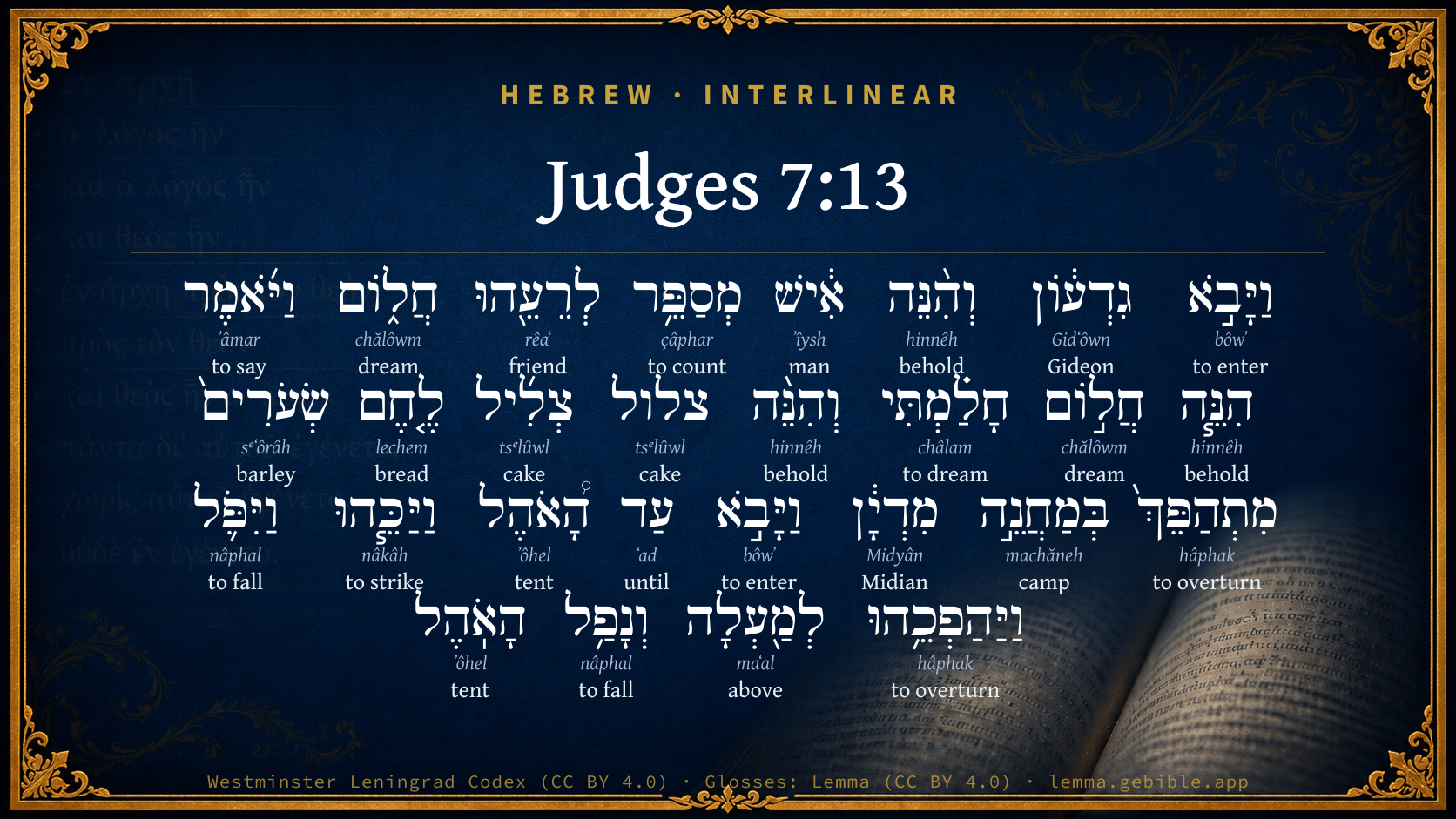
Hebrew (Westminster Leningrad Codex) Judges 7:13 appears in the Hebrew Old Testament. The text above is from the Westminster Leningrad Codex. Each word links to its Strong’s number, a concise gloss, and parsing drawn from the Open Scriptures Hebrew Bible morphology. Click any word for its full Brown-Driver-Briggs (BDB) entry.
Download image
Cite this verse

Judges 7:13 (World English Bible). Public Domain. Lemma interlinear Bible study tool, https://lemma.gebible.app/v/judges/7/13.

Show BibTeX & RIS
BibTeX
RIS
English Translation
When Gideon had come, behold, there was a man telling a dream to his fellow; and he said, Behold, I dreamed a dream; and, behold, a cake of barley bread tumbled into the camp of Midian, and came to the tent, and struck it so that it fell, and turned it upside down, so that the tent lay flat.
World English Bible · Public Domain
Highlights
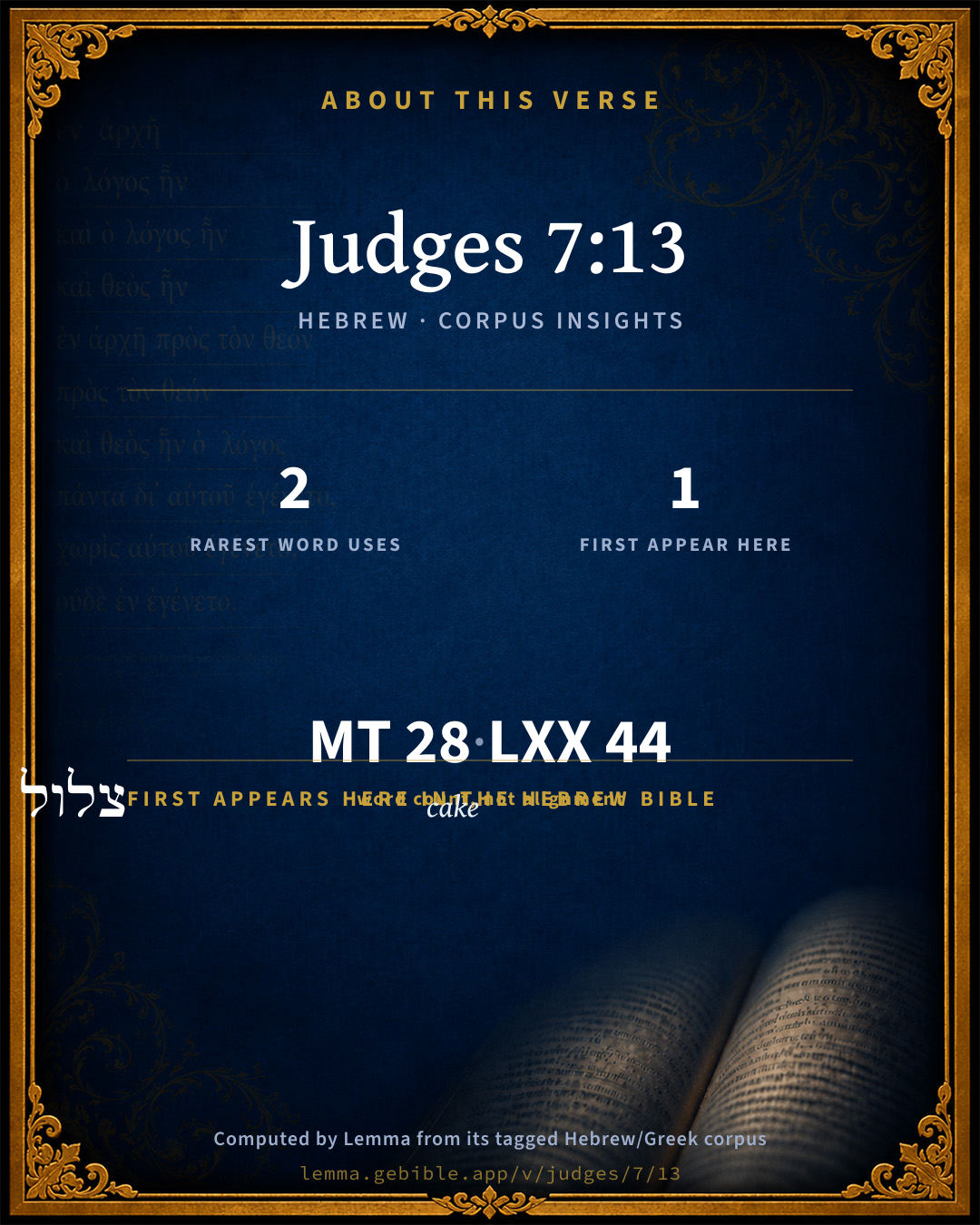
  • 1 first appearance in the Hebrew Bible
Full analysis ↓
Download a study sheet

One document with this verse’s original text, its word-by-word gloss line, the meaning frame, cross-references with their text, attributed commentary, and full source and license credits — printable, and it pastes into notes with its structure intact.

This verse Autodidact and up

Study sheet (.html) Plain text (.txt)

A passage Seminary Student

Up to 50 verses in one chapter. A passage sheet keeps up to 6 commentary sources and 12 cross-references per verse, in the order this page ranks them, and says so on the sheet whenever that leaves anything out. Ask for a single verse and you get the Autodidact verse sheet above.

Everything on this page stays free to read, with no account — the sheet is a download of what is already on screen, not access to it.

Want to remove ads? Support Godless Engineer
Compare translations 3

The same verse in 3 English versions, stacked beneath the original-language interlinear above. Click any original word for its lexicon entry.

Each is an independent rendering of the whole verse — the interlinear is not word-aligned to these translations.

Highlighted words mark where these versions differ — a whole-verse word diff, not a word-by-word alignment.

  • World English Bible Public Domain
    When Gideon had come, behold, there was a man telling a dream to his fellow; and he said, Behold, I dreamed a dream; and, behold, a cake of barley bread tumbled into the camp of Midian, and came to the tent, and struck it so that it fell, and turned it upside down, so that the tent lay flat.
  • King James Version Public Domain
    And when Gideon was come, behold, there was a man that told a dream unto his fellow, and said, Behold, I dreamed a dream, and, lo, a cake of barley bread tumbled into the host of Midian, and came unto a tent, and smote it that it fell, and overturned it, that the tent lay along.
  • unfoldingWord Literal Text CC BY-SA 4.0
    And Gideon came, and behold, a man was recounting a dream to his comrade. And he said, “Behold, I dreamed a dream, and behold, a loaf of bread of barley was tumbling into the camp of Midian, and it came to the tent and struck it and it fell, for it overturned it upwards, and the tent fell.”

unfoldingWord Literal Text — © unfoldingWord, licensed CC BY-SA 4.0. Word-aligned USFM3 via Door43 (git.door43.org/unfoldingWord/en_ult).

Versions to compare (up to 4)

3 of 4 selected

Show all 18 translations

Every available English version of this verse, each an independent rendering of the whole verse.

  • World English Bible Public Domain
    When Gideon had come, behold, there was a man telling a dream to his fellow; and he said, Behold, I dreamed a dream; and, behold, a cake of barley bread tumbled into the camp of Midian, and came to the tent, and struck it so that it fell, and turned it upside down, so that the tent lay flat.
  • Berean Standard Bible Public Domain
    And as Gideon arrived, a man was telling his friend about a dream. “Behold, I had a dream,” he said, “and I saw a loaf of barley bread come tumbling into the Midianite camp. It struck the tent so hard that the tent overturned and collapsed.”
  • Majority Standard Bible Public Domain
    And as Gideon arrived, a man was telling his friend about a dream. “Behold, I had a dream,” he said, “and I saw a loaf of barley bread come tumbling into the Midianite camp. It struck the tent so hard that the tent overturned and collapsed.”
  • King James Version Public Domain
    And when Gideon was come, behold, there was a man that told a dream unto his fellow, and said, Behold, I dreamed a dream, and, lo, a cake of barley bread tumbled into the host of Midian, and came unto a tent, and smote it that it fell, and overturned it, that the tent lay along.
  • American Standard Version (1901) Public Domain
    And when Gideon was come, behold, there was a man telling a dream unto his fellow; and he said, Behold, I dreamed a dream; and, lo, a cake of barley bread tumbled into the camp of Midian, and came unto the tent, and smote it so that it fell, and turned it upside down, so that the tent lay flat.
  • Revised Version (1885) Public Domain
    And when Gideon was come, behold, there was a man that told a dream unto his fellow, and said, Behold, I dreamed a dream, and, lo, a cake of barley bread tumbled into the camp of Midian, and came unto the tent, and smote it that it fell, and turned it upside down, that the tent lay along.
  • Geneva Bible (1599) Public Domain
    And when Gideon was come, beholde, a man tolde a dreame vnto his neighbour, and said, Behold, I dreamed a dreame, and lo, a cake of barley bread tumbled from aboue into the hoste of Midian, and came vnto a tent, and smote it that it fell, and ouerturned it, that the tent fell downe.
  • Douay-Rheims (1899) Public Domain
    And when Gedeon was come, one told his neighbour a dream: and in this manner related what he had seen: I dreamt a dream, and it seemed to me as if a hearth cake of barley bread rolled and came down into the camp of Madian: and when it was come to a tent it struck it, and beat it down flat to the ground.
  • Young's Literal Translation Public Domain
    And Gideon cometh in, and lo, a man is recounting to his companion a dream, and saith, `Lo, a dream I have dreamed, and lo, a cake of barley-bread is turning itself over into the camp of Midian, and it cometh in unto the tent, and smiteth it, and it falleth, and turneth it upwards, and the tent hath fallen.'
  • Literal Standard Version CC BY-SA 4.0
    And Gideon comes in, and behold, a man is recounting a dream to his companion, and says, “Behold, I have dreamed a dream, and behold, a cake of barley-bread is turning itself over into the camp of Midian, and it comes to the tent, and strikes it, and it falls, and turns it upwards, and the tent has fallen.”
  • Unlocked Literal Bible CC BY-SA 4.0
    When Gideon arrived there, a man was telling a dream to his companion. The man said, “Look! I had a dream, and I saw a round loaf of barley bread tumbling into the camp of Midian. It came to the tent, and hit it so hard that it fell down and turned it upside down, so that it lay flat.”
  • unfoldingWord Literal Text CC BY-SA 4.0
    And Gideon came, and behold, a man was recounting a dream to his comrade. And he said, “Behold, I dreamed a dream, and behold, a loaf of bread of barley was tumbling into the camp of Midian, and it came to the tent and struck it and it fell, for it overturned it upwards, and the tent fell.”
  • Darby Bible Public Domain
    When Gideon came, behold, a man was telling a dream to his comrade; and he said, "Behold, I dreamed a dream; and lo, a cake of barley bread tumbled into the camp of Mid'ian, and came to the tent, and struck it so that it fell, and turned it upside down, so that the tent lay flat."
  • World Messianic Bible Public Domain
    When Gideon had come, behold, there was a man telling a dream to his fellow. He said, “Behold, I dreamed a dream; and behold, a cake of barley bread tumbled into the camp of Midian, came to the tent, and struck it so that it fell, and turned it upside down, so that the tent lay flat.”
  • Webster's Bible Public Domain
    And when Gideon had come, behold, there was a man that told a dream to his fellow, and said, Behold, I dreamed a dream, and lo, a cake of barley-bread rolled into the host of Midian, and came to a tent, and smote it that it fell, and overturned it that the tent lay along.
  • Free Bible Version CC BY-SA 4.0
    Just as Gideon arrived, a man was telling his friend about a dream he'd had. He was saying, “I had this dream. I dreamed I saw a round loaf of barley bread come rolling into the Midianite camp. It hit a tent, knocking it upside-down, flat on the ground!”
  • Bible in Basic English Public Domain
    When Gideon came there, a man was giving his friend an account of his dream, saying, See, I had a dream about a cake of barley bread which, falling into the tents of Midian, came on to the tent, overturning it so that it was stretched out flat on the earth.
  • JPS Tanakh (1917) Public Domain
    And when Gideon was come, behold, there was a man telling a dream unto his follow, and saying: 'Behold, I dreamed a dream, and, lo, a cake of barley bread tumbled into the camp of Midian, and came unto the tent, and smote it that it fell, and turned it upside down, that the tent lay flat.'

Literal Standard Version (2020), Covenant Press — licensed CC BY-SA 4.0. Text via the HelloAO Bible API (eBible.org). Unlocked Literal Bible (unfoldingWord) — licensed CC BY-SA 4.0. Text via the HelloAO Bible API (eBible.org). unfoldingWord Literal Text — © unfoldingWord, licensed CC BY-SA 4.0. Word-aligned USFM3 via Door43 (git.door43.org/unfoldingWord/en_ult). Free Bible Version, Dr. Jonathan Gallagher — licensed CC BY-SA 4.0. Text via the HelloAO Bible API (eBible.org).

Word by word

More ways to search: Search by grammar → Find every occurrence → Compare this word →

Practice this passage: Drill this verse → Learn its vocabulary →

צלול
tsᵉlûwl
H6742
“cake of”
Noun, Common, Masculine, Singular, Construct
Part of Speech
Noun
Type
Common
Gender
Masculine
Number
Singular
State
Construct
Full BDB Definition

Origin: from H6749 in the sense of rolling

TWOT: 1922a

cake, round loaf, round, rolling
  1. וַיָּבֹ֣א bôwʼ H935 “and · to enter” Conjunction + Verb, Qal, Sequential Imperfect, 3rd Person, Masculine, Singular
  2. גִדְע֔וֹן Gidʻôwn H1439 “Gideon” Noun, Proper
  3. וְהִ֨נֵּה hinnêh H2009 “and · behold” Conjunction + Particle, Demonstrative
  4. אִ֔ישׁ ʼîysh H376 “man” Noun, Common, Masculine, Singular, Absolute
  5. מְסַפֵּ֥ר çâphar H5608 “counting” Verb, Piel, Participle Active, Masculine, Singular, Absolute
  6. לְרֵעֵ֖הוּ rêaʻ H7453 “to/for · friend · his” Preposition + Noun, Common, Masculine, Singular, Construct + Suffix, Personal, 3rd Person, Masculine, Singular
  7. חֲל֑וֹם chălôwm H2472 “dream” Noun, Common, Masculine, Singular, Absolute
  8. וַיֹּ֜אמֶר ʼâmar H559 “and · to say” Conjunction + Verb, Qal, Sequential Imperfect, 3rd Person, Masculine, Singular
  9. הִנֵּ֧ה hinnêh H2009 “behold” Particle, Demonstrative
  10. חֲל֣וֹם chălôwm H2472 “dream” Noun, Common, Masculine, Singular, Absolute
  11. חָלַ֗מְתִּי châlam H2492 “to dream” Verb, Qal, Perfect, 1st Person, Common, Singular
  12. וְהִנֵּ֨ה hinnêh H2009 “and · behold” Conjunction + Particle, Demonstrative
  13. צְלִ֜יל tsᵉlûwl H6742 “cake of” Noun, Common, Masculine, Singular, Construct
  14. לֶ֤חֶם lechem H3899 “bread of” Noun, Common, Both, Singular, Construct
  15. שְׂעֹרִים֙ sᵉʻôrâh H8184 “barley” Noun, Common, Feminine, Plural, Absolute
  16. מִתְהַפֵּךְ֙ hâphak H2015 “overturning” Verb, Hithpael, Participle Active, Masculine, Singular, Absolute
  17. בְּמַחֲנֵ֣ה machăneh H4264 “in/at · camp of” Preposition + Noun, Common, Both, Singular, Construct
  18. מִדְיָ֔ן Midyân H4080 “Midian” Noun, Proper
  19. וַיָּבֹ֣א bôwʼ H935 “and · to enter” Conjunction + Verb, Qal, Sequential Imperfect, 3rd Person, Masculine, Singular
  20. עַד ʻad H5704 “until” Preposition
  21. הָ֠אֹהֶל ʼôhel H168 “the · tent” Particle, Definite Article + Noun, Common, Masculine, Singular, Absolute
  22. וַיַּכֵּ֧הוּ nâkâh H5221 “and · to strike · him” Conjunction + Verb, Hiphil, Sequential Imperfect, 3rd Person, Masculine, Singular + Suffix, Personal, 3rd Person, Masculine, Singular
  23. וַיִּפֹּ֛ל nâphal H5307 “and · to fall” Conjunction + Verb, Qal, Sequential Imperfect, 3rd Person, Masculine, Singular
  24. וַיַּהַפְכֵ֥הוּ hâphak H2015 “and · to overturn · him” Conjunction + Verb, Qal, Sequential Imperfect, 3rd Person, Masculine, Singular + Suffix, Personal, 3rd Person, Masculine, Singular
  25. לְמַ֖עְלָה maʻal H4605 “to/for · above · toward” Preposition + Adverb + Suffix, Demonstrative
  26. וְנָפַ֥ל nâphal H5307 “and · to fall” Conjunction + Verb, Qal, Perfect, 3rd Person, Masculine, Singular
  27. הָאֹֽהֶל ʼôhel H168 “the · tent” Particle, Definite Article + Noun, Common, Masculine, Singular, Absolute

About this verse

These counts appear in no published source. They are computed here, from the morphology-tagged text and Lemma’s own curated glosses. What Lemma adds →

28
words
20
distinct lemmas
Historical
section

Notable vocabulary

The rarest word here is צלול cake H6742 — appearing just 2 times in the whole Hebrew Bible.

First appearance in Scripture

This word makes its first canonical appearance in the Hebrew Bible here:

Grammatical profile

  • 10 verbs
  • 13 nouns
  • 1 preposition
  • 1 adverb
  • 3 particles

Verb forms

  • וַיָּבֹ֣א Qal · Sequential Imperfect
  • מְסַפֵּ֥ר Piel · Participle Active
  • וַיֹּ֜אמֶר Qal · Sequential Imperfect
  • חָלַ֗מְתִּי Qal · Perfect
  • מִתְהַפֵּךְ֙ Hithpael · Participle Active
  • וַיָּבֹ֣א Qal · Sequential Imperfect
  • וַיַּכֵּ֧הוּ Hiphil · Sequential Imperfect
  • וַיִּפֹּ֛ל Qal · Sequential Imperfect
  • וַיַּהַפְכֵ֥הוּ Qal · Sequential Imperfect
  • וְנָפַ֥ל Qal · Perfect

Repetition

Words recur within this verse — often emphatic in Hebrew:

  • וְהִ֨נֵּה behold H2009 ×3
  • וַיָּבֹ֣א to enter H935 ×2
  • חֲל֑וֹם dream H2472 ×2
  • צלול cake H6742 ×2
  • מִתְהַפֵּךְ֙ to overturn H2015 ×2
  • הָ֠אֹהֶל tent H168 ×2
  • וַיִּפֹּ֛ל to fall H5307 ×2

Hebrew & Septuagint length

In English translation the verse runs 59 words from the Hebrew and 59 from the Septuagint (LXX English) — the same length.

A rough comparison of the two English renderings, which tokenize alike — not a word-level alignment.

Word counts can differ between the Hebrew and the Greek without any difference in meaning — e.g. the Hebrew direct-object marker אֵת has no separate Greek word, and Greek often adds the article ὁ.

In the original languages it is 28 Hebrew tokens and 44 Greek tokens — but the two are counted differently (Hebrew bundles its prefixes and suffixes into one token; the Greek is in lemma form), so that isn’t a like-for-like length.

Cross-references

7

Topical passages linked to Judges 7:13 in the Treasury of Scripture Knowledge — connected by theme and wording, ordered by reader-vote popularity; previews shown in the World English Bible.

  • Judges 3:15 But when the children of Israel cried to Yahweh, Yahweh raised them up a savior, Ehud the son of Gera, the Benjamite, a man left-handed. The children of Israel sent tribute by him to Eglon the king of Moab.
  • Judges 3:31 After him was Shamgar the son of Anath, who struck of the Philistines six hundred men with an ox-goad: and he also saved Israel.
  • Judges 4:9 She said, I will surely go with you: notwithstanding, the journey that you take shall not be for your honor; for Yahweh will sell Sisera into the hand of a woman. Deborah arose, and went with Barak to Kedesh.
  • Judges 4:21 Then Jael Heber's wife took a tent-pin, and took a hammer in her hand, and went softly to him, and struck the pin into his temples, and it pierced through into the ground; for he was in a deep sleep; so he swooned and died.
  • Judges 6:15 He said to him, Oh, Lord, with which shall I save Israel? behold, my family is the poorest in Manasseh, and I am the least in my father's house.
  • Isaiah 41:14–15 Don't be afraid, you worm Jacob, and you men of Israel; I will help you, says Yahweh, and your Redeemer is the Holy One of Israel.
  • 1 Corinthians 1:27 but God chose the foolish things of the world that he might put to shame those who are wise. God chose the weak things of the world, that he might put to shame the things that are strong;

Cross-references courtesy of OpenBible.info (CC BY 4.0).

Hebrew and Greek witnesses Masoretic Hebrew ↔ Greek Septuagint

The same verse in the two great witnesses to the Old Testament, shown verse-for-verse.

These are two independent witnesses, not word-aligned to each other, and the Septuagint is shown in lemma (dictionary) form.

Hebrew Judges 7:13 Masoretic · Westminster Leningrad Codex

וַיָּבֹ֣א גִדְע֔וֹן וְהִ֨נֵּה אִ֔ישׁ מְסַפֵּ֥ר לְרֵעֵ֖הוּ חֲל֑וֹם וַיֹּ֜אמֶר הִנֵּ֧ה חֲל֣וֹם חָלַ֗מְתִּי וְהִנֵּ֨ה צלול צְלִ֜יל לֶ֤חֶם שְׂעֹרִים֙ מִתְהַפֵּךְ֙ בְּמַחֲנֵ֣ה מִדְיָ֔ן וַיָּבֹ֣א עַד הָ֠אֹהֶל וַיַּכֵּ֧הוּ וַיִּפֹּ֛ל וַיַּהַפְכֵ֥הוּ לְמַ֖עְלָה וְנָפַ֥ל הָאֹֽהֶל

When Gideon had come, behold, there was a man telling a dream to his fellow; and he said, Behold, I dreamed a dream; and, behold, a cake of barley bread tumbled into the camp of Midian, and came to the tent, and struck it so that it fell, and turned it upside down, so that the tent lay flat.

World English Bible · Public Domain

Greek LXX Judges 7:13 Septuagint · lemma form

καί ἔρχομαι γεδεων καί ἰδού ἀνήρ ἐκἡγέομαι ὁ πλησίον αὐτός ἐνύπνιον καί εἶπον ἐνύπνιον ἰδού ἐνυπνιάζω καί ἰδού μαγίς ἄρτος κρίθινος στρέφω ἐν ὁ παρεμβολή μαδιαμ καί ἔρχομαι ἕως ὁ σκηνή καί πατάσσω αὐτός καί πίπτω καί ἀναστρέφω αὐτός ἄνω καί πίπτω ὁ σκηνή

And Gedeon came, and behold a man was relating to his neighbor a dream, and he said, Behold, I have dreamed a dream, and behold, a cake of barley bread rolling into the camp of Madiam, and it came as far as a tent, and struck it, and it fell, and it turned it up, and the tent fell.

LXX2012 (modern English Septuagint) · Public Domain

On this verse, Ellicott's Commentary for English Readers discusses the Septuagint’s reading. Read the note in Commentary ↓

Hebrew: Westminster Leningrad Codex (CC BY 4.0). Greek: Septuagint (public domain); English from LXX2012 (modern English Septuagint) (Public Domain). How the Septuagint differs from the Hebrew →

Targum (Aramaic paraphrase)

1

The Targum is the ancient Jewish Aramaic paraphrase of the Hebrew Scriptures — an interpretive translation, not the Hebrew text itself. Onkelos (literal) and Pseudo-Jonathan (expansive) render the Torah, and Jonathan the Prophets. Coverage is partial: where no permissively-licensed English translation exists for a verse, only the Aramaic is shown. This is verse-level text, not a word-by-word alignment to the Hebrew.

  1. Targum Jonathan Prophets (Joshua–Malachi)
    וַאֲתָא גִדְעוֹן וְהָא גַבְרָא מִשְׁתָּעֵי לְחַבְרֵיהּ חֶלְמָא וַאֲמַר הָא חֶלְמָא חַלְמֵית וְהָא חֲרַר דִלְחֵם שְׂעוֹרִין מִתְהַפִּיךְ בְּמַשִׁרְיַת מִדְיָנָאֵי וַאֲתָא עַד מַשְׁכְּנָא וּמְחָהִי וּנְפַל וְאַפְכֵיהּ לְעֵילָא וּנְפַל מַשְׁכְּנָא:

    (no public-domain English translation for this verse)

    Targum Jonathan — Aramaic: “Mikraot Gedolot” (public domain). English: “Sefaria Community Translation” (CC0 1.0 (public-domain dedication)); “London "Chaldee Paraphrase," 1871” (public domain). Text via Sefaria.

Commentary

Notes on Judges 7:13 from classic Christian and Jewish commentators (each source and its license shown beneath its notes). The classic Christian expositions comment on the surrounding passage and are grouped to its opening verse, so a note may address several verses; the Jewish commentaries on the Tanakh (Rashi and others) are per-verse, so they appear only where the commentator wrote on this verse.

Lemma curates 59 commentaries, every one of them public domain or Creative Commons licensed, each selected and text-cleaned for this edition rather than reprinted as found. About our sources →

Trapp's Complete Commentary

John Trapp

Jdg 7:13 And when Gideon was come, behold, [there was] a man that told a dream unto his fellow, and said, Behold, I dreamed a dream, and, lo, a cake of barley bread tumbled into the host of Midian, and came unto a tent, and smote it that it fell, and overturned it, that the tent lay along.

Ver. 13. Behold, there was a man that told a dream.] So now-a-days, saith a divine, men dream their Midianitish dreams of errors, and tell it for gospel to their neighbours. This man told his dream to his fellow: but for no good to himself, yet to Gideon’s comfort: as Balaam, and afterwards Caiaphas, prophesied for the good of the Church.

Behold, I dreamed a dream.] This dream was of God (Homer saith of some dreams that they are διοπεμπτα), and his fellow gave a right interpretation thereof. Wicked men may have common gifts. They read their own doom, but have not grace to repent, and make a holy use of it, as Mr Rough the martyr did, who not long before his apprehension, dreamed that he was carried forcibly to Bishop Bonnet, and that the bishop plucked off his beard, and cast it into the fire, saying these words, Now I may say I have a piece of a heretic burnt in mine house. All which fell out accordingly; and he looked upon it as a sweet mercy to be thus forewarned. {a}

And, lo, a cake of barley bread.] This cake represented the smallness and weakness of Gideon’s forces: the matter of it, barley bread, the meanness of Gideon’s person, little esteemed; the trundling of it down a hill, his impetuous falling upon the Midianites, who had robbed the Israelites of their better food, and made them glad to eat barley bread.

And came unto a tent.] Ad tentorium omnium elgantissimum et fortissimum, unto a fair strong tent (for so much the notificative article ä implieth), which it utterly overturned, to note the routing and ruining of the army.

{a} Act. and Mon., 1843.

John Trapp, A Commentary or Exposition upon All the Books of the Old and New Testament (1647–1656) — public domain. Text from a community e-Sword module.

Joseph Benson's Commentary

Jdg 7:13-14. And lo, a cake tumbled into the host of Midian — A weak and contemptible thing, and in itself as unable to overthrow a tent as to remove a mountain; but, being thrown by a divine hand, it bore down all before it. His fellow answered, &c. — As there are many examples of significant dreams, given by God to heathen, so some of them had the gift of interpreting dreams; which they sometimes did by divine direction, as in this case. For it is evident that God influenced the mind of this man, to give this interpretation to the dream of his companion, for the encouragement of Gideon; otherwise, considering the numerous host of the Midianites, and the small force which Gideon had, it does not seem probable that a Midianitish soldier should have entertained such a conjecture; and one may observe the soldier speaks as if under some prophetic influence. Into his hand hath God delivered Midian, and all the host — It is certain, at least, that the hand of God was in this affair, that Gideon should be directed to this particular tent, and that the soldier should be telling his dream just at that very moment.

Joseph Benson's Commentary on the Old and New Testaments (1811–1818) — public domain. Text from a community e-Sword module.

MacLaren's Expositions of Holy Scripture

Alexander MacLaren

Judges

A BATTLE WITHOUT A SWORD

Jdg 7:13 - Jdg 7:23.

To reduce thirty-two thousand to three hundred was a strange way of preparing for a fight; and, no doubt, the handful left felt some sinking of their courage when they looked on their own small number and then on the widespread Midianite host. Gideon, too, would need heartening. So the first thing to be noted is the encouragement given him. God strengthens faith when it needs strengthening, and He has many ways of doing so. Note that Gideon’s visit to the Midianite camp was on ‘the same night’ on which his little band was left alone after the ordeal by water. How punctually to meet our need, when it begins to be felt, does God’s help come! It was by God’s command that he undertook the daring adventure of stealing down to the camp. We can fancy how silently he and Phurah crept down the hillside, and, with hushed breath and wary steps, lest they should stumble on and wake some sleeper, or even rouse some tethered camel, picked their way among the tents. But they had God’s command and promise, and these make men brave, and turn what would else be foolhardy into prudence. Ho put his ear to the black camel’s-hair wall of one tent, and heard what his faith could not but recognise as God’s message to him.

The soldier’s dream was just such as such a man would dream in such circumstances. A round loaf of barley {the commonest kind of bread} was dreamed of as rolling down from a height and upsetting ‘the tent.’ The use of the definite article seems to point to some particular tent, perhaps simply the one in which the dreamer lay, or perhaps the general’s; but the noun may be used as a collective, and what is meant may be that the loaf went through the camp, overturning all the tents in its way. The interpretation needed no Daniel, but the immediate explanation given, shows not only the transparency of the symbol, but the dread in the Midianite ranks of Gideon’s prowess. A nameless awe, which goes far to produce the defeat it dreads, was beginning to creep over them. It finds utterance both in the dream and in its translation. The tiny loaf worked effects disproportioned to its size. A rock thundering down the hillside might have mass and momentum enough to level a line of tents, but one poor loaf to do it! Some mightier than human hand must have set it going on its career. So the soldier interprets that God had delivered the army into Gideon’s hand.

This dream suggests two or three considerations. In several instances we find God speaking to those outside Israel by dreams; for example, to Pharaoh and his two officers, Nebuchadnezzar, Pilate’s wife. It is the lowest form of divine communication, and, like other lower forms, is not to be looked for when the higher teaching of the Spirit of Christ is open to us all.

Again, while both dream and interpretation might be accounted for on simply natural grounds, a deeper insight into the so-called ‘natural’ brings us to see it as all penetrated by the operations of the ever-present God. And the coincidences which brought Gideon to just that tent among the thousands along the valley at just the moment when the two startled sleepers were talking, might well strike Gideon, as they did, as being God’s own fulfilment of the promise that ‘what they say’ would strengthen his hands for the attack {Jdg 7:11}.

Further, Gideon had already had the sign of the fleece and the dew; but God does not disdain to let him have an additional encouragement, and to let him draw confirmation of his own token from the talk of two Midianites. Faith may be buttressed by men’s words, albeit its only foundation is God’s.

Gideon has a place in the muster-roll of heroes of faith in Heb 11:32, and his whole conduct in this incident proves his right to stand there. ‘He worshipped,’ for his soul went out in trust to God, whose voice he heard through the two Midianites, and bowed in thankfulness and submissive obedience. There could be no outward worship there, with an army of sleepers close by, but the silent uplifting of confidence and desire reaches God and strengthens the man. So he went back with new assurance of victory, and roused his sleeping band.

Mark his words as another token of his faith. The Midianite interpreter had said, ‘God has delivered’; Gideon says, ‘The Lord has delivered.’ The former name is the more general, and is natural on the lips of a heathen; the latter is the covenant name, and to use it implies reliance on the Jehovah revealed by His acts to Israel. The Midianite had said that the host was delivered into Gideon’s hand; he says that it is delivered into the hands of the three hundred, suppressing himself and honouring them. God’s soldiers must be willing to ‘esteem others better than themselves,’ and to fight for God’s glory, not their own. The Midianite had said, ‘This is . . . the sword of Gideon’; he bid his men cry ‘the sword of the Lord, and of Gideon.’ It was God’s cause for which they were contending, not his; and yet it was his, inasmuch as he was God’s instrument. ‘Excellent mixture,’ says Thomas Fuller, ‘both joined together; admirable method, God put in the first place. Where divine blessing leads up the van, and man’s valour brings up the battle, must not victory needs follow in the rear?’

Gideon does not seem to have been divinely directed to the stratagem by which the Midianites were thrown into panic. He had been promised victory, but that does not lead him to idle waiting for fulfilment of the promise. ‘To wait for God’s performance in doing nothing is to abuse that divine providence, which will so work that it will not allow us to idle’ {Bishop Hall}. True faith will wisely adopt means to reach promised ends, and, having used brain and hand as if all depended on ourselves, will look to Him, as if nothing depended on us, but all on Him.

There was strong faith as well as daring and skilful generalship in leading down the three hundred, with no weapons but trumpets and pitchers, to close quarters with an armed enemy so superior in numbers. And did it not need some faith, too, not only in Gideon but in God, on the part of his band, to plunge down the hill on such an errand, each man with both his hands full, and so unable to strike a blow? The other three hundred at Thermopylae have been wept over and sung; were not these three hundred as true heroes? Let us not count heads when we are called on to take God’s side. His soldiers are always in the minority, but, if He is reckoned in, the minority becomes the majority. ‘They that be with us are more than they that be with them.’

One can fancy the sleepers starting up dazed by the sudden bray of the trumpets and the wild shout of that war-cry yelled from every side. As they stumbled out of their tents, without leaders, without knowledge of the numbers of their foe, and saw all around the flaring torches, and heard the trumpet-blasts, which seemed to speak of an immense attacking force, no wonder that panic shook them, and they fled. Huge mobs of undisciplined men, as Eastern armies are, and these eminently were, are especially liable to such infectious alarms; and the larger the force, the faster does panic spread, the more unmanageable does the army become, and the more fatal are the results. Each man reflects, and so increases, his neighbour’s fear. ‘Great armies, once struck with amazement, are like wounded whales. Give them but line enough, and the fishes will be the fishermen to catch themselves.’

So the host broke up in wild disorder, and hurried in fragments towards the Jordan fords, trampling each other down as they raced through the darkness, and each man, as he ran, dreading to feel the enemy’s sword in his back next moment. `The wicked flee when no man pursueth: but the righteous is bold as a lion.’ Thus without stroke of weapon was the victory won. The battle was the Lord’s.

And the story is not antiquated in substance, however the form of the contests which God’s soldiers have to-day to fight has changed. Still it is true that we shall only wage war aright when we feel that it is His cause for which we contend, and His sword which wins the victory. If Gideon had put himself first in his warcry, or had put his own name only in it, the issue would have been different.

May we not also venture to apply the peculiar accoutrements of the victorious three hundred to ourselves? Christ’s men have no weapons to wield but the sounding out from them, as from a trumpet, of the word of the Lord, and the light of a Christian life shining through earthen vessels. If we boldly lift up our voices in the ancient war-cry, and let that word peal forth from us, and flash the light of holy lives on a dark world, we may break the sleeper’s slumbers to a glad waking, and win the noblest of victories by leading them to enlist in the army of our Captain, and to become partakers of His conquests by letting Him conquer, and thereby save them.

Alexander MacLaren, Expositions of Holy Scripture (1904–1910) — public domain. Text from a community e-Sword module.

Geneva Bible (1599)

Geneva Bible translators

Some read, a trembling noise of barley bread: meaning, that one of no reputation should make their great army to tremble.

Geneva Bible (1599) marginal notes — public domain. Text via Bolls.life.

Jamieson, Fausset & Brown

Robert Jamieson, A. R. Fausset & David Brown

I dreamed a dream, and, lo, a cake of barley bread tumbled into the host of Midian--This was a characteristic and very expressive dream for an Arab in the circumstances. The rolling down the hill, striking against the tents, and overturning them, naturally enough connected it in his mind with the position and meditated attack of the Israelitish leader. The circumstance of the cake, too, was very significant. Barley was usually the food of the poor, and of beasts; but most probably, from the widespread destruction of the crops by the invaders, multitudes must have been reduced to poor and scanty fare.

Jamieson, Fausset & Brown — Commentary Critical and Explanatory on the Whole Bible (1871) — public domain (CC PDM 1.0). Text via the HelloAO Bible API.

Adam Clarke's Commentary

Verse 13. Told a dream] Both the dream and the interpretation were inspired by God for the purpose of increasing the confidence of Gideon, and appalling his enemies.

Adam Clarke's Commentary on the Bible (1810–1826) — public domain. Text from a community e-Sword/MySword module.

Ellicott's Commentary for English Readers

(13) Behold, I dreamed a dream.—Since dreams, no less than the Bath Kol, were recognised channels for Divine intimations (Gen_41:12; Num_12:6; 1Sa_28:6; Joe_2:28, &c.), Gideon would feel doubly assured.

A cake.—The Hebrew word tsalol (or tselil in the Keri, or margin) is a word which occurs nowhere else. Rabbis Kimchi and Tanchun derive it from tsalal, “he tinkled” (as in tselselim and other names for musical instruments), or “he overshadowed.” Neither derivation yields any sense. The Chaldee, Syriac, and Rashi render it “a cake baked on coals,” and so, too, the LXX. (since such is the meaning of magie), the Vulgate (panis subcinericius), and Josephus (maza krithinç); this seems to be the true sense. Ewald makes it mean “a dry rattling crust.” Niebuhr tells us that the desert Arabs thrust a round lump of dough into hot ashes, then take it out and eat it. (Arab., p. 52.)

Of barley bread.—Josephus helps us to see the significance of the symbol by adding, “which men can (hardly) eat for its coarseness.” It must be remembered that the Israelites had been reduced to such poverty by these raids that the mass of them would have nothing to subsist on but common barley bread such as that used to this day, with bitter complaints, by the Fellahîn of Palestine. Among the Greeks also “barley bread” was proverbial as a kind of food hardly fit to be eaten, although such was the poverty which the Saviour bore for our sakes that it seems to have been the ordinary food of Him and His apostles (Joh_6:9). “A cake of barley bread” would, therefore, naturally recall the thought of the Israelites, who were no doubt taunted by their enemies with being reduced to this food; just as Dr. Johnson defined oats as “food for horses in England, and for men in Scotland.” Thus, in 1Ki_4:28, the “barley” is only for the horses and dromedaries. “If the Midianites were accustomed to call Gideon and his band ‘eaters of barley bread,’ as their successors, the haughty Bedouins, often do to ridicule their enemies, the application would be the more natural” (Thomson, Land and Book, p. 447). Josephus makes the soldier say that, as barley is the vilest of all seed, so the Israelites were the vilest of all the people of Asia.

Tumbled.—Rather, was rolling itself.

Unto a tent.—Rather, into the tent, which doubtless means (as Josephus says) the tent-royal—the tent of Zebah and Salmanah.

Smote it.—Perhaps the dream involved that it also (as Josephus says) “threw down the tents of all the soldiers.”

Overturned it, that the tent lay along.—The latter words are involved in the first verb, and are only added for emphasis in accordance with the full picturesque Hebrew style. (Comp. “A bullock that hath horns and hoofs;” “I am a widow woman, and my husband is dead,” &c.) This leisurely stateliness of description is found again and again in the Bible. (See my Origin of Language, p. 168, and Brief Greek Syntax, p. 200.)

A Bible Commentary for English Readers, edited by Charles John Ellicott (1878–1897) — public domain. Text from a community e-Sword module.

The Cambridge Bible for Schools and Colleges

gen. ed. J. J. S. Perowne

13. Behold, I dreamed a dream, and, lo] The phraseology recalls Gen_37:6 f., Gen_40:9 E. No doubt the two Midianites were lying in their tent: Gideon could listen without being seen.

a cake of barley bread] The word rendered cake occurs only here, and is of doubtful meaning; the context suggests a flat circular cake. Barley bread, the coarse food of the poor, was a symbol of the peasantry; the tent a symbol of the nomad.

tumbled] This same form of the verb is used of the flaming sword which turned in every direction, Gen_3:24. So the cake turned over and over, this way and that, until it smote the tent which the man saw in his dream, not the tent, i.e. of the king, as Josephus takes it, misunderstanding the idiomatic use of the article; Ant. Jdg_7:6; Jdg_7:4.

and it fell] The words are out of place; the text as it stands makes the tent fall, then be turned upside down, and then fall. At the end of the verse, that the tent lay along ought probably to be rendered and the tent remained fallen. Perhaps some reader wrote the normal form and it fell in the margin, whence it crept into the text after and smote it.

The Cambridge Bible for Schools and Colleges (gen. ed. J. J. S. Perowne; Cambridge University Press, 1878–1918) — public domain. Text from a community e-Sword module.

John Gill's Exposition

And when Gideon was come,.... With his servant, near and within hearing the talk and conversation of the outer guards or sentinels: there was

a man that told a dream unto his fellow; his comrade that stood next him, and was upon guard with him; perhaps it was a dream he had dreamed the night before or this selfsame night, being just called up to take his turn in the watch, and so it was fresh upon his mind:

and said, behold, I dreamed a dream, and, lo; thus it was as I am going to relate; twice he uses the word "behold", or "lo", the dream having rely much struck and impressed his mind, and was what he thought worthy of the attention of his comrade:

a cake of barley bread tumbled into the host of Midian: barley bread, Pliny (z) says, was the most ancient food; the word for "cake" (a) signifies a "shadow", and may design the appearance of a barley loaf; or something like one to him appeared in the dream: or a "noise"; the noise of it rolling and tumbling, so that it seemed to the soldier that he heard a noise, as well as saw something he took for a barley loaf. Jarchi observes, that it signifies a cake baked upon coals, and it seemed to this man as if it came smoking hot from the coals, tumbling down an hill, such an one where Gideon and his army were and rolling into the host of Midian, which lay in a valley:

and came unto a tent; or, "the tent (b)" the largest and most magnificent in the host; and Josephus (c) calls it expressly the king's tent, and the Arabic version the tent of the generals:

and smote it that it fell; which might justly seem strange, that a barley loaf should come with such a force against a tent, perhaps the largest and strongest in the whole camp, which was fastened with cords to stakes and nails driven into the ground, so as to cause it to fall: yea, it is added:

and overturned it, that the tent lay along: turned it topsy-turvy, or turned it "upwards" (d), as the phrase in the Hebrew text is; it fell with the bottom upwards; it was entirely demolished, that there was no raising and setting of it up again.

(z) Nat. Hist. l. 18. c. 7. (a) "umbra", vid. Gussetium, p. 715. "strepitus", Tigurine version; so Kimchi & Ben Gersom; "subcineritius", V. L. "tostus", Junius & Tremellius, Piscator. (b) (c) Antiqu. l. 5. c. 6. sect. 4. (d) "desuper", Pagninus, Montanus; "superne", Tigurine version.

John Gill's Exposition of the Whole Bible (1746–1763) — public domain (CC PDM 1.0). Text via the HelloAO Bible API.

Albert Barnes' Notes on the Bible

A cake of barley bread - i. e. such a cake as could hardly be eaten by men, it was so vile: a term expressive of the contempt of the Midianites for the people of Israel.

A tent - The tent, meaning, probably, the tent of the king of Midian, or of the captain of the host.

Albert Barnes' Notes on the Bible (1834–1885) — public domain. Text from a community e-Sword/MySword module.

Haydock's Catholic Bible Commentary

A dream. Observation of dreams is commonly superstitious, and as such is condemned by the word of God; but in some extraordinary cases, as we here see, God is pleased by dreams to foretel what he is about to do. (Challoner) --- See Genesis xl., Leviticus xix. 26., and Deuteronomy xviii. 10. (Worthington) --- The small company of Gedeon stood in need of every sort of encouragement. (Haydock)

George Leo Haydock (1774–1849), Haydock's Catholic Family Bible and Commentary, 1859 edition — public domain. Excludes Psalms (Douay-Rheims chapter numbering differs from Protestant) and Deuterocanonical books (Catholic canon only).

Matthew Poole's English Annotations

A cake of barley bread; a weak and contemptible thing, and in itself as unable to overthrow a tent as to remove a mountain; but being thrown by a Divine hand, bore down all before it; which fitly resembled Gideon’s case, which was mean and despicable, as himself saith, Jdg 6:15; yet he was mighty, through God, to destroy the Midianites.

Matthew Poole's English Annotations on the Holy Bible (1683–1685) — public domain. Text from a community e-Sword/MySword module.

Whedon's Commentary on the Bible

Daniel D. Whedon

13. I dreamed a dream — Dreaming has ever been the subject of curious speculations, and the Scriptures afford us various and some wonderful specimens of dreams. Compare Gen_20:3; Gen_28:12; Gen_31:11; Gen_31:24; Gen_37:6-11; 1Ki_3:5. They were one medium of divine revelation.

Num_12:6. The dream of this Midianite was a noticeable interposition of Divine Providence, and was designed to encourage Gideon. There may have been, and probably was, a natural psychological basis for the dream in the fears and suspicions of this Midianite, for the assembling of over thirty thousand Israelites at the call of Gideon could hardly be kept a secret from the entire host of Midianites.

A cake of barley bread — Apt symbol, in the conceptions of a nomad, for a cultivator of the soil, whose life would seem to be all occupied in raising grain and baking bread.

Tumbled — Rolled down the mountain like a wheel.

Unto a tent — The tent of some Midianitish chieftain, which, in the mind of the dreamer, would be associated with nomadic habits of life, and therefore a symbol of his people’s freedom, greatness, and power.

The tent lay along — The different expressions which describe the overthrow of the tent are noticeable. The barley cake smites it so as to knock it down; it falls, then is turned over upwards (למעלה) from having the tent pins torn out of the ground, and, rolling over and over, finally falls out flat upon the earth. This was a significant image of the complete overthrow of the Midianitish power.

Daniel D. Whedon (gen. ed.), Commentary on the Old and New Testaments (1874–1909) — public domain. Text from a community e-Sword module.

The Pulpit Commentary

A cake. The Hebrew word occurs nowhere else. Of barley bread. The commonest kind of bread, the food of only the poorer classes, indicating, therefore, the humble origin and station of Gideon. A tent. Rather, the tent ; what in a Roman camp would be the pretorium, the general"s tent. The words at the end of the verse are heaped up to indicate the total and entire upsetting and overthrow of the tent, symbolic of the rout and destruction of the Midianite host.

The Pulpit Commentary (1880–1919), ed. H.D.M. Spence-Jones & Joseph S. Exell — public domain. Text from a community e-Sword module.

John Wesley's Explanatory Notes

A cake - A weak and contemptible thing; and in itself as unable to overthrow a tent, as to remove a mountain; but being thrown by a divine hand, it bore down all before it.

John Wesley, Explanatory Notes Upon the Whole Bible (1754–1765) — public domain. Text via the GEBible commentary corpus.

unfoldingWord translationNotes

Door43 World Missions Community

This is nothing other than the sword of Gideon

Here "the sword of Gideon" refers to Gideon's army attacking. AT: "The loaf of barley bread in your dream must be the army of Gideon" (See: Metonymy)

God has given him victory over Midian

This future event is spoken of as if it were a past event. This emphasizes that it will certainly happen. AT: "God will certainly help the Israelites defeat the Midianites" (See: Predictive Past)

translationWords

Gideon

dream

companion

barley

bread

Midian

tent

sword

son

Joash

Israel

God

unfoldingWord translationNotes — © Distant Shores Media and the Door43 World Missions Community, licensed CC BY-SA 4.0. Source: git.door43.org/Door43/en_tn.

Rashi

Rabbi Shlomo Yitzchaki (Rashi)

Toasted. The written text is צׇלוּל, "clear". The generation was cleared of righteous men.

A toasted barley bread. A loaf of barley bread. A loaf toasted over coals.

Barley bread. This represents the merit of the Omer offering, which was brought on Pesach.

And hit it, and it collapsed (the tent), then it overturned the tent, completely overturned, and the tent collapsed.

Rashi on the Tanakh — English translations: “The Judaica Press complete Tanach with Rashi, translated by A. J. Rosenberg” (CC BY 4.0); “Pentateuch with Rashi's commentary by M. Rosenbaum and A.M. Silbermann, 1929-1934” (public domain); “The Metsudah Tanach series, Lakewood, N.J” (CC BY 4.0); and “The Book of Joshua, Metsudah Publications, 1997” (CC BY 4.0). Text via Sefaria.

Lesson kit

Teaching starters — assembled from the data on this page, not authored interpretation. Every prompt links to the verse data it draws on. Edit before teaching.

Judges, in the Historical, opens this verse with 28 words (20 distinct Hebrew lemmas). Its most distinctive word is tsᵉlûwl (“cake”). A historical commentator’s framing appears above. Read the whole chapter for the surrounding context.

Discussion questions

  1. The word tsᵉlûwl carries the sense “cake.” How does it shape the verse?
  2. This is the first place “cake” appears in Scripture (first appears here). What does its debut here establish?
  3. How does Judges 3:15, which shares this passage’s theme, read alongside this verse?
  4. What does the repetition of “behold” (3× in this one verse) do in this verse?
  5. The translations on this page render this verse differently — a whole-verse word diff, not a word-by-word alignment. What might account for the different wordings?
  6. «וַיָּבֹ֣א» is a Qal Sequential Imperfect verb. How does that grammatical form shape the action described?
  7. Compare how Trapp's Complete Commentary and Joseph Benson's Commentary read this verse. Where do they agree or differ?

Things to notice

Reading settings

Reading text

Shown beneath each verse's original-language words.

Old Testament
Old Testament edition

Read the OT as the Masoretic Hebrew (MT) or the Greek Septuagint (LXX).

English shown for the Greek Septuagint (in the Hebrew ↔ Greek comparison).

Comparing translations? Open the Compare panel on any verse page to stack up to four side by side.