Numbers 24:4

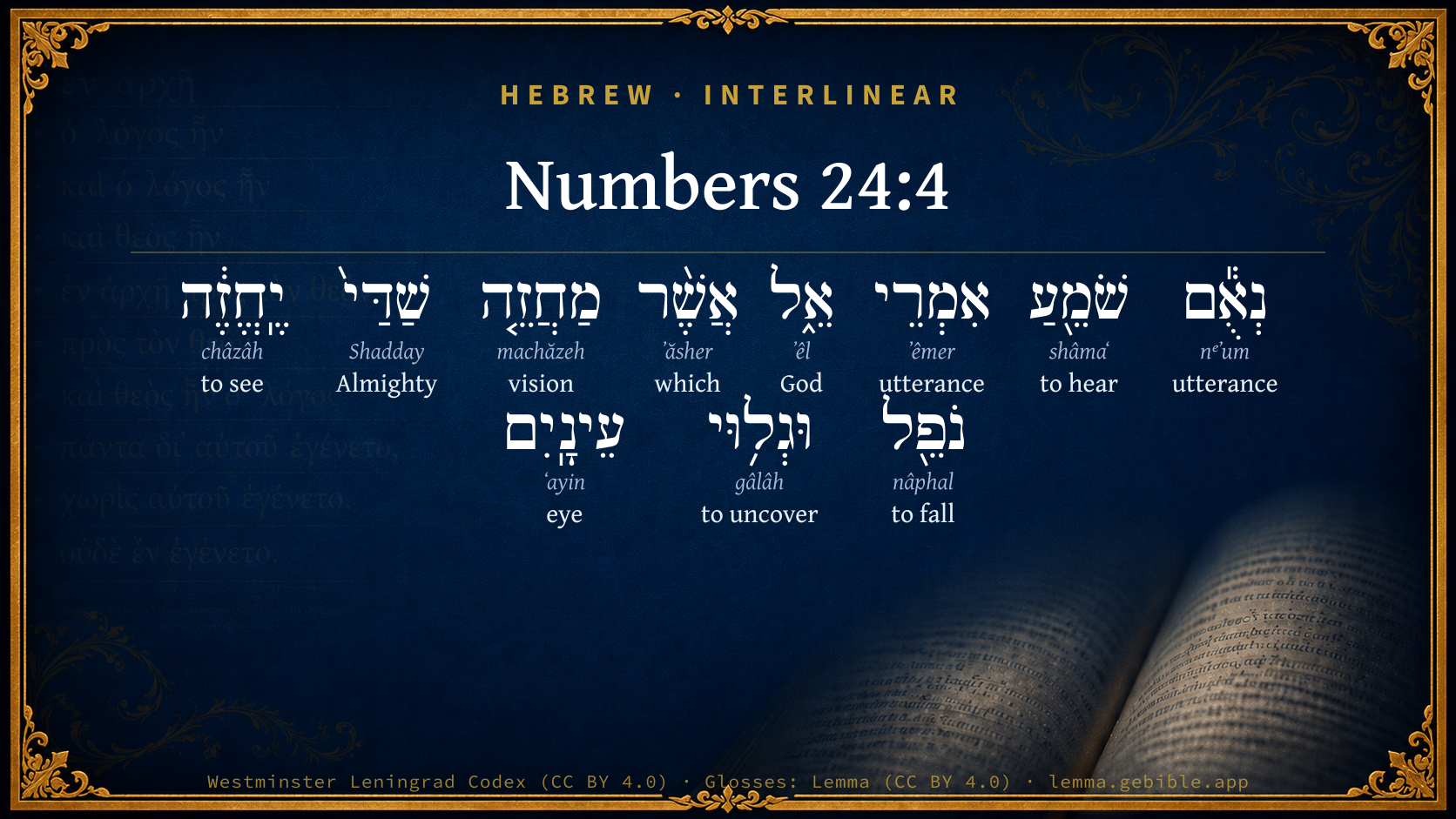
Hebrew (Westminster Leningrad Codex) Numbers 24:4 appears in the Hebrew Old Testament. The text above is from the Westminster Leningrad Codex. Each word links to its Strong’s number, a concise gloss, and parsing drawn from the Open Scriptures Hebrew Bible morphology. Click any word for its full Brown-Driver-Briggs (BDB) entry.
Download image
Cite this verse

Numbers 24:4 (World English Bible). Public Domain. Lemma interlinear Bible study tool, https://lemma.gebible.app/v/numbers/24/4.

Show BibTeX & RIS
BibTeX
RIS
English Translation
He says, who hears the words of God, Who sees the vision of the Almighty, Falling down, and having his eyes open:
World English Bible · Public Domain
Download a study sheet

One document with this verse’s original text, its word-by-word gloss line, the meaning frame, cross-references with their text, attributed commentary, and full source and license credits — printable, and it pastes into notes with its structure intact.

This verse Autodidact and up

Study sheet (.html) Plain text (.txt)

A passage Seminary Student

Up to 50 verses in one chapter. A passage sheet keeps up to 6 commentary sources and 12 cross-references per verse, in the order this page ranks them, and says so on the sheet whenever that leaves anything out. Ask for a single verse and you get the Autodidact verse sheet above.

Everything on this page stays free to read, with no account — the sheet is a download of what is already on screen, not access to it.

Want to remove ads? Support Godless Engineer
Compare translations 3

The same verse in 3 English versions, stacked beneath the original-language interlinear above. Click any original word for its lexicon entry.

Each is an independent rendering of the whole verse — the interlinear is not word-aligned to these translations.

Highlighted words mark where these versions differ — a whole-verse word diff, not a word-by-word alignment.

  • World English Bible Public Domain
    He says, who hears the words of God, Who sees the vision of the Almighty, Falling down, and having his eyes open:
  • King James Version Public Domain
    He hath said, which heard the words of God, which saw the vision of the Almighty, falling into a trance, but having his eyes open:
  • unfoldingWord Literal Text CC BY-SA 4.0
    the declaration of the hearer of the words of God, who sees the vision of the Almighty, falling down and opened of eyes:

unfoldingWord Literal Text — © unfoldingWord, licensed CC BY-SA 4.0. Word-aligned USFM3 via Door43 (git.door43.org/unfoldingWord/en_ult).

Versions to compare (up to 4)

3 of 4 selected

Show all 18 translations

Every available English version of this verse, each an independent rendering of the whole verse.

  • World English Bible Public Domain
    He says, who hears the words of God, Who sees the vision of the Almighty, Falling down, and having his eyes open:
  • Berean Standard Bible Public Domain
    the prophecy of one who hears the words of God, who sees a vision from the Almighty, who bows down with eyes wide open:
  • Majority Standard Bible Public Domain
    the prophecy of one who hears the words of God, who sees a vision from the Almighty, who bows down with eyes wide open:
  • King James Version Public Domain
    He hath said, which heard the words of God, which saw the vision of the Almighty, falling into a trance, but having his eyes open:
  • American Standard Version (1901) Public Domain
    He saith, who heareth the words of God, Who seeth the vision of the Almighty, Falling down, and having his eyes open:
  • Revised Version (1885) Public Domain
    He saith, which heareth the words of God, Which seeth the vision of the Almighty, Falling down, and having his eyes open:
  • Geneva Bible (1599) Public Domain
    He hath sayde, which heard the wordes of God, and sawe the vision of the Almightie, and falling in a traunce had his eyes opened:
  • Douay-Rheims (1899) Public Domain
    The hearer of the words of God hath said, he that hath beheld the vision of the Almighty, he that falleth, and so his eyes are opened:
  • Young's Literal Translation Public Domain
    An affirmation of him who is hearing sayings of God -- Who a vision of the Almighty seeth, Falling -- and eyes uncovered:
  • Literal Standard Version CC BY-SA 4.0
    An affirmation of him who is hearing sayings of God, || Who sees a vision of the Almighty, || Falling—and eyes uncovered:
  • Unlocked Literal Bible CC BY-SA 4.0
    He speaks and hears God's words. He sees a vision from the Almighty, Before whom he bows down with his eyes open.
  • unfoldingWord Literal Text CC BY-SA 4.0
    the declaration of the hearer of the words of God, who sees the vision of the Almighty, falling down and opened of eyes:
  • Darby Bible Public Domain
    He saith, who heareth the words of ùGod, who seeth the vision of the Almighty, who falleth down, and who hath his eyes open:
  • World Messianic Bible Public Domain
    he says, who hears the words of God, who sees the vision of the Almighty, falling down, and having his eyes open:
  • Webster's Bible Public Domain
    He hath said, who heard the words of God, who saw the vision of the Almighty, falling into a trance, but having his eyes open:
  • Free Bible Version CC BY-SA 4.0
    “This is the prophecy of Balaam, son of Beor, the prophecy of a man who sees with eyes that are wide open, the prophecy of one who hears the words of God, who sees the vision given by Almighty, who bows down in respect with open eyes.
  • Bible in Basic English Public Domain
    He says, whose ears are open to the words of God, who has seen the vision of the Ruler of all, falling down, but having his eyes open:
  • JPS Tanakh (1917) Public Domain
    The saying of him who heareth the words of God, who seeth the vision of the Almighty, fallen down, yet with opened eyes:

Literal Standard Version (2020), Covenant Press — licensed CC BY-SA 4.0. Text via the HelloAO Bible API (eBible.org). Unlocked Literal Bible (unfoldingWord) — licensed CC BY-SA 4.0. Text via the HelloAO Bible API (eBible.org). unfoldingWord Literal Text — © unfoldingWord, licensed CC BY-SA 4.0. Word-aligned USFM3 via Door43 (git.door43.org/unfoldingWord/en_ult). Free Bible Version, Dr. Jonathan Gallagher — licensed CC BY-SA 4.0. Text via the HelloAO Bible API (eBible.org).

Word by word

More ways to search: Search by grammar → Find every occurrence → Compare this word →

Practice this passage: Drill this verse → Learn its vocabulary →

About this verse

These counts appear in no published source. They are computed here, from the morphology-tagged text and Lemma’s own curated glosses. What Lemma adds →

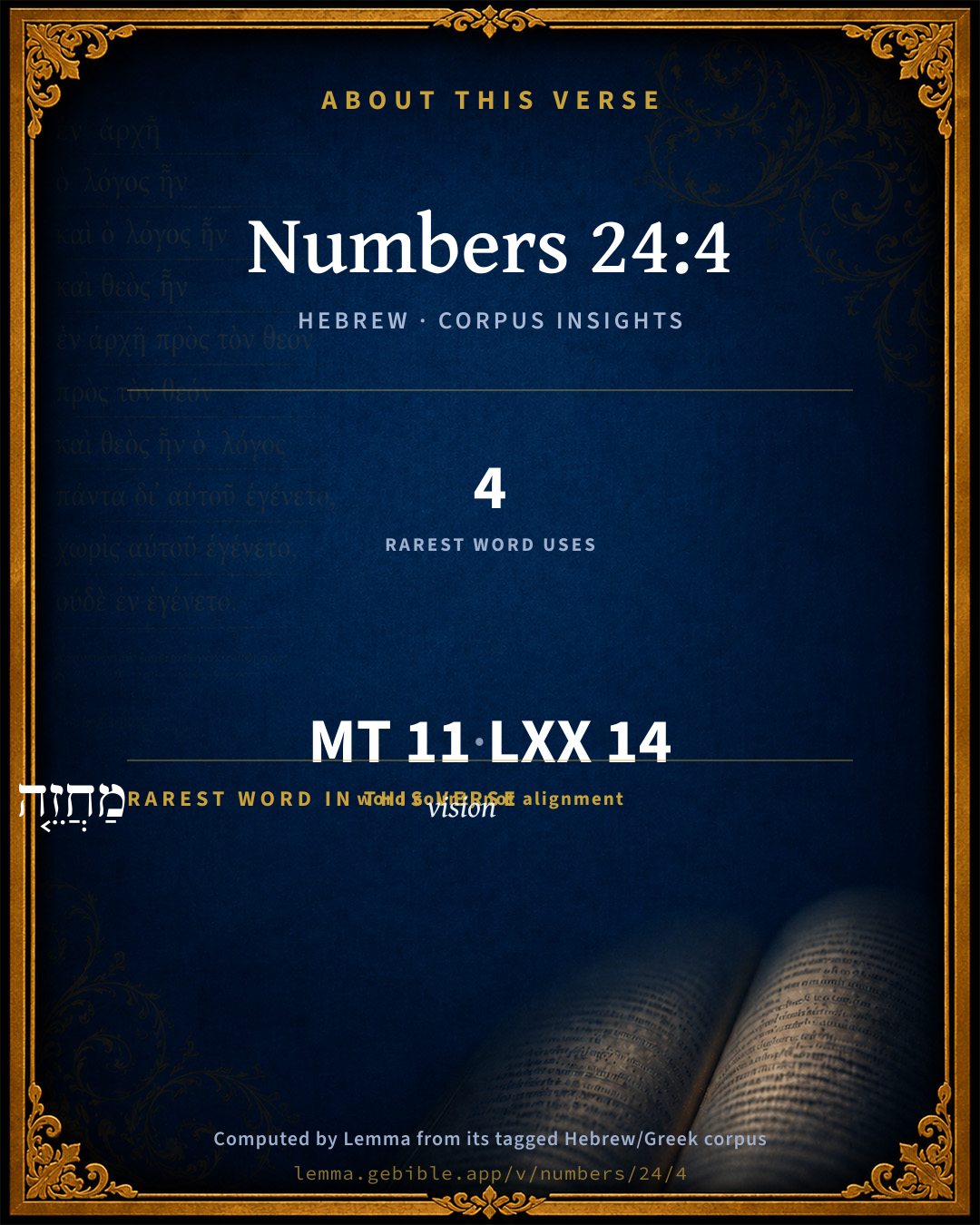
11
words
11
distinct lemmas
Pentateuch
section

Notable vocabulary

The rarest word here is מַחֲזֵ֤ה vision H4236 — appearing just 4 times in the whole Hebrew Bible.

Shared distinctive vocabulary

מַחֲזֵ֤ה vision H4236 occurs in 4 verses of the Hebrew Bible. Also found in:

Grammatical profile

  • 4 verbs
  • 6 nouns
  • 1 particle

Verb forms

  • שֹׁמֵ֖עַ Qal · Participle Active
  • יֶֽחֱזֶ֔ה Qal · Imperfect
  • נֹפֵ֖ל Qal · Participle Active
  • וּגְל֥וּי Qal · Participle Passive

Hebrew & Septuagint length

In English translation the verse runs 22 words from the Hebrew and 22 from the Septuagint (LXX English) — the same length.

A rough comparison of the two English renderings, which tokenize alike — not a word-level alignment.

Word counts can differ between the Hebrew and the Greek without any difference in meaning — e.g. the Hebrew direct-object marker אֵת has no separate Greek word, and Greek often adds the article ὁ.

In the original languages it is 11 Hebrew tokens and 14 Greek tokens — but the two are counted differently (Hebrew bundles its prefixes and suffixes into one token; the Greek is in lemma form), so that isn’t a like-for-like length.

Cross-references

17

Topical passages linked to Numbers 24:4 in the Treasury of Scripture Knowledge — connected by theme and wording, ordered by reader-vote popularity; previews shown in the World English Bible.

  • Revelation 1:17 When I saw him, I fell at his feet like a dead man. He laid his right hand on me, saying, "Don't be afraid. I am the first and the last,
  • Revelation 1:10 I was in the Spirit on the Lord's day, and I heard behind me a loud voice, like a trumpet
  • Numbers 12:6 He said, Hear now my words: if there be a prophet among you, I Yahweh will make myself known to him in a vision, I will speak with him in a dream.
  • Ezekiel 1:28 As the appearance of the bow that is in the cloud in the day of rain, so was the appearance of the brightness round about. This was the appearance of the likeness of the glory of Yahweh. When I saw it, I fell on my face, and I heard a voice of one that spoke.
  • 2 Corinthians 12:1–4 It is doubtless not profitable for me to boast. For I will come to visions and revelations of the Lord.
  • Genesis 15:1 After these things the word of Yahweh came to Abram in a vision, saying, "Don't be afraid, Abram. I am your shield, your exceedingly great reward."
  • Genesis 15:12 When the sun was going down, a deep sleep fell on Abram. Now terror and great darkness fell on him.
  • Numbers 22:20 God came to Balaam at night, and said to him, If the men are come to call you, rise up, go with them; but only the word which I speak to you, that shall you do.
  • Numbers 22:31 Then Yahweh opened the eyes of Balaam, and he saw the angel of Yahweh standing in the way, with his sword drawn in his hand; and he bowed his head, and fell on his face.
  • 1 Samuel 19:24 He also stripped off his clothes, and he also prophesied before Samuel, and lay down naked all that day and all that night. Therefore they say, "Is Saul also among the prophets?"
  • Psalms 89:19 Then you spoke in vision to your saints, And said, "I have bestowed strength on the warrior. I have exalted a young man from the people.
  • Daniel 8:17–18 So he came near where I stood; and when he came, I was frightened, and fell on my face: but he said to me, Understand, son of man; for the vision belongs to the time of the end.
  • Daniel 8:26–27 The vision of the evenings and mornings which has been told is true: but seal up the vision; for it belongs to many days [to come].
  • Daniel 10:15–16 and when he had spoken to me according to these words, I set my face toward the ground, and was mute.
  • Acts 10:10 He became hungry and desired to eat, but while they were preparing, he fell into a trance.
  • Acts 10:19 While Peter was pondering the vision, the Spirit said to him, "Behold, three men seek you.
  • Acts 22:17 "It happened that, when I had returned to Jerusalem, and while I prayed in the temple, I fell into a trance,

Cross-references courtesy of OpenBible.info (CC BY 4.0).

Hebrew and Greek witnesses Masoretic Hebrew ↔ Greek Septuagint

The same verse in the two great witnesses to the Old Testament, shown verse-for-verse.

These are two independent witnesses, not word-aligned to each other, and the Septuagint is shown in lemma (dictionary) form.

Hebrew Numbers 24:4 Masoretic · Westminster Leningrad Codex

נְאֻ֕ם שֹׁמֵ֖עַ אִמְרֵי אֵ֑ל אֲשֶׁ֨ר מַחֲזֵ֤ה שַׁדַּי֙ יֶֽחֱזֶ֔ה נֹפֵ֖ל וּגְל֥וּי עֵינָֽיִם

He says, who hears the words of God, Who sees the vision of the Almighty, Falling down, and having his eyes open:

World English Bible · Public Domain

Greek LXX Numbers 24:4 Septuagint · lemma form

φημί ἀκούω λόγιον θεός ὅστις ὅρασις θεός ὁράω ἐν ὕπνος ἀποκαλύπτω ὁ ὀφθαλμός αὐτός

he says who hears the oracle of the Mighty One, who saw a vision of God in sleep; his eyes were opened:

LXX2012 (modern English Septuagint) · Public Domain

On this verse, Haydock's Catholic Bible Commentary discusses the Septuagint’s reading. Read the note in Commentary ↓

Hebrew: Westminster Leningrad Codex (CC BY 4.0). Greek: Septuagint (public domain); English from LXX2012 (modern English Septuagint) (Public Domain). How the Septuagint differs from the Hebrew →

Targum (Aramaic paraphrase)

2

The Targum is the ancient Jewish Aramaic paraphrase of the Hebrew Scriptures — an interpretive translation, not the Hebrew text itself. Onkelos (literal) and Pseudo-Jonathan (expansive) render the Torah, and Jonathan the Prophets. Coverage is partial: where no permissively-licensed English translation exists for a verse, only the Aramaic is shown. This is verse-level text, not a word-by-word alignment to the Hebrew.

  1. Targum Onkelos Torah (Genesis–Deuteronomy)
    אֵימַר דִשְׁמַע מֵימַר מִן קֳדָם אֵל וְחֵזוּ מִן קֳדָם שַׁדַי חָזֵי שְׁכִיב וּמִתְגְלֵי לֵיהּ

    (no public-domain English translation for this verse)

    Targum Onkelos — Aramaic: “Onkelos Genesis” (public domain); “Onkelos Exodus” (public domain); “Onkelos Leviticus” (public domain); “Onkelos Numbers” (public domain); “Onkelos Deuteronomy” (public domain). English: “Sefaria Community Translation” (CC0 1.0 (public-domain dedication)); “J.W. Etheridge. The Targums of Onkelos and Jonathan Ben Uzziel on the Pentateuch. London: Longmans, Green, 1862” (public domain). Text via Sefaria.

  2. Targum Pseudo-Jonathan Torah (Genesis–Deuteronomy)
    אֵימַר דִשְׁמַע מֵימַר מִן קֳדָם אֱלָהָא חַיָיא דְחֵיזִיוּ מִן קֳדָם אֵל שַׁדַי הֲוָה חָמֵי וְכַד בָּעֵי דְמִתְגְלֵי לֵיהּ הֲוָה מִשְׁתַּטַח עַל אַנְפּוֹי וְרַזְיָא סְתִימַיָא מָה דְאִתְכַּסֵי מִן נְבִיָא מִתְגְלֵי לֵיהּ

    he hath said who heard the Word from before the living God; who ­beheld the vision before God the Almighty, and, seeking that it might be discovered to him, fell upon his face, and the secret mysteries hidden from the prophets were revealed to him.

    Targum Pseudo-Jonathan — Aramaic: “Targum Jonathan on Genesis” (public domain); “Targum Jonathan on Exodus” (public domain); “Targum Jonathan on Leviticus” (public domain); “Targum Jonathan on Numbers” (public domain); “Targum Jonathan on Deuteronomy” (public domain). English: “The Targum of Jonathan ben Uzziel, trans. J. W. Etheridge, London, 1862” (public domain). Text via Sefaria.

Commentary

Notes on Numbers 24:4 from classic Christian and Jewish commentators (each source and its license shown beneath its notes). The classic Christian expositions comment on the surrounding passage and are grouped to its opening verse, so a note may address several verses; the Jewish commentaries on the Tanakh (Rashi and others) are per-verse, so they appear only where the commentator wrote on this verse.

Lemma curates 59 commentaries, every one of them public domain or Creative Commons licensed, each selected and text-cleaned for this edition rather than reprinted as found. About our sources →

Trapp's Complete Commentary

John Trapp

Num 24:4 He hath said, which heard the words of God, which saw the vision of the Almighty, falling [into a trance], but having his eyes open:

Ver. 4. Falling into a trance.] As was usual with the prophets; {Gen 15:12 Dan 8:17-19 2Pe 1:21} {See Trapp on "1Pe 1:21"} They were carried out of and beyond themselves. And still -

“ Amor Dei est ecstaticus, neque iuris

Se sinit esse sui - ”

John Trapp, A Commentary or Exposition upon All the Books of the Old and New Testament (1647–1656) — public domain. Text from a community e-Sword module.

Joseph Benson's Commentary

Num 24:4. The vision of the Almighty — So called properly, because he was awake when the following things were revealed to him. Falling into a trance — In the Hebrew it is only falling, namely, fainting and falling to the ground, as the prophets sometimes used to do. Our translators supply the words, into a trance, supposing him to have been in an ecstasy or rapture when he had the vision, as it is probable he was; because it follows, having his eyes open — Which implies, that when all his outward senses were locked up, his mind had a clear apprehension of the things which God revealed to him.

Joseph Benson's Commentary on the Old and New Testaments (1811–1818) — public domain. Text from a community e-Sword module.

Geneva Bible (1599)

Geneva Bible translators

Though he lay as in a sleep, yet the eyes of his mind were open.

Geneva Bible (1599) marginal notes — public domain. Text via Bolls.life.

Adam Clarke's Commentary

Verse 4. Falling into a trance] There is no indication in the Hebrew that he fell into a trance; these words are added by our translators, but they are not in the original. נפל nophel is the only word used, and simply signifies falling, or falling down, perhaps in this instance by way of religious prostration.

Adam Clarke's Commentary on the Bible (1810–1826) — public domain. Text from a community e-Sword/MySword module.

Ellicott's Commentary for English Readers

(4) Falling into a trance, but having his eyes open.—Better, falling (upon his face), and having his eyes opened. The physical effect produced upon Balaam appears to have been the same as that which was produced upon Saul (1Sa_19:24), upon Ezekiel (Num. i 28), upon Daniel (Num. viii, 17. 18). and upon St. John (Rev_1:17). The word which is here rendered “open” (gelui) is a different word from that which is so rendered in Num_24:2, and is frequently used in reference to Divine communications and spiritual intuition. There may be a reference to the events which befel Balaam on his journey (Num_22:31).

A Bible Commentary for English Readers, edited by Charles John Ellicott (1878–1897) — public domain. Text from a community e-Sword module.

The Cambridge Bible for Schools and Colleges

gen. ed. J. J. S. Perowne

4. The parallelism of these opening words with those in Num_24:15-16 suggests that the line ‘And knoweth the knowledge of the Most High’ has fallen out of the present passage.

the Almighty] Heb. Shaddai. Num_24:16 and Gen_49:25 are probably the only pre-exilic occurrences of the word. In the latter passage the divine title should probably be read ’El Shaddai, which occurs in Exo_6:3, Eze_10:5 and five times in Genesis. Shaddai alone occurs, besides here and Num_24:16, thirty-eight times, of which thirty-one are in Job, and it also forms a part of two or three proper names.

Its original meaning is much disputed; ‘the Almighty’ has become a conventional equivalent, but is in no sense a rendering of the word. It is possible that its true spelling is Shadai. See the writer’s note in Exodus, pp. 40 f.

Falling down, and having his eyes uncovered] This is generally understood to mean ‘falling asleep, or into a prophetic trance (A.V. [Note: .V. The Authorised Version.] ), but having the eyes of the mind open to receive God’s revelation.’ Balaam, however, is not represented as receiving his messages in a state of unconsciousness. But there is nothing in the narrative which actually forbids this explanation.

The Cambridge Bible for Schools and Colleges (gen. ed. J. J. S. Perowne; Cambridge University Press, 1878–1918) — public domain. Text from a community e-Sword module.

John Gill's Exposition

He hath said, which heard the words of God,.... God speaking to him, which he did several times, and with which he was greatly elated, see Num 22:9,

which saw the vision of the Almighty; not that he had a sight of any similitude of God, though the angel that appeared to him, which was Christ the uncreated angel, might appear in an human form, for some visible form was seen both by the ass and him; but rather this respects the visions of God to him in the night; it may be in a dream, as has been already observed, and which the following words seem to confirm:

falling into a trance, but having his eyes open: or falling into a deep sleep, and yet the eyes of his body open, which sometimes is the case with persons asleep; or the eyes of his mind open, to receive the instructions given him in a dream or vision of the night; unless this is to be understood of his falling on his face, when he had his vision, as sometimes the prophets did, see Eze 1:28, so the Targums of Jonathan and Jerusalem paraphrase it; and the latter says, he prophesied of himself, that he should fall by the sword; which is better than to interpret it of his falling when his ass lay down with him, as some do: so men may have a great deal of light and knowledge in their heads, and yet not have true grace in their hearts; great gifts, which puff up with pride and vanity, but not sanctifying grace, which is of an humbling nature, Co1 8:1, what he said under a spirit of prophecy follows.

John Gill's Exposition of the Whole Bible (1746–1763) — public domain (CC PDM 1.0). Text via the HelloAO Bible API.

Albert Barnes' Notes on the Bible

The “falling” of which Balaam speaks was the condition under which the inward opening of his eyes took place. It indicates the force of the divine inspiration overpowering the seer. The faithful prophets of the Lord do not appear to have been subject to these violent illapses Dan 8:17; Rev 1:17.

In Balaam and in Saul 1Sa 19:24 the word of God could only prevail by first subduing the alien will, and overpowering the bodily energies which the will ordinarily directs.

Albert Barnes' Notes on the Bible (1834–1885) — public domain. Text from a community e-Sword/MySword module.

Haydock's Catholic Bible Commentary

Falleth. Out of respect to God, or in a trance. Septuagint, "in sleep, his eyes are uncovered." He was accustomed to commune with the spirits in the night, chap. xxii. 8. (Haydock) --- He who is clear-sighted enough in teaching others, neglecteth his own salvation; or, being naturally incapable of diving into futurity, he derives this power solely from the operation of the spirit. (Menochius)

George Leo Haydock (1774–1849), Haydock's Catholic Family Bible and Commentary, 1859 edition — public domain. Excludes Psalms (Douay-Rheims chapter numbering differs from Protestant) and Deuterocanonical books (Catholic canon only).

Matthew Poole's English Annotations

The vision; so called either strictly and properly, because he was awake when this was revealed to him; or largely and improperly, for any extraordinary discovery of God’s mind to him, whether sleeping or waking. A trance, or ecstasy, fainting and falling upon the ground, as the prophets used to do. See 1Sa 19:24; Eze 1:28; 3:23; 43:3; Dan 8:17,18; 10:15; Rev 1:17. Others, falling suddenly into a sleep, as the prophets sometimes did, as Gen 15:12; Dan 8:18.

Matthew Poole's English Annotations on the Holy Bible (1683–1685) — public domain. Text from a community e-Sword/MySword module.

Whedon's Commentary on the Bible

Daniel D. Whedon

4. Falling — He was thrown to the ground by the Spirit of God descending mightily upon him. This whole introduction tends to prove that during the time of this inspiration “he was a true prophet of God, and had received the blessing which he uttered from a celestial oracle.” — Calvin.

Daniel D. Whedon (gen. ed.), Commentary on the Old and New Testaments (1874–1909) — public domain. Text from a community e-Sword module.

The Pulpit Commentary

Falling into a trance. Rather, "falling down." Qui cadit, Vulgate. The case of Saul, who "fell down naked all that day", (1Sa_19:24) overcome by the illapse of the Spirit, affords the best comparison. Physically, it would seem to have been a kind of catalepsy, in which the senses were closed to outward things, and the eyes open but unseeing. The word for "open" in this verse is the ordinary one, not that used in verse 3.

The Pulpit Commentary (1880–1919), ed. H.D.M. Spence-Jones & Joseph S. Exell — public domain. Text from a community e-Sword module.

John Wesley's Explanatory Notes

The vision - So called properly, because he was awake when this was revealed to him: A trance - Or, extasy, fainting and falling upon the ground, as the prophets used to do.

John Wesley, Explanatory Notes Upon the Whole Bible (1754–1765) — public domain. Text via the GEBible commentary corpus.

Scofield Reference Notes

C. I. Scofield

falling into

i.e. prostrated by the prophetic impulse. See, 1Sa 19:24; Eze 1:23; Dan 8:18; 2Co 12:2-4; Rev 1:10; Rev 1:17.

The Scofield Reference Bible (1917 edition), notes by C. I. Scofield — public domain. Text from a community e-Sword module.

unfoldingWord translationNotes

Door43 World Missions Community

General Information:

Balaam continues to prophesy under the control of the Spirit of God.

He speaks ... He sees ... he bows

Here Balaam refers to himself as "He." (See: First, Second, or Third Person)

he bows down

This is an act of humility. (See: Symbolic Action)

with his eyes open

Here "eyes open" is an idiom that means Balaam has received the ability to know what God wants to say. (See: Idiom)

How beautiful are your tents, Jacob, the place where you live, Israel!

Both of these statements mean the same thing. They emphasize the Israelite camp was beautiful to Balaam. (See: Parallelism)

translationWords

word of God

vision

Almighty

bow

tent

Jacob

life

Israel

unfoldingWord translationNotes — © Distant Shores Media and the Door43 World Missions Community, licensed CC BY-SA 4.0. Source: git.door43.org/Door43/en_tn.

Rashi

Rabbi Shlomo Yitzchaki (Rashi)

נפל וגלוי עינים FALLING BUT HAVING HIS EYES OPEN — Its plain sense is as the Targum has it (“lying down when it was revealed to him”), meaning, that God revealed Himself to him only at night when he was lying on his bed. — And a Midrashic explanation of it is: When He revealed Himself to him he had no strength to stand on his feet, and he, therefore, fell on his face — because he was uncircumcised and it was therefore a loathsome thing that He should reveal Himself to him whilst he stood in an erect posture before Him (cf. Tar. Jon. and Rashi on Genesis 17:3).

Rashi on the Tanakh — English translations: “The Judaica Press complete Tanach with Rashi, translated by A. J. Rosenberg” (CC BY 4.0); “Pentateuch with Rashi's commentary by M. Rosenbaum and A.M. Silbermann, 1929-1934” (public domain); “The Metsudah Tanach series, Lakewood, N.J” (CC BY 4.0); and “The Book of Joshua, Metsudah Publications, 1997” (CC BY 4.0). Text via Sefaria.

Lesson kit

Teaching starters — assembled from the data on this page, not authored interpretation. Every prompt links to the verse data it draws on. Edit before teaching.

Numbers, in the Pentateuch, opens this verse with 11 words (11 distinct Hebrew lemmas). Its most distinctive word is machăzeh (“vision”). A historical commentator’s framing appears above. Read the whole chapter for the surrounding context.

Discussion questions

  1. What does “vision” (machăzeh) contribute to the verse as a whole?
  2. Genesis 15:1 shares the word «vision» with this verse. How do the two illuminate each other?
  3. The translations on this page render this verse differently — a whole-verse word diff, not a word-by-word alignment. What might account for the different wordings?
  4. The verb «שֹׁמֵ֖עַ» is Qal Participle Active. How does its form color the action?
  5. Reading how Trapp's Complete Commentary and Joseph Benson's Commentary read this verse, where do the two commentators agree and where do they part?

Things to notice

Reading settings

Reading text

Shown beneath each verse's original-language words.

Old Testament
Old Testament edition

Read the OT as the Masoretic Hebrew (MT) or the Greek Septuagint (LXX).

English shown for the Greek Septuagint (in the Hebrew ↔ Greek comparison).

Comparing translations? Open the Compare panel on any verse page to stack up to four side by side.