
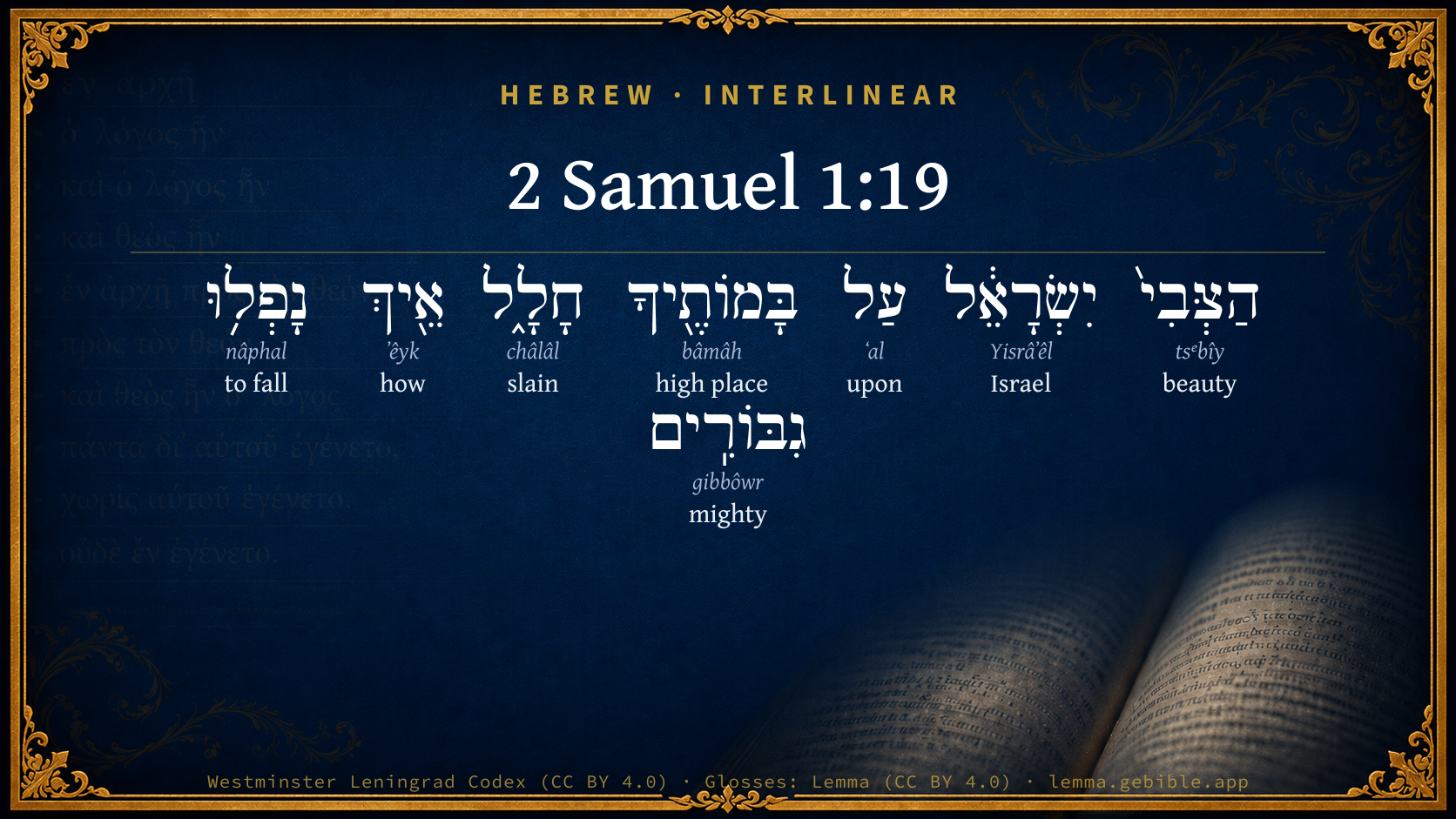
2 Samuel 1:19

Hebrew (Westminster Leningrad Codex) 2 Samuel 1:19 appears in the Hebrew Old Testament. The text above is from the Westminster Leningrad Codex. Each word links to its Strong’s number, a concise gloss, and parsing drawn from the Open Scriptures Hebrew Bible morphology. Click any word for its full Brown-Driver-Briggs (BDB) entry.
Download image
Cite this verse

2 Samuel 1:19 (World English Bible). Public Domain. Lemma interlinear Bible study tool, https://lemma.gebible.app/v/2-samuel/1/19.

Show BibTeX & RIS
BibTeX
RIS
English Translation
Your glory, Israel, is slain on your high places! How are the mighty fallen!
World English Bible · Public Domain
Download a study sheet

One document with this verse’s original text, its word-by-word gloss line, the meaning frame, cross-references with their text, attributed commentary, and full source and license credits — printable, and it pastes into notes with its structure intact.

This verse Autodidact and up

Study sheet (.html) Plain text (.txt)

A passage Seminary Student

Up to 50 verses in one chapter. A passage sheet keeps up to 6 commentary sources and 12 cross-references per verse, in the order this page ranks them, and says so on the sheet whenever that leaves anything out. Ask for a single verse and you get the Autodidact verse sheet above.

Everything on this page stays free to read, with no account — the sheet is a download of what is already on screen, not access to it.

Want to remove ads? Support Godless Engineer
Compare translations 3

The same verse in 3 English versions, stacked beneath the original-language interlinear above. Click any original word for its lexicon entry.

Each is an independent rendering of the whole verse — the interlinear is not word-aligned to these translations.

Highlighted words mark where these versions differ — a whole-verse word diff, not a word-by-word alignment.

  • World English Bible Public Domain
    Your glory, Israel, is slain on your high places! How are the mighty fallen!
  • King James Version Public Domain
    The beauty of Israel is slain upon thy high places: how are the mighty fallen!
  • unfoldingWord Literal Text CC BY-SA 4.0
    “The splendor of Israel slain on your high places! How the mighty have fallen!

unfoldingWord Literal Text — © unfoldingWord, licensed CC BY-SA 4.0. Word-aligned USFM3 via Door43 (git.door43.org/unfoldingWord/en_ult).

Versions to compare (up to 4)

3 of 4 selected

Show all 18 translations

Every available English version of this verse, each an independent rendering of the whole verse.

  • World English Bible Public Domain
    Your glory, Israel, is slain on your high places! How are the mighty fallen!
  • Berean Standard Bible Public Domain
    “Your glory, O Israel, lies slain on your heights. How the mighty have fallen!
  • Majority Standard Bible Public Domain
    “Your glory, O Israel, lies slain on your heights. How the mighty have fallen!
  • King James Version Public Domain
    The beauty of Israel is slain upon thy high places: how are the mighty fallen!
  • American Standard Version (1901) Public Domain
    Thy glory, O Israel, is slain upon thy high places! How are the mighty fallen!
  • Revised Version (1885) Public Domain
    Thy glory, O Israel, is slain upon thy high places! how are the mighty fallen!
  • Geneva Bible (1599) Public Domain
    O noble Israel, hee is slane vpon thy hie places: how are the mightie ouerthrowen!
  • Douay-Rheims (1899) Public Domain
    The illustrious of Israel are slain upon thy mountains: how are the valiant fallen?
  • Young's Literal Translation Public Domain
    `The Roebuck, O Israel, On thy high places `is' wounded; How have the mighty fallen!
  • Literal Standard Version CC BY-SA 4.0
    “The beauty of Israel || [Is] wounded on your high places; How the mighty have fallen!
  • Unlocked Literal Bible CC BY-SA 4.0
    “Your glory, Israel, is dead, killed on your high places! How the mighty have fallen!
  • unfoldingWord Literal Text CC BY-SA 4.0
    “The splendor of Israel slain on your high places! How the mighty have fallen!
  • Darby Bible Public Domain
    The beauty of Israel is slain upon thy high places: how are the mighty fallen!
  • World Messianic Bible Public Domain
    “Your glory, Israel, was slain on your high places! How the mighty have fallen!
  • Webster's Bible Public Domain
    The beauty of Israel is slain upon thy high places: how are the mighty fallen!
  • Free Bible Version CC BY-SA 4.0
    “Israel, the glorious one lies dead on your mountains. How the mighty have fallen!
  • Bible in Basic English Public Domain
    The glory, O Israel, is dead on your high places! How have the great ones been made low!
  • JPS Tanakh (1917) Public Domain
    Thy beauty, O Israel, upon thy high places is slain! How are the mighty fallen!

Literal Standard Version (2020), Covenant Press — licensed CC BY-SA 4.0. Text via the HelloAO Bible API (eBible.org). Unlocked Literal Bible (unfoldingWord) — licensed CC BY-SA 4.0. Text via the HelloAO Bible API (eBible.org). unfoldingWord Literal Text — © unfoldingWord, licensed CC BY-SA 4.0. Word-aligned USFM3 via Door43 (git.door43.org/unfoldingWord/en_ult). Free Bible Version, Dr. Jonathan Gallagher — licensed CC BY-SA 4.0. Text via the HelloAO Bible API (eBible.org).

Word by word

More ways to search: Search by grammar → Find every occurrence → Compare this word →

Practice this passage: Drill this verse → Learn its vocabulary →

About this verse

These counts appear in no published source. They are computed here, from the morphology-tagged text and Lemma’s own curated glosses. What Lemma adds →

8
words
8
distinct lemmas
Historical
section

Shared distinctive vocabulary

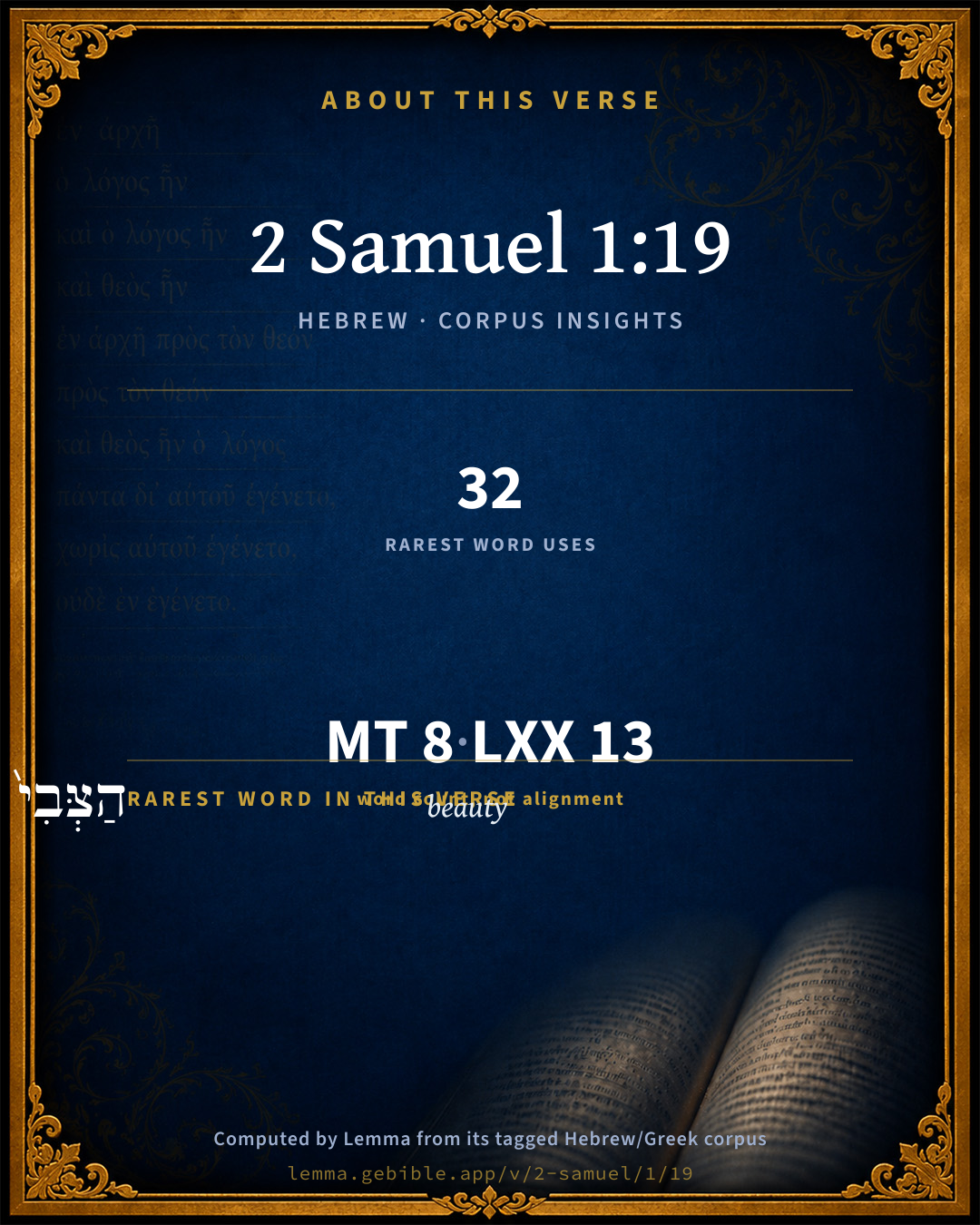
הַצְּבִי֙ beauty H6643 occurs in 32 verses of the Hebrew Bible. Also found in:

Grammatical profile

  • 1 verb
  • 3 nouns
  • 2 adjectives
  • 1 preposition
  • 1 particle

Verb forms

  • נָפְל֥וּ Qal · Perfect

Hebrew & Septuagint length

In English translation the verse runs 14 words from the Hebrew and 20 from the Septuagint (LXX English) — the Septuagint runs noticeably longer here. See the side-by-side →

A rough comparison of the two English renderings, which tokenize alike — not a word-level alignment.

Word counts can differ between the Hebrew and the Greek without any difference in meaning — e.g. the Hebrew direct-object marker אֵת has no separate Greek word, and Greek often adds the article ὁ.

In the original languages it is 8 Hebrew tokens and 13 Greek tokens — but the two are counted differently (Hebrew bundles its prefixes and suffixes into one token; the Greek is in lemma form), so that isn’t a like-for-like length.

Cross-references

11

Topical passages linked to 2 Samuel 1:19 in the Treasury of Scripture Knowledge — connected by theme and wording, ordered by reader-vote popularity; previews shown in the World English Bible.

  • 2 Samuel 1:27 How are the mighty fallen, The weapons of war perished!
  • Deuteronomy 4:7–8 For what great nation is there, that has a god so near to them, as Yahweh our God is whenever we call on him?
  • 2 Samuel 1:25 How are the mighty fallen in the midst of the battle! Jonathan is slain on your high places.
  • Lamentations 5:16 The crown is fallen from our head: Woe to us! for we have sinned.
  • 1 Samuel 31:8 It happened on the next day, when the Philistines came to strip the slain, that they found Saul and his three sons fallen on Mount Gilboa.
  • 2 Samuel 1:23 Saul and Jonathan were lovely and pleasant in their lives, In their death they were not divided: They were swifter than eagles, They were stronger than lions.
  • Isaiah 4:2 In that day, Yahweh's branch will be beautiful and glorious, and the fruit of the land will be the beauty and glory of the survivors of Israel.
  • Lamentations 2:1 How has the Lord covered the daughter of Zion with a cloud in his anger! He has cast down from heaven to the earth the beauty of Israel, And hasn't remembered his footstool in the day of his anger.
  • Zechariah 11:7 So I fed the flock of slaughter, especially the oppressed of the flock. I took for myself two staffs. The one I called "Favor," and the other I called "Union," and I fed the flock.
  • Zechariah 11:10 I took my staff Favor, and cut it apart, that I might break my covenant that I had made with all the peoples.
  • Isaiah 53:2 For he grew up before him as a tender plant, and as a root out of a dry ground: he has no form nor comeliness; and when we see him, there is no beauty that we should desire him.

Cross-references courtesy of OpenBible.info (CC BY 4.0).

Hebrew and Greek witnesses Masoretic Hebrew ↔ Greek Septuagint

The same verse in the two great witnesses to the Old Testament, shown verse-for-verse.

Here the Septuagint runs noticeably longer than the Hebrew — LXX2012 (modern English Septuagint) 20 words vs World English Bible 14. A rough length comparison of the two English translations, not a word-level alignment — read both below.

These are two independent witnesses, not word-aligned to each other, and the Septuagint is shown in lemma (dictionary) form.

Hebrew 2 Samuel 1:19 Masoretic · Westminster Leningrad Codex

הַצְּבִי֙ יִשְׂרָאֵ֔ל עַל בָּמוֹתֶ֖יךָ חָלָ֑ל אֵ֖יךְ נָפְל֥וּ גִבּוֹרִֽים

Your glory, Israel, is slain on your high places! How are the mighty fallen!

World English Bible · Public Domain

Greek LXX 2 Samuel 1:19 Septuagint · lemma form

στηλόω ἰσραήλ ὑπέρ ὁ θνήσκω ἐπί ὁ ὕψος σύ τραυματίας πῶς πίπτω δυνατός

Set up a pillar, O Israel, for the slain that died upon your high places: how are the mighty fallen!

LXX2012 (modern English Septuagint) · Public Domain

Hebrew: Westminster Leningrad Codex (CC BY 4.0). Greek: Septuagint (public domain); English from LXX2012 (modern English Septuagint) (Public Domain). How the Septuagint differs from the Hebrew →

Targum (Aramaic paraphrase)

1

The Targum is the ancient Jewish Aramaic paraphrase of the Hebrew Scriptures — an interpretive translation, not the Hebrew text itself. Onkelos (literal) and Pseudo-Jonathan (expansive) render the Torah, and Jonathan the Prophets. Coverage is partial: where no permissively-licensed English translation exists for a verse, only the Aramaic is shown. This is verse-level text, not a word-by-word alignment to the Hebrew.

  1. Targum Jonathan Prophets (Joshua–Malachi)
    אִתְעַתַּדְתּוּן יִשְׂרָאֵל עַל בֵּית תּוֹקְפֵיכוֹן אִתְרְמֵיתוּן קְטִילִין אֵיכְדֵין אִתְקְטָלוּ גִיבָּרַיָא:

    (no public-domain English translation for this verse)

    Targum Jonathan — Aramaic: “Mikraot Gedolot” (public domain). English: “Sefaria Community Translation” (CC0 1.0 (public-domain dedication)); “London "Chaldee Paraphrase," 1871” (public domain). Text via Sefaria.

Commentary

Notes on 2 Samuel 1:19 from classic Christian and Jewish commentators (each source and its license shown beneath its notes). The classic Christian expositions comment on the surrounding passage and are grouped to its opening verse, so a note may address several verses; the Jewish commentaries on the Tanakh (Rashi and others) are per-verse, so they appear only where the commentator wrote on this verse.

Lemma curates 59 commentaries, every one of them public domain or Creative Commons licensed, each selected and text-cleaned for this edition rather than reprinted as found. About our sources →

Trapp's Complete Commentary

John Trapp

2Sa 1:19 The beauty of Israel is slain upon thy high places: how are the mighty fallen!

Ver. 19. The beauty of Israel.] Here beginneth this sad sonnet, whereof this verse is the foot, and is therefore repeated. {2Sa 1:25; 2Sa 1:27} Junius {a} readeth it, O thou beauty of Israel: which is, saith he, a periphrasis of God, of the land, saith Diodate. {Dan 8:9; Dan 11:16} In this short song there are many things to be understood as being concise: the expressions of a man grieved for the death of his dear friends, and done in metre, which causeth a cloud.

How are the mighty fallen!] q.d., By a divine hand doubtless, else they could hardly have been over matched: such notable warriors they were. In the remembrance of many that are yet alive at Ostend in the Netherlands, the most warlike soldiers of Europe, whilst they most eagerly contended for that barren plot of land, had, as it were, one common sepulchre, but an eternal monument of their valour. {b}

{a} Est genus lamentationis cycloides. - Jun. Decus, desiderium, et gloria.

{b} Camd., Elis.

John Trapp, A Commentary or Exposition upon All the Books of the Old and New Testament (1647–1656) — public domain. Text from a community e-Sword module.

The Biblical Illustrator

Joseph S. Exell

2Sa_1:19-20

The beauty of Israel is slain.

The fall of Christians

We have here an illustration of the degenerating influences of sin upon the character of Christians, and the lamentable effects in the eyes of the world.

I. The beauty of Israel. Christianity imparts a distinguishing character to the believer; the moral counterpart of Israel's separation from the heathen inhabitants that surrounded them, and the evil practices from which they were called.

II. The beauty of Israel slain. The history of souls proves this possibility.

III. The beauty of Israel slain in the high places. Many Christians who flourished in the Church while they occupied a lowly position, have had their beauty slain by an ecclesiastical or secular elevation. God's gems shine best in the shade. But few trees of His growth can challenge the stormy winds of high places.

IV. The lamentation. How are the mighty fallen, etc.

V. The church's proclamation. Tell it not, etc. (The Study.)

How are the mighty fallen!--

The death of the great

1. How is the mighty fallen!--fallen under the superior power of death!--Death, the king of terrors, the conqueror of conquerors; whom riches cannot bribe, nor power resist; whom goodness cannot soften, nor dignity and loyalty deter, or awe to a reverential distance. Death intrudes into palaces as well as cottages; and arrests the monarch as well as the slave. How astonishing and lamentable is the stupidity of mankind! Can the natural or the moral world exhibit another phenomenon so shocking and unaccountable? Death sweeps off thousands of our fellow-subjects every year. Our neighbours, like leaves in autumn, drop into the grave, in a thick succession; and our attendance upon funerals is almost as frequent and formal as our visits of friendship or complaisance. Yet how few realise the thought that they must die! Pilgrims and strangers imagine themselves everlasting residents; and make this transitory life their all, as if earth was to be their eternal home; as if eternity was but a fairy land, and heaven and hell but majestic chimeras.

2. Since the mighty is fallen, how vain are all things beneath the sun! Vanity of vanities; all is vanity! How unworthy the hopes, how inferior to the desires, how unequal to the duration of human nature! Who then art thou, who settest thine affections on things below? Dost thou value thyself on thy birth? Dost thou value thyself on thy riches? Dost thou value thyself on thy power? Dost thou glory in thy constancy, humanity, affection to thy friend; justice, veracity, popularity, universal love? If even kings cannot extract perfect happiness from things below; if the gross, unsubstantial, and fleeting enjoyments of life are in their own nature incapable of affording pure, solid, and lasting felicity, must we not all despair of it? Yet such a happiness we desire; such we need; nay, such we must have; or our very existence will become our curse, and all our powers of enjoyment but capacities of pain. And where shall we seek for it? where, but in the supreme Good? But though crowns, and thrones, and kings, though stars, and suns, and worlds, sink into promiscuous ruin, there is one gift of Heaven to mankind which shall survive; which shall flourish and reign for ever; a gift little esteemed or solicited, and which makes no brilliant figure in mortal eyes; I mean religion. Religion! Thou brightest ornament of human natural Thou fairest image of the Divine! Thou sacred spark of celestial fire, which now glimmers with but a feeble lustre; but will shine bright in the night of affliction; will irradiate the thick gloom of death, and blaze out into immortality in its native element! This will be an unfailing source of happiness, through the revolutions of eternal ages. These majestic trifles are not the tests of real worth, nor the badges of Heaven's favourites: it is religion that marks out the happy man; that distinguishes the heir of an unfading crown; who, when the dubious conflict of life is over, shall inherit all things, and sit in triumph for ever with the King of kings, and Lord of lords. (S. Davies, A. M.)

The Biblical Illustrator, edited by Joseph S. Exell (c. 1880s–1900s) — public domain. Text from a community e-Sword module.

Joseph Benson's Commentary

2Sa 1:19. The beauty of Israel — Hebrew, הצבי, hatsebi; the honour, glory, flower, or ornament, meaning Saul and Jonathan, and their army. Delaney understands the expression only of Jonathan, and observes, as Jonathan’s death touched him nearest, it was natural he should be the first object of his lamentation; and, to put it out of all doubt that Jonathan is meant, he varies the expression in a subsequent verse — Jonathan slain in thy high places! The word rendered slain, חלל, chalal, properly means stabbed, and does not appear anywhere to bear the sense that Dr. Kennicott would put upon it, who would understand it as a noun, and not as a participle, and translate it a warrior. How moving a circumstance is this here noticed! Jonathan’s falling on his own high places! those in which he might naturally have expected safety; those in which he delighted; those in which he had long enjoyed peace and pleasure. Or thine, O land of Israel. How are the mighty fallen — How untimely and lamentably Jonathan! How sadly and shamefully Saul by his own hand! How strangely! how unexpectedly! how universally the army! This solemn, noble, and pathetic exclamation of sorrow was probably repeated at the close of every verse of this mournful song.

Joseph Benson's Commentary on the Old and New Testaments (1811–1818) — public domain. Text from a community e-Sword module.

Keil & Delitzsch

C. F. Keil & F. Delitzsch

The ode is arranged in three strophes, which gradually diminish in force and sweep (viz., Sa2 1:19-24, Sa2 1:25-26, Sa2 1:27), and in which the vehemence of the sorrow so gradually modified, and finally dies away. Each strophe opens with the exclamation, "How are the mighty fallen!" The first contains all that had to be said in praise of the fallen heroes; the deepest mourning for their death; and praise of their bravery, of their inseparable love, and of the virtues of Saul as king. The second commemorates the friendship between David and Jonathan. The third simply utters the last sigh, with which the elegy becomes silent. The first strophe runs thus:

19 The ornament, O Israel, is slain upon thy heights!

Oh how are the mighty fallen!

20 Tell it not in Gath, publish it not in the streets of Askelon;

Lest the daughters of the Philistines rejoice,

Lest the daughters of the uncircumcised triumph!

21 Ye mountains of Gilboa, let now dew or rain be upon you, or fields of first-fruit offerings:

For there is the shield of the mighty defiled,

The shield of Saul, not anointed with oil.

22 From the blood of the slain, from the fat of the mighty,

The bow of Jonathan turned not back,

And the sword of Saul returned not empty.

23 Saul and Jonathan, beloved and kind, in life

And in death they are not divided.

Lighter than eagles were they; stronger than lions.

24 Ye daughters of Israel, weep over Saul,

Who clothed you in purple with delight;

Who put a golden ornament upon your apparel!

The beauty of Israel is slain upon thy high places: how are the mighty fallen! The first clause of Sa2 1:19 contains the theme of the entire ode. הצּבי does not mean the gazelle here (as the Syriac and Clericus and others render it), the only plausible support of which is the expression "upon thy heights," whereas the parallel גּבּורים shows that by הצּבי we are to understand the two heroes Saul and Jonathan, and that the word is used in the appellative sense of ornament. The king and his noble son were the ornament of Israel. They were slain upon the heights of Israel. Luther has given a correct rendering, so far as the sense is concerned (die Edelsten, the noblest), after the inclyti of the Vulgate. The pronoun "thy high places" refers to Israel. The reference is to the heights of the mountains of Gilboa (see Sa2 1:21). This event threw Israel into deep mourning, which commences in the second clause.

Keil & Delitzsch — Biblical Commentary on the Old Testament (1861–1891) — public domain (CC PDM 1.0). Text via the HelloAO Bible API. (Old Testament only.)

Tyndale Open Study Notes

Tyndale Open Resources

1:19 Your pride and joy: David’s description focused more on Saul’s royal position than on his personal characteristics.

Tyndale Open Study Notes — © Tyndale Open Resources, licensed CC BY-SA 4.0. Text via the HelloAO Bible API.

Geneva Bible (1599)

Geneva Bible translators

Meaning, Saul.

Geneva Bible (1599) marginal notes — public domain. Text via Bolls.life.

Jamieson, Fausset & Brown

Robert Jamieson, A. R. Fausset & David Brown

The beauty of Israel is slain upon thy high places--literally, "the gazelle" or "antelope of Israel." In Eastern countries, that animal is the chosen type of beauty and symmetrical elegance of form.

how are the mighty fallen!--This forms the chorus.

Jamieson, Fausset & Brown — Commentary Critical and Explanatory on the Whole Bible (1871) — public domain (CC PDM 1.0). Text via the HelloAO Bible API.

Ellicott's Commentary for English Readers

(19) The beauty of Israel, in the sense of the glory or ornament of Israel, referring to Saul and Jonathan. The rendering of the Syriac and some commentators, “the gazelle,” as a poetic name for Jonathan, is uncalled for, both because the words are spoken of Saul and Jonathan together, and because there is no evidence elsewhere that Jonathan was so called, nor is there any allusion to him under this figure in the song.

Upon thy high places.—Comp. 2Sa_1:21; 2Sa_1:25. This line may be considered as the superscription of the whole song.

A Bible Commentary for English Readers, edited by Charles John Ellicott (1878–1897) — public domain. Text from a community e-Sword module.

The Cambridge Bible for Schools and Colleges

gen. ed. J. J. S. Perowne

19. The beauty of Israel, &c.] Better, Thy beauty (lit. the beauty), O Israel, upon thine high places is slain. Saul and Jonathan are thus described as the chief ornament and honour of Israel. The word translated glory may also mean roe or gazelle, a rendering which is adopted by some commentators, who refer it to Jonathan. There is not however any satisfactory evidence to shew that Jonathan’s personal beauty and swiftness of foot in attack or retreat had gained for him among the troops the name of ‘the Gazelle,’ as Ewald supposes (Hist. of Israel, III. 30), and as the elegy celebrates both Saul and Jonathan, the opening word cannot be limited to the latter only.

thy high places] Gilboa is meant. The expression suggests the extremity of the disaster, when the mountain-strongholds of the land were forced and their defenders slain. Cp. note on ch. 2Sa_22:34.

The Cambridge Bible for Schools and Colleges (gen. ed. J. J. S. Perowne; Cambridge University Press, 1878–1918) — public domain. Text from a community e-Sword module.

John Gill's Exposition

The beauty of Israel is slain upon thy high places,.... The high mountains of Gilboa, where Saul their king, and Jonathan his son, a prince of the blood, and natural heir to the crown, and multitudes of young men, the flower of the nation, were wounded and slain. Here begins the lamentation, or the elegiac song:

how are the mighty fallen! mighty men of war, strong and valiant, as Saul and his sons were, and the soldiers in his army.

John Gill's Exposition of the Whole Bible (1746–1763) — public domain (CC PDM 1.0). Text via the HelloAO Bible API.

Albert Barnes' Notes on the Bible

The beauty ... - i. e. Saul and Jonathan who were the chief ornament and pride of Israel, and slain upon “high places” 2Sa 1:25, namely, on Mount Gilboa.

Albert Barnes' Notes on the Bible (1834–1885) — public domain. Text from a community e-Sword/MySword module.

Haydock's Catholic Bible Commentary

Illustrious. Hebrew, "the glory (beauty, hart, &c.) of Israel hath been pierced," &c. The comparison of Saul with a hart, is noble enough in the ideas of the ancients, Psalm xvii. 34., Canticle of Canticles ii. 9., and viii. 14. Syriac and Arabic, "O hart of Israel, they have been slain," &c. (Calmet) --- Slain. Hebrew chalal, signifies also "a soldier;" and this word agrees perfectly well with giborim, "valiant," both here and ver. 22 and 25. Kennicott would apply it to Jonathan, upon whom David’s attention is mostly fixed. "O ornament of Israel! O warrior, upon thy high places! How," &c. (Haydock) --- In this manner many such pieces commence, Lamentations i. (Tirinus)

George Leo Haydock (1774–1849), Haydock's Catholic Family Bible and Commentary, 1859 edition — public domain. Excludes Psalms (Douay-Rheims chapter numbering differs from Protestant) and Deuterocanonical books (Catholic canon only).

Matthew Poole's English Annotations

The beauty of Israel; their flower and glory, Saul and Jonathan, and their army, consisting of young and valiant men.

Upon thy high places, i.e. those which belong to thee, O land of Israel.

How are the mighty fallen! how strangely! how suddenly! how dreadfully and universally!

Matthew Poole's English Annotations on the Holy Bible (1683–1685) — public domain. Text from a community e-Sword/MySword module.

Whedon's Commentary on the Bible

Daniel D. Whedon

19. Gazelle — The word צביprimarily means ornament, beauty, and is so rendered by the common version and most interpreters. But it also Signifies in many places a gazelle, or antelope, one of the fleetest and most beautiful of eastern animals. We prefer this rendering here because of its appropriateness and beauty. The allusion is to Jonathan, not to both Saul and Jonathan. This is seen in 2Sa_1:25, where, instead of gazelle of Israel, we have the name Jonathan. Hence the mistake of those who urge that mighty ones of one member of the parallelism must be equivalent to the corresponding word of the other.

Thy mountains — The mountains of the gazelle. The image is that of a fleet and beautiful animal pierced with arrows, and dead upon its own native heights.

Daniel D. Whedon (gen. ed.), Commentary on the Old and New Testaments (1874–1909) — public domain. Text from a community e-Sword module.

The Pulpit Commentary

The beauty of Israel. The word zebi means both "beauty" and also "the gazelle." Ewald takes it in the second sense, and explains it of Jonathan. "everywhere the first in courage, in activity, and speed; slender also and of well-made figure, and whose personal beauty and swiftness of foot in attack or retreat gained for him among the troops the name of "the gazelle." The Syriac Version also translates "gazelle, but Ephrem says that the whole Israelite nation is meant, the flower of whoso manhood lay slaughtered on Mount Gilboa. Which signification we take must really depend upon the meaning we attach to the words, "thy high place;" and these in the Authorized Version have nothing to refer to, and so become unmeaning. The Revised Version follows the Vulgate in taking Israel as a vocative, sad renders, "Thy glory, O Israel, is slain upon thy high places." The sense would thus be that given by Ephrem, Israel"s glory being its "mighty" men or heroes, its warriors slain upon Mount Gilboa with their king. But ver. 25 makes it plain that the "high places" are Jonathan"s, and not those of the nation; and the more correct rendering is "O beauty or, "gazelle" of Israel, slain upon thy high places! how are the heroes fallen!" Thus Jonathan is certainly meant, and the heroes are the young, prince and his father; and as the hunted antelope is said to return to its lair in the mountains, and there await its death, "gazelle" is probably the right rendering. In a dirge in honour of Saul and Jonathan we may be pretty sure that Jonathan would be referred to in its opening words, and the camp name of his friend would bring back to David"s mind many a brave feat wrought together, and many a pleasant hour of companionship in past years.

Vers. 19-27.

David"s lamentation over Saul and Jonathan.

In this lamentation there is

I A DECLARATION OF THE CAUSE OF MOURNING.

O pride of Israel, on thy high places slain!

Alas! fallen are the heroes. (Ver. 19.)

This is the keynote. It contains "the theme of the entire ode.

1. Men of rich endowments are the ornament, beauty, and glory of apeople.

2. Such men are sometimes stricken down suddenly and under unexpectedcircumstances. "Not on the level plains where defeat from the chariots and horses of the enemy might have been expected and had been before encountered, but on the high places where victory seemed the rightful prize of the mountain chiefs and the indomitable infantry of the Israelitish hosts" there the towering form of Saul was "hit by the archers", (1Sa_31:3) the heroic heart of Jonathan thrust through, the splendour of Israel eclipsed. "All flesh is grass, and all the goodliness thereof is as the flower of the field," etc. (Isa_40:6, Isa_40:7; Jer_9:23, Jer_9:24)

3. Their loss is a great calamity, and a source of bitter grief to those whoform a proper estimate of their worth, and possess a genuine concern for the public good (ver. 12).

II A DEPRECATION OF THE TRIUMPH OF THE ENEMY.

Tell it not in Garth, Publish not the tidings in the streets of Askelon; Lest the daughters of the Philistines rejoice, Lest the daughters of the uncircumcised exult. (Ver. 20.)

In imagination the poet sees the swift-footed messengers bearing the tidings to the nearest cities of the Philistines to Gath and Askelon; hears their songs of victory; and, in sympathy with his people, he utters the wish, "Oh that it might not have been!

1. The fall of men of eminence among the people of God causes exultationamong their adversaries.

2. The triumph of the wicked (the "uncircumcised") increases the sufferingand shame of the godly in their misfortunes. (Psa_44:9-26 Psa_123:4)

3. Whatever contributes to this result should be earnestly deprecated by allwho have a sincere regard for the reputation of the great, the welfare of the good, and the honour of God. That which makes the ungodly rejoice should often make the faithful weep.

III AN IMPRECATION ON THE SCENE OF DISASTER.

O mountains in Gilboa, nor dew nor rain (be) upon you, Nor fields of sacred offerings! For there lies rusting the shield of heroes, The shield of Saul unanointed with oil. (Ver. 21.)

"Over against the exultant joy of victory of Israel"s enemies, which he would be gladly spared, David sets the attitude of mourning, in which he would behold the mountains of Gilboa, the scene of the heroes" death struggle" (Erdmann). As that scene presents itself to his imagination, its beauty and fertility appear incongruous with the degradation of the slain, the misery of Israel, and his own absorbing grief. Has it no sympathy with them in their woe? He impatiently resents its indifference to his sorrow, and says in effect, "Oh that it might no more enjoy the favour of Heaven, nor produce the oblations by which its wrath is propitiated, but be a perpetual memorial of the mournful event!". (Eze_31:15)

1. It is the tendency of grief to dwell upon the objects that are associatedwith its cause, and by the contemplation of them it becomes intensified.

2. Under the influence of strong emotion the mind seeks sympathy withitself even in material and inanimate objects, and is apt to indulge in wishes that are incapable of literal fulfilment.

3. The aspects of nature correspond in greater or less degree with themental mood in which they are regarded. Sorrow projects its shadow over the external world, and clothes the fairest scenes with gloom.

4. The language of poetic inspiration must not be interpreted in its literal,prosaic sense, but in the light of the feeling and imagination of the poet. David"s imprecation was no more intended to have an actual effect on the fields of Gilboa than Job"s (Job_3:1) on the day of his birth.

IV A CELEBRATION OF THE VIRTUES OF THE FALLEN.

From blood of slain, From fat of heroes The bow of Jonathan turned not backward, And the sword of Saul returned not unsatisfied. Saul and Jonathan! the beloved and lovely! In their lives and in their death they were not parted; Than eagles fleeter, Than lions stronger. (Vers. 22, 23.)

The poet turns away from the melancholy scene to contemplate the heroes as he had known them, and describes their warlike prowess, their amiable dispositions, their mutual affection and faithful companionship, their agility and strength. Sincere sorrow over the dead:

1. Imposes a becoming silence concerning their imperfections, is forgetfulof personal injuries, and puts out of sight everything that is contrary to itself (vers. 11, 12). De mortuis nil nisi bonum.

2. Delights to dwell upon the special aspects of their character which areworthy of admiration.

1. Sees in their extraordinary virtues a measure of the loss that has beenexperienced. "The nobility of Jonathan"s character cannot easily be overestimated. The rival claims of friendship and of nature, of David and Saul, were adjusted with admirable delicacy. He strengthened his friend"s (1Sa_22:16) and saved his life; but he clung to his father. The shadows were falling on Saul, yet he did not join David"s party, though he knew that he would succeed to the throne. With a gallant loyalty and a true-hearted despair, he followed his doomed sire to Gilboa" (B. Kent).

2. AN ENUMERATION OF THE GIFTS OF A BENEFACTOR.

O daughters of Israel, wail for Saul! He clothed you in scarlet with loveliness; He put jewels of gold upon your apparel.

Alas! fallen aye the heroes

In the midst of the battle. (Vers. 24, 25.)

stream of sorrow, which down to this point has been united, here divides." David calls upon the daughters of Israel to wail, while the daughters of the Philistines triumph; and reminds them of the beneficence of Saul in distributing among them the spoils of war gained in his former victories.

1. The benefits conferred by an able and successful ruler upon his peopleare great, and deserve a grateful recognition.

2. The value of those benefits is seldom fully appreciated until they can beno longer bestowed.

3. Public mourning is as appropriate in its season as public rejoicing. (1Sa_13:7) It expresses and deepens the general sorrow, and is a testimony to departed worth. The chorus is here repeated. "This recurrence of the same idea is perfectly congenial to the nature of elegy, since grief is fond of dwelling upon the particular objects of the passion, and frequently repeating them" (Lowth).

VI A COMMEMORATION OF THE LOVE OF A FRIEND.

O Jonathan, on thy high places slain! Woe is me for thee, my brother Jonathan! Lovely wast thou to me exceedingly, Marvellous (was) thy love to me beyond the love of woman.

Alas! fallen are the heroes,

And perished the instruments of battle. (Vers. 26, 27.)

this culmination of grief the lament again sounds the keynote of the whole, and returns in conclusion to its chief object, the sorrow for the hero glory of Israel destroyed in Saul and Jonathan." David"s expression of sorrow manifests his deep love to his friend; still more, commemorates the "wonderful" love of his friend to him. "And in that love which he had borne towards him, there was something "separate from all beside," "miraculous," like a special work of God (this is the force of the word), more singular, undivided, and devoted than the love of women even of Michal, of Ahinoam, of Abigail" (Stanley).

1. Pure, fervent, self-denying love is the chief excellence of humancharacter. It is the greatest of all great things (1Co_13:13; Col_3:14; Jam_2:8; 1Pe_1:22)

2. It is exalted and glorified in our view by means of death.

3. The memory of those in whom it dwells in an eminent degree is worthyof being perpetuated to all ages. (For translations and paraphrases of this

lament see Lowth; Horsley, "Bibl. Crit.;" Geo. Sandys: 1636; J. Oldham: 1677.) D.

How are the mighty fallen!

This expression suggests numerous refleclions on

I THE VANITY OF MAN in the glory of his might. He is proud of his exalted state, his wisdom, strength, or riches; and he is admired and envied by others. But:

1. How precarious his position! He stands on "slippery places." All his grandeur rests on life, than which nothing is more unsubstantial or uncertain.

2. How futile his purposes! Formed in ignorance, weakness, and presumption, they are defeated and" broken off." "There is no king saved by the multitude of a host;" etc.. (Psa_33:16)

3. How unsatisfying his possessions! They afford no solid peace in life or death. "Vanity of vanities," etc.. (Ecc_1:1)

4. How transient his duration! "Man is like to vanity; his days are as a shadow that passeth away". (Psa_144:4)

5. How signal his downfall! "How are they brought into desolation as in a moment!". (Psa_73:19)

6. Hew evanescent his fame!

Your renown Is as the herb, whose hue doth come and go; And his might withers it, by whom it sprang Crude from the lap of earth." (Dante, "Purg.," 11.)

7. How complete his humiliation! The sword of Saul is cast away, his shield covered with blood and rust, his sceptre broken, his diadem and bracelet pilfered, his head placed in the temple of Dagon, his body fastened on the wall of Bethshan, his sons slain, and his dynasty destroyed. "Man that is in honour, and understandeth not, is like the beasts that perish" (Psa_49:20 Psa_39:5; Dan_4:31; Act_12:23) "The last act is sanguinary, beautiful as is all the rest of the play. Dust is cast upon the head, and there is an end and forever" (Pascal).

Farewell, a long farewell, to all my greatness! This is the state of man: Today he putteth forth The tender leaves of hope; tomorrow blossoms, And bears his blushing honours thick upon him:

The third day comes a frost, a killing frost; And, when he thinks, good easy man, full surely His greatness is a-ripening, nips his root, And then he falls, as I do. (Shakespeare, "Henry VIII")

II THE PROVIDENCE OF GOD in the fall of the mighty. "If there be a God, the world must be governed by Providence". (1Sa_2:1-10 1Sa_9:1-25)

1. How evident its existence! "The Lord reigneth." It is not only declared in the Scriptures, but also plainly shown by the facts of history and daily observation. Of Saul it is said, "The Lord slew him". (1Ch_10:14)

2. How great its power! "He bringeth the princes to nothing; he maketh the judges of the earth as vanity" (Isa_40:23; Dan_4:25)

3. How vast its domain! All space, all time, all orders of being and all events, the least as well as the greatest. (Mat_10:29) Even the actions of free and responsible creatures, of individuals and nations, the Philistines as well as the Israelites, the evil as well as the good, are encircled and pervaded by it; foreseen, permitted, directed, controlled, restrained, or overruled. The course of Saul was foreseen at his appointment; yet he was not thereby placed under the necessity of acting as he did

Contingency, whose verge extendeth not Beyond the tablet of your mortal mold, Is all depictured in the eternal sight; But hence deriveth not necessity, More than the tall ship, hurried down the flood, Is driven by the eye that looks on it. ("Par.," 17.)

1. How manifold its operations! What skilful adaptations it makes! What endless instrumentalities it employs! What varied issues it evolves!

2. How mysterious its methods! The fact is certain, the mode unknown. Its ways are obscure, perplexing, completely hidden for a while, and then made apparent and fully justified. "We know in part.

3. How righteous its administration!. (Psa_31:23 Psa_37:1-11 Psa_97:2) "Saul died for his transgression," and Israel (whose self-will he reflected) was chastised through the man of their own choice.

4. How beneficent its aims! The repression of sin, the salvation of men, the glory of God. The fall of Israel"s first king was overruled for the good of the nation; the fall of Israel, in subsequent ages, was "the riches of the world." "Oh the depth," etc.!. (Rom_11:33-36)

IMPROVEMENT.

1. Glory not in any earthly good, but only in the Lord.

2. Be ambitious to serve rather than to rule.

3. "Rest in the Lord, and wait patiently for him.

4. Strive for the crown and kingdom that will endure forever. D.

The Pulpit Commentary (1880–1919), ed. H.D.M. Spence-Jones & Joseph S. Exell — public domain. Text from a community e-Sword module.

John Wesley's Explanatory Notes

Beauty - Their flower and glory. Saul and Jonathan, and their army. High places - Hebrew. upon thy high places; that is, those which belong to thee, O land of Israel. How - How strangely! How suddenly! How universally!

John Wesley, Explanatory Notes Upon the Whole Bible (1754–1765) — public domain. Text via the GEBible commentary corpus.

Rashi

Rabbi Shlomo Yitzchaki (Rashi)

Pillar of Yisroel, on your heights [you have been rendered] a corpse. Pillars of Yisroel, on the mightiest point of your stronghold you have fallen as corpses. This is Yonasan's translation.

Rashi on the Tanakh — English translations: “The Judaica Press complete Tanach with Rashi, translated by A. J. Rosenberg” (CC BY 4.0); “Pentateuch with Rashi's commentary by M. Rosenbaum and A.M. Silbermann, 1929-1934” (public domain); “The Metsudah Tanach series, Lakewood, N.J” (CC BY 4.0); and “The Book of Joshua, Metsudah Publications, 1997” (CC BY 4.0). Text via Sefaria.

Lesson kit

Teaching starters — assembled from the data on this page, not authored interpretation. Every prompt links to the verse data it draws on. Edit before teaching.

2 Samuel, in the Historical, opens this verse with 8 words (8 distinct Hebrew lemmas). Its most distinctive word is tsᵉbîy (“beauty”). The Greek Septuagint runs longer here. A historical commentator’s framing appears above. Read the whole chapter for the surrounding context.

Discussion questions

  1. The word tsᵉbîy carries the sense “beauty.” How does it shape the verse?
  2. Deuteronomy 12:15 shares the word «beauty» with this verse. How do the two illuminate each other?
  3. Compared with the Hebrew, the Septuagint runs longer here. What questions does that raise?
  4. These translations render this verse differently. What is at stake in choosing one wording over another?
  5. The verb «נָפְל֥וּ» is Qal Perfect. How does its form color the action?
  6. Reading how Trapp's Complete Commentary and The Biblical Illustrator read this verse, where do the two commentators agree and where do they part?

Things to notice

Reading settings

Reading text

Shown beneath each verse's original-language words.

Old Testament
Old Testament edition

Read the OT as the Masoretic Hebrew (MT) or the Greek Septuagint (LXX).

English shown for the Greek Septuagint (in the Hebrew ↔ Greek comparison).

Comparing translations? Open the Compare panel on any verse page to stack up to four side by side.