
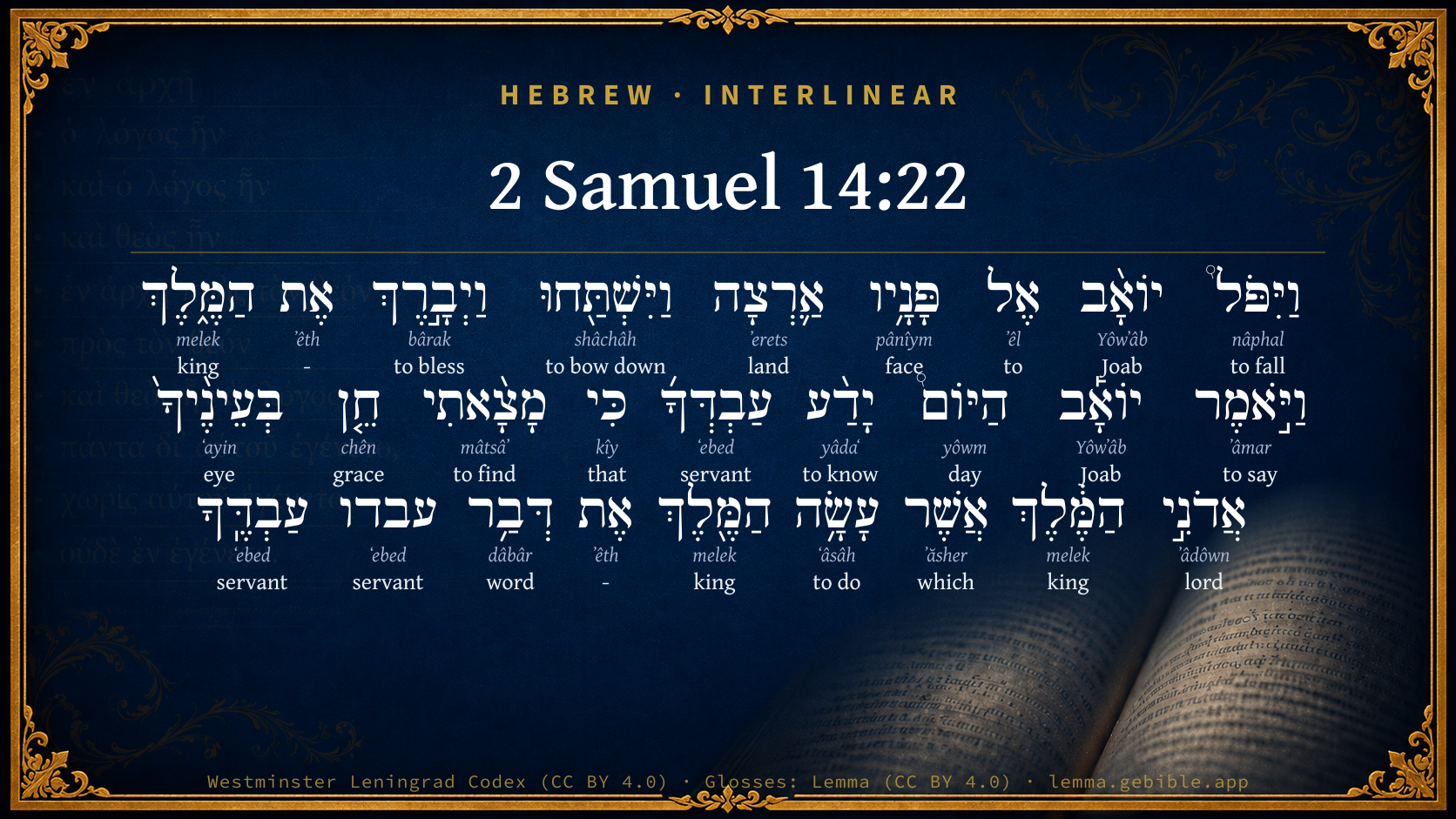
2 Samuel 14:22

Hebrew (Westminster Leningrad Codex) 2 Samuel 14:22 appears in the Hebrew Old Testament. The text above is from the Westminster Leningrad Codex. Each word links to its Strong’s number, a concise gloss, and parsing drawn from the Open Scriptures Hebrew Bible morphology. Click any word for its full Brown-Driver-Briggs (BDB) entry.
Download image
Cite this verse

2 Samuel 14:22 (World English Bible). Public Domain. Lemma interlinear Bible study tool, https://lemma.gebible.app/v/2-samuel/14/22.

Show BibTeX & RIS
BibTeX
RIS
English Translation
Joab fell to the ground on his face, and did obeisance, and blessed the king: and Joab said, Today your servant knows that I have found favor in your sight, my lord, king, in that the king has performed the request of his servant.
World English Bible · Public Domain
Download a study sheet

One document with this verse’s original text, its word-by-word gloss line, the meaning frame, cross-references with their text, attributed commentary, and full source and license credits — printable, and it pastes into notes with its structure intact.

This verse Autodidact and up

Study sheet (.html) Plain text (.txt)

A passage Seminary Student

Up to 50 verses in one chapter. A passage sheet keeps up to 6 commentary sources and 12 cross-references per verse, in the order this page ranks them, and says so on the sheet whenever that leaves anything out. Ask for a single verse and you get the Autodidact verse sheet above.

Everything on this page stays free to read, with no account — the sheet is a download of what is already on screen, not access to it.

Want to remove ads? Support Godless Engineer
Compare translations 3

The same verse in 3 English versions, stacked beneath the original-language interlinear above. Click any original word for its lexicon entry.

Each is an independent rendering of the whole verse — the interlinear is not word-aligned to these translations.

Highlighted words mark where these versions differ — a whole-verse word diff, not a word-by-word alignment.

  • World English Bible Public Domain
    Joab fell to the ground on his face, and did obeisance, and blessed the king: and Joab said, Today your servant knows that I have found favor in your sight, my lord, king, in that the king has performed the request of his servant.
  • King James Version Public Domain
    And Joab fell to the ground on his face, and bowed himself, and thanked the king: and Joab said, To day thy servant knoweth that I have found grace in thy sight, my lord, O king, in that the king hath fulfilled the request of his servant.
  • unfoldingWord Literal Text CC BY-SA 4.0
    And Joab fell on his face to the ground, and he prostrated himself, and he blessed the king. And Joab said, “Today your servant knows that I have found favor in your eyes, my lord the king, that the king does the word of his servant.”

unfoldingWord Literal Text — © unfoldingWord, licensed CC BY-SA 4.0. Word-aligned USFM3 via Door43 (git.door43.org/unfoldingWord/en_ult).

Versions to compare (up to 4)

3 of 4 selected

Show all 18 translations

Every available English version of this verse, each an independent rendering of the whole verse.

  • World English Bible Public Domain
    Joab fell to the ground on his face, and did obeisance, and blessed the king: and Joab said, Today your servant knows that I have found favor in your sight, my lord, king, in that the king has performed the request of his servant.
  • Berean Standard Bible Public Domain
    Joab fell facedown in homage and blessed the king. “Today,” said Joab, “your servant knows that he has found favor with you, my lord the king, because the king has granted his request.”
  • Majority Standard Bible Public Domain
    Joab fell facedown in homage and blessed the king. “Today,” said Joab, “your servant knows that he has found favor in your eyes, my lord the king, because the king has granted his request.”
  • King James Version Public Domain
    And Joab fell to the ground on his face, and bowed himself, and thanked the king: and Joab said, To day thy servant knoweth that I have found grace in thy sight, my lord, O king, in that the king hath fulfilled the request of his servant.
  • American Standard Version (1901) Public Domain
    And Joab fell to the ground on his face, and did obeisance, and blessed the king: and Joab said, To-day thy servant knoweth that I have found favor in thy sight, my lord, O king, in that the king hath performed the request of his servant.
  • Revised Version (1885) Public Domain
    And Joab fell to the ground on his face, and did obeisance, and blessed the king: end Joab said, Today thy servant knoweth that I have found grace in thy sight, my lord, O king, in that the king hath performed the request of his servant.
  • Geneva Bible (1599) Public Domain
    And Ioab fell to the grounde on his face, and bowed himselfe, and thanked the King. Then Ioab sayde, This day thy seruant knoweth, that I haue found grace in thy sight, my lord the King, in that the King hath fulfilled the request of his seruant.
  • Douay-Rheims (1899) Public Domain
    And Joab falling down to the ground upon his face, adored, and blessed the king: and Joab said: This day thy servant hath understood, that I have found grace in thy sight, my lord, O king: for thou hast fulfilled the request of thy servant.
  • Young's Literal Translation Public Domain
    And Joab falleth on his face to the earth, and doth obeisance, and blesseth the king, and Joab saith, `To-day hath thy servant known that I have found grace in thine eyes, my lord, O king, in that the king hath done the word of his servant.'
  • Literal Standard Version CC BY-SA 4.0
    And Joab falls on his face to the earth, and pays respect, and blesses the king, and Joab says, “Today your servant has known that I have found grace in your eyes, my lord, O king, in that the king has done the word of his servant.”
  • Unlocked Literal Bible CC BY-SA 4.0
    So Joab lay facedown on the ground in honor and gratitude to the king. Joab said, “Today your servant knows that I have found favor in your eyes, my master, king, in that the king has performed the request of his servant.”
  • unfoldingWord Literal Text CC BY-SA 4.0
    And Joab fell on his face to the ground, and he prostrated himself, and he blessed the king. And Joab said, “Today your servant knows that I have found favor in your eyes, my lord the king, that the king does the word of his servant.”
  • Darby Bible Public Domain
    And Joab fell to the ground on his face and bowed himself, and blessed the king; and Joab said, To-day thy servant knows that I have found favour in thy sight, my lord, O king, in that the king has fulfilled the request of his servant.
  • World Messianic Bible Public Domain
    Joab fell to the ground on his face, showed respect, and blessed the king. Joab said, “Today your servant knows that I have found favor in your sight, my lord, O king, in that the king has performed the request of his servant.”
  • Webster's Bible Public Domain
    And Joab fell to the ground on his face, and bowed himself, and thanked the king: and Joab said, To-day thy servant knoweth that I have found grace in thy sight, my lord, O king, in that the king hath fulfilled the request of his servant.
  • Free Bible Version CC BY-SA 4.0
    Joab bowed down with his face to the ground in respect, and blessed the king. “Today,” said Joab, “I, your servant, know that you approve of me, Your Majesty, because you have granted my request.”
  • Bible in Basic English Public Domain
    Then Joab, falling down on his face on the earth, gave the king honour and blessing; and Joab said, Today it is clear to your servant that I have grace in your eyes, my lord king, because the king has given effect to the request of his servant.
  • JPS Tanakh (1917) Public Domain
    And Joab fell to the ground on his face, and prostrated himself, and blessed the king; and Joab said: 'To-day thy servant knoweth that I have found favour in thy sight, my lord, O king, in that the king hath performed the request of thy servant.'

Literal Standard Version (2020), Covenant Press — licensed CC BY-SA 4.0. Text via the HelloAO Bible API (eBible.org). Unlocked Literal Bible (unfoldingWord) — licensed CC BY-SA 4.0. Text via the HelloAO Bible API (eBible.org). unfoldingWord Literal Text — © unfoldingWord, licensed CC BY-SA 4.0. Word-aligned USFM3 via Door43 (git.door43.org/unfoldingWord/en_ult). Free Bible Version, Dr. Jonathan Gallagher — licensed CC BY-SA 4.0. Text via the HelloAO Bible API (eBible.org).

Word by word

More ways to search: Search by grammar → Find every occurrence → Compare this word →

Practice this passage: Drill this verse → Learn its vocabulary →

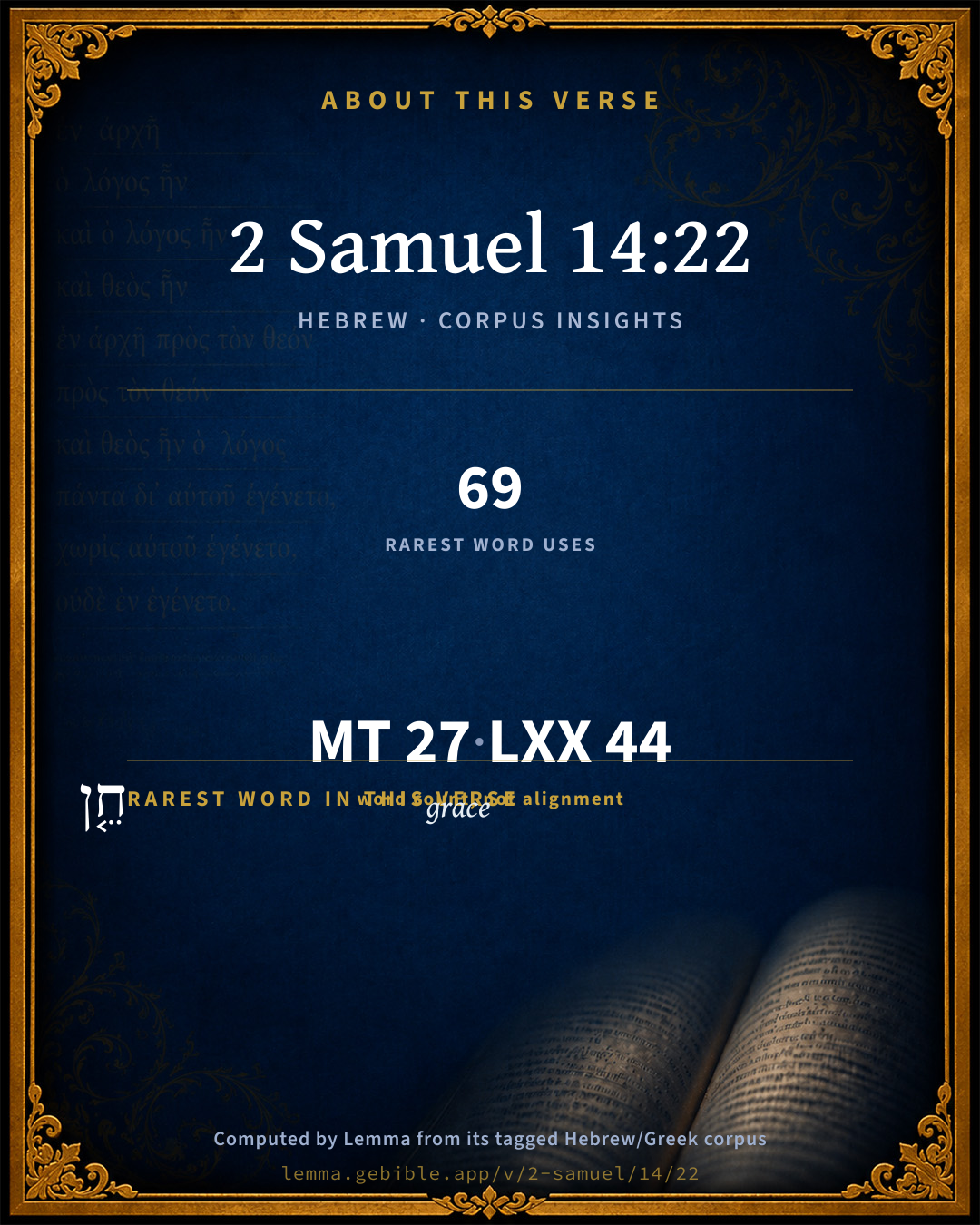
חֵ֤ן
chên
H2580
“grace”
Noun, Common, Masculine, Singular, Absolute
Part of Speech
Noun
Type
Common
Gender
Masculine
Number
Singular
State
Absolute
Full BDB Definition

Origin: from H2603

TWOT: TWOT- 694a

favour, grace, charm - favour, grace, elegance - favour, acceptance
  1. וַיִּפֹּל֩ nâphal H5307 “and · to fall” Conjunction + Verb, Qal, Sequential Imperfect, 3rd Person, Masculine, Singular
  2. יוֹאָ֨ב Yôwʼâb H3097 “Joab” Noun, Proper
  3. אֶל ʼêl H413 “to” Preposition
  4. פָּנָ֥יו pânîym H6440 “face(s) · his” Noun, Common, Both, Plural, Construct + Suffix, Personal, 3rd Person, Masculine, Singular
  5. אַ֛רְצָה ʼerets H776 “land · toward” Noun, Common, Both, Singular, Absolute + Suffix, Demonstrative
  6. וַיִּשְׁתַּ֖חוּ shâchâh H7812 “and · to bow down” Conjunction + Verb, Hithpael, Sequential Imperfect, 3rd Person, Masculine, Singular
  7. וַיְבָ֣רֶךְ bârak H1288 “and · to bless” Conjunction + Verb, Piel, Sequential Imperfect, 3rd Person, Masculine, Singular
  8. אֶת ʼêth H853 “-” Particle, Direct Object
  9. הַמֶּ֑לֶךְ melek H4428 “the · king” Particle, Definite Article + Noun, Common, Masculine, Singular, Absolute
  10. וַיֹּ֣אמֶר ʼâmar H559 “and · to say” Conjunction + Verb, Qal, Sequential Imperfect, 3rd Person, Masculine, Singular
  11. יוֹאָ֡ב Yôwʼâb H3097 “Joab” Noun, Proper
  12. הַיּוֹם֩ yôwm H3117 “the · day” Particle, Definite Article + Noun, Common, Masculine, Singular, Absolute
  13. יָדַ֨ע yâdaʻ H3045 “to know” Verb, Qal, Perfect, 3rd Person, Masculine, Singular
  14. עַבְדְּךָ֜ ʻebed H5650 “servant · your” Noun, Common, Masculine, Singular, Construct + Suffix, Personal, 2nd Person, Masculine, Singular
  15. כִּי kîy H3588 “that” Conjunction
  16. מָצָ֨אתִי mâtsâʼ H4672 “to find” Verb, Qal, Perfect, 1st Person, Common, Singular
  17. בְּעֵינֶ֨יךָ֙ ʻayin H5869 “in/at · eyes · your” Preposition + Noun, Common, Both, Dual, Construct + Suffix, Personal, 2nd Person, Masculine, Singular
  18. אֲדֹנִ֣י ʼâdôwn H113 “lord · my” Noun, Common, Masculine, Singular, Construct + Suffix, Personal, 1st Person, Common, Singular
  19. הַמֶּ֔לֶךְ melek H4428 “the · king” Particle, Definite Article + Noun, Common, Masculine, Singular, Absolute
  20. אֲשֶׁר ʼăsher H834 “which” Particle, Relative
  21. עָשָׂ֥ה ʻâsâh H6213 “to do” Verb, Qal, Perfect, 3rd Person, Masculine, Singular
  22. הַמֶּ֖לֶךְ melek H4428 “the · king” Particle, Definite Article + Noun, Common, Masculine, Singular, Absolute
  23. אֶת ʼêth H853 “-” Particle, Direct Object
  24. דְּבַ֥ר dâbâr H1697 “word of” Noun, Common, Masculine, Singular, Construct
  25. עבדו ʻebed H5650 “servant · his” Noun, Common, Masculine, Singular, Construct + Suffix, Personal, 3rd Person, Masculine, Singular
  26. עַבְדֶּֽךָ ʻebed H5650 “servant · your” Noun, Common, Masculine, Singular, Construct + Suffix, Personal, 2nd Person, Masculine, Singular

About this verse

These counts appear in no published source. They are computed here, from the morphology-tagged text and Lemma’s own curated glosses. What Lemma adds →

27
words
21
distinct lemmas
Historical
section

Grammatical profile

  • 7 verbs
  • 15 nouns
  • 1 preposition
  • 1 conjunction
  • 3 particles

Verb forms

  • וַיִּפֹּל֩ Qal · Sequential Imperfect
  • וַיִּשְׁתַּ֖חוּ Hithpael · Sequential Imperfect
  • וַיְבָ֣רֶךְ Piel · Sequential Imperfect
  • וַיֹּ֣אמֶר Qal · Sequential Imperfect
  • יָדַ֨ע Qal · Perfect
  • מָצָ֨אתִי Qal · Perfect
  • עָשָׂ֥ה Qal · Perfect

Repetition

Words recur within this verse — often emphatic in Hebrew:

  • הַמֶּ֑לֶךְ king H4428 ×3
  • עַבְדְּךָ֜ servant H5650 ×3
  • יוֹאָ֨ב Joab H3097 ×2

Hebrew & Septuagint length

In English translation the verse runs 44 words from the Hebrew and 47 from the Septuagint (LXX English) — closely comparable.

A rough comparison of the two English renderings, which tokenize alike — not a word-level alignment.

Word counts can differ between the Hebrew and the Greek without any difference in meaning — e.g. the Hebrew direct-object marker אֵת has no separate Greek word, and Greek often adds the article ὁ.

In the original languages it is 27 Hebrew tokens and 44 Greek tokens — but the two are counted differently (Hebrew bundles its prefixes and suffixes into one token; the Greek is in lemma form), so that isn’t a like-for-like length.

Cross-references

9

Topical passages linked to 2 Samuel 14:22 in the Treasury of Scripture Knowledge — connected by theme and wording, ordered by reader-vote popularity; previews shown in the World English Bible.

  • Genesis 6:8 But Noah found favor in Yahweh's eyes.
  • Exodus 33:16–17 For how would people know that I have found favor in your sight, I and your people? Isn't it in that you go with us, so that we are separated, I and your people, from all the people who are on the surface of the earth?"
  • Ruth 2:2 Ruth the Moabitess said to Naomi, Let me now go to the field, and glean among the ears of grain after him in whose sight I shall find favor. She said to her, Go, my daughter.
  • 1 Samuel 20:3 David swore moreover, and said, Your father knows well that I have found favor in your eyes; and he says, Don't let Jonathan know this, lest he be grieved: but truly as Yahweh lives, and as your soul lives, there is but a step between me and death.
  • 2 Samuel 19:39 All the people went over the Jordan, and the king went over: and the king kissed Barzillai, and blessed him; and he returned to his own place.
  • Nehemiah 11:2 The people blessed all the men who willingly offered themselves to dwell in Jerusalem.
  • Job 29:11 For when the ear heard me, then it blessed me; And when the eye saw me, it commended me:
  • Job 31:20 If his heart hasn't blessed me, If he hasn't been warmed with my sheep's fleece;
  • Proverbs 31:28 Her children rise up and call her blessed. Her husband also praises her:

Cross-references courtesy of OpenBible.info (CC BY 4.0).

Hebrew and Greek witnesses Masoretic Hebrew ↔ Greek Septuagint

The same verse in the two great witnesses to the Old Testament, shown verse-for-verse.

These are two independent witnesses, not word-aligned to each other, and the Septuagint is shown in lemma (dictionary) form.

Hebrew 2 Samuel 14:22 Masoretic · Westminster Leningrad Codex

וַיִּפֹּל֩ יוֹאָ֨ב אֶל פָּנָ֥יו אַ֛רְצָה וַיִּשְׁתַּ֖חוּ וַיְבָ֣רֶךְ אֶת הַמֶּ֑לֶךְ וַיֹּ֣אמֶר יוֹאָ֡ב הַיּוֹם֩ יָדַ֨ע עַבְדְּךָ֜ כִּי מָצָ֨אתִי חֵ֤ן בְּעֵינֶ֨יךָ֙ אֲדֹנִ֣י הַמֶּ֔לֶךְ אֲשֶׁר עָשָׂ֥ה הַמֶּ֖לֶךְ אֶת דְּבַ֥ר עבדו עַבְדֶּֽךָ

Joab fell to the ground on his face, and did obeisance, and blessed the king: and Joab said, Today your servant knows that I have found favor in your sight, my lord, king, in that the king has performed the request of his servant.

World English Bible · Public Domain

Greek LXX 2 Samuel 14:22 Septuagint · lemma form

καί πίπτω ιωαβ ἐπί πρόσωπον αὐτός ἐπί ὁ γῆ καί προςκυνέω καί εὐλογέω ὁ βασιλεύς καί εἶπον ιωαβ σήμερον γιγνώσκω ὁ δοῦλος σύ ὅτι εὑρίσκω χάρις ἐν ὀφθαλμός σύ κύριος ἐγώ βασιλεύς ὅτι ποιέω ὁ κύριος ἐγώ ὁ βασιλεύς ὁ λόγος ὁ δοῦλος αὐτός

And Joab fell on his face to the ground, and did obeisance, and blessed the king: and Joab said, To-day your servant knows that I have found grace in your sight, my lord, O king, for my lord the king has performed the request of his servant.

LXX2012 (modern English Septuagint) · Public Domain

Hebrew: Westminster Leningrad Codex (CC BY 4.0). Greek: Septuagint (public domain); English from LXX2012 (modern English Septuagint) (Public Domain). How the Septuagint differs from the Hebrew →

Targum (Aramaic paraphrase)

1

The Targum is the ancient Jewish Aramaic paraphrase of the Hebrew Scriptures — an interpretive translation, not the Hebrew text itself. Onkelos (literal) and Pseudo-Jonathan (expansive) render the Torah, and Jonathan the Prophets. Coverage is partial: where no permissively-licensed English translation exists for a verse, only the Aramaic is shown. This is verse-level text, not a word-by-word alignment to the Hebrew.

  1. Targum Jonathan Prophets (Joshua–Malachi)
    וּנְפַל יוֹאָב עַל אַפּוֹהִי לְאַרְעָא וּסְגִיד וּבָרִיךְ יַת מַלְכָּא וַאֲמַר יוֹאָב יוֹמָא דֵין יְדַע עַבְדָךְ אֲרֵי אַשְׁכָּחִית רַחֲמִין בְּעֵינָךְ רִבּוֹנִי מַלְכָּא דַעֲבַד מַלְכָּא יַת פִּתְגָמָא דְעַבְדֵיהּ:

    (no public-domain English translation for this verse)

    Targum Jonathan — Aramaic: “Mikraot Gedolot” (public domain). English: “Sefaria Community Translation” (CC0 1.0 (public-domain dedication)); “London "Chaldee Paraphrase," 1871” (public domain). Text via Sefaria.

Commentary

Notes on 2 Samuel 14:22 from classic Christian and Jewish commentators (each source and its license shown beneath its notes). The classic Christian expositions comment on the surrounding passage and are grouped to its opening verse, so a note may address several verses; the Jewish commentaries on the Tanakh (Rashi and others) are per-verse, so they appear only where the commentator wrote on this verse.

Lemma curates 59 commentaries, every one of them public domain or Creative Commons licensed, each selected and text-cleaned for this edition rather than reprinted as found. About our sources →

Jamieson, Fausset & Brown

Robert Jamieson, A. R. Fausset & David Brown

JOAB BRINGS ABSALOM TO JERUSALEM. (Sa2 14:22-33)

To-day thy servant knoweth that I have found grace in thy sight--Joab betrayed not a little selfishness amid his professions of joy at this act of grace to Absalom, and flattered himself that he now brought both father and son under lasting obligations. In considering this act of David, many extenuating circumstances may be urged in favor of it; the provocation given to Absalom; his being now in a country where justice could not overtake him; the risk of his imbibing a love for heathen principles and worship; the safety and interests of the Hebrew kingdom; together with the strong predilection of the Hebrew people for Absalom, as represented by the stratagem of Joab--these considerations form a plausible apology for David's grant of pardon to his bloodstained son. But, in granting this pardon, he was acting in the character of an Oriental despot rather than a constitutional king of Israel. The feelings of the father triumphed over the duty of the king, who, as the supreme magistrate, was bound to execute impartial justice on every murderer, by the express law of God (Gen 9:6; Num 35:30-31), which he had no power to dispense with (Deu 18:18; Jos 1:8; Sa1 10:25).

Jamieson, Fausset & Brown — Commentary Critical and Explanatory on the Whole Bible (1871) — public domain (CC PDM 1.0). Text via the HelloAO Bible API.

Trapp's Complete Commentary

John Trapp

2Sa 14:22 And Joab fell to the ground on his face, and bowed himself, and thanked the king: and Joab said, To day thy servant knoweth that I have found grace in thy sight, my lord, O king, in that the king hath fulfilled the request of his servant.

Ver. 22. And thanked the king.] The king could have found in his heart to have thanked him, but for stark shame; and that Joab knew well enough, though he thus colluded.

John Trapp, A Commentary or Exposition upon All the Books of the Old and New Testament (1647–1656) — public domain. Text from a community e-Sword module.

Geneva Bible (1599)

Geneva Bible translators

Hebrew, blessed.

Geneva Bible (1599) marginal notes — public domain. Text via Bolls.life.

The Cambridge Bible for Schools and Colleges

gen. ed. J. J. S. Perowne

22. his servant] This is the reading of the Kthîbh, and is clearly best: the marginal alternative thy comes from the Qrî.

The Cambridge Bible for Schools and Colleges (gen. ed. J. J. S. Perowne; Cambridge University Press, 1878–1918) — public domain. Text from a community e-Sword module.

John Gill's Exposition

And Joab fell to the ground on his face, and bowed himself,.... Or bowed so low as to the ground, in reverence of the king:

and thanked the king; for giving him leave to fetch Absalom home, as if it was a favour done to himself: or "blessed" (s) him; wished all happiness and prosperity might attend him, in consequence of this grant, which he knew would be acceptable to the people:

and Joab said, today thy servant knoweth that I have found grace in thy sight, my lord, O king, in that the king hath fulfilled the request of his servant; he might presume upon this, that as the king had given orders at his request to recall Absalom, who had murdered his brother, which was tacitly giving him a pardon; so he would forgive him the murder of Abner, Sa2 3:30, and think no more of it; since he perceived now, which he had not so clearly perceived before from that time, that he found grace in his sight, or shared in his favour and good will, as now he saw he did.

(s) "et benedixit", V. L. Pagninus, Montanus, Junius & Tremellius, Piscator.

John Gill's Exposition of the Whole Bible (1746–1763) — public domain (CC PDM 1.0). Text via the HelloAO Bible API.

Haydock's Catholic Bible Commentary

Blessed. That is, praised, and gave thanks to the king.

George Leo Haydock (1774–1849), Haydock's Catholic Family Bible and Commentary, 1859 edition — public domain. Excludes Psalms (Douay-Rheims chapter numbering differs from Protestant) and Deuterocanonical books (Catholic canon only).

Matthew Poole's English Annotations

i.e. Restored Absalom at my request; whereby. Joab thought to establish himself for ever, and that he should be both the father’s and the son’s favourite.

Quest. Whether David did well in granting this request?

Answ. Although there be some circumstances which in part extenuate David’s fault herein, as Amnon’s high provocation of Absalom; Absalom’s being out of the reach of David’s justice, where also he could and would have kept himself, if David had not promised him immunity; the extreme danger of Absalom’s infection by heathenish principles and practices; the safety of David’s kingdom, which seemed to depend upon the, establishment of the succession, and that upon Absalom, to whom the hearts of the people were so universally and vehemently inclined, if the matter was really so, and not pretended or magnified by the art of this subtle woman: yet it seems most probable that David was faulty herein, because this action was directly contrary to the express laws of God, which strictly command the supreme magistrate to execute justice upon all wilful murderers, without any reservation, Gen 9:6; Num 35:30,31. And David had no power to dispense with God’s laws, nor to spare any whom God commanded him to destroy; for the laws of God did bind the kings and rulers as well as the people of Israel to observe and obey them, as is most evident from Deu 17:18,19, and from Jos 1:8, and many other places. And indeed we may read David’s sin in the glass of those tremendous judgments of God which befell him, by means of his indulgence to Absalom. For although God’s providences be in themselves no rule to judge of the good or evil of men’s actions; yet where they comply with God’s word, and accomplish his threatenings, as here they did, they are to be taken for the tokens of God’s displeasure.

Matthew Poole's English Annotations on the Holy Bible (1683–1685) — public domain. Text from a community e-Sword/MySword module.

The Pulpit Commentary

In that the king hath fulfilled the request of his servant. Keil concludes from this that Joab had often interceded for Absalom"s pardon, and that this had made the king suspect him of being the prime mover in the affair. But this is to force the meaning, Joab now stood confessed as the person who had brought the woman before the king, and had employed her to gain a hearing. Had he been allowed to plead freely, her intervention would not have been necessary. We have seen, too, that the king"s suspicions have been made in the Authorized Version much stronger than they really were. Many commentators also assume that Joab had a friendship for Absalom, but there are few traces of it in his conduct, and more probably Joab was chiefly influenced by politic motives. It was injurious to the well being of the nation that there should be discord and enmity between the king and his eldest son, and that the latter should be living in exile. The K"ri, thy servant, placed in the margin, is to be decidedly rejected, with all other attempts of the Massorites to remove little roughnesses of grammar.

The Pulpit Commentary (1880–1919), ed. H.D.M. Spence-Jones & Joseph S. Exell — public domain. Text from a community e-Sword module.

John Wesley's Explanatory Notes

Fulfilled - But it seems David had no power to dispense with God's laws, nor to spare any whom God appointed him to destroy: for the laws of God bound the kings and rulers, as well as the people of Israel. How justly did God make this man, whom he had so sinfully spared, a scourge to him?

John Wesley, Explanatory Notes Upon the Whole Bible (1754–1765) — public domain. Text via the GEBible commentary corpus.

Lesson kit

Teaching starters — assembled from the data on this page, not authored interpretation. Every prompt links to the verse data it draws on. Edit before teaching.

2 Samuel, in the Historical, opens this verse with 27 words (21 distinct Hebrew lemmas). Its most distinctive word is chên (“grace”). A historical commentator’s framing appears above. Read the whole chapter for the surrounding context.

Discussion questions

  1. How does “grace” (chên) shape what this verse is saying?
  2. Genesis 6:8 shares this passage’s theme. How do the two illuminate each other?
  3. “king” occurs 3× in this one verse. What is the effect of the repetition?
  4. These translations render this verse differently; the difference is in the English rendering, not the original. What questions does that raise?
  5. The verb «וַיִּפֹּל֩» is Qal Sequential Imperfect. How does its form color the action?
  6. Reading how Jamieson, Fausset & Brown and Trapp's Complete Commentary read this verse, where do the two commentators agree and where do they part?

Things to notice

Reading settings

Reading text

Shown beneath each verse's original-language words.

Old Testament
Old Testament edition

Read the OT as the Masoretic Hebrew (MT) or the Greek Septuagint (LXX).

English shown for the Greek Septuagint (in the Hebrew ↔ Greek comparison).

Comparing translations? Open the Compare panel on any verse page to stack up to four side by side.