
2 Kings 25:11

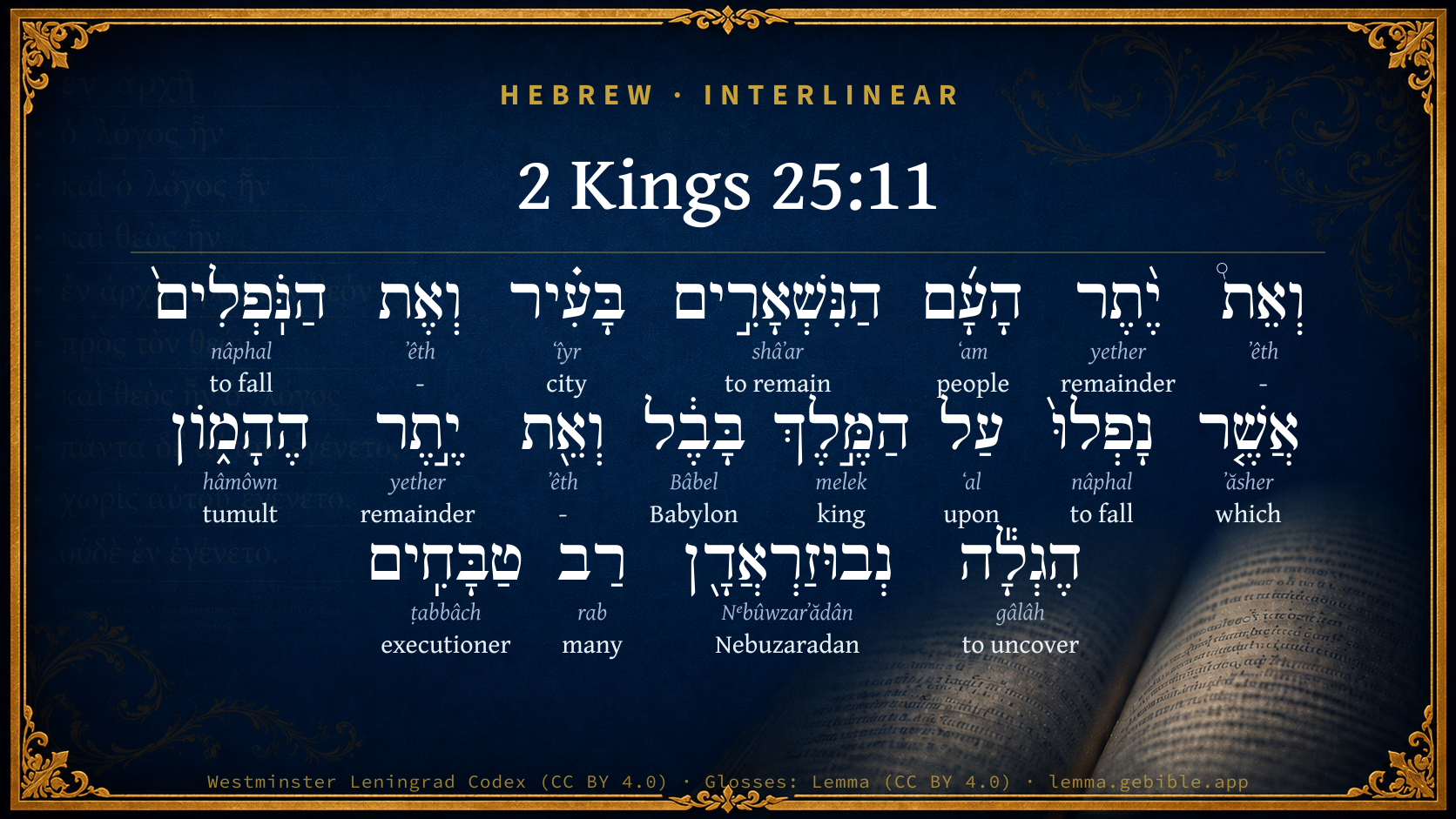
Hebrew (Westminster Leningrad Codex) 2 Kings 25:11 appears in the Hebrew Old Testament. The text above is from the Westminster Leningrad Codex. Each word links to its Strong’s number, a concise gloss, and parsing drawn from the Open Scriptures Hebrew Bible morphology. Click any word for its full Brown-Driver-Briggs (BDB) entry.
Download image
Cite this verse

2 Kings 25:11 (World English Bible). Public Domain. Lemma interlinear Bible study tool, https://lemma.gebible.app/v/2-kings/25/11.

Show BibTeX & RIS
BibTeX
RIS
English Translation
The residue of the people who were left in the city, and those who fell away, who fell to the king of Babylon, and the residue of the multitude, did Nebuzaradan the captain of the guard carry away captive.
World English Bible · Public Domain
Download a study sheet

One document with this verse’s original text, its word-by-word gloss line, the meaning frame, cross-references with their text, attributed commentary, and full source and license credits — printable, and it pastes into notes with its structure intact.

This verse Autodidact and up

Study sheet (.html) Plain text (.txt)

A passage Seminary Student

Up to 50 verses in one chapter. A passage sheet keeps up to 6 commentary sources and 12 cross-references per verse, in the order this page ranks them, and says so on the sheet whenever that leaves anything out. Ask for a single verse and you get the Autodidact verse sheet above.

Everything on this page stays free to read, with no account — the sheet is a download of what is already on screen, not access to it.

Want to remove ads? Support Godless Engineer
Compare translations 3

The same verse in 3 English versions, stacked beneath the original-language interlinear above. Click any original word for its lexicon entry.

Each is an independent rendering of the whole verse — the interlinear is not word-aligned to these translations.

Highlighted words mark where these versions differ — a whole-verse word diff, not a word-by-word alignment.

  • World English Bible Public Domain
    The residue of the people who were left in the city, and those who fell away, who fell to the king of Babylon, and the residue of the multitude, did Nebuzaradan the captain of the guard carry away captive.
  • King James Version Public Domain
    Now the rest of the people that were left in the city, and the fugitives that fell away to the king of Babylon, with the remnant of the multitude, did Nebuzaradan the captain of the guard carry away.
  • unfoldingWord Literal Text CC BY-SA 4.0
    But the rest of the people left in the city and the ones having fallen, who had fallen to the king of Babylon, and the rest of the multitude, Nebuzaradan, the chief of the guards, exiled.

unfoldingWord Literal Text — © unfoldingWord, licensed CC BY-SA 4.0. Word-aligned USFM3 via Door43 (git.door43.org/unfoldingWord/en_ult).

Versions to compare (up to 4)

3 of 4 selected

Show all 18 translations

Every available English version of this verse, each an independent rendering of the whole verse.

  • World English Bible Public Domain
    The residue of the people who were left in the city, and those who fell away, who fell to the king of Babylon, and the residue of the multitude, did Nebuzaradan the captain of the guard carry away captive.
  • Berean Standard Bible Public Domain
    Then Nebuzaradan captain of the guard carried into exile the people who remained in the city, along with the deserters who had defected to the king of Babylon and the rest of the population.
  • Majority Standard Bible Public Domain
    Then Nebuzaradan captain of the guard carried into exile the people who remained in the city, along with the deserters who had defected to the king of Babylon and the rest of the population.
  • King James Version Public Domain
    Now the rest of the people that were left in the city, and the fugitives that fell away to the king of Babylon, with the remnant of the multitude, did Nebuzaradan the captain of the guard carry away.
  • American Standard Version (1901) Public Domain
    And the residue of the people that were left in the city, and those that fell away, that fell to the king of Babylon, and the residue of the multitude, did Nebuzaradan the captain of the guard carry away captive.
  • Revised Version (1885) Public Domain
    And the residue of the people that were left in the city, and those that fell away, that fell to the king of Babylon, and the residue of the multitude, did Nebuzaradan the captain of the guard carry away captive.
  • Geneva Bible (1599) Public Domain
    And the rest of the people that were left in the citie, and those that were fled and fallen to the King of Babel, with the remnant of the multitude, did Nebuzar-adan chiefe steward carie away captiue.
  • Douay-Rheims (1899) Public Domain
    And Nabuzardan the commander of the army, carried away the rest of the people that remained in the city, and the fugitives that had gone over to the king of Babylon, and the remnant of the common people.
  • Young's Literal Translation Public Domain
    And the rest of the people, those left in the city, and those falling who have fallen to the king of Babylon, and the rest of the multitude, hath Nebuzaradan chief of the executioners removed;
  • Literal Standard Version CC BY-SA 4.0
    And the rest of the people, those left in the city, and those falling who have fallen to the king of Babylon, and the rest of the multitude, Nebuzaradan chief of the executioners has removed;
  • Unlocked Literal Bible CC BY-SA 4.0
    As for the rest of the people who were left in the city, those who had deserted to the king of Babylon, and the remainder of the population—Nebuzaradan, the commander of the bodyguard, took them away into exile.
  • unfoldingWord Literal Text CC BY-SA 4.0
    But the rest of the people left in the city and the ones having fallen, who had fallen to the king of Babylon, and the rest of the multitude, Nebuzaradan, the chief of the guards, exiled.
  • Darby Bible Public Domain
    And Nebuzar-adan the captain of the body-guard carried away captive the rest of the people that were left in the city, and the deserters that had deserted to the king of Babylon, and the rest of the multitude.
  • World Messianic Bible Public Domain
    Nebuzaradan the captain of the guard carried away captive the rest of the people who were left in the city and those who had deserted to the king of Babylon—all the rest of the multitude.
  • Webster's Bible Public Domain
    Now the rest of the people that were left in the city, and the fugitives that fell away to the king of Babylon, with the remnant of the multitude, did Nebuzar-adan the captain of the guard carry away.
  • Free Bible Version CC BY-SA 4.0
    Nebuzaradan, the commander of the guard, deported those who were left in the city, even those who had gone over to the side of the king of Babylon, as well as the rest of the population.
  • Bible in Basic English Public Domain
    And the rest of the people who were still in the town, and all those who had given themselves up to the king of Babylon, and all the rest of the workmen, Nebuzaradan, the captain of the armed men, took away as prisoners;
  • JPS Tanakh (1917) Public Domain
    And the residue of the people that were left in the city, and those that fell away, that fell to the king of Babylon, and the residue of the multitude, did Nebuzaradan the captain of the guard carry away captive.

Literal Standard Version (2020), Covenant Press — licensed CC BY-SA 4.0. Text via the HelloAO Bible API (eBible.org). Unlocked Literal Bible (unfoldingWord) — licensed CC BY-SA 4.0. Text via the HelloAO Bible API (eBible.org). unfoldingWord Literal Text — © unfoldingWord, licensed CC BY-SA 4.0. Word-aligned USFM3 via Door43 (git.door43.org/unfoldingWord/en_ult). Free Bible Version, Dr. Jonathan Gallagher — licensed CC BY-SA 4.0. Text via the HelloAO Bible API (eBible.org).

Word by word

More ways to search: Search by grammar → Find every occurrence → Compare this word →

Practice this passage: Drill this verse → Learn its vocabulary →

נְבוּזַרְאֲדָ֖ן
Nᵉbûwzarʼădân
H5018
“Nebuzaradan”
Noun, Proper
Part of Speech
Noun
Type
Proper
Full BDB Definition

Origin: of foreign origin

TWOT: None

Nebuzaradan = "Nebo has given seed" - a general of Nebuchadnezzar's army at the capture of Jerusalem
  1. וְאֵת֩ ʼêth H853 “and · -” Conjunction + Particle, Direct Object
  2. יֶ֨תֶר yether H3499 “remainder of” Noun, Common, Masculine, Singular, Construct
  3. הָעָ֜ם ʻam H5971 “the · people” Particle, Definite Article + Noun, Common, Masculine, Singular, Absolute
  4. הַנִּשְׁאָרִ֣ים shâʼar H7604 “the · remaining” Particle, Definite Article + Verb, Niphal, Participle Active, Masculine, Plural, Absolute
  5. בָּעִ֗יר ʻîyr H5892 “in/at the · city” Preposition, Determined + Noun, Common, Feminine, Singular, Absolute
  6. וְאֶת ʼêth H853 “and · -” Conjunction + Particle, Direct Object
  7. הַנֹּֽפְלִים֙ nâphal H5307 “the · falling” Particle, Definite Article + Verb, Qal, Participle Active, Masculine, Plural, Absolute
  8. אֲשֶׁ֤ר ʼăsher H834 “which” Particle, Relative
  9. נָפְלוּ֙ nâphal H5307 “to fall” Verb, Qal, Perfect, 3rd Person, Common, Plural
  10. עַל ʻal H5921 “upon” Preposition
  11. הַמֶּ֣לֶךְ melek H4428 “the · king” Particle, Definite Article + Noun, Common, Masculine, Singular, Absolute
  12. בָּבֶ֔ל Bâbel H894 “Babylon” Noun, Proper
  13. וְאֵ֖ת ʼêth H853 “and · -” Conjunction + Particle, Direct Object
  14. יֶ֣תֶר yether H3499 “remainder of” Noun, Common, Masculine, Singular, Construct
  15. הֶהָמ֑וֹן hâmôwn H1995 “the · tumult” Particle, Definite Article + Noun, Common, Masculine, Singular, Absolute
  16. הֶגְלָ֕ה gâlâh H1540 “to uncover” Verb, Hiphil, Perfect, 3rd Person, Masculine, Singular
  17. רַב rab H7227 “many of” Noun, Common, Masculine, Singular, Construct
  18. טַבָּחִֽים ṭabbâch H2876 “executioners” Noun, Common, Masculine, Plural, Absolute

About this verse

These counts appear in no published source. They are computed here, from the morphology-tagged text and Lemma’s own curated glosses. What Lemma adds →

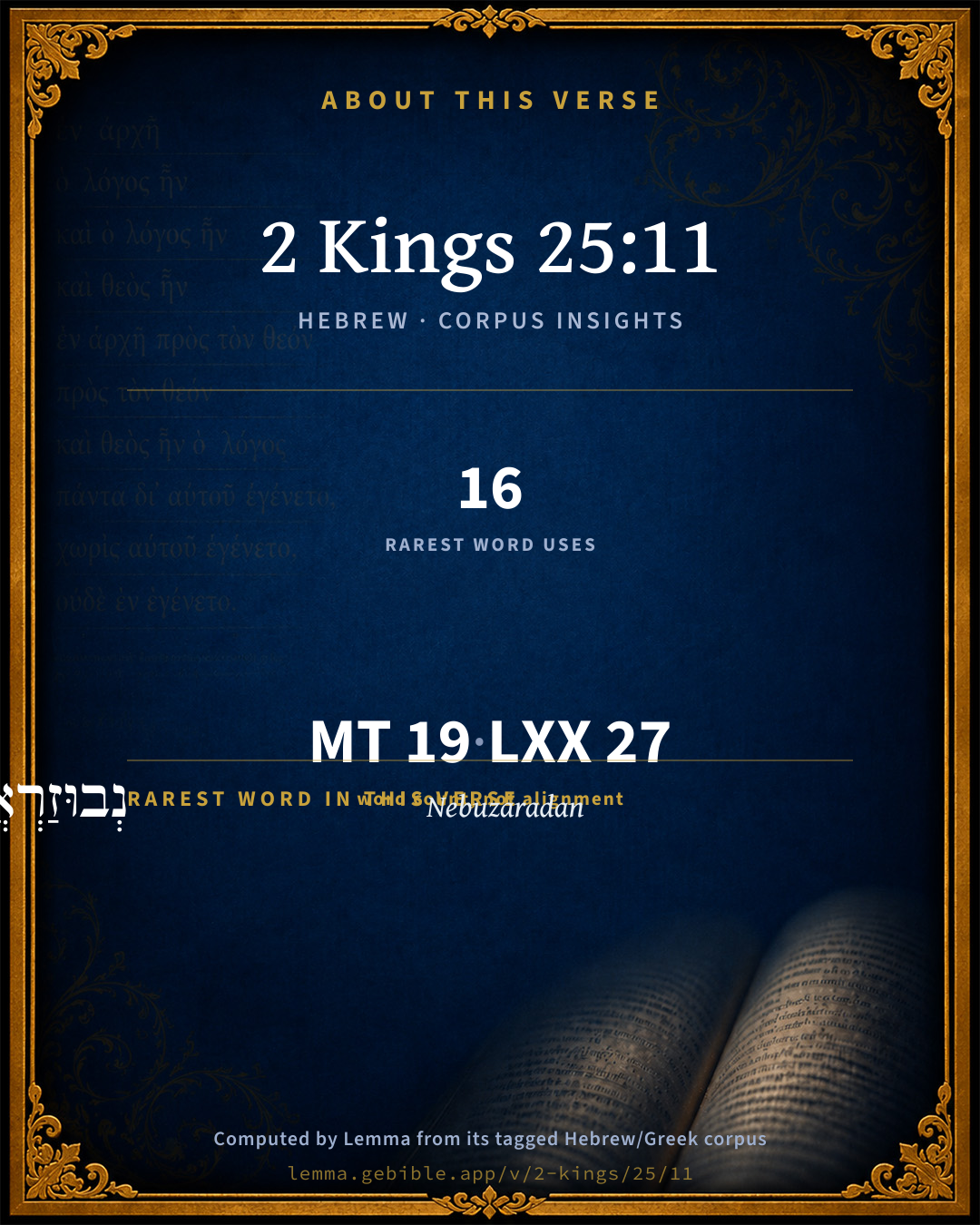
19
words
15
distinct lemmas
Historical
section

Notable vocabulary

The rarest word here is נְבוּזַרְאֲדָ֖ן Nebuzaradan H5018 — appearing just 16 times in the whole Hebrew Bible.

Shared distinctive vocabulary

נְבוּזַרְאֲדָ֖ן Nebuzaradan H5018 occurs in 15 verses of the Hebrew Bible. Also found in:

Grammatical profile

  • 4 verbs
  • 10 nouns
  • 1 preposition
  • 4 particles

Verb forms

  • הַנִּשְׁאָרִ֣ים Niphal · Participle Active
  • הַנֹּֽפְלִים֙ Qal · Participle Active
  • נָפְלוּ֙ Qal · Perfect
  • הֶגְלָ֕ה Hiphil · Perfect

Repetition

Words recur within this verse — often emphatic in Hebrew:

  • יֶ֨תֶר remainder H3499 ×2
  • הַנֹּֽפְלִים֙ to fall H5307 ×2

Hebrew & Septuagint length

In English translation the verse runs 39 words from the Hebrew and 36 from the Septuagint (LXX English) — closely comparable.

A rough comparison of the two English renderings, which tokenize alike — not a word-level alignment.

Word counts can differ between the Hebrew and the Greek without any difference in meaning — e.g. the Hebrew direct-object marker אֵת has no separate Greek word, and Greek often adds the article ὁ.

In the original languages it is 19 Hebrew tokens and 27 Greek tokens — but the two are counted differently (Hebrew bundles its prefixes and suffixes into one token; the Greek is in lemma form), so that isn’t a like-for-like length.

Cross-references

7

Topical passages linked to 2 Kings 25:11 in the Treasury of Scripture Knowledge — connected by theme and wording, ordered by reader-vote popularity; previews shown in the World English Bible.

  • 2 Chronicles 36:20 Those who had escaped from the sword carried he away to Babylon; and they were servants to him and his sons until the reign of the kingdom of Persia:
  • Jeremiah 15:1–2 Then said Yahweh to me, Though Moses and Samuel stood before me, yet my mind would not be toward this people: cast them out of my sight, and let them go forth.
  • Jeremiah 39:9 Then Nebuzaradan the captain of the guard carried away captive into Babylon the residue of the people who remained in the city, the deserters also who fell away to him, and the residue of the people who remained.
  • Jeremiah 52:12 Now in the fifth month, in the tenth day of the month, which was the nineteenth year of king Nebuchadrezzar, king of Babylon, came Nebuzaradan the captain of the guard, who stood before the king of Babylon, into Jerusalem:
  • Ezekiel 5:2 A third part shall you burn in the fire in the midst of the city, when the days of the siege are fulfilled; and you shall take a third part, and strike with the sword round about it; and a third part you shall scatter to the wind, and I will draw out a sword after them.
  • Ezekiel 12:15–16 They shall know that I am Yahweh, when I shall disperse them among the nations, and scatter them through the countries.
  • Ezekiel 22:15–16 I will scatter you among the nations, and disperse you through the countries; and I will consume your filthiness out of you.

Cross-references courtesy of OpenBible.info (CC BY 4.0).

Hebrew and Greek witnesses Masoretic Hebrew ↔ Greek Septuagint

The same verse in the two great witnesses to the Old Testament, shown verse-for-verse.

These are two independent witnesses, not word-aligned to each other, and the Septuagint is shown in lemma (dictionary) form.

Hebrew 2 Kings 25:11 Masoretic · Westminster Leningrad Codex

וְאֵת֩ יֶ֨תֶר הָעָ֜ם הַנִּשְׁאָרִ֣ים בָּעִ֗יר וְאֶת הַנֹּֽפְלִים֙ אֲשֶׁ֤ר נָפְלוּ֙ עַל הַמֶּ֣לֶךְ בָּבֶ֔ל וְאֵ֖ת יֶ֣תֶר הֶהָמ֑וֹן הֶגְלָ֕ה נְבוּזַרְאֲדָ֖ן רַב טַבָּחִֽים

The residue of the people who were left in the city, and those who fell away, who fell to the king of Babylon, and the residue of the multitude, did Nebuzaradan the captain of the guard carry away captive.

World English Bible · Public Domain

Greek LXX 2 Kings 25:11 Septuagint · lemma form

καί ὁ περισσός ὁ λαός ὁ καταλείπω ἐν ὁ πόλις καί ὁ ἐνπίπτω ὅς ἐνπίπτω πρός βασιλεύς βαβυλών καί ὁ λοιπός ὁ στήριγμα μετααἴρω ναβουζαρδαν ὁ ἀρχιμάγειρος

And Nabuzardan the captain of the guard removed the rest of the people that were left in the city, and the men who had deserted to the king of Babylon, and the rest of the multitude.

LXX2012 (modern English Septuagint) · Public Domain

Hebrew: Westminster Leningrad Codex (CC BY 4.0). Greek: Septuagint (public domain); English from LXX2012 (modern English Septuagint) (Public Domain). How the Septuagint differs from the Hebrew →

Targum (Aramaic paraphrase)

1

The Targum is the ancient Jewish Aramaic paraphrase of the Hebrew Scriptures — an interpretive translation, not the Hebrew text itself. Onkelos (literal) and Pseudo-Jonathan (expansive) render the Torah, and Jonathan the Prophets. Coverage is partial: where no permissively-licensed English translation exists for a verse, only the Aramaic is shown. This is verse-level text, not a word-by-word alignment to the Hebrew.

  1. Targum Jonathan Prophets (Joshua–Malachi)
    וְיַת שְׁאָר עַמָא דְאִשְׁתַּאֲרוּ בְקַרְתָּא וְיַת שְׁמִיעַיָא דְאִשְׁתַּמָעוּ עַל מַלְכָּא דְבָבֶל וְיַת שְׁאָר הֲמוֹנָא אַגְלֵי נְבוּזַרְאֲדָן רַב קָטוֹלַיָא:

    (no public-domain English translation for this verse)

    Targum Jonathan — Aramaic: “Mikraot Gedolot” (public domain). English: “Sefaria Community Translation” (CC0 1.0 (public-domain dedication)); “London "Chaldee Paraphrase," 1871” (public domain). Text via Sefaria.

Commentary

Notes on 2 Kings 25:11 from classic Christian and Jewish commentators (each source and its license shown beneath its notes). The classic Christian expositions comment on the surrounding passage and are grouped to its opening verse, so a note may address several verses; the Jewish commentaries on the Tanakh (Rashi and others) are per-verse, so they appear only where the commentator wrote on this verse.

Lemma curates 59 commentaries, every one of them public domain or Creative Commons licensed, each selected and text-cleaned for this edition rather than reprinted as found. About our sources →

Trapp's Complete Commentary

John Trapp

2Ki 25:11 Now the rest of the people [that were] left in the city, and the fugitives that fell away to the king of Babylon, with the remnant of the multitude, did Nebuzaradan the captain of the guard carry away.

Ver. 11. Now the rest of the people.] Who were eight hundred and thirty-two persons. {Jer 40:1; Jer 52:29}

John Trapp, A Commentary or Exposition upon All the Books of the Old and New Testament (1647–1656) — public domain. Text from a community e-Sword module.

Joseph Benson's Commentary

2Ki 25:11-12. Now the rest of the people that were left in the city — Whom neither the sword nor famine had destroyed, who were eight hundred and thirty-two persons, (Jer 52:29,) being members and traders of that city: for it is likely that there were very many more of the country people fled thither, who were left with others of their brethren to manure the land. And the fugitives that fell away to the king of Babylon — That is, all that fled to him, and put themselves under his protection; with the remnant of the multitudes — Of the inhabitants of the country. For the captain of the guard left of the poor of the land — So while the rich were prisoners in a strange land, the poor had liberty and peace in their own country! Thus Providence sometimes humbles the proud, and favours them of low degree.

Joseph Benson's Commentary on the Old and New Testaments (1811–1818) — public domain. Text from a community e-Sword module.

Tyndale Open Study Notes

Tyndale Open Resources

25:11-12 The Babylonians took the majority of the population into exile, even some who willingly defected (Jer 39:9; 52:15). • Because the poorest people were unlikely to cause trouble, they were left behind to work the vineyards and fields.

Tyndale Open Study Notes — © Tyndale Open Resources, licensed CC BY-SA 4.0. Text via the HelloAO Bible API.

Geneva Bible (1599)

Geneva Bible translators

While the siege endured.

Geneva Bible (1599) marginal notes — public domain. Text via Bolls.life.

Ellicott's Commentary for English Readers

(11) The fugitives that fell away—i.e., the deserters. (See Jer_27:12; Jer_37:13 sea., Jer_38:2; Jer_38:4; Jer_38:17; Jer_38:19.)

The multitude.—Probably the rank and file of the fighting-men (Jdg_4:7). The word is hâmôn, strictly a shouting throng. (The Syriac has “the rest of the army.”) Jer_52:15, spells the word with the light breathing (‘âniôn—either a dialectic use, or a mistake, not a distinct word).

A Bible Commentary for English Readers, edited by Charles John Ellicott (1878–1897) — public domain. Text from a community e-Sword module.

The Cambridge Bible for Schools and Colleges

gen. ed. J. J. S. Perowne

11. Now the rest [R.V. And the residue] of the people] The change is in accordance with Jer_52:15 where the same people are spoken of.

and the fugitives that fell away to the king of Babylon] R.V. and those that fell away, that fell to the king of Babylon. This alteration is also from A.V. in the parallel passage just referred to, where the Hebrew is the same as here.

with the remnant [R.V. residue] of the multitude] Also R.V. adds captive after ‘carry away’ at the close of the verse. Thus the two parallel and nearly identical passages are brought as closely into agreement in the English as they are in the original.

Nebuzar-adan took the residue of the better sort, both those who still were faithful to their country and those who had gone over to the Babylonian side, and the residue of the common folks, who were likely to prove useful in some settlement or other, and carried both these classes with him.

The Cambridge Bible for Schools and Colleges (gen. ed. J. J. S. Perowne; Cambridge University Press, 1878–1918) — public domain. Text from a community e-Sword module.

Albert Barnes' Notes on the Bible

The fugitives ... - It was from a fear of the treatment which he would receive at the hands of these deserters that Zedekiah persisted in defending the city to the last Jer 38:19.

Albert Barnes' Notes on the Bible (1834–1885) — public domain. Text from a community e-Sword/MySword module.

Matthew Poole's English Annotations

The people that were left in the city, whom neither the sword nor famine had destroyed, who were eight hundred and thirty-two persons, Jer 52:29, being members and traders of that city; for it is likely that there were very many more of the country people who were fled thither, who were left with others of their brethren to manure the land, as it here follows.

The remnant of the multitude, to wit, of the inhabitants of the country.

Matthew Poole's English Annotations on the Holy Bible (1683–1685) — public domain. Text from a community e-Sword/MySword module.

Whedon's Commentary on the Bible

Daniel D. Whedon

11. Rest of the people… in the city — Such warriors and leading citizens as had not attempted to escape.

Fugitives… to the king of Babylon — Deserters who had gone over to the Chaldeans.

Remnant of the multitude — The mass of the less important population in and around Jerusalem.

Daniel D. Whedon (gen. ed.), Commentary on the Old and New Testaments (1874–1909) — public domain. Text from a community e-Sword module.

The Pulpit Commentary

Vers. 11-21. Fate of the inhabitants of Judah, and of the contents of the temple. Having burnt the temple, the royal palace, and the grand residences of the principal citizens, Nebuzar-adan proceeded to divide the inhabitants of the city and country into two bodies those whom he would leave in the land, and those whom he would carry off. The line of demarcation was, in a general way, a social one. The rich and well-to-do he would take with him; the poor and insignificant he would leave behind (vers. 11, 12). Among the former were included the high priest, the "second priest," three of the temple Levites, the commandant of the city, a certain number of the royal councilors, the "principal scribe of the host," and sixty of the "princes" (vers. 18, 19). The latter were chiefly persons of the agricultural class, who were left to be "vinedressers and husbandmen." From the temple, which had been already plundered twice, (2Ch_36:7, 2Ch_36:10) he carried off such vessels in gold and silver and bronze as were still remaining there, together with the bronze of the two pillars Jachin and Boaz, of the great laver, or "molten sea," and of the stands for the smaller layers, all of which he broke up (ver. 13). Having reached Riblah, where Nebuchadnezzar still was, he delivered up to him both the booty and the prisoners. Rather more than seventy of the latter Nebuchadnezzar punished with death (ver. 21). The rest were taken to Babylon.

Now the rest of the people that were left in the cityi.e. , that remained behind when the king and the garrison fledand the fugitives that fen away to the King of Babylon, with the remnant of the multitude; rather, both the fugitives that had fallen away to the King of Babylon, and the remnant of the multitude, The writer means to divide "the rest of the people" into two classes:

(1) those who during the siege, or before it, had deserted to the Babylonians, as no doubt many did, and as Jeremiah was accused of doing; (Jer_37:13)

(2) those who were found inside the city when it was taken. Did Nebuzaradan the captain of the guard carry away.

Vers. 11-21. The final deportation.

An end having been made of the city, the next step was to complete the conquest by deporting to Babylon the remnant of the population, and carrying away the spoil. To this task Nebuzar-adan now addressed himself.

I THE PEOPLE CARRIED AWAY.

1. The gleanings taken. Ten or eleven thousand persons had been carried away in the earlier captivity, (2Ki_24:14) including amongst them the best part of the population (cf. Jer_24:3-10) The remnant had since been thinned by famine, pestilence, and war. (Jer_21:7 Jer_24:10) On the most probable view of, (Jer_52:28 ("seventeenth" for "seventh a further large deportation of captives over three thousand took place a year before the conclusion of the siege. Now there were only the gleanings to take away, and these amounted to but eight hundred and thirty-two persons. (Jer_52:29) They were buta small handful compared with those who had perished, but they would comprise all the people of any position and influence. They consisted of those who were in the city, of those who had previously deserted to the Chaldeans, and of the pickings of the multitude outside. The mourning and lamentation occasioned by these captivities is poetically represented by Jeremiah in the well-known description of Rachel weeping for her children, and refusing to be comforted, as she sees the long trains defile away. (Jer_31:15)

2. The poor left. As before, it was only the poorest of the land, those "which had nothing" (Jer_39:10) who were left behind, to till the fields and care for the vineyards. With the exception of these, the country was depopulated. The best even of this poorer class had been removed in the last sifting of the population, so that the residue must have been poor indeed. They formed but a scant remnant; but even they, as we shall see, were unable to hold together, and were soon to be expatriated, leaving the land utterly desolate.

II THE BRAZES VESSELS CARRIED AWAY. The temple plunder. The more valuable of the temple vessels had been carried away in the first captivity, (2Ki_24:13) but there remained a large number of articles and utensils of brass, together with some of the precious metals (ver. 15), either formerly overlooked or subsequently replaced. All these had been gathered out before the temple was burnt, and were now carried away as spoil. They consisted

(1) of the two brazen pillars, Jachin and Boaz, which stood in the porch of the temple, and by their symbolical names, "He shall establish," "In it is strength," witnessed to the fact that God"s dwelling-place was now established in the midst of his people, and that its stability was secured by his presence.

(2) The bases, with their layers, for washing the sacrifices; and the molten sea for the use of the priests.

(3) The common utensils connected with the service of the altar and sanctuary pets, shovels, etc. These brazen pillars, vessels, and utensils were the work of Hiram of Tyro, and were wrought with the utmost artistic skill. (1Ki_7:13-51) The pillars were masterpieces of strength and ornamental beauty; the sea and bases were also exquisitely carved and adorned with figures of cherubim, palms, and flowers. They were the pride and glory of the temple, and as mere works of art stood in the highest place.

2. Treatment of the vessels. The more grievous, for the above reasons, was the treatment to which these beautiful objects were now subjected. Not only were they torn from their places and uses in the temple, but they were ruthlessly broken to pieces, that they might be the more easily carried away. Hiram"s masterpieces had sunk to the level of common brass, and were treated only as such. The lesser vessels were, of course, taken away whole. What could more significantly tell of the departure of God from his house, the rejection of its worship, and the reversal of the promises of stability, etc., he had given in connection with it, than this ignominious treatment of its sacred vessels. They had, indeed, when his presence was withdrawn, become mere "pieces of brass," as did the brazen serpent of Moses, when men turned it into an occasion for sin. (2Ki_18:4) Their house was left unto them desolate. (Mat_23:38)

III THE SLAUGHTER OF THE CHIEF MEN. A final act of vengeance was yet to be perpetrated. Singling out a number of the chief men, Nebuzar-adan brought them to Nebuchadnezzar at Riblah, and there "the King of Babylon smote them, and slew them." The victims were contributed by:

1. The temple. "Seraiah the chief priest, and Zephaniah the second priest, and three keepers of the door.

2. The army and court "An officer that was set over the men of war, and five men of them that were in the king"s presence... and the principal scribe of the host.

3. The citizens. "Three score men of the people of the land that were found in the city." All classes were thus represented, and bore their share, in the expiation of the common guilt. The slaughter was no doubt partly intended to inspire terror in those who were left. J.O.

The Pulpit Commentary (1880–1919), ed. H.D.M. Spence-Jones & Joseph S. Exell — public domain. Text from a community e-Sword module.

John Wesley's Explanatory Notes

People - Whom neither the sword nor famine had destroyed, who were eight hundred and thirty two persons, Jer. lii, 29, being members and traders of that city: for it is likely, there were very many more of the country people fled thither, who were left with others of their brethren to manure the land. Multitude - Of the inhabitants of the country.

John Wesley, Explanatory Notes Upon the Whole Bible (1754–1765) — public domain. Text via the GEBible commentary corpus.

unfoldingWord translationNotes

Door43 World Missions Community

As for the rest of the people ... city, those

"This is what happened to the rest of the people ... city: those"

the rest of the people who were left in the city

"the people who remained in the city"

deserted to the king

"left the city and gone to be with the king"

translationWords

exile

vineyard

unfoldingWord translationNotes — © Distant Shores Media and the Door43 World Missions Community, licensed CC BY-SA 4.0. Source: git.door43.org/Door43/en_tn.

Rashi

Rabbi Shlomo Yitzchaki (Rashi)

And the defectors. [Those] who obeyed Nevuchadnetzar and went out to him from the city, as in, “When he went to Tziklag, [members] of Menashe defected to him, etc.”

Rashi on the Tanakh — English translations: “The Judaica Press complete Tanach with Rashi, translated by A. J. Rosenberg” (CC BY 4.0); “Pentateuch with Rashi's commentary by M. Rosenbaum and A.M. Silbermann, 1929-1934” (public domain); “The Metsudah Tanach series, Lakewood, N.J” (CC BY 4.0); and “The Book of Joshua, Metsudah Publications, 1997” (CC BY 4.0). Text via Sefaria.

Lesson kit

Teaching starters — assembled from the data on this page, not authored interpretation. Every prompt links to the verse data it draws on. Edit before teaching.

2 Kings, in the Historical, opens this verse with 19 words (15 distinct Hebrew lemmas). Its most distinctive word is Nᵉbûwzarʼădân (“Nebuzaradan”). A historical commentator’s framing appears above. Read the whole chapter for the surrounding context.

Discussion questions

  1. How does “Nebuzaradan” (Nᵉbûwzarʼădân) shape what this verse is saying?
  2. How does 2 Kings 25:8, which shares the word «Nebuzaradan», read alongside this verse?
  3. What does the repetition of “remainder” (2× in this one verse) do in this verse?
  4. These translations render this verse differently. What is at stake in choosing one wording over another?
  5. «הַנִּשְׁאָרִ֣ים» is a Niphal Participle Active verb. How does that grammatical form shape the action described?
  6. Compare how Trapp's Complete Commentary and Joseph Benson's Commentary read this verse. Where do they agree or differ?

Things to notice

Reading settings

Reading text

Shown beneath each verse's original-language words.

Old Testament
Old Testament edition

Read the OT as the Masoretic Hebrew (MT) or the Greek Septuagint (LXX).

English shown for the Greek Septuagint (in the Hebrew ↔ Greek comparison).

Comparing translations? Open the Compare panel on any verse page to stack up to four side by side.