
Ezekiel 11:5

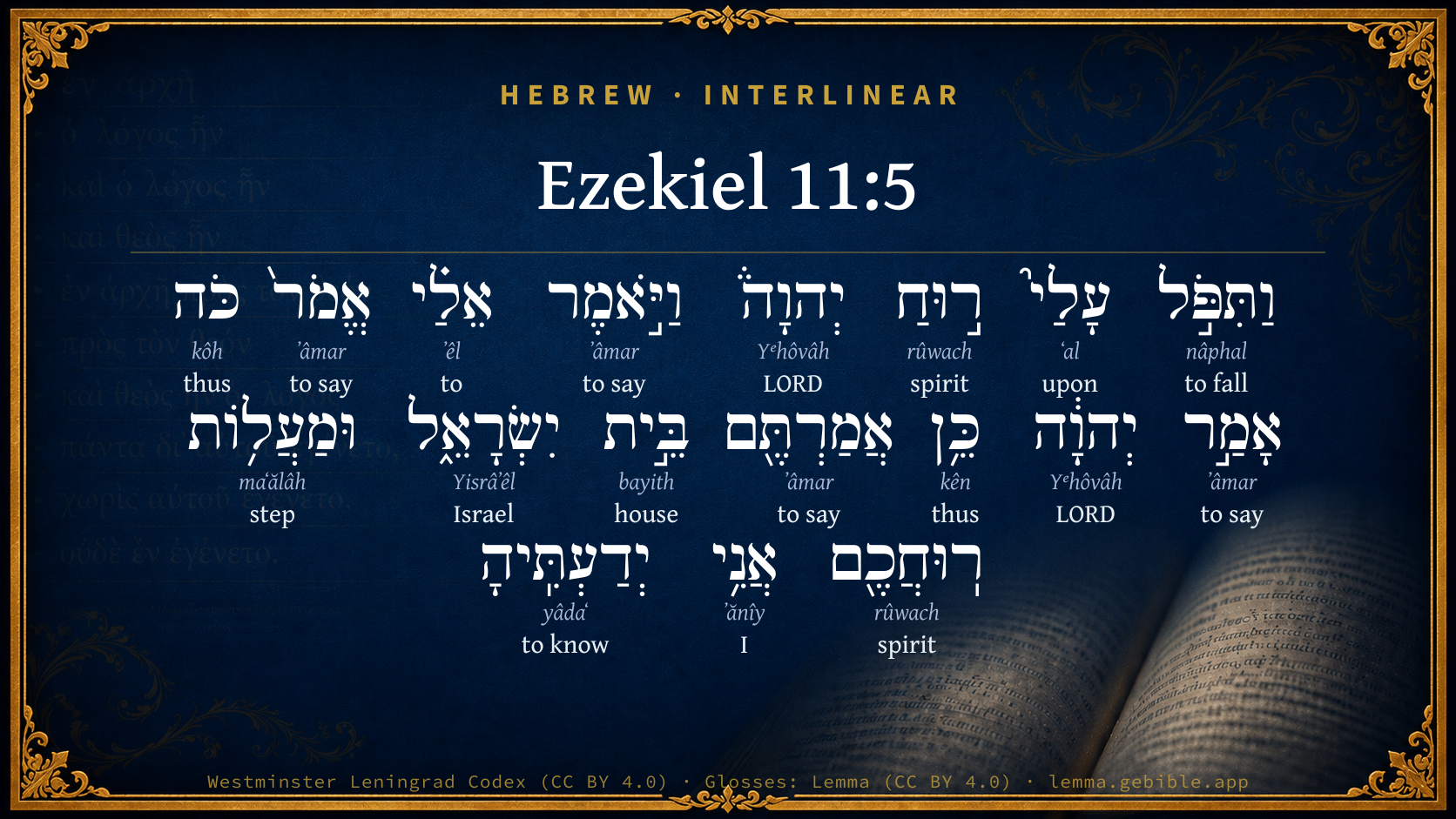
Hebrew (Westminster Leningrad Codex) Ezekiel 11:5 appears in the Hebrew Old Testament. The text above is from the Westminster Leningrad Codex. Each word links to its Strong’s number, a concise gloss, and parsing drawn from the Open Scriptures Hebrew Bible morphology. Click any word for its full Brown-Driver-Briggs (BDB) entry.
Download image
Cite this verse

Ezekiel 11:5 (World English Bible). Public Domain. Lemma interlinear Bible study tool, https://lemma.gebible.app/v/ezekiel/11/5.

Show BibTeX & RIS
BibTeX
RIS
English Translation
The Spirit of Yahweh fell on me, and he said to me, Speak, Thus says Yahweh: Thus have you said, house of Israel; for I know the things that come into your mind.
World English Bible · Public Domain
Download a study sheet

One document with this verse’s original text, its word-by-word gloss line, the meaning frame, cross-references with their text, attributed commentary, and full source and license credits — printable, and it pastes into notes with its structure intact.

This verse Autodidact and up

Study sheet (.html) Plain text (.txt)

A passage Seminary Student

Up to 50 verses in one chapter. A passage sheet keeps up to 6 commentary sources and 12 cross-references per verse, in the order this page ranks them, and says so on the sheet whenever that leaves anything out. Ask for a single verse and you get the Autodidact verse sheet above.

Everything on this page stays free to read, with no account — the sheet is a download of what is already on screen, not access to it.

Want to remove ads? Support Godless Engineer
Compare translations 3

The same verse in 3 English versions, stacked beneath the original-language interlinear above. Click any original word for its lexicon entry.

Each is an independent rendering of the whole verse — the interlinear is not word-aligned to these translations.

Highlighted words mark where these versions differ — a whole-verse word diff, not a word-by-word alignment.

  • World English Bible Public Domain
    The Spirit of Yahweh fell on me, and he said to me, Speak, Thus says Yahweh: Thus have you said, house of Israel; for I know the things that come into your mind.
  • King James Version Public Domain
    And the Spirit of the LORD fell upon me, and said unto me, Speak; Thus saith the LORD; Thus have ye said, O house of Israel: for I know the things that come into your mind, every one of them.
  • unfoldingWord Literal Text CC BY-SA 4.0
    Then the Spirit of Yahweh fell on me and he said for me to say: This is what Yahweh says, “That is what you are saying, house of Israel; for I know what goes through your mind.

unfoldingWord Literal Text — © unfoldingWord, licensed CC BY-SA 4.0. Word-aligned USFM3 via Door43 (git.door43.org/unfoldingWord/en_ult).

Versions to compare (up to 4)

3 of 4 selected

Show all 18 translations

Every available English version of this verse, each an independent rendering of the whole verse.

  • World English Bible Public Domain
    The Spirit of Yahweh fell on me, and he said to me, Speak, Thus says Yahweh: Thus have you said, house of Israel; for I know the things that come into your mind.
  • Berean Standard Bible Public Domain
    And the Spirit of the LORD fell upon me and told me to declare that this is what the LORD says: “That is what you are thinking, O house of Israel; and I know the thoughts that arise in your minds.
  • Majority Standard Bible Public Domain
    And the Spirit of the LORD fell upon me and told me to declare that this is what the LORD says: “That is what you are thinking, O house of Israel; and I know the thoughts that arise in your minds.
  • King James Version Public Domain
    And the Spirit of the LORD fell upon me, and said unto me, Speak; Thus saith the LORD; Thus have ye said, O house of Israel: for I know the things that come into your mind, every one of them.
  • American Standard Version (1901) Public Domain
    And the Spirit of Jehovah fell upon me, and he said unto me, Speak, Thus saith Jehovah: Thus have ye said, O house of Israel; for I know the things that come into your mind.
  • Revised Version (1885) Public Domain
    And the spirit of the LORD fell upon me, and he said unto me, Speak, Thus saith the LORD: Thus have ye said, O house of Israel; for I know the things that come into your mind.
  • Geneva Bible (1599) Public Domain
    And the Spirite of the Lord fell vpon me, and said vnto me, Speake, Thus saith the Lord, O ye house of Israel, this haue ye said, and I know that which riseth vp of your mindes.
  • Douay-Rheims (1899) Public Domain
    And the spirit of the Lord fell upon me, and said to me: Speak: Thus saith the Lord: Thus have you spoken, O house of Israel, for I know the thoughts of your heart.
  • Young's Literal Translation Public Domain
    And fall upon me doth the Spirit of Jehovah, and He saith unto me, `Say: Thus said Jehovah: Rightly ye have said, O house of Israel, And the steps of your spirit I have known.
  • Literal Standard Version CC BY-SA 4.0
    And [the] Spirit of YHWH falls on me, and He says to me, “Say, Thus said YHWH: You have said correctly, O house of Israel, || And I have known the steps of your spirit.
  • Unlocked Literal Bible CC BY-SA 4.0
    Then the Spirit of Yahweh fell on me and he said for me to say: This is what Yahweh says, “That is what you are saying, house of Israel; for I know what goes through your mind.
  • unfoldingWord Literal Text CC BY-SA 4.0
    Then the Spirit of Yahweh fell on me and he said for me to say: This is what Yahweh says, “That is what you are saying, house of Israel; for I know what goes through your mind.
  • Darby Bible Public Domain
    And the Spirit of Jehovah fell on me, and said unto me, Speak, Thus saith Jehovah: Thus have ye said, O house of Israel; and the things that come into your mind, I know them.
  • World Messianic Bible Public Domain
    The LORD’s Spirit fell on me, and he said to me, “Speak, ‘The LORD says: “Thus you have said, house of Israel; for I know the things that come into your mind.
  • Webster's Bible Public Domain
    And the spirit of the LORD fell upon me, and said to me, Speak; Thus saith the LORD; Thus have ye said, O house of Israel: for I know the things that come into your mind, every one of them.
  • Free Bible Version CC BY-SA 4.0
    The Spirit of the Lord came upon me and told me to say: This is what the Lord says: “People of Israel, that's what you're saying! I know what you're thinking inside!
  • Bible in Basic English Public Domain
    And the spirit of the Lord came on me, and he said to me, Say, These are the words of the Lord: This is what you have said, O children of Israel; what comes into your mind is clear to me.
  • JPS Tanakh (1917) Public Domain
    And the spirit of the LORD fell upon me, and He said unto me: 'Speak: Thus saith the LORD: Thus have ye said, O house of Israel; for I know the things that come into your mind.

Literal Standard Version (2020), Covenant Press — licensed CC BY-SA 4.0. Text via the HelloAO Bible API (eBible.org). Unlocked Literal Bible (unfoldingWord) — licensed CC BY-SA 4.0. Text via the HelloAO Bible API (eBible.org). unfoldingWord Literal Text — © unfoldingWord, licensed CC BY-SA 4.0. Word-aligned USFM3 via Door43 (git.door43.org/unfoldingWord/en_ult). Free Bible Version, Dr. Jonathan Gallagher — licensed CC BY-SA 4.0. Text via the HelloAO Bible API (eBible.org).

Word by word

More ways to search: Search by grammar → Find every occurrence → Compare this word →

Practice this passage: Drill this verse → Learn its vocabulary →

וּמַעֲל֥וֹת
maʻălâh
H4609
“and · steps of”
Conjunction + Noun, Common, Feminine, Plural, Construct
Part of Speech
Conjunction + Noun
Type
Common
Gender
Feminine
Number
Plural
State
Construct
Full BDB Definition

Origin: from H4608

TWOT: 1624 L, 1624m

what comes up, thoughts - step, stair - step, stair - steps (of sundial) - stories (of heaven) - ascent - song of ascent - to the three great pilgrim feasts (Psalm titles)
  1. וַתִּפֹּ֣ל nâphal H5307 “and · to fall” Conjunction + Verb, Qal, Sequential Imperfect, 3rd Person, Feminine, Singular
  2. עָלַי֮ ʻal H5921 “upon · me” Preposition + Suffix, Personal, 1st Person, Common, Singular
  3. ר֣וּחַ rûwach H7307 “spirit of” Noun, Common, Both, Singular, Construct
  4. יְהוָה֒ Yᵉhôvâh H3068 “LORD” Noun, Proper
  5. וַיֹּ֣אמֶר ʼâmar H559 “and · to say” Conjunction + Verb, Qal, Sequential Imperfect, 3rd Person, Masculine, Singular
  6. אֵלַ֗י ʼêl H413 “to · me” Preposition + Suffix, Personal, 1st Person, Common, Singular
  7. אֱמֹר֙ ʼâmar H559 “say” Verb, Qal, Imperative, 2nd Person, Masculine, Singular
  8. כֹּה kôh H3541 “thus” Adverb
  9. אָמַ֣ר ʼâmar H559 “to say” Verb, Qal, Perfect, 3rd Person, Masculine, Singular
  10. יְהוָ֔ה Yᵉhôvâh H3068 “LORD” Noun, Proper
  11. כֵּ֥ן kên H3651 “thus” Particle, Demonstrative
  12. אֲמַרְתֶּ֖ם ʼâmar H559 “to say” Verb, Qal, Perfect, 2nd Person, Masculine, Plural
  13. בֵּ֣ית bayith H1004 “house of” Noun, Common, Masculine, Singular, Construct
  14. יִשְׂרָאֵ֑ל Yisrâʼêl H3478 “Israel” Noun, Proper
  15. רֽוּחֲכֶ֖ם rûwach H7307 “spirit · your” Noun, Common, Both, Singular, Construct + Suffix, Personal, 2nd Person, Masculine, Plural
  16. אֲנִ֥י ʼănîy H589 “I” Pronoun, Personal, 1st Person, Common, Singular
  17. יְדַעְתִּֽיהָ yâdaʻ H3045 “to know · her” Verb, Qal, Perfect, 1st Person, Common, Singular + Suffix, Personal, 3rd Person, Feminine, Singular

About this verse

These counts appear in no published source. They are computed here, from the morphology-tagged text and Lemma’s own curated glosses. What Lemma adds →

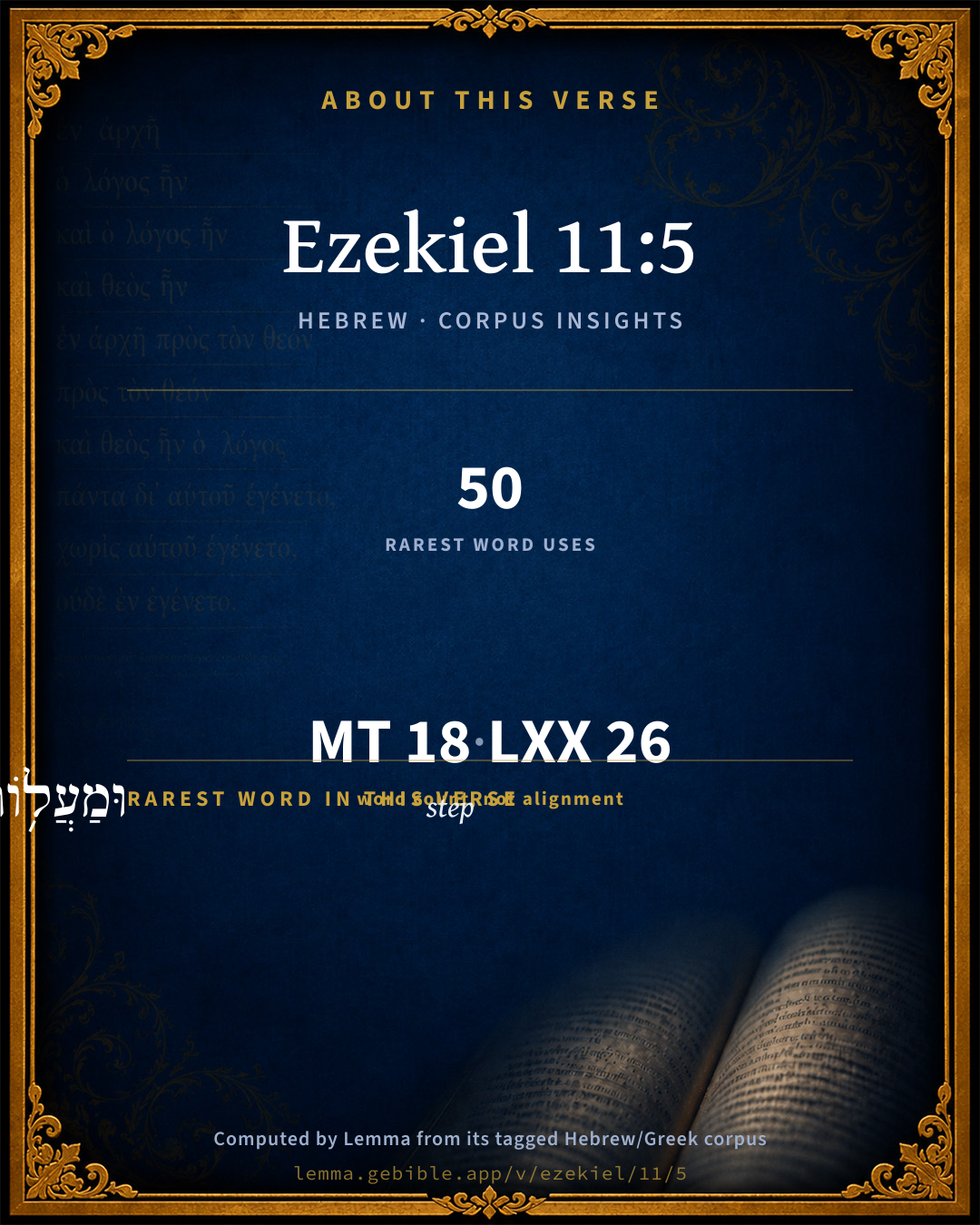
18
words
13
distinct lemmas
Prophets
section

Shared distinctive vocabulary

וּמַעֲל֥וֹת step H4609 occurs in 40 verses of the Hebrew Bible. Also found in:

Grammatical profile

  • 6 verbs
  • 7 nouns
  • 1 pronoun
  • 2 prepositions
  • 1 adverb
  • 1 particle

Verb forms

  • וַתִּפֹּ֣ל Qal · Sequential Imperfect
  • וַיֹּ֣אמֶר Qal · Sequential Imperfect
  • אֱמֹר֙ Qal · Imperative
  • אָמַ֣ר Qal · Perfect
  • אֲמַרְתֶּ֖ם Qal · Perfect
  • יְדַעְתִּֽיהָ Qal · Perfect

Repetition

Words recur within this verse — often emphatic in Hebrew:

  • וַיֹּ֣אמֶר to say H559 ×4
  • ר֣וּחַ spirit H7307 ×2
  • יְהוָה֒ LORD H3068 ×2

Hebrew & Septuagint length

In English translation the verse runs 33 words from the Hebrew and 34 from the Septuagint (LXX English) — closely comparable.

A rough comparison of the two English renderings, which tokenize alike — not a word-level alignment.

Word counts can differ between the Hebrew and the Greek without any difference in meaning — e.g. the Hebrew direct-object marker אֵת has no separate Greek word, and Greek often adds the article ὁ.

In the original languages it is 18 Hebrew tokens and 26 Greek tokens — but the two are counted differently (Hebrew bundles its prefixes and suffixes into one token; the Greek is in lemma form), so that isn’t a like-for-like length.

Cross-references

31

Topical passages linked to Ezekiel 11:5 in the Treasury of Scripture Knowledge — connected by theme and wording, ordered by reader-vote popularity; previews shown in the World English Bible.

  • Jeremiah 17:10 I, Yahweh, search the mind, I try the heart, even to give every man according to his ways, according to the fruit of his doings.
  • Jeremiah 16:17 For my eyes are on all their ways; they are not hidden from my face, neither is their iniquity concealed from my eyes.
  • Ezekiel 2:2 The Spirit entered into me when he spoke to me, and set me on my feet; and I heard him who spoke to me.
  • Revelation 2:23 I will kill her children with Death, and all the assemblies will know that I am he who searches the minds and hearts. I will give to each one of you according to your deeds.
  • Numbers 11:25–26 Yahweh came down in the cloud, and spoke to him, and took of the Spirit that was on him, and put it on the seventy elders: and it happened that when the Spirit rested on them, they prophesied, but they did so no more.
  • 1 Samuel 10:6 and the Spirit of Yahweh will come mightily on you, and you shall prophesy with them, and shall be turned into another man.
  • 1 Samuel 10:10 When they came there to the hill, behold, a band of prophets met him; and the Spirit of God came mightily on him, and he prophesied among them.
  • 1 Chronicles 28:9 You, Solomon my son, know the God of your father, and serve him with a perfect heart and with a willing mind; for Yahweh searches all hearts, and understands all the imaginations of the thoughts: if you seek him, he will be found of you; but if you forsake him, he will cast you off forever.
  • Psalms 7:9 Oh let the wickedness of the wicked come to an end, But establish the righteous; Their minds and hearts are searched by the righteous God.
  • Psalms 50:21 You have done these things, and I kept silent. You thought that the "I AM" was just like you. I will rebuke you, and accuse you in front of your eyes.
  • Psalms 139:2–3 You know my sitting down and my rising up. You perceive my thoughts from afar.
  • Isaiah 28:15 Because you have said, We have made a covenant with death, and with Sheol are we at agreement; when the overflowing scourge shall pass through, it shall not come to us; for we have made lies our refuge, and under falsehood have we hid ourselves:
  • Isaiah 58:1 Cry aloud, don't spare, lift up your voice like a trumpet, and declare to my people their disobedience, and to the house of Jacob their sins.
  • Ezekiel 2:4–5 The children are impudent and stiff-hearted: I do sent you to them; and you shall tell them, Thus says the Lord Yahweh.
  • Ezekiel 2:7 You shall speak my words to them, whether they will hear, or whether they will forbear; for they are most rebellious.
  • Ezekiel 3:11 Go, get you to them of the captivity, to the children of your people, and speak to them, and tell them, Thus says the Lord Yahweh; whether they will hear, or whether they will forbear.
  • Ezekiel 3:24 Then the Spirit entered into me, and set me on my feet; and he spoke with me, and said to me, Go, shut yourself within your house.
  • Ezekiel 3:27 But when I speak with you, I will open your mouth, and you shall tell them, Thus says the Lord Yahweh: He who hears, let him hear; and he who forbears, let him forbear: for they are a rebellious house.
  • Ezekiel 8:1 It happened in the sixth year, in the sixth [month], in the fifth [day] of the month, as I sat in my house, and the elders of Judah sat before me, that the hand of the Lord Yahweh fell there on me.
  • Ezekiel 28:2 Son of man, tell the prince of Tyre, Thus says the Lord Yahweh: Because your heart is lifted up, and you have said, I am a god, I sit in the seat of God, in the midst of the seas; yet you are man, and not God, though you did set your heart as the heart of God;-
  • Ezekiel 29:3 speak, and say, Thus says the Lord Yahweh: Behold, I am against you, Pharaoh king of Egypt, the great monster that lies in the midst of his rivers, that has said, My river is my own, and I have made it for myself.
  • Ezekiel 38:10–11 Thus says the Lord Yahweh: It shall happen in that day, that things shall come into your mind, and you shall devise an evil device:
  • Malachi 3:13–14 "Your words have been stout against me," says Yahweh. "Yet you say, 'What have we spoken against you?'
  • Hebrews 4:13 There is no creature that is hidden from his sight, but all things are naked and laid open before the eyes of him with whom we have to do.
  • Mark 2:8 Immediately Jesus, perceiving in his spirit that they so reasoned within themselves, said to them, "Why do you reason these things in your hearts?
  • Mark 3:22–30 The scribes who came down from Jerusalem said, "He has Beelzebul," and, "By the prince of the demons he casts out the demons."
  • John 2:24–25 But Jesus didn't trust himself to them, because he knew everyone,
  • John 21:17 He said to him the third time, "Simon, son of Jonah, do you have affection for me?" Peter was grieved because he asked him the third time, "Do you have affection for me?" He said to him, "Lord, you know everything. You know that I have affection for you." Jesus said to him, "Feed my sheep.
  • Acts 10:44 While Peter was still speaking these words, the Holy Spirit fell on all those who heard the word.
  • Acts 11:15 As I began to speak, the Holy Spirit fell on them, even as on us at the beginning.
  • James 3:6 And the tongue is a fire. The world of iniquity among our members is the tongue, which defiles the whole body, and sets on fire the course of nature, and is set on fire by Gehenna.

Cross-references courtesy of OpenBible.info (CC BY 4.0).

Hebrew and Greek witnesses Masoretic Hebrew ↔ Greek Septuagint

The same verse in the two great witnesses to the Old Testament, shown verse-for-verse.

These are two independent witnesses, not word-aligned to each other, and the Septuagint is shown in lemma (dictionary) form.

Hebrew Ezekiel 11:5 Masoretic · Westminster Leningrad Codex

וַתִּפֹּ֣ל עָלַי֮ ר֣וּחַ יְהוָה֒ וַיֹּ֣אמֶר אֵלַ֗י אֱמֹר֙ כֹּה אָמַ֣ר יְהוָ֔ה כֵּ֥ן אֲמַרְתֶּ֖ם בֵּ֣ית יִשְׂרָאֵ֑ל וּמַעֲל֥וֹת רֽוּחֲכֶ֖ם אֲנִ֥י יְדַעְתִּֽיהָ

The Spirit of Yahweh fell on me, and he said to me, Speak, Thus says Yahweh: Thus have you said, house of Israel; for I know the things that come into your mind.

World English Bible · Public Domain

Greek LXX Ezekiel 11:5 Septuagint · lemma form

καί πίπτω ἐπί ἐγώ πνεῦμα κύριος καί εἶπον πρός ἐγώ λέγω ὅδε λέγω κύριος οὕτως εἶπον οἶκος ἰσραήλ καί ὁ διαβούλιον ὁ πνεῦμα σύ ἐγώ ἐπιἵστημι

And the Spirit of the Lord fell upon me, and said to me, say; Thus says the Lord; Thus have you⌃ said, O house of Israel: and I know the devices of your spirit.

LXX2012 (modern English Septuagint) · Public Domain

Hebrew: Westminster Leningrad Codex (CC BY 4.0). Greek: Septuagint (public domain); English from LXX2012 (modern English Septuagint) (Public Domain). How the Septuagint differs from the Hebrew →

Targum (Aramaic paraphrase)

1

The Targum is the ancient Jewish Aramaic paraphrase of the Hebrew Scriptures — an interpretive translation, not the Hebrew text itself. Onkelos (literal) and Pseudo-Jonathan (expansive) render the Torah, and Jonathan the Prophets. Coverage is partial: where no permissively-licensed English translation exists for a verse, only the Aramaic is shown. This is verse-level text, not a word-by-word alignment to the Hebrew.

  1. Targum Jonathan Prophets (Joshua–Malachi)
    וּשְׁרַת עֲלֵי רוּחַ נְבוּאָה מִן קֳדָם יְיָ וַאֲמַר לִי אֱמַר כִּדְנַן אֲמַר יְיָ כֵּן אֲמַרְתּוּן בֵּית יִשְׂרָאֵל וְדִי אַתּוּן מְהַרְהֲרִין וְדִסְלִיקַת עַל לִבְּכוֹן קֳדָמַי גְלַן:

    (no public-domain English translation for this verse)

    Targum Jonathan — Aramaic: “Mikraot Gedolot” (public domain). English: “Sefaria Community Translation” (CC0 1.0 (public-domain dedication)); “London "Chaldee Paraphrase," 1871” (public domain). Text via Sefaria.

Commentary

Notes on Ezekiel 11:5 from classic Christian and Jewish commentators (each source and its license shown beneath its notes). The classic Christian expositions comment on the surrounding passage and are grouped to its opening verse, so a note may address several verses; the Jewish commentaries on the Tanakh (Rashi and others) are per-verse, so they appear only where the commentator wrote on this verse.

Lemma curates 59 commentaries, every one of them public domain or Creative Commons licensed, each selected and text-cleaned for this edition rather than reprinted as found. About our sources →

Trapp's Complete Commentary

John Trapp

Eze 11:5 And the Spirit of the LORD fell upon me, and said unto me, Speak; Thus saith the LORD; Thus have ye said, O house of Israel: for I know the things that come into your mind, [every one of] them.

Ver. 5. And the Spirit of the Lord fell upon me.] Et irruit in me Spiritus Iehovae; with force and power. It was a mighty lapse from a God much offended.

Thus have ye said.] As Eze 11:3; but better ye had held your peace. Or, Thus have ye thought, and as good ye might have spake out.

For I know the things that came into your mind.] Heb., And the ascensions of your spirit, I know it; i.e., I know them every one, as if they had all been but one. I understand your ironies, your sly jeers and will deal with you accordingly. See Luk 24:38 Deu 31:21.

John Trapp, A Commentary or Exposition upon All the Books of the Old and New Testament (1647–1656) — public domain. Text from a community e-Sword module.

The Biblical Illustrator

Joseph S. Exell

Eze_11:5

I know the things that come into your mind, every one of them.

Gods knowledge of human thought

The union of omniscience with sympathy, Of active cognisance of human thoughts with infinite mercy, is expressed in Heb_4:12-16. There are no reflections more interesting than those connected with the Divine knowledge of man. Our duty is to ponder all this fact includes. The instinct of the Divine love must be the very strongest feeling in us all; because it never occurs to anyone that Gods knowledge of our thoughts can prevent the outflow of His love, or the reality of His fellowship. Yet if anyone else were acquainted with us, with everything that comes into our minds, we should certainly incur his hate and contempt. I believe, therefore, that the instinct of Gods love towards us is like that of parental love, a great original attribute of humanity which sin has grievously obscured, so that in the minds of thousands it has been utterly subverted, and God has appeared as a vindictive tyrant, requiring to be appeased with human blood. But the purpose of the Gospel is to assure us that God is love; and the inclination to make Him the depository of every secret is grounded on that instinct, Which the fall has not been able to extinguish--that He who knows us best, loves us most. What a strong interest He must feel in people, to take active cognisance of everything that comes into their minds! God takes the deepest interest in the thoughts of the weakest the commonest, and the most selfish, when their thoughts must be repulsive, hateful, and abominable to Him; He searches into them, and sends messengers to assure us that He is not indifferent to the thoughts of His creatures. The mind of man is the greatest and most wonderful product of the Almighty. It is the nearest approach to the Divine--it is the Divine image. This is His chief work. We are warranted in concluding that, next to God our Saviour, the greatest thing in the universe is a mans mind, and that this is the reason why the Maker looks narrowly at everything that comes into it. The mind is the sphere of the Divine government, where the sovereign Ruler displays His great wisdom, holiness, and truth. Because man can obey and love, can feel responsibility, sense of duty, sense of sin, therefore he is the subject of rule. It is in ruling men that the highest qualities are always displayed. Here righteousness, the highest of all things, can be expressed. We cannot conceive of God showing His righteousness unless He had subjects like ourselves to govern. For it is through opposition, ignorance, injustice, selfishness, want, that righteousness in a ruler comes to be felt and admired. Where there is no wrong, how could we see the right? Mind in opposition to God shows us His holy mind. The mind is the sphere of Divine rule, and it is the seat of rebellion. And the righteous government of heaven is exercised to restore this chief of Gods works to loyalty. In man, the metropolis of the universe is in revolt. This is the reason why He who is our Lord and God would have us assured that He knows the things that come into our mind, every one of them. To give the history of His knowledge and purpose to conciliate the mind of His subject is to give the history of the Bible. The great crowning act of His righteous rule is She mission of His Son. This shows His purpose--to reconcile; not to vanquish, destroy, condemn, but to persuade; to carry our convictions--to constrain our minds. In sending His Son, I think we have a right to conclude that the business of reconstituting the spirit of man is the first and greatest thought of God, in which His wisdom and power are most of all put forth. Here is the depth of the riches both of the wisdom and knowledge of God! Then let us learn to look on the operations of our minds with the aid of these truths. Nothing can be insignificant that comes into your mind, if God takes knowledge of it. Passing thoughts that come and go--love and hate--passion and regret--reverence and hope--conviction and prayer--the thought of God--the thought of your child--if they are watched and scanned by Him, can we be indifferent to them? (B. Kent, M. A.)

The Biblical Illustrator, edited by Joseph S. Exell (c. 1880s–1900s) — public domain. Text from a community e-Sword module.

Jamieson, Fausset & Brown

Robert Jamieson, A. R. Fausset & David Brown

Spirit . . . fell upon me--stronger than "entered into me" (Eze 2:2; Eze 3:24), implying the zeal of the Spirit of God roused to immediate indignation at the contempt of God shown by the scorners.

I know-- (Psa 139:1-4). Your scornful jests at My word escape not My notice.

Jamieson, Fausset & Brown — Commentary Critical and Explanatory on the Whole Bible (1871) — public domain (CC PDM 1.0). Text via the HelloAO Bible API.

John Calvin's Commentaries

Here the Prophet turns the impious scurrility of the people into another sense, for they had corrupted what Jeremiah had said. They knew what he meant by the pot and the flesh, but they thought they could avert God’s wrath by their cleverness. Here the Prophet brings forward another sense, not that of Jeremiah, nor that of the people, but a third. In the twenty-fourth chapter he will again denounce them as like flesh, since God will cast them into a pot to be cooked, so that even their bones should be consumed. But here the Prophet only considers how he shall refute their wicked saying, by which they think to catch Jeremiah in a snare, as they did not agree sufficiently with his prophecy. What does he say, then? First, that the Spirit had fallen upon, him, that he might gain a hearing for his prophecy; for if he had spoken from his own mind he might be rejected with impunity; for the speakers ought to utter God’s word, and to be the organ of his Spirit. The Pope boasts this to his followers, but the true and faithful servants of God ought to do this in reality, namely, not to utter their own comments, but to receive from God’s hands what they deliver to the people, and thus to discharge their duty faithfully. To this end the Prophet says, that the Spirit fell upon him. For although he had been previously endued with the gift of prophecy, yet as often as he exercised it this grace ought, to be renewed; because it is not sufficient for us to be imbued once with the illumination of the Holy Spirit, unless God works in us daily. Since, therefore, he follows up his gifts in his servants while he uses their assistance, hence it is not in vain that Ezekiel says, the Spirit was still given to him, because this gift was necessary for every act. Afterward she expresses more dearly what he had said, namely, that the Spirit had spoken; for it signifies that what he shortly subjoins had been dictated to him.

Here, therefore, he admonishes the Jews that they should not foolishly promise themselves impunity, when they despised his prophecies, since he does not speak from himself, but only relates what the Spirit suggested and dictated. Thus have ye spoken, O house of Israel, said he, and I have known the risings of your heart God here precisely urges the Jews that they should not hope to obtain anything by turning their backs; for we know how carelessly and boldly hypocrites reject all teaching, and do not hesitate to strive with God, since they find many pretexts by which they excuse themselves. Hence there would be no end, unless the Lord should racet them, and with the supreme command and power of a judge, should show them that subterfuges were vain, and make all their excuses idle, and of no moment. This then is the Prophet’s meaning when he says, that whatever rose up in their heart was known to God But by these words he implies, that they sought in vain a theater in the world, as if they should succeed if they proved their cause before men: he says that it is vain, because they must come into the court of heaven, where God will be the only Judge. Now, when our thoughts are known to God, in vain we take up with this or that; because God will not admit our subterfuges, nor will he allow himself to be deluded by our smartness and cunning. Now, therefore, we see what the Prophet means by saying that God knows what sprang up in the heart of the Jews, because, forsooth, they had never desisted from contending and quarreling by their fallacies, so as to draw away all confidence from his prophecies. Hence we see the utility of the doctrine, that we deceive ourselves in vain by acuteness, so as to escape by our crooked imaginations, because God sees men’s cunning, and while they desire to be ingenious, he seizes them, and shows the vanity of what they think the greatest wisdom. So let us desire to approve ourselves to God, and not esteem our deeds and plans according to our own sense and judgment. Now it follows —

John Calvin's Commentaries (1540-1563) — public domain. Text from the Calvin Translation Society English edition (1840s-50s) via the Christian Classics Ethereal Library (ccel.org). Calvin's coverage is partial (roughly two-thirds of the Bible); uncommented books and verses are honest gaps, never fabricated. The 19th-century editor's footnotes and remarks are omitted so the notes are faithfully Calvin's own voice.

The Cambridge Bible for Schools and Colleges

gen. ed. J. J. S. Perowne

5. things that come into your mind] i.e. your projects. Apparently as yet the rebellion was no more than a plan which was being hatched.

The Cambridge Bible for Schools and Colleges (gen. ed. J. J. S. Perowne; Cambridge University Press, 1878–1918) — public domain. Text from a community e-Sword module.

John Gill's Exposition

And the spirit of the Lord fell upon me,.... In an extraordinary manner, and afresh, and enlightened his mind, and showed him things that should come to pass; and filled him with boldness and courage to declare them. The Targum interprets it of the spirit of prophecy:

and said unto me, speak; what I shall show and put into thy mouth, that speak out; be not afraid, but boldly declare all that I give thee in commission to say:

thus saith the Lord, thus have ye said, O house of Israel; as in Eze 11:3; which perhaps was said in secret, and spoken privately, but known by the Lord; and it was not only the princes that said it, but the whole body of the people joined in with it, and agreed to it; though it is very probable they were influenced by the former:

for I know the things that come into your mind, everyone of them; not only their scoffing words, but the thoughts of their hearts; not one of them escaped the knowledge of God; the consideration of which should command an awe on men, and engage them to a watchfulness over their thoughts, words, and actions.

John Gill's Exposition of the Whole Bible (1746–1763) — public domain (CC PDM 1.0). Text via the HelloAO Bible API.

Matthew Poole's English Annotations

The Spirit of prophecy again moved him, which is here called the Spirit of the Lord, or, the Spirit the Lord, as the Hebrew will bear.

Fell upon me; descended, by its own act powerfully, sweetly, and prevailingly entered the man.

Said unto me; inclined me, that I could not but speak.

Thus saith the Lord; as thou goest by my appointment, so be sure to use my name and authority.

Thus have ye said; profanely, with scoffs, as hath been reported, Eze 11:3.

I know the things that come into your mind; ye may be assured all that ariseth up in your mind is known to me. I see each one of the imaginations of your mind so soon as ever they peep up in your heart. Your thoughts I know afar off, Psa 139:2.

Matthew Poole's English Annotations on the Holy Bible (1683–1685) — public domain. Text from a community e-Sword/MySword module.

Whedon's Commentary on the Bible

Daniel D. Whedon

5. I know the things that come into your mind — The plots they are hatching are known to Jehovah and to his prophets. These whisperings of rebellion against Babylon and of alliance with Egypt are no longer secrets.

Daniel D. Whedon (gen. ed.), Commentary on the Old and New Testaments (1874–1909) — public domain. Text from a community e-Sword module.

The Pulpit Commentary

God"s knowledge of man"s thought.

I THE FACT. We know a few men; God knows all. None are so obscure, or remote, or secretive as to hide from him. We know the exterior life; God knows the life within every thought, and wish, and dream, and fancy. We know in part and with many obscurities, having to piece together scattered hints, and possibly Falling into great blunders in our estimation of our neighbours. God knows completely and without possibility of error, searching into the deep secrets of the heart, not setting down aught in malice, but also not blinded to sad truths by the partiality of an imperfect love.

1. God knows our ideas. He sees when we are in error, observes the crooked course of our ill-trained thinking, and notes the narrowness of our notions. He also knows the true thought which is not understood by our fellow men.

2. He knows our desires. If he does not grant them, it is not because he is ignorant of them. Before a prayer is out of our lips the wish of it has reached the mind of God. When we cannot find words to express the longing of our souls, those vague, dumb desires are exactly measured and fully comprehended by God. God knows our evil desires, the wicked wishes that have not yet found vent in wicked deeds.

3. He knows our sorrows. Though the heart only knoweth its own bitterness among men, the sympathetic knowledge of God has gauged it to the bottom. No one can say, "My grief is quite beyond comprehension." No one can be utterly misunderstood. Misjudged by man, the martyr is known to God.

4. God knows our sin. There is no secret place where a deed of wrong can be done without the eye of God seeing it. Abel is murdered in the field, but still his blood cries to God for vengeance.

II ITS CONSEQUENCES.

1. Hypocrisy is a mistake. It only hides our shame from the less important spectators, while the all-seeing eye of God regards it as an addition to the guilt which lurks beneath.

2. Postponement of punishment is no guarantee for escape. The criminal who is not caught red-handed hopes that he will now elude the vigilance of the ministers of justice, and the longer he remains undetected the more confident does he grow in the assurance that he will never be caught, until long years of immunity almost beget a feeling of innocence. But if God knows all, there is no escape from his anger behind the obscuring growth of years.

3. God"s long suffering is manifest. The heathen might say, "My God does not strike me, because he has not discovered my offence." But when the omniscience of God is admitted, his forbearance is seen to be a wonder of patience and love. He knows all, and yet he is still ready to pardon, still waiting to be gracious, nay, even still heaping upon his sinful children many favours!

4. There is hope of salvation. If our escape lay only in our concealment of guilt, there would always be a danger of ruin through discovery. The criminal who has no better hope than this is standing on thin ice. But now we see that God knows the worst of us, and yet offers pardon and reconciliation through the gift of his Son, we have the greatest encouragement to accept his grace. Moreover, since he knows our troubles, hopes, fears, aspirations, and difficulties, he can send the exact help we need.

Divine omniscience.

Among the many elements of that superiority which is distinctive of monotheism over polytheism must be noted the perfect knowledge which the one God possesses of all the creatures whom he has made. Men who believe in the "gods many" of the heathen have not, and cannot have, that constant sense of the Divine omniscience which must exercise so signal an influence for good over the worshipper of the Supreme.

I THE REASONABLENESS OF THIS DOCTRINE. We attribute to the Deity infinite perfection; and this is not consistent with the limitation of his knowledge. It is absurd to suppose that he who has made the mind of man has lost the power of recognizing the thoughts and intents of the heart which he fashioned by his power and wisdom. There is no part of his universe in which God is not present. Much more evidence is it that the Father of the spirits of all flesh is in possession of every secret of the intellectual and spiritual nature of man.

II THE FORGETFULNESS OF THIS DOCTRINE. It is evident that the inhabitants of Jerusalem, and especially the false teachers and evil counsellors in the city, lost sight of this great truth. God was not in all their thoughts. It may net have occurred to them, as they pursued their selfish plans and lived their irreligious life, that every purpose and hope was known to the Divine Lord and Judge. "All things are naked and opened to the eyes of him with whom we haw to do.

III THE TERROR WHICH THIS DOCTRINE SHOULD HAVE FOR EVIL DOERS WHO ARE REMINDED OF IT. God knows the wicked things that come into men"s minds and are encouraged to abide there the injustice, the covetousness, the falsehood, the impurity, the cruelty, the hatred, the malevolence, which are distinctive of those who depart from God. Such qualities, even before they find expression in word and act, are repugnant to the nature of the just and holy God. And he is not simply an observer; he is a Judge. He disapproves and condemns thoughts, sentiments, and purposes which are in opposition to his own laws, to his own character. He has revealed his intention to bring men into judgment for all their conduct, and forevery secret thing, good or bad. From this reckoning with the Judge of all there is no escape. The prospect may well strike the impenitent sinner with dismay.

IV THE DISSUASIVE POWER WHICH THIS DOCTRINE SHOULD EXERCISE OVER THOSE WHO ARE HESITATING WHETHER OR NOT TO YIELD TO TEMPTATION. In order to resist temptation to sin, it is not enough to guard our actions, to order aright our circumstances and associations. It is in the mind that the real battle must be fought. And upon this battlefield, what auxiliary is so potent and effectual as the remembrance of the Lord"s omniscience? He is with us to assist us in the regulation of our thoughts and desires; for he knows alike the force of temptation, and the sincerity of our endeavour to check and to overcome it.

V THE WELCOME GIVEN BY GOD"S PEOPLE TO THIS DOCTRINE. The same truth is a joy and consolation to the Christian, which the ungodly man finds an occasion of distress and dread. Why is this? It is because God has in Christ made himself known to his heart as his Friend and Father. Thus openness and confidence and holy intimacy prevail between the Christian and his God. The faithful servant of God knows his infirmities and his faults, and he is grateful to be assured that those are known to his Father in heaven, who will deal leniently and compassionately with them, and will assist him in overcoming them. God knows the aspirations and endeavours of his own children, is interested in every effort to attain to a fuller knowledge of himself, and a more constant and practical subjection to his will. In Psalm 139, the feelings of the good man, conscious of the Divine omniscience, find a full and most poetical and fervent expression, There is nothing which such a man would wish to hide from such a Friend. T.

God"s knowledge of our thoughts.

know the things that come into your mind, every one of them." Hengstenberg translates, "And that which riseth up in your mind I know." The fact thus stated is

I Most REASONABLE.

1. From the nature of God. Grant that God is infinite, and the statement of our text must be true. Nothing can be so great as to overmatch his comprehension; nothing so small as to escape his notice. Our Lord declared the Divine interest in the smallest and lowliest things. (Mat_6:26-30 Mat_10:29, Mat_10:30) It is unphilosophical to think that even the smallest thing is in any way unknown to him. It is limiting his knowledge.

2. From the nature of the human mind.

(1) It is the most wonderful creation of God. Man can reflect, reason, anticipate, imagine. "God created man in his own image, in the image of God created he him." We have reason, conscience, affection, adoration. The greatness of the human mind appears very clearly when we consider its achievements. Mention some of them. Its capacity and impulse for progress also indicate its greatness. "It never rests, it has never attained, it is never perfect. Its law is progress. A point which yesterday was invisible is its goal today, and will be its starting post tomorrow.

(2) It is the sphere of the most wonderful operations. We see much of God in his operations in matter; e.g. power, wisdom, constancy. We see more of him in his operations in mind; e.g. more marvellous power, profounder wisdom, richer goodness. In the government of mind the righteousness, truth, and love of God are manifested. We see most of God in his dealings with sinful, disordered minds. The sin of man occasioned the most glorious display of the Divine mind and will. We see the wisdom and love of God in his method of reconciling, saving, lost men as they were never manifested before. I do not wonder, then, that God knows everything that arises in our mind, for our mind is his most wonderful creation, and his most wonderful creation disorganized, ruined; and he is engaged in saving it. How deep must be his interest in it!

II Most WONDERFUL. Not because of anything in God as a difficulty or hindrance to this vast and minute knowledge; but:

1. Because of the intellectual quality of" the things that come into our mind. How insignificant, trifling, vain, many of them are! How few really great thoughts ever rise in our mind! We know how trying it is to be compelled to listen to the trivial talk of an ill-furnished mind; to hear all the paltry details of matters in which we have no interest or concern. Yet God knows all our petty, trifling, vain thoughts. Not one of them escapes him. How wonderful!

2. Because of the moral quality of "the things that come into our mind. Not only are many of our thoughts insignificant and trifling, many are also mean, corrupt, and sinful. It is painful to become acquainted with the ungenerous or base thoughts and feelings of another"s mind and heart. We shrink with loathing from the contemplation of the malicious or cruel designs of any one. In our own selves there is much that we would not that any one should gaze upon, or any mind know, so deeply are we ashamed of it. Yet God knows every dark thought and guilty memory; we can hide nothing from him. He regards all sinful thoughts and feelings with unutterable hatred; yet he knows them every one. But while hating our sin with unappeasable hatred, he loves us with unspeakable love. He looks at our thoughts and weighs them, because they are ours, and he would save us from the vain and sinful ones, and inspire and strengthen within us the wise and good ones. His love for us is as great as his knowledge of us, and leads him to interest himself in all that concerns us.

III MOST ADMONITORY.

1. No thoughts are unimportant. Since the Lord takes knowledge of, and is so deeply interested in, all that arises in our mind, nothing there can be trivial. You think that your foolish or vain thoughts are of no importance; that they are not like words or actions which affect others: that thoughts influence no one so long as they remain unexpressed. But your thoughts give tone and colour to your mind and character. To a great extent they arise out of your character, and they react upon your character according to your treatment of them. If you foster the impure thought, it will make you more impure; if you entertain the trivial thought, it will increase your triviality. Your mind is God"s temple. Should you not take heed how you treat it?

2. All our thoughts should be such as he approves. They should be:

(1) True. He exhorts us to "buy the truth, and sell it not;" to "prove all things; hold fast that which is good." He is himself the "God of truth." Jesus Christ is "the Truth." We should cultivate the true in thought in every department of knowledge and of life. Endeavour to think only those thoughts which accord with the reality of things. Be true.

(2) Pure. Shun with loathing the unchaste desire or impure feeling. You cannot prevent the low or foul suggestion; but you are free to welcome such suggestion, or to shrink from it with repugnance. Welcome it, and it will corrupt you. Resist it, and it cannot contaminate you. If you would be free from impure thoughts, you will gain your end most swiftly and surely by cultivating pure and beautiful ones. If your thoughts be true and pure, God will smile approval, etc. Be pure.

(3) Earnest. Let not your true and holy thoughts be dreamy, visionary, impractical. We are in a world of toil and trial, sin and sorrow, sickness and death, a world that cries for help; and God demands earnest thought with a view to noble life and work.

CONCLUSION.

1. Here is warning to the wicked. God knows all your life and thought. You cannot hide anything from him. (cf Job_34:21, Job_34:22; Psa_139:1-6; Heb_4:13) And he who knows us will also judge us. "Cleanse thou me from secret faults." "The blood of Jesus Christ cleanseth us from all sin.

2. Here is encouragement to the good. God knows your thoughts, devices, purposes, motives. lie never misunderstands you. If, like Job, you are misjudged by man, you may say with him, "But he knoweth the way that I take." Therefore be encouraged. W.J.

The Pulpit Commentary (1880–1919), ed. H.D.M. Spence-Jones & Joseph S. Exell — public domain. Text from a community e-Sword module.

Keil & Delitzsch

C. F. Keil & F. Delitzsch

And the Spirit of Jehovah fell upon me, and said to me: Say, Thus saith Jehovah, So ye say, O house of Israel, and what riseth up in your spirit, that I know. Eze 11:6. Ye have increased your slain in this city, and filled its streets with slain. Eze 11:7. Therefore, thus saith the Lord Jehovah, Your slain, whom ye have laid in the midst of it, they are the flesh, and it is the pot; but men will lead you out of it. Eze 11:8. The sword you fear; but the sword shall I bring upon you, is the saying of the Lord Jehovah. Eze 11:9. I shall lead you out of it and give you into the hand of foreigners, and shall execute judgments upon you. Eze 11:10. By the sword shall ye fall: on the frontier of Israel shall I judge you; and ye shall learn that I am Jehovah. Eze 11:11. It shall not be as a pot to you, so that you should be flesh therein: on the frontier of Israel shall I judge. Eze 11:12. And ye shall learn that I am Jehovah, in whose statutes ye have not walked, and my judgments ye have not done, but have acted according to the judgments of the heathen who are round about you. - For תּפּל עלי , compare Eze 8:1. Instead of the "hand" (Eze 8:1), the Spirit of Jehovah is mentioned here; because what follows is simply a divine inspiration, and there is no action connected with it. The words of God are directed against the "house of Israel,' whose words and thoughts are discerned by God, because the twenty-five men are the leaders and counsellors of the nation. מעלות, thoughts, suggestions of the mind, may be explained from the phrase עלה על לב, to come into the mind. Their actions furnish the proof of the evil suggestions of their heart. They have filled the city with slain; not "turned the streets of the city into a battle-field," however, by bringing about the capture of Jerusalem in the time of Jeconiah, as Hitzig would explain it. The words are to be understood in a much more general sense, as signifying murder, in both the coarser and the more refined signification of the word.

(Note: Calvin has given the correct explanation, thus: "He does not mean that men had been openly assassinated in the streets of Jerusalem; but under this form of speech he embraces all kinds of injustice. For we know that all who oppressed the poor, deprived men of their possessions, or shed innocent blood, were regarded as murderers in the sight of God.")

מלּאתים is a copyist's error for מלּאתם. Those who have been murdered by you are the flesh in the caldron (Eze 11:7). Ezekiel gives them back their own words, as words which contain an undoubted truth, but in a different sense from that in which they have used them. By their bloodshed they have made the city into a pot in which the flesh of the slain is pickled. Only in this sense is Jerusalem a pot for them; not a pot to protect the flesh from burning while cooking, but a pot into which the flesh of the slaughtered is thrown. Yet even in this sense will Jerusalem not serve as a pot to these worthless counsellors (Eze 11:11). They will lead you out of the city (הוציא, in Eze 11:7, is the 3rd pers. sing. with an indefinite subject). The sword which ye fear, and from which this city is to protect you, will come upon you, and cut you down - not in Jerusalem, but on the frontier of Israel. על־גּבוּל, in Eze 11:10, cannot be taken in the sense of "away over the frontier," as Kliefoth proposes; if only because of the synonym אל־גּבוּל in Eze 11:11. This threat was literally fulfilled in the bloody scenes at Riblah (Jer 52:24-27). It is not therefore a vaticinium ex eventu, but contains the general thought, that the wicked who boasted of security in Jerusalem or in the land of Israel as a whole, but were to be led out of the land, and judged outside. This threat intensifies the punishment, as Calvin has already shown.

(Note: "He threatens a double punishment; first, that God will cast them out of Jerusalem, in which they delight, and where they say that they will still make their abode for a long time to come, so that exile may be the first punishment. He then adds, secondly, that He will not be content with exile, but will send a severer punishment, after they have been cast out, and both home and land have spued them out as a stench which they could not bear. I will judge you at the frontier of Israel, i.e., outside the holy land, so that when one curse shall have become manifest in exile, a severer and more formidable punishment shall still await you.")

In Eze 11:11 the negation (לא) of the first clause is to be supplied in the second, as, for example, in Deu 33:6. For Eze 11:12, compare the remarks on Eze 5:7. The truth and the power of this word are demonstrated at once by what is related in the following verse.

Keil & Delitzsch — Biblical Commentary on the Old Testament (1861–1891) — public domain (CC PDM 1.0). Text via the HelloAO Bible API. (Old Testament only.)

unfoldingWord translationNotes

Door43 World Missions Community

General Information:

Yahweh continues to talk to the prophet Ezekiel.

the Spirit of Yahweh fell on me

Ezekiel speaks of the Spirit of Yahweh inspiring and empowering him to prophesy as if the Spirit of Yahweh fell upon him. AT: "the Spirit of Yahweh empowered me" (See: Metaphor)

That is what you are saying

"You are saying these things." This refers to what the people were saying in Ezekiel 11:3.

house of Israel

The word "house" is a metonym for the family that lives in the house, in this case the Israelites, the descendants of Jacob over many years. See how you translated this in Ezekiel 3:1. AT: "Israelites" or "Israelite people group" (See: Metonymy)

The people you have killed ... are the meat, and this city is the pot

Yahweh speaks of the people whom they have killed as if they were good cuts of meat and of the city as if it were a pot in which the meat was stored or cooked. See how you translated this metaphor in Ezekiel 11:3. AT: "The people you have killed ... are like the meat in the pot, and this city is like the pot. (See: Metaphor)

But you are going to be brought out

This can be stated in active form. AT: "But I am going to bring you out" (See: Active or Passive)

translationWords

Holy Spirit

Yahweh

Israel

mind

Lord Yahweh

Jerusalem

unfoldingWord translationNotes — © Distant Shores Media and the Door43 World Missions Community, licensed CC BY-SA 4.0. Source: git.door43.org/Door43/en_tn.

Rashi

Rabbi Shlomo Yitzchaki (Rashi)

So have you said I know that you have said this, that Jerusalem is the pot and you are the meat, but I say to you that for the slain whom you have laid in it, it becomes a pot, for they are finished in it; but for you, it will not become a pot to retain you until the day of death, for you I shall take out of it.

and what enters your mind [lit. what goes up in your spirit.] What goes up on your thoughts, votre talant in Old French, your mind [intentions].

Rashi on the Tanakh — English translations: “The Judaica Press complete Tanach with Rashi, translated by A. J. Rosenberg” (CC BY 4.0); “Pentateuch with Rashi's commentary by M. Rosenbaum and A.M. Silbermann, 1929-1934” (public domain); “The Metsudah Tanach series, Lakewood, N.J” (CC BY 4.0); and “The Book of Joshua, Metsudah Publications, 1997” (CC BY 4.0). Text via Sefaria.

Lesson kit

Teaching starters — assembled from the data on this page, not authored interpretation. Every prompt links to the verse data it draws on. Edit before teaching.

Ezekiel, in the Prophets, opens this verse with 18 words (13 distinct Hebrew lemmas). Its most distinctive word is maʻălâh (“step”). A historical commentator’s framing appears above. Read the whole chapter for the surrounding context.

Discussion questions

  1. The word maʻălâh carries the sense “step.” How does it shape the verse?
  2. Exodus 20:26 shares the word «step» with this verse. How do the two illuminate each other?
  3. “to say” occurs 4× in this one verse. What is the effect of the repetition?
  4. These translations render this verse differently. What is at stake in choosing one wording over another?
  5. The verb «וַתִּפֹּ֣ל» is Qal Sequential Imperfect. How does its form color the action?
  6. Reading how Trapp's Complete Commentary and The Biblical Illustrator read this verse, where do the two commentators agree and where do they part?

Things to notice

Reading settings

Reading text

Shown beneath each verse's original-language words.

Old Testament
Old Testament edition

Read the OT as the Masoretic Hebrew (MT) or the Greek Septuagint (LXX).

English shown for the Greek Septuagint (in the Hebrew ↔ Greek comparison).

Comparing translations? Open the Compare panel on any verse page to stack up to four side by side.