Deuteronomy 22:4

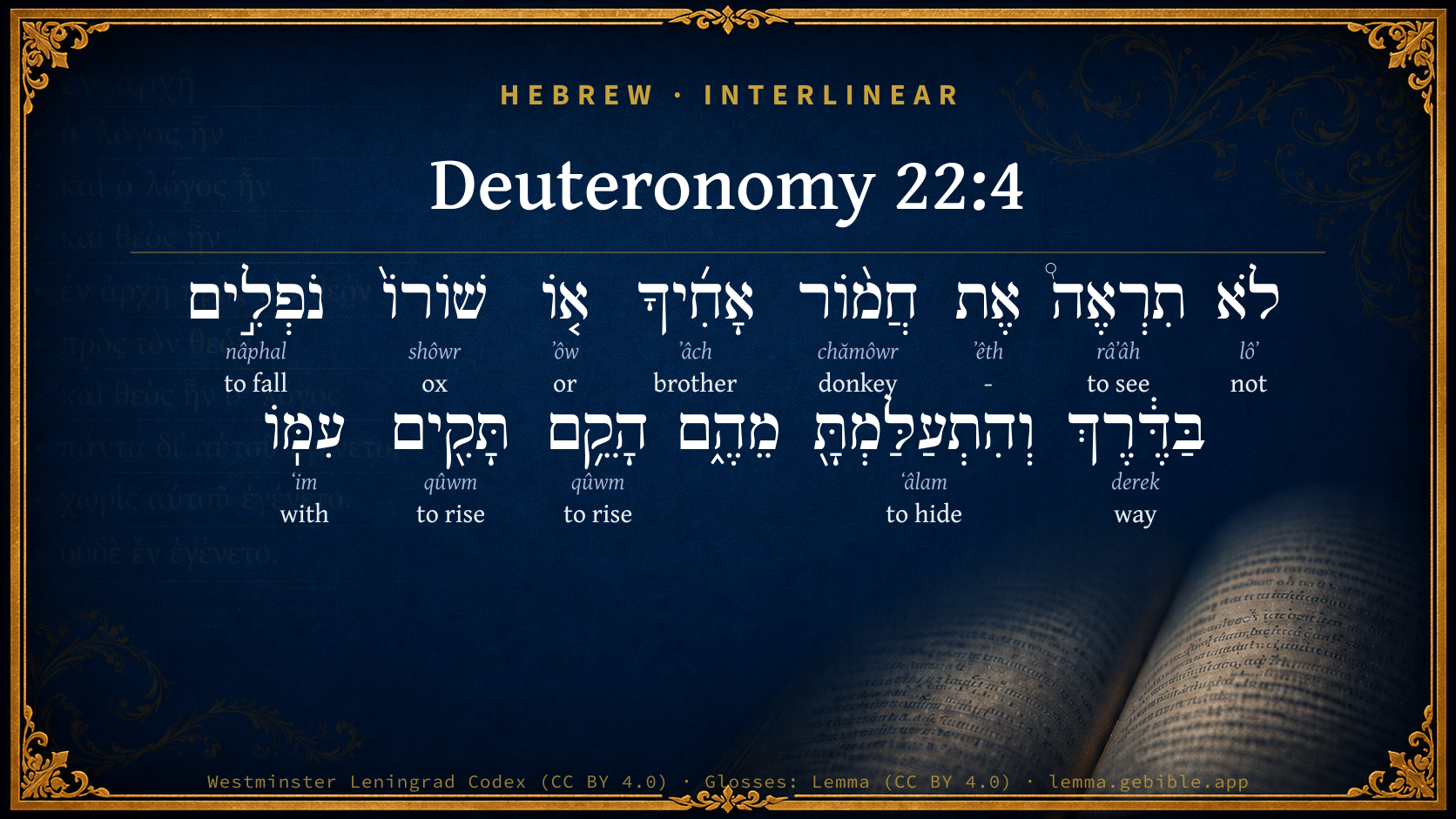
Hebrew (Westminster Leningrad Codex) Deuteronomy 22:4 appears in the Hebrew Old Testament. The text above is from the Westminster Leningrad Codex. Each word links to its Strong’s number, a concise gloss, and parsing drawn from the Open Scriptures Hebrew Bible morphology. Click any word for its full Brown-Driver-Briggs (BDB) entry.
Download image
Cite this verse

Deuteronomy 22:4 (World English Bible). Public Domain. Lemma interlinear Bible study tool, https://lemma.gebible.app/v/deuteronomy/22/4.

Show BibTeX & RIS
BibTeX
RIS
English Translation
You shall not see your brother's donkey or his ox fallen down by the way, and hide yourself from them: you shall surely help him to lift them up again.
World English Bible · Public Domain
Download a study sheet

One document with this verse’s original text, its word-by-word gloss line, the meaning frame, cross-references with their text, attributed commentary, and full source and license credits — printable, and it pastes into notes with its structure intact.

This verse Autodidact and up

Study sheet (.html) Plain text (.txt)

A passage Seminary Student

Up to 50 verses in one chapter. A passage sheet keeps up to 6 commentary sources and 12 cross-references per verse, in the order this page ranks them, and says so on the sheet whenever that leaves anything out. Ask for a single verse and you get the Autodidact verse sheet above.

Everything on this page stays free to read, with no account — the sheet is a download of what is already on screen, not access to it.

Want to remove ads? Support Godless Engineer
Compare translations 3

The same verse in 3 English versions, stacked beneath the original-language interlinear above. Click any original word for its lexicon entry.

Each is an independent rendering of the whole verse — the interlinear is not word-aligned to these translations.

Highlighted words mark where these versions differ — a whole-verse word diff, not a word-by-word alignment.

  • World English Bible Public Domain
    You shall not see your brother's donkey or his ox fallen down by the way, and hide yourself from them: you shall surely help him to lift them up again.
  • King James Version Public Domain
    Thou shalt not see thy brother's ass or his ox fall down by the way, and hide thyself from them: thou shalt surely help him to lift them up again.
  • unfoldingWord Literal Text CC BY-SA 4.0
    You shall not see the donkey of your brother or his ox fallen down in the road and hide yourself from them; lifting, you shall lift it up.

unfoldingWord Literal Text — © unfoldingWord, licensed CC BY-SA 4.0. Word-aligned USFM3 via Door43 (git.door43.org/unfoldingWord/en_ult).

Versions to compare (up to 4)

3 of 4 selected

Show all 18 translations

Every available English version of this verse, each an independent rendering of the whole verse.

  • World English Bible Public Domain
    You shall not see your brother's donkey or his ox fallen down by the way, and hide yourself from them: you shall surely help him to lift them up again.
  • Berean Standard Bible Public Domain
    If you see your brother’s donkey or ox fallen on the road, you must not ignore it; you must help him lift it up.
  • Majority Standard Bible Public Domain
    If you see your brother’s donkey or ox fallen on the road, you must not ignore it; you must help him lift it up.
  • King James Version Public Domain
    Thou shalt not see thy brother's ass or his ox fall down by the way, and hide thyself from them: thou shalt surely help him to lift them up again.
  • American Standard Version (1901) Public Domain
    Thou shalt not see thy brother's ass or his ox fallen down by the way, and hide thyself from them: thou shalt surely help him to lift them up again.
  • Revised Version (1885) Public Domain
    Thou shalt not see thy brother’s ass or his ox fallen down by the way, and hide thyself from them: thou shalt surely help him to lift them up again.
  • Geneva Bible (1599) Public Domain
    Thou shalt not see thy brothers asse nor his oxe fal downe by the way, and withdrawe thy selfe from them, but shalt lift them vp with him.
  • Douay-Rheims (1899) Public Domain
    If thou see thy brother's ass or his ox to be fallen down in the way, thou shalt not slight it, but shalt lift it up with him.
  • Young's Literal Translation Public Domain
    `Thou dost not see the ass of thy brother, or his ox, falling in the way, and hast hid thyself from them; thou dost certainly raise `them' up with him.
  • Literal Standard Version CC BY-SA 4.0
    You do not see the donkey of your brother, or his ox, falling in the way, and have hid yourself from them; you certainly raise [them] up for him.
  • Unlocked Literal Bible CC BY-SA 4.0
    You must not see your fellow Israelite's donkey or his ox fallen down in the road and hide yourself from them; you must surely help him to lift it up again.
  • unfoldingWord Literal Text CC BY-SA 4.0
    You shall not see the donkey of your brother or his ox fallen down in the road and hide yourself from them; lifting, you shall lift it up.
  • Darby Bible Public Domain
    Thou shalt not see thy brother's ass or his ox fall by the way, and hide thyself from them: thou shalt in any case [help] him to lift them up.
  • World Messianic Bible Public Domain
    You shall not see your brother’s donkey or his ox fallen down by the way, and hide yourself from them. You shall surely help him to lift them up again.
  • Webster's Bible Public Domain
    Thou shalt not see thy brother's ass or his ox fall down by the way, and hide thyself from them: thou shalt surely help him to lift them up again.
  • Free Bible Version CC BY-SA 4.0
    If you see someone's donkey or cow that has fallen down on the road, don't just ignore it. Help lift it up.
  • Bible in Basic English Public Domain
    If you see your brother's ox or his ass falling down on the road, do not go by without giving him help in lifting it up again.
  • JPS Tanakh (1917) Public Domain
    Thou shalt not see thy brother's ass or his ox fallen down by the way, and hide thyself from them; thou shalt surely help him to lift them up again.

Literal Standard Version (2020), Covenant Press — licensed CC BY-SA 4.0. Text via the HelloAO Bible API (eBible.org). Unlocked Literal Bible (unfoldingWord) — licensed CC BY-SA 4.0. Text via the HelloAO Bible API (eBible.org). unfoldingWord Literal Text — © unfoldingWord, licensed CC BY-SA 4.0. Word-aligned USFM3 via Door43 (git.door43.org/unfoldingWord/en_ult). Free Bible Version, Dr. Jonathan Gallagher — licensed CC BY-SA 4.0. Text via the HelloAO Bible API (eBible.org).

Word by word

More ways to search: Search by grammar → Find every occurrence → Compare this word →

Practice this passage: Drill this verse → Learn its vocabulary →

וְהִתְעַלַּמְתָּ֖
ʻâlam
H5956
“and · to hide”
Conjunction + Verb, Hithpael, Sequential Perfect, 2nd Person, Masculine, Singular
Part of Speech
Conjunction + Verb
Stem
Hithpael
Form
Sequential Perfect
Person
2nd Person
Gender
Masculine
Number
Singular
Full BDB Definition

Origin: a primitive root

TWOT: 1629

to conceal, hide, be hidden, be concealed, be secret - (Qal) secret (participle) - (Niphal) - to be concealed - concealed, dissembler (participle) - (Hiphil) to conceal, hide - (Hithpael) to hide oneself
  1. לֹא lôʼ H3808 “not” Particle, Negative
  2. תִרְאֶה֩ râʼâh H7200 “to see” Verb, Qal, Imperfect, 2nd Person, Masculine, Singular
  3. אֶת ʼêth H853 “-” Particle, Direct Object
  4. חֲמ֨וֹר chămôwr H2543 “donkey of” Noun, Common, Both, Singular, Construct
  5. אָחִ֜יךָ ʼâch H251 “brother · your” Noun, Common, Masculine, Singular, Construct + Suffix, Personal, 2nd Person, Masculine, Singular
  6. א֤וֹ ʼôw H176 “or” Conjunction
  7. שׁוֹרוֹ֙ shôwr H7794 “ox · his” Noun, Common, Masculine, Singular, Construct + Suffix, Personal, 3rd Person, Masculine, Singular
  8. נֹפְלִ֣ים nâphal H5307 “falling” Verb, Qal, Participle Active, Masculine, Plural, Absolute
  9. בַּדֶּ֔רֶךְ derek H1870 “in/at the · way” Preposition, Determined + Noun, Common, Both, Singular, Absolute
  10. הָקֵ֥ם qûwm H6965 “to rise” Verb, Hiphil, Infinitive Absolute
  11. תָּקִ֖ים qûwm H6965 “to rise” Verb, Hiphil, Imperfect, 2nd Person, Masculine, Singular
  12. עִמּֽוֹ ʻim H5973 “with · him” Preposition + Suffix, Personal, 3rd Person, Masculine, Singular

About this verse

These counts appear in no published source. They are computed here, from the morphology-tagged text and Lemma’s own curated glosses. What Lemma adds →

14
words
12
distinct lemmas
Pentateuch
section

Shared distinctive vocabulary

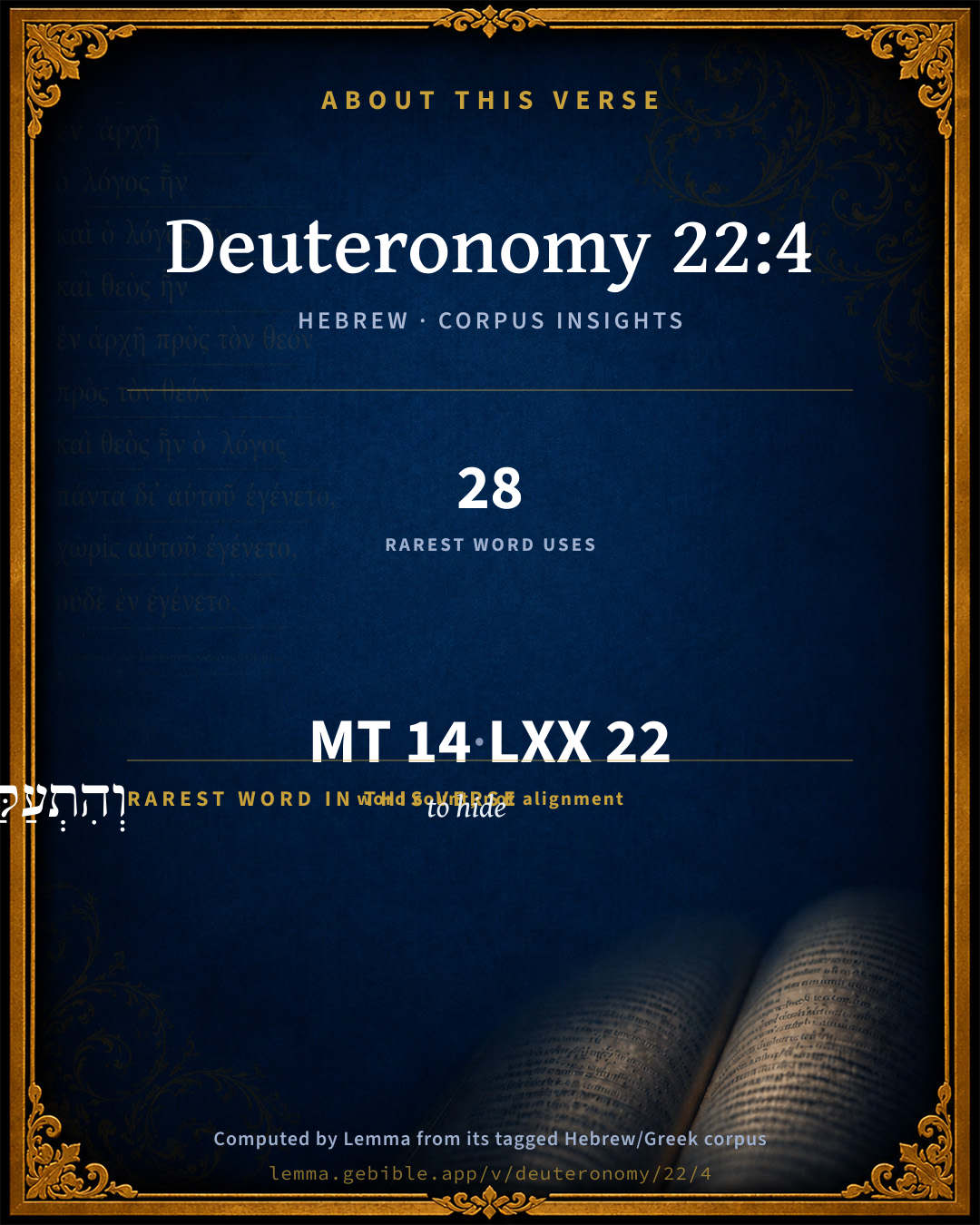
וְהִתְעַלַּמְתָּ֖ to hide H5956 occurs in 27 verses of the Hebrew Bible. Also found in:

Grammatical profile

  • 5 verbs
  • 4 nouns
  • 2 prepositions
  • 1 conjunction
  • 2 particles

Verb forms

  • תִרְאֶה֩ Qal · Imperfect
  • נֹפְלִ֣ים Qal · Participle Active
  • וְהִתְעַלַּמְתָּ֖ Hithpael · Sequential Perfect
  • הָקֵ֥ם Hiphil · Infinitive Absolute
  • תָּקִ֖ים Hiphil · Imperfect

Repetition

A word recurs within this verse — often emphatic in Hebrew:

  • הָקֵ֥ם to rise H6965 ×2

Hebrew & Septuagint length

In English translation the verse runs 30 words from the Hebrew and 30 from the Septuagint (LXX English) — the same length.

A rough comparison of the two English renderings, which tokenize alike — not a word-level alignment.

Word counts can differ between the Hebrew and the Greek without any difference in meaning — e.g. the Hebrew direct-object marker אֵת has no separate Greek word, and Greek often adds the article ὁ.

In the original languages it is 14 Hebrew tokens and 22 Greek tokens — but the two are counted differently (Hebrew bundles its prefixes and suffixes into one token; the Greek is in lemma form), so that isn’t a like-for-like length.

Cross-references

8

Topical passages linked to Deuteronomy 22:4 in the Treasury of Scripture Knowledge — connected by theme and wording, ordered by reader-vote popularity; previews shown in the World English Bible.

  • Exodus 23:4–5 "If you meet your enemy's ox or his donkey going astray, you shall surely bring it back to him again.
  • Matthew 5:44 But I tell you, love your enemies, bless those who curse you, do good to those who hate you, and pray for those who mistreat you and persecute you,
  • Luke 10:29–37 But he, desiring to justify himself, asked Jesus, "Who is my neighbor?"
  • Romans 15:1 Now we who are strong ought to bear the weaknesses of the weak, and not to please ourselves.
  • 2 Corinthians 12:15 I will most gladly spend and be spent for your souls. If I love you more abundantly, am I loved the less?
  • Galatians 6:1–2 Brothers, even if a man is caught in some fault, you who are spiritual must restore such a one in a spirit of gentleness; looking to yourself so that you also aren't tempted.
  • 1 Thessalonians 5:14 We exhort you, brothers, admonish the disorderly, encourage the fainthearted, support the weak, be patient toward all.
  • Hebrews 12:12–13 Therefore, lift up the hands that hang down and the feeble knees,

Cross-references courtesy of OpenBible.info (CC BY 4.0).

Hebrew and Greek witnesses Masoretic Hebrew ↔ Greek Septuagint

The same verse in the two great witnesses to the Old Testament, shown verse-for-verse.

These are two independent witnesses, not word-aligned to each other, and the Septuagint is shown in lemma (dictionary) form.

Hebrew Deuteronomy 22:4 Masoretic · Westminster Leningrad Codex

לֹא תִרְאֶה֩ אֶת חֲמ֨וֹר אָחִ֜יךָ א֤וֹ שׁוֹרוֹ֙ נֹפְלִ֣ים בַּדֶּ֔רֶךְ וְהִתְעַלַּמְתָּ֖ מֵהֶ֑ם הָקֵ֥ם תָּקִ֖ים עִמּֽוֹ

You shall not see your brother's donkey or his ox fallen down by the way, and hide yourself from them: you shall surely help him to lift them up again.

World English Bible · Public Domain

Greek LXX Deuteronomy 22:4 Septuagint · lemma form

οὐ ὁράω ὁ ὄνος ὁ ἀδελφός σύ ἤ ὁ μόσχος αὐτός πίπτω ἐν ὁ ὁδός μή ὑπερὁράω αὐτός ἀναἵστημι ἀναἵστημι μετά αὐτός

You shall not see the ass of your brother, or his calf, fallen in the way: you shall not overlook them, you shall surely help him to raise them up.

LXX2012 (modern English Septuagint) · Public Domain

Hebrew: Westminster Leningrad Codex (CC BY 4.0). Greek: Septuagint (public domain); English from LXX2012 (modern English Septuagint) (Public Domain). How the Septuagint differs from the Hebrew →

Targum (Aramaic paraphrase)

2

The Targum is the ancient Jewish Aramaic paraphrase of the Hebrew Scriptures — an interpretive translation, not the Hebrew text itself. Onkelos (literal) and Pseudo-Jonathan (expansive) render the Torah, and Jonathan the Prophets. Coverage is partial: where no permissively-licensed English translation exists for a verse, only the Aramaic is shown. This is verse-level text, not a word-by-word alignment to the Hebrew.

  1. Targum Onkelos Torah (Genesis–Deuteronomy)
    לָא תֶחֱזֵי יָת חֲמָרָא דְאָחוּךְ אוֹ תוֹרֵהּ רָמָן בְּאָרְחָא וְתִתְכְּבֵשׁ מִנְהוֹן אֲקָמָא תְקִים עִמֵהּ

    (no public-domain English translation for this verse)

    Targum Onkelos — Aramaic: “Onkelos Genesis” (public domain); “Onkelos Exodus” (public domain); “Onkelos Leviticus” (public domain); “Onkelos Numbers” (public domain); “Onkelos Deuteronomy” (public domain). English: “Sefaria Community Translation” (CC0 1.0 (public-domain dedication)); “J.W. Etheridge. The Targums of Onkelos and Jonathan Ben Uzziel on the Pentateuch. London: Longmans, Green, 1862” (public domain). Text via Sefaria.

  2. Targum Pseudo-Jonathan Torah (Genesis–Deuteronomy)
    לָא תֶחְמוּן יַת חֲמָרָא דַאֲחוּכוֹן אוֹ תוֹרֵי רְמָאָן בְּאוֹרְחָא וְתִכְבְּשׁוּן עֵינֵיכוֹן מִנְהוֹן מֵיקַם תְּקוּמוּן עִמֵּיהּ

    Thou shalt not see thy brother’s ass nor his ox thrown on the way, and turn thy eyes from them; thou shalt verily lift it up for him.

    Targum Pseudo-Jonathan — Aramaic: “Targum Jonathan on Genesis” (public domain); “Targum Jonathan on Exodus” (public domain); “Targum Jonathan on Leviticus” (public domain); “Targum Jonathan on Numbers” (public domain); “Targum Jonathan on Deuteronomy” (public domain). English: “The Targum of Jonathan ben Uzziel, trans. J. W. Etheridge, London, 1862” (public domain). Text via Sefaria.

Commentary

Notes on Deuteronomy 22:4 from classic Christian and Jewish commentators (each source and its license shown beneath its notes). The classic Christian expositions comment on the surrounding passage and are grouped to its opening verse, so a note may address several verses; the Jewish commentaries on the Tanakh (Rashi and others) are per-verse, so they appear only where the commentator wrote on this verse.

Lemma curates 59 commentaries, every one of them public domain or Creative Commons licensed, each selected and text-cleaned for this edition rather than reprinted as found. About our sources →

The Cambridge Bible for Schools and Colleges

gen. ed. J. J. S. Perowne

4. Of Assisting to Lift Fallen Beasts. D’s more comprehensive and more simply expressed edition of E’s law, Exo_23:5, which enjoins the duty of helping him that hateth thee to release (an archaic word) his animals when foundered beneath their burdens. On fallen, see Deu_21:1.

An animal fallen under its load needs two persons to put it right: ‘an operation which can be performed for a loaded animal only by lifting up the burden on both sides at once, unless it be unloaded and loaded again, implying much loss of time, and even this often cannot be done without assistance. Jew and Christian, Muslim and Koord mutually assist each other, though inimical to one another’s faith’ (Van Lennep, Bible Lands, etc., 231).

The Cambridge Bible for Schools and Colleges (gen. ed. J. J. S. Perowne; Cambridge University Press, 1878–1918) — public domain. Text from a community e-Sword module.

John Gill's Exposition

Thou shall not see thy brother's ox or his ass fall down by the way,.... And lie under his burden, not being able to rise with it of himself, nor with all the assistance about it, without further help:

and hide thyself from them; cover thine eyes, or turn them another way, and make as if thou didst not see them in distress:

thou shalt surely help him to lift them up again; that is, help the brother and owner of it, the ox and ass; assist him in getting them up again, and lay on their burden, and fasten them aright, which either were rolled off by the fall, or were obliged to be taken off in order to raise them up; and if this was to be done for an enemy, then much more for a brother, as is required; see Gill on Exo 23:5, or "lifting up, thou shall lift them up with him" (d); that is, most certainly do it, and lift with all his strength, and as often as there is occasion; if they fell down again after raised up, help is still to be continued, even, as Maimonides (e) says, though it was an hundred times.

(d) "erigendo eriges", Pagninus, Montanus. (e) Hilchot Rotzeach, c. 13. sect. 5.

John Gill's Exposition of the Whole Bible (1746–1763) — public domain (CC PDM 1.0). Text via the HelloAO Bible API.

Haydock's Catholic Bible Commentary

With him. Hebrew, "thou shalt not hide thyself, but help him to lift up," Exodus xxiii. 4.

George Leo Haydock (1774–1849), Haydock's Catholic Family Bible and Commentary, 1859 edition — public domain. Excludes Psalms (Douay-Rheims chapter numbering differs from Protestant) and Deuterocanonical books (Catholic canon only).

Matthew Poole's English Annotations

Help him, i.e. thy brother, the owner. Compare Exo 13:5.

Matthew Poole's English Annotations on the Holy Bible (1683–1685) — public domain. Text from a community e-Sword/MySword module.

The Pulpit Commentary

An animal that had fallen was also to be lifted up, and the owner was to be assisted to do this. In Exodus, it is specially declared that both these services are to be rendered, even though the parties are at enmity with each ether, and the one is the object of hatred to the other.

The Pulpit Commentary (1880–1919), ed. H.D.M. Spence-Jones & Joseph S. Exell — public domain. Text from a community e-Sword module.

Rashi

Rabbi Shlomo Yitzchaki (Rashi)

הקם תקים [THOU SHALT NOT SEE THY BROTHER’S ASS OR ANY OF HIS HERD FALL DOWN BY THE WAY, AND HIDE THYSELF FROM THEM] THOU SHALT SURELY RAISE UP — This refers to the duty of loading — to re-load the burden that fell from it.

עמו [THOU SHALT SURELY UPLOAD] WITH HIM — i.e. with the owner. But if he goes aside and sits down and says to him, “Since it is a duty for you to load it, if you want to load, go ahead and load!” — [“I” am not commanded to do it”], he is exempt from doing it (cf. Bava Metzia 32a).

Rashi on the Tanakh — English translations: “The Judaica Press complete Tanach with Rashi, translated by A. J. Rosenberg” (CC BY 4.0); “Pentateuch with Rashi's commentary by M. Rosenbaum and A.M. Silbermann, 1929-1934” (public domain); “The Metsudah Tanach series, Lakewood, N.J” (CC BY 4.0); and “The Book of Joshua, Metsudah Publications, 1997” (CC BY 4.0). Text via Sefaria.

Ramban (Nachmanides)

Rabbi Moshe ben Nachman (Ramban / Nachmanides)

In the commandment on assisting someone to lift up his burden, he added a warning thereon constituting a negative commandment [Thou shalt not see thy brother’s ass or his ox fallen down by the way etc.], for in the Torah He stated Thou shalt surely release it with him [i.e., by helping to unload the burden] which is a positive commandment [and thus we learn that in failing to render assistance one violates both a positive and a negative commandment]. He also adds [here the expression] fallen down by the way, for there He stated, lying under its burden, and He mentioned there only the ass because it commonly carries a great burden and, therefore, is liable to crouch under it. Also, here it says thy brother’s and there it states thy enemy’s, and of him that hateth thee, meaning [here] to say, “Do thus to him [in assisting him], and remember the brotherhood between you and forget the hatred.”

Ramban (Nachmanides) on the Tanakh — English translation: “Commentary on the Torah by Ramban (Nachmanides). Translated and annotated by Charles B. Chavel. New York, Shilo Pub. House, 1971-1976” (CC BY 4.0). Text via Sefaria.

Lesson kit

Teaching starters — assembled from the data on this page, not authored interpretation. Every prompt links to the verse data it draws on. Edit before teaching.

Deuteronomy, in the Pentateuch, opens this verse with 14 words (12 distinct Hebrew lemmas). Its most distinctive word is ʻâlam (“to hide”). A historical commentator’s framing appears above. Read the whole chapter for the surrounding context.

Discussion questions

  1. The word ʻâlam carries the sense “to hide.” How does it shape the verse?
  2. How does Leviticus 4:13, which shares the word «to hide», read alongside this verse?
  3. What does the repetition of “to rise” (2× in this one verse) do in this verse?
  4. These translations render this verse differently. What is at stake in choosing one wording over another?
  5. «תִרְאֶה֩» is a Qal Imperfect verb. How does that grammatical form shape the action described?
  6. Compare how The Cambridge Bible for Schools and Colleges and John Gill's Exposition read this verse. Where do they agree or differ?

Things to notice

Reading settings

Reading text

Shown beneath each verse's original-language words.

Old Testament
Old Testament edition

Read the OT as the Masoretic Hebrew (MT) or the Greek Septuagint (LXX).

English shown for the Greek Septuagint (in the Hebrew ↔ Greek comparison).

Comparing translations? Open the Compare panel on any verse page to stack up to four side by side.