
2 Samuel 9:6

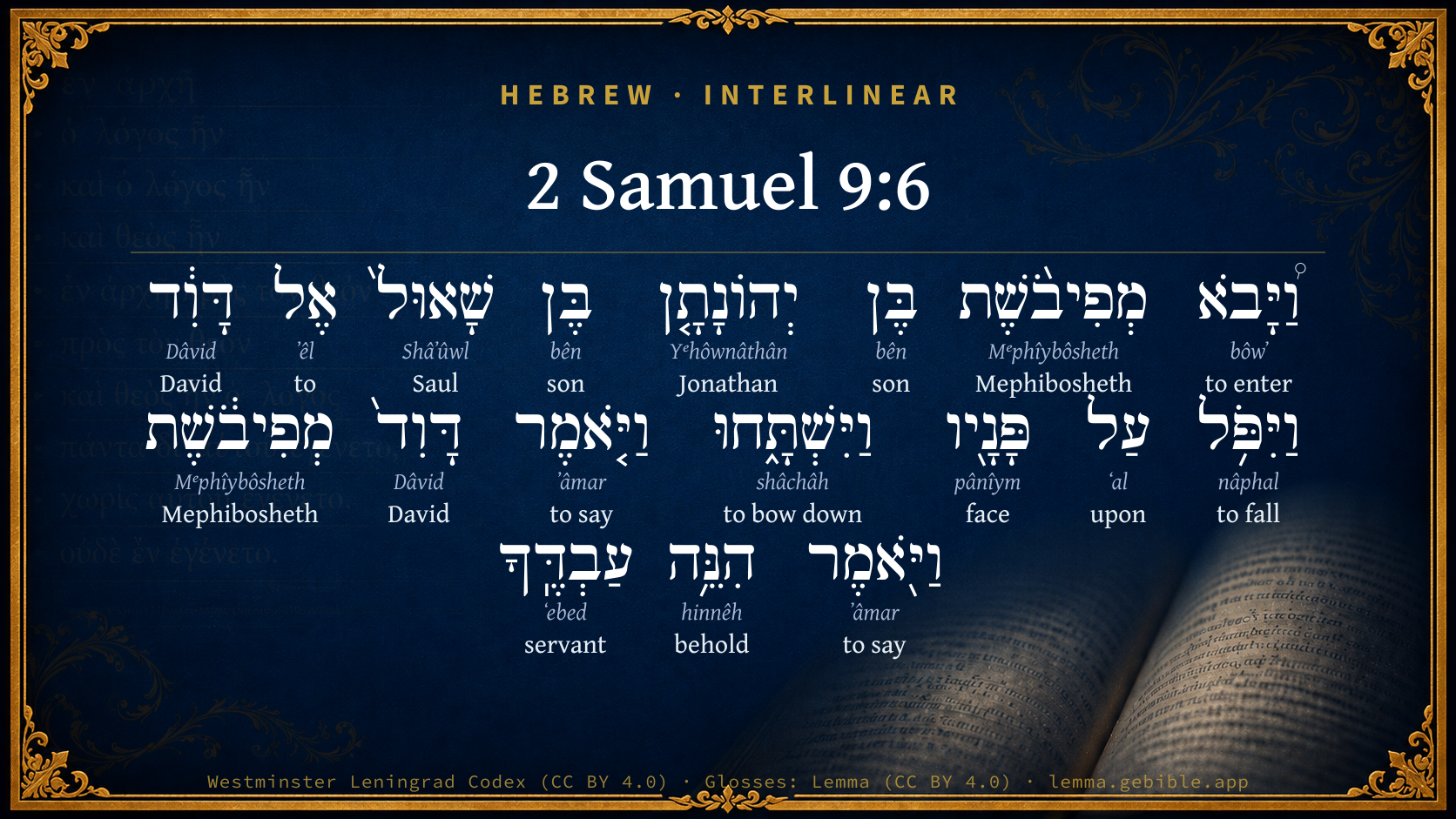
Hebrew (Westminster Leningrad Codex) 2 Samuel 9:6 appears in the Hebrew Old Testament. The text above is from the Westminster Leningrad Codex. Each word links to its Strong’s number, a concise gloss, and parsing drawn from the Open Scriptures Hebrew Bible morphology. Click any word for its full Brown-Driver-Briggs (BDB) entry.
Download image
Cite this verse

2 Samuel 9:6 (World English Bible). Public Domain. Lemma interlinear Bible study tool, https://lemma.gebible.app/v/2-samuel/9/6.

Show BibTeX & RIS
BibTeX
RIS
English Translation
Mephibosheth, the son of Jonathan, the son of Saul, came to David, and fell on his face, and did obeisance. David said, Mephibosheth. He answered, Behold, your servant!
World English Bible · Public Domain
Download a study sheet

One document with this verse’s original text, its word-by-word gloss line, the meaning frame, cross-references with their text, attributed commentary, and full source and license credits — printable, and it pastes into notes with its structure intact.

This verse Autodidact and up

Study sheet (.html) Plain text (.txt)

A passage Seminary Student

Up to 50 verses in one chapter. A passage sheet keeps up to 6 commentary sources and 12 cross-references per verse, in the order this page ranks them, and says so on the sheet whenever that leaves anything out. Ask for a single verse and you get the Autodidact verse sheet above.

Everything on this page stays free to read, with no account — the sheet is a download of what is already on screen, not access to it.

Want to remove ads? Support Godless Engineer
Compare translations 3

The same verse in 3 English versions, stacked beneath the original-language interlinear above. Click any original word for its lexicon entry.

Each is an independent rendering of the whole verse — the interlinear is not word-aligned to these translations.

Highlighted words mark where these versions differ — a whole-verse word diff, not a word-by-word alignment.

  • World English Bible Public Domain
    Mephibosheth, the son of Jonathan, the son of Saul, came to David, and fell on his face, and did obeisance. David said, Mephibosheth. He answered, Behold, your servant!
  • King James Version Public Domain
    Now when Mephibosheth, the son of Jonathan, the son of Saul, was come unto David, he fell on his face, and did reverence. And David said, Mephibosheth. And he answered, Behold thy servant!
  • unfoldingWord Literal Text CC BY-SA 4.0
    And Mephibosheth, the son of Jonathan, the son of Saul, came to David, and he fell on his face, and he prostrated himself. And David said, “Mephibosheth.” And he said, “Behold your servant.”

unfoldingWord Literal Text — © unfoldingWord, licensed CC BY-SA 4.0. Word-aligned USFM3 via Door43 (git.door43.org/unfoldingWord/en_ult).

Versions to compare (up to 4)

3 of 4 selected

Show all 18 translations

Every available English version of this verse, each an independent rendering of the whole verse.

  • World English Bible Public Domain
    Mephibosheth, the son of Jonathan, the son of Saul, came to David, and fell on his face, and did obeisance. David said, Mephibosheth. He answered, Behold, your servant!
  • Berean Standard Bible Public Domain
    And when Mephibosheth son of Jonathan, the son of Saul, came to David, he fell facedown in reverence. Then David said, “Mephibosheth!” “I am your servant,” he replied.
  • Majority Standard Bible Public Domain
    And when Mephibosheth son of Jonathan, the son of Saul, came to David, he fell facedown in reverence. Then David said, “Mephibosheth!” “I am your servant,” he replied.
  • King James Version Public Domain
    Now when Mephibosheth, the son of Jonathan, the son of Saul, was come unto David, he fell on his face, and did reverence. And David said, Mephibosheth. And he answered, Behold thy servant!
  • American Standard Version (1901) Public Domain
    And Mephibosheth, the son of Jonathan, the son of Saul, came unto David, and fell on his face, and did obeisance. And David said, Mephibosheth. And he answered, Behold, thy servant!
  • Revised Version (1885) Public Domain
    And Mephibosheth, the son of Jonathan, the son of Saul, came unto David, and fell on his face, and did obeisance. And David said, Mephibosheth. And he answered, Behold thy servant!
  • Geneva Bible (1599) Public Domain
    Nowe when Mephibosheth the sonne of Ionathan, the sonne of Saul was come vnto Dauid, he fel on his face, and did reuerence. And Dauid sayde, Mephibosheth? And he answered, Beholde thy seruant.
  • Douay-Rheims (1899) Public Domain
    And when Miphiboseth the son of Jonathan the son of Saul was come to David, he fell on his face and worshipped. And David said: Miphiboseth? And he answered: Behold thy servant.
  • Young's Literal Translation Public Domain
    and Mephibosheth son of Jonathan, son of Saul, cometh unto David, and falleth on his face, and doth obeisance, and David saith, `Mephibosheth;' and he saith, `Lo, thy servant.'
  • Literal Standard Version CC BY-SA 4.0
    and Mephibosheth son of Jonathan, son of Saul, comes to David, and falls on his face, and pays respect, and David says, “Mephibosheth”; and he says, “Behold, your servant.”
  • Unlocked Literal Bible CC BY-SA 4.0
    So Mephibosheth son of Jonathan son of Saul, came to David and bowed down his face to the floor in honor of David. David said, “Mephibosheth.” He answered, “See, I am your servant!”
  • unfoldingWord Literal Text CC BY-SA 4.0
    And Mephibosheth, the son of Jonathan, the son of Saul, came to David, and he fell on his face, and he prostrated himself. And David said, “Mephibosheth.” And he said, “Behold your servant.”
  • Darby Bible Public Domain
    And Mephibosheth, the son of Jonathan, the son of Saul, came to David, and fell on his face and did obeisance. And David said, Mephibosheth. And he said, Behold thy servant!
  • World Messianic Bible Public Domain
    Mephibosheth, the son of Jonathan, the son of Saul, came to David, fell on his face, and showed respect. David said, “Mephibosheth?” He answered, “Behold, your servant!”
  • Webster's Bible Public Domain
    Now when Mephibosheth, the son of Jonathan, the son of Saul, had come to David, he fell on his face, and did reverence. And David said, Mephibosheth. And he answered, Behold thy servant!
  • Free Bible Version CC BY-SA 4.0
    When Mephibosheth, son of Jonathan, son of Saul, came to David, he bowed facedown to the ground in respect. Then David said, “Welcome, Mephibosheth.” “I am your servant,” he replied.
  • Bible in Basic English Public Domain
    And Mephibosheth, the son of Jonathan, came to David, and falling down on his face, gave him honour. And David said, Mephibosheth. And answering he said, Your servant is here.
  • JPS Tanakh (1917) Public Domain
    And Mephibosheth, the son of Jonathan, the son of Saul, came unto David, and fell on his face, and prostrated himself. And David said: 'Mephibosheth!' And he answered: 'Behold thy servant!'

Literal Standard Version (2020), Covenant Press — licensed CC BY-SA 4.0. Text via the HelloAO Bible API (eBible.org). Unlocked Literal Bible (unfoldingWord) — licensed CC BY-SA 4.0. Text via the HelloAO Bible API (eBible.org). unfoldingWord Literal Text — © unfoldingWord, licensed CC BY-SA 4.0. Word-aligned USFM3 via Door43 (git.door43.org/unfoldingWord/en_ult). Free Bible Version, Dr. Jonathan Gallagher — licensed CC BY-SA 4.0. Text via the HelloAO Bible API (eBible.org).

Word by word

More ways to search: Search by grammar → Find every occurrence → Compare this word →

Practice this passage: Drill this verse → Learn its vocabulary →

מְפִיבֹ֨שֶׁת
Mᵉphîybôsheth
H4648
“Mephibosheth”
Noun, Proper
Part of Speech
Noun
Type
Proper
Full BDB Definition

Origin: probably from H6284 and H1322

TWOT: None

Mephibosheth = "exterminating the idol" - grandson of Saul and son of Rizpah the daughter of Aiah, Saul's concubine; he and his brother Armoni were among the 7 victims surrendered by David to the Gibeonites to avert a famine - son of Jonathan and grandson of Saul - also 'Merib-baal'
  1. וַ֠יָּבֹא bôwʼ H935 “and · to enter” Conjunction + Verb, Qal, Sequential Imperfect, 3rd Person, Masculine, Singular
  2. בֶּן bên H1121 “son of” Noun, Common, Masculine, Singular, Construct
  3. יְהוֹנָתָ֤ן Yᵉhôwnâthân H3083 “Jonathan” Noun, Proper
  4. בֶּן bên H1121 “son of” Noun, Common, Masculine, Singular, Construct
  5. שָׁאוּל֙ Shâʼûwl H7586 “Saul” Noun, Proper
  6. אֶל ʼêl H413 “to” Preposition
  7. דָּוִ֔ד Dâvid H1732 “David” Noun, Proper
  8. וַיִּפֹּ֥ל nâphal H5307 “and · to fall” Conjunction + Verb, Qal, Sequential Imperfect, 3rd Person, Masculine, Singular
  9. עַל ʻal H5921 “upon” Preposition
  10. פָּנָ֖יו pânîym H6440 “face(s) · his” Noun, Common, Both, Plural, Construct + Suffix, Personal, 3rd Person, Masculine, Singular
  11. וַיִּשְׁתָּ֑חוּ shâchâh H7812 “and · to bow down” Conjunction + Verb, Hithpael, Sequential Imperfect, 3rd Person, Masculine, Singular
  12. וַיֹּ֤אמֶר ʼâmar H559 “and · to say” Conjunction + Verb, Qal, Sequential Imperfect, 3rd Person, Masculine, Singular
  13. דָּוִד֙ Dâvid H1732 “David” Noun, Proper
  14. מְפִיבֹ֔שֶׁת Mᵉphîybôsheth H4648 “Mephibosheth” Noun, Proper
  15. וַיֹּ֖אמֶר ʼâmar H559 “and · to say” Conjunction + Verb, Qal, Sequential Imperfect, 3rd Person, Masculine, Singular
  16. הִנֵּ֥ה hinnêh H2009 “behold” Particle, Demonstrative
  17. עַבְדֶּֽךָ ʻebed H5650 “servant · your” Noun, Common, Masculine, Singular, Construct + Suffix, Personal, 2nd Person, Masculine, Singular

About this verse

These counts appear in no published source. They are computed here, from the morphology-tagged text and Lemma’s own curated glosses. What Lemma adds →

18
words
14
distinct lemmas
Historical
section

Notable vocabulary

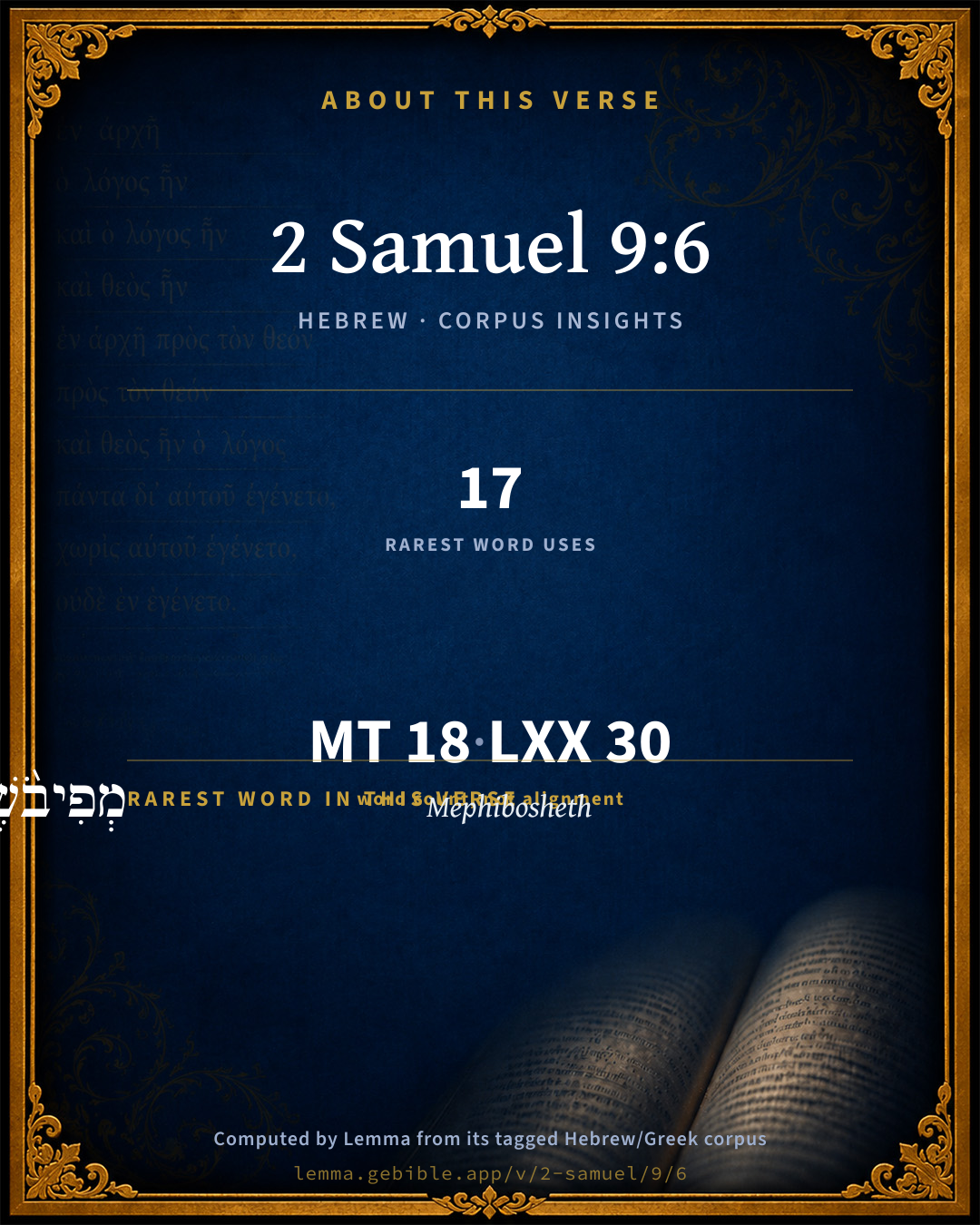
The rarest word here is מְפִיבֹ֨שֶׁת Mephibosheth H4648 — appearing just 17 times in the whole Hebrew Bible.

Shared distinctive vocabulary

מְפִיבֹ֨שֶׁת Mephibosheth H4648 occurs in 13 verses of the Hebrew Bible. Also found in:

Grammatical profile

  • 5 verbs
  • 10 nouns
  • 2 prepositions
  • 1 particle

Verb forms

  • וַ֠יָּבֹא Qal · Sequential Imperfect
  • וַיִּפֹּ֥ל Qal · Sequential Imperfect
  • וַיִּשְׁתָּ֑חוּ Hithpael · Sequential Imperfect
  • וַיֹּ֤אמֶר Qal · Sequential Imperfect
  • וַיֹּ֖אמֶר Qal · Sequential Imperfect

Repetition

Words recur within this verse — often emphatic in Hebrew:

  • מְפִיבֹ֨שֶׁת Mephibosheth H4648 ×2
  • בֶּן son H1121 ×2
  • דָּוִ֔ד David H1732 ×2
  • וַיֹּ֤אמֶר to say H559 ×2

Hebrew & Septuagint length

In English translation the verse runs 28 words from the Hebrew and 38 from the Septuagint (LXX English) — closely comparable.

A rough comparison of the two English renderings, which tokenize alike — not a word-level alignment.

Word counts can differ between the Hebrew and the Greek without any difference in meaning — e.g. the Hebrew direct-object marker אֵת has no separate Greek word, and Greek often adds the article ὁ.

In the original languages it is 18 Hebrew tokens and 30 Greek tokens — but the two are counted differently (Hebrew bundles its prefixes and suffixes into one token; the Greek is in lemma form), so that isn’t a like-for-like length.

Cross-references

8

Topical passages linked to 2 Samuel 9:6 in the Treasury of Scripture Knowledge — connected by theme and wording, ordered by reader-vote popularity; previews shown in the World English Bible.

  • 2 Samuel 16:4 Then said the king to Ziba, Behold, all that pertains to Mephibosheth is yours. Ziba said, I do obeisance; let me find favor in your sight, my lord, O king.
  • 1 Chronicles 9:40 The son of Jonathan was Merib Baal; and Merib Baal became the father of Micah.
  • 2 Samuel 19:24–30 Mephibosheth the son of Saul came down to meet the king; and he had neither dressed his feet, nor trimmed his beard, nor washed his clothes, from the day the king departed until the day he came home in peace.
  • 1 Samuel 25:23 When Abigail saw David, she hurried, and alighted from her donkey, and fell before David on her face, and bowed herself to the ground.
  • 1 Chronicles 8:34 The son of Jonathan was Merib Baal; and Merib Baal became the father of Micah.
  • Genesis 18:2 He lifted up his eyes and looked, and saw that three men stood opposite him. When he saw them, he ran to meet them from the tent door, and bowed himself to the earth,
  • Genesis 33:3 He himself passed over in front of them, and bowed himself to the ground seven times, until he came near to his brother.
  • 1 Samuel 20:41 As soon as the boy was gone, David arose out of [a place] toward the South, and fell on his face to the ground, and bowed himself three times: and they kissed one another, and wept one with another, until David exceeded.

Cross-references courtesy of OpenBible.info (CC BY 4.0).

Hebrew and Greek witnesses Masoretic Hebrew ↔ Greek Septuagint

The same verse in the two great witnesses to the Old Testament, shown verse-for-verse.

These are two independent witnesses, not word-aligned to each other, and the Septuagint is shown in lemma (dictionary) form.

Hebrew 2 Samuel 9:6 Masoretic · Westminster Leningrad Codex

וַ֠יָּבֹא מְפִיבֹ֨שֶׁת בֶּן יְהוֹנָתָ֤ן בֶּן שָׁאוּל֙ אֶל דָּוִ֔ד וַיִּפֹּ֥ל עַל פָּנָ֖יו וַיִּשְׁתָּ֑חוּ וַיֹּ֤אמֶר דָּוִד֙ מְפִיבֹ֔שֶׁת וַיֹּ֖אמֶר הִנֵּ֥ה עַבְדֶּֽךָ

Mephibosheth, the son of Jonathan, the son of Saul, came to David, and fell on his face, and did obeisance. David said, Mephibosheth. He answered, Behold, your servant!

World English Bible · Public Domain

Greek LXX 2 Samuel 9:6 Septuagint · lemma form

καί παραγίγνομαι μεμφιβοσθε υἱός ιωναθα υἱός σαούλ πρός ὁ βασιλεύς δαυίδ καί πίπτω ἐπί πρόσωπον αὐτός καί προςκυνέω αὐτός καί εἶπον αὐτός δαυίδ μεμφιβοσθε καί εἶπον ἰδού ὁ δοῦλος σύ

And Memphibosthe the son of Jonathan the son of Saul comes to the king David, and he fell upon his face and did obeisance to him: and David said to him, Memphibosthe: and he said, Behold your servant.

LXX2012 (modern English Septuagint) · Public Domain

Hebrew: Westminster Leningrad Codex (CC BY 4.0). Greek: Septuagint (public domain); English from LXX2012 (modern English Septuagint) (Public Domain). How the Septuagint differs from the Hebrew →

Targum (Aramaic paraphrase)

1

The Targum is the ancient Jewish Aramaic paraphrase of the Hebrew Scriptures — an interpretive translation, not the Hebrew text itself. Onkelos (literal) and Pseudo-Jonathan (expansive) render the Torah, and Jonathan the Prophets. Coverage is partial: where no permissively-licensed English translation exists for a verse, only the Aramaic is shown. This is verse-level text, not a word-by-word alignment to the Hebrew.

  1. Targum Jonathan Prophets (Joshua–Malachi)
    וַאֲתָא מְפִיבֹשֶׁת בַּר יְהוֹנָתָן בַּר שָׁאוּל לְוַת דָוִד וּנְפַל עַל אַפּוֹהִי וּסְגִיד וַאֲמַר דָוִד מְפִיבֹשֶׁת וַאֲמַר הָא עַבְדָךְ:

    (no public-domain English translation for this verse)

    Targum Jonathan — Aramaic: “Mikraot Gedolot” (public domain). English: “Sefaria Community Translation” (CC0 1.0 (public-domain dedication)); “London "Chaldee Paraphrase," 1871” (public domain). Text via Sefaria.

Commentary

Notes on 2 Samuel 9:6 from classic Christian and Jewish commentators (each source and its license shown beneath its notes). The classic Christian expositions comment on the surrounding passage and are grouped to its opening verse, so a note may address several verses; the Jewish commentaries on the Tanakh (Rashi and others) are per-verse, so they appear only where the commentator wrote on this verse.

Lemma curates 59 commentaries, every one of them public domain or Creative Commons licensed, each selected and text-cleaned for this edition rather than reprinted as found. About our sources →

Trapp's Complete Commentary

John Trapp

2Sa 9:6 Now when Mephibosheth, the son of Jonathan, the son of Saul, was come unto David, he fell on his face, and did reverence. And David said, Mephibosheth. And he answered, Behold thy servant!

Ver. 6. And David said, Mephibosheth.] He is also called Meribbaal, {1Ch 8:34} but his name was, haply, turned to Mephibosheth, saith Martyr, for some deformity that happened to his face in his fall. {2Sa 4:4}

John Trapp, A Commentary or Exposition upon All the Books of the Old and New Testament (1647–1656) — public domain. Text from a community e-Sword module.

Joseph Benson's Commentary

2Sa 9:6-8. He fell on his face and did reverence — As the manner was when men came into the presence of the king or king’s son; for thus David himself prostrated himself before Jonathan, 1Sa 20:41. I will restore thee all the land of Saul thy father — That is, according to our mode of speaking, thy grand-father. This land was, perhaps, the family estate of Saul, to which he had annexed other lands for his private use. But because they had been taken by virtue of Saul’s royal prerogative, therefore they were now considered, and perhaps had been seized, as appertaining to his successor on the throne, David. And he bowed himself — It is good to have the heart humbled under humbling providences. If, when divine providence brings our condition down, divine grace bring our spirits down, we shall be easy. That thou shouldest look on such a dead dog — This is a high expression of humility; for a dog was accounted a vile and unclean creature, and a dead dog as of no use at all. And it is likely that Mephibosheth spoke this, both in regard of his bodily infirmity of lameness, and because he was not instructed in, or had no natural genius for affairs of state.

Joseph Benson's Commentary on the Old and New Testaments (1811–1818) — public domain. Text from a community e-Sword module.

Tyndale Open Study Notes

Tyndale Open Resources

9:6 Given Mephibosheth’s physical limitations, bowing low to the ground must have been very difficult.

Tyndale Open Study Notes — © Tyndale Open Resources, licensed CC BY-SA 4.0. Text via the HelloAO Bible API.

The Cambridge Bible for Schools and Colleges

gen. ed. J. J. S. Perowne

6. Mephibosheth] See note on ch. 2Sa_4:4.

The Cambridge Bible for Schools and Colleges (gen. ed. J. J. S. Perowne; Cambridge University Press, 1878–1918) — public domain. Text from a community e-Sword module.

John Gill's Exposition

Now when Mephibosheth, the son of Jonathan, the son of Saul,.... For that was his name, though sometimes called Meribbaal, Ch1 8:34; and this was his relation to Jonathan and Saul, the son of the one, and grandson of the other:

was come unto David; to his court and palace in Jerusalem, being thither brought; for he could not go of himself, being lame:

he fell on his face, and did reverence; to him as a king, in a civil way, and in the best manner he could, considering that he was lame on his feet:

and David said, Mephibosheth; is it he? having learnt what his name was, this he expressed with great vehemency and affection, as glad that he had found one of Jonathan's posterity: and

he answered, behold thy servant! he answered to his name, and owned his subjection to David, and was ready to take the oath of allegiance to him, and give him homage, and serve him in what way he could.

John Gill's Exposition of the Whole Bible (1746–1763) — public domain (CC PDM 1.0). Text via the HelloAO Bible API.

Albert Barnes' Notes on the Bible

Mephibosheth - Also called Merib-baal (and Meri-baal, probably by a clerical error, 1Ch 9:40). The two names seem to have the same meaning: Bosheth, shame, being the equivalent for Baal, and Mephi (scattering or destroying, being equivalent to Merib (contending with). Compare Ish-bosheth and Esh-baal, Jerub-baal and Jerub-besheth.

He fell on his face - In fear. Such generosity to a fallen rival as David showed in restoring him his paternal property seemed to him scarcely credible.

Albert Barnes' Notes on the Bible (1834–1885) — public domain. Text from a community e-Sword/MySword module.

Whedon's Commentary on the Bible

Daniel D. Whedon

6. Fell on his face — Probably fearing that he had been suspected as an aspirant to the throne of his grandfather Saul, (comp. 2Sa_16:3,) and had been summoned into the king’s presence to receive sentence of death.

Daniel D. Whedon (gen. ed.), Commentary on the Old and New Testaments (1874–1909) — public domain. Text from a community e-Sword module.

The Pulpit Commentary

He fell on his face. Mephibosheth probably expected the fate which in the East usually befalls the members of a dethroned dynasty. Subsequently in Israel each new line of usurpers put to death every male relative of its predecessor, and it was with difficulty in Judah that one babe was rescued from the hands of its own grandmother, Athaliah, when she usurped the throne. Looked at, then, in the light of Oriental policy, David"s conduct was most generous.

The Pulpit Commentary (1880–1919), ed. H.D.M. Spence-Jones & Joseph S. Exell — public domain. Text from a community e-Sword module.

Lesson kit

Teaching starters — assembled from the data on this page, not authored interpretation. Every prompt links to the verse data it draws on. Edit before teaching.

2 Samuel, in the Historical, opens this verse with 18 words (14 distinct Hebrew lemmas). Its most distinctive word is Mᵉphîybôsheth (“Mephibosheth”). A historical commentator’s framing appears above. Read the whole chapter for the surrounding context.

Discussion questions

  1. What does “Mephibosheth” (Mᵉphîybôsheth) contribute to the verse as a whole?
  2. 2 Samuel 4:4 shares the word «Mephibosheth» with this verse. How do the two illuminate each other?
  3. “Mephibosheth” occurs 2× in this one verse. What is the effect of the repetition?
  4. The translations on this page render this verse differently — a whole-verse word diff, not a word-by-word alignment. What might account for the different wordings?
  5. The verb «וַ֠יָּבֹא» is Qal Sequential Imperfect. How does its form color the action?
  6. Reading how Trapp's Complete Commentary and Joseph Benson's Commentary read this verse, where do the two commentators agree and where do they part?

Things to notice

Reading settings

Reading text

Shown beneath each verse's original-language words.

Old Testament
Old Testament edition

Read the OT as the Masoretic Hebrew (MT) or the Greek Septuagint (LXX).

English shown for the Greek Septuagint (in the Hebrew ↔ Greek comparison).

Comparing translations? Open the Compare panel on any verse page to stack up to four side by side.