
Ezekiel 30:4

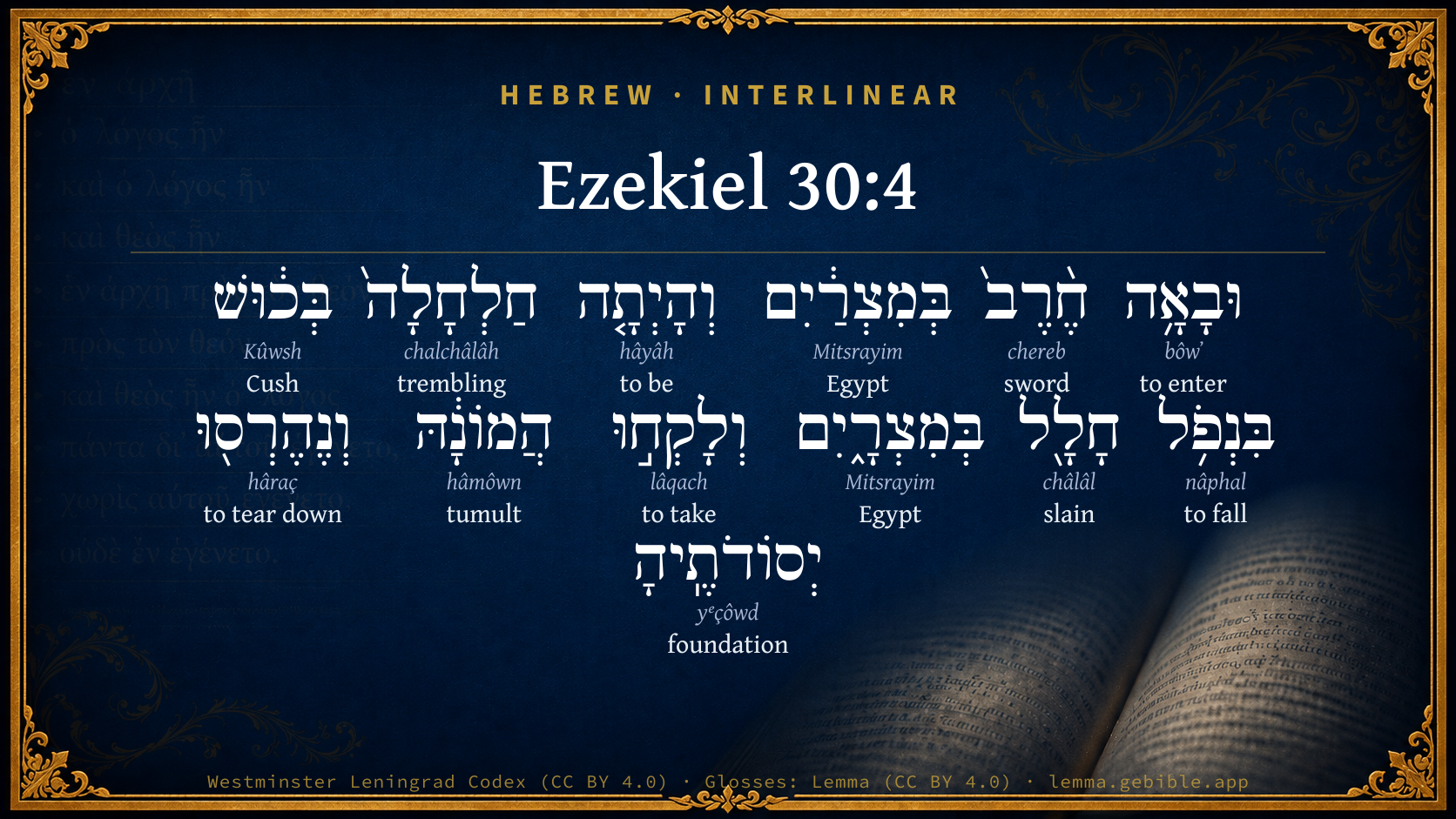
Hebrew (Westminster Leningrad Codex) Ezekiel 30:4 appears in the Hebrew Old Testament. The text above is from the Westminster Leningrad Codex. Each word links to its Strong’s number, a concise gloss, and parsing drawn from the Open Scriptures Hebrew Bible morphology. Click any word for its full Brown-Driver-Briggs (BDB) entry.
Download image
Cite this verse

Ezekiel 30:4 (World English Bible). Public Domain. Lemma interlinear Bible study tool, https://lemma.gebible.app/v/ezekiel/30/4.

Show BibTeX & RIS
BibTeX
RIS
English Translation
A sword shall come on Egypt, and anguish shall be in Ethiopia, when the slain shall fall in Egypt; and they shall take away her multitude, and her foundations shall be broken down.
World English Bible · Public Domain
Download a study sheet

One document with this verse’s original text, its word-by-word gloss line, the meaning frame, cross-references with their text, attributed commentary, and full source and license credits — printable, and it pastes into notes with its structure intact.

This verse Autodidact and up

Study sheet (.html) Plain text (.txt)

A passage Seminary Student

Up to 50 verses in one chapter. A passage sheet keeps up to 6 commentary sources and 12 cross-references per verse, in the order this page ranks them, and says so on the sheet whenever that leaves anything out. Ask for a single verse and you get the Autodidact verse sheet above.

Everything on this page stays free to read, with no account — the sheet is a download of what is already on screen, not access to it.

Want to remove ads? Support Godless Engineer
Compare translations 3

The same verse in 3 English versions, stacked beneath the original-language interlinear above. Click any original word for its lexicon entry.

Each is an independent rendering of the whole verse — the interlinear is not word-aligned to these translations.

Highlighted words mark where these versions differ — a whole-verse word diff, not a word-by-word alignment.

  • World English Bible Public Domain
    A sword shall come on Egypt, and anguish shall be in Ethiopia, when the slain shall fall in Egypt; and they shall take away her multitude, and her foundations shall be broken down.
  • King James Version Public Domain
    And the sword shall come upon Egypt, and great pain shall be in Ethiopia, when the slain shall fall in Egypt, and they shall take away her multitude, and her foundations shall be broken down.
  • unfoldingWord Literal Text CC BY-SA 4.0
    Then a sword will come against Egypt, and there will be anguish in Cush when the killed people fall in Egypt— when they take her wealth, and when her foundations are ruined.

unfoldingWord Literal Text — © unfoldingWord, licensed CC BY-SA 4.0. Word-aligned USFM3 via Door43 (git.door43.org/unfoldingWord/en_ult).

Versions to compare (up to 4)

3 of 4 selected

Show all 18 translations

Every available English version of this verse, each an independent rendering of the whole verse.

  • World English Bible Public Domain
    A sword shall come on Egypt, and anguish shall be in Ethiopia, when the slain shall fall in Egypt; and they shall take away her multitude, and her foundations shall be broken down.
  • Berean Standard Bible Public Domain
    A sword will come against Egypt, and there will be anguish in Cush when the slain fall in Egypt, its wealth is taken away, and its foundations are torn down.
  • Majority Standard Bible Public Domain
    A sword will come against Egypt, and there will be anguish in Cush when the slain fall in Egypt, its wealth is taken away, and its foundations are torn down.
  • King James Version Public Domain
    And the sword shall come upon Egypt, and great pain shall be in Ethiopia, when the slain shall fall in Egypt, and they shall take away her multitude, and her foundations shall be broken down.
  • American Standard Version (1901) Public Domain
    And a sword shall come upon Egypt, and anguish shall be in Ethiopia, when the slain shall fall in Egypt; and they shall take away her multitude, and her foundations shall be broken down.
  • Revised Version (1885) Public Domain
    And a sword shall come upon Egypt, and anguish shall be in Ethiopia, when the slain shall fall in Egypt; and they shall take away her multitude, and her foundations shall be broken down.
  • Geneva Bible (1599) Public Domain
    And the sword shall come vpon Egypt, and feare shall be in Ethiopia, when the slaine shall fall in Egypt, when they shall take away her multitude, and when her foundations shall be broken downe.
  • Douay-Rheims (1899) Public Domain
    And the sword shall come upon Egypt: and there shall be dread in Ethiopia, when the wounded shall fall in Egypt, and the multitude thereof shall be taken away, and the foundations thereof shall be destroyed.
  • Young's Literal Translation Public Domain
    And come in hath a sword to Egypt, And there hath been great pain in Cush, In the falling of the wounded in Egypt, And they have taken its store, And broken down have been its foundations.
  • Literal Standard Version CC BY-SA 4.0
    And a sword has come into Egypt, || And there has been great pain in Cush, || In the falling of the wounded in Egypt, || And they have taken its store, || And its foundations have been broken down.
  • Unlocked Literal Bible CC BY-SA 4.0
    Then a sword will come against Egypt, and there will be anguish in Cush when the killed people fall in Egypt— when they take her wealth, and when her foundations are ruined.
  • unfoldingWord Literal Text CC BY-SA 4.0
    Then a sword will come against Egypt, and there will be anguish in Cush when the killed people fall in Egypt— when they take her wealth, and when her foundations are ruined.
  • Darby Bible Public Domain
    And the sword shall come upon Egypt, and there shall be anguish in Ethiopia, when the slain shall fall in Egypt, and they shall take away her multitude, and her foundations shall be overthrown.
  • World Messianic Bible Public Domain
    A sword will come on Egypt, and anguish will be in Ethiopia, when the slain fall in Egypt. They take away her multitude, and her foundations are broken down.
  • Webster's Bible Public Domain
    And the sword shall come upon Egypt, and great pain shall be in Cush, when the slain shall fall in Egypt, and they shall take away her multitude, and her foundations shall be broken down.
  • Free Bible Version CC BY-SA 4.0
    A sword will come to attack Egypt, and there will be anguish in Cush when people are killed in Egypt, when it's robbed of its wealth and the country ruined.
  • Bible in Basic English Public Domain
    And a sword will come on Egypt, and cruel pain will be in Ethiopia, when they are falling by the sword in Egypt; and they will take away her wealth and her bases will be broken down.
  • JPS Tanakh (1917) Public Domain
    And a sword shall come upon Egypt, and convulsion shall be in Ethiopia, when the slain shall fall in Egypt; and they shall take away her abundance, and her foundation shall be broken down.

Literal Standard Version (2020), Covenant Press — licensed CC BY-SA 4.0. Text via the HelloAO Bible API (eBible.org). Unlocked Literal Bible (unfoldingWord) — licensed CC BY-SA 4.0. Text via the HelloAO Bible API (eBible.org). unfoldingWord Literal Text — © unfoldingWord, licensed CC BY-SA 4.0. Word-aligned USFM3 via Door43 (git.door43.org/unfoldingWord/en_ult). Free Bible Version, Dr. Jonathan Gallagher — licensed CC BY-SA 4.0. Text via the HelloAO Bible API (eBible.org).

Word by word

More ways to search: Search by grammar → Find every occurrence → Compare this word →

Practice this passage: Drill this verse → Learn its vocabulary →

חַלְחָלָה֙
chalchâlâh
H2479
“trembling”
Noun, Common, Feminine, Singular, Absolute
Part of Speech
Noun
Type
Common
Gender
Feminine
Number
Singular
State
Absolute
Full BDB Definition

Origin: from the same as H2478

TWOT: 623f

pain, trembling, terror, writhing, anguish
  1. וּבָאָ֥ה bôwʼ H935 “and · to enter” Conjunction + Verb, Qal, Sequential Perfect, 3rd Person, Feminine, Singular
  2. חֶ֨רֶב֙ chereb H2719 “sword” Noun, Common, Feminine, Singular, Absolute
  3. בְּמִצְרַ֔יִם Mitsrayim H4714 “in/at · Egypt” Preposition + Noun, Proper
  4. וְהָיְתָ֤ה hâyâh H1961 “and · to be” Conjunction + Verb, Qal, Sequential Perfect, 3rd Person, Feminine, Singular
  5. בְּכ֔וּשׁ Kûwsh H3568 “in/at · Cush” Preposition + Noun, Proper
  6. בִּנְפֹ֥ל nâphal H5307 “in/at · to fall” Preposition + Verb, Qal, Infinitive Construct
  7. חָלָ֖ל châlâl H2491 “slain” Adjective, Adjective, Masculine, Singular, Absolute
  8. בְּמִצְרָ֑יִם Mitsrayim H4714 “in/at · Egypt” Preposition + Noun, Proper
  9. וְלָקְח֣וּ lâqach H3947 “and · to take” Conjunction + Verb, Qal, Sequential Perfect, 3rd Person, Common, Plural
  10. הֲמוֹנָ֔הּ hâmôwn H1995 “tumult · her” Noun, Common, Masculine, Singular, Construct + Suffix, Personal, 3rd Person, Feminine, Singular
  11. וְנֶהֶרְס֖וּ hâraç H2040 “and · to tear down” Conjunction + Verb, Niphal, Sequential Perfect, 3rd Person, Common, Plural
  12. יְסוֹדֹתֶֽיהָ yᵉçôwd H3247 “foundations · her” Noun, Common, Masculine, Plural, Construct + Suffix, Personal, 3rd Person, Feminine, Singular

About this verse

These counts appear in no published source. They are computed here, from the morphology-tagged text and Lemma’s own curated glosses. What Lemma adds →

13
words
12
distinct lemmas
Prophets
section

Notable vocabulary

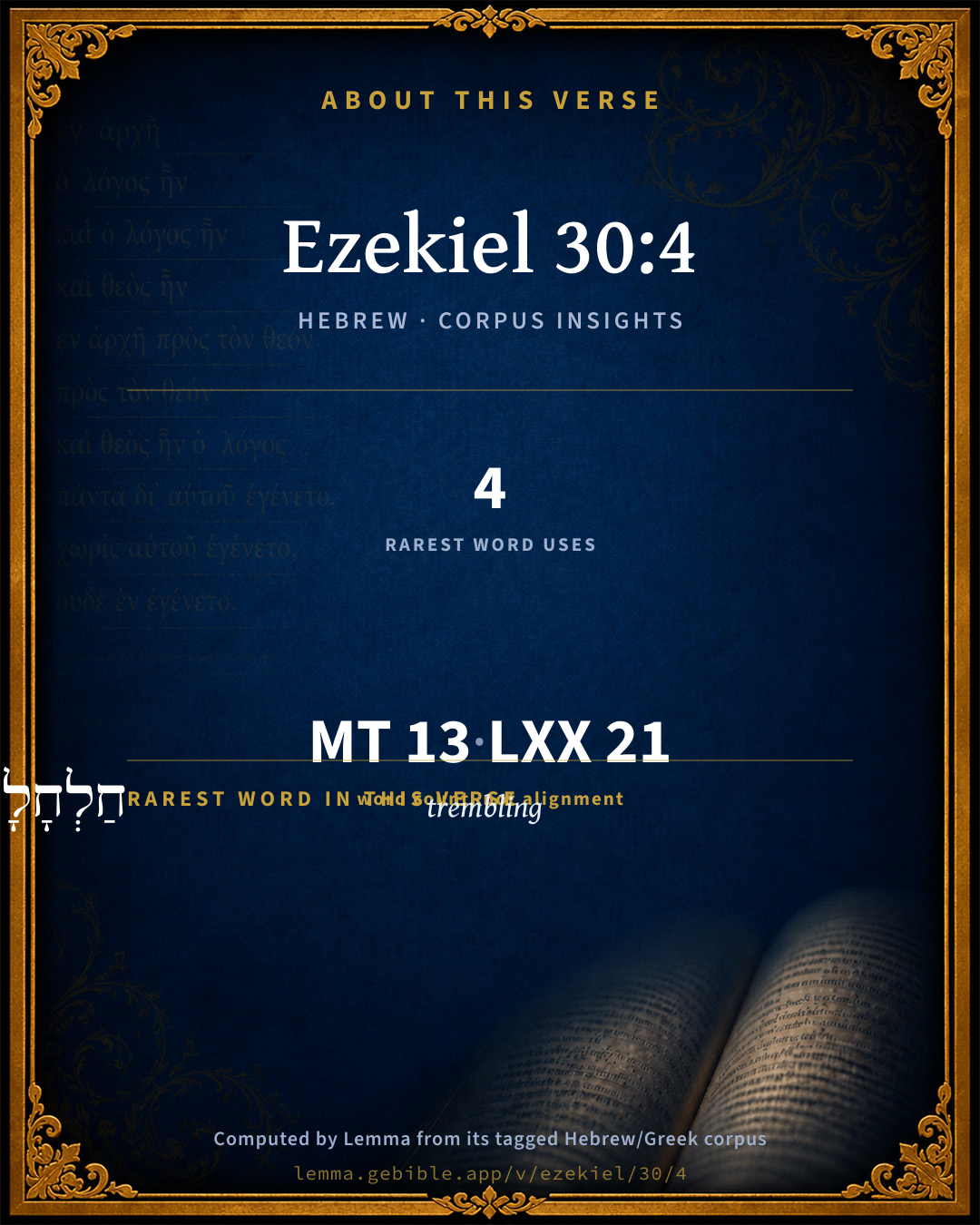
The rarest word here is חַלְחָלָה֙ trembling H2479 — appearing just 4 times in the whole Hebrew Bible.

Shared distinctive vocabulary

חַלְחָלָה֙ trembling H2479 occurs in 4 verses of the Hebrew Bible. Also found in:

Grammatical profile

  • 5 verbs
  • 7 nouns
  • 1 adjective

Verb forms

  • וּבָאָ֥ה Qal · Sequential Perfect
  • וְהָיְתָ֤ה Qal · Sequential Perfect
  • בִּנְפֹ֥ל Qal · Infinitive Construct
  • וְלָקְח֣וּ Qal · Sequential Perfect
  • וְנֶהֶרְס֖וּ Niphal · Sequential Perfect

Repetition

A word recurs within this verse — often emphatic in Hebrew:

  • בְּמִצְרַ֔יִם Egypt H4714 ×2

Hebrew & Septuagint length

In English translation the verse runs 33 words from the Hebrew and 29 from the Septuagint (LXX English) — closely comparable.

A rough comparison of the two English renderings, which tokenize alike — not a word-level alignment.

Word counts can differ between the Hebrew and the Greek without any difference in meaning — e.g. the Hebrew direct-object marker אֵת has no separate Greek word, and Greek often adds the article ὁ.

In the original languages it is 13 Hebrew tokens and 21 Greek tokens — but the two are counted differently (Hebrew bundles its prefixes and suffixes into one token; the Greek is in lemma form), so that isn’t a like-for-like length.

Cross-references

12

Topical passages linked to Ezekiel 30:4 in the Treasury of Scripture Knowledge — connected by theme and wording, ordered by reader-vote popularity; previews shown in the World English Bible.

  • Ezekiel 29:19 Therefore thus says the Lord Yahweh: Behold, I will give the land of Egypt to Nebuchadrezzar king of Babylon; and he shall carry off her multitude, and take her spoil, and take her prey; and it shall be the wages for his army.
  • Ezekiel 29:8 Therefore thus says the Lord Yahweh: Behold, I will bring a sword on you, and will cut off from you man and animal.
  • Exodus 15:14–16 The peoples have heard. They tremble. Pangs have taken hold on the inhabitants of Philistia.
  • Psalms 48:6–7 Trembling took hold of them there, Pain, as of a woman in travail.
  • Isaiah 16:7 Therefore shall Moab wail for Moab, everyone shall wail: for the raisin-cakes of Kir Hareseth shall you mourn, utterly stricken.
  • Isaiah 19:2 I will stir up the Egyptians against the Egyptians: and they shall fight everyone against his brother, and everyone against his neighbor; city against city, [and] kingdom against kingdom.
  • Isaiah 19:16–17 In that day shall the Egyptians be like women; and they shall tremble and fear because of the shaking of the hand of Yahweh of Hosts, which he shakes over them.
  • Jeremiah 50:15 Shout against her round about: she has submitted herself; her bulwarks are fallen, her walls are thrown down; for it is the vengeance of Yahweh: take vengeance on her; as she has done, do to her.
  • Jeremiah 50:35–37 A sword is on the Chaldeans, says Yahweh, and on the inhabitants of Babylon, and on her princes, and on her wise men.
  • Ezekiel 29:12 I will make the land of Egypt a desolation in the midst of the countries that are desolate; and her cities among the cities that are laid waste shall be a desolation forty years; and I will scatter the Egyptians among the nations, and will disperse them through the countries.
  • Ezekiel 30:9–10 In that day shall messengers go forth from before me in ships to make the careless Ethiopians afraid; and there shall be anguish on them, as in the day of Egypt; for, behold, it comes.
  • Revelation 18:9–10 The kings of the earth, who committed sexual immorality and lived wantonly with her, will weep and wail over her, when they look at the smoke of her burning,

Cross-references courtesy of OpenBible.info (CC BY 4.0).

Hebrew and Greek witnesses Masoretic Hebrew ↔ Greek Septuagint

The same verse in the two great witnesses to the Old Testament, shown verse-for-verse.

These are two independent witnesses, not word-aligned to each other, and the Septuagint is shown in lemma (dictionary) form.

Hebrew Ezekiel 30:4 Masoretic · Westminster Leningrad Codex

וּבָאָ֥ה חֶ֨רֶב֙ בְּמִצְרַ֔יִם וְהָיְתָ֤ה חַלְחָלָה֙ בְּכ֔וּשׁ בִּנְפֹ֥ל חָלָ֖ל בְּמִצְרָ֑יִם וְלָקְח֣וּ הֲמוֹנָ֔הּ וְנֶהֶרְס֖וּ יְסוֹדֹתֶֽיהָ

A sword shall come on Egypt, and anguish shall be in Ethiopia, when the slain shall fall in Egypt; and they shall take away her multitude, and her foundations shall be broken down.

World English Bible · Public Domain

Greek LXX Ezekiel 30:4 Septuagint · lemma form

καί ἥκω μάχαιρα ἐπί αἰγύπτιος καί εἰμί ταραχή ἐν ὁ αἰθιοπία καί πίπτω τραυματίζω ἐν αἴγυπτος καί συνπίπτω αὐτός ὁ θεμέλιον

And the sword shall come upon the Egyptians, and there shall be tumult in Ethiopia, and in Egypt men shall fall down slain together, and her foundations shall fall.

LXX2012 (modern English Septuagint) · Public Domain

Hebrew: Westminster Leningrad Codex (CC BY 4.0). Greek: Septuagint (public domain); English from LXX2012 (modern English Septuagint) (Public Domain). How the Septuagint differs from the Hebrew →

Targum (Aramaic paraphrase)

1

The Targum is the ancient Jewish Aramaic paraphrase of the Hebrew Scriptures — an interpretive translation, not the Hebrew text itself. Onkelos (literal) and Pseudo-Jonathan (expansive) render the Torah, and Jonathan the Prophets. Coverage is partial: where no permissively-licensed English translation exists for a verse, only the Aramaic is shown. This is verse-level text, not a word-by-word alignment to the Hebrew.

  1. Targum Jonathan Prophets (Joshua–Malachi)
    וְתָחוֹל חַרְבָּא בְּמִצְרַיִם וִיהֵי זִיעַ בְּכוּשׁ כַּד יִתְרְמוּן קְטִילִין בְּמִצְרַיִם וְיִשְׁבּוּן אִתְרְגוּשְׁתָּהּ וְיִתְפַּגְרוּן אוּשְׁוָתָהָא:

    (no public-domain English translation for this verse)

    Targum Jonathan — Aramaic: “Mikraot Gedolot” (public domain). English: “Sefaria Community Translation” (CC0 1.0 (public-domain dedication)); “London "Chaldee Paraphrase," 1871” (public domain). Text via Sefaria.

Commentary

Notes on Ezekiel 30:4 from classic Christian and Jewish commentators (each source and its license shown beneath its notes). The classic Christian expositions comment on the surrounding passage and are grouped to its opening verse, so a note may address several verses; the Jewish commentaries on the Tanakh (Rashi and others) are per-verse, so they appear only where the commentator wrote on this verse.

Lemma curates 59 commentaries, every one of them public domain or Creative Commons licensed, each selected and text-cleaned for this edition rather than reprinted as found. About our sources →

Trapp's Complete Commentary

John Trapp

Eze 30:4 And the sword shall come upon Egypt, and great pain shall be in Ethiopia, when the slain shall fall in Egypt, and they shall take away her multitude, and her foundations shall be broken down.

Ver. 4. Great pain.] Heb., Pain upon pain, as the throes in childbirth.

John Trapp, A Commentary or Exposition upon All the Books of the Old and New Testament (1647–1656) — public domain. Text from a community e-Sword module.

Jamieson, Fausset & Brown

Robert Jamieson, A. R. Fausset & David Brown

pain--literally, "pangs with trembling as of a woman in childbirth."

Jamieson, Fausset & Brown — Commentary Critical and Explanatory on the Whole Bible (1871) — public domain (CC PDM 1.0). Text via the HelloAO Bible API.

The Cambridge Bible for Schools and Colleges

gen. ed. J. J. S. Perowne

4. great pain] anguish, a late word, cf. Eze_30:9.

her multitude] Ch. Eze_29:19; cf. Eze_29:10; cf. Eze_29:15, ch. Eze_31:2. Her “foundations” is suggested by the idea of a building overthrown. Reference is hardly to the allies and mercenaries on whom Egypt relied in war, rather to the classes and institutions in which the strength of the state lay.

The Cambridge Bible for Schools and Colleges (gen. ed. J. J. S. Perowne; Cambridge University Press, 1878–1918) — public domain. Text from a community e-Sword module.

John Gill's Exposition

And the sword shall come upon Egypt,.... The sword of the Chaldeans shall come upon the Egyptians, by which they should be cut off; it having a commission from the Lord for that purpose:

and great pain shall be in Ethiopia, when the slain shall fall in Egypt; Ethiopia being a neighbouring nation to Egypt, shall be in a panic when it shall hear of the sword of the Chaldeans being in Egypt, and of the ravages made by it, of the multitudes slain with it; fearing it will be their turn next to fall into the same hands, and in the same manner; and the rather, not only as they were neighbours, but allies:

and they shall take away her multitude; that is, the Chaldeans shall carry captive vast numbers of the Egyptians; such as fell not by the sword should not escape the hand of the enemy, but be taken and carried into other lands. Egypt was a very populous country; according to Agrippa's speech in Josephus (f), there were in it 7,500,000 persons from Ethiopia to Alexandria, besides the inhabitants of the latter, as might be gathered from the tribute each person paid; hence they are compared to the trees of a forest that cannot be searched, and to grasshoppers innumerable, Jer 46:23, but now their numbers should be lesser:

and her foundations shall be broken down; either in a literal sense, the foundations of the cities, towers, and fortified places in Egypt, should be undermined and destroyed, and consequently the buildings on them must sink and fall; or in a figurative sense, her king, princes, magistrates, laws, and government, which are the support of a state, should be removed, and be of no more service.

(f) De Bello Jud. l. 2. c. 16. sect. 4.

John Gill's Exposition of the Whole Bible (1746–1763) — public domain (CC PDM 1.0). Text via the HelloAO Bible API.

Haydock's Catholic Bible Commentary

Ethiopia. Hebrew, "Chus," denoting part of Arabia, or rather Ethiopia.

George Leo Haydock (1774–1849), Haydock's Catholic Family Bible and Commentary, 1859 edition — public domain. Excludes Psalms (Douay-Rheims chapter numbering differs from Protestant) and Deuterocanonical books (Catholic canon only).

Matthew Poole's English Annotations

The sword: see Eze 29:8.

In Ethiopia; next neighbour and ally to Egypt; they shall tremble at so great danger, so near, and they uncertain whether it will come on them, but very certain to be ruined if it does come, and as certain that they have cause to suspect it will come on them.

When the slain shall fall in Egypt; when the Egyptians, under the eye of the Ethiopians, shall fall in battle, and at the taking of their towns.

They shall take away her multitude; in miserable captivity carry them to Babylon, by whole droves.

Her foundations, their government, laws, counsellors, strong holds, which are to a nation as foundations to a house, are destroyed.

Matthew Poole's English Annotations on the Holy Bible (1683–1685) — public domain. Text from a community e-Sword/MySword module.

Whedon's Commentary on the Bible

Daniel D. Whedon

4. Multitude — See Eze_29:19.

Her foundations shall be broken down — The national power of Egypt was as strong as her temple walls, but both should feel the shock of invasion.

Daniel D. Whedon (gen. ed.), Commentary on the Old and New Testaments (1874–1909) — public domain. Text from a community e-Sword module.

The Pulpit Commentary

Great pain shall be in Ethiopia. The words point to the extension of the invasion of Egypt by Nebuchadnezzar in the first instance, and afterwards by other conquerors to the upper valley of the Nile. They shall take away her multitude. The word is taken by Keil, Smend, and others of things rather than persons, the multitude of possessions. Hengstenberg renders "tumult" in the sense of the stir of a crowded city. The foundations are probably to be taken figuratively of the bases of the prosperity of Egypt, its allies and mercenaries, rather than of actual buildings. (comp. Psa_11:3 Psa_82:5)

Vers. 4-6. Associated calamities.

I TROUBLE SPREADS.

1. In the individual. The first mischief in Egypt comes from the sword of the invader; but this is quickly followed by other ills. After Nebuchadnezzar"s invasion the "abundance" is taken away, and the "foundations" are broken down.

2. Among communities of men. Cush follows the fate of Egypt, and other nations also fall under the wide sweep of judgment. We are members one of another, and when one member suffers all the members suffer. No people can afford to ignore the ruin of their neighbors. Selfish indifference is ultimately punished by a man"s being compelled to share the sad consequences of the troubles of those whom he has neglected.

II ASSOCIATION IN SIN WILL BE FOLLOWED BY ASSOCIATION IN PUNISHMENT. Cash was joined to Egypt in wickedness; she will be joined to the greater nation in suffering. He who walks in the way of sinners will come to the end of sinners. There is no assurance against the fatal consequences of wickedness that can be effected by means of association. "Though hand join in hand, the wicked shall not be unpunished". (Pro_11:21)

III THERE IS NO PROTECTION IN OBSCURITY. Poor Cush and Phut and Lud are obscure, unimportant, and remote. Yet they share the fate of better-known Egypt-No one can hide his sin under the cloak of his own insignificance. No ferret is so keen as a man"s own sin when the time comes for it to find him out.

IV ALLIANCE WITH GREAT SINNERS WILL NOT AFFORD ANY PROTECTION. These other nations were joined to great Egypt. But this alliance did not save then. On the contrary, the grandeur of Egypt attracted Nebuchadnezzar to their neighborhood. Had there been no rich and famous Egypt, he would not have troubled himself to attack Cush and Phut and Lud. We gain nothing by the power or prestige of influential connections when we are called to judgment for our sins.

V THEY ARE GUILTY OF SIN WHO AID AND ABET IT. These neighboring nations uphold Egypt. They will share her fate. From Migdol on the Delta to the granite-quarries of Syene far away to the south on the borders of the Soudan five hundred miles the ruin of great Egypt will extend; it will also spread to the people who support her policy and contribute to her prosperity. He who makes others to sin is himself the greatest of sinners. Fagin the trainer of child-thieves is himself a monstrous thief, though he never steals a handkerchief with his own fingers. People who encourage opium-eating, drunkenness, or profligacy, by supporting the causes of those evils, are guilty of them. The mercenaries of Egypt share the fate of their wealthy mistress. There are too many mercenaries of sin in the present day. For the sake of gain men will carry on a business which they know is directly ministering to the ruin of their fellow-creatures. They attempt to defend themselves with the excuse that they do not force those whom they supply with the means of self-destruction to avail themselves of it. This is true; but, on the other hand, they tempt the miserable victims by affording facility for fatal indulgence. That is the sin of Satan.

The Pulpit Commentary (1880–1919), ed. H.D.M. Spence-Jones & Joseph S. Exell — public domain. Text from a community e-Sword module.

John Wesley's Explanatory Notes

Ethiopia - The neighbour and ally to Egypt. Take away - Into miserable captivity. Her foundations - Their government, laws, and strong holds.

John Wesley, Explanatory Notes Upon the Whole Bible (1754–1765) — public domain. Text via the GEBible commentary corpus.

unfoldingWord translationNotes

Door43 World Missions Community

General Information:

These are Yahweh's words about Egypt.

Then a sword will come against Egypt

The word "sword" here represents war or an army that attacks. AT: "There will be war against Egypt" or "An enemy army will attack Egypt" (See: Metonymy)

there will be anguish in Cush

The abstract noun "anguish" can be expressed in terms of how the people feel. AT: "the people of Cush will be very sad" or "the people of Cush will suffer" (See: Abstract Nouns)

when the killed people fall in Egypt

Possible meanings are that 1) "fall" is a euphemism for dying. AT: "when people in Egypt die in war" or 2) "fall" refers to their bodies falling and lying on the ground. AT: "when people in Egypt die in war and lie fallen" (See: Euphemism)

when they take her wealth

"when the attackers take away the wealth of Egypt"

when her foundations are ruined

This can be translated in active form. AT: "when the attackers destroy the foundations of the buildings in Egypt" (See: Active or Passive)

Cush and Put, Lydia and all Arabia, and Libya

These names refer to the people of these countries. AT: "The people of Cush and Put, Libya, and all Arabia, and Lydia" (See: Metonymy)

Libya

Libya is a country west of Egypt. (See: How to Translate Names)

Lydia

This probably refers to the kingdom of Lydia which was in what is now Turkey.

the people belonging to the covenant

Possible meanings are 1) the "covenant" refers to the agreement that Yahweh made with the Israelites. AT: "the Jews who live in Egypt" or 2) the "covenant" refers to an agreement that Egypt made with other nations. AT: "the people of the nations that had a covenant with Egypt" or "Egypt's allies" (See: Assumed Knowledge and Implicit Information)

will all fall by the sword

Here the sword represents battle. AT: "will all die in battle" or "will all die in the war" (See: Metonymy)

will all fall by the sword

The word "all" here is a generalization. It means that many people will die. (See: Hyperbole and Generalization)

translationWords

sword

Egypt

Cush

found

ruin

covenant

unfoldingWord translationNotes — © Distant Shores Media and the Door43 World Missions Community, licensed CC BY-SA 4.0. Source: git.door43.org/Door43/en_tn.

Rashi

Rabbi Shlomo Yitzchaki (Rashi)

and there will be quaking in Cush [Heb. חַלְחָלָה,] expression of trembling. When they hear of Egypt’s downfall, they will fear for their lives: perhaps the king of Babylon will rise up against them.

Rashi on the Tanakh — English translations: “The Judaica Press complete Tanach with Rashi, translated by A. J. Rosenberg” (CC BY 4.0); “Pentateuch with Rashi's commentary by M. Rosenbaum and A.M. Silbermann, 1929-1934” (public domain); “The Metsudah Tanach series, Lakewood, N.J” (CC BY 4.0); and “The Book of Joshua, Metsudah Publications, 1997” (CC BY 4.0). Text via Sefaria.

Lesson kit

Teaching starters — assembled from the data on this page, not authored interpretation. Every prompt links to the verse data it draws on. Edit before teaching.

Ezekiel, in the Prophets, opens this verse with 13 words (12 distinct Hebrew lemmas). Its most distinctive word is chalchâlâh (“trembling”). A historical commentator’s framing appears above. Read the whole chapter for the surrounding context.

Discussion questions

  1. How does “trembling” (chalchâlâh) shape what this verse is saying?
  2. Isaiah 21:3 shares the word «trembling» with this verse. How do the two illuminate each other?
  3. “Egypt” occurs 2× in this one verse. What is the effect of the repetition?
  4. The translations on this page render this verse differently — a whole-verse word diff, not a word-by-word alignment. What might account for the different wordings?
  5. The verb «וּבָאָ֥ה» is Qal Sequential Perfect. How does its form color the action?
  6. Reading how Trapp's Complete Commentary and Jamieson, Fausset & Brown read this verse, where do the two commentators agree and where do they part?

Things to notice

Reading settings

Reading text

Shown beneath each verse's original-language words.

Old Testament
Old Testament edition

Read the OT as the Masoretic Hebrew (MT) or the Greek Septuagint (LXX).

English shown for the Greek Septuagint (in the Hebrew ↔ Greek comparison).

Comparing translations? Open the Compare panel on any verse page to stack up to four side by side.