Exodus 21:27

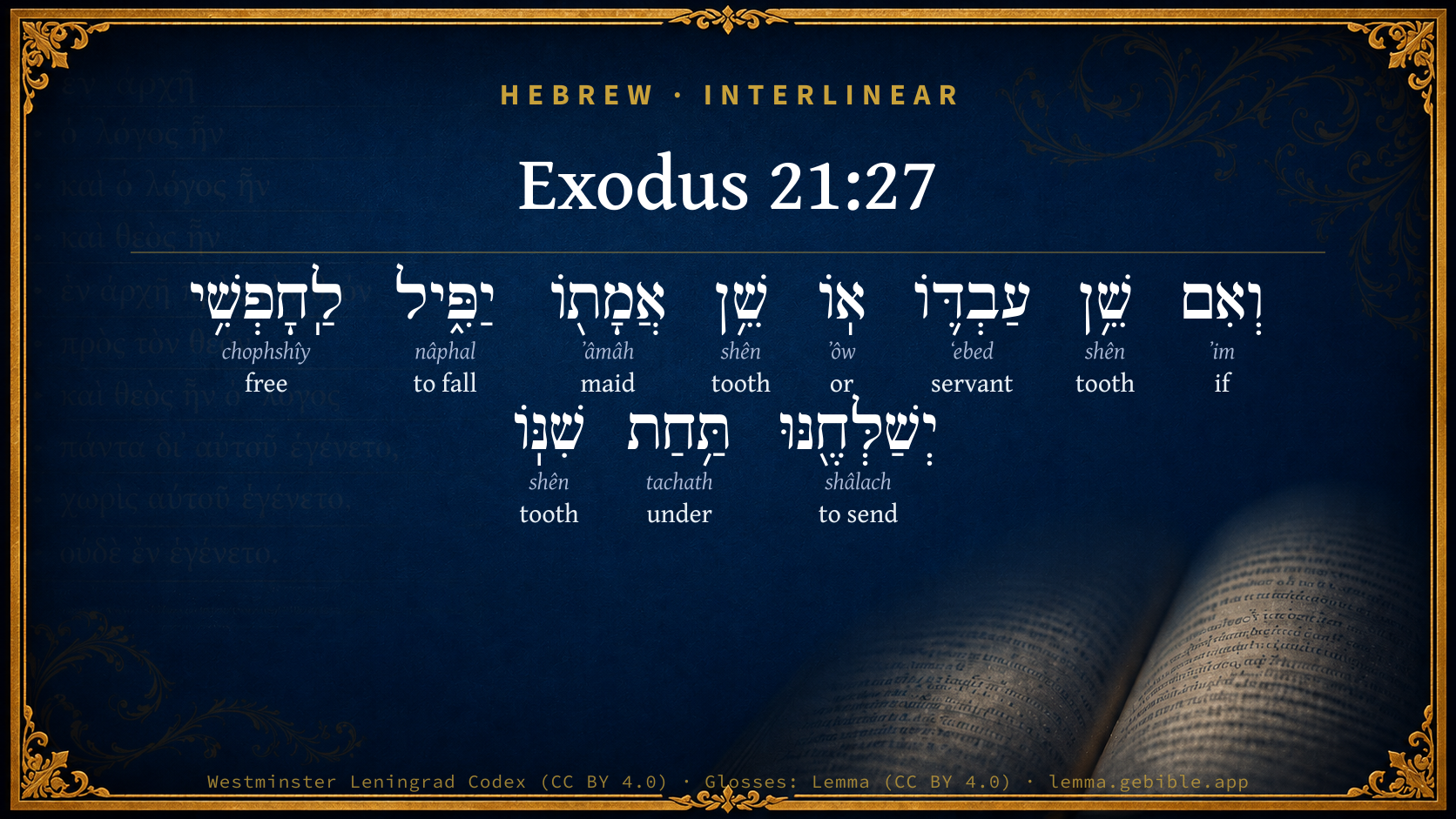
Hebrew (Westminster Leningrad Codex) Exodus 21:27 appears in the Hebrew Old Testament. The text above is from the Westminster Leningrad Codex. Each word links to its Strong’s number, a concise gloss, and parsing drawn from the Open Scriptures Hebrew Bible morphology. Click any word for its full Brown-Driver-Briggs (BDB) entry.
Download image
Cite this verse

Exodus 21:27 (World English Bible). Public Domain. Lemma interlinear Bible study tool, https://lemma.gebible.app/v/exodus/21/27.

Show BibTeX & RIS
BibTeX
RIS
English Translation
If he strikes out his man-servant's tooth, or his maid-servant's tooth, he shall let him go free for his tooth's sake.
World English Bible · Public Domain
Download a study sheet

One document with this verse’s original text, its word-by-word gloss line, the meaning frame, cross-references with their text, attributed commentary, and full source and license credits — printable, and it pastes into notes with its structure intact.

This verse Autodidact and up

Study sheet (.html) Plain text (.txt)

A passage Seminary Student

Up to 50 verses in one chapter. A passage sheet keeps up to 6 commentary sources and 12 cross-references per verse, in the order this page ranks them, and says so on the sheet whenever that leaves anything out. Ask for a single verse and you get the Autodidact verse sheet above.

Everything on this page stays free to read, with no account — the sheet is a download of what is already on screen, not access to it.

Want to remove ads? Support Godless Engineer
Compare translations 3

The same verse in 3 English versions, stacked beneath the original-language interlinear above. Click any original word for its lexicon entry.

Each is an independent rendering of the whole verse — the interlinear is not word-aligned to these translations.

Highlighted words mark where these versions differ — a whole-verse word diff, not a word-by-word alignment.

  • World English Bible Public Domain
    If he strikes out his man-servant's tooth, or his maid-servant's tooth, he shall let him go free for his tooth's sake.
  • King James Version Public Domain
    And if he smite out his manservant's tooth, or his maidservant's tooth; he shall let him go free for his tooth's sake.
  • unfoldingWord Literal Text CC BY-SA 4.0
    And if he knocks out a tooth of his male servant or a tooth of his female servant, he shall let him go free as compensation for the tooth.

unfoldingWord Literal Text — © unfoldingWord, licensed CC BY-SA 4.0. Word-aligned USFM3 via Door43 (git.door43.org/unfoldingWord/en_ult).

Versions to compare (up to 4)

3 of 4 selected

Show all 18 translations

Every available English version of this verse, each an independent rendering of the whole verse.

  • World English Bible Public Domain
    If he strikes out his man-servant's tooth, or his maid-servant's tooth, he shall let him go free for his tooth's sake.
  • Berean Standard Bible Public Domain
    And if he knocks out the tooth of his manservant or maidservant, he must let the servant go free as compensation for the tooth.
  • Majority Standard Bible Public Domain
    And if he knocks out the tooth of his manservant or maidservant, he must let the servant go free as compensation for the tooth.
  • King James Version Public Domain
    And if he smite out his manservant's tooth, or his maidservant's tooth; he shall let him go free for his tooth's sake.
  • American Standard Version (1901) Public Domain
    And if he smite out his man-servant's tooth, or his maid-servant's tooth, he shall let him go free for his tooth's sake.
  • Revised Version (1885) Public Domain
    And if he smite out his manservant’s tooth, or his maidservant’s tooth; he shall let him go free for his tooth’s sake.
  • Geneva Bible (1599) Public Domain
    Also if he smite out his seruants tooth, or his maides tooth, he shall let him goe out free for his tooth.
  • Douay-Rheims (1899) Public Domain
    Also if he strike out a tooth of his manservant or maidservant, he shall in like manner make them free.
  • Young's Literal Translation Public Domain
    and if a tooth of his man-servant or a tooth of his handmaid he knock out, as a freeman he doth send him away for his tooth.
  • Literal Standard Version CC BY-SA 4.0
    and if he knocks out a tooth of his manservant or a tooth of his handmaid, he sends him away as a freeman for his tooth.
  • Unlocked Literal Bible CC BY-SA 4.0
    If he knocks out a tooth of his male servant or female servant, he must let the servant go free as compensation for the tooth.
  • unfoldingWord Literal Text CC BY-SA 4.0
    And if he knocks out a tooth of his male servant or a tooth of his female servant, he shall let him go free as compensation for the tooth.
  • Darby Bible Public Domain
    And if he knock out his bondman's tooth or his handmaid's tooth, he shall let him go free for his tooth.
  • World Messianic Bible Public Domain
    If he strikes out his male servant’s tooth, or his female servant’s tooth, he shall let the servant go free for his tooth’s sake.
  • Webster's Bible Public Domain
    And if he shall smite out his man-servant's tooth, or his maid-servant's tooth; he shall let him go free for his tooth's sake.
  • Free Bible Version CC BY-SA 4.0
    Anyone who knocks out the tooth of their male or female slave must free the slave as compensation for the tooth.
  • Bible in Basic English Public Domain
    Or if the loss of a tooth is caused by his blow, he will let him go free on account of his tooth.
  • JPS Tanakh (1917) Public Domain
    And if he smite out his bondman's tooth, or his bondwoman's tooth, he shall let him go free for his tooth's sake.

Literal Standard Version (2020), Covenant Press — licensed CC BY-SA 4.0. Text via the HelloAO Bible API (eBible.org). Unlocked Literal Bible (unfoldingWord) — licensed CC BY-SA 4.0. Text via the HelloAO Bible API (eBible.org). unfoldingWord Literal Text — © unfoldingWord, licensed CC BY-SA 4.0. Word-aligned USFM3 via Door43 (git.door43.org/unfoldingWord/en_ult). Free Bible Version, Dr. Jonathan Gallagher — licensed CC BY-SA 4.0. Text via the HelloAO Bible API (eBible.org).

Word by word

More ways to search: Search by grammar → Find every occurrence → Compare this word →

Practice this passage: Drill this verse → Learn its vocabulary →

לַֽחָפְשִׁ֥י
chophshîy
H2670
“to/for the · free”
Preposition, Determined + Adjective, Adjective, Masculine, Singular, Absolute
Part of Speech
Preposition + Adjective
Type
Adjective
Gender
Masculine
Number
Singular
State
Absolute
Full BDB Definition

Origin: from H2666

TWOT: 717c

free - free (from slavery) - free (from taxes or obligations)
  1. וְאִם ʼim H518 “and · if” Conjunction + Conjunction
  2. שֵׁ֥ן shên H8127 “tooth of” Noun, Common, Both, Singular, Construct
  3. עַבְדּ֛וֹ ʻebed H5650 “servant · his” Noun, Common, Masculine, Singular, Construct + Suffix, Personal, 3rd Person, Masculine, Singular
  4. אֽוֹ ʼôw H176 “or” Conjunction
  5. שֵׁ֥ן shên H8127 “tooth of” Noun, Common, Both, Singular, Construct
  6. אֲמָת֖וֹ ʼâmâh H519 “maid · his” Noun, Common, Feminine, Singular, Construct + Suffix, Personal, 3rd Person, Masculine, Singular
  7. יַפִּ֑יל nâphal H5307 “to fall” Verb, Hiphil, Imperfect, 3rd Person, Masculine, Singular
  8. יְשַׁלְּחֶ֖נּוּ shâlach H7971 “to send · him” Verb, Piel, Imperfect, 3rd Person, Masculine, Singular + Suffix, Personal, 3rd Person, Masculine, Singular
  9. תַּ֥חַת tachath H8478 “under” Preposition
  10. שִׁנּֽוֹ shên H8127 “tooth · his” Noun, Common, Both, Singular, Construct + Suffix, Personal, 3rd Person, Masculine, Singular

About this verse

These counts appear in no published source. They are computed here, from the morphology-tagged text and Lemma’s own curated glosses. What Lemma adds →

11
words
9
distinct lemmas
Pentateuch
section

Notable vocabulary

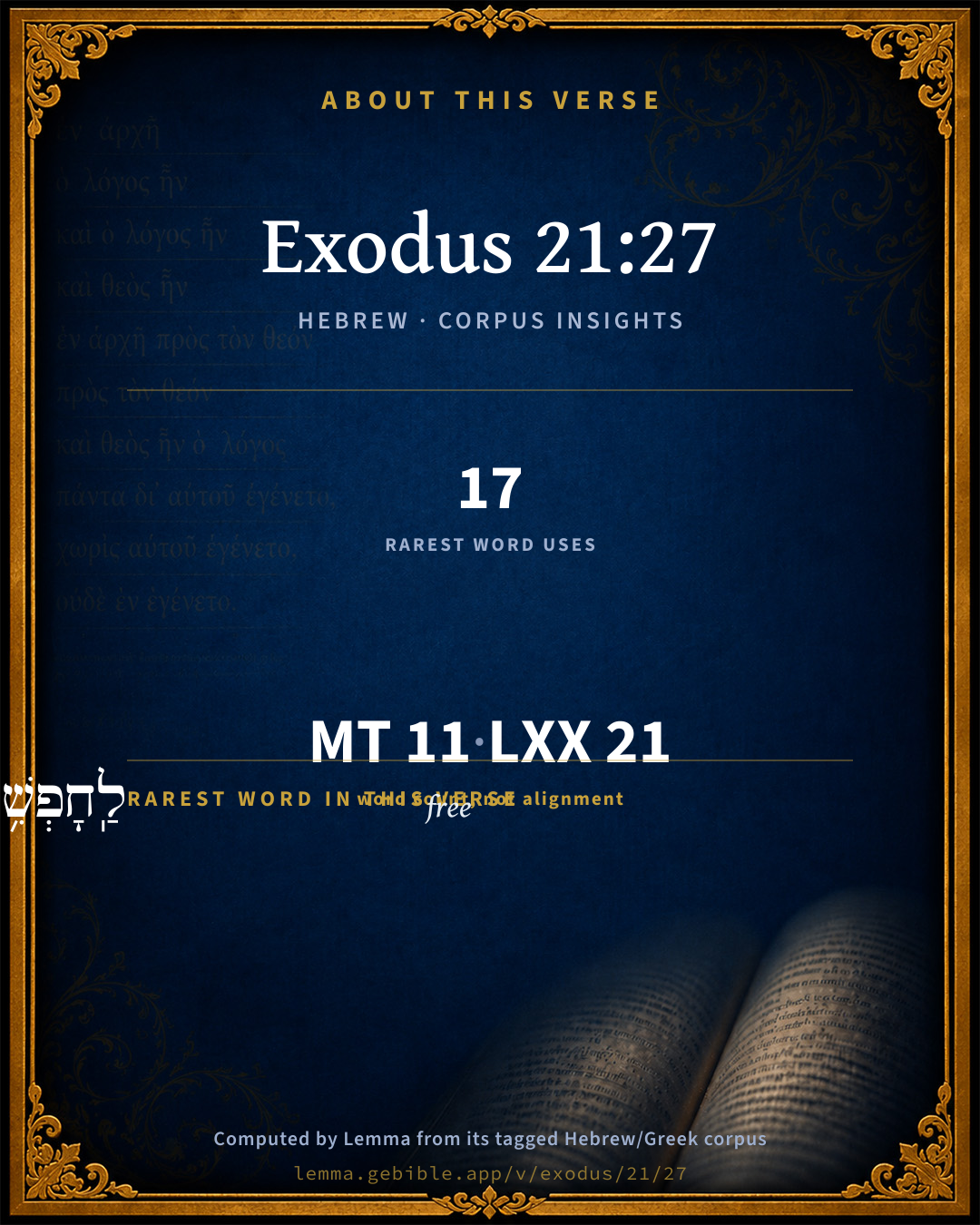
The rarest word here is לַֽחָפְשִׁ֥י free H2670 — appearing just 17 times in the whole Hebrew Bible.

Shared distinctive vocabulary

לַֽחָפְשִׁ֥י free H2670 occurs in 17 verses of the Hebrew Bible. Also found in:

Grammatical profile

  • 2 verbs
  • 5 nouns
  • 1 adjective
  • 1 preposition
  • 2 conjunctions

Verb forms

  • יַפִּ֑יל Hiphil · Imperfect
  • יְשַׁלְּחֶ֖נּוּ Piel · Imperfect

Repetition

A word recurs within this verse — often emphatic in Hebrew:

  • שֵׁ֥ן tooth H8127 ×3

Hebrew & Septuagint length

In English translation the verse runs 21 words from the Hebrew and 27 from the Septuagint (LXX English) — closely comparable.

A rough comparison of the two English renderings, which tokenize alike — not a word-level alignment.

Word counts can differ between the Hebrew and the Greek without any difference in meaning — e.g. the Hebrew direct-object marker אֵת has no separate Greek word, and Greek often adds the article ὁ.

In the original languages it is 11 Hebrew tokens and 21 Greek tokens — but the two are counted differently (Hebrew bundles its prefixes and suffixes into one token; the Greek is in lemma form), so that isn’t a like-for-like length.

Hebrew and Greek witnesses Masoretic Hebrew ↔ Greek Septuagint

The same verse in the two great witnesses to the Old Testament, shown verse-for-verse.

These are two independent witnesses, not word-aligned to each other, and the Septuagint is shown in lemma (dictionary) form.

Hebrew Exodus 21:27 Masoretic · Westminster Leningrad Codex

וְאִם שֵׁ֥ן עַבְדּ֛וֹ אֽוֹ שֵׁ֥ן אֲמָת֖וֹ יַפִּ֑יל לַֽחָפְשִׁ֥י יְשַׁלְּחֶ֖נּוּ תַּ֥חַת שִׁנּֽוֹ

If he strikes out his man-servant's tooth, or his maid-servant's tooth, he shall let him go free for his tooth's sake.

World English Bible · Public Domain

Greek LXX Exodus 21:27 Septuagint · lemma form

ἐάν δέ ὁ ὀδούς ὁ οἰκέτης ἤ ὁ ὀδούς ὁ θεράπαινα αὐτός ἐκκόπτω ἐλεύθερος ἐκ ἀποστέλλω αὐτός ἀντί ὁ ὀδούς αὐτός

And if he should strike out the tooth of his man-servant, or the tooth of his maidservant, he shall send them away free for their tooth's sake.

LXX2012 (modern English Septuagint) · Public Domain

Hebrew: Westminster Leningrad Codex (CC BY 4.0). Greek: Septuagint (public domain); English from LXX2012 (modern English Septuagint) (Public Domain). How the Septuagint differs from the Hebrew →

Targum (Aramaic paraphrase)

2

The Targum is the ancient Jewish Aramaic paraphrase of the Hebrew Scriptures — an interpretive translation, not the Hebrew text itself. Onkelos (literal) and Pseudo-Jonathan (expansive) render the Torah, and Jonathan the Prophets. Coverage is partial: where no permissively-licensed English translation exists for a verse, only the Aramaic is shown. This is verse-level text, not a word-by-word alignment to the Hebrew.

  1. Targum Onkelos Torah (Genesis–Deuteronomy)
    וְאִם שִׁנָא דְעַבְדֵהּ אוֹ שִּׁנָא דְאַמְתֵהּ יַפֵּל לְבַר חוֹרִין יִפְטְרִנֵהּ חֳלָף שִׁנֵהּ:

    (no public-domain English translation for this verse)

    Targum Onkelos — Aramaic: “Onkelos Genesis” (public domain); “Onkelos Exodus” (public domain); “Onkelos Leviticus” (public domain); “Onkelos Numbers” (public domain); “Onkelos Deuteronomy” (public domain). English: “Sefaria Community Translation” (CC0 1.0 (public-domain dedication)); “J.W. Etheridge. The Targums of Onkelos and Jonathan Ben Uzziel on the Pentateuch. London: Longmans, Green, 1862” (public domain). Text via Sefaria.

  2. Targum Pseudo-Jonathan Torah (Genesis–Deuteronomy)
    וְאִין שִׁינָא דְעַבְדֵיהּ כְּנַעֲנָאֵי אוֹ שִׁינָא דְאַמְתֵיהּ כְּנַעֲנִיתָא יַפִּיל לְבַר חוֹרִין יִפְטְרִינֵיהּ חוֹלַף שִׁינֵיהּ

    And if he strike out the tooth of his Kenaanite man or maid-servant, he shall make the servant free on account of the tooth.

    Targum Pseudo-Jonathan — Aramaic: “Targum Jonathan on Genesis” (public domain); “Targum Jonathan on Exodus” (public domain); “Targum Jonathan on Leviticus” (public domain); “Targum Jonathan on Numbers” (public domain); “Targum Jonathan on Deuteronomy” (public domain). English: “The Targum of Jonathan ben Uzziel, trans. J. W. Etheridge, London, 1862” (public domain). Text via Sefaria.

Commentary

Notes on Exodus 21:27 from classic Christian and Jewish commentators (each source and its license shown beneath its notes). The classic Christian expositions comment on the surrounding passage and are grouped to its opening verse, so a note may address several verses; the Jewish commentaries on the Tanakh (Rashi and others) are per-verse, so they appear only where the commentator wrote on this verse.

Lemma curates 59 commentaries, every one of them public domain or Creative Commons licensed, each selected and text-cleaned for this edition rather than reprinted as found. About our sources →

Geneva Bible (1599)

Geneva Bible translators

So God revengeth cruelty in the most least things.

Geneva Bible (1599) marginal notes — public domain. Text via Bolls.life.

Adam Clarke's Commentary

Verse 27. If he smite out his - tooth] It was a noble law that obliged the unmerciful slaveholder to set the slave at liberty whose eye or tooth he had knocked out. If this did not teach them humanity, it taught them caution, as one rash blow might have deprived them of all right to the future services of the slave; and thus self-interest obliged them to be cautious and circumspect.

Adam Clarke's Commentary on the Bible (1810–1826) — public domain. Text from a community e-Sword/MySword module.

John Gill's Exposition

And if he smite out his manservant's tooth, or his maidservant's tooth,.... Give them such a slap on the face, or a blow on the mouth, as to strike out one of their teeth; this also the Targum of Jonathan and Jarchi restrain to a Canaanitish servant or maid:

he shall let him go free for his tooth's sake; both him and her, the servant and the maid; this, though of lesser consequence than the loss of an eye, was punished in the same manner with the loss of the servant man or maid, to make masters careful how they abused their servants in any degree. And though only these parts are expressed, yet Jarchi and Aben Ezra observe, that all other principal members of the body, which they reckon to be twenty four, are included, as the fingers, toes, &c.

John Gill's Exposition of the Whole Bible (1746–1763) — public domain (CC PDM 1.0). Text via the HelloAO Bible API.

Matthew Poole's English Annotations

Some confine this to the Israelitish servants, but the text doth not so limit it; and the reason of the law seems to reach to Gentile servants, this being a just punishment to unmerciful masters, (who ought to be merciful to their beasts, much more to such servants,) and a fit recompence to a servant for such a loss. And this law reacheth the loss of any other member, these two being instanced in, the one as the chief, and the other as the meanest, to intimate that other parts of a like or middle nature are included.

Matthew Poole's English Annotations on the Holy Bible (1683–1685) — public domain. Text from a community e-Sword/MySword module.

Lesson kit

Teaching starters — assembled from the data on this page, not authored interpretation. Every prompt links to the verse data it draws on. Edit before teaching.

Exodus, in the Pentateuch, opens this verse with 11 words (9 distinct Hebrew lemmas). Its most distinctive word is chophshîy (“free”). A historical commentator’s framing appears above. Read the whole chapter for the surrounding context.

Discussion questions

  1. What does “free” (chophshîy) contribute to the verse as a whole?
  2. Exodus 21:2 shares the word «free» with this verse. How do the two illuminate each other?
  3. “tooth” occurs 3× in this one verse. What is the effect of the repetition?
  4. These translations render this verse differently. What is at stake in choosing one wording over another?
  5. The verb «יַפִּ֑יל» is Hiphil Imperfect. How does its form color the action?
  6. Reading how Geneva Bible (1599) and Adam Clarke's Commentary read this verse, where do the two commentators agree and where do they part?

Things to notice

Reading settings

Reading text

Shown beneath each verse's original-language words.

Old Testament
Old Testament edition

Read the OT as the Masoretic Hebrew (MT) or the Greek Septuagint (LXX).

English shown for the Greek Septuagint (in the Hebrew ↔ Greek comparison).

Comparing translations? Open the Compare panel on any verse page to stack up to four side by side.