
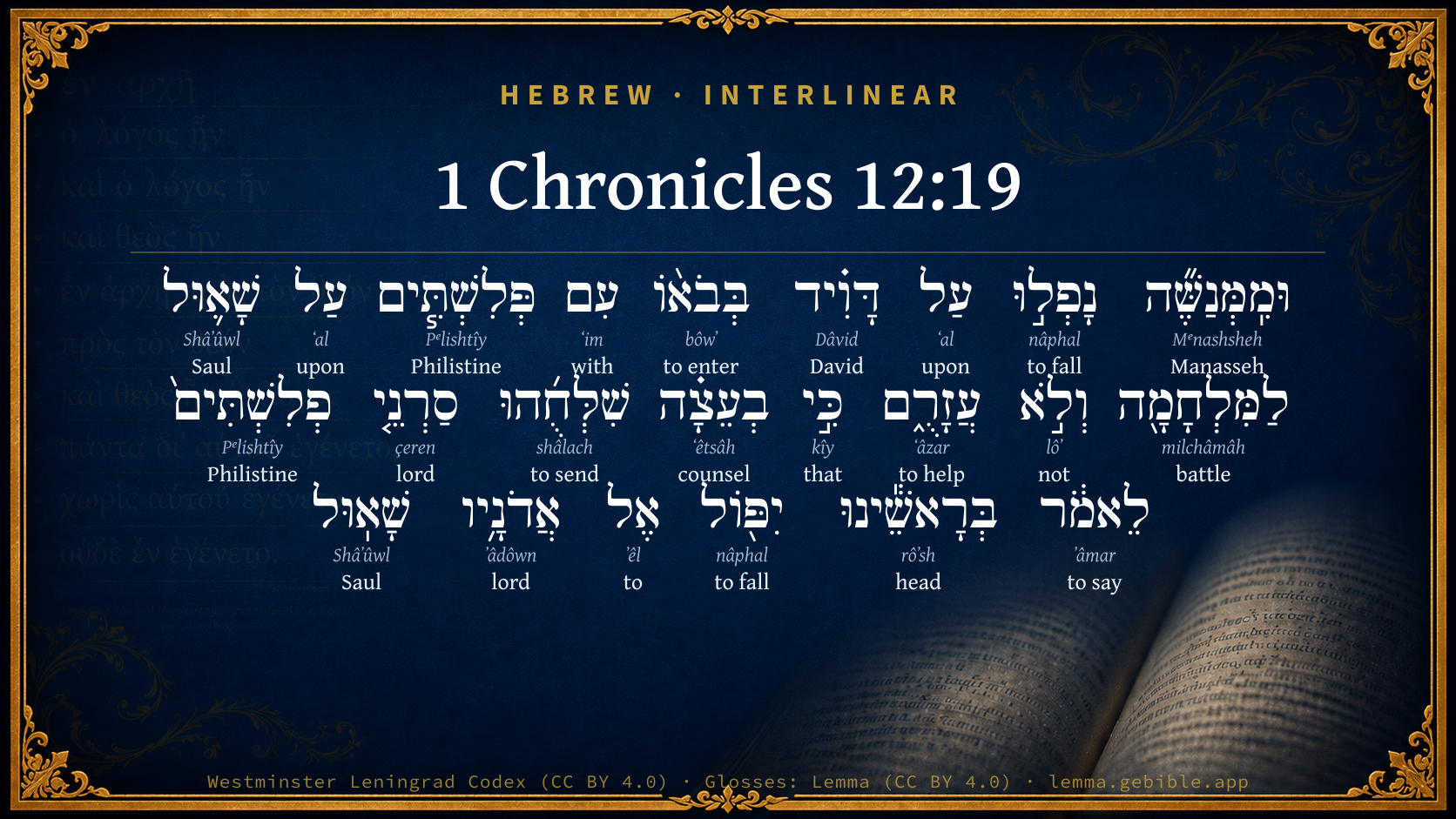
1 Chronicles 12:19

Hebrew (Westminster Leningrad Codex) 1 Chronicles 12:19 appears in the Hebrew Old Testament. The text above is from the Westminster Leningrad Codex. Each word links to its Strong’s number, a concise gloss, and parsing drawn from the Open Scriptures Hebrew Bible morphology. Click any word for its full Brown-Driver-Briggs (BDB) entry.
Download image
Cite this verse

1 Chronicles 12:19 (World English Bible). Public Domain. Lemma interlinear Bible study tool, https://lemma.gebible.app/v/1-chronicles/12/19.

Show BibTeX & RIS
BibTeX
RIS
English Translation
Of Manasseh also there fell away some to David, when he came with the Philistines against Saul to battle: but they didn't help them; for the lords of the Philistines sent him away after consultation, saying, He will fall away to his master Saul to the jeopardy of our heads.
World English Bible · Public Domain
Download a study sheet

One document with this verse’s original text, its word-by-word gloss line, the meaning frame, cross-references with their text, attributed commentary, and full source and license credits — printable, and it pastes into notes with its structure intact.

This verse Autodidact and up

Study sheet (.html) Plain text (.txt)

A passage Seminary Student

Up to 50 verses in one chapter. A passage sheet keeps up to 6 commentary sources and 12 cross-references per verse, in the order this page ranks them, and says so on the sheet whenever that leaves anything out. Ask for a single verse and you get the Autodidact verse sheet above.

Everything on this page stays free to read, with no account — the sheet is a download of what is already on screen, not access to it.

Want to remove ads? Support Godless Engineer
Compare translations 3

The same verse in 3 English versions, stacked beneath the original-language interlinear above. Click any original word for its lexicon entry.

Each is an independent rendering of the whole verse — the interlinear is not word-aligned to these translations.

Highlighted words mark where these versions differ — a whole-verse word diff, not a word-by-word alignment.

  • World English Bible Public Domain
    Of Manasseh also there fell away some to David, when he came with the Philistines against Saul to battle: but they didn't help them; for the lords of the Philistines sent him away after consultation, saying, He will fall away to his master Saul to the jeopardy of our heads.
  • King James Version Public Domain
    And there fell some of Manasseh to David, when he came with the Philistines against Saul to battle: but they helped them not: for the lords of the Philistines upon advisement sent him away, saying, He will fall to his master Saul to the jeopardy of our heads.
  • unfoldingWord Literal Text CC BY-SA 4.0
    And from Manasseh fell to David when he came with the Philistines to battle against Saul. But they did not help them, for, by counsel, the lords of the Philistines sent him away, saying, “By our heads, he will fall to his master Saul.”

unfoldingWord Literal Text — © unfoldingWord, licensed CC BY-SA 4.0. Word-aligned USFM3 via Door43 (git.door43.org/unfoldingWord/en_ult).

Versions to compare (up to 4)

3 of 4 selected

Show all 18 translations

Every available English version of this verse, each an independent rendering of the whole verse.

  • World English Bible Public Domain
    Of Manasseh also there fell away some to David, when he came with the Philistines against Saul to battle: but they didn't help them; for the lords of the Philistines sent him away after consultation, saying, He will fall away to his master Saul to the jeopardy of our heads.
  • Berean Standard Bible Public Domain
    Some from Manasseh defected to David when he went with the Philistines to fight against Saul. (They did not help the Philistines because the Philistine rulers consulted and sent David away, saying, “It will cost us our heads if he defects to his master Saul.”)
  • Majority Standard Bible Public Domain
    Some from Manasseh defected to David when he went with the Philistines to fight against Saul. (They did not help the Philistines because the Philistine rulers consulted and sent David away, saying, “It will cost us our heads if he defects to his master Saul.”)
  • King James Version Public Domain
    And there fell some of Manasseh to David, when he came with the Philistines against Saul to battle: but they helped them not: for the lords of the Philistines upon advisement sent him away, saying, He will fall to his master Saul to the jeopardy of our heads.
  • American Standard Version (1901) Public Domain
    Of Manasseh also there fell away some to David, when he came with the Philistines against Saul to battle: but they helped them not; for the lords of the Philistines upon advisement sent him away, saying, He will fall away to his master Saul to the jeopardy of our heads.
  • Revised Version (1885) Public Domain
    Of Manasseh also there fell away some to David, when he came with the Philistines against Saul to battle, but they helped them not: for the lords of the Philistines upon advisement sent him away, saying, He will fall away to his master Saul to the jeopardy of our heads.
  • Geneva Bible (1599) Public Domain
    And of Manasseh some fell to Dauid, when he came with the Philistims against Saul to battell, but they helped them not: for the Princes of the Philistims by aduisement sent him away, saying, He will fall to his master Saul for our heads.
  • Douay-Rheims (1899) Public Domain
    And there were some of Manasses that went over to David, when he came with the Philistines against Saul to fight: but he did not fight with them: because the lords of the Philistines taking counsel sent him back, saying: With the danger of our heads he will return to his master Saul.
  • Young's Literal Translation Public Domain
    And of Manasseh there have fallen unto David in his coming with the Philistines against Israel to battle -- and they helped them not, for by counsel the princes of the Philistines sent him away, saying, `With our heads he doth fall unto his master Saul.' --
  • Literal Standard Version CC BY-SA 4.0
    And [some] from Manasseh have defected to David in his coming with the Philistines against Israel to battle—and they did not help them, for by counsel the princes of the Philistines sent him away, saying, “He defects with our heads to his master Saul.”
  • Unlocked Literal Bible CC BY-SA 4.0
    Some from Manasseh also deserted to David when he came with the Philistines against Saul to battle. Yet they did not help the Philistines, because the Philistine lords consulted with each other and sent David away. They said, “He will desert to his master Saul at the risk of our lives.”
  • unfoldingWord Literal Text CC BY-SA 4.0
    And from Manasseh fell to David when he came with the Philistines to battle against Saul. But they did not help them, for, by counsel, the lords of the Philistines sent him away, saying, “By our heads, he will fall to his master Saul.”
  • Darby Bible Public Domain
    And there fell some of Manasseh to David, when he came with the Philistines against Saul to battle: but they helped them not; for the lords of the Philistines upon deliberation sent him away, saying, He will fall to his master Saul at the peril of our heads.
  • World Messianic Bible Public Domain
    Some of Manasseh also joined David when he came with the Philistines against Saul to battle, but they didn’t help them, for the lords of the Philistines sent him away after consultation, saying, “He will desert to his master Saul to the jeopardy of our heads.”
  • Webster's Bible Public Domain
    And there fell some of Manasseh to David, when he came with the Philistines against Saul to battle: but they helped them not: for the lords of the Philistines upon advisement sent him away, saying, He will fall to his master Saul to the jeopardy of our heads.
  • Free Bible Version CC BY-SA 4.0
    Others came over to David's side from the tribe of Manasseh and joined him when he went with Philistines to attack Saul. However, the Philistine rulers eventually decided to send them away, saying to themselves, “It will cost us our heads if he deserts us and goes over to his master Saul.”
  • Bible in Basic English Public Domain
    And some of the men of Manasseh came over to David, when he went with the Philistines to the war against Saul, but he gave them no help: for the lords of the Philistines, after discussion, sent him away, saying, He will go back to his master Saul, at the price of our lives.
  • JPS Tanakh (1917) Public Domain
    (12-20) Of Manasseh also there fell away some to David, when he came with the Philistines against Saul to battle, but they helped them not; for the lords of the Philistines upon advisement sent him away, saying: 'He will fall away to his master Saul to the jeopardy of our heads.'

Literal Standard Version (2020), Covenant Press — licensed CC BY-SA 4.0. Text via the HelloAO Bible API (eBible.org). Unlocked Literal Bible (unfoldingWord) — licensed CC BY-SA 4.0. Text via the HelloAO Bible API (eBible.org). unfoldingWord Literal Text — © unfoldingWord, licensed CC BY-SA 4.0. Word-aligned USFM3 via Door43 (git.door43.org/unfoldingWord/en_ult). Free Bible Version, Dr. Jonathan Gallagher — licensed CC BY-SA 4.0. Text via the HelloAO Bible API (eBible.org).

Word by word

More ways to search: Search by grammar → Find every occurrence → Compare this word →

Practice this passage: Drill this verse → Learn its vocabulary →

סַרְנֵ֤י
çeren
H5633
“lords of”
Noun, Common, Masculine, Plural, Construct
Part of Speech
Noun
Type
Common
Gender
Masculine
Number
Plural
State
Construct
Full BDB Definition

Origin: from an unused root of uncertain meaning

TWOT: 1546 , 1547

lord, ruler, tyrant - axle
  1. וּמִֽמְּנַשֶּׁ֞ה Mᵉnashsheh H4519 “and · from · Manasseh” Conjunction + Preposition + Noun, Proper
  2. נָפְל֣וּ nâphal H5307 “to fall” Verb, Qal, Perfect, 3rd Person, Common, Plural
  3. עַל ʻal H5921 “upon” Preposition
  4. דָּוִ֗יד Dâvid H1732 “David” Noun, Proper
  5. בְּבֹא֨וֹ bôwʼ H935 “in/at · to enter · him” Preposition + Verb, Qal, Infinitive Construct + Suffix, Personal, 3rd Person, Masculine, Singular
  6. עִם ʻim H5973 “with” Preposition
  7. פְּלִשְׁתִּ֧ים Pᵉlishtîy H6430 “Philistines” Noun, Gentilic, Masculine, Plural, Absolute
  8. עַל ʻal H5921 “upon” Preposition
  9. שָׁא֛וּל Shâʼûwl H7586 “Saul” Noun, Proper
  10. לַמִּלְחָמָ֖ה milchâmâh H4421 “to/for the · battle” Preposition, Determined + Noun, Common, Feminine, Singular, Absolute
  11. וְלֹ֣א lôʼ H3808 “and · not” Conjunction + Particle, Negative
  12. עֲזָרֻ֑ם ʻâzar H5826 “to help · them” Verb, Qal, Perfect, 3rd Person, Common, Plural + Suffix, Personal, 3rd Person, Masculine, Plural
  13. כִּ֣י kîy H3588 “that” Conjunction
  14. בְעֵצָ֗ה ʻêtsâh H6098 “in/at · counsel” Preposition + Noun, Common, Feminine, Singular, Absolute
  15. שִׁלְּחֻ֜הוּ shâlach H7971 “to send · him” Verb, Piel, Perfect, 3rd Person, Common, Plural + Suffix, Personal, 3rd Person, Masculine, Singular
  16. פְלִשְׁתִּים֙ Pᵉlishtîy H6430 “Philistines” Noun, Gentilic, Masculine, Plural, Absolute
  17. לֵאמֹ֔ר ʼâmar H559 “to say” Preposition + Verb, Qal, Infinitive Construct
  18. בְּרָאשֵׁ֕ינוּ rôʼsh H7218 “in/at · heads · our” Preposition + Noun, Common, Masculine, Plural, Construct + Suffix, Personal, 1st Person, Common, Plural
  19. יִפּ֖וֹל nâphal H5307 “to fall” Verb, Qal, Imperfect, 3rd Person, Masculine, Singular
  20. אֶל ʼêl H413 “to” Preposition
  21. אֲדֹנָ֥יו ʼâdôwn H113 “lords · his” Noun, Common, Masculine, Plural, Construct + Suffix, Personal, 3rd Person, Masculine, Singular
  22. שָׁאֽוּל Shâʼûwl H7586 “Saul” Noun, Proper

About this verse

These counts appear in no published source. They are computed here, from the morphology-tagged text and Lemma’s own curated glosses. What Lemma adds →

23
words
19
distinct lemmas
Historical
section

Notable vocabulary

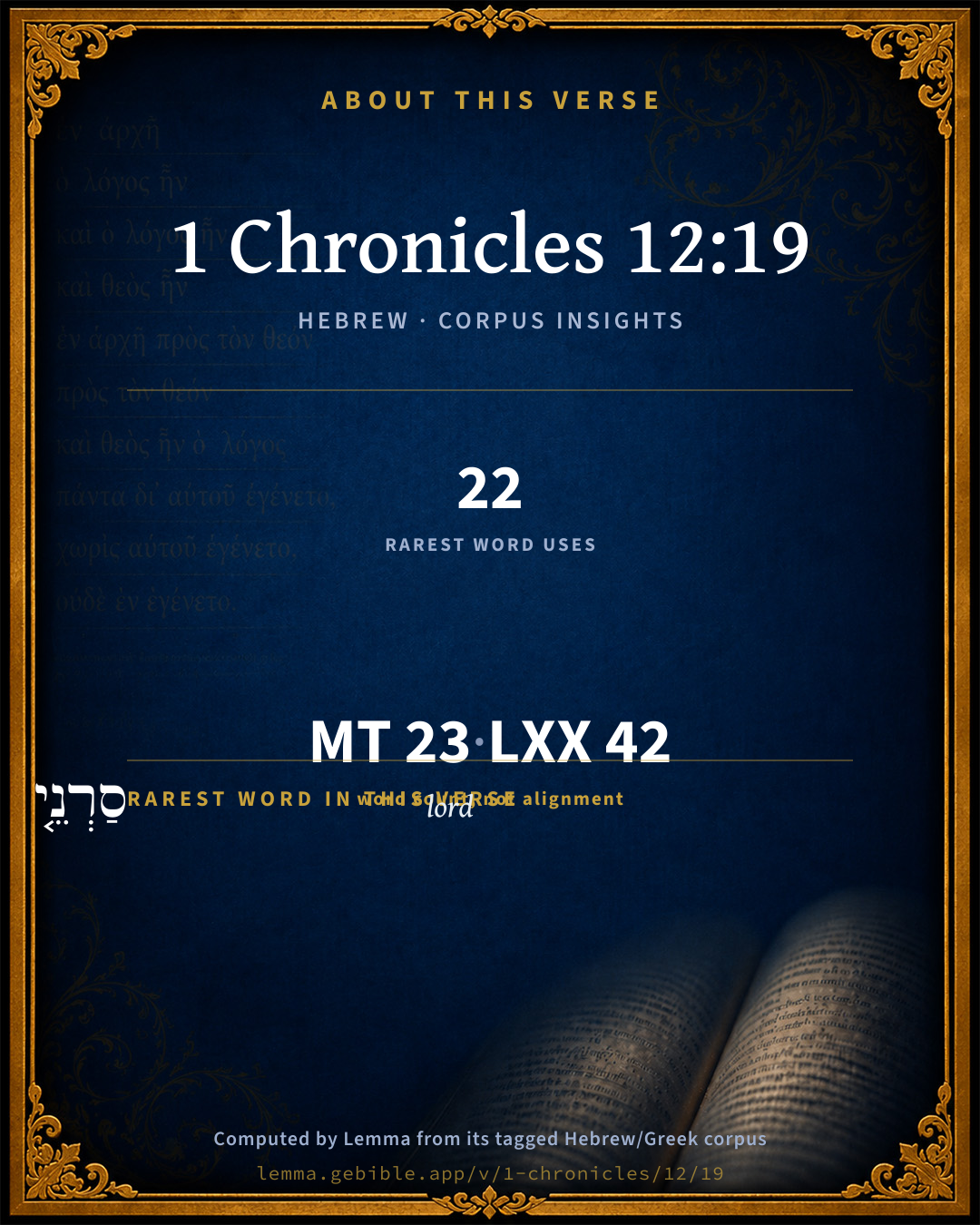
The rarest word here is סַרְנֵ֤י lord H5633 — appearing just 22 times in the whole Hebrew Bible.

Shared distinctive vocabulary

סַרְנֵ֤י lord H5633 occurs in 20 verses of the Hebrew Bible. Also found in:

Grammatical profile

  • 6 verbs
  • 11 nouns
  • 4 prepositions
  • 1 conjunction
  • 1 particle

Verb forms

  • נָפְל֣וּ Qal · Perfect
  • בְּבֹא֨וֹ Qal · Infinitive Construct
  • עֲזָרֻ֑ם Qal · Perfect
  • שִׁלְּחֻ֜הוּ Piel · Perfect
  • לֵאמֹ֔ר Qal · Infinitive Construct
  • יִפּ֖וֹל Qal · Imperfect

Repetition

Words recur within this verse — often emphatic in Hebrew:

  • נָפְל֣וּ to fall H5307 ×2
  • עַל upon H5921 ×2
  • פְּלִשְׁתִּ֧ים Philistine H6430 ×2
  • שָׁא֛וּל Saul H7586 ×2

Hebrew & Septuagint length

In English translation the verse runs 50 words from the Hebrew and 42 from the Septuagint (LXX English) — closely comparable.

A rough comparison of the two English renderings, which tokenize alike — not a word-level alignment.

Word counts can differ between the Hebrew and the Greek without any difference in meaning — e.g. the Hebrew direct-object marker אֵת has no separate Greek word, and Greek often adds the article ὁ.

In the original languages it is 23 Hebrew tokens and 42 Greek tokens — but the two are counted differently (Hebrew bundles its prefixes and suffixes into one token; the Greek is in lemma form), so that isn’t a like-for-like length.

Cross-references

1

Topical passages linked to 1 Chronicles 12:19 in the Treasury of Scripture Knowledge — connected by theme and wording, ordered by reader-vote popularity; previews shown in the World English Bible.

  • 1 Samuel 29:2–9 The lords of the Philistines passed on by hundreds, and by thousands; and David and his men passed on in the rearward with Achish.

Cross-references courtesy of OpenBible.info (CC BY 4.0).

Hebrew and Greek witnesses Masoretic Hebrew ↔ Greek Septuagint

The same verse in the two great witnesses to the Old Testament, shown verse-for-verse.

These are two independent witnesses, not word-aligned to each other, and the Septuagint is shown in lemma (dictionary) form.

Hebrew 1 Chronicles 12:19 Masoretic · Westminster Leningrad Codex

וּמִֽמְּנַשֶּׁ֞ה נָפְל֣וּ עַל דָּוִ֗יד בְּבֹא֨וֹ עִם פְּלִשְׁתִּ֧ים עַל שָׁא֛וּל לַמִּלְחָמָ֖ה וְלֹ֣א עֲזָרֻ֑ם כִּ֣י בְעֵצָ֗ה שִׁלְּחֻ֜הוּ סַרְנֵ֤י פְלִשְׁתִּים֙ לֵאמֹ֔ר בְּרָאשֵׁ֕ינוּ יִפּ֖וֹל אֶל אֲדֹנָ֥יו שָׁאֽוּל

Of Manasseh also there fell away some to David, when he came with the Philistines against Saul to battle: but they didn't help them; for the lords of the Philistines sent him away after consultation, saying, He will fall away to his master Saul to the jeopardy of our heads.

World English Bible · Public Domain

Greek LXX 1 Chronicles 12:19 Septuagint · lemma form

καί πνεῦμα ἐνδύω ὁ αμασαι ἄρχων ὁ τριάκοντα καί εἶπον πορεύομαι καί ὁ λαός σύ δαυίδ υἱός ιεσσαι εἰρήνη εἰρήνη σύ καί εἰρήνη ὁ βοηθός σύ ὅτι βοηθέω σύ ὁ θεός σύ καί προςδέχομαι αὐτός δαυίδ καί καταἵστημι αὐτός ἄρχων ὁ δύναμις

And some came to David from Manasse, when the Philistines came against Saul to war: and he helped them not, because the captains of the Philistines took counsel, saying, With the heads of those men will he return to his master Saul.

LXX2012 (modern English Septuagint) · Public Domain

Hebrew: Westminster Leningrad Codex (CC BY 4.0). Greek: Septuagint (public domain); English from LXX2012 (modern English Septuagint) (Public Domain). How the Septuagint differs from the Hebrew →

Commentary

Notes on 1 Chronicles 12:19 from classic Christian and Jewish commentators (each source and its license shown beneath its notes). The classic Christian expositions comment on the surrounding passage and are grouped to its opening verse, so a note may address several verses; the Jewish commentaries on the Tanakh (Rashi and others) are per-verse, so they appear only where the commentator wrote on this verse.

Lemma curates 59 commentaries, every one of them public domain or Creative Commons licensed, each selected and text-cleaned for this edition rather than reprinted as found. About our sources →

Trapp's Complete Commentary

John Trapp

1Ch 12:19 And there fell [some] of Manasseh to David, when he came with the Philistines against Saul to battle: but they helped them not: for the lords of the Philistines upon advisement sent him away, saying, He will fall to his master Saul to [the jeopardy of] our heads.

Ver. 19. When he came with the Philistines, &c.] See on 1Sa 29:1-11.

John Trapp, A Commentary or Exposition upon All the Books of the Old and New Testament (1647–1656) — public domain. Text from a community e-Sword module.

Joseph Benson's Commentary

1Ch 12:19-20. They helped them not — That is, the Manassites here named, and the rest of David’s forces, to whom they had now joined themselves, did not help the Philistines in battle, as David had pretended to do. As he went to Ziklag — As he returned thither from the camp of the Philistines.

Joseph Benson's Commentary on the Old and New Testaments (1811–1818) — public domain. Text from a community e-Sword module.

Geneva Bible (1599)

Geneva Bible translators

Or, on the jeopardy of our heads.

They came only to help David, and not to succor the Philistines, which were enemies to their country.

Geneva Bible (1599) marginal notes — public domain. Text via Bolls.life.

Jamieson, Fausset & Brown

Robert Jamieson, A. R. Fausset & David Brown

there fell some of Manasseh--The period of their accession is fixed as the time when David came with the Philistines against Saul to battle.

but they helped them not--(See on Sa1 29:4).

Jamieson, Fausset & Brown — Commentary Critical and Explanatory on the Whole Bible (1871) — public domain (CC PDM 1.0). Text via the HelloAO Bible API.

Ellicott's Commentary for English Readers

(19) There fell.—The regular term for desertion of one cause for another (2Ki_25:11).

When he came with the Philistines.—(Comp. 1Sa_29:2-11.) This verse is a summary of the narrative of 1Sa_29:2 to 1Sa_30:1.

They helped them not.—David and his men helped not the Philistines. Perhaps the right reading is he helped them (‘azarâm), not they helped them (‘azarûm).

Upon advisement.—After deliberation (Pro_20:18).

To the jeopardy of our heads.—At the price of our heads (1Ch_11:19). By betraying us he will make his peace with his old master.

(19-22) The seven Manassite chieftains who went over to David on the eve of Saul’s last battle.

A Bible Commentary for English Readers, edited by Charles John Ellicott (1878–1897) — public domain. Text from a community e-Sword module.

The Cambridge Bible for Schools and Colleges

gen. ed. J. J. S. Perowne

19–22. Manassite Adherents

19. And there fell some of Manasseh] R.V. Of Manasseh aslo there fell away some.

when he came with the Philistines] See 1Sa_28:1-2; 1Sa_29:1-11.

but they helped them not] David’s men did not help the Philistines.

upon advisement] “After consideration”; lit. “by counsel.” Cp. 1Ch_21:12, “advise thyself.”

fall] R.V. fall away.

to the jeopardy of our heads] Rather, at the price of our heads. David once became son-in-law to Saul at the price of the lives of two hundred of the Philistines (1Sa_18:27); their lords here (in Chron.) express their dread lest David reconcile himself to Saul by some act of treachery and slaughter done against his present Philistine patrons; cp. 1Sa_29:4 (“with” = “at the price of”).

The Cambridge Bible for Schools and Colleges (gen. ed. J. J. S. Perowne; Cambridge University Press, 1878–1918) — public domain. Text from a community e-Sword module.

John Gill's Exposition

For at that time, day by day, there came to David to help him,.... Particularly after the defeat of Saul by the Philistines, unto the time that David came to Hebron:

until it was a great host, like the host of God; the heavenly host, the angels; so the Targum.

John Gill's Exposition of the Whole Bible (1746–1763) — public domain (CC PDM 1.0). Text via the HelloAO Bible API.

Haydock's Catholic Bible Commentary

Fight. They joined him after he had left the Philistines. (Calmet) --- But he. Hebrew, "they helped them not." Neither David nor his partizans were involved in this danger, which might have caused their fidelity to be suspected, 1 Kings xxix. (Haydock)

George Leo Haydock (1774–1849), Haydock's Catholic Family Bible and Commentary, 1859 edition — public domain. Excludes Psalms (Douay-Rheims chapter numbering differs from Protestant) and Deuterocanonical books (Catholic canon only).

Matthew Poole's English Annotations

They helped them not, i.e. the Manassites here named, and the rest of David’s forces, to whom they had now joined themselves, did not help the Philistines in battle, as David had pretended to do.

Matthew Poole's English Annotations on the Holy Bible (1683–1685) — public domain. Text from a community e-Sword/MySword module.

Whedon's Commentary on the Bible

Daniel D. Whedon

19. There fell some of Manasseh to David, when he came with the Philistines against Saul — On David’s connexion with this war, see 1Sa_28:1-2; 1Sa_29:1-11. As the march with the Philistines led David through the territory of Manasseh, it was easy for members of this tribe to join him as he returned to Ziklag.

Daniel D. Whedon (gen. ed.), Commentary on the Old and New Testaments (1874–1909) — public domain. Text from a community e-Sword module.

The Pulpit Commentary

And there fell of Manasseh to David. Of this use of Al lp"n; there are many other examples (2Ch_15:9; Jer_37:14; 39:9). The phrase does not correspond with our own idiom of "falling to" one"s lot, but with that of" falling away" from the service or love of one to another, i.e. deserting. The occasion hero spoken of is described in full in 1Sa_29:2-11.

The Pulpit Commentary (1880–1919), ed. H.D.M. Spence-Jones & Joseph S. Exell — public domain. Text from a community e-Sword module.

Keil & Delitzsch

C. F. Keil & F. Delitzsch

For at that time, day by day, there came to David to help him,.... Particularly after the defeat of Saul by the Philistines, unto the time that David came to Hebron:

until it was a great host, like the host of God; the heavenly host, the angels; so the Targum.

Keil & Delitzsch — Biblical Commentary on the Old Testament (1861–1891) — public domain (CC PDM 1.0). Text via the HelloAO Bible API. (Old Testament only.)

unfoldingWord translationNotes

Door43 World Missions Community

deserted to

"left their leaders to join"

He will desert to his master Saul

"He will stop fighting with us and fight for his master Saul"

Adnah, Jozabad, Jediael, Michael, Jozabad, Elihu, and Zillethai

These are the names of men. (See: How to Translate Names)

captains over thousands of Manasseh

This means that each of these men led groups of a thousand soldiers in the tribe of Manasseh. AT: "each a captain over 1,000 men in the tribe of Manasseh" (See: Numbers)

translationWords

Manasseh

Philistines

Saul (OT)

lord

unfoldingWord translationNotes — © Distant Shores Media and the Door43 World Missions Community, licensed CC BY-SA 4.0. Source: git.door43.org/Door43/en_tn.

Rashi

Rabbi Shlomo Yitzchaki (Rashi)

And a spirit enwrapped Amasai - Heb. רוּחַ, talent, a will or desire, not a spirit of prophecy; i.e., this desire and will enwrapped him so that he sprang first to speak before the sons of Benjamin and Judah who came with him. A similar instance is (Jud. 11:29): “And a spirit of the Lord was upon Jephthah” and he said: To you, David You say, “Have you come to me in peace?” We have surely come to you in peace. and with you, O son of Jesse We wish to be with you and at your assistance.

peace, peace to you and peace to your helper And you ask me to help you? We have surely come to help you, but you need not thank us because it is from the Lord, and that is the meaning of “for your God has helped you.”

and David received them those sons of Benjamin and placed them at the head of his troop.

Rashi on the Tanakh — English translations: “The Judaica Press complete Tanach with Rashi, translated by A. J. Rosenberg” (CC BY 4.0); “Pentateuch with Rashi's commentary by M. Rosenbaum and A.M. Silbermann, 1929-1934” (public domain); “The Metsudah Tanach series, Lakewood, N.J” (CC BY 4.0); and “The Book of Joshua, Metsudah Publications, 1997” (CC BY 4.0). Text via Sefaria.

Lesson kit

Teaching starters — assembled from the data on this page, not authored interpretation. Every prompt links to the verse data it draws on. Edit before teaching.

1 Chronicles, in the Historical, opens this verse with 23 words (19 distinct Hebrew lemmas). Its most distinctive word is çeren (“lord”). A historical commentator’s framing appears above. Read the whole chapter for the surrounding context.

Discussion questions

  1. The word çeren carries the sense “lord.” How does it shape the verse?
  2. Joshua 13:3 shares the word «lord» with this verse. How do the two illuminate each other?
  3. “to fall” occurs 2× in this one verse. What is the effect of the repetition?
  4. The translations on this page render this verse differently — a whole-verse word diff, not a word-by-word alignment. What might account for the different wordings?
  5. The verb «נָפְל֣וּ» is Qal Perfect. How does its form color the action?
  6. Reading how Trapp's Complete Commentary and Joseph Benson's Commentary read this verse, where do the two commentators agree and where do they part?

Things to notice

Reading settings

Reading text

Shown beneath each verse's original-language words.

Old Testament
Old Testament edition

Read the OT as the Masoretic Hebrew (MT) or the Greek Septuagint (LXX).

English shown for the Greek Septuagint (in the Hebrew ↔ Greek comparison).

Comparing translations? Open the Compare panel on any verse page to stack up to four side by side.