
2 Chronicles 20:24

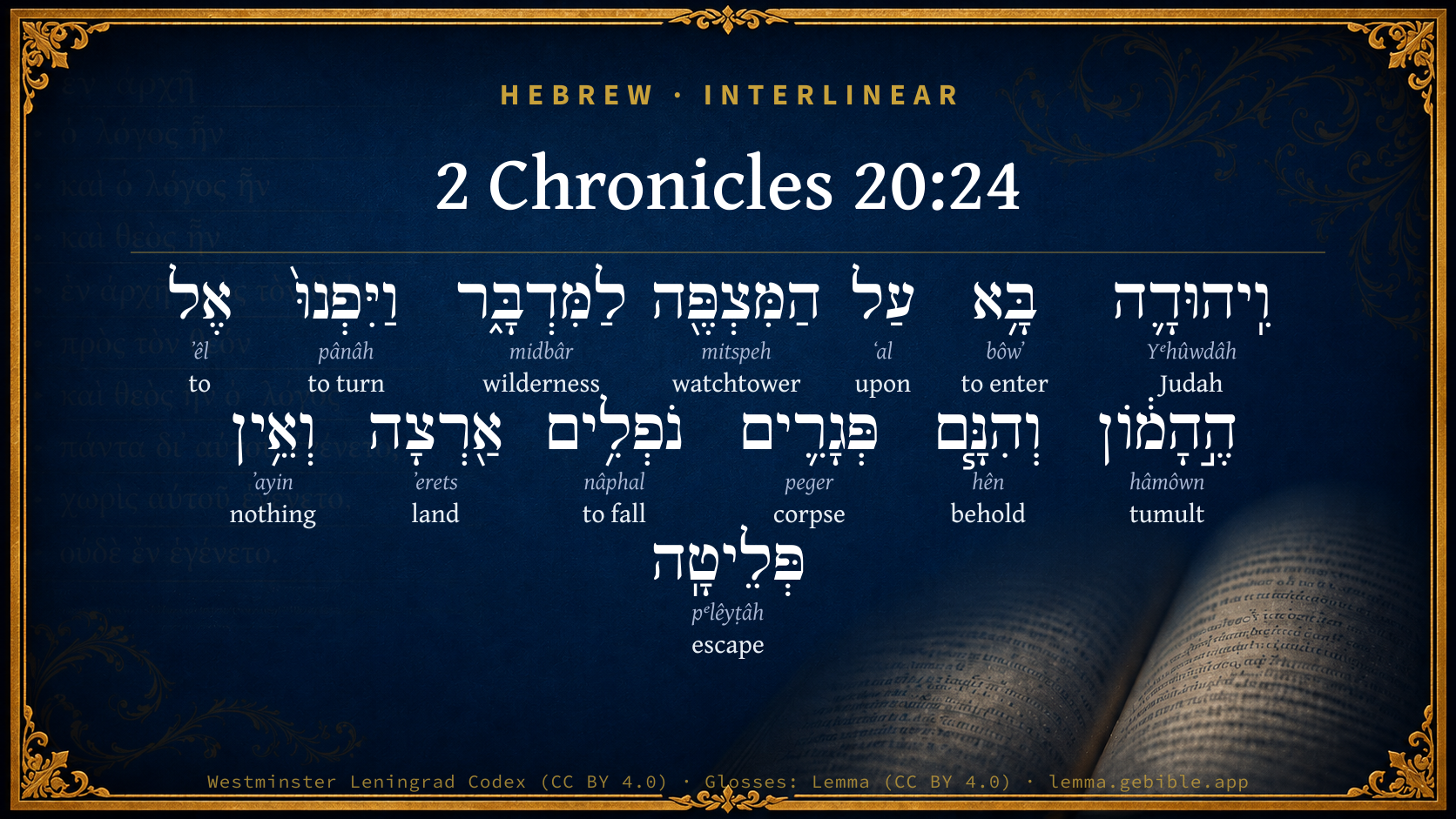
Hebrew (Westminster Leningrad Codex) 2 Chronicles 20:24 appears in the Hebrew Old Testament. The text above is from the Westminster Leningrad Codex. Each word links to its Strong’s number, a concise gloss, and parsing drawn from the Open Scriptures Hebrew Bible morphology. Click any word for its full Brown-Driver-Briggs (BDB) entry.
Download image
Cite this verse

2 Chronicles 20:24 (World English Bible). Public Domain. Lemma interlinear Bible study tool, https://lemma.gebible.app/v/2-chronicles/20/24.

Show BibTeX & RIS
BibTeX
RIS
English Translation
When Judah came to the watch-tower of the wilderness, they looked at the multitude; and, behold, they were dead bodies fallen to the earth, and there were none who escaped.
World English Bible · Public Domain
Highlights
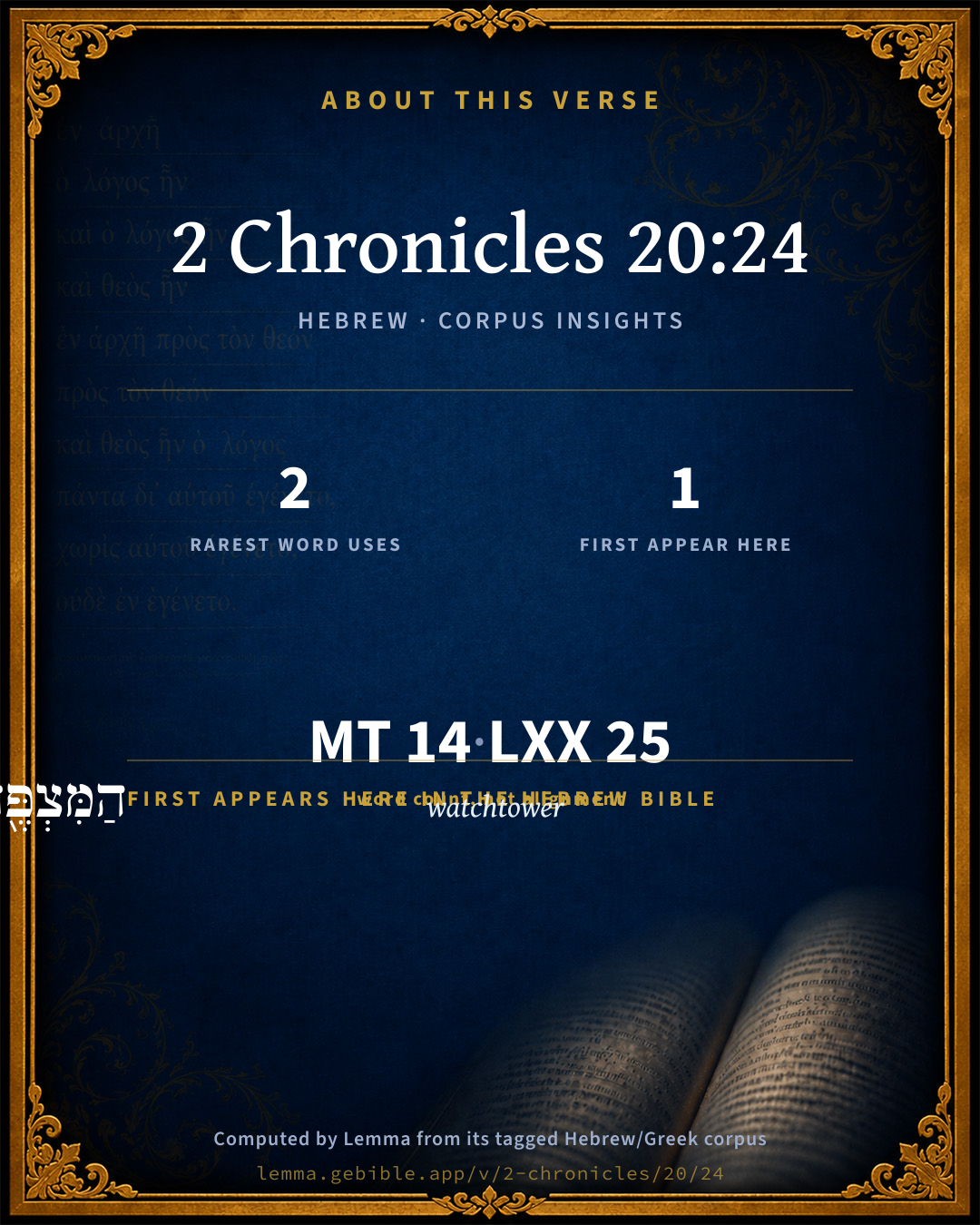
  • 1 first appearance in the Hebrew Bible
Full analysis ↓
Download a study sheet

One document with this verse’s original text, its word-by-word gloss line, the meaning frame, cross-references with their text, attributed commentary, and full source and license credits — printable, and it pastes into notes with its structure intact.

This verse Autodidact and up

Study sheet (.html) Plain text (.txt)

A passage Seminary Student

Up to 50 verses in one chapter. A passage sheet keeps up to 6 commentary sources and 12 cross-references per verse, in the order this page ranks them, and says so on the sheet whenever that leaves anything out. Ask for a single verse and you get the Autodidact verse sheet above.

Everything on this page stays free to read, with no account — the sheet is a download of what is already on screen, not access to it.

Want to remove ads? Support Godless Engineer
Compare translations 3

The same verse in 3 English versions, stacked beneath the original-language interlinear above. Click any original word for its lexicon entry.

Each is an independent rendering of the whole verse — the interlinear is not word-aligned to these translations.

Highlighted words mark where these versions differ — a whole-verse word diff, not a word-by-word alignment.

  • World English Bible Public Domain
    When Judah came to the watch-tower of the wilderness, they looked at the multitude; and, behold, they were dead bodies fallen to the earth, and there were none who escaped.
  • King James Version Public Domain
    And when Judah came toward the watch tower in the wilderness, they looked unto the multitude, and, behold, they were dead bodies fallen to the earth, and none escaped.
  • unfoldingWord Literal Text CC BY-SA 4.0
    And Judah came to the watchtower of the wilderness, and they turned toward the multitude. And behold, corpses fallen to the earth! And there none who escaped.

unfoldingWord Literal Text — © unfoldingWord, licensed CC BY-SA 4.0. Word-aligned USFM3 via Door43 (git.door43.org/unfoldingWord/en_ult).

Versions to compare (up to 4)

3 of 4 selected

Show all 18 translations

Every available English version of this verse, each an independent rendering of the whole verse.

  • World English Bible Public Domain
    When Judah came to the watch-tower of the wilderness, they looked at the multitude; and, behold, they were dead bodies fallen to the earth, and there were none who escaped.
  • Berean Standard Bible Public Domain
    When the men of Judah came to a place overlooking the wilderness, they looked for the vast army, but there were only corpses lying on the ground; no one had escaped.
  • Majority Standard Bible Public Domain
    When the men of Judah came to a place overlooking the wilderness, they looked for the vast army, but there were only corpses lying on the ground; no one had escaped.
  • King James Version Public Domain
    And when Judah came toward the watch tower in the wilderness, they looked unto the multitude, and, behold, they were dead bodies fallen to the earth, and none escaped.
  • American Standard Version (1901) Public Domain
    And when Judah came to the watch-tower of the wilderness, they looked upon the multitude; and, behold, they were dead bodies fallen to the earth, and there were none that escaped.
  • Revised Version (1885) Public Domain
    And when Judah came to the watch-tower of the wilderness, they looked upon the multitude; and, behold, they were dead bodies fallen to the earth, and there were none that escaped.
  • Geneva Bible (1599) Public Domain
    And when Iudah came towarde Mizpah in the wildernes, they looked vnto the multitude: and behold, the carkeises were fallen to the earth, and none escaped.
  • Douay-Rheims (1899) Public Domain
    And when Juda came to the watch tower, that looketh toward the desert, they saw afar off all the country, for a great space, full of dead bodies, and that no one was left that could escape death.
  • Young's Literal Translation Public Domain
    And Judah hath come in unto the watch-tower, to the wilderness, and they look unto the multitude, and lo, they `are' carcases fallen to the earth, and there is none escaped,
  • Literal Standard Version CC BY-SA 4.0
    And Judah has come to the watchtower in the wilderness, and they look toward the multitude, and behold, they [are] carcasses fallen to the earth, and none [had] an escape,
  • Unlocked Literal Bible CC BY-SA 4.0
    When Judah came to a place overlooking the wilderness, they looked out on the army. Behold, they were dead, fallen to the ground; none had escaped.
  • unfoldingWord Literal Text CC BY-SA 4.0
    And Judah came to the watchtower of the wilderness, and they turned toward the multitude. And behold, corpses fallen to the earth! And there none who escaped.
  • Darby Bible Public Domain
    And Judah came on to the mountain-watch in the wilderness, and they looked toward the multitude; and behold, they were dead bodies fallen to the earth, and none had escaped.
  • World Messianic Bible Public Domain
    When Judah came to the place overlooking the wilderness, they looked at the multitude; and behold, they were dead bodies fallen to the earth, and there were none who escaped.
  • Webster's Bible Public Domain
    And when Judah came towards the watch-tower in the wilderness, they looked to the multitude, and behold, they were dead bodies fallen to the earth, and none escaped.
  • Free Bible Version CC BY-SA 4.0
    So when the men of Judah came to the watchtower in the desert, they looked out to see the enemy army and all they saw were corpses lying on the ground! No one had escaped.
  • Bible in Basic English Public Domain
    And Judah came to the watchtower of the waste land, and looking in the direction of the army, they saw only dead bodies stretched on the earth; no living man was to be seen.
  • JPS Tanakh (1917) Public Domain
    And when Judah came to the watch-tower of the wilderness, they looked upon the multitude; and, behold, they were dead bodies fallen to the earth, and there were none that escaped.

Literal Standard Version (2020), Covenant Press — licensed CC BY-SA 4.0. Text via the HelloAO Bible API (eBible.org). Unlocked Literal Bible (unfoldingWord) — licensed CC BY-SA 4.0. Text via the HelloAO Bible API (eBible.org). unfoldingWord Literal Text — © unfoldingWord, licensed CC BY-SA 4.0. Word-aligned USFM3 via Door43 (git.door43.org/unfoldingWord/en_ult). Free Bible Version, Dr. Jonathan Gallagher — licensed CC BY-SA 4.0. Text via the HelloAO Bible API (eBible.org).

Word by word

More ways to search: Search by grammar → Find every occurrence → Compare this word →

Practice this passage: Drill this verse → Learn its vocabulary →

הַמִּצְפֶּ֖ה
mitspeh
H4707
“the · watchtower”
Particle, Definite Article + Noun, Common, Masculine, Singular, Absolute
Part of Speech
Particle + Noun
Type
Common
Gender
Masculine
Number
Singular
State
Absolute
Full BDB Definition

Origin: from H6822

TWOT: 1950b

watchtower, lookout point
  1. וִֽיהוּדָ֛ה Yᵉhûwdâh H3063 “and · Judah” Conjunction + Noun, Proper
  2. בָּ֥א bôwʼ H935 “to enter” Verb, Qal, Perfect, 3rd Person, Masculine, Singular
  3. עַל ʻal H5921 “upon” Preposition
  4. לַמִּדְבָּ֑ר midbâr H4057 “to/for the · wilderness” Preposition, Determined + Noun, Common, Masculine, Singular, Absolute
  5. וַיִּפְנוּ֙ pânâh H6437 “and · to turn” Conjunction + Verb, Qal, Sequential Imperfect, 3rd Person, Masculine, Plural
  6. אֶל ʼêl H413 “to” Preposition
  7. הֶ֣הָמ֔וֹן hâmôwn H1995 “the · tumult” Particle, Definite Article + Noun, Common, Masculine, Singular, Absolute
  8. וְהִנָּ֧ם hên H2005 “and · behold · them” Conjunction + Particle, Demonstrative + Suffix, Personal, 3rd Person, Masculine, Plural
  9. פְּגָרִ֛ים peger H6297 “corpses” Noun, Common, Masculine, Plural, Absolute
  10. נֹפְלִ֥ים nâphal H5307 “falling” Verb, Qal, Participle Active, Masculine, Plural, Absolute
  11. אַ֖רְצָה ʼerets H776 “land · toward” Noun, Common, Both, Singular, Absolute + Suffix, Demonstrative
  12. וְאֵ֥ין ʼayin H369 “and · nothing” Conjunction + Particle, Negative
  13. פְּלֵיטָֽה pᵉlêyṭâh H6413 “escape” Noun, Common, Feminine, Singular, Absolute

About this verse

These counts appear in no published source. They are computed here, from the morphology-tagged text and Lemma’s own curated glosses. What Lemma adds →

14
words
14
distinct lemmas
Historical
section

Notable vocabulary

The rarest word here is הַמִּצְפֶּ֖ה watchtower H4707 — appearing just 2 times in the whole Hebrew Bible.

First appearance in Scripture

This word makes its first canonical appearance in the Hebrew Bible here:

  • הַמִּצְפֶּ֖ה watchtower H4707

Shared distinctive vocabulary

הַמִּצְפֶּ֖ה watchtower H4707 occurs in 2 verses of the Hebrew Bible. Also found in:

Grammatical profile

  • 3 verbs
  • 7 nouns
  • 2 prepositions
  • 2 particles

Verb forms

  • בָּ֥א Qal · Perfect
  • וַיִּפְנוּ֙ Qal · Sequential Imperfect
  • נֹפְלִ֥ים Qal · Participle Active

Hebrew & Septuagint length

In English translation the verse runs 30 words from the Hebrew and 28 from the Septuagint (LXX English) — closely comparable.

A rough comparison of the two English renderings, which tokenize alike — not a word-level alignment.

Word counts can differ between the Hebrew and the Greek without any difference in meaning — e.g. the Hebrew direct-object marker אֵת has no separate Greek word, and Greek often adds the article ὁ.

In the original languages it is 14 Hebrew tokens and 25 Greek tokens — but the two are counted differently (Hebrew bundles its prefixes and suffixes into one token; the Greek is in lemma form), so that isn’t a like-for-like length.

Cross-references

6

Topical passages linked to 2 Chronicles 20:24 in the Treasury of Scripture Knowledge — connected by theme and wording, ordered by reader-vote popularity; previews shown in the World English Bible.

  • Isaiah 37:36 The angel of Yahweh went forth, and struck in the camp of the Assyrians one hundred and eighty-five thousand; and when men arose early in the morning, behold, these were all dead bodies.
  • Exodus 14:30 Thus Yahweh saved Israel that day out of the hand of the Egyptians; and Israel saw the Egyptians dead on the seashore.
  • 1 Chronicles 5:22 For there fell many slain, because the war was of God. They lived in their place until the captivity.
  • Ezra 9:14 shall we again break your commandments, and join in affinity with the peoples that do these abominations? would not you be angry with us until you had consumed us, so that there should be no remnant, nor any to escape?
  • Psalms 110:6 He will judge among the nations. He will heap up dead bodies. He will crush the ruler of the whole earth.
  • Jeremiah 33:5 while [men] come to fight with the Chaldeans, and to fill them with the dead bodies of men, whom I have killed in my anger and in my wrath, and for all whose wickedness I have hid my face from this city:

Cross-references courtesy of OpenBible.info (CC BY 4.0).

Hebrew and Greek witnesses Masoretic Hebrew ↔ Greek Septuagint

The same verse in the two great witnesses to the Old Testament, shown verse-for-verse.

These are two independent witnesses, not word-aligned to each other, and the Septuagint is shown in lemma (dictionary) form.

Hebrew 2 Chronicles 20:24 Masoretic · Westminster Leningrad Codex

וִֽיהוּדָ֛ה בָּ֥א עַל הַמִּצְפֶּ֖ה לַמִּדְבָּ֑ר וַיִּפְנוּ֙ אֶל הֶ֣הָמ֔וֹן וְהִנָּ֧ם פְּגָרִ֛ים נֹפְלִ֥ים אַ֖רְצָה וְאֵ֥ין פְּלֵיטָֽה

When Judah came to the watch-tower of the wilderness, they looked at the multitude; and, behold, they were dead bodies fallen to the earth, and there were none who escaped.

World English Bible · Public Domain

Greek LXX 2 Chronicles 20:24 Septuagint · lemma form

καί ἰούδας ἔρχομαι ἐπί ὁ σκοπιά ὁ ἐρῆμος καί ἐπιβλέπω καί ὁράω ὁ πλῆθος καί ἰδού πᾶς νεκρός πίπτω ἐπί ὁ γῆ οὐ εἰμί σώζω

And Juda came to the watch-tower of the wilderness, and looked, and saw the multitude, and, behold, they were all fallen dead upon the earth, not one escaped.

LXX2012 (modern English Septuagint) · Public Domain

Hebrew: Westminster Leningrad Codex (CC BY 4.0). Greek: Septuagint (public domain); English from LXX2012 (modern English Septuagint) (Public Domain). How the Septuagint differs from the Hebrew →

Commentary

Notes on 2 Chronicles 20:24 from classic Christian and Jewish commentators (each source and its license shown beneath its notes). The classic Christian expositions comment on the surrounding passage and are grouped to its opening verse, so a note may address several verses; the Jewish commentaries on the Tanakh (Rashi and others) are per-verse, so they appear only where the commentator wrote on this verse.

Lemma curates 59 commentaries, every one of them public domain or Creative Commons licensed, each selected and text-cleaned for this edition rather than reprinted as found. About our sources →

Trapp's Complete Commentary

John Trapp

2Ch 20:24 And when Judah came toward the watch tower in the wilderness, they looked unto the multitude, and, behold, they [were] dead bodies fallen to the earth, and none escaped.

Ver. 24. And none escaped.] Ne ignifer quidem reliquus est factus, ut in Proverbio est. See the like history in Jdg 7:22-25, and learn how we may be freed from our spiritual enemies - viz., not by our own might and merits, but by faith in Christ, who hath made us more than conquerors, {Rom 8:37} that is, triumphers. {2Co 2:14}

John Trapp, A Commentary or Exposition upon All the Books of the Old and New Testament (1647–1656) — public domain. Text from a community e-Sword module.

Jamieson, Fausset & Brown

Robert Jamieson, A. R. Fausset & David Brown

when Judah came toward the watchtower in the wilderness--Most probably the conical hill, Jebel Fereidis, or Frank Mountain, from the summit of which they obtained the first view of the scene of slaughter. Jehoshaphat and his people found the field strewed with dead bodies, so that they had not to fight at all, but rather to take possession of an immense booty, the collection of which occupied three days. On the fourth they set out on their return to Jerusalem in the same order and joyful mood as they came. The place where they mustered previous to departure was, from their public thanksgiving service, called, "The Valley of Berachah" ("benediction"), now Wady Bereikut.

Jamieson, Fausset & Brown — Commentary Critical and Explanatory on the Whole Bible (1871) — public domain (CC PDM 1.0). Text via the HelloAO Bible API.

Ellicott's Commentary for English Readers

(24) And when Judah came.—Now Judah had come; by the time the slaughter was complete.

Toward the watch tower.—The look-out of the desert. A height overlooking the wilderness of Jeruel (2Ch_20:16). The word mizpeh means watch-tower in Isa_21:8.

They looked.—And they looked.

Behold, they were dead bodies.—Comp. 2Ki_19:35.

None escaped.—No survivors were anywhere visible. Vulg., “Porro Juda cum venisset ad speculam quae respicit solitudinem vidit procul . . . nec superesse quemquam qui necem potuisset evadere.”

A Bible Commentary for English Readers, edited by Charles John Ellicott (1878–1897) — public domain. Text from a community e-Sword module.

The Cambridge Bible for Schools and Colleges

gen. ed. J. J. S. Perowne

24. toward the watch tower] R.V. to the watch-tower. This tower may have been one of the castles mentioned in 2Ch_17:12.

unto the multitude] R.V. upon the multitude.

and none escaped] R.V. and there were none that escaped.

The Cambridge Bible for Schools and Colleges (gen. ed. J. J. S. Perowne; Cambridge University Press, 1878–1918) — public domain. Text from a community e-Sword module.

John Gill's Exposition

When Judah came towards the watch tower in the wilderness,.... Which might stand upon the hill or cliff of Ziz, for the sake of the direction of travellers, and the preservation of them from thieves and robbers:

they looked unto the multitude; which they could take a view of from the top of the hill:

and behold, they were dead bodies fallen to the earth, and none escaped; all to a man slain, there was not one to be seen standing on his feet.

John Gill's Exposition of the Whole Bible (1746–1763) — public domain (CC PDM 1.0). Text via the HelloAO Bible API.

Albert Barnes' Notes on the Bible

The march of Judah from Jerusalem would take five or six hours. By the time they reached the watch-towers in the wilderness of Jeruel all was over.

Albert Barnes' Notes on the Bible (1834–1885) — public domain. Text from a community e-Sword/MySword module.

Haydock's Catholic Bible Commentary

Tower. Maspha, in the tribe of Benjamin, (C.) or some other (H.) eminence. M.

George Leo Haydock (1774–1849), Haydock's Catholic Family Bible and Commentary, 1859 edition — public domain. Excludes Psalms (Douay-Rheims chapter numbering differs from Protestant) and Deuterocanonical books (Catholic canon only).

Matthew Poole's English Annotations

Toward the watch-tower; which stood upon the cliff of Ziz, mentioned above, 2Ch 20:16, or some other hill which looked toward the wilderness, where their enemies lay encamped, whose numbers, and order, and condition they could decry from thence.

Matthew Poole's English Annotations on the Holy Bible (1683–1685) — public domain. Text from a community e-Sword/MySword module.

Whedon's Commentary on the Bible

Daniel D. Whedon

24. Watchtower in the wilderness — The tower near Tekoa, which commanded a wide view over the neighbouring desert. Compare 2Ch_26:10; 2Ki_9:17, note.

Daniel D. Whedon (gen. ed.), Commentary on the Old and New Testaments (1874–1909) — public domain. Text from a community e-Sword module.

The Pulpit Commentary

The watch-tower. Seemi, 2Ch_26:10, where, however, the ordinary lDg and not the present word (only found, except as a proper name, here and, (Isa_21:8) is employed. It is scarcely likely that a built watch-tower is intended even here, but rather a lofty site and point of view from which a large number of people could see. The proper names Mitzpeh (Mizpeh) and Mitzpah (Mizpah) are of course familiar. They looked unto the multitude. Judah and its army and heralding Levite singers would see now in new significance the thing said by Jahaziel in our ver. 16, "Ye shall find them at the end of the brook-course, before the wilderness of Jeruel." And none escaped; i.e. "without an exception.

The Pulpit Commentary (1880–1919), ed. H.D.M. Spence-Jones & Joseph S. Exell — public domain. Text from a community e-Sword module.

John Wesley's Explanatory Notes

The watch tower - Which stood upon the cliff of Ziz, mentioned ver. 16, and looked toward the wilderness, where their enemies lay encamped, whose numbers, and order, and condition, they could descry from thence.

John Wesley, Explanatory Notes Upon the Whole Bible (1754–1765) — public domain. Text via the GEBible commentary corpus.

Keil & Delitzsch

C. F. Keil & F. Delitzsch

Now, when Judah came to the height in the wilderness (מצפּה, specula, watch-tower, here a height in the wilderness of Tekoa, whence one might look out over the wilderness Jeruel, Ch2 20:16), and turned, or was about to turn, against the multitude of the enemy (ההמון referring back to Ch2 20:12), behold, they saw "corpses lying upon the earth, and none had escaped," i.e., they saw corpses in such multitude lying there, that to all appearance none had escaped.

Keil & Delitzsch — Biblical Commentary on the Old Testament (1861–1891) — public domain (CC PDM 1.0). Text via the HelloAO Bible API. (Old Testament only.)

unfoldingWord translationNotes

Door43 World Missions Community

Behold, they were dead

The word "behold" is used here to mark a surprising event.

they were dead, fallen to the ground

The phrase "fallen to the ground" is an idiomatic way to say that "they were dead." AT: "they were all dead on the ground" (See: Idiom and Doublet)

translationWords

Judah

desert

die

unfoldingWord translationNotes — © Distant Shores Media and the Door43 World Missions Community, licensed CC BY-SA 4.0. Source: git.door43.org/Door43/en_tn.

Lesson kit

Teaching starters — assembled from the data on this page, not authored interpretation. Every prompt links to the verse data it draws on. Edit before teaching.

2 Chronicles, in the Historical, opens this verse with 14 words (14 distinct Hebrew lemmas). Its most distinctive word is mitspeh (“watchtower”). A historical commentator’s framing appears above. Read the whole chapter for the surrounding context.

Discussion questions

  1. The word mitspeh carries the sense “watchtower.” How does it shape the verse?
  2. The word “watchtower” first appears here in Scripture. What is being introduced at this debut?
  3. Isaiah 21:8 shares the word «watchtower» with this verse. How do the two illuminate each other?
  4. These translations render this verse differently; the difference is in the English rendering, not the original. What questions does that raise?
  5. The verb «בָּ֥א» is Qal Perfect. How does its form color the action?
  6. Reading how Trapp's Complete Commentary and Jamieson, Fausset & Brown read this verse, where do the two commentators agree and where do they part?

Things to notice

Reading settings

Reading text

Shown beneath each verse's original-language words.

Old Testament
Old Testament edition

Read the OT as the Masoretic Hebrew (MT) or the Greek Septuagint (LXX).

English shown for the Greek Septuagint (in the Hebrew ↔ Greek comparison).

Comparing translations? Open the Compare panel on any verse page to stack up to four side by side.