
1 Samuel 14:42

Hebrew (Westminster Leningrad Codex) 1 Samuel 14:42 appears in the Hebrew Old Testament. The text above is from the Westminster Leningrad Codex. Each word links to its Strong’s number, a concise gloss, and parsing drawn from the Open Scriptures Hebrew Bible morphology. Click any word for its full Brown-Driver-Briggs (BDB) entry.
Download image
Cite this verse

1 Samuel 14:42 (World English Bible). Public Domain. Lemma interlinear Bible study tool, https://lemma.gebible.app/v/1-samuel/14/42.

Show BibTeX & RIS
BibTeX
RIS
English Translation
Saul said, Cast [lots] between me and Jonathan my son. Jonathan was taken.
World English Bible · Public Domain
Download a study sheet

One document with this verse’s original text, its word-by-word gloss line, the meaning frame, cross-references with their text, attributed commentary, and full source and license credits — printable, and it pastes into notes with its structure intact.

This verse Autodidact and up

Study sheet (.html) Plain text (.txt)

A passage Seminary Student

Up to 50 verses in one chapter. A passage sheet keeps up to 6 commentary sources and 12 cross-references per verse, in the order this page ranks them, and says so on the sheet whenever that leaves anything out. Ask for a single verse and you get the Autodidact verse sheet above.

Everything on this page stays free to read, with no account — the sheet is a download of what is already on screen, not access to it.

Want to remove ads? Support Godless Engineer
Compare translations 3

The same verse in 3 English versions, stacked beneath the original-language interlinear above. Click any original word for its lexicon entry.

Each is an independent rendering of the whole verse — the interlinear is not word-aligned to these translations.

Highlighted words mark where these versions differ — a whole-verse word diff, not a word-by-word alignment.

  • World English Bible Public Domain
    Saul said, Cast [lots] between me and Jonathan my son. Jonathan was taken.
  • King James Version Public Domain
    And Saul said, Cast lots between me and Jonathan my son. And Jonathan was taken.
  • unfoldingWord Literal Text CC BY-SA 4.0
    And Saul said, “Cause it to fall between me and between Jonathan my son.” And Jonathan was taken.

unfoldingWord Literal Text — © unfoldingWord, licensed CC BY-SA 4.0. Word-aligned USFM3 via Door43 (git.door43.org/unfoldingWord/en_ult).

Versions to compare (up to 4)

3 of 4 selected

Show all 18 translations

Every available English version of this verse, each an independent rendering of the whole verse.

  • World English Bible Public Domain
    Saul said, Cast [lots] between me and Jonathan my son. Jonathan was taken.
  • Berean Standard Bible Public Domain
    Then Saul said, “Cast the lot between me and my son Jonathan.” And Jonathan was selected.
  • Majority Standard Bible Public Domain
    Then Saul said, “Cast the lot between me and my son Jonathan.” And Jonathan was selected.
  • King James Version Public Domain
    And Saul said, Cast lots between me and Jonathan my son. And Jonathan was taken.
  • American Standard Version (1901) Public Domain
    And Saul said, Cast `lots' between me and Jonathan my son. And Jonathan was taken.
  • Revised Version (1885) Public Domain
    And Saul said, Cast lots between me and Jonathan my son. And Jonathan was taken.
  • Geneva Bible (1599) Public Domain
    And Saul saide, Cast lot betweene me and Ionathan my sonne. And Ionathan was taken.
  • Douay-Rheims (1899) Public Domain
    And Saul said: Cast lots between me, and Jonathan my son. And Jonathan was taken.
  • Young's Literal Translation Public Domain
    And Saul saith, `Cast between me and Jonathan my son;' and Jonathan is captured.
  • Literal Standard Version CC BY-SA 4.0
    And Saul says, “Cast between me and my son Jonathan”; and Jonathan is captured.
  • Unlocked Literal Bible CC BY-SA 4.0
    Then Saul said, “Cast lots between me and Jonathan my son.” Then Jonathan was taken by lot.
  • unfoldingWord Literal Text CC BY-SA 4.0
    And Saul said, “Cause it to fall between me and between Jonathan my son.” And Jonathan was taken.
  • Darby Bible Public Domain
    And Saul said, Cast [lots] between me and Jonathan my son. And Jonathan was taken.
  • World Messianic Bible Public Domain
    Saul said, “Cast lots between me and Jonathan my son.” Jonathan was selected.
  • Webster's Bible Public Domain
    And Saul said, Cast lots between me and Jonathan my son. And Jonathan was taken.
  • Free Bible Version CC BY-SA 4.0
    Then Saul said, “Cast lots between me and my son Jonathan.” Jonathan was selected.
  • Bible in Basic English Public Domain
    And Saul said, Give your decision between my son Jonathan and me. And Jonathan was taken.
  • JPS Tanakh (1917) Public Domain
    And Saul said: 'Cast lots between me and Jonathan my son.' And Jonathan was taken.

Literal Standard Version (2020), Covenant Press — licensed CC BY-SA 4.0. Text via the HelloAO Bible API (eBible.org). Unlocked Literal Bible (unfoldingWord) — licensed CC BY-SA 4.0. Text via the HelloAO Bible API (eBible.org). unfoldingWord Literal Text — © unfoldingWord, licensed CC BY-SA 4.0. Word-aligned USFM3 via Door43 (git.door43.org/unfoldingWord/en_ult). Free Bible Version, Dr. Jonathan Gallagher — licensed CC BY-SA 4.0. Text via the HelloAO Bible API (eBible.org).

Word by word

More ways to search: Search by grammar → Find every occurrence → Compare this word →

Practice this passage: Drill this verse → Learn its vocabulary →

יוֹנָתָ֣ן
Yôwnâthân
H3129
“Jonathan”
Noun, Proper
Part of Speech
Noun
Type
Proper
Full BDB Definition

Origin: a form of H3083

TWOT: None

Jonathan or Jehonathan = "Jehovah has given" - a son of king Saul and a friend of David - a son of the high priest Abiathar and the last descendant of Eli of whom we hear - one of David's mighty warriors - a Levite and father of Zechariah, a priest who blew the trumpet at the dedication of the wall - a son of Kareah and a brother of Johanan; a Judaite captain after the fall of Jerusalem - another Judaite - father of Ebed in the time of Ezra - son of Asahel in the time of Ezra - a priest of the family of Melicu in the time of Nehemiah - son of Joiada and his successor to the high priesthood in the time of Nehemiah
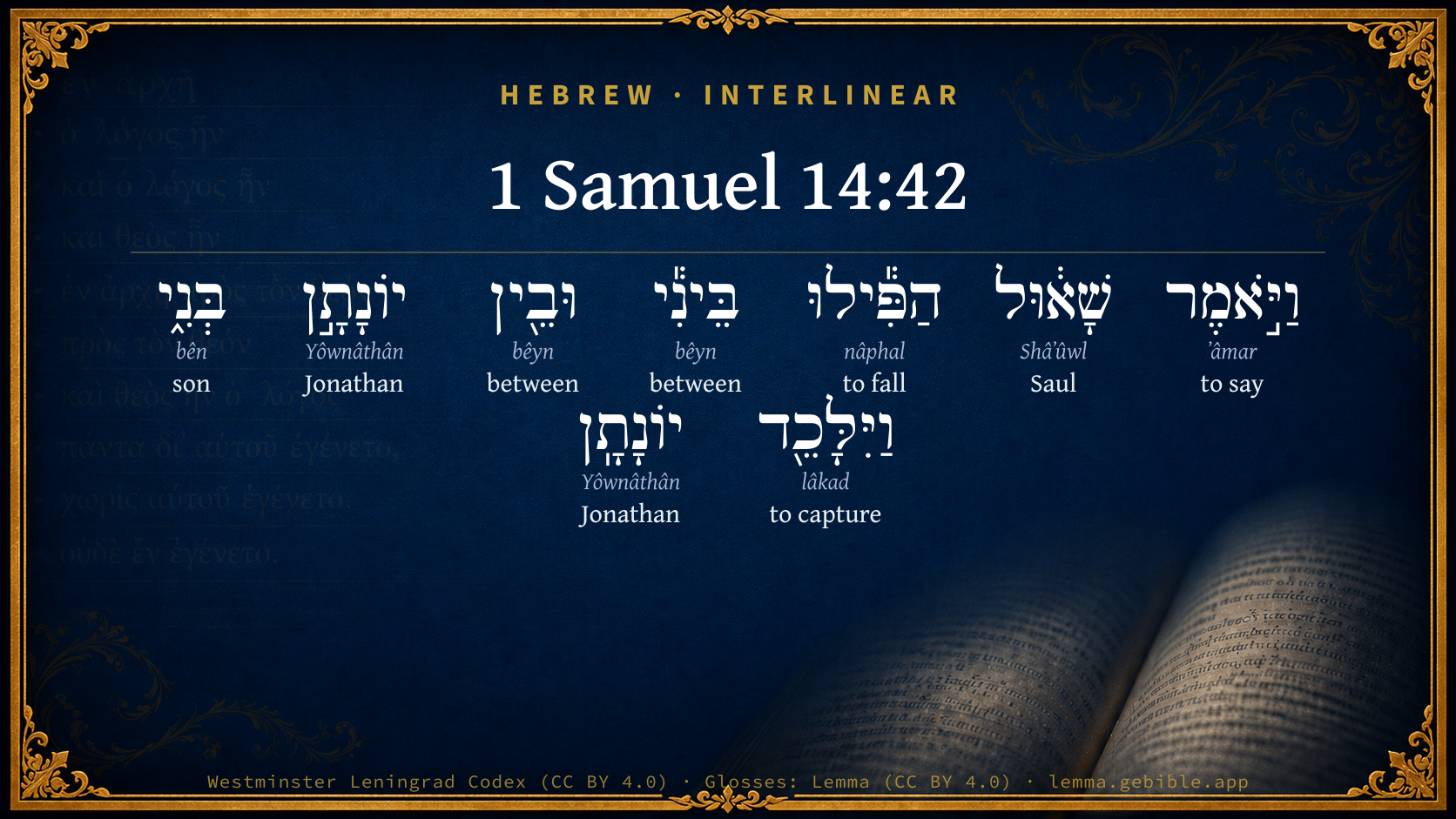
  1. וַיֹּ֣אמֶר ʼâmar H559 “and · to say” Conjunction + Verb, Qal, Sequential Imperfect, 3rd Person, Masculine, Singular
  2. שָׁא֔וּל Shâʼûwl H7586 “Saul” Noun, Proper
  3. הַפִּ֕ילוּ nâphal H5307 “fall” Verb, Hiphil, Imperative, 2nd Person, Masculine, Plural
  4. בֵּינִ֕י bêyn H996 “between · me” Preposition + Suffix, Personal, 1st Person, Common, Singular
  5. וּבֵ֖ין bêyn H996 “and · between” Conjunction + Preposition
  6. בְּנִ֑י bên H1121 “son · my” Noun, Common, Masculine, Singular, Construct + Suffix, Personal, 1st Person, Common, Singular
  7. וַיִּלָּכֵ֖ד lâkad H3920 “and · to capture” Conjunction + Verb, Niphal, Sequential Imperfect, 3rd Person, Masculine, Singular
  8. יוֹנָתָֽן Yôwnâthân H3129 “Jonathan” Noun, Proper

About this verse

These counts appear in no published source. They are computed here, from the morphology-tagged text and Lemma’s own curated glosses. What Lemma adds →

9
words
7
distinct lemmas
Historical
section

Shared distinctive vocabulary

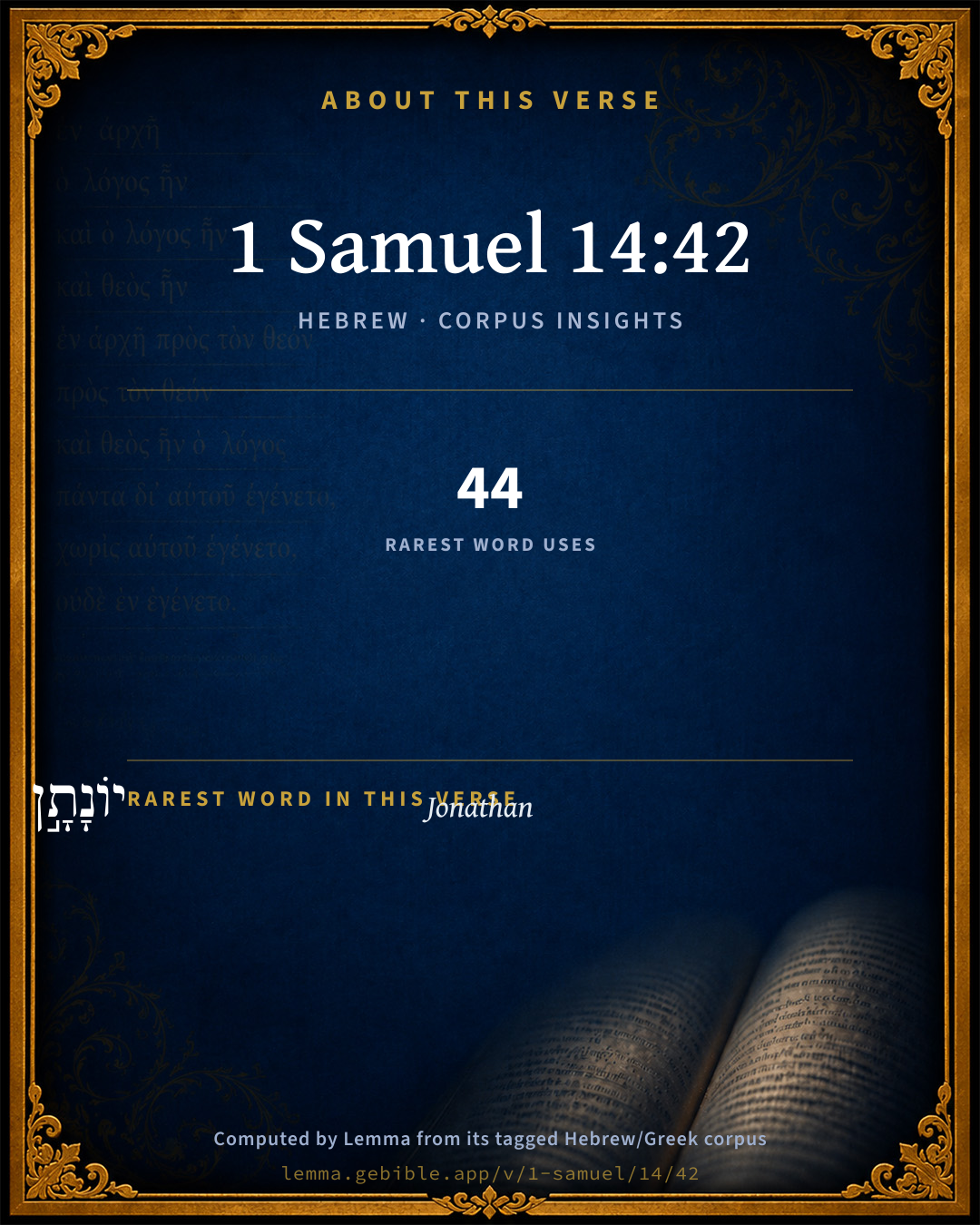
יוֹנָתָ֣ן Jonathan H3129 occurs in 36 verses of the Hebrew Bible. Also found in:

Grammatical profile

  • 3 verbs
  • 4 nouns
  • 2 prepositions

Verb forms

  • וַיֹּ֣אמֶר Qal · Sequential Imperfect
  • הַפִּ֕ילוּ Hiphil · Imperative
  • וַיִּלָּכֵ֖ד Niphal · Sequential Imperfect

Repetition

Words recur within this verse — often emphatic in Hebrew:

  • בֵּינִ֕י between H996 ×2
  • יוֹנָתָ֣ן Jonathan H3129 ×2

Hebrew & Septuagint length

In English translation the verse runs 13 words from the Hebrew and 59 from the Septuagint (LXX English) — the Septuagint runs noticeably longer here. See the side-by-side →

A rough comparison of the two English renderings, which tokenize alike — not a word-level alignment.

Word counts can differ between the Hebrew and the Greek without any difference in meaning — e.g. the Hebrew direct-object marker אֵת has no separate Greek word, and Greek often adds the article ὁ.

Hebrew and Greek witnesses Masoretic Hebrew ↔ Greek Septuagint

The same verse in the two great witnesses to the Old Testament, shown verse-for-verse.

Here the Septuagint runs noticeably longer than the Hebrew — LXX2012 (modern English Septuagint) 59 words vs World English Bible 13. A rough length comparison of the two English translations, not a word-level alignment — read both below.

These are two independent witnesses, not word-aligned to each other, and the Septuagint is shown in lemma (dictionary) form.

Hebrew 1 Samuel 14:42 Masoretic · Westminster Leningrad Codex

וַיֹּ֣אמֶר שָׁא֔וּל הַפִּ֕ילוּ בֵּינִ֕י וּבֵ֖ין יוֹנָתָ֣ן בְּנִ֑י וַיִּלָּכֵ֖ד יוֹנָתָֽן

Saul said, Cast [lots] between me and Jonathan my son. Jonathan was taken.

World English Bible · Public Domain

Greek LXX 1 Samuel 14:42 Septuagint · lemma form

καί εἶπον σαούλ βάλλω ἀνά μέσος ἐγώ καί ἀνά μέσος ιωναθαν ὁ υἱός ἐγώ ὅς ἄν κατακληρόω κύριος ἀποθνήσκω καί εἶπον ὁ λαός πρός σαούλ οὐ εἰμί ὁ ῥῆμα οὗτος καί κατακρατέω σαούλ ὁ λαός καί βάλλω ἀνά μέσος αὐτός καί ἀνά μέσος ιωναθαν ὁ υἱός αὐτός καί κατακληρόω ιωναθαν

And Saul said, Cast lots between me and my son Jonathan: whoever the Lord shall cause to be taken by lot, let him die: and the people said to Saul, This thing is not to be done: and Saul prevailed against the people, and they cast lots between him and Jonathan his son, and Jonathan is taken by lot.

LXX2012 (modern English Septuagint) · Public Domain

Hebrew: Westminster Leningrad Codex (CC BY 4.0). Greek: Septuagint (public domain); English from LXX2012 (modern English Septuagint) (Public Domain). How the Septuagint differs from the Hebrew →

Targum (Aramaic paraphrase)

1

The Targum is the ancient Jewish Aramaic paraphrase of the Hebrew Scriptures — an interpretive translation, not the Hebrew text itself. Onkelos (literal) and Pseudo-Jonathan (expansive) render the Torah, and Jonathan the Prophets. Coverage is partial: where no permissively-licensed English translation exists for a verse, only the Aramaic is shown. This is verse-level text, not a word-by-word alignment to the Hebrew.

  1. Targum Jonathan Prophets (Joshua–Malachi)
    וַאֲמַר שָׁאוּל רְמוֹ עַדְבִין בֵּינָא וּבֵין יוֹנָתָן בְּרִי וְאִיתְאָחַד יוֹנָתָן:

    (no public-domain English translation for this verse)

    Targum Jonathan — Aramaic: “Mikraot Gedolot” (public domain). English: “Sefaria Community Translation” (CC0 1.0 (public-domain dedication)); “London "Chaldee Paraphrase," 1871” (public domain). Text via Sefaria.

Commentary

Notes on 1 Samuel 14:42 from classic Christian and Jewish commentators (each source and its license shown beneath its notes). The classic Christian expositions comment on the surrounding passage and are grouped to its opening verse, so a note may address several verses; the Jewish commentaries on the Tanakh (Rashi and others) are per-verse, so they appear only where the commentator wrote on this verse.

Lemma curates 59 commentaries, every one of them public domain or Creative Commons licensed, each selected and text-cleaned for this edition rather than reprinted as found. About our sources →

Trapp's Complete Commentary

John Trapp

1Sa 14:42 And Saul said, Cast [lots] between me and Jonathan my son. And Jonathan was taken.

Ver. 42. And Jonathan was taken.] Not in answer to Saul’s prayers, which God valued not. But, (1.) To show that he is the disposer of lots; (2.) To humble Jonathan, who was in danger of being puffed up too much with the joy of his victory; (3.) To discover Saul’s hypocrisy. {a}

{a} Peter Martyr.

John Trapp, A Commentary or Exposition upon All the Books of the Old and New Testament (1647–1656) — public domain. Text from a community e-Sword module.

Adam Clarke's Commentary

Verse 42. And Jonathan was taken.] The object of the inquiry most evidently was, "Who has gone contrary to the king's adjuration today?" The answer to that must be JONATHAN. But was this a proof of the Divine displeasure against the man? By no means: the holy oracle told the truth, but neither that oracle nor the God who gave it fixed any blame upon Jonathan, and his own conscience acquits him. He seeks not pardon from God, because he is conscious he had not transgressed. But why did not God answer the priest that day? Because he did not think it proper to send the people by night in pursuit of the vanquished Philistines. Saul's motive was perfectly vindictive: Let us go down after the Philistines by night, and spoil them unto the morning light, and let us not leave a man of them; that is, Let us burn, waste, destroy, and slay all before us! Was it right to indulge a disposition of this kind, which would have led to the destruction of many innocent country people, and of many Israelites who resided among the Philistines? Besides, was there not a most manifest reason in the people why God could not be among them? Multitudes of them were defiled in a very solemn manner; they had eaten the flesh with the blood; and however sacrifices might be offered to atone for this transgression of the law, they must continue unclean till the evening. Here were reasons enough why God would not go on with the people for that night.

Adam Clarke's Commentary on the Bible (1810–1826) — public domain. Text from a community e-Sword/MySword module.

The Cambridge Bible for Schools and Colleges

gen. ed. J. J. S. Perowne

42. And Saul said, &c.] Again the Sept. text is fuller. “And Saul said, Cast lots between me and Jonathan my son: whomsoever the Lord taketh by lot, let him die. And the people said unto Saul, This thing shall not be. And Saul prevailed over the people, and they cast lots between him and Jonathan his son, and Jonathan was taken.” The omission in the Heb. text may be accounted for by homoeoteleuton (1Sa_10:1. note), the words for my son and his son being almost identical.

The Cambridge Bible for Schools and Colleges (gen. ed. J. J. S. Perowne; Cambridge University Press, 1878–1918) — public domain. Text from a community e-Sword module.

John Gill's Exposition

And Saul said, cast lots between me and Jonathan my son,..... Which showed his regard strict justice, and that he had no consciousness of guilt in himself, and should not spare his own son if found guilty:

and Jonathan was taken: the lot fell upon him, which was so directed, that his ignorance of his father's charge and oath might appear; and that the affection of the people might be discovered; and that a regard is to be had to the orders and commands of princes, and obedience to be yielded to them in all in which conscience is not concerned, though they may be grievous; and to bring Saul to a sense of rashness in making such an oath, which brought his own son into so much danger.

John Gill's Exposition of the Whole Bible (1746–1763) — public domain (CC PDM 1.0). Text via the HelloAO Bible API.

Haydock's Catholic Bible Commentary

Jonathan was taken. Though Jonathan was excused from sin, through ignorance of the prohibition, yet God was pleased on this occasion to let the lot fall upon him, to shew to all, the great obligation of obedience to princes and parents, (Challoner) the sacred nature of an oath, and at the same time to give Saul a warning not to swear rashly. (Calmet) --- How must he have been afflicted, when he saw that he had brought his beloved son into such danger! (Menochius)

George Leo Haydock (1774–1849), Haydock's Catholic Family Bible and Commentary, 1859 edition — public domain. Excludes Psalms (Douay-Rheims chapter numbering differs from Protestant) and Deuterocanonical books (Catholic canon only).

Matthew Poole's English Annotations

God so ordered the lot; not that he approved Saul’s execration, 1Sa 14:24, or his oath that the transgressor should die, 1Sa 14:39, nor that he would expose Jonathan to death; (for he designed so to rule the hearts of the people, and of Saul also, that Jonathan should not die;) but because he would have the whole matter brought to light; partly, that Saul’s folly might be chastised, when he saw what danger it had brought upon his eldest and excellent son; partly, that Jonathan’s innocency might he cleared; and partly, to stablish the authority of kings and rulers, and the obedience which subjects owe to all their lawful commands.

Matthew Poole's English Annotations on the Holy Bible (1683–1685) — public domain. Text from a community e-Sword/MySword module.

Whedon's Commentary on the Bible

Daniel D. Whedon

42. Jonathan was taken — But Jonathan had not knowingly transgressed, and by the victory God had set his approving seal to the young hero’s Gideon-like faith, and Saul’s oath was rash, unwise, and without divine counsel; why, then, should the cloud of divine indignation rest upon the people, and why should the Lord God of Israel designate Jonathan as the offender? We answer, This taking of Jonathan by lot was not a designation of him as the special object of the Divine anger, nor did the people so understand it, as we see from their action in rescuing him from death. But though it convicted him of no guilt before God, it did show him to be the violator of the king’s oath; and a solemn oath, made by the anointed king of God’s chosen people, though it be hasty and unwise, must be vindicated in the eye of the nation as a thing not to be treated lightly. The taking of Jonathan led to an investigation of the whole matter of the oath, and resulted in showing that he who violated this oath was not so guilty before God as he who made it. And this result would further show that the sin of the people in eating with the blood (1Sa_14:33) was a consequence of Saul’s rash adjuration. The king himself, then, had been the cause of the trouble, and of Jehovah’s refusal to answer him that day, and with a fallen countenance and a saddened heart he returned from the pursuit of the Philistines. They who hold high positions of authority among men should be exceedingly careful how they deal with solemn oaths. In Israelitish history Saul’s rash adjuration was the last relic of the age of vows.

Daniel D. Whedon (gen. ed.), Commentary on the Old and New Testaments (1874–1909) — public domain. Text from a community e-Sword module.

John Wesley's Explanatory Notes

Jonathan - God so ordered the lot; not that he approved Saul's execration, ver. 24, or his oath that the transgressor should die, ver. 39, nor that he would expose Jonathan to death; but that Saul's folly might be chastised, when he saw what danger it had brought upon his eldest and excellent son; and that Jonathan's innocency might be cleared.

John Wesley, Explanatory Notes Upon the Whole Bible (1754–1765) — public domain. Text via the GEBible commentary corpus.

Lesson kit

Teaching starters — assembled from the data on this page, not authored interpretation. Every prompt links to the verse data it draws on. Edit before teaching.

1 Samuel, in the Historical, opens this verse with 9 words (7 distinct Hebrew lemmas). Its most distinctive word is Yôwnâthân (“Jonathan”). The Greek Septuagint runs longer here. A historical commentator’s framing appears above. Read the whole chapter for the surrounding context.

Discussion questions

  1. The word Yôwnâthân carries the sense “Jonathan.” How does it shape the verse?
  2. How does Judges 18:30, which shares the word «Jonathan», read alongside this verse?
  3. What does the repetition of “between” (2× in this one verse) do in this verse?
  4. The Septuagint runs longer here than the Hebrew. What might account for the difference?
  5. These translations render this verse differently. What is at stake in choosing one wording over another?
  6. «וַיֹּ֣אמֶר» is a Qal Sequential Imperfect verb. How does that grammatical form shape the action described?
  7. Compare how Trapp's Complete Commentary and Adam Clarke's Commentary read this verse. Where do they agree or differ?

Things to notice

  • These translations choose different wording for 4 words in this verse.
  • “between” occurs 2× in this single verse.
  • 7 distinct Hebrew lemmas span 9 words in this verse.

Reading settings

Reading text

Shown beneath each verse's original-language words.

Old Testament
Old Testament edition

Read the OT as the Masoretic Hebrew (MT) or the Greek Septuagint (LXX).

English shown for the Greek Septuagint (in the Hebrew ↔ Greek comparison).

Comparing translations? Open the Compare panel on any verse page to stack up to four side by side.