Numbers 14:5

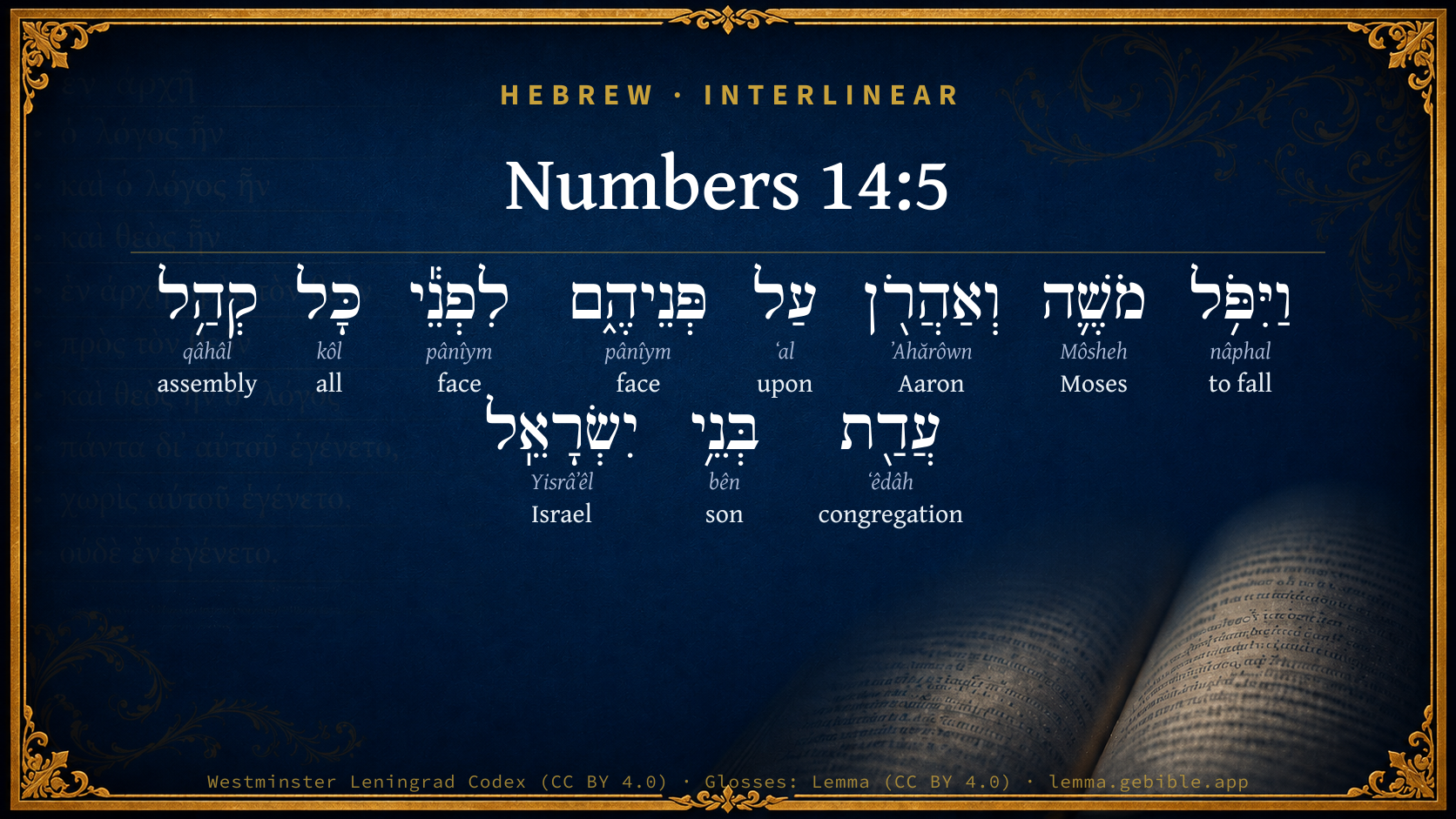
Hebrew (Westminster Leningrad Codex) Numbers 14:5 appears in the Hebrew Old Testament. The text above is from the Westminster Leningrad Codex. Each word links to its Strong’s number, a concise gloss, and parsing drawn from the Open Scriptures Hebrew Bible morphology. Click any word for its full Brown-Driver-Briggs (BDB) entry.
Download image
Cite this verse

Numbers 14:5 (World English Bible). Public Domain. Lemma interlinear Bible study tool, https://lemma.gebible.app/v/numbers/14/5.

Show BibTeX & RIS
BibTeX
RIS
English Translation
Then Moses and Aaron fell on their faces before all the assembly of the congregation of the children of Israel.
World English Bible · Public Domain
Download a study sheet

One document with this verse’s original text, its word-by-word gloss line, the meaning frame, cross-references with their text, attributed commentary, and full source and license credits — printable, and it pastes into notes with its structure intact.

This verse Autodidact and up

Study sheet (.html) Plain text (.txt)

A passage Seminary Student

Up to 50 verses in one chapter. A passage sheet keeps up to 6 commentary sources and 12 cross-references per verse, in the order this page ranks them, and says so on the sheet whenever that leaves anything out. Ask for a single verse and you get the Autodidact verse sheet above.

Everything on this page stays free to read, with no account — the sheet is a download of what is already on screen, not access to it.

Want to remove ads? Support Godless Engineer
Compare translations 3

The same verse in 3 English versions, stacked beneath the original-language interlinear above. Click any original word for its lexicon entry.

Each is an independent rendering of the whole verse — the interlinear is not word-aligned to these translations.

Highlighted words mark where these versions differ — a whole-verse word diff, not a word-by-word alignment.

  • World English Bible Public Domain
    Then Moses and Aaron fell on their faces before all the assembly of the congregation of the children of Israel.
  • King James Version Public Domain
    Then Moses and Aaron fell on their faces before all the assembly of the congregation of the children of Israel.
  • unfoldingWord Literal Text CC BY-SA 4.0
    And Moses fell and Aaron on their faces to the face of all the assembly of the congregation of the sons of Israel,

unfoldingWord Literal Text — © unfoldingWord, licensed CC BY-SA 4.0. Word-aligned USFM3 via Door43 (git.door43.org/unfoldingWord/en_ult).

Versions to compare (up to 4)

3 of 4 selected

Show all 18 translations

Every available English version of this verse, each an independent rendering of the whole verse.

  • World English Bible Public Domain
    Then Moses and Aaron fell on their faces before all the assembly of the congregation of the children of Israel.
  • Berean Standard Bible Public Domain
    Then Moses and Aaron fell facedown before the whole assembly of the congregation of Israel.
  • Majority Standard Bible Public Domain
    Then Moses and Aaron fell facedown before the whole assembly of the congregation of Israel.
  • King James Version Public Domain
    Then Moses and Aaron fell on their faces before all the assembly of the congregation of the children of Israel.
  • American Standard Version (1901) Public Domain
    Then Moses and Aaron fell on their faces before all the assembly of the congregation of the children of Israel.
  • Revised Version (1885) Public Domain
    Then Moses and Aaron fell on their faces before all the assembly of the congregation of the children of Israel.
  • Geneva Bible (1599) Public Domain
    Then Moses and Aaron fell on their faces before all the assemblie of the Congregation of the children of Israel.
  • Douay-Rheims (1899) Public Domain
    And when Moses and Aaron heard this, they fell down flat upon the ground before the multitude of the children of Israel.
  • Young's Literal Translation Public Domain
    And Moses falleth -- Aaron also -- on their faces, before all the assembly of the company of the sons of Israel.
  • Literal Standard Version CC BY-SA 4.0
    And Moses falls—Aaron also—on their faces, before all the assembly of the congregation of the sons of Israel.
  • Unlocked Literal Bible CC BY-SA 4.0
    Then Moses and Aaron lay facedown before all the assembly of the community of the people of Israel.
  • unfoldingWord Literal Text CC BY-SA 4.0
    And Moses fell and Aaron on their faces to the face of all the assembly of the congregation of the sons of Israel,
  • Darby Bible Public Domain
    Then Moses and Aaron fell upon their faces before the whole congregation of the assembly of the children of Israel.
  • World Messianic Bible Public Domain
    Then Moses and Aaron fell on their faces before all the assembly of the congregation of the children of Israel.
  • Webster's Bible Public Domain
    Then Moses and Aaron fell on their faces before all the assembly of the congregation of the children of Israel.
  • Free Bible Version CC BY-SA 4.0
    Moses and Aaron fell facedown on the ground in front of all the assembled Israelites.
  • Bible in Basic English Public Domain
    Then Moses and Aaron went down on their faces before the meeting of the people.
  • JPS Tanakh (1917) Public Domain
    Then Moses and Aaron fell on their faces before all the assembly of the congregation of the children of Israel.

Literal Standard Version (2020), Covenant Press — licensed CC BY-SA 4.0. Text via the HelloAO Bible API (eBible.org). Unlocked Literal Bible (unfoldingWord) — licensed CC BY-SA 4.0. Text via the HelloAO Bible API (eBible.org). unfoldingWord Literal Text — © unfoldingWord, licensed CC BY-SA 4.0. Word-aligned USFM3 via Door43 (git.door43.org/unfoldingWord/en_ult). Free Bible Version, Dr. Jonathan Gallagher — licensed CC BY-SA 4.0. Text via the HelloAO Bible API (eBible.org).

Word by word

More ways to search: Search by grammar → Find every occurrence → Compare this word →

Practice this passage: Drill this verse → Learn its vocabulary →

קְהַ֥ל
qâhâl
H6951
“assembly of”
Noun, Common, Masculine, Singular, Construct
Part of Speech
Noun
Type
Common
Gender
Masculine
Number
Singular
State
Construct
Full BDB Definition

Origin: from H6950

TWOT: 1991a

assembly, company, congregation, convocation - assembly - for evil counsel, war or invasion, religious purposes - company (of returning exiles) - congregation - as organised body
  1. וַיִּפֹּ֥ל nâphal H5307 “and · to fall” Conjunction + Verb, Qal, Sequential Imperfect, 3rd Person, Masculine, Singular
  2. מֹשֶׁ֛ה Môsheh H4872 “Moses” Noun, Proper
  3. וְאַהֲרֹ֖ן ʼAhărôwn H175 “and · Aaron” Conjunction + Noun, Proper
  4. עַל ʻal H5921 “upon” Preposition
  5. פְּנֵיהֶ֑ם pânîym H6440 “face(s) · their” Noun, Common, Both, Plural, Construct + Suffix, Personal, 3rd Person, Masculine, Plural
  6. לִפְנֵ֕י pânîym H6440 “to/for · face(s) of” Preposition + Noun, Common, Both, Plural, Construct
  7. כָּל kôl H3605 “all of” Noun, Common, Masculine, Singular, Construct
  8. עֲדַ֖ת ʻêdâh H5712 “congregation of” Noun, Common, Feminine, Singular, Construct
  9. בְּנֵ֥י bên H1121 “sons of” Noun, Common, Masculine, Plural, Construct
  10. יִשְׂרָאֵֽל Yisrâʼêl H3478 “Israel” Noun, Proper

About this verse

These counts appear in no published source. They are computed here, from the morphology-tagged text and Lemma’s own curated glosses. What Lemma adds →

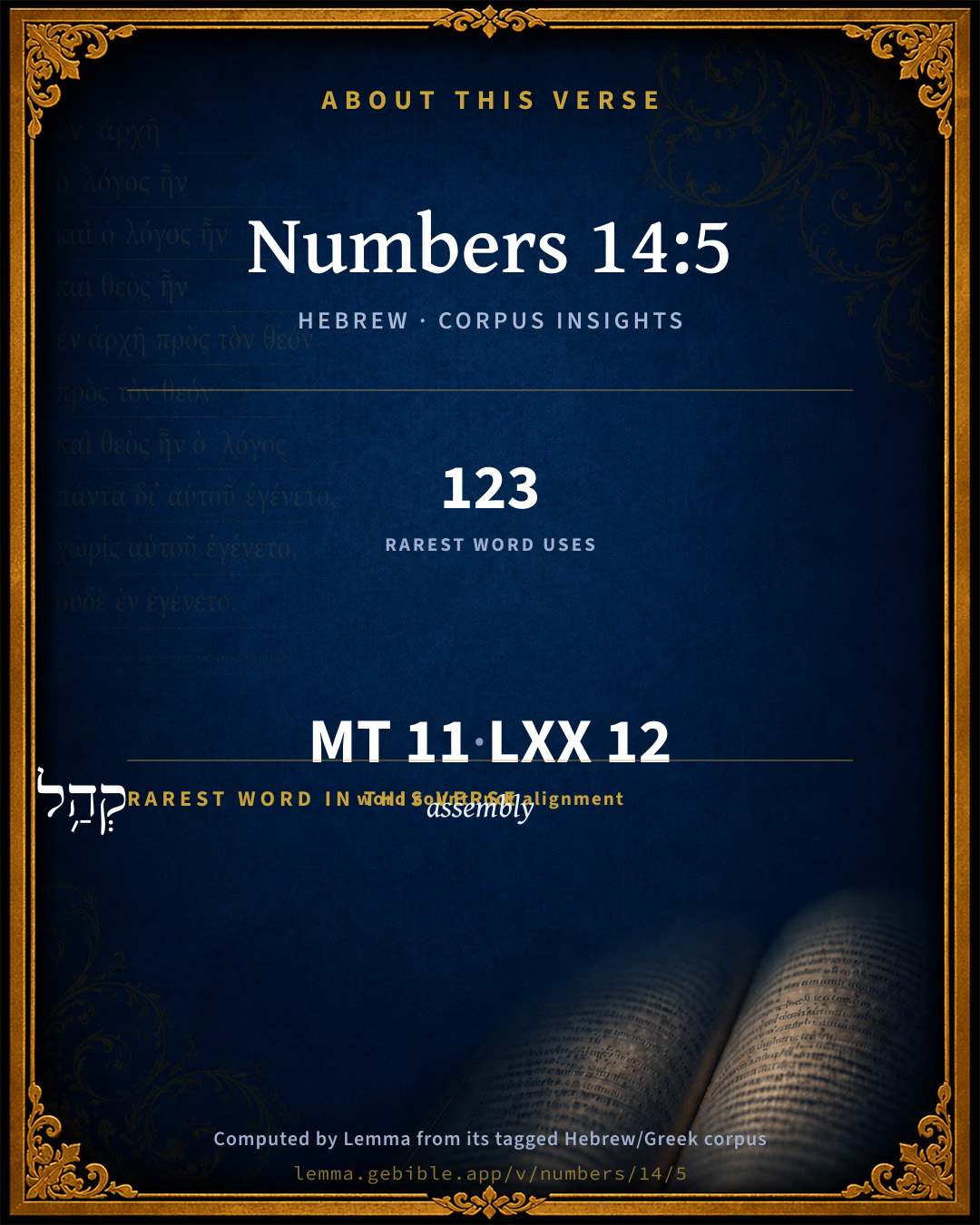
11
words
10
distinct lemmas
Pentateuch
section

Grammatical profile

  • 1 verb
  • 9 nouns
  • 1 preposition

Verb forms

  • וַיִּפֹּ֥ל Qal · Sequential Imperfect

Repetition

A word recurs within this verse — often emphatic in Hebrew:

  • פְּנֵיהֶ֑ם face H6440 ×2

Hebrew & Septuagint length

In English translation the verse runs 20 words from the Hebrew and 17 from the Septuagint (LXX English) — closely comparable.

A rough comparison of the two English renderings, which tokenize alike — not a word-level alignment.

Word counts can differ between the Hebrew and the Greek without any difference in meaning — e.g. the Hebrew direct-object marker אֵת has no separate Greek word, and Greek often adds the article ὁ.

In the original languages it is 11 Hebrew tokens and 12 Greek tokens — but the two are counted differently (Hebrew bundles its prefixes and suffixes into one token; the Greek is in lemma form), so that isn’t a like-for-like length.

Cross-references

15

Topical passages linked to Numbers 14:5 in the Treasury of Scripture Knowledge — connected by theme and wording, ordered by reader-vote popularity; previews shown in the World English Bible.

  • Numbers 16:4 When Moses heard it, he fell on his face:
  • Numbers 16:22 They fell on their faces, and said, God, the God of the spirits of all flesh, shall one man sin, and will you be angry with all the congregation?
  • Numbers 16:45 Get away from among this congregation, that I may consume them in a moment. They fell on their faces.
  • Genesis 17:3 Abram fell on his face. God talked with him, saying,
  • Leviticus 9:24 There came forth fire from before Yahweh, and consumed the burnt offering and the fat upon the altar: and when all the people saw it, they shouted, and fell on their faces.
  • Joshua 5:14 He said, No; but [as] prince of the host of Yahweh am I now come. Joshua fell on his face to the earth, and did worship, and said to him, What says my lord to his servant?
  • 1 Chronicles 21:16 David lifted up his eyes, and saw the angel of Yahweh standing between earth and the sky, having a drawn sword in his hand stretched out over Jerusalem. Then David and the elders, clothed in sackcloth, fell on their faces.
  • Ezekiel 9:8 It happened, while they were smiting, and I was left, that I fell on my face, and cried, and said, Ah Lord Yahweh! will you destroy all the residue of Israel in your pouring out of your wrath on Jerusalem?
  • Joshua 7:10 Yahweh said to Joshua, Get you up; why are you thus fallen on your face?
  • 1 Kings 18:39 When all the people saw it, they fell on their faces: and they said, Yahweh, he is God; Yahweh, he is God.
  • Daniel 10:9 Yet heard I the voice of his words; and when I heard the voice of his words, then was I fallen into a deep sleep on my face, with my face toward the ground.
  • Matthew 26:39 He went forward a little, fell on his face, and prayed, saying, "My Father, if it is possible, let this cup pass away from me; nevertheless, not what I desire, but what you desire."
  • Revelation 4:10 the twenty-four elders fall down before him who sits on the throne, and worship him who lives forever and ever, and throw their crowns before the throne, saying,
  • Revelation 5:14 The four living creatures said, "Amen!" The elders fell down and worshiped.
  • Revelation 7:11 All the angels were standing around the throne, the elders, and the four living creatures; and they fell on their faces before his throne, and worshiped God,

Cross-references courtesy of OpenBible.info (CC BY 4.0).

Hebrew and Greek witnesses Masoretic Hebrew ↔ Greek Septuagint

The same verse in the two great witnesses to the Old Testament, shown verse-for-verse.

These are two independent witnesses, not word-aligned to each other, and the Septuagint is shown in lemma (dictionary) form.

Hebrew Numbers 14:5 Masoretic · Westminster Leningrad Codex

וַיִּפֹּ֥ל מֹשֶׁ֛ה וְאַהֲרֹ֖ן עַל פְּנֵיהֶ֑ם לִפְנֵ֕י כָּל קְהַ֥ל עֲדַ֖ת בְּנֵ֥י יִשְׂרָאֵֽל

Then Moses and Aaron fell on their faces before all the assembly of the congregation of the children of Israel.

World English Bible · Public Domain

Greek LXX Numbers 14:5 Septuagint · lemma form

καί πίπτω μωυσῆς καί ἀαρών ἐπί πρόσωπον ἐναντίον πᾶς συναγωγή υἱός ἰσραήλ

And Moses and Aaron fell upon their face before all the congregation of the children of Israel.

LXX2012 (modern English Septuagint) · Public Domain

Hebrew: Westminster Leningrad Codex (CC BY 4.0). Greek: Septuagint (public domain); English from LXX2012 (modern English Septuagint) (Public Domain). How the Septuagint differs from the Hebrew →

Targum (Aramaic paraphrase)

2

The Targum is the ancient Jewish Aramaic paraphrase of the Hebrew Scriptures — an interpretive translation, not the Hebrew text itself. Onkelos (literal) and Pseudo-Jonathan (expansive) render the Torah, and Jonathan the Prophets. Coverage is partial: where no permissively-licensed English translation exists for a verse, only the Aramaic is shown. This is verse-level text, not a word-by-word alignment to the Hebrew.

  1. Targum Onkelos Torah (Genesis–Deuteronomy)
    וּנְפַל משֶׁה וְאַהֲרֹן עַל אַפֵּיהוֹן קֳדָם כָּל קְהַל כְּנִשְׁתָּא דִבְנֵי יִשְׂרָאֵל

    (no public-domain English translation for this verse)

    Targum Onkelos — Aramaic: “Onkelos Genesis” (public domain); “Onkelos Exodus” (public domain); “Onkelos Leviticus” (public domain); “Onkelos Numbers” (public domain); “Onkelos Deuteronomy” (public domain). English: “Sefaria Community Translation” (CC0 1.0 (public-domain dedication)); “J.W. Etheridge. The Targums of Onkelos and Jonathan Ben Uzziel on the Pentateuch. London: Longmans, Green, 1862” (public domain). Text via Sefaria.

  2. Targum Pseudo-Jonathan Torah (Genesis–Deuteronomy)
    וְאִתְרְכִינוּ משֶׁה וְאַהֲרן עַל אַפֵּיהוֹן קֳדָם כָּל כְּנִישְׁתָּא דִבְנֵי יִשְרָאֵל

    And Mosheh and Aharon bowed upon their faces before all the congregation of the sons of Israel;

    Targum Pseudo-Jonathan — Aramaic: “Targum Jonathan on Genesis” (public domain); “Targum Jonathan on Exodus” (public domain); “Targum Jonathan on Leviticus” (public domain); “Targum Jonathan on Numbers” (public domain); “Targum Jonathan on Deuteronomy” (public domain). English: “The Targum of Jonathan ben Uzziel, trans. J. W. Etheridge, London, 1862” (public domain). Text via Sefaria.

Commentary

Notes on Numbers 14:5 from classic Christian and Jewish commentators (each source and its license shown beneath its notes). The classic Christian expositions comment on the surrounding passage and are grouped to its opening verse, so a note may address several verses; the Jewish commentaries on the Tanakh (Rashi and others) are per-verse, so they appear only where the commentator wrote on this verse.

Lemma curates 59 commentaries, every one of them public domain or Creative Commons licensed, each selected and text-cleaned for this edition rather than reprinted as found. About our sources →

Matthew Henry's Commentary

The friends of Israel here interpose to save them if possible from ruining themselves, but in vain. The physicians of their state would have healed them, but they would not be healed; their watchmen gave them warning, but they would not take warning, and so their blood is upon their own heads.

I. The best endeavours were used to still the tumult, and, if now at last they would have understood the things that belonged to their peace, all the following mischief would have been prevented.

1. Moses and Aaron did their part, Num 14:5. Though it was against them that they murmured (Num 14:2), yet they bravely overlooked the affront and injury done them, and approved themselves faithful friends to those who were outrageous enemies to them. The clamour and noise of the people were so great that Moses and Aaron could not be heard; should they order any of their servants to proclaim silence, the angry multitude would perhaps be the more clamorous; and therefore, to gain audience in the sight of all the assembly, they fell on their faces, thus expressing, (1.) Their humble prayers to God to still the noise of this sea, the noise of its waves, even the tumult of the people. (2.) The great trouble and concern of their own spirits. They fell down as men astonished and even thunder-struck, amazed to see a people throw away their own mercies: to see those so ill-humoured who were so well taught. And, (3.) Their great earnestness with the people to cease their murmurings; they hoped to work upon them by this humble posture, and to prevail with them not to persist in their rebellion; Moses and Aaron beseech them, as though by them God himself did beseech them, to be reconciled unto God. What they said to the people Moses relates in the repetition of this story. Deu 1:29, Deu 1:30, Be not afraid; the Lord your God shall fight for you. Note, Those that are zealous friends to precious souls will stoop to any thing for their salvation. Moses and Aaron, notwithstanding the posts of honour they are in, prostrate themselves to the people to beg of them not to ruin themselves.

2. Caleb and Joshua did their part: they rent their clothes in a holy indignation at the sin of the people, and a holy dread of the wrath of God, which they saw ready to break out against them. it was the greater trouble to these good men because the tumult was occasioned by those spies with whom they had been joined in commission; and therefore they thought themselves obliged to do what they could to still the storm which their fellows had raised. No reasoning could be more pertinent and pathetic than theirs was (Num 14:7-9), and they spoke as with authority.

(1.) They assured them of the goodness of the land they had surveyed, and that it was really worth venturing for, and not a land that ate up the inhabitants, as the evil spies had represented it. It is an exceedingly good land (Num 14:7); it is very, very good, so the word is; so that they had no reason to despise this pleasant land. Note, If men were but thoroughly convinced of the desirableness of the gains of religion, they would not stick at the services of it.

(2.) They made nothing of the difficulties that seemed to lie in the way of their gaining the possession of it: "Fear not the people of the land, Num 14:9. Whatever formidable ideas have been given you of them, the lion is not so fierce as he is painted. They are bread for us," that is, "they are set before us rather to be fed upon than to be fought with, so easily, so pleasantly, and with so much advantage to ourselves shall we master them." Pharaoh is said to have been given them for meat (Psa 74:14), and the Canaanites will be so too. They show that, whatever was suggested to the contrary, the advantage was clear on Israel's side. For, [1.] Though the Canaanites dwell in walled cities, they are naked: Their defence has departed from them; that common providence which preserves the rights of nations has abandoned them, and will be no shelter nor protection to them. The other spies took notice of their strength, but these of their wickedness, and thence inferred that God had forsaken them, and therefore their defence had departed. No people can be safe when they have provoked God to leave them. [2.] Though Israel dwell in tents they are fortified: The Lord is with us, and his name is a strong tower; fear them not. Note, While we have the presence of God with us, we need not fear the most powerful force against us.

(3.) They showed them plainly that all the danger they were in was from their own discontents, and that they would succeed against all their enemies if they did not make God their enemy. On this point alone the cause would turn (Num 14:8): "If the Lord delight in us, as certainly he does, and will if we do not provoke him, he will bring us into this good land; we shall without fail get it in possession by his favour, and the light of his countenance (Psa 44:3), if we do not forfeit his favour and by our own follies turn away our own mercies." It has come to this issue (Num 14:9): Only rebel not you against the Lord. Note, Nothing can ruin sinners but their own rebellion. If God leave them, it is because they drive him from them; and they die because they will die. None are excluded the heavenly Canaan but those that exclude themselves. And, now, could the case have been made more plain? could it have been urged more closely? But what was the effect?

II. It was all to no purpose; they were deaf to this fair reasoning; nay, they were exasperated by it, and grew more outrageous: All the congregation bade stone them with stones, Num 14:10. The rulers of the congregation, and the great men (so bishop Patrick), ordered the common people to fall upon them, and knock their brains out. Their case was sad indeed when their leaders thus caused them to err. Note, It is common for those whose hearts are fully set in them to do evil to rage at those who give them good counsel. Those who hate to be reformed hate those that would reform them, and count them their enemies because they tell them the truth. Thus early did Israel begin to misuse the prophets, and stone those that were sent to them, and it was this that filled the measure of their sin, Mat 23:37. Stone them with stones! Why, what evil have they done? No crime can be laid to their charge; but the truth is these two witnesses tormented those that were obstinate in their infidelity, Rev 11:10. Caleb and Joshua had but just said, The Lord is with us; fear them not (Num 14:9): and, if Israel will not apply those encouraging words to their own fears, those that uttered them know how to encourage themselves with them against this enraged multitude that spoke of stoning them, as David in a like cause, Sa1 30:6. Those that cannot prevail to edify others with their counsels and comforts should endeavour at least to edify themselves. Caleb and Joshua knew they appeared for God and his glory, and therefore doubted not but God would appear for them and their safety. And they were not disappointed, for immediately the glory of the Lord appeared, to the terror and confusion of those that were for stoning the servants of God. When they reflected upon God (Num 14:3), his glory appeared not to silence their blasphemies; but, when they threatened Caleb and Joshua, they touched the apple of his eye, and his glory appeared immediately. Note, Those who faithfully expose themselves for God are sure to be taken under his special protection, and shall be hidden from the rage of men, either under heaven or in heaven.

Matthew Henry's Commentary on the Whole Bible (1708–1710) — public domain (CC PDM 1.0). Text via the HelloAO Bible API.

Trapp's Complete Commentary

John Trapp

Num 14:5 Then Moses and Aaron fell on their faces before all the assembly of the congregation of the children of Israel.

Ver. 5. Before all the assembly.] What they said unto them see Deu 1:29-30. See also on Num 16:15.

John Trapp, A Commentary or Exposition upon All the Books of the Old and New Testament (1647–1656) — public domain. Text from a community e-Sword module.

Joseph Benson's Commentary

Num 14:5. Fell on their faces — As humble and earnest supplicants to God, the only refuge to which Moses resorted in all such straits, and who alone was able to govern this stiff-necked people. Before all the assembly — That they might awake to apprehend their sin and danger, when they saw Moses at his prayers, whom God never failed to defend, even with the destruction of his enemies.

Joseph Benson's Commentary on the Old and New Testaments (1811–1818) — public domain. Text from a community e-Sword module.

Tyndale Open Study Notes

Tyndale Open Resources

14:5 Moses and Aaron prostrated themselves out of humility, fear, grief, and anguish.

Tyndale Open Study Notes — © Tyndale Open Resources, licensed CC BY-SA 4.0. Text via the HelloAO Bible API.

Geneva Bible (1599)

Geneva Bible translators

Lamenting the people, and praying for them.

Geneva Bible (1599) marginal notes — public domain. Text via Bolls.life.

Jamieson, Fausset & Brown

Robert Jamieson, A. R. Fausset & David Brown

Moses and Aaron fell on their faces--as humble and earnest suppliants--either to the people, entreating them to desist from so perverse a design; or rather, to God, as the usual and only refuge from the violence of that tumultuous and stiff-necked rabble--a hopeful means of softening and impressing their hearts.

Jamieson, Fausset & Brown — Commentary Critical and Explanatory on the Whole Bible (1871) — public domain (CC PDM 1.0). Text via the HelloAO Bible API.

John Gill's Exposition

Then Moses and Aaron fell on their faces,.... Through shame and confusion of face for them, at hearing so shocking a proposal made, and such wretched ingratitude expressed; they blushed at it, and were in the utmost distress on account of it, and therefore threw themselves into this posture; or it may be this was done either to beg of them that they would lay aside all thoughts of this kind, or to supplicate the divine Majesty that he would convince them of their sin and folly, and give them repentance for it and forgiveness of it; and this they did

before all the assembly of the congregation of the children of Israel; to affect them the more with a sense of their sin and danger.

John Gill's Exposition of the Whole Bible (1746–1763) — public domain (CC PDM 1.0). Text via the HelloAO Bible API.

Albert Barnes' Notes on the Bible

Already Caleb had endeavored to still the people before Moses Num 13:30; already Moses himself (Deu 1:29 ff) had endeavored to recall the people to obedience. After the failure of these efforts Moses and Aaron cast themselves down in solemn prayer before God (compare Num 16:22); and the appearance of the glory of the Lord in the “tabernacle of the congregation” Num 14:10 was the immediate answer.

Albert Barnes' Notes on the Bible (1834–1885) — public domain. Text from a community e-Sword/MySword module.

Haydock's Catholic Bible Commentary

Israel; begging that God would not destroy them, as he had done their brethren, chap. xi. (Menochius)

George Leo Haydock (1774–1849), Haydock's Catholic Family Bible and Commentary, 1859 edition — public domain. Excludes Psalms (Douay-Rheims chapter numbering differs from Protestant) and Deuterocanonical books (Catholic canon only).

Matthew Poole's English Annotations

As humble and earnest suppliants, either to the people, to entreat them to desist from their wicked and pernicious enterprise; or rather, to God, by comparing this with Num 16:4; 20:6, the only refuge to which Moses resorted in all such straits, and who alone was able to still and govern this tumultuous and stiff-necked people.

Before all the assembly, that they might be awaked to apprehend their sin and danger, when they saw Moses at his prayers, whom God never used to deny, and never failed to defend, even with the destruction of his enemies.

Matthew Poole's English Annotations on the Holy Bible (1683–1685) — public domain. Text from a community e-Sword/MySword module.

Whedon's Commentary on the Bible

Daniel D. Whedon

5. Fell on their faces — This attitude was expressive of the deepest sorrow, and at the same time it was a mute but eloquent appeal to the mutinous multitude to desist from their insane purpose. He who was accustomed to speak face to face with God might have fortified his dishonoured authority by invoking against these rebellious murmurers the bolts of God’s wrath. But he loved the Abrahamic race more than his own dignity and power.

Daniel D. Whedon (gen. ed.), Commentary on the Old and New Testaments (1874–1909) — public domain. Text from a community e-Sword module.

The Pulpit Commentary

Moses and Aaron fell on their faces. After making ineffectual efforts to reason with the people, or rather with their leaders. (Deu_1:29-31) It was not, however, in this case an attitude of intercession, but the instinctive action of those who await in silent horror a catastrophe which they see to be inevitable; it testified to all who saw it that they were overwhelmed with shame and sorrow in view of the awful sin of the people, and of the terrible punishment which must follow.

A mute appeal.

I THERE COMES A TIME WHEN ALL EXPOSTULATION WITH MEN IS VAIN, at all events the expostulation of certain people. Moses felt no word he could say would be of the slightest use. In vain you throw the pearls of truth and soberness before the swinish multitude, and it is the humbling testimony of history that only too often men get so embruted in their prejudices and passions as to be for all purposes of rational action little better than swine. Caleb and Joshua spoke, only to be threatened with stones. Moses and Aaron make no attempt to speak, but fall on their faces before all the assembly. What the seventy elders were about all this time we know not. When even Moses has to be silent it is little wonder their presence should count for nothing. We need to recollect this madness and perversity of men, this ease and rapidity with which human passion mounts to the violence of a hurricane. The reasonableness of human nature is far too frequently glorified. There was a time when Paul"s converts in Galatia would have plucked out their eyes, and given them to him; yet as years pass on, and they listen to another gospel, which is not another, he has to mourn that he seems to have become their enemy because he tells them the truth. (Gal_4:15, Gal_4:16)

II But when we can do nothing for men directly, WE MUST NOT, therefore, WAIT IN COMPLETE INACTION. Moses was obliged to be silent in words; not even to God does he seem to have spoken; but he fell to the ground in mute and humble appeal. There, prostrate before the tabernacle, were Moses and Aaron, the leader and the priest, brethren according to the flesh, united now by deep affliction, if a little while ago they were separated by envy. Nor was the lowly attitude simply an appeal to God; it might have effect on some of the better sort among the multitude, finding a way to the heart by the eye, which for the time was not open by the ear. Neither was the appeal simply for the sake of Moses and Aaron. The people had treated them badly, but this was a small matter compared with their treatment of God. How often we fume over injustice to ourselves, utterly forgetting the great world"s huge and light-hearted negligence of him who made and redeemed it. Consider Martha, complaining so bitterly of Mary, while she herself was refusing the true hospitality to Jesus. A man with the mind of Christ Jesus in him will be always more affected by slights upon the Saviour than upon himself.

III There is always then this one thing we can do in the turmoil of human affairs: we CAN RECOGNIZE WITH DEEP HUMILITY THE AWFUL PRESENCE OF GOD. As we are driven irate a sense of utter helplessness, let us think of him from whom, and by whom, and to whom are all things. It is only when we are humbled before him, and recollect his love and power in Christ, that we can be calm in the presence of the awful problems of human existence. How much better off was Moses in his extremity than the Israelites in theirs I They rejected Moses and the tabernacle to speak vain words about returning to Egypt; he, shut out as it were from service to them, found his sure refuge in prostration before God. Y. (Psa_46:1-3)

The Pulpit Commentary (1880–1919), ed. H.D.M. Spence-Jones & Joseph S. Exell — public domain. Text from a community e-Sword module.

John Wesley's Explanatory Notes

Fell on their faces - As humble and earnest suppliants to God, the only refuge to which Moses resorted in all such straits, and who alone was able to govern this stiff-necked people. Before all the assembly -That they might awake to apprehend their sin and danger, when they saw Moses at his prayers, whom God never failed to defend, even with the destruction of his enemies.

John Wesley, Explanatory Notes Upon the Whole Bible (1754–1765) — public domain. Text via the GEBible commentary corpus.

Keil & Delitzsch

C. F. Keil & F. Delitzsch

At this murmuring, which was growing into open rebellion, Moses and Aaron fell upon their faces before the whole of the assembled congregation, namely, to pour out their distress before the Lord, and move Him to interpose; that is to say, after they had made an unsuccessful attempt, as we may supply from Deu 1:29-31, to cheer up the people, by pointing them to the help they had thus far received from God. "In such distress, nothing remained but to pour out their desires before God; offering their prayer in public, however, and in the sight of all the people, in the hope of turning their minds" (Calvin). Joshua and Caleb, who had gone with the others to explore the land, also rent their clothes, as a sign of their deep distress at the rebellious attitude of the people (see at Lev 10:6), and tried to convince them of the goodness and glory of the land they had travelled through, and to incite them to trust in the Lord. "If Jehovah take pleasure in us,"; they said, "He will bring us into this land. Only rebel not ye against Jehovah, neither fear ye that people of the land; for they are our food;" i.e., we can and shall swallow them up, or easily destroy them (cf. Num 22:4; Num 24:8; Deu 7:16; Psa 14:4). "Their shadow is departed from them, and Jehovah is with us: fear them not!" "Their shadow" is the shelter and protection of God (cf. Ps 91; Psa 121:5). The shadow, which defends from the burning heat of the sun, was a very natural figure in the sultry East, to describe defence from injury, a refuge from danger and destruction (Isa 30:2). The protection of God had departed from the Canaanites, because God had determined to destroy them when the measure of their iniquity was full (Gen 15:16; cf. Exo 34:24; Lev 18:25; Lev 20:23). But the excited people resolved to stone them, when Jehovah interposed with His judgment, and His glory appeared in the tabernacle to all the Israelites; that is to say, the majesty of God flashed out before the eyes of the people in a light which suddenly burst forth from the tabernacle (see at Exo 16:10).

Keil & Delitzsch — Biblical Commentary on the Old Testament (1861–1891) — public domain (CC PDM 1.0). Text via the HelloAO Bible API. (Old Testament only.)

Ramban (Nachmanides)

Rabbi Moshe ben Nachman (Ramban / Nachmanides)

THEN MOSES AND AARON FELL ON THEIR FACES. The reason for this was that they saw that the people were about to decide to appoint a leader and return [to Egypt] immediately; so the righteous ones [Moses and Aaron] arose and prostrated themselves with their faces on the ground saying to them, ‘I pray you, my brethren, do not so wickedly,’ and let this be no stumbling-block unto you. Therefore it says [that they fell on their faces] before all the congregation of the children of Israel, for it was for their sake that they prostrated themselves on their faces [imploring them to abandon their plan to return to Egypt]. ] before all the assembly of the congregation of the children of Israel, thus indicating that they did so in order to implore them to abandon their plan of returning to Egypt. See also Note 155 further. Similarly, and he [David] fell on his face to the ground and bowed down three times [before Jonathan, is an expression of conciliation and supplication]. And the meaning of the word liphnei [“before” — ‘before’ all the assembly] is like lahem [“for them” — to implore them, for their good, to renounce their plan of returning to Egypt]. Similarly, And his brethren also went and fell down ‘l’phanav (‘before’ him) [also means “to” him — Joseph — to beg him for forgiveness]. There are many examples of this usage.

Ramban (Nachmanides) on the Tanakh — English translation: “Commentary on the Torah by Ramban (Nachmanides). Translated and annotated by Charles B. Chavel. New York, Shilo Pub. House, 1971-1976” (CC BY 4.0). Text via Sefaria.

Lesson kit

Teaching starters — assembled from the data on this page, not authored interpretation. Every prompt links to the verse data it draws on. Edit before teaching.

Numbers, in the Pentateuch, opens this verse with 11 words (10 distinct Hebrew lemmas). Its most distinctive word is qâhâl (“assembly”). A historical commentator’s framing appears above. Read the whole chapter for the surrounding context.

Discussion questions

  1. How does “assembly” (qâhâl) shape what this verse is saying?
  2. Numbers 16:4 shares this passage’s theme. How do the two illuminate each other?
  3. “face” occurs 2× in this one verse. What is the effect of the repetition?
  4. The translations on this page render this verse differently — a whole-verse word diff, not a word-by-word alignment. What might account for the different wordings?
  5. The verb «וַיִּפֹּ֥ל» is Qal Sequential Imperfect. How does its form color the action?
  6. Reading how Matthew Henry's Commentary and Trapp's Complete Commentary read this verse, where do the two commentators agree and where do they part?

Things to notice

Reading settings

Reading text

Shown beneath each verse's original-language words.

Old Testament
Old Testament edition

Read the OT as the Masoretic Hebrew (MT) or the Greek Septuagint (LXX).

English shown for the Greek Septuagint (in the Hebrew ↔ Greek comparison).

Comparing translations? Open the Compare panel on any verse page to stack up to four side by side.