
1 Samuel 4:10

Hebrew (Westminster Leningrad Codex) 1 Samuel 4:10 appears in the Hebrew Old Testament. The text above is from the Westminster Leningrad Codex. Each word links to its Strong’s number, a concise gloss, and parsing drawn from the Open Scriptures Hebrew Bible morphology. Click any word for its full Brown-Driver-Briggs (BDB) entry.
Download image
Cite this verse

1 Samuel 4:10 (World English Bible). Public Domain. Lemma interlinear Bible study tool, https://lemma.gebible.app/v/1-samuel/4/10.

Show BibTeX & RIS
BibTeX
RIS
English Translation
The Philistines fought, and Israel was struck, and they fled every man to his tent: and there was a very great slaughter; for there fell of Israel thirty thousand footmen.
World English Bible · Public Domain
Download a study sheet

One document with this verse’s original text, its word-by-word gloss line, the meaning frame, cross-references with their text, attributed commentary, and full source and license credits — printable, and it pastes into notes with its structure intact.

This verse Autodidact and up

Study sheet (.html) Plain text (.txt)

A passage Seminary Student

Up to 50 verses in one chapter. A passage sheet keeps up to 6 commentary sources and 12 cross-references per verse, in the order this page ranks them, and says so on the sheet whenever that leaves anything out. Ask for a single verse and you get the Autodidact verse sheet above.

Everything on this page stays free to read, with no account — the sheet is a download of what is already on screen, not access to it.

Want to remove ads? Support Godless Engineer
Compare translations 3

The same verse in 3 English versions, stacked beneath the original-language interlinear above. Click any original word for its lexicon entry.

Each is an independent rendering of the whole verse — the interlinear is not word-aligned to these translations.

Highlighted words mark where these versions differ — a whole-verse word diff, not a word-by-word alignment.

  • World English Bible Public Domain
    The Philistines fought, and Israel was struck, and they fled every man to his tent: and there was a very great slaughter; for there fell of Israel thirty thousand footmen.
  • King James Version Public Domain
    And the Philistines fought, and Israel was smitten, and they fled every man into his tent: and there was a very great slaughter; for there fell of Israel thirty thousand footmen.
  • unfoldingWord Literal Text CC BY-SA 4.0
    And the Philistines fought, and Israel was struck and fled, a man to his tent. And it was a very great striking, for 30,000 foot soldiers from Israel fell.

unfoldingWord Literal Text — © unfoldingWord, licensed CC BY-SA 4.0. Word-aligned USFM3 via Door43 (git.door43.org/unfoldingWord/en_ult).

Versions to compare (up to 4)

3 of 4 selected

Show all 18 translations

Every available English version of this verse, each an independent rendering of the whole verse.

  • World English Bible Public Domain
    The Philistines fought, and Israel was struck, and they fled every man to his tent: and there was a very great slaughter; for there fell of Israel thirty thousand footmen.
  • Berean Standard Bible Public Domain
    So the Philistines fought, and Israel was defeated, and each man fled to his tent. The slaughter was very great—thirty thousand foot soldiers of Israel fell.
  • Majority Standard Bible Public Domain
    So the Philistines fought, and Israel was defeated, and each man fled to his tent. The slaughter was very great—thirty thousand foot soldiers of Israel fell.
  • King James Version Public Domain
    And the Philistines fought, and Israel was smitten, and they fled every man into his tent: and there was a very great slaughter; for there fell of Israel thirty thousand footmen.
  • American Standard Version (1901) Public Domain
    And the Philistines fought, and Israel was smitten, and they fled every man to his tent: and there was a very great slaughter; for there fell of Israel thirty thousand footmen.
  • Revised Version (1885) Public Domain
    And the Philistines fought, and Israel was smitten, and they fled every man to his tent: and there was a very great slaughter; for there fell of Israel thirty thousand footmen.
  • Geneva Bible (1599) Public Domain
    And the Philistims fought, and Israel was smitten downe, and fled euery man into his tent: and there was an exceeding great slaughter: for there fell of Israel thirtie thousand footemen.
  • Douay-Rheims (1899) Public Domain
    So the Philistines fought, and Israel was overthrown, and every man fled to his own dwelling: and there was an exceeding great slaughter; for there fell of Israel thirty thousand footmen.
  • Young's Literal Translation Public Domain
    And the Philistines fight, and Israel is smitten, and they flee each to his tents, and the blow is very great, and there fall of Israel thirty thousand footmen;
  • Literal Standard Version CC BY-SA 4.0
    And the Philistines fight, and Israel is struck, and they each flee to his tents, and the slaughter is very great, and thirty thousand footmen of Israel fall;
  • Unlocked Literal Bible CC BY-SA 4.0
    The Philistines fought, and Israel was defeated. Every man fled to his house, and the slaughter was very great; for thirty thousand foot soldiers from Israel fell.
  • unfoldingWord Literal Text CC BY-SA 4.0
    And the Philistines fought, and Israel was struck and fled, a man to his tent. And it was a very great striking, for 30,000 foot soldiers from Israel fell.
  • Darby Bible Public Domain
    And the Philistines fought, and Israel was routed, and they fled every man to his tent; and there was a very great slaughter, and there fell of Israel thirty thousand footmen.
  • World Messianic Bible Public Domain
    The Philistines fought, and Israel was defeated, and each man fled to his tent. There was a very great slaughter; for thirty thousand footmen of Israel fell.
  • Webster's Bible Public Domain
    And the Philistines fought, and Israel was smitten, and they fled every man into his tent: and there was a very great slaughter, for there fell of Israel thirty thousand footmen.
  • Free Bible Version CC BY-SA 4.0
    So the Philistines fought, and the Israelites were defeated—every man ran away home. The death toll was very large: thirty thousand of the Israelite infantry were killed.
  • Bible in Basic English Public Domain
    So the Philistines went to the fight, and Israel was overcome, and every man went in flight to his tent: and great was the destruction, for thirty thousand footmen of Israel were put to the sword.
  • JPS Tanakh (1917) Public Domain
    And the Philistines fought, and Israel was smitten, and they fled every man to his tent; and there was a very great slaughter; for there fell of Israel thirty thousand footmen.

Literal Standard Version (2020), Covenant Press — licensed CC BY-SA 4.0. Text via the HelloAO Bible API (eBible.org). Unlocked Literal Bible (unfoldingWord) — licensed CC BY-SA 4.0. Text via the HelloAO Bible API (eBible.org). unfoldingWord Literal Text — © unfoldingWord, licensed CC BY-SA 4.0. Word-aligned USFM3 via Door43 (git.door43.org/unfoldingWord/en_ult). Free Bible Version, Dr. Jonathan Gallagher — licensed CC BY-SA 4.0. Text via the HelloAO Bible API (eBible.org).

Word by word

More ways to search: Search by grammar → Find every occurrence → Compare this word →

Practice this passage: Drill this verse → Learn its vocabulary →

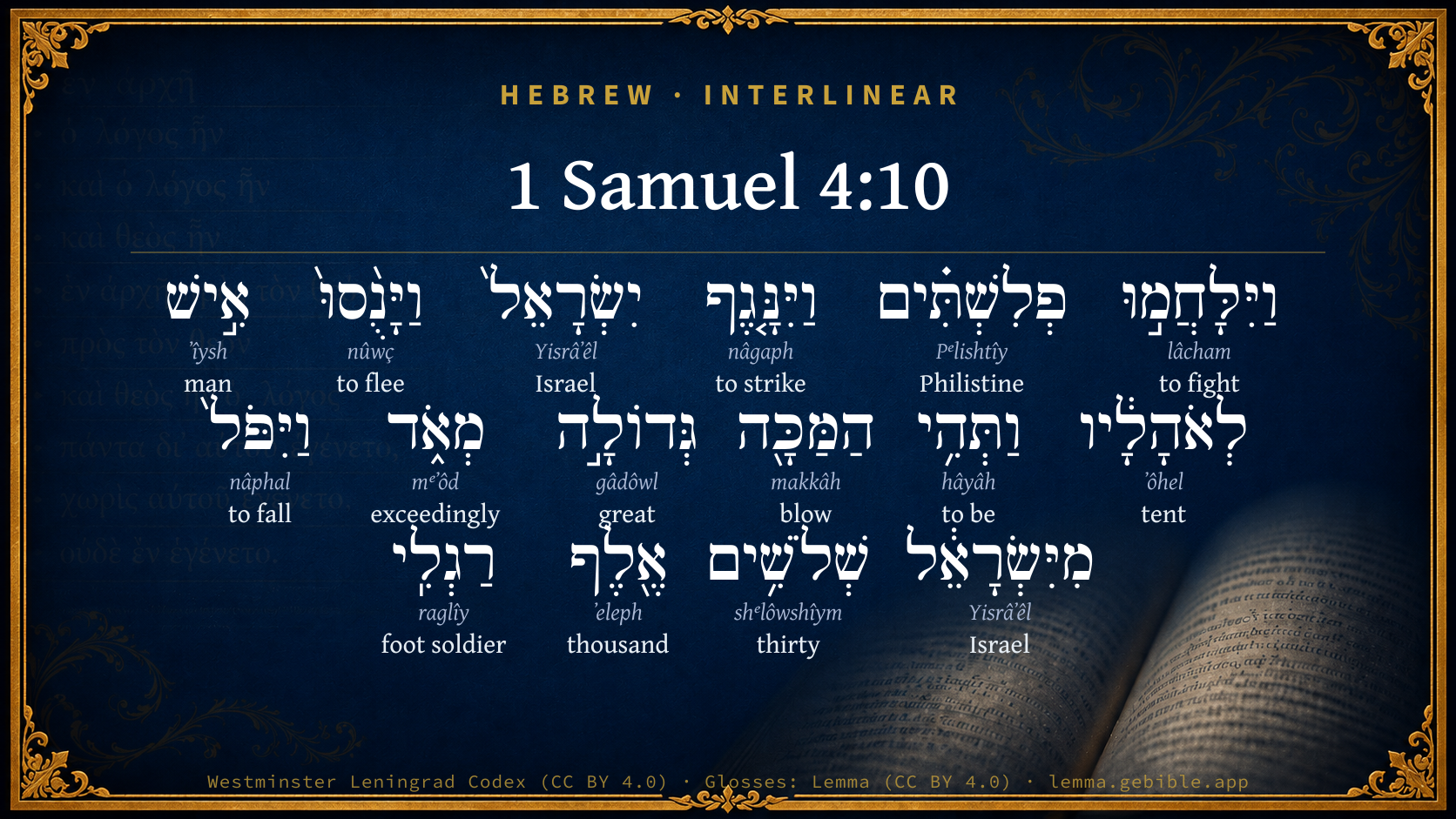
רַגְלִֽי
raglîy
H7273
“foot soldier”
Adjective, Adjective, Masculine, Singular, Absolute
Part of Speech
Adjective
Type
Adjective
Gender
Masculine
Number
Singular
State
Absolute
Full BDB Definition

Origin: from H7272

TWOT: 2113b

on foot - man on foot, footman, foot soldier
  1. וַיִּלָּחֲמ֣וּ lâcham H3898 “and · to fight” Conjunction + Verb, Niphal, Sequential Imperfect, 3rd Person, Masculine, Plural
  2. פְלִשְׁתִּ֗ים Pᵉlishtîy H6430 “Philistines” Noun, Gentilic, Masculine, Plural, Absolute
  3. וַיִּנָּ֤גֶף nâgaph H5062 “and · to strike” Conjunction + Verb, Niphal, Sequential Imperfect, 3rd Person, Masculine, Singular
  4. יִשְׂרָאֵל֙ Yisrâʼêl H3478 “Israel” Noun, Proper
  5. וַיָּנֻ֨סוּ֙ nûwç H5127 “and · to flee” Conjunction + Verb, Qal, Sequential Imperfect, 3rd Person, Masculine, Plural
  6. אִ֣ישׁ ʼîysh H376 “man” Noun, Common, Masculine, Singular, Absolute
  7. לְאֹהָלָ֔יו ʼôhel H168 “to/for · tents · his” Preposition + Noun, Common, Masculine, Plural, Construct + Suffix, Personal, 3rd Person, Masculine, Singular
  8. וַתְּהִ֥י hâyâh H1961 “and · to be” Conjunction + Verb, Qal, Sequential Imperfect, 3rd Person, Feminine, Singular
  9. הַמַּכָּ֖ה makkâh H4347 “the · blow” Particle, Definite Article + Noun, Common, Feminine, Singular, Absolute
  10. גְּדוֹלָ֣ה gâdôwl H1419 “great” Adjective, Adjective, Feminine, Singular, Absolute
  11. מְאֹ֑ד mᵉʼôd H3966 “exceedingly” Adverb
  12. וַיִּפֹּל֙ nâphal H5307 “and · to fall” Conjunction + Verb, Qal, Sequential Imperfect, 3rd Person, Masculine, Singular
  13. מִיִּשְׂרָאֵ֔ל Yisrâʼêl H3478 “from · Israel” Preposition + Noun, Proper
  14. שְׁלֹשִׁ֥ים shᵉlôwshîym H7970 “thirty” Adjective, Cardinal number, Both, Plural, Absolute
  15. אֶ֖לֶף ʼeleph H505 “thousand” Adjective, Cardinal number, Both, Singular, Absolute

About this verse

These counts appear in no published source. They are computed here, from the morphology-tagged text and Lemma’s own curated glosses. What Lemma adds →

16
words
15
distinct lemmas
Historical
section

Notable vocabulary

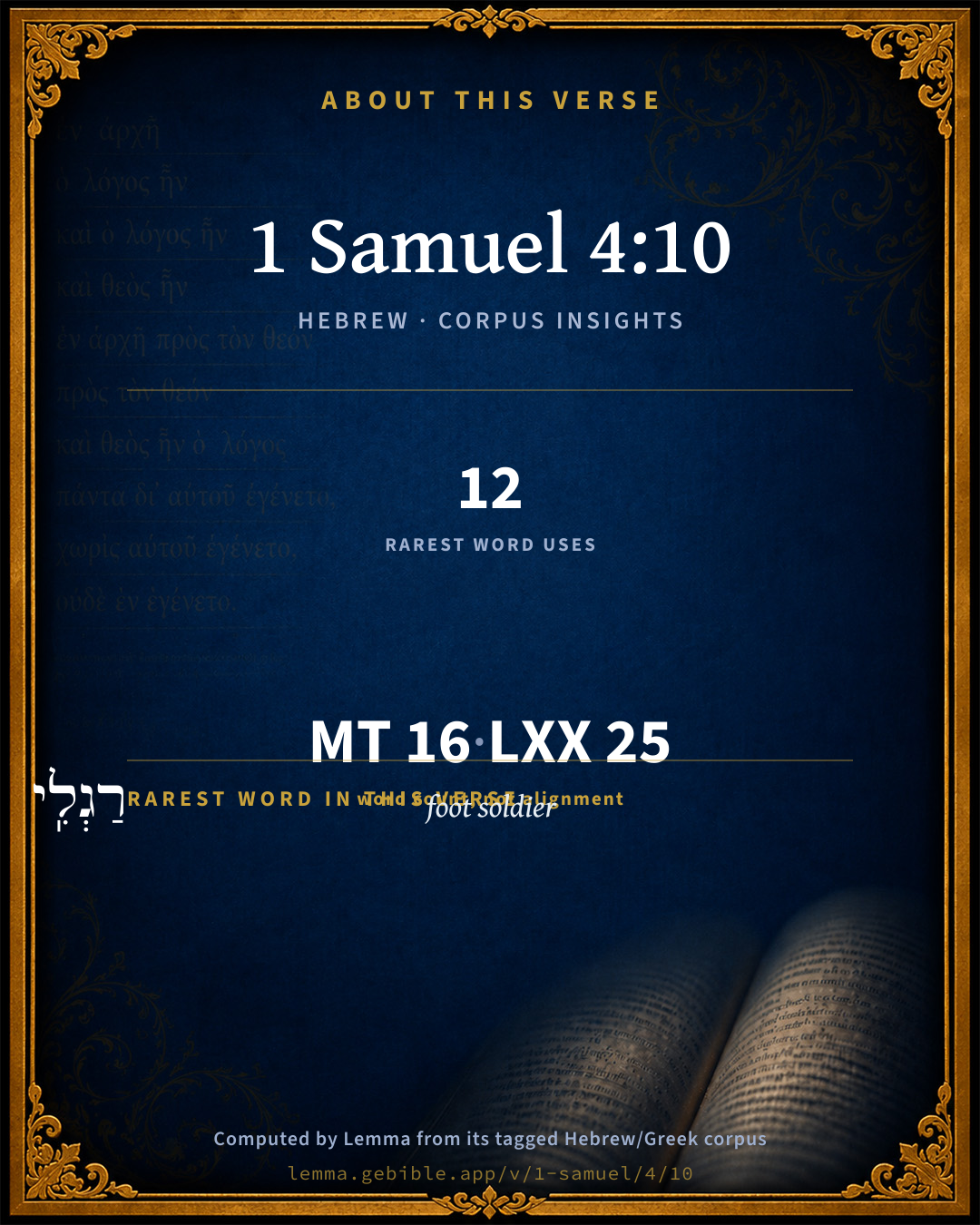
The rarest word here is רַגְלִֽי foot soldier H7273 — appearing just 12 times in the whole Hebrew Bible.

Shared distinctive vocabulary

רַגְלִֽי foot soldier H7273 occurs in 12 verses of the Hebrew Bible. Also found in:

Grammatical profile

  • 5 verbs
  • 6 nouns
  • 4 adjectives
  • 1 adverb

Verb forms

  • וַיִּלָּחֲמ֣וּ Niphal · Sequential Imperfect
  • וַיִּנָּ֤גֶף Niphal · Sequential Imperfect
  • וַיָּנֻ֨סוּ֙ Qal · Sequential Imperfect
  • וַתְּהִ֥י Qal · Sequential Imperfect
  • וַיִּפֹּל֙ Qal · Sequential Imperfect

Repetition

A word recurs within this verse — often emphatic in Hebrew:

  • יִשְׂרָאֵל֙ Israel H3478 ×2

Hebrew & Septuagint length

In English translation the verse runs 30 words from the Hebrew and 35 from the Septuagint (LXX English) — closely comparable.

A rough comparison of the two English renderings, which tokenize alike — not a word-level alignment.

Word counts can differ between the Hebrew and the Greek without any difference in meaning — e.g. the Hebrew direct-object marker אֵת has no separate Greek word, and Greek often adds the article ὁ.

In the original languages it is 16 Hebrew tokens and 25 Greek tokens — but the two are counted differently (Hebrew bundles its prefixes and suffixes into one token; the Greek is in lemma form), so that isn’t a like-for-like length.

Cross-references

16

Topical passages linked to 1 Samuel 4:10 in the Treasury of Scripture Knowledge — connected by theme and wording, ordered by reader-vote popularity; previews shown in the World English Bible.

  • 1 Samuel 4:2 The Philistines put themselves in array against Israel: and when they joined battle, Israel was struck before the Philistines; and they killed of the army in the field about four thousand men.
  • Leviticus 26:17 I will set my face against you, and you will be struck before your enemies. Those who hate you will rule over you; and you will flee when no one pursues you.
  • Deuteronomy 28:25 Yahweh will cause you to be struck before your enemies; you shall go out one way against them, and shall flee seven ways before them: and you shall be tossed back and forth among all the kingdoms of the earth.
  • 2 Kings 14:12 Judah was put to the worse before Israel; and they fled every man to his tent.
  • 2 Samuel 18:17 They took Absalom, and cast him into the great pit in the forest, and raised over him a very great heap of stones: and all Israel fled everyone to his tent.
  • Psalms 78:60–64 So that he forsook the tent of Shiloh, The tent which he placed among men;
  • 2 Samuel 18:7 The people of Israel were struck there before the servants of David, and there was a great slaughter there that day of twenty thousand men.
  • 2 Samuel 19:8 Then the king arose, and sat in the gate. They told to all the people, saying, Behold, the king is sitting in the gate: and all the people came before the king. Now Israel had fled every man to his tent.
  • 2 Samuel 20:1 There happened to be there a base fellow, whose name was Sheba, the son of Bichri, a Benjamite: and he blew the trumpet, and said, We have no portion in David, neither have we inheritance in the son of Jesse: every man to his tents, Israel.
  • 1 Kings 12:16 When all Israel saw that the king didn't listen to them, the people answered the king, saying, What portion have we in David? neither have we inheritance in the son of Jesse: to your tents, Israel: now see to your own house, David. So Israel departed to their tents.
  • 1 Kings 22:36 There went a cry throughout the host about the going down of the sun, saying, Every man to his city, and every man to his country.
  • 2 Chronicles 13:17 Abijah and his people killed them with a great slaughter: so there fell down slain of Israel five hundred thousand chosen men.
  • 2 Chronicles 25:22 Judah was put to the worse before Israel; and they fled every man to his tent.
  • 2 Chronicles 28:5–6 Therefore Yahweh his God delivered him into the hand of the king of Syria; and they struck him, and carried away of his a great multitude of captives, and brought them to Damascus. He was also delivered into the hand of the king of Israel, who struck him with a great slaughter.
  • Psalms 78:9 The children of Ephraim, being armed and carrying bows, Turned back in the day of battle.
  • Isaiah 10:3–6 What will you do in the day of visitation, and in the desolation which shall come from far? to whom will you flee for help? and where will you leave your glory?

Cross-references courtesy of OpenBible.info (CC BY 4.0).

Hebrew and Greek witnesses Masoretic Hebrew ↔ Greek Septuagint

The same verse in the two great witnesses to the Old Testament, shown verse-for-verse.

These are two independent witnesses, not word-aligned to each other, and the Septuagint is shown in lemma (dictionary) form.

Hebrew 1 Samuel 4:10 Masoretic · Westminster Leningrad Codex

וַיִּלָּחֲמ֣וּ פְלִשְׁתִּ֗ים וַיִּנָּ֤גֶף יִשְׂרָאֵל֙ וַיָּנֻ֨סוּ֙ אִ֣ישׁ לְאֹהָלָ֔יו וַתְּהִ֥י הַמַּכָּ֖ה גְּדוֹלָ֣ה מְאֹ֑ד וַיִּפֹּל֙ מִיִּשְׂרָאֵ֔ל שְׁלֹשִׁ֥ים אֶ֖לֶף רַגְלִֽי

The Philistines fought, and Israel was struck, and they fled every man to his tent: and there was a very great slaughter; for there fell of Israel thirty thousand footmen.

World English Bible · Public Domain

Greek LXX 1 Samuel 4:10 Septuagint · lemma form

καί πολεμέω αὐτός καί πταίω ἀνήρ ἰσραήλ καί φεύγω ἕκαστος εἰς σκήνωμα αὐτός καί γίγνομαι πληγή μέγας σφόδρα καί πίπτω ἐκ ἰσραήλ τριάκοντα χιλιάς τάγμα

And they fought with them; and the men of Israel fall, and they fled every man to his tent; and there was a very great slaughter; and there fell of Israel thirty thousand fighting men.

LXX2012 (modern English Septuagint) · Public Domain

Hebrew: Westminster Leningrad Codex (CC BY 4.0). Greek: Septuagint (public domain); English from LXX2012 (modern English Septuagint) (Public Domain). How the Septuagint differs from the Hebrew →

Targum (Aramaic paraphrase)

1

The Targum is the ancient Jewish Aramaic paraphrase of the Hebrew Scriptures — an interpretive translation, not the Hebrew text itself. Onkelos (literal) and Pseudo-Jonathan (expansive) render the Torah, and Jonathan the Prophets. Coverage is partial: where no permissively-licensed English translation exists for a verse, only the Aramaic is shown. This is verse-level text, not a word-by-word alignment to the Hebrew.

  1. Targum Jonathan Prophets (Joshua–Malachi)
    וְאַגִיחוּ קְרָבָא פְּלִשְׁתָּאֵי וְאִתַּבָּרוּ יִשְׂרָאֵל וְאַפָּכוּ גְבַר לְקִירְווֹהִי וַהֲוָה מְחָתָא רַבְּתָא לַחֲדָא וְאִתְקְטַל מִיִשְׂרָאֵל תְּלָתִין אַלְפִין גְבַר רִגְלָי:

    (no public-domain English translation for this verse)

    Targum Jonathan — Aramaic: “Mikraot Gedolot” (public domain). English: “Sefaria Community Translation” (CC0 1.0 (public-domain dedication)); “London "Chaldee Paraphrase," 1871” (public domain). Text via Sefaria.

Commentary

Notes on 1 Samuel 4:10 from classic Christian and Jewish commentators (each source and its license shown beneath its notes). The classic Christian expositions comment on the surrounding passage and are grouped to its opening verse, so a note may address several verses; the Jewish commentaries on the Tanakh (Rashi and others) are per-verse, so they appear only where the commentator wrote on this verse.

Lemma curates 59 commentaries, every one of them public domain or Creative Commons licensed, each selected and text-cleaned for this edition rather than reprinted as found. About our sources →

Matthew Henry's Commentary

Here is a short account of the issue of this battle.

I. Israel was smitten, the army dispersed and totally routed, not retiring into the camp, as before (Sa1 4:2) when they hoped to rally again, but returning to their tents, every man shifting for his own safety and making the best of his way home, despairing to make head any more; and 30,000 were slain in the field of battle, Sa1 4:10. Israel was put to the worse, 1. Though they had the better cause, were the people of God and the Philistines were uncircumcised; they stood up in necessary defence of their just rights and liberties against invaders, and yet they failed of success, for their rock had sold them. A good cause often suffers for the sake of the bad men that undertake it. 2. Though they had the greater confidence, and were the more courageous. They shouted, while the Philistines trembled, and yet, when God pleased so to order it, the Philistines' terrors were turned into triumphs, and Israel's shouts into lamentations. 3. Though they had the ark of God with them. External privileges will secure none that abuse them and do not live up to them. The ark in the camp will add nothing to its strength when there is an Achan in it.

II. The ark itself was taken by the Philistines; and Hophni and Phinehas, who it is likely kept close to it, and when it was in danger ventured far in the defense of it, because by it they got their living, were both slain, Sa1 4:11. To this sad even the Psalmist refers, Psa 78:61. 64, He delivered his strength into captivity, and his glory into the enemy's hands. Their priests fell by the sword. 1. The slaughter of the priests, considering their bad character, was no great loss to Israel, but it was a dreadful judgment upon the house of Eli. The word which God had spoken was fulfilled in it (Sa1 2:34): This shall be a sign unto thee, an earnest of the judgments threatened, thy two sons shall die both in one day, and so shall all the increase of thy house die in the flower of their age, v. 33. If Eli had done his duty, and put them, as polluted, from the priesthood (Neh 7:64), they might have lived, though in disgrace; but now God takes the work into his own hands, and chases them out of the world by the sword of the uncircumcised. The Lord is known by those judgments which he executeth. It is true the sword devours one as well as another, but these were waited for of the sword, marked for vengeance. They were out of the place; what had they to do in the camp? When men leave the way of their duty they shut themselves out of God's protection. But this was not all; they had betrayed the ark, by bringing it into danger, without a warrant from God, and this filled the measure of their iniquities. But, 2. The taking of the ark was a very great judgment upon Israel, and a certain token of God's hot displeasure against them. Now they are made to see their folly in trusting to their external privileges which they had by their wickedness forfeited them, and fancying that the ark would save them when God had departed from them. Now they are made to reflect, with the utmost regret, upon their own rashness and presumption in bringing the ark into the camp and so exposing it, and wish a thousand times they had left it where God had fixed it. Now they are convinced that God will not be prescribed to by vain and foolish men, and that though he has bound us to his ark he has not bound himself to it, but will rather deliver it into the hands of his sworn enemies than suffer it to be profaned by his false friends, and countenance their superstition. Let none think to shelter themselves from the wrath of God under the cloak of a visible profession, for there will be those cast into outer darkness that have eaten and drunk in Christ's presence.

Matthew Henry's Commentary on the Whole Bible (1708–1710) — public domain (CC PDM 1.0). Text via the HelloAO Bible API.

Trapp's Complete Commentary

John Trapp

1Sa 4:10 And the Philistines fought, and Israel was smitten, and they fled every man into his tent: and there was a very great slaughter; for there fell of Israel thirty thousand footmen.

Ver. 10. Every man into his tent,] i.e., Into his house, pedibus pro armis usi, et depositis hastis domum ad beatos rastros, benedictum aratrum, sanctamque stivam recurrerunt, as one {a} saith of the Dutch boors.

And there was a very great slaughter.] Notwithstanding the presence of the ark, and far greater than before. {1Sa 4:2} Men fare the worse for their external privileges, if they rest in them. "Of the Jew first," &c. {Rom 2:9}

Thirty thousand footmen.] That is, Men able to march afoot; for horsemen they had none.

{a} Bucholc.

John Trapp, A Commentary or Exposition upon All the Books of the Old and New Testament (1647–1656) — public domain. Text from a community e-Sword module.

The Biblical Illustrator

Joseph S. Exell

1Sa_4:10-22

And the Philistines fought and Israel was smitten.

The Harvest of Sin

This story tells of a harvest that had long been predicted, and that at length was reaped. They have sown the wind, and they shall reap the whirlwind. See, now, the various harvests that were reaped that day.

1. Israel reaped a great harvest. How did this come about? Not surely because Israel had not enough men with whom to fight! For Gideon, with a much smaller body of men, had once defeated a much larger army than the Philistines had that day. Nor was it because God was not able to maintain the dignity of His own ark. For soon after this, without any army at all, He forced the Philistines to send back the ark--and so plagued them that they were only too, thankful to get rid of it. No; Israel reaped defeat that day because for years they had sown disobedience.

2. Hophni and Phinehas reaped a great harvest that day. Rapacious, licentious, blasphemous; they had profaned holy things, and that for many years current, so that at last they probably thought that God would not act, even if they forgot all decency, and rivalled the heathen in their sins. Because sentence against their evil work was not executed speedily, therefore their heart was fully set in them to do evil (Ecc_8:11). So far had they gone, that they in common with Israel forgot that the ark was only a symbol of the Divine presence, and that, if they so acted as to forfeit the real presence of God, no number of arks could save them. Such being the case, no wonder that their fate was what it was.

3. Eli reaped a sad harvest. His fate was by no means as dark as that of his two sons; for he was a godly man, though weak. His heart was right, after all, and he was more anxious for the welfare of the ark than for that of his wicked sons. Still, his fate was sad. Compare his end with that of Joshua, and you will realise what a vast difference there was between the two. One went out in a blaze of glory, while the other was darkened by an eclipse. His sowing in the education of his sons had been very faulty, and he had been duly warned, but in vain. As a result, he too had to reap a harvest of the same kind that he had sown. Gods laws are ever the same. Men may think that He has changed, but He has not. Or they may think that He will make an exception in their case; but they are mistaken. God makes no exceptions. Sow to the flesh--reap corruption. Sow to the Spirit--reap everlasting life. This was the law then, and this is the law today. (A. F. Schauffler, D. D.)

The Biblical Illustrator, edited by Joseph S. Exell (c. 1880s–1900s) — public domain. Text from a community e-Sword module.

Joseph Benson's Commentary

1Sa 4:10. They fled every man to his tent — They were so routed that they did not flee to their camp as before, with an intent to renew the fight, but each man to his habitation, here called by the ancient name of tent. There fell — Before, they lost but four thousand; now, in the presence of the ark, thirty thousand, to teach them that the ark and ordinances of God were never designed as a refuge to impenitent sinners, but only for the comfort of those that repent.

Joseph Benson's Commentary on the Old and New Testaments (1811–1818) — public domain. Text from a community e-Sword module.

Tyndale Open Study Notes

Tyndale Open Resources

4:10 30,000 was more than seven times as many as haddied previously without the Ark (4:2). The Israelites learned the hard way that the Ark was not a talisman to ward off misfortune.

Tyndale Open Study Notes — © Tyndale Open Resources, licensed CC BY-SA 4.0. Text via the HelloAO Bible API.

Geneva Bible (1599)

Geneva Bible translators

David alluding to this place, Ps. 78:63, saith they were consumed with fire: meaning they were suddenly destroyed.

Geneva Bible (1599) marginal notes — public domain. Text via Bolls.life.

Ellicott's Commentary for English Readers

(10) And Israel was smitten.—The result was strictly in accordance with those immutable laws which have ever guided the connection of Israel and their God-Friend. As long as they clave to the invisible Preserver, and served Him with their whole heart and soul, and kept themselves pure from the pollution of the idol nations around them, so long was He in their midst, so long would they be invincible; but if, as now, they chose to revel in the impure joys, and to delight themselves in the selfish, shameless lives of the idolatrous world around them, and only carried the Ark on their shoulders, with no memory of Him whom the mercy-seat and the overshadowing cherubim of that Ark symbolised, in their hearts, then—to use the solemn words of the hymn of Asaph—“Then God was wroth, and greatly abhorred Israel, and forsook the tabernacle of Shiloh, and delivered his strength into captivity, and his glory into the enemy’s hand.” (See Psa_78:59-61, where the crushing defeat of Aphek and the signal victory of the Philistines is recounted in detail.)

A Bible Commentary for English Readers, edited by Charles John Ellicott (1878–1897) — public domain. Text from a community e-Sword module.

The Cambridge Bible for Schools and Colleges

gen. ed. J. J. S. Perowne

10. they fled every man into his tent] The battle ended in a sauve qui peut, every man who could escaping to his own home. The use of the word tent is a relic of the nomad life in the wilderness. Cp. 2Sa_20:1.

The Cambridge Bible for Schools and Colleges (gen. ed. J. J. S. Perowne; Cambridge University Press, 1878–1918) — public domain. Text from a community e-Sword module.

John Gill's Exposition

And the Philistines fought,.... With great ardour and spirit, quitted themselves like men of valour and courage, their case being desperate as they imagined, since God was in the camp of Israel:

and Israel was smitten: were routed and beaten:

and they fled every man into his tent; such of them as escaped the sword of the Philistines fled to their own houses in the several cities from whence they came; so the Targum,"every man to his city''so that their army was quite broken up:

and there was a very great slaughter far greater than in the first battle:

For there fell of Israel thirty thousand footmen; their army chiefly, if not altogether, consisting of footmen, there being few horses in Israel; and if any cavalry now, these may be supposed to flee; before they lost only 4000, now 30,000; so that the ark was no security to them, which was suffered, to show their vain trust and confidence in it.

John Gill's Exposition of the Whole Bible (1746–1763) — public domain (CC PDM 1.0). Text via the HelloAO Bible API.

Haydock's Catholic Bible Commentary

Footmen. They had no cavalry, (Calmet) as God seemed to discourage any. (Haydock) --- Even after Solomon’s time, they had not many horsemen. (Calmet) --- The Israelites had before lost 4,000: now when they were full of confidence, and fought with valour, they behold 30,000 fall. The ark proved thus fatal to them. (Haydock)

George Leo Haydock (1774–1849), Haydock's Catholic Family Bible and Commentary, 1859 edition — public domain. Excludes Psalms (Douay-Rheims chapter numbering differs from Protestant) and Deuterocanonical books (Catholic canon only).

Matthew Poole's English Annotations

Into his tent, i.e. to his habitation, called by the ancient name of his tent. Before they lost but four thousand, now in the presence of the ark thirty thousand, to teach them that the ark and ordinances of God were never designed for sanctuaries or refuges to impenitent sinners, but only for the comfort and relief of those that repent. Horsemen are not mentioned; either, first, Because they had few or none, God having forbidden the multiplication of their horses, Deu 17:16, and the Philistines, their lords and oppressors, having taken away what they had. Or, secondly, Because they fled away, as is usual in such cases, whilst the footmen were more easily overtaken.

Matthew Poole's English Annotations on the Holy Bible (1683–1685) — public domain. Text from a community e-Sword/MySword module.

Whedon's Commentary on the Bible

Daniel D. Whedon

10. Fled every man into his tent — That is, to his own home. A large proportion of the Israelitish people dwelt in tents. Compare Jos_22:7; 1Ki_12:16. The Israelites were utterly routed, and fled pellmell from field and camp — an army completely panic-stricken and demoralized.

Daniel D. Whedon (gen. ed.), Commentary on the Old and New Testaments (1874–1909) — public domain. Text from a community e-Sword module.

The Pulpit Commentary

Israel fled every man into better tohis tent. Their camp stood them this time in no stead. It was stormed by the Philistines, and the whole army fled in confusion. In those days the Israelites dwelt in tents, and to flee "every man to his tent" means that they fled away in every direction, each to his own home. It is in this indiscriminate flight that an army suffers most. As long as men keep together the loss is comparatively slight. But now, thus utterly broken, there fell of Israel thirty thousand footmen a terrible slaughter. They are called footmen because the Israelites had neither cavalry nor chariots.

The Pulpit Commentary (1880–1919), ed. H.D.M. Spence-Jones & Joseph S. Exell — public domain. Text from a community e-Sword module.

John Wesley's Explanatory Notes

Tent - To his habitation, called by the ancient name of his tent. There fell - Before, they lost but four thousand, now in the presence of the ark, thirty thousand, to teach them that the ark and ordinances of God, were never designed as a refuge to impenitent sinners, but only for the comfort of those that repent.

John Wesley, Explanatory Notes Upon the Whole Bible (1754–1765) — public domain. Text via the GEBible commentary corpus.

Keil & Delitzsch

C. F. Keil & F. Delitzsch

Stimulated in this way, they fought and smote Israel, so that every one fled home ("to his tent," see at Jos 22:8), and 30,000 men of Israel fell. The ark also was taken, and the two sons of Eli died, i.e., were slain when the ark was taken, - a practical proof to the degenerate nation, that Jehovah, who was enthroned above the cherubim, had departed from them, i.e., had withdrawn His gracious presence.

(Note: "It is just the same now, when we take merely a historical Christ outside us for our Redeemer. He must prove His help chiefly internally by His Holy Spirit, to redeem us out of the hand of the Philistines; though externally He must not be thrown into the shade, as accomplishing our justification. If we had not Christ, we could never stand. For there is no help in heaven and on earth beside Him. But if we have Him in no other way than merely without us and under us, if we only preach about Him, teach, hear, read, talk, discuss, and dispute about Him, take His name into our mouth, but will not let Him work and show His power in us, He will no more help us than the ark helped the Israelites." - Berleburger Bible.)

Keil & Delitzsch — Biblical Commentary on the Old Testament (1861–1891) — public domain (CC PDM 1.0). Text via the HelloAO Bible API. (Old Testament only.)

unfoldingWord translationNotes

Door43 World Missions Community

Israel was defeated

This can be stated in active form. Also, "Israel" refers to the army of Israel. AT: "they defeated the army of Israel" (See: Active or Passive and Synecdoche)

The ark of God was taken

This can be stated in active form. AT: "The Philistines also took the ark of God" (See: Active or Passive)

translationWords

slaughter

ark of the covenant

die

unfoldingWord translationNotes — © Distant Shores Media and the Door43 World Missions Community, licensed CC BY-SA 4.0. Source: git.door43.org/Door43/en_tn.

Lesson kit

Teaching starters — assembled from the data on this page, not authored interpretation. Every prompt links to the verse data it draws on. Edit before teaching.

1 Samuel, in the Historical, opens this verse with 16 words (15 distinct Hebrew lemmas). Its most distinctive word is raglîy (“foot soldier”). A historical commentator’s framing appears above. Read the whole chapter for the surrounding context.

Discussion questions

  1. How does “foot soldier” (raglîy) shape what this verse is saying?
  2. How does Exodus 12:37, which shares the word «foot soldier», read alongside this verse?
  3. What does the repetition of “Israel” (2× in this one verse) do in this verse?
  4. These translations render this verse differently; the difference is in the English rendering, not the original. What questions does that raise?
  5. «וַיִּלָּחֲמ֣וּ» is a Niphal Sequential Imperfect verb. How does that grammatical form shape the action described?
  6. Compare how Matthew Henry's Commentary and Trapp's Complete Commentary read this verse. Where do they agree or differ?

Things to notice

Reading settings

Reading text

Shown beneath each verse's original-language words.

Old Testament
Old Testament edition

Read the OT as the Masoretic Hebrew (MT) or the Greek Septuagint (LXX).

English shown for the Greek Septuagint (in the Hebrew ↔ Greek comparison).

Comparing translations? Open the Compare panel on any verse page to stack up to four side by side.