
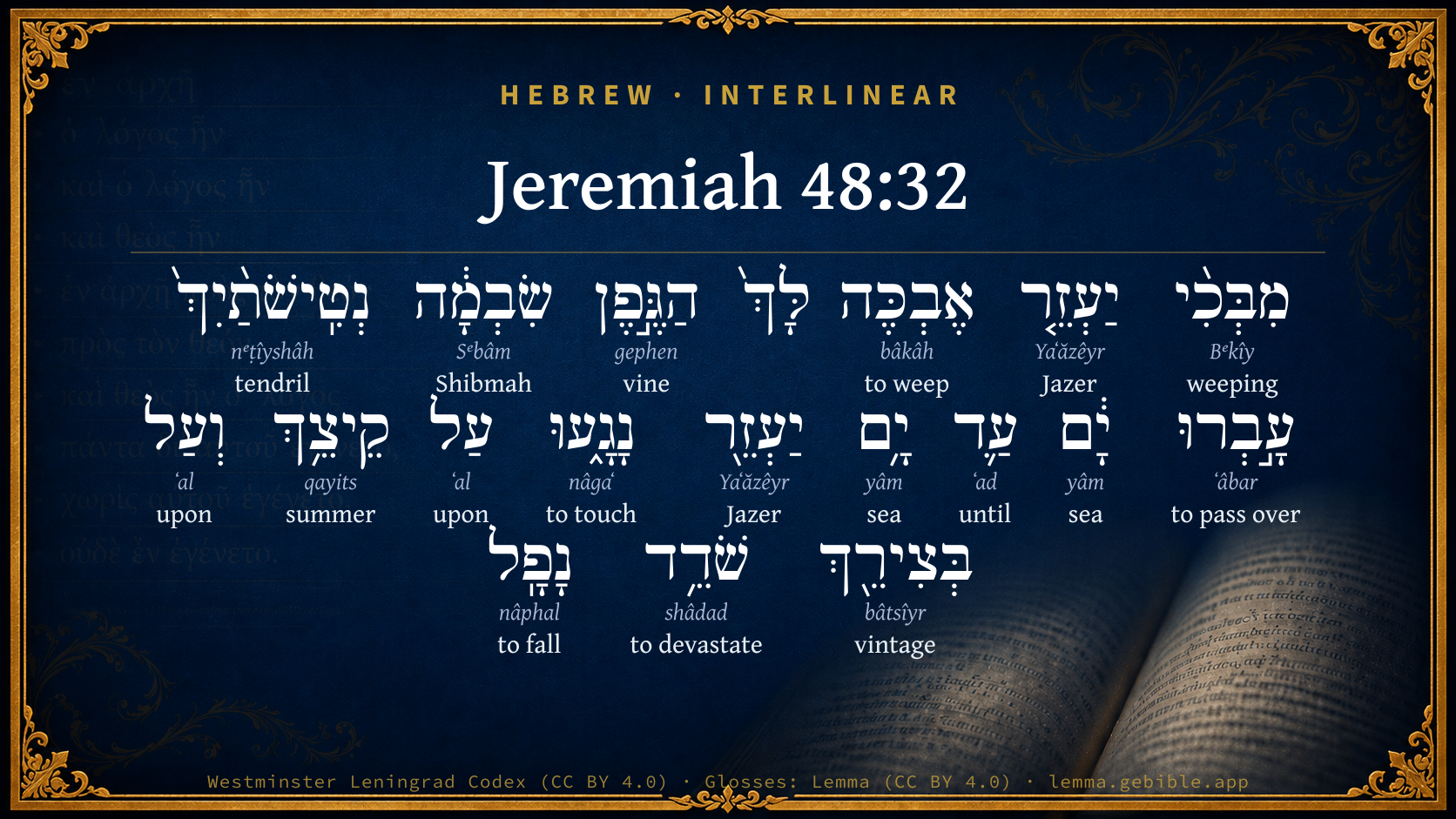
Jeremiah 48:32

Hebrew (Westminster Leningrad Codex) Jeremiah 48:32 appears in the Hebrew Old Testament. The text above is from the Westminster Leningrad Codex. Each word links to its Strong’s number, a concise gloss, and parsing drawn from the Open Scriptures Hebrew Bible morphology. Click any word for its full Brown-Driver-Briggs (BDB) entry.
Download image
Cite this verse

Jeremiah 48:32 (World English Bible). Public Domain. Lemma interlinear Bible study tool, https://lemma.gebible.app/v/jeremiah/48/32.

Show BibTeX & RIS
BibTeX
RIS
English Translation
With more than the weeping of Jazer will I weep for you, vine of Sibmah: your branches passed over the sea, they reached even to the sea of Jazer: on your summer fruits and on your vintage the destroyer is fallen.
World English Bible · Public Domain
Download a study sheet

One document with this verse’s original text, its word-by-word gloss line, the meaning frame, cross-references with their text, attributed commentary, and full source and license credits — printable, and it pastes into notes with its structure intact.

This verse Autodidact and up

Study sheet (.html) Plain text (.txt)

A passage Seminary Student

Up to 50 verses in one chapter. A passage sheet keeps up to 6 commentary sources and 12 cross-references per verse, in the order this page ranks them, and says so on the sheet whenever that leaves anything out. Ask for a single verse and you get the Autodidact verse sheet above.

Everything on this page stays free to read, with no account — the sheet is a download of what is already on screen, not access to it.

Want to remove ads? Support Godless Engineer
Compare translations 3

The same verse in 3 English versions, stacked beneath the original-language interlinear above. Click any original word for its lexicon entry.

Each is an independent rendering of the whole verse — the interlinear is not word-aligned to these translations.

Highlighted words mark where these versions differ — a whole-verse word diff, not a word-by-word alignment.

  • World English Bible Public Domain
    With more than the weeping of Jazer will I weep for you, vine of Sibmah: your branches passed over the sea, they reached even to the sea of Jazer: on your summer fruits and on your vintage the destroyer is fallen.
  • King James Version Public Domain
    O vine of Sibmah, I will weep for thee with the weeping of Jazer: thy plants are gone over the sea, they reach even to the sea of Jazer: the spoiler is fallen upon thy summer fruits and upon thy vintage.
  • unfoldingWord Literal Text CC BY-SA 4.0
    I will weep for you more than I did for Jazer, vine of Sibmah! Your branches passed across the Salt Sea and reached as far as Jazer. The destroyers have attacked your summer fruit and your wine.

unfoldingWord Literal Text — © unfoldingWord, licensed CC BY-SA 4.0. Word-aligned USFM3 via Door43 (git.door43.org/unfoldingWord/en_ult).

Versions to compare (up to 4)

3 of 4 selected

Show all 18 translations

Every available English version of this verse, each an independent rendering of the whole verse.

  • World English Bible Public Domain
    With more than the weeping of Jazer will I weep for you, vine of Sibmah: your branches passed over the sea, they reached even to the sea of Jazer: on your summer fruits and on your vintage the destroyer is fallen.
  • Berean Standard Bible Public Domain
    I will weep for you, O vine of Sibmah, more than I weep for Jazer. Your tendrils have extended to the sea; they reach even to Jazer. The destroyer has descended on your summer fruit and grape harvest.
  • Majority Standard Bible Public Domain
    I will weep for you, O vine of Sibmah, more than I weep for Jazer. Your tendrils have extended to the sea; they reach even to Jazer. The destroyer has descended on your summer fruit and grape harvest.
  • King James Version Public Domain
    O vine of Sibmah, I will weep for thee with the weeping of Jazer: thy plants are gone over the sea, they reach even to the sea of Jazer: the spoiler is fallen upon thy summer fruits and upon thy vintage.
  • American Standard Version (1901) Public Domain
    With more than the weeping of Jazer will I weep for thee, O vine of Sibmah: thy branches passed over the sea, they reached even to the sea of Jazer: upon thy summer fruits and upon thy vintage the destroyer is fallen.
  • Revised Version (1885) Public Domain
    With more than the weeping of Jazer will I weep for thee, O vine of Sibmah: thy branches passed over the sea, they reached even to the sea of Jazer: upon thy summer fruits and upon thy vintage the spoiler is fallen.
  • Geneva Bible (1599) Public Domain
    O vine of Sibmah, I will weepe for thee, as I wept for Iazer: thy plants are gone ouer the sea, they are come to the sea of Iazer: ye destroyer is fallen vpon thy somer fruites, and vpon thy vintage,
  • Douay-Rheims (1899) Public Domain
    O vineyard of Sabama, I will weep for thee, with the mourning of Jazer: thy branches are gone over the sea, they are come even to the sea of Jazer: the robber hath rushed in upon thy harvest and thy vintage.
  • Young's Literal Translation Public Domain
    With the weeping of Jazer, I weep for thee, O vine of Sibmah, Thy branches have passed over a sea, Unto the sea of Jazer they have come, On thy summer fruits, and on thy harvest, A spoiler hath fallen.
  • Literal Standard Version CC BY-SA 4.0
    With the weeping of Jazer, I weep for you, O vine of Sibmah, || Your branches have passed over a sea, || They have come to the Sea of Jazer, || On your summer fruits, and on your harvest, || A spoiler has fallen.
  • Unlocked Literal Bible CC BY-SA 4.0
    I will weep for you more than I did for Jazer, vine of Sibmah! Your branches passed across the Salt Sea and reached as far as Jazer. The destroyers have attacked your summer fruit and your wine.
  • unfoldingWord Literal Text CC BY-SA 4.0
    I will weep for you more than I did for Jazer, vine of Sibmah! Your branches passed across the Salt Sea and reached as far as Jazer. The destroyers have attacked your summer fruit and your wine.
  • Darby Bible Public Domain
    O vine of Sibmah, I will weep for thee with more than the weeping of Jaazer: thy shoots passed over the sea, they reached to the sea of Jaazer. The spoiler is fallen upon thy summer fruits and upon thy vintage.
  • World Messianic Bible Public Domain
    With more than the weeping of Jazer I will weep for you, vine of Sibmah. Your branches passed over the sea. They reached even to the sea of Jazer. The destroyer has fallen on your summer fruits and on your vintage.
  • Webster's Bible Public Domain
    O vine of Sibmah, I will weep for thee with the weeping of Jazer: thy plants have gone over the sea, they reach even to the sea of Jazer: the spoiler hath fallen upon thy summer fruits and upon thy vintage.
  • Free Bible Version CC BY-SA 4.0
    will weep for you, people of the town of Sibmah with its vineyards, more than I weep for the town of Jazer. Your vines have spread to the sea, and all the way to Jazer. But the destroyer has stolen your harvest of summer fruit and grapes.
  • Bible in Basic English Public Domain
    My weeping for you, O vine of Sibmah, will be more than the weeping of Jazer: your branches have gone over the sea, stretching even to Jazer: destruction has come down on your summer fruits and your cut grapes.
  • JPS Tanakh (1917) Public Domain
    With more than the weeping of Jazer will I weep for thee, O vine of Sibmah; thy branches passed over the sea, they reached even to the sea of Jazer; upon thy summer fruits and upon thy vintage the spoiler is fallen.

Literal Standard Version (2020), Covenant Press — licensed CC BY-SA 4.0. Text via the HelloAO Bible API (eBible.org). Unlocked Literal Bible (unfoldingWord) — licensed CC BY-SA 4.0. Text via the HelloAO Bible API (eBible.org). unfoldingWord Literal Text — © unfoldingWord, licensed CC BY-SA 4.0. Word-aligned USFM3 via Door43 (git.door43.org/unfoldingWord/en_ult). Free Bible Version, Dr. Jonathan Gallagher — licensed CC BY-SA 4.0. Text via the HelloAO Bible API (eBible.org).

Word by word

More ways to search: Search by grammar → Find every occurrence → Compare this word →

Practice this passage: Drill this verse → Learn its vocabulary →

נְטִֽישֹׁתַ֨יִךְ֙
nᵉṭîyshâh
H5189
“tendrils · your”
Noun, Common, Feminine, Plural, Construct + Suffix, Personal, 2nd Person, Feminine, Singular
Part of Speech
Noun
Type
Common
Gender
Feminine
Number
Plural
State
Construct
Full BDB Definition

Origin: from H5203

TWOT: 1357a

twig, tendril, tendrils of a vine (as spread out)
  1. מִבְּכִ֨י Bᵉkîy H1065 “from · weeping of” Preposition + Noun, Common, Masculine, Singular, Construct
  2. יַעְזֵ֤ר Yaʻăzêyr H3270 “Jazer” Noun, Proper
  3. אֶבְכֶּה bâkâh H1058 “to weep” Verb, Qal, Imperfect, 1st Person, Common, Singular
  4. הַגֶּ֣פֶן gephen H1612 “the · vine” Particle, Definite Article + Noun, Common, Both, Singular, Absolute
  5. שִׂבְמָ֔ה Sᵉbâm H7643 “Shibmah” Noun, Proper
  6. עָ֣בְרוּ ʻâbar H5674 “to pass over” Verb, Qal, Perfect, 3rd Person, Common, Plural
  7. יָ֔ם yâm H3220 “sea” Noun, Common, Masculine, Singular, Absolute
  8. עַ֛ד ʻad H5704 “until” Preposition
  9. יָ֥ם yâm H3220 “sea of” Noun, Common, Masculine, Singular, Construct
  10. יַעְזֵ֖ר Yaʻăzêyr H3270 “Jazer” Noun, Proper
  11. נָגָ֑עוּ nâgaʻ H5060 “to touch” Verb, Qal, Perfect, 3rd Person, Common, Plural
  12. עַל ʻal H5921 “upon” Preposition
  13. קֵיצֵ֥ךְ qayits H7019 “summer · your” Noun, Common, Masculine, Singular, Construct + Suffix, Personal, 2nd Person, Feminine, Singular
  14. וְעַל ʻal H5921 “and · upon” Conjunction + Preposition
  15. בְּצִירֵ֖ךְ bâtsîyr H1210 “vintage · your” Noun, Common, Masculine, Singular, Construct + Suffix, Personal, 2nd Person, Feminine, Singular
  16. שֹׁדֵ֥ד shâdad H7703 “devastating” Verb, Qal, Participle Active, Masculine, Singular, Absolute
  17. נָפָֽל nâphal H5307 “to fall” Verb, Qal, Perfect, 3rd Person, Masculine, Singular

About this verse

These counts appear in no published source. They are computed here, from the morphology-tagged text and Lemma’s own curated glosses. What Lemma adds →

19
words
15
distinct lemmas
Prophets
section

Notable vocabulary

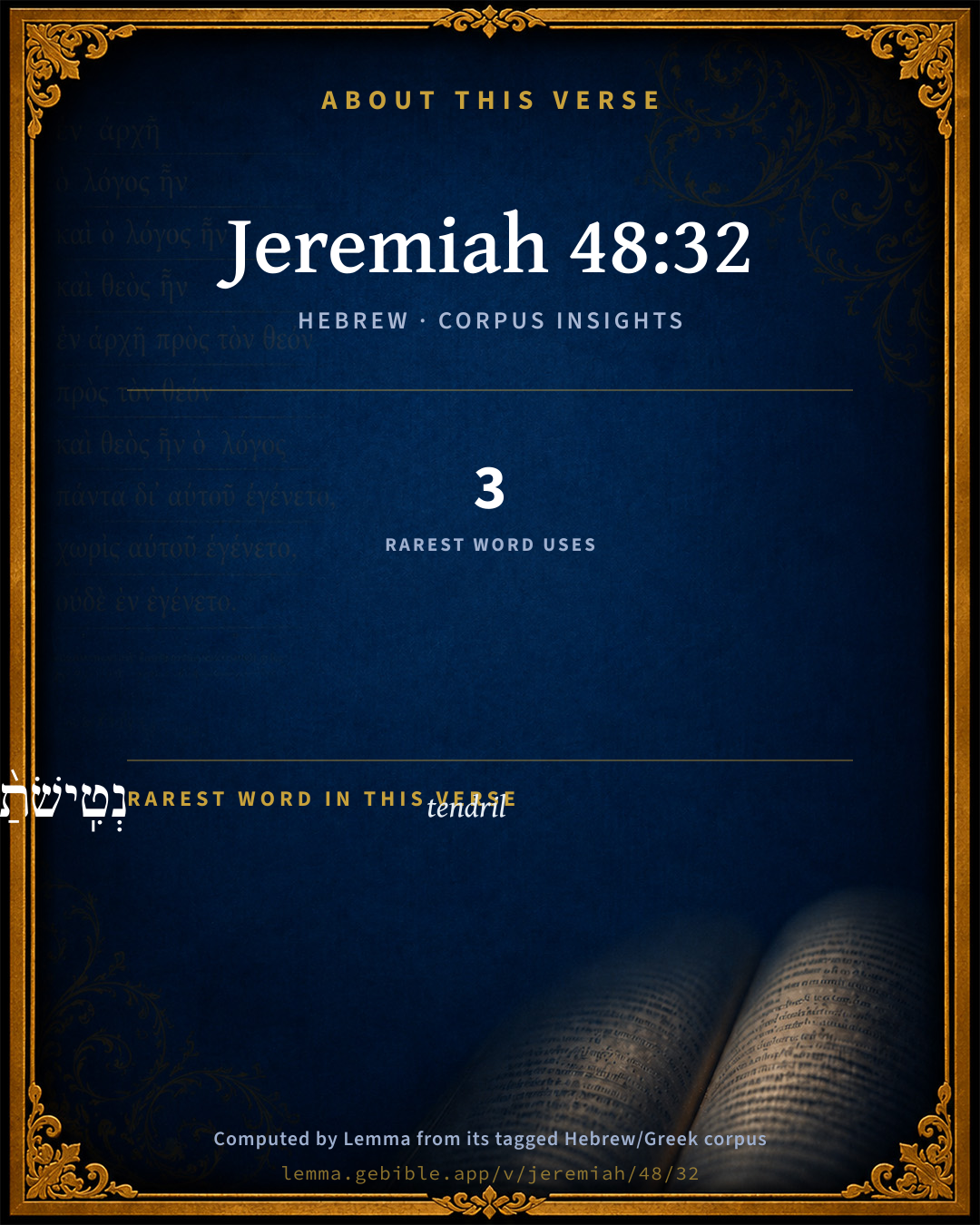
The rarest word here is נְטִֽישֹׁתַ֨יִךְ֙ tendril H5189 — appearing just 3 times in the whole Hebrew Bible.

Shared distinctive vocabulary

נְטִֽישֹׁתַ֨יִךְ֙ tendril H5189 occurs in 3 verses of the Hebrew Bible. Also found in:

Grammatical profile

  • 5 verbs
  • 10 nouns
  • 4 prepositions

Verb forms

  • אֶבְכֶּה Qal · Imperfect
  • עָ֣בְרוּ Qal · Perfect
  • נָגָ֑עוּ Qal · Perfect
  • שֹׁדֵ֥ד Qal · Participle Active
  • נָפָֽל Qal · Perfect

Repetition

Words recur within this verse — often emphatic in Hebrew:

  • יַעְזֵ֤ר Jazer H3270 ×2
  • יָ֔ם sea H3220 ×2
  • עַל upon H5921 ×2

Cross-references

11

Topical passages linked to Jeremiah 48:32 in the Treasury of Scripture Knowledge — connected by theme and wording, ordered by reader-vote popularity; previews shown in the World English Bible.

  • Isaiah 16:8–9 For the fields of Heshbon languish, [and] the vine of Sibmah; the lords of the nations have broken down the choice branches of it, which reached even to Jazer, which wandered into the wilderness; its shoots were spread abroad, they passed over the sea.
  • Numbers 21:32 Moses sent to spy out Jazer; and they took the towns of it, and drove out the Amorites who were there.
  • Joshua 13:19 and Kiriathaim, and Sibmah, and Zereth-shahar in the mount of the valley,
  • Numbers 32:1 Now the children of Reuben and the children of Gad had a very great multitude of cattle: and when they saw the land of Jazer, and the land of Gilead, that behold, the place was a place for cattle;
  • Numbers 32:35 and Atrothshophan, and Jazer, and Jogbehah,
  • Numbers 32:38 and Nebo, and Baal Meon, (their names being changed), and Sibmah: and they gave other names to the cities which they built.
  • Joshua 21:39 Heshbon with its suburbs, Jazer with its suburbs; four cities in all.
  • Jeremiah 40:10 As for me, behold, I will dwell at Mizpah, to stand before the Chaldeans who shall come to us: but you, gather you wine and summer fruits and oil, and put them in your vessels, and dwell in your cities that you have taken.
  • Jeremiah 48:8 The destroyer shall come on every city, and no city shall escape; the valley also shall perish, and the plain shall be destroyed; as Yahweh has spoken.
  • Jeremiah 48:15 Moab is laid waste, and they are gone up into his cities, and his chosen young men are gone down to the slaughter, says the King, whose name is Yahweh of Hosts.
  • Jeremiah 48:18 You daughter who dwells in Dibon, come down from your glory, and sit in thirst; for the destroyer of Moab is come up against you, he has destroyed your strongholds.

Cross-references courtesy of OpenBible.info (CC BY 4.0).

Hebrew and Greek witnesses Masoretic Hebrew ↔ Greek Septuagint

The same verse in the two great witnesses to the Old Testament, shown verse-for-verse.

These are two independent witnesses, not word-aligned to each other, and the Septuagint is shown in lemma (dictionary) form.

Hebrew Jeremiah 48:32 Masoretic · Westminster Leningrad Codex

מִבְּכִ֨י יַעְזֵ֤ר אֶבְכֶּה לָּךְ֙ הַגֶּ֣פֶן שִׂבְמָ֔ה נְטִֽישֹׁתַ֨יִךְ֙ עָ֣בְרוּ יָ֔ם עַ֛ד יָ֥ם יַעְזֵ֖ר נָגָ֑עוּ עַל קֵיצֵ֥ךְ וְעַל בְּצִירֵ֖ךְ שֹׁדֵ֥ד נָפָֽל

With more than the weeping of Jazer will I weep for you, vine of Sibmah: your branches passed over the sea, they reached even to the sea of Jazer: on your summer fruits and on your vintage the destroyer is fallen.

World English Bible · Public Domain

Greek LXX Structure differs

In the Septuagint, Jeremiah is about an eighth shorter than the Hebrew and arranges its material differently — the Oracles Against the Nations (Hebrew chapters 46–51) appear in the middle of the Greek book, after 25:13. Because the chapter and verse boundaries do not line up, a verse-for-verse comparison with the Hebrew is not shown.

A verse-for-verse comparison isn’t shown here because the chapters and verses don’t line up. Switch to the LXX edition with the MT / LXX toggle above to read the Greek directly.

On this verse, Jamieson, Fausset & Brown discusses the Septuagint’s reading. Read the note in Commentary ↓

Hebrew: Westminster Leningrad Codex (CC BY 4.0). Greek: Septuagint (public domain); English from a public-domain English Septuagint. How the Septuagint differs from the Hebrew →

Targum (Aramaic paraphrase)

1

The Targum is the ancient Jewish Aramaic paraphrase of the Hebrew Scriptures — an interpretive translation, not the Hebrew text itself. Onkelos (literal) and Pseudo-Jonathan (expansive) render the Torah, and Jonathan the Prophets. Coverage is partial: where no permissively-licensed English translation exists for a verse, only the Aramaic is shown. This is verse-level text, not a word-by-word alignment to the Hebrew.

  1. Targum Jonathan Prophets (Joshua–Malachi)
    בְּכֵן כְּמָא דְאַיְתֵיתִי מַשִׁרְיָן עַל יַעְזֵר כֵּן אַיְתֵי קְטוֹלִין עַל שִׂבְמָא מְטַלְטְלָךְ גָזוּ עֲבָרוּ יַמָא עַד יַם יַעְזֵר מָטוּ עַל חִצְרִיךְ וְעַל קַטְפִיךְ בָּזוּזִין נָפְלוּ:

    (no public-domain English translation for this verse)

    Targum Jonathan — Aramaic: “Mikraot Gedolot” (public domain). English: “Sefaria Community Translation” (CC0 1.0 (public-domain dedication)); “London "Chaldee Paraphrase," 1871” (public domain). Text via Sefaria.

Commentary

Notes on Jeremiah 48:32 from classic Christian and Jewish commentators (each source and its license shown beneath its notes). The classic Christian expositions comment on the surrounding passage and are grouped to its opening verse, so a note may address several verses; the Jewish commentaries on the Tanakh (Rashi and others) are per-verse, so they appear only where the commentator wrote on this verse.

Lemma curates 59 commentaries, every one of them public domain or Creative Commons licensed, each selected and text-cleaned for this edition rather than reprinted as found. About our sources →

Trapp's Complete Commentary

John Trapp

Jer 48:32 O vine of Sibmah, I will weep for thee with the weeping of Jazer: thy plants are gone over the sea, they reach [even] to the sea of Jazer: the spoiler is fallen upon thy summer fruits and upon thy vintage.

Ver. 32. I will weep with thee for the weeping of Jazer.] Or, More than the weeping of Jazer - i.e., saith Junius, more largely and lamentably than Isaiah bewailed Jazer. {Isa 16:8-9}

John Trapp, A Commentary or Exposition upon All the Books of the Old and New Testament (1647–1656) — public domain. Text from a community e-Sword module.

Tyndale Open Study Notes

Tyndale Open Resources

48:32 Sibmah and Jazer were conquered and rebuilt by the tribe of Reuben (Num 32:3, 38; Josh 13:19), who transformed the high plateau east of the Dead Sea into vineyards.

Tyndale Open Study Notes — © Tyndale Open Resources, licensed CC BY-SA 4.0. Text via the HelloAO Bible API.

Geneva Bible (1599)

Geneva Bible translators

Which city was in the utmost border of Moab: and hereby he signifieth that the whole land should be destroyed, and the people carried away.

Geneva Bible (1599) marginal notes — public domain. Text via Bolls.life.

Jamieson, Fausset & Brown

Robert Jamieson, A. R. Fausset & David Brown

with the weeping--with the same weeping as Jazer, now vanquished, wept with for the destruction of its vines. The same calamity shall befall thee, Sibmah, as befell Jazer. The Hebrew preposition here is different from that in Isa 16:9, for which reason MAURER translates, "with more than the weeping of Jazer." English Version understands it of the continuation of the weeping; after they have wept for Jazer, fresh subject of lamentation will present itself for the wasting of the vine-abounding Sibmah.

plants . . . gone over . . . sea of Jazer--As the Septuagint reads "cities of Jazer," and as no traces of a lake near Jazer are found, the reading of English Version is doubtful. Retaining the present reading, we avoid the difficulty by translating [GROTIUS], "Thy plants (that is, citizens: alluding to the 'vine') are gone over the sea (that is, shall be transported beyond the sea to Cyprus, and such distant lands subject to Babylon; and this, too, in summertime), whereas Jazer (that is, the men of Jazer) reached the sea" (shore only, but are not transported beyond the sea); so that worse shall befall thee than befalls Jazer.

spoiler--Nebuzara-dan.

Jamieson, Fausset & Brown — Commentary Critical and Explanatory on the Whole Bible (1871) — public domain (CC PDM 1.0). Text via the HelloAO Bible API.

Adam Clarke's Commentary

Verse 32. O vine of Sibmah] See Clarke on Isa 16:8.

Adam Clarke's Commentary on the Bible (1810–1826) — public domain. Text from a community e-Sword/MySword module.

John Calvin's Commentaries

Here the Prophet shews more clearly what he had said generally before, that Sibmah would weep for her vines, after having wept for Jazer. These were cities in the land of Moab, as it appears from other places. Some give this rendering, “In comparison with the weeping” or mourning, etc.; and מן, men, as it is well known, has this meaning; but as ב, beth, “in weeping,” is adopted by Isaiah, instead of מן, men, there is no doubt but that the Prophet means a continued mourning, when he says, From (or with) the weeping of Jazer I will weep for thee, vine of Sibmah; that is, there will be no end to weeping; for after the Moabites had mourned for the destruction of the city Jazer, a new cause of weeping would arise, for other cities would be destroyed, and especially Sibmah.

Now the region of Sibmah was very fertile, especially on account of the abundance of vines. Then the Prophet includes the whole wealth of that city under the word vine; nay, he designates the citizens as its shoots or young branches. I will weep, he says, “over thee, the vine of the vine-bearing region of Sibmah; for thy shoots, that is, thy wealth, have passed over the sea, and the citizens of Jazer, who were thy neighbors.” He afterwards repeats respecting the city of Jazer what he had said, because its calamity was connected with the other, and was the same. For God had involved these two cities in the same destruction. Jazer then came even to the sea. Now a waster rushed in: Isaiah has shouting, הידד, eidad, which is added presently here; but the word there has quite a different meaning, that all rejoicing would cease. The word here is שדד, shidad, and means a waster or spoiler. A waster then has fallen, that is, has come with great irresistible force, on thy vintages and harvests; that is, that he may scatter and consume all things. It follows, —

John Calvin's Commentaries (1540-1563) — public domain. Text from the Calvin Translation Society English edition (1840s-50s) via the Christian Classics Ethereal Library (ccel.org). Calvin's coverage is partial (roughly two-thirds of the Bible); uncommented books and verses are honest gaps, never fabricated. The 19th-century editor's footnotes and remarks are omitted so the notes are faithfully Calvin's own voice.

Ellicott's Commentary for English Readers

(32) O vine of Sibmah.—Here again we have an echo of Isa_16:9. Sibmah appears in Jos_13:19 as assigned to the Reubenites, in the region east of Jordan. After that date it does not appear again till we find it in these prophetic notices. Jerome (Comm. in Isa. Jeremiah 5) names it as a strong city about half a mile from Heshbon, but its site has not been identified by modern travellers. It would appear from these notices to have been famous for vineyards that extended to Jazer. The city so named, identified with the modern Es Szir, had belonged to the Amorites (Num_21:32, there spelt Jaazer), and lay between Heshbon and Bashan, about fifteen miles north of the former city. It passed afterwards into the possession of the Gadites (Jos_13:25; 2Sa_24:5), and was evidently, when the two prophets wrote, in that of the Moabites. The phrase “weeping of Jazer” implies that it was to share in the desolation of Sibmah. The “sea of Jazer” (if the text is right, the LXX. giving “city”) must have been some inland lake or pond, which has not since been identified. The “sea” of the parallel passage of Isa_16:8 is commonly interpreted of the Dead Sea. The “summer fruits” were the figs and pomegranates which were commonly cultivated together with the vine.

A Bible Commentary for English Readers, edited by Charles John Ellicott (1878–1897) — public domain. Text from a community e-Sword module.

The Cambridge Bible for Schools and Colleges

gen. ed. J. J. S. Perowne

32. Based on Isa_16:8 f.

With more than the weeping of Jazer] over its ruins, and wasted vineyards. But, by the slightest alteration of MT., we can obtain the reading in Is., viz. with the weeping of Jazer (so too LXX).

O vine of Sibmah] Sibmah was two and a half miles W.N. W., and Jazer was ten miles N. of Heshbon. The grapes of the region of Heshbon are still said to be excellent.

thy branches] thy tendrils.

over the sea] to the W. shore of the Dead Sea. A hyperbolical metaphor to express the great luxuriance of Sibmah’s vines.

the sea of Jazer] “Sea” is an accidental repetition from the previous clause.

thy vintage] Isaiah, whose word differs only by a single letter, has “thy harvest.”

the spoiler] Isaiah has “a shouting.”

The Cambridge Bible for Schools and Colleges (gen. ed. J. J. S. Perowne; Cambridge University Press, 1878–1918) — public domain. Text from a community e-Sword module.

John Gill's Exposition

And joy and gladness is taken from the plentiful field,.... Or, from Carmel (k); not Mount Carmel in the land of Israel; for the prophecy is of Moab; though that reached to Sibmah; but here it signifies any fruitful place, like Carmel, where were good pasturage, corn, and fruit bearing trees, which produced great plenty of good things, and caused joy to the owners of them: but now all being destroyed by the enemy, joy and gladness would cease:

and from the land of Moab; from all parts of it, where there had used to be plenty, and so joy:

and I have caused wine to fail from the wine presses: there being no grapes to put into them, or men to tread them, were there any; or, if put in and trodden, not the owners, but the enemy, should have the wine; so that it should fail from the Moabites; they should be never the better for it. These are the words of the Lord, who has the disposal of the fruits of the earth:

none shall tread with shouting; as treaders in the wine press used to do, to encourage one another, and make their labour more easy, and the time to pass on in it more pleasantly; but now there should neither be treading nor shouting; see Isa 16:10;

their shouting shall be no shouting; not a shouting of joy, as used to be when they trod out the wine; but a cry of mourning and lamentation, because of the sword of the enemy.

(k) "de Carmelo", V. L. "de Charmel", Montanus; "ex Carmelo", Schmidt.

John Gill's Exposition of the Whole Bible (1746–1763) — public domain (CC PDM 1.0). Text via the HelloAO Bible API.

Albert Barnes' Notes on the Bible

Or, “More than the weeping of Jazer” over its ruined vineyards “will I weep for thee, O vine of Sibmah.” Compare the marginal reference. Jazer lies in an upland valley about 15 miles north of Heshbon.

Thy plants ... - “Thy branches are gone over the sea, i. e.” the power of Moab is felt even on the western side of the Dead Sea; “they reached etc.”

Albert Barnes' Notes on the Bible (1834–1885) — public domain. Text from a community e-Sword/MySword module.

Haydock's Catholic Bible Commentary

Jazer, or "more than for Jazer;" about six leagues to the north of Sebama, which had a rivulet communicating with the sea of Jazer.

George Leo Haydock (1774–1849), Haydock's Catholic Family Bible and Commentary, 1859 edition — public domain. Excludes Psalms (Douay-Rheims chapter numbering differs from Protestant) and Deuterocanonical books (Catholic canon only).

Matthew Poole's English Annotations

We read of this

vine of Sibmah also Isa 16:8,9. Both Sibmah and Jahaza were places in the portion of Reuben, Jos 13:18,19. Sibmah was doubtless a place famous in those days for vines and vineyards. This Jahaza or

Jazer was, as it should seem, first taken and carried into captivity, which caused a great lamentation. The prophet foretells such a weeping for Sibmah as was for Jazer. By plants he means the inhabitants of Sibmah, which he prophesieth should be carried into captivity over the Dead Sea. As an aggravation of the judgment that should come upon them, God, by his prophet, tells them that the spoiler should come upon them in their vintage and harvest time.

Matthew Poole's English Annotations on the Holy Bible (1683–1685) — public domain. Text from a community e-Sword/MySword module.

The Pulpit Commentary

Shortened from Isa_16:8, Isa_16:9. With the weeping of Jaser; rather, more than the weeping of Jazer. This may mean either "more than I weep for Jazer" (which is favoured by the insertion of "for thee") or more than Jazer weeps" (for the devastated vineyards of Sibmah); comp. Isaiah, l.c. The site of Jazer is placed by Seetzen between Ramoth (Salt) and Heshbon, where some ruins called Sir are now found. "Sibmah," according to St. Jerome, was not more than half a mile from Heshbon. King Mesha is thought to refer to it under the form Seran, miswritten for Seban; (Sebam so the form should be read is an Old Testament version of the name; see Num_32:3) see inscription on Moabite Stone, line 13. It appears to have been famous for its vineyards; and Seetzen tolls us that grapes and raisins of specially good quality are still carried from the neighbouring Salt to Jerusalem. Thy plants are gone over the sea; rather, thy shoots passed over the sea. The prophet here describes the extensive range of these vines. The northern limit of their culture was Jazer, its southern or western file further shore of "the sea," i.e. the Dead Sea. By a touch of poetic hyperbole the prophet traces the excellence of vines such as those of En-gedi (on the western bank of the Dead Sea) to a Moabitish origin. The reference to the sea of Jazer throws the whole passage into confusion. There is no lake or large pool at present to be found at Jazer, and the simplest explanation is that a scribe repeated the word "sea" by mistake. The true text will then be simply," they reached unto Jazer." The spoiler. Isa_16:9 has the more picturesque expression, "the shouting," i.e. the wild battle cry.

The Pulpit Commentary (1880–1919), ed. H.D.M. Spence-Jones & Joseph S. Exell — public domain. Text from a community e-Sword module.

John Wesley's Explanatory Notes

Sibmah - Sibmah was famous in those days for vines. Jazer - Jazer was it seems first taken, and carried into captivity.

John Wesley, Explanatory Notes Upon the Whole Bible (1754–1765) — public domain. Text via the GEBible commentary corpus.

Rashi

Rabbi Shlomo Yitzchaki (Rashi)

From the weeping of Jazar I will weep for you When this prophecy was said, Jazer had already been destroyed, and that was near Moab.

I will weep for you I will weep for you, similar to that other weeping [i.e., for Jazer], for you will be destroyed just like [Jazer].

O grape vine of Sibmah It was a land of vineyards.

your tendrils Since he compared them to a grape vine, he compared their mighty men to the tendrils of the vine.

crossed the sea i.e., they went into exile.

your dried figs Heb. קיצך, an expression of dried figs, but קִצֵךְ (51:13), an expression of (קץ), an end, has no ‘yud’ and its ‘tzaddi’ has a ‘dagesh.’

Rashi on the Tanakh — English translations: “The Judaica Press complete Tanach with Rashi, translated by A. J. Rosenberg” (CC BY 4.0); “Pentateuch with Rashi's commentary by M. Rosenbaum and A.M. Silbermann, 1929-1934” (public domain); “The Metsudah Tanach series, Lakewood, N.J” (CC BY 4.0); and “The Book of Joshua, Metsudah Publications, 1997” (CC BY 4.0). Text via Sefaria.

Lesson kit

Teaching starters — assembled from the data on this page, not authored interpretation. Every prompt links to the verse data it draws on. Edit before teaching.

Jeremiah, in the Prophets, opens this verse with 19 words (15 distinct Hebrew lemmas). Its most distinctive word is nᵉṭîyshâh (“tendril”). A historical commentator’s framing appears above. Read the whole chapter for the surrounding context.

Discussion questions

  1. How does “tendril” (nᵉṭîyshâh) shape what this verse is saying?
  2. Isaiah 18:5 shares the word «tendril» with this verse. How do the two illuminate each other?
  3. “Jazer” occurs 2× in this one verse. What is the effect of the repetition?
  4. These translations render this verse differently. What is at stake in choosing one wording over another?
  5. The verb «אֶבְכֶּה» is Qal Imperfect. How does its form color the action?
  6. Reading how Trapp's Complete Commentary and Tyndale Open Study Notes read this verse, where do the two commentators agree and where do they part?

Things to notice

Reading settings

Reading text

Shown beneath each verse's original-language words.

Old Testament
Old Testament edition

Read the OT as the Masoretic Hebrew (MT) or the Greek Septuagint (LXX).

English shown for the Greek Septuagint (in the Hebrew ↔ Greek comparison).

Comparing translations? Open the Compare panel on any verse page to stack up to four side by side.