
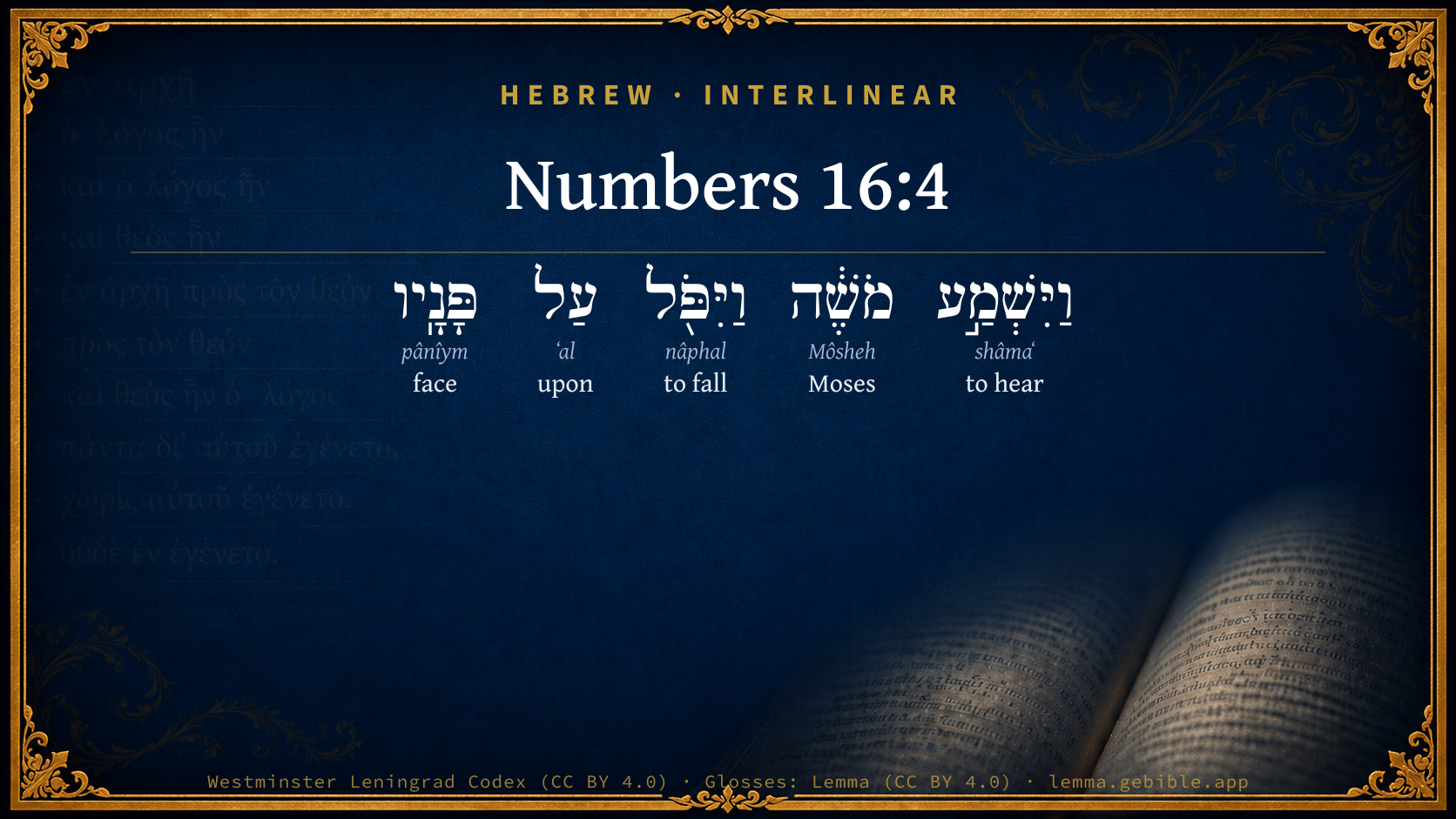
Numbers 16:4

Hebrew (Westminster Leningrad Codex) Numbers 16:4 appears in the Hebrew Old Testament. The text above is from the Westminster Leningrad Codex. Each word links to its Strong’s number, a concise gloss, and parsing drawn from the Open Scriptures Hebrew Bible morphology. Click any word for its full Brown-Driver-Briggs (BDB) entry.
Download image
Cite this verse

Numbers 16:4 (World English Bible). Public Domain. Lemma interlinear Bible study tool, https://lemma.gebible.app/v/numbers/16/4.

Show BibTeX & RIS
BibTeX
RIS
English Translation
When Moses heard it, he fell on his face:
World English Bible · Public Domain
Download a study sheet

One document with this verse’s original text, its word-by-word gloss line, the meaning frame, cross-references with their text, attributed commentary, and full source and license credits — printable, and it pastes into notes with its structure intact.

This verse Autodidact and up

Study sheet (.html) Plain text (.txt)

A passage Seminary Student

Up to 50 verses in one chapter. A passage sheet keeps up to 6 commentary sources and 12 cross-references per verse, in the order this page ranks them, and says so on the sheet whenever that leaves anything out. Ask for a single verse and you get the Autodidact verse sheet above.

Everything on this page stays free to read, with no account — the sheet is a download of what is already on screen, not access to it.

Want to remove ads? Support Godless Engineer
Compare translations 3

The same verse in 3 English versions, stacked beneath the original-language interlinear above. Click any original word for its lexicon entry.

Each is an independent rendering of the whole verse — the interlinear is not word-aligned to these translations.

Highlighted words mark where these versions differ — a whole-verse word diff, not a word-by-word alignment.

  • World English Bible Public Domain
    When Moses heard it, he fell on his face:
  • King James Version Public Domain
    And when Moses heard it, he fell upon his face:
  • unfoldingWord Literal Text CC BY-SA 4.0
    And Moses heard and fell on his face.

unfoldingWord Literal Text — © unfoldingWord, licensed CC BY-SA 4.0. Word-aligned USFM3 via Door43 (git.door43.org/unfoldingWord/en_ult).

Versions to compare (up to 4)

3 of 4 selected

Show all 18 translations

Every available English version of this verse, each an independent rendering of the whole verse.

  • World English Bible Public Domain
    When Moses heard it, he fell on his face:
  • Berean Standard Bible Public Domain
    When Moses heard this, he fell facedown.
  • Majority Standard Bible Public Domain
    When Moses heard this, he fell facedown.
  • King James Version Public Domain
    And when Moses heard it, he fell upon his face:
  • American Standard Version (1901) Public Domain
    And when Moses heard it, he fell upon his face:
  • Revised Version (1885) Public Domain
    And when Moses heard it, he fell upon his face:
  • Geneva Bible (1599) Public Domain
    But when Moses heard it, hee fell vpon his face,
  • Douay-Rheims (1899) Public Domain
    When Moses heard this, he fell flat on his face:
  • Young's Literal Translation Public Domain
    And Moses heareth, and falleth on his face,
  • Literal Standard Version CC BY-SA 4.0
    And Moses hears, and falls on his face,
  • Unlocked Literal Bible CC BY-SA 4.0
    When Moses heard that, he lay facedown.
  • unfoldingWord Literal Text CC BY-SA 4.0
    And Moses heard and fell on his face.
  • Darby Bible Public Domain
    When Moses heard this, he fell on his face.
  • World Messianic Bible Public Domain
    When Moses heard it, he fell on his face.
  • Webster's Bible Public Domain
    And when Moses heard it, he fell upon his face:
  • Free Bible Version CC BY-SA 4.0
    When Moses heard what they were saying, he fell facedown on the ground.
  • Bible in Basic English Public Domain
    And Moses, hearing this, went down on his face;
  • JPS Tanakh (1917) Public Domain
    And when Moses heard it, he fell upon his face.

Literal Standard Version (2020), Covenant Press — licensed CC BY-SA 4.0. Text via the HelloAO Bible API (eBible.org). Unlocked Literal Bible (unfoldingWord) — licensed CC BY-SA 4.0. Text via the HelloAO Bible API (eBible.org). unfoldingWord Literal Text — © unfoldingWord, licensed CC BY-SA 4.0. Word-aligned USFM3 via Door43 (git.door43.org/unfoldingWord/en_ult). Free Bible Version, Dr. Jonathan Gallagher — licensed CC BY-SA 4.0. Text via the HelloAO Bible API (eBible.org).

Word by word

More ways to search: Search by grammar → Find every occurrence → Compare this word →

Practice this passage: Drill this verse → Learn its vocabulary →

וַיִּפֹּ֖ל
nâphal
H5307
“and · to fall”
Conjunction + Verb, Qal, Sequential Imperfect, 3rd Person, Masculine, Singular
Part of Speech
Conjunction + Verb
Stem
Qal
Form
Sequential Imperfect
Person
3rd Person
Gender
Masculine
Number
Singular
Full BDB Definition

Origin: a primitive root

TWOT: 1392

to fall, lie, be cast down, fail - (Qal) - to fall - to fall (of violent death) - to fall prostrate, prostrate oneself before - to fall upon, attack, desert, fall away to, go away to, fall into the hand of - to fall short, fail, fall out, turn out, result - to settle, waste away, be offered, be inferior to - to lie, lie prostrate - (Hiphil) - to cause to fall, fell, throw down, knock out, lay prostrate - to overthrow - to make the lot fall, assign by lot, apportion by lot - to let drop, cause to fail (figuratively) - to cause to fall - (Hithpael) - to throw or prostrate oneself, throw oneself upon - to lie prostrate, prostrate oneself - (Pilel) to fall
  1. וַיִּשְׁמַ֣ע shâmaʻ H8085 “and · to hear” Conjunction + Verb, Qal, Sequential Imperfect, 3rd Person, Masculine, Singular
  2. מֹשֶׁ֔ה Môsheh H4872 “Moses” Noun, Proper
  3. עַל ʻal H5921 “upon” Preposition
  4. פָּנָֽיו pânîym H6440 “face(s) · his” Noun, Common, Both, Plural, Construct + Suffix, Personal, 3rd Person, Masculine, Singular

About this verse

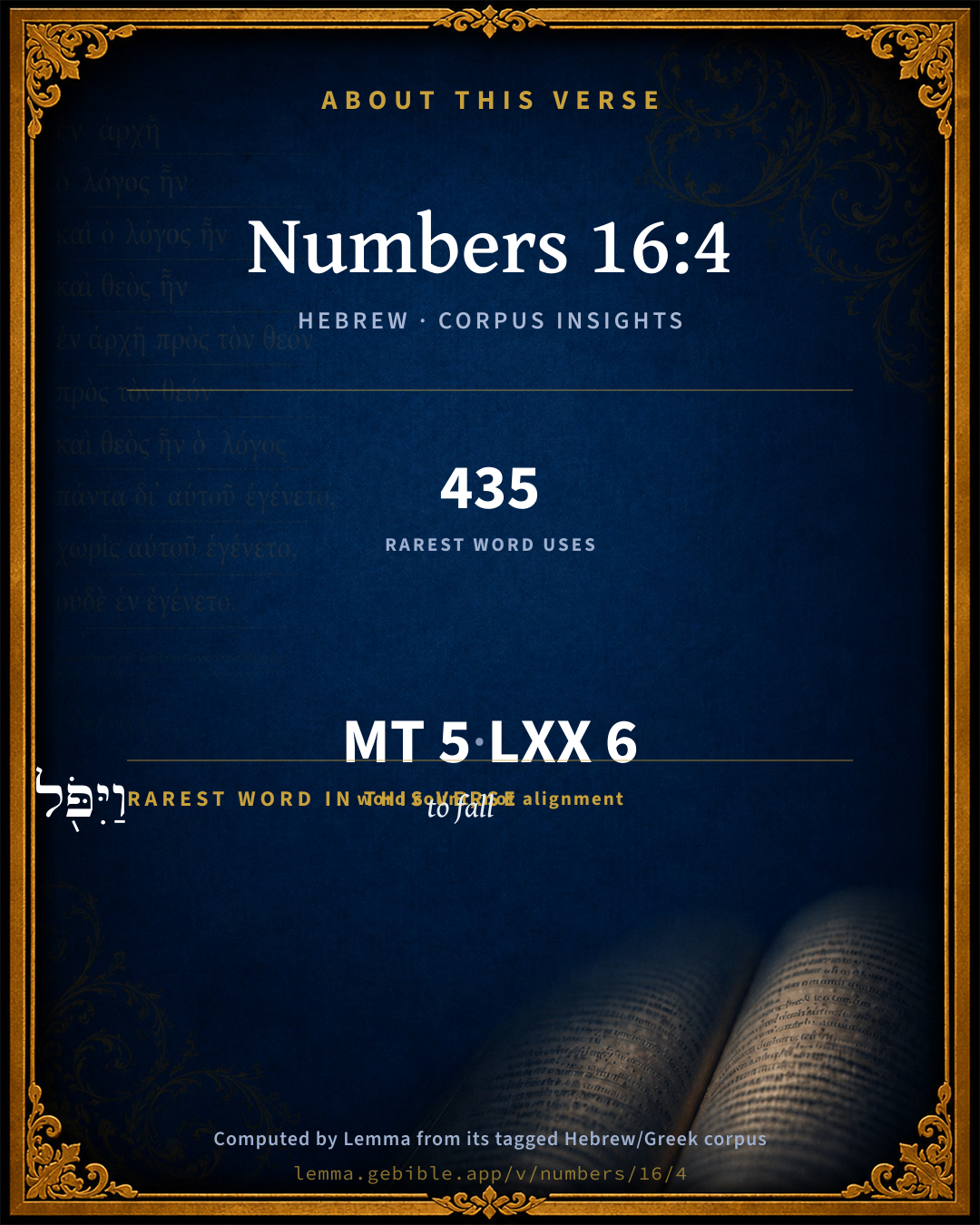
These counts appear in no published source. They are computed here, from the morphology-tagged text and Lemma’s own curated glosses. What Lemma adds →

5
words
5
distinct lemmas
Pentateuch
section

Grammatical profile

  • 2 verbs
  • 2 nouns
  • 1 preposition

Verb forms

  • וַיִּשְׁמַ֣ע Qal · Sequential Imperfect
  • וַיִּפֹּ֖ל Qal · Sequential Imperfect

Hebrew & Septuagint length

In English translation the verse runs 9 words from the Hebrew and 10 from the Septuagint (LXX English) — closely comparable.

A rough comparison of the two English renderings, which tokenize alike — not a word-level alignment.

Word counts can differ between the Hebrew and the Greek without any difference in meaning — e.g. the Hebrew direct-object marker אֵת has no separate Greek word, and Greek often adds the article ὁ.

In the original languages it is 5 Hebrew tokens and 6 Greek tokens — but the two are counted differently (Hebrew bundles its prefixes and suffixes into one token; the Greek is in lemma form), so that isn’t a like-for-like length.

Cross-references

4

Topical passages linked to Numbers 16:4 in the Treasury of Scripture Knowledge — connected by theme and wording, ordered by reader-vote popularity; previews shown in the World English Bible.

  • Numbers 14:5 Then Moses and Aaron fell on their faces before all the assembly of the congregation of the children of Israel.
  • Numbers 20:6 Moses and Aaron went from the presence of the assembly to the door of the tent of meeting, and fell on their faces: and the glory of Yahweh appeared to them.
  • Numbers 16:45 Get away from among this congregation, that I may consume them in a moment. They fell on their faces.
  • Joshua 7:6 Joshua tore his clothes, and fell to the earth on his face before the ark of Yahweh until the evening, he and the elders of Israel; and they put dust on their heads.

Cross-references courtesy of OpenBible.info (CC BY 4.0).

Hebrew and Greek witnesses Masoretic Hebrew ↔ Greek Septuagint

The same verse in the two great witnesses to the Old Testament, shown verse-for-verse.

These are two independent witnesses, not word-aligned to each other, and the Septuagint is shown in lemma (dictionary) form.

Hebrew Numbers 16:4 Masoretic · Westminster Leningrad Codex

וַיִּשְׁמַ֣ע מֹשֶׁ֔ה וַיִּפֹּ֖ל עַל פָּנָֽיו

When Moses heard it, he fell on his face:

World English Bible · Public Domain

Greek LXX Numbers 16:4 Septuagint · lemma form

καί ἀκούω μωυσῆς πίπτω ἐπί πρόσωπον

And when Moses heard it, he fell on his face.

LXX2012 (modern English Septuagint) · Public Domain

Hebrew: Westminster Leningrad Codex (CC BY 4.0). Greek: Septuagint (public domain); English from LXX2012 (modern English Septuagint) (Public Domain). How the Septuagint differs from the Hebrew →

Targum (Aramaic paraphrase)

2

The Targum is the ancient Jewish Aramaic paraphrase of the Hebrew Scriptures — an interpretive translation, not the Hebrew text itself. Onkelos (literal) and Pseudo-Jonathan (expansive) render the Torah, and Jonathan the Prophets. Coverage is partial: where no permissively-licensed English translation exists for a verse, only the Aramaic is shown. This is verse-level text, not a word-by-word alignment to the Hebrew.

  1. Targum Onkelos Torah (Genesis–Deuteronomy)
    וּשְׁמַע משֶׁה וּנְפַל עַל אַפּוֹהִי

    (no public-domain English translation for this verse)

    Targum Onkelos — Aramaic: “Onkelos Genesis” (public domain); “Onkelos Exodus” (public domain); “Onkelos Leviticus” (public domain); “Onkelos Numbers” (public domain); “Onkelos Deuteronomy” (public domain). English: “Sefaria Community Translation” (CC0 1.0 (public-domain dedication)); “J.W. Etheridge. The Targums of Onkelos and Jonathan Ben Uzziel on the Pentateuch. London: Longmans, Green, 1862” (public domain). Text via Sefaria.

  2. Targum Pseudo-Jonathan Torah (Genesis–Deuteronomy)
    וּשְׁמַע משֶׁה הֵיךְ קַנְיַין כָּל חַד מִנְהוֹן יַת אִנְתְּתֵיהּ לְאַשְׁקָיוּתְהֶן מַיָא בְּדוֹקַיָא מְטוֹל משֶׁה וּנְפַל עַל אַנְפּוֹי מִן כִּיסוּפָא

    And Mosheh heard, as if every one of them was jealous of his wife, and would have them drink of the trial-water on account of Mosheh; and he fell on his face for shame.

    Targum Pseudo-Jonathan — Aramaic: “Targum Jonathan on Genesis” (public domain); “Targum Jonathan on Exodus” (public domain); “Targum Jonathan on Leviticus” (public domain); “Targum Jonathan on Numbers” (public domain); “Targum Jonathan on Deuteronomy” (public domain). English: “The Targum of Jonathan ben Uzziel, trans. J. W. Etheridge, London, 1862” (public domain). Text via Sefaria.

Commentary

Notes on Numbers 16:4 from classic Christian and Jewish commentators (each source and its license shown beneath its notes). The classic Christian expositions comment on the surrounding passage and are grouped to its opening verse, so a note may address several verses; the Jewish commentaries on the Tanakh (Rashi and others) are per-verse, so they appear only where the commentator wrote on this verse.

Lemma curates 59 commentaries, every one of them public domain or Creative Commons licensed, each selected and text-cleaned for this edition rather than reprinted as found. About our sources →

Trapp's Complete Commentary

John Trapp

Num 16:4 And when Moses heard [it], he fell upon his face:

Ver. 4. He fell upon his face.] As a suppliant to them, not to proceed in their rebellion; or rather to God, not to proceed against them for their sin.

John Trapp, A Commentary or Exposition upon All the Books of the Old and New Testament (1647–1656) — public domain. Text from a community e-Sword module.

Joseph Benson's Commentary

Num 16:4. Moses fell upon his face — Humbly begging that God would direct and vindicate him. Accordingly God answers his prayers, and strengthens him with new courage, and confidence of success.

Joseph Benson's Commentary on the Old and New Testaments (1811–1818) — public domain. Text from a community e-Sword module.

Tyndale Open Study Notes

Tyndale Open Resources

16:4-7 Moses . . . fell face down on the ground in intercession (cp. 14:5; 16:22), then challenged Korah and his followers to a test.

Tyndale Open Study Notes — © Tyndale Open Resources, licensed CC BY-SA 4.0. Text via the HelloAO Bible API.

Jamieson, Fausset & Brown

Robert Jamieson, A. R. Fausset & David Brown

when Moses heard it, he fell upon his face--This attitude of prostration indicated not only his humble and earnest desire that God would interpose to free him from the false and odious imputation, but also his strong sense of the daring sin involved in this proceeding. Whatever feelings may be entertained respecting Aaron, who had formerly headed a sedition himself [Num 12:1], it is impossible not to sympathize with Moses in this difficult emergency. But he was a devout man, and the prudential course he adopted was probably the dictate of that heavenly wisdom with which, in answer to his prayers, he was endowed.

Jamieson, Fausset & Brown — Commentary Critical and Explanatory on the Whole Bible (1871) — public domain (CC PDM 1.0). Text via the HelloAO Bible API.

John Gill's Exposition

And when Moses heard it,.... What they said, their complaint against him, for setting up Aaron for an high priest, and against Aaron for taking this honour to himself:

he fell upon his face; through shame, as the Targum of Jonathan, blushing at their sin, in opposing the ordinance of God; and through fear of the divine displeasure, and of the wrath of God coming upon them for such wickedness; and in order to pray to God for them to make them sensible of their sin, and give them repentance for it, and pardon of it, and avert his judgments from them such a conduct called aloud for.

John Gill's Exposition of the Whole Bible (1746–1763) — public domain (CC PDM 1.0). Text via the HelloAO Bible API.

Matthew Poole's English Annotations

Humbly begging that God would direct him, and defend and vindicate him from this false and odious imputation. See Num 14:5. Accordingly God answers his prayers, and inspires him with this following answer to Korah, and strengthens him with new courage, and confidence of good success.

Matthew Poole's English Annotations on the Holy Bible (1683–1685) — public domain. Text from a community e-Sword/MySword module.

The Pulpit Commentary

Vers. 4-35. Korah"s rebellion.

How the rebellion was encountered and put down, M oses was the meekest of men. There were circumstances of aggravation in the rebellion of Korah which would have exhausted the meekness of most men, but they failed to break down that of Moses. The much-enduring patience of the servant of the Lord never shone out more brightly than in the way in which he encountered the sedition of his bold, unscrupulous kinsman.

I HE CARRIED THE CAUSE BY APPEAL TO THE MOST HIGH. A proposal to this effect was made

1. To Korah and the two hundred and fifty chiefs of the conspiracy; verses 5-7: q.d. "You challenge the legitimacy of my government and of Aaron"s priesthood. You insinuate that we climbed so high by treading on the rights of our brethren. I might plead in reply that Aaron and I did not grasp at our present honours; they were thrust on us by the Lord. But let us refer the matter to the Lord"s decision. Let him show who are his, who are holy, whom he hath chosen to draw near to him in his sanctuary. Take censers and present yourselves before the Lord tomorrow; I and Aaron will come likewise. Let the Lord answer by fire." Such is the proposal. To Moses the result is not doubtful. Yet his heart yearns over the misguided men. This comes out

(1) In his putting off the trial till next day. After a night"s reflection they may perhaps repent:

(2) In his remonstrance with those of the two hundred and fifty who were Levites (verses 8-10). Their participation in the rebellion was peculiarly inexcusable.

2. To the Reubenites. Moses sent for them also; but they were not so bold as the two hundred and fifty, and refused to come. They sent back, instead, an insolent and reproachful reply (verses 13, 14). Nevertheless, in their case also Moses refers the decision to the Lord (verse 15): q.d. "They accuse me of playing the prince and tyrant over them, whereas I have never exacted from them an ordinary governor"s dues. So far from defrauding" them, I have not taken from them so much as an ass. The Lord judge between them and me, and respect not their offering.

II THE APPEAL WAS HEARD AND JUDGMENT WAS PRONOUNCED.

1. We are not told bow the two hundred and fifty passed the night. Some of them must have had misgivings. They could not fail to remember the tragic death of Nadab and Abihu when they drew near to the Lord with strange fire. But Korah suffered no flinching. He mustered them on the morrow. His emissaries too had been busy in the camp, for when the two hundred and fifty took their places they were surrounded with a vast congregation of eager and sympathizing spectators. This gathering it was hoped would at once confirm the resolution of the conspirators and overawe Moses and Aaron. Moses, on his part, having referred the matter to the Lord, left it in his hand; with what result need hardly be told. First the pillar of fire appeared in a way that struck dismay; and then, after a while, fire came forth and consumed Korah and his two hundred and fifty sinners against their own souls.

2. The fate of the Reubenites presented features of a still more tragic interest (verses 23-34). It was resolved flint they should be made a signal example of Divine vengeance. But, in the first place, the congregation were charged to separate themselves from them. (cf. Rev_18:4) This might well have awakened fear, and led to repentance. But they were infatuated in their error. Instead of repenting and craving mercy, "they came out and stood in the door of their tents, and their wives, and their sons, and their little children." Oh these last words! What a harrowing scene they bring before the mind! Was it not enough that Dathan and Abiram and their sons should perish? Why should the women and unconscious children die? The sight is a harrowing one, but it is one that meets us every day. When a blaspheming wretch passes us on the road with his like-minded wife, and a string of little children at their heels, is not that Abiram over again, with his wife and little children? A sight not to be contemplated without fear and pity. Read the terms in which Moses referred the decision in this case to the Lord, and the awful judgment that ensued, verses 28-34. One can hardly help commiserating the Reubenites more than the Levites, for the Levites, one would think, must have sinned against the clearer light. Yet the facts seem to show that the Reubenites were the more aggravated sinners, or at least that their families took part more entirely in their sin. This at least is certain, that while the families of the Reubenite rebels perished with them, the family of Korah survived. Centuries after this, the sons of Korah flourished in Judah, and did honourable service as psalmists (titles of Psalms 42-49, and 84-88).

The story of Korah is an admonition to nations, and especially to churches, to "look diligently lest any root of bitterness springing up trouble them, and thereby many be defiled". (Heb_12:15) When a society provokes God"s displeasure, he does not need to send against it some external foe; there are other and more humiliating forms of chastisement at his disposal. He may suffer some root of bitterness to spring up from within; he may suffer some one of its own children to be its scourge. A Korah will work more mischief in Israel than the Egyptians and the Amalekites put together can effect. B.

Vers. 4-11. The reply of Moses to Korah.

I KORAH"S QUESTION IS ONE FOR GOD TO ANSWER. It brings an accusation to which Moses had no answer in any language or conduct of his own. He was in a humbler way like Jesus before his enemies. When Jesus spoke of his relation to the Father, his complete dependence on the Father"s will, and obedience to it, and of himself as the sole revealer of the Father, these enemies sneered and threatened; and no reply was effectual except that in which the Father glorified the Son by raising him from the dead. And even this was denied by those so enamoured of lies that it was impossible for them to receive the truth. Moses here could but wait an answer in some effectual and crushing way out of the great Invisible. Thus we have the impressive sight of a man who knows he is falsely accused and can wait serenely for the justifying word. If be had been guilty of self-seeking, as Korah was, and with the stain of it on his conscience, he could never have appealed in this way. It was not an empty call upon God, a mere rhetorical device. The challenge to Korah and his band is definite, and expresses a sure confidence in God as vindicator of his servants. "An honest cause fears not a trial, fears not a second trial, fears not a speedy trial." An innocent person needs do nothing in rashness, nor will he seek causes of evasion and delay. Let there be time for decent preparation, and on the morrow a decisive answer shall be given.

II THE QUESTION SHALL BE ADDRESSED TO GOD IN THE MOST EXPLICIT WAY. By a solemn act he shall be questioned, and by a solemn act he shall answer. Let the people be effectually tested as to this holiness of which Korah makes so much. If even he and his band are holy before God as Aaron is, then let them attempt a part of Aaron"s office. (Exo_30:1-9) If God accepts the service from them as from Aaron, then all that Korah says may be taken as true, and Aaron may retreat into obscurity and shame as a detected impostor. Moses was ready for the one test that should be complete. It is always open to us, if we do not believe statements made on authority, to try them for ourselves. If we do not believe that arsenic is poisonous, it is quite open to us to make the experiment on our own life. It may be a foolish experiment, but it is certainly a possible one. There was no fortified wall round the sanctuary. God did not put a guard of soldiers to keep defilers back. He himself was guard of his sanctuary. His own Divine energy resided in the holy things to avenge them against any polluted touch. Thus when men repudiate gospel truth and say, "Who is Christ, or who Paul, that we should be tied to square our future and control our hopes by their requirements?" God takes in hand the clearing of his Son and servants from all reproaches. There is nothing to prevent a man trying to please God apart from him who is appointed the Way, the Truth, and the Life, and to whom all power is given in heaven and on earth; but God in his own due time will make the trial manifest as ending in disastrous, ignominious failure. The more distinct and emphatic the challenge, the more distinct and emphatic shall the answer be.

III MOSES SUGGESTS CERTAIN CONSIDERATIONS WHICH MAY LEAD TO A TIMELY RETREAT. Moses doubtless had a prophet"s premonitions of the terrible doom into which this proud band was advancing; therefore he mentions things which Korah had neglected sufficiently to consider, and which would show him that God had been honouring him as well as Moses and Aaron. Korah belonged to a tribe specially separated to the service of God. If we complain of those who stand in a higher rank than ourselves, then those who are lower may complain of us in turn. All had been by God"s appointment. The tribe of Levi had no more right to complain against Moses and Aaron than any other tribe had to complain against Levi. The God who arranged one body and many members arranged tile whole body of Israel, so that every part should contribute in harmony to the whole, and receive good in return. The service of Korah was just as needful in its way as that of Moses and Aaron. Korah was clamouring for the priesthood: who then was to do Korah"s work if he stepped into Aaron"s shoes? Thus Moses made an appeal to whatever generous and public spirit was in him to think more seriously on the good of the whole. God could not allow any one to imperil the integrity of Israel. They were in a dangerous position, this band of rebels, yet they knew it not. It was the Lord they were gathered against, and not Moses and Aaron, and just in proportion to the greatness of their ignorance was the greatness of their peril. They had talked indeed as if it was the Lord"s cause they were thinking of, but their real object, which seemed easily in their grasp, was to trample down Moses and Aaron and take their place. "What is Aaron, that ye murmur against him?" An earthen vessel is a very common, cheap, fragile thing. If it is nothing more than an earthen vessel, then you may in a moment, unhindered, dash it to pieces. But if God, to show the excellency of his power, has put his treasure in an earthen vessel, then it were safer for you to conspire against the best founded of human governments than to touch that earthen vessel with so much as your little finger. Y.

The Pulpit Commentary (1880–1919), ed. H.D.M. Spence-Jones & Joseph S. Exell — public domain. Text from a community e-Sword module.

John Wesley's Explanatory Notes

On his face - Humbly begging that God would direct and vindicate him. Accordingly God answers his prayers, and strengthens him with new courage, and confidence of success.

John Wesley, Explanatory Notes Upon the Whole Bible (1754–1765) — public domain. Text via the GEBible commentary corpus.

Keil & Delitzsch

C. F. Keil & F. Delitzsch

When Moses heard these words of the rebels, he fell upon his face, to complain of the matter to the Lord, as in Num 14:5. He then said to Korah and his company, "To-morrow Jehovah will show who is His and holy, and will let him come near to Him, and he whom He chooseth will draw near to Him." The meaning of לו אשׁר is evident from בּו יבחר אשׁר. He is Jehovah's, whom He chooses, so that He belongs to Him with his whole life. The reference is to the priestly rank, to which God had chosen Aaron and his sons out of the whole nation, and sanctified them by a special consecration (Exo 28:1; Exo 29:1; Lev 8:12, Lev 8:30), and by which they became the persons "standing near to Him" (Lev 10:3), and were qualified to appear before Him in the sanctuary, and present to Him the sacrifices of the nation.

Keil & Delitzsch — Biblical Commentary on the Old Testament (1861–1891) — public domain (CC PDM 1.0). Text via the HelloAO Bible API. (Old Testament only.)

unfoldingWord translationNotes

Door43 World Missions Community

he lay facedown

This indicates that Moses was humbling himself before God. He was afraid that God would punish the people for rebelling against God and his chosen leaders. (See: Symbolic Action)

who is set apart to him

This can be stated in active form. AT: "whom Yahweh has set apart for himself" (See: Active or Passive)

translationWords

set apart

unfoldingWord translationNotes — © Distant Shores Media and the Door43 World Missions Community, licensed CC BY-SA 4.0. Source: git.door43.org/Door43/en_tn.

Rashi

Rabbi Shlomo Yitzchaki (Rashi)

ויפל על פניו [AND WHEN MOSES HEARD IT,] HE FELL UPON HIS FACE because of the rebellion, for this was already the fourth offence on their part: when they sinned by worshipping the Golden Calf, it states, (Exodus 32:11) "And Moses besought [the Lord]”; in the case of the “people who complained”, (Numbers 11:1) it states: “and Moses prayed”; at the incident of the “spies”, (Numbers 14:13) “And Moses said unto the Lord, ‘When the Egyptians shall hear it... [and now I beseech Thee etc.]”; but now at the rebellion of Korah, his hands sank down (he felt himself powerless) A parable! This may be compared to the case of a prince who sinned against his father and for whom his (the father’s) friend gained forgiveness once, twice, three times. When he offended for the fourth time the friend felt himself powerless, for he said, “ How long can I trouble the king? Perhaps he will not again accept advocacy from me!” (Midrash Tanchuma, Korach 4).

Rashi on the Tanakh — English translations: “The Judaica Press complete Tanach with Rashi, translated by A. J. Rosenberg” (CC BY 4.0); “Pentateuch with Rashi's commentary by M. Rosenbaum and A.M. Silbermann, 1929-1934” (public domain); “The Metsudah Tanach series, Lakewood, N.J” (CC BY 4.0); and “The Book of Joshua, Metsudah Publications, 1997” (CC BY 4.0). Text via Sefaria.

Ramban (Nachmanides)

Rabbi Moshe ben Nachman (Ramban / Nachmanides)

AND WHEN MOSES HEARD IT, HE FELL UPON HIS FACE. It does not say “and they fell [upon their faces],” for Aaron in his modesty and holiness did not utter a word throughout this whole controversy, but he was as one that held his peace, and who admits that Korach’s status was greater than his own, and he only acted according to Moses’ behest, fulfilling the king’s decree.

Ramban (Nachmanides) on the Tanakh — English translation: “Commentary on the Torah by Ramban (Nachmanides). Translated and annotated by Charles B. Chavel. New York, Shilo Pub. House, 1971-1976” (CC BY 4.0). Text via Sefaria.

Lesson kit

Teaching starters — assembled from the data on this page, not authored interpretation. Every prompt links to the verse data it draws on. Edit before teaching.

Numbers, in the Pentateuch, opens this verse with 5 words (5 distinct Hebrew lemmas). Its most distinctive word is nâphal (“to fall”). A historical commentator’s framing appears above. Read the whole chapter for the surrounding context.

Discussion questions

  1. How does “to fall” (nâphal) shape what this verse is saying?
  2. How does Numbers 14:5, which shares this passage’s theme, read alongside this verse?
  3. These translations render this verse differently; the difference is in the English rendering, not the original. What questions does that raise?
  4. «וַיִּשְׁמַ֣ע» is a Qal Sequential Imperfect verb. How does that grammatical form shape the action described?
  5. Compare how Trapp's Complete Commentary and Joseph Benson's Commentary read this verse. Where do they agree or differ?

Things to notice

Reading settings

Reading text

Shown beneath each verse's original-language words.

Old Testament
Old Testament edition

Read the OT as the Masoretic Hebrew (MT) or the Greek Septuagint (LXX).

English shown for the Greek Septuagint (in the Hebrew ↔ Greek comparison).

Comparing translations? Open the Compare panel on any verse page to stack up to four side by side.