
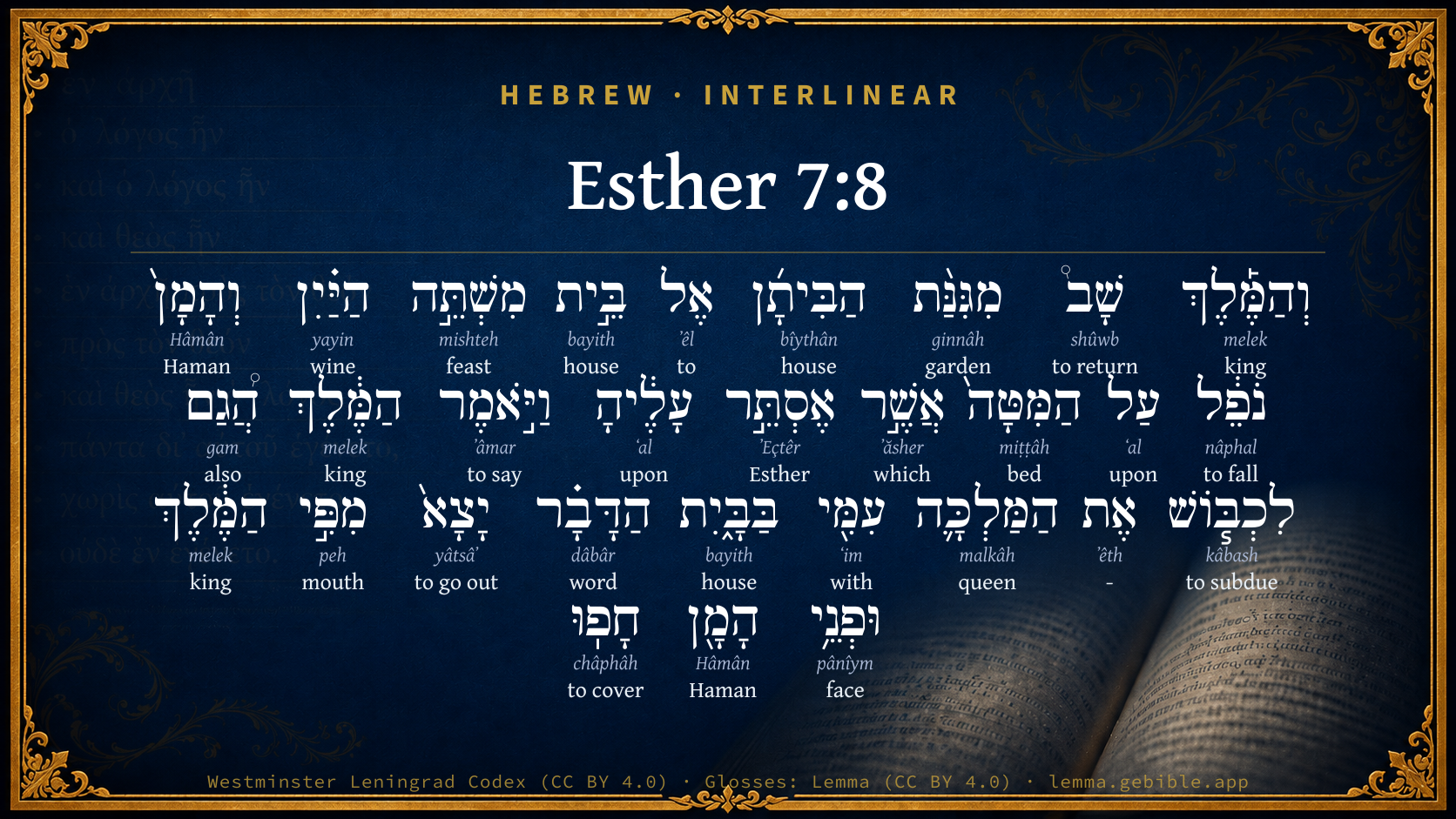
Esther 7:8

Hebrew (Westminster Leningrad Codex) Esther 7:8 appears in the Hebrew Old Testament. The text above is from the Westminster Leningrad Codex. Each word links to its Strong’s number, a concise gloss, and parsing drawn from the Open Scriptures Hebrew Bible morphology. Click any word for its full Brown-Driver-Briggs (BDB) entry.
Download image
Cite this verse

Esther 7:8 (World English Bible). Public Domain. Lemma interlinear Bible study tool, https://lemma.gebible.app/v/esther/7/8.

Show BibTeX & RIS
BibTeX
RIS
English Translation
Then the king returned out of the palace garden into the place of the banquet of wine; and Haman was fallen on the couch whereon Esther was. Then said the king, Will he even force the queen before me in the house? As the word went out of the king's mouth, they covered Haman's face.
World English Bible · Public Domain
Download a study sheet

One document with this verse’s original text, its word-by-word gloss line, the meaning frame, cross-references with their text, attributed commentary, and full source and license credits — printable, and it pastes into notes with its structure intact.

This verse Autodidact and up

Study sheet (.html) Plain text (.txt)

A passage Seminary Student

Up to 50 verses in one chapter. A passage sheet keeps up to 6 commentary sources and 12 cross-references per verse, in the order this page ranks them, and says so on the sheet whenever that leaves anything out. Ask for a single verse and you get the Autodidact verse sheet above.

Everything on this page stays free to read, with no account — the sheet is a download of what is already on screen, not access to it.

Want to remove ads? Support Godless Engineer
Compare translations 3

The same verse in 3 English versions, stacked beneath the original-language interlinear above. Click any original word for its lexicon entry.

Each is an independent rendering of the whole verse — the interlinear is not word-aligned to these translations.

Highlighted words mark where these versions differ — a whole-verse word diff, not a word-by-word alignment.

  • World English Bible Public Domain
    Then the king returned out of the palace garden into the place of the banquet of wine; and Haman was fallen on the couch whereon Esther was. Then said the king, Will he even force the queen before me in the house? As the word went out of the king's mouth, they covered Haman's face.
  • King James Version Public Domain
    Then the king returned out of the palace garden into the place of the banquet of wine; and Haman was fallen upon the bed whereon Esther was. Then said the king, Will he force the queen also before me in the house? As the word went out of king's mouth, they covered Haman's face.
  • unfoldingWord Literal Text CC BY-SA 4.0
    Now when the king returned from the garden of the palace to the house of the banquet of wine, Haman was fallen on the couch on which Esther was. And the king said, “Is it also to subdue the queen with me in the house?” The word was going out from the mouth of the king when they covered the face of Haman.

unfoldingWord Literal Text — © unfoldingWord, licensed CC BY-SA 4.0. Word-aligned USFM3 via Door43 (git.door43.org/unfoldingWord/en_ult).

Versions to compare (up to 4)

3 of 4 selected

Show all 18 translations

Every available English version of this verse, each an independent rendering of the whole verse.

  • World English Bible Public Domain
    Then the king returned out of the palace garden into the place of the banquet of wine; and Haman was fallen on the couch whereon Esther was. Then said the king, Will he even force the queen before me in the house? As the word went out of the king's mouth, they covered Haman's face.
  • Berean Standard Bible Public Domain
    Just as the king returned from the palace garden to the banquet hall, Haman was falling on the couch where Esther was reclining. The king exclaimed, “Would he actually assault the queen while I am in the palace?” As soon as the words had left the king’s mouth, they covered Haman’s face.
  • Majority Standard Bible Public Domain
    Just as the king returned from the palace garden to the banquet hall, Haman was falling on the couch where Esther was reclining. The king exclaimed, “Would he actually assault the queen while I am in the palace?” As soon as the words had left the king’s mouth, they covered Haman’s face.
  • King James Version Public Domain
    Then the king returned out of the palace garden into the place of the banquet of wine; and Haman was fallen upon the bed whereon Esther was. Then said the king, Will he force the queen also before me in the house? As the word went out of king's mouth, they covered Haman's face.
  • American Standard Version (1901) Public Domain
    Then the king returned out of the palace garden into the place of the banquet of wine; and Haman was fallen upon the couch whereon Esther was. Then said the king, Will he even force the queen before me in the house? As the word went out of the king's mouth, they covered Haman's face.
  • Revised Version (1885) Public Domain
    Then the king returned out of the palace garden into the place of the banquet of wine; and Haman was fallen upon the couch whereon Esther was. Then said the king, Will he even force the queen before me in the house? As the word went out of the king’s mouth, they covered Haman’s face.
  • Geneva Bible (1599) Public Domain
    And when the King came againe out of the palace garden, into the house where they dranke wine, Haman was fallen vpon the bed whereon Ester sate! therefore the King sayd, Will he force the Queene also before me in the house? As the worde went out of the Kings mouth, they couered Hamans face.
  • Douay-Rheims (1899) Public Domain
    And when the king came back out of the garden set with trees, and entered into the place of the banquet, he found Aman was fallen upon the bed on which Esther lay, and he said: He will force the queen also in my presence, in my own house. The word was not yet gone out of the king's mouth, and immediately they covered his face.
  • Young's Literal Translation Public Domain
    And the king hath turned back out of the garden of the house unto the house of the banquet of wine, and Haman is falling on the couch on which Esther `is', and the king saith, `Also to subdue the queen with me in the house?' the word hath gone out from the mouth of the king, and the face of Haman they have covered.
  • Literal Standard Version CC BY-SA 4.0
    And the king has turned back out of the garden of the house to the house of the banquet of wine, and Haman is falling on the couch on which Esther [is], and the king says, “Also to subdue the queen with me in the house?” The word has gone out from the mouth of the king, and the face of Haman they have covered.
  • Unlocked Literal Bible CC BY-SA 4.0
    Then the king returned from the palace garden into the room where the wine had been served. Haman had just fallen on the couch where Esther was. The king said, “Will he assault the queen in my presence in my own house?” As soon as this sentence came out of the king's mouth, the servants covered Haman's face.
  • unfoldingWord Literal Text CC BY-SA 4.0
    Now when the king returned from the garden of the palace to the house of the banquet of wine, Haman was fallen on the couch on which Esther was. And the king said, “Is it also to subdue the queen with me in the house?” The word was going out from the mouth of the king when they covered the face of Haman.
  • Darby Bible Public Domain
    And the king returned out of the palace garden into the house of the banquet of wine, and Haman was fallen upon the couch on which Esther was. And the king said, Will he even force the queen before me in the house? The word went forth out of the king's mouth, and they covered Haman's face.
  • World Messianic Bible Public Domain
    Then the king returned out of the palace garden into the place of the banquet of wine; and Haman had fallen on the couch where Esther was. Then the king said, “Will he even assault the queen in front of me in the house?” As the word went out of the king’s mouth, they covered Haman’s face.
  • Webster's Bible Public Domain
    Then the king returned out of the palace-garden into the place of the banquet of wine; and Haman had fallen upon the bed on which Esther was. Then said the king, Will he force the queen also before me in the house? As the word went out of the king's mouth, they covered Haman's face.
  • Free Bible Version CC BY-SA 4.0
    When the king came back in from the palace garden to the dining room, Haman had thrown himself on the couch where Queen Esther was. The king shouted out, “Is he even going to rape the queen here in the palace, right in front of me?” As soon as the king said this, the servants covered Haman's face.
  • Bible in Basic English Public Domain
    Then the king came back from the garden into the room where they had been drinking; and Haman was stretched out on the seat where Esther was. Then the king said, Is he taking the queen by force before my eyes in my house? And while the words were on the king's lips, they put a cloth over Haman's face.
  • JPS Tanakh (1917) Public Domain
    Then the king returned out of the palace garden into the place of the banquet of wine; and Haman was fallen upon the couch whereon Esther was. Then said the king: 'Will he even force the queen before me in the house?' As the word went out of the king's mouth, they covered Haman's face.

Literal Standard Version (2020), Covenant Press — licensed CC BY-SA 4.0. Text via the HelloAO Bible API (eBible.org). Unlocked Literal Bible (unfoldingWord) — licensed CC BY-SA 4.0. Text via the HelloAO Bible API (eBible.org). unfoldingWord Literal Text — © unfoldingWord, licensed CC BY-SA 4.0. Word-aligned USFM3 via Door43 (git.door43.org/unfoldingWord/en_ult). Free Bible Version, Dr. Jonathan Gallagher — licensed CC BY-SA 4.0. Text via the HelloAO Bible API (eBible.org).

Word by word

More ways to search: Search by grammar → Find every occurrence → Compare this word →

Practice this passage: Drill this verse → Learn its vocabulary →

הַבִּיתָ֜ן
bîythân
H1055
“the · house”
Particle, Definite Article + Noun, Common, Masculine, Singular, Absolute
Part of Speech
Particle + Noun
Type
Common
Gender
Masculine
Number
Singular
State
Absolute
Full BDB Definition

Origin: probably from H1004

TWOT: 241c

house, palace
  1. וְהַמֶּ֡לֶךְ melek H4428 “and · the · king” Conjunction + Particle, Definite Article + Noun, Common, Masculine, Singular, Absolute
  2. שָׁב֩ shûwb H7725 “to return” Verb, Qal, Perfect, 3rd Person, Masculine, Singular
  3. מִגִּנַּ֨ת ginnâh H1594 “from · garden of” Preposition + Noun, Common, Feminine, Singular, Construct
  4. אֶל ʼêl H413 “to” Preposition
  5. בֵּ֣ית bayith H1004 “house of” Noun, Common, Masculine, Singular, Construct
  6. מִשְׁתֵּ֣ה mishteh H4960 “feast of” Noun, Common, Masculine, Singular, Construct
  7. הַיַּ֗יִן yayin H3196 “the · wine” Particle, Definite Article + Noun, Common, Masculine, Singular, Absolute
  8. וְהָמָן֙ Hâmân H2001 “and · Haman” Conjunction + Noun, Proper
  9. נֹפֵ֔ל nâphal H5307 “falling” Verb, Qal, Participle Active, Masculine, Singular, Absolute
  10. עַל ʻal H5921 “upon” Preposition
  11. הַמִּטָּה֙ miṭṭâh H4296 “the · bed” Particle, Definite Article + Noun, Common, Feminine, Singular, Absolute
  12. אֲשֶׁ֣ר ʼăsher H834 “which” Particle, Relative
  13. אֶסְתֵּ֣ר ʼEçtêr H635 “Esther” Noun, Proper
  14. עָלֶ֔יהָ ʻal H5921 “upon · her” Preposition + Suffix, Personal, 3rd Person, Feminine, Singular
  15. וַיֹּ֣אמֶר ʼâmar H559 “and · to say” Conjunction + Verb, Qal, Sequential Imperfect, 3rd Person, Masculine, Singular
  16. הַמֶּ֔לֶךְ melek H4428 “the · king” Particle, Definite Article + Noun, Common, Masculine, Singular, Absolute
  17. הֲ֠גַם gam H1571 “also” Particle, Interrogative + Adverb
  18. לִכְבּ֧וֹשׁ kâbash H3533 “to subdue” Preposition + Verb, Qal, Infinitive Construct
  19. אֶת ʼêth H853 “-” Particle, Direct Object
  20. הַמַּלְכָּ֛ה malkâh H4436 “the · queen” Particle, Definite Article + Noun, Common, Feminine, Singular, Absolute
  21. עִמִּ֖י ʻim H5973 “with · me” Preposition + Suffix, Personal, 1st Person, Common, Singular
  22. בַּבָּ֑יִת bayith H1004 “in/at the · house” Preposition, Determined + Noun, Common, Masculine, Singular, Absolute
  23. הַדָּבָ֗ר dâbâr H1697 “the · word” Particle, Definite Article + Noun, Common, Masculine, Singular, Absolute
  24. יָצָא֙ yâtsâʼ H3318 “to go out” Verb, Qal, Perfect, 3rd Person, Masculine, Singular
  25. מִפִּ֣י peh H6310 “from · mouth of” Preposition + Noun, Common, Masculine, Singular, Construct
  26. הַמֶּ֔לֶךְ melek H4428 “the · king” Particle, Definite Article + Noun, Common, Masculine, Singular, Absolute
  27. וּפְנֵ֥י pânîym H6440 “and · face(s) of” Conjunction + Noun, Common, Both, Plural, Construct
  28. הָמָ֖ן Hâmân H2001 “Haman” Noun, Proper
  29. חָפֽוּ châphâh H2645 “to cover” Verb, Qal, Perfect, 3rd Person, Common, Plural

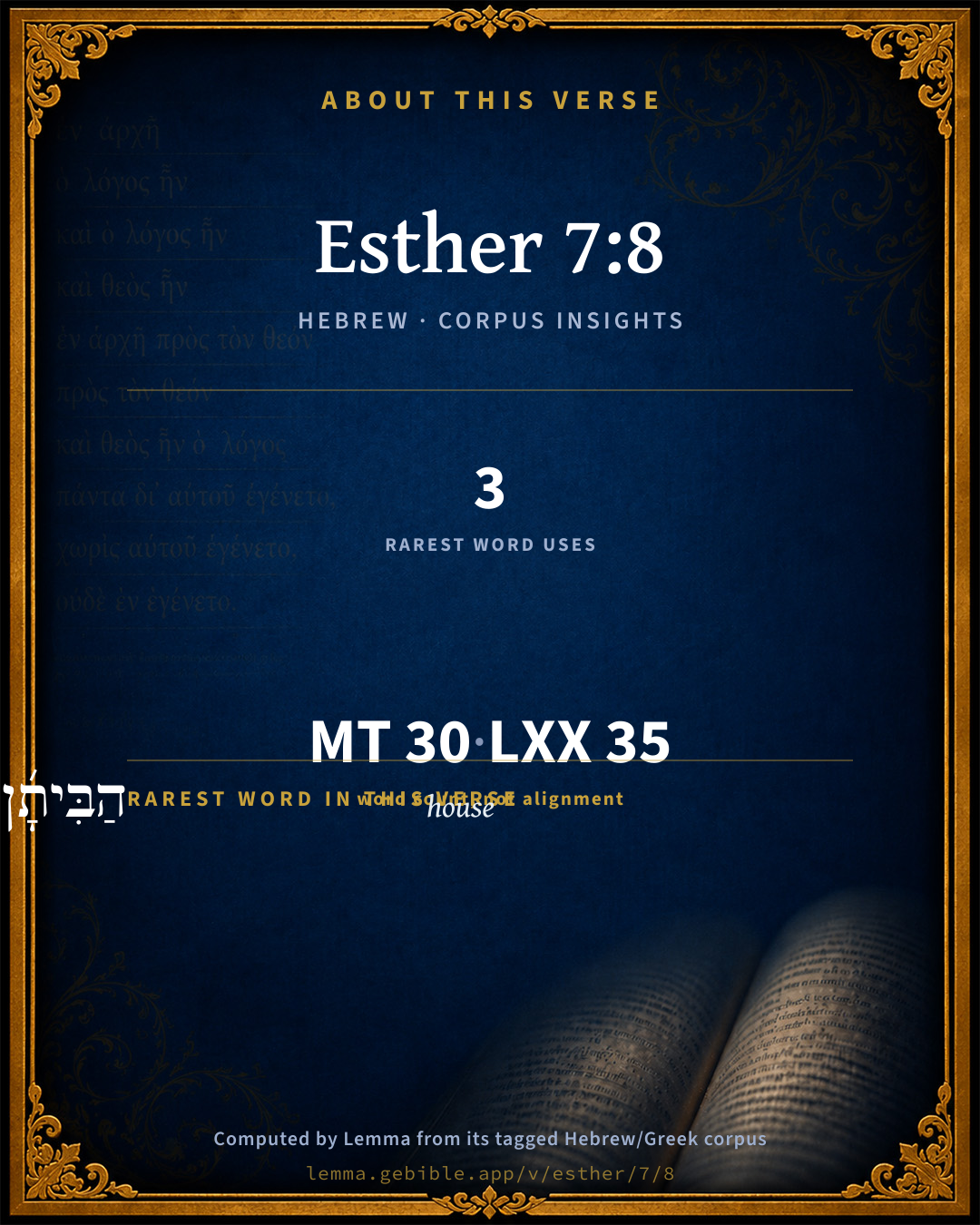
About this verse

These counts appear in no published source. They are computed here, from the morphology-tagged text and Lemma’s own curated glosses. What Lemma adds →

30
words
25
distinct lemmas
Historical
section

Notable vocabulary

The rarest word here is הַבִּיתָ֜ן house H1055 — appearing just 3 times in the whole Hebrew Bible.

Shared distinctive vocabulary

הַבִּיתָ֜ן house H1055 occurs in 3 verses of the Hebrew Bible. Also found in:

Grammatical profile

  • 6 verbs
  • 17 nouns
  • 4 prepositions
  • 1 adverb
  • 2 particles

Verb forms

  • שָׁב֩ Qal · Perfect
  • נֹפֵ֔ל Qal · Participle Active
  • וַיֹּ֣אמֶר Qal · Sequential Imperfect
  • לִכְבּ֧וֹשׁ Qal · Infinitive Construct
  • יָצָא֙ Qal · Perfect
  • חָפֽוּ Qal · Perfect

Repetition

Words recur within this verse — often emphatic in Hebrew:

  • וְהַמֶּ֡לֶךְ king H4428 ×3
  • בֵּ֣ית house H1004 ×2
  • וְהָמָן֙ Haman H2001 ×2
  • עַל upon H5921 ×2

Hebrew & Septuagint length

In English translation the verse runs 55 words from the Hebrew and 38 from the Septuagint (LXX English) — the Septuagint runs noticeably shorter here. See the side-by-side →

A rough comparison of the two English renderings, which tokenize alike — not a word-level alignment.

Word counts can differ between the Hebrew and the Greek without any difference in meaning — e.g. the Hebrew direct-object marker אֵת has no separate Greek word, and Greek often adds the article ὁ.

In the original languages it is 30 Hebrew tokens and 35 Greek tokens — but the two are counted differently (Hebrew bundles its prefixes and suffixes into one token; the Greek is in lemma form), so that isn’t a like-for-like length.

Cross-references

5

Topical passages linked to Esther 7:8 in the Treasury of Scripture Knowledge — connected by theme and wording, ordered by reader-vote popularity; previews shown in the World English Bible.

  • Esther 1:6 [There were hangings of] white [cloth], [of] green, and [of] blue, fastened with cords of fine linen and purple to silver rings and pillars of marble: the couches were of gold and silver, on a pavement of red, and white, and yellow, and black marble.
  • Esther 6:12 Mordecai came again to the king's gate. But Haman hurried to his house, mourning and having his head covered.
  • Job 9:24 The earth is given into the hand of the wicked. He covers the faces of the judges of it. If not he, then who is it?
  • Isaiah 22:17 Behold, Yahweh, like a [strong] man, will hurl you away violently; yes, he will wrap you up closely.
  • Isaiah 49:23 Kings shall be your nursing fathers, and their queens your nursing mothers: they shall bow down to you with their faces to the earth, and lick the dust of your feet; and you shall know that I am Yahweh; and those who wait for me shall not be disappointed.

Cross-references courtesy of OpenBible.info (CC BY 4.0).

Hebrew and Greek witnesses Masoretic Hebrew ↔ Greek Septuagint

The same verse in the two great witnesses to the Old Testament, shown verse-for-verse.

Here the Septuagint runs noticeably shorter than the Hebrew — LXX2012 (modern English Septuagint) 38 words vs World English Bible 55. A rough length comparison of the two English translations, not a word-level alignment — read both below.

These are two independent witnesses, not word-aligned to each other, and the Septuagint is shown in lemma (dictionary) form.

Hebrew Esther 7:8 Masoretic · Westminster Leningrad Codex

וְהַמֶּ֡לֶךְ שָׁב֩ מִגִּנַּ֨ת הַבִּיתָ֜ן אֶל בֵּ֣ית מִשְׁתֵּ֣ה הַיַּ֗יִן וְהָמָן֙ נֹפֵ֔ל עַל הַמִּטָּה֙ אֲשֶׁ֣ר אֶסְתֵּ֣ר עָלֶ֔יהָ וַיֹּ֣אמֶר הַמֶּ֔לֶךְ הֲ֠גַם לִכְבּ֧וֹשׁ אֶת הַמַּלְכָּ֛ה עִמִּ֖י בַּבָּ֑יִת הַדָּבָ֗ר יָצָא֙ מִפִּ֣י הַמֶּ֔לֶךְ וּפְנֵ֥י הָמָ֖ן חָפֽוּ

Then the king returned out of the palace garden into the place of the banquet of wine; and Haman was fallen on the couch whereon Esther was. Then said the king, Will he even force the queen before me in the house? As the word went out of the king's mouth, they covered Haman's face.

World English Bible · Public Domain

Greek LXX Esther 7:8 Septuagint · lemma form

ἐπιστρέφω δέ ὁ βασιλεύς ἐκ ὁ κῆπος αμαν δέ ἐπιπίπτω ἐπί ὁ κλίνη ἀξιόω ὁ βασίλισσα εἶπον δέ ὁ βασιλεύς ὥστε καί ὁ γυνή βιάζομαι ἐν ὁ οἰκία ἐγώ αμαν δέ ἀκούω διατρέπω ὁ πρόσωπον

And the king returned from the garden; and Aman had fallen upon the bed, intreating the queen. And the king said, Will you even force my wife in my house? And when Aman heard it, he changed countenance.

LXX2012 (modern English Septuagint) · Public Domain

On this verse, The Cambridge Bible for Schools and Colleges discusses the Septuagint’s reading. Read the note in Commentary ↓

Hebrew: Westminster Leningrad Codex (CC BY 4.0). Greek: Septuagint (public domain); English from LXX2012 (modern English Septuagint) (Public Domain). How the Septuagint differs from the Hebrew →

Commentary

Notes on Esther 7:8 from classic Christian and Jewish commentators (each source and its license shown beneath its notes). The classic Christian expositions comment on the surrounding passage and are grouped to its opening verse, so a note may address several verses; the Jewish commentaries on the Tanakh (Rashi and others) are per-verse, so they appear only where the commentator wrote on this verse.

Lemma curates 59 commentaries, every one of them public domain or Creative Commons licensed, each selected and text-cleaned for this edition rather than reprinted as found. About our sources →

Trapp's Complete Commentary

John Trapp

Est 7:8 Then the king returned out of the palace garden into the place of the banquet of wine; and Haman was fallen upon the bed whereon Esther [was]. Then said the king, Will he force the queen also before me in the house? As the word went out of the king’s mouth, they covered Haman’s face.

Ver. 8. Then the king returned out of the palace garden] Where he had either increased his choler, and cast on more fuel by plodding, or, as some think, strove to digest it, as horses do by biting on the bit.

Ut fragilis glacies occidit ira mora.

Unto the house of the banquet of wine] Called also by the Hebrew, Bethmittoth, the house of beds, triclinium; because at beds they used to sit, as we do at tables, to eat and drink. See Est 1:6.

And Haman was fallen upon the bed whereon Esther was] He had stood up before (for he saw the queen took no felicity in his company) to make request for his life, which now was in suspense; here he falls down, either as swooning, or supplicating at the queen’s feet, to beg her favour. But she very well knew that there is both a cruel mercy and a pious cruelty, and that although the sword of justice should be furbished with the oil of mercy, yet there are cases (and this was one) wherein severity ought to cast the scale; when there is no hope of curing, men must fall to cutting, Immedicabile vulnus, &c.

Then said the king, Will he force the queen also] Haman had little mind of any such matter, as being now in the hands of the king of terrors, and ready to be devoured by the firstborn of death, as Bildad hath it, Job 18:13. But the angry king was willing to misinterpret him, and to take all things at the worst. It is an easy matter to find a club for a dog, to pick a quarrel where men intend a mischief. Ahasuerus was not unwilling to misconstrue the posture of Haman’s body, while prostrate, he spread his arms in a vehement imploration up to the queen’s bed. How oft might he have done so, and more, while he was in favour, uncensured? Actions are not the same when the man alters. Men either judge or not judge, as their passions and affections carry them. See this Act 23:9. Before Paul had reveal himself to be a Pharisee, This man is not worthy to live, said they; but when he had cried out in the council, I am a Pharisee, the son of a Pharisee, oh how finely do they mince the matter! Perhaps an angel hath revealed it to him, &c. Paul was an honest man then.

Impedit ira animum, ne possit cernere verum.

But though the king were unjust in judging thus amiss of Haman, yet God was righteous in measuring to him as he had meted to others, by belying and slandering so many innocents as he had designed to destruction. The devil was, and still is, first a liar, and then a murderer, he cannot murder without slandering first. But God loves to retaliate and proportion device to device, Mic 2:1; Mic 2:3, frowardness to frowardness, Psa 18:26, spoiling to spoiling, Isa 33:1, tribulation to them that trouble his people, 2Th 1:6.

As the word went out of the king’s mouth] Either the former words, or else some words of command not here related, such as are Corripite, velate vultum, Take him away, cover his face. And this word was to Haman the messenger of death, driving him from the light into darkness, and chasing him out of the world, Job 18:18. Nay, worse. That Book of Job elegantly sets forth the misery of a wicked man dying, under the notion of one not only driven out of the light by devils, where he shall see nothing but his tormentors, but also made to stand upon snares or gins with iron teeth, ready to strike up and grind him to pieces, having gall poured down to his belly, with an instrument raking in his bowels, and the pains of a travailing woman upon him, and a hideous noise of horror in his ears, and a great giant with a spear running upon his neck, and a flame burning upon him round about, &c., and yet all this to hell itself is but as a prick with a pin, or a flea biting, Job 18:18; Job 20:15; Job 20:24; Job 15:20-21; Job 15:26; Job 15:30.

They covered Haman’s face] In token of his irrevocable condition. See Job 9:24 Isa 22:17. The Turks cast a black gown upon such, as they sit at supper with the Great Turk, and presently strangle them. Many of their viziers or greatest favourites die in this sort, which makes them use this proverb, He that is greatest in office is but a statue of glass. Plutarch wittily compareth great men to counters, which now stand for a thousand pounds, and anon for a farthing. - Sic transit gloria mundi. so passes the glory of the world.

Quem dies veniens vidit superbum,

Hunc dies abiens vidit iacentem.

Haman, for instance, and so Sejanus; the same senators who accompanied him to the senate, conducted him to prison; they which sacrificed unto him as to their god, which kneeled down to adore him, scoffed at him, seeing him dragged from the temple to the jail, from supreme honour to extreme ignominy, Ludit in humanis divina potentia rebus (Pertinax Imp. fortunae pila dictus est). One reason why the king flung out of the room, and went into the palace garden, might be because he could not endure the sight of Haman any more. Wherefore upon his return they instantly covered his face. Some say the manner was, that when the king of Persia was most highly offended with any man, his face was immediately covered, to show that he was unworthy to see the sun, whom they counted their god; or to be an eye-sore to the displeased king, Tanquam indignus qui regem oculis usurparet just as great an indignity ro see the king with their eyes. (Drus.). Among the Romans it was, Maiestas laesa si exeunti Proconsuli meretrix non summovetur, high treason for any strumpet to stand in the proconsuls way, whenever he came abroad. The statues of the gods were transported or covered in those places where any punishment was inflicted. That in Cicero and Livy is well known, I lictor colliga manus, caput abnubito, arbori infelici suspendito, Go, hangman, bind his hands, cover his face, hang him on the gallow-tree. This was their condemnatory sentence.

John Trapp, A Commentary or Exposition upon All the Books of the Old and New Testament (1647–1656) — public domain. Text from a community e-Sword module.

Joseph Benson's Commentary

Est 7:8. Then the king returned out of the palace garden — Yet more exasperated than when he went into it. The more he thought of Haman’s conduct, the more enraged he was against him. Haman was fallen upon the bed whereon Esther was — Or by, or beside the bed, on which the queen sat at meat, after the manner of those times and countries. For it was then a custom among the Persians, as well as many other nations, to sit, or rather lie, upon beds, when they ate or drank. And Haman, it seems, fell down as a supplicant at the feet of Esther, laying his hands upon her knees, and beseeching her to take pity upon him: for it is not improbable that it was the custom among the Persians, as it was among the Greeks and Romans, to embrace the knees of those whom they petitioned to be favourable to them. Then said the king — Finding him in this posture; Will he force the queen also before me in the house? — Will he attempt my queen’s chastity, as he hath already attempted her life, and that in my own presence and palace? His presumption and impudence, I see, will stick at nothing. He speaks not this out of real jealousy, for which there was no cause in those circumstances; but from an exasperated mind, which takes all occasions to vent itself against the person who gave the provocation, and puts the worst construction on all his words and actions. They covered Haman’s face — That the king might not be offended or grieved at the sight of a person whom he now detested; and because they looked upon him as a condemned person, for the faces of such used to be covered.

Joseph Benson's Commentary on the Old and New Testaments (1811–1818) — public domain. Text from a community e-Sword module.

Tyndale Open Study Notes

Tyndale Open Resources

7:8 he fell on the couch where Queen Esther was reclining: A major mistake, for no one should touch the queen, much less be on the same couch with her. • Will he even assault the queen . . . before my very eyes? This exaggerated rhetorical question implicates Haman with the worst possible motives.

Tyndale Open Study Notes — © Tyndale Open Resources, licensed CC BY-SA 4.0. Text via the HelloAO Bible API.

Geneva Bible (1599)

Geneva Bible translators

He fell down at the bed’s feet or couch, whereupon she sat, and made request for his life.

This was the manner of the Persians, when one was out of the King’s favor.

Geneva Bible (1599) marginal notes — public domain. Text via Bolls.life.

Jamieson, Fausset & Brown

Robert Jamieson, A. R. Fausset & David Brown

Haman was fallen upon the bed whereon Esther was--We do not know the precise form of the couches on which the Persians reclined at table. But it is probable that they were not very different from those used by the Greeks and Romans. Haman, perhaps, at first stood up to beg pardon of Esther; but driven in his extremity to resort to an attitude of the most earnest supplication, he fell prostrate on the couch where the queen was recumbent. The king returning that instant was fired at what seemed an outrage on female modesty.

they covered Haman's face--The import of this striking action is, that a criminal is unworthy any longer to look on the face of the king, and hence, when malefactors are consigned to their doom in Persia, the first thing is to cover the face with a veil or napkin.

Jamieson, Fausset & Brown — Commentary Critical and Explanatory on the Whole Bible (1871) — public domain (CC PDM 1.0). Text via the HelloAO Bible API.

Adam Clarke's Commentary

Verse 8. Will he force the queen] On the king's return he found him at the queen's knees; and, professing to think that he intended to do violence to her honour, used the above expressions; though he must have known that, in such circumstances, the thought of perpetrating an act of this kind could not possibly exist.

They covered Haman's face.] This was a sign of his being devoted to death: for the attendants saw that the king was determined on his destruction. When a criminal was condemned by a Roman judge, he was delivered into the hands of the serjeant with these words: I, lictor; caput obnubito, arbori infelici suspendito. "Go, serjeant; cover his head, and hang him on the accursed tree."

Adam Clarke's Commentary on the Bible (1810–1826) — public domain. Text from a community e-Sword/MySword module.

Ellicott's Commentary for English Readers

(8) The bed—i.e., the couch on which she had been reclining at the banquet. This was the customary posture at meals, not only of the Persians, but also of the Greeks and Romans, and of the later Jews. The Last Supper was thus eaten. Haman had obviously thrown himself at the queen’s feet to ask for mercy. The king on his return was evidently full of wrath against Haman, and though he was for the time God’s instrument in averting Haman’s wicked design, his own base and worthless character is none the less conspicuous. The attempted massacre had been authorised with the full knowledge and consent of the king, who yet ignores utterly his own share of the responsibility. Great and noble ends are at times brought about by the instrumentality of unholy men, blind instruments in a purpose whose end they understand not. What greater blessing, for example, did God vouchsafe to England than the Reformation, whose foremost agent was a bloody and unholy king?

Will he force. . . .—Ahasuerus must have known perfectly well that Haman’s position was that of a suppliant; his words do but indicate his utter anger, as the attendants clearly perceive, for they immediately covered Haman’s face—he must not see the king’s face again. (See above, Est_1:13.)

A Bible Commentary for English Readers, edited by Charles John Ellicott (1878–1897) — public domain. Text from a community e-Sword module.

The Cambridge Bible for Schools and Colleges

gen. ed. J. J. S. Perowne

8. the word] This seems to refer to the speech just preceding. It was clear to the attendants, without any more specific utterance on the king’s part, that Haman was doomed to death.

they covered Haman’s face] Curtius in his history of Alexander the Great (vi. 8) speaks of this as done to Philotas, who had served with distinction under that monarch, when, on a confession of treason having been wrung from him by torture, he was about to be stoned to death. Livy also (i. 26) mentions it as a Roman custom. We have no authority beyond this passage for its practice among the Persians, and it is possible that, with a slight change in the Heb. word rendered ‘they covered,’ we should translate, his face became flushed (with dismay and shame). Cp. LXX. ‘he was utterly perturbed (confounded) in countenance.’[77]

[77] διετράπη τῷ προσώπῳ.

9 Harbonah] mentioned in the list of Est_1:10.

Behold also] by a fortunate coincidence. Harbonah’s words indicate a malicious joy at the downfall of the favourite.

Est_8:1. the house of Haman] his goods. See on Est_3:11. For the confiscation of the property of a condemned criminal in Persia see Herod. iii. 129, where, after a description of the death sentence carried out in the case of Oroetes, a Persian, for murder and other misdeeds, the historian mentions as a matter of course that ‘the treasures of Oroetes’ were conveyed to Sardis.

Esther had told what he was unto her] There was no longer any motive for concealing the relationship, Mordecai being now secure in the king’s favour. Her own Jewish origin she had been obliged to disclose already (Est_7:4).

The Cambridge Bible for Schools and Colleges (gen. ed. J. J. S. Perowne; Cambridge University Press, 1878–1918) — public domain. Text from a community e-Sword module.

John Gill's Exposition

Then the king returned out of the palace garden into the place of the banquet of wine,.... Being a little cooler, and more composed in his mind, see See Gill on Est 1:5.

and Haman was fallen upon the bed whereon Esther was; not the bed she lay on to sleep in the night, (for it cannot be thought that it was a bedchamber in which the banquet was,) but on the bed or couch on which she sat or reclined at the banquet, as was the custom in the eastern countries; now, "by", or "near" this, as the word may be rendered, Haman fell down, even at the feet of the queen, begging for mercy; and some think he might embrace her feet or knees, as was the custom of the Greeks and Romans as they were supplicating (k); and so it seems to have been with the Jews, see Kg2 4:27, and being in this posture, it might appear the more indecent, and give the king an opportunity to say as follows:

then said the king, will he force the queen also before me in the house?, that is, ravish her; not that he really thought so; it was not a time nor place for such an action; nor can it be thought that Haman, in such terror and confusion he was in, could be so disposed; and besides there were others present, as the next clause shows: but this he said, putting the worst construction on his actions, and plainly declaring his opinion of him, that he thought him a man capable of committing the vilest of crimes, and that his supplications were not to be regarded:

as the word went out of the king's mouth, they covered Haman's face; the servants present, as a man unworthy to see the light; and they took what the king said to amount to a sentence of condemnation, and that it was his will he should die; and they covered his face, as condemned malefactors used to be; which was a custom among the Greeks and Romans, of which many instances may be given (l); though Aben Ezra says it was the custom of the kings of Persia, that their servants covered the face of him the king was angry with, that he might not see his face any more, which was well known in the Persian writings.

(k) "Genibusque suas", &c. Claudian. de Raptu Proserpin l. 1. ver. 50. & Barthius in ib. Vid. Homer. Iliad. 21. l. 75. Plin. l. 1. Ep. 18. (l) "Caput obnubito", &c. Ciceron. Orat. 18. "pro Rabirio", Liv. Hist. l. 1. p. 15. Curt. Hist. l. 6. c. 11. Vid. Solerium de Pileo, sect. 2. p. 20. & Lipsii not. in lib. 1. c. 1. de Cruce, p. 203, 204.

John Gill's Exposition of the Whole Bible (1746–1763) — public domain (CC PDM 1.0). Text via the HelloAO Bible API.

Albert Barnes' Notes on the Bible

Like the Greeks and Romans, the Persians reclined at their meals on sofas or couches. Haman, in the intensity of his supplication, had thrown himself upon the couch at Esther’s feet.

They covered Haman’s face - The Macedonians and the Romans are known to have commonly muffled the heads of prisoners before executing them. It may have also been a Persian custom.

Albert Barnes' Notes on the Bible (1834–1885) — public domain. Text from a community e-Sword/MySword module.

Haydock's Catholic Bible Commentary

My own. Hebrew, "will he force....in the house?" (Haydock) --- Those who know with what jealousy the Persians treated their wives, so at to punish with death those who crossed the road before the queens, (Plut. Artax.) or touched them, will not wonder at the indignation of Assuerus, (Calmet) though his suspicions were groundless. (Haydock) --- Aman wished to incline the queen to shew clemency, (Menochius) and intercede for him. He threw himself as a suppliant at her feet, as she lay on the bed at table. (Haydock) --- Face. His crime was notorious; no trial was requisite, and the kings could treat their subjects as slaves. It was customary to cover the faces of those who were led to execution. Philotas was thus conducted into the presence of Alexander. (Curtius vi.)

George Leo Haydock (1774–1849), Haydock's Catholic Family Bible and Commentary, 1859 edition — public domain. Excludes Psalms (Douay-Rheims chapter numbering differs from Protestant) and Deuterocanonical books (Catholic canon only).

Matthew Poole's English Annotations

Upon the bed; or, by or beside the bed; on which the queen sat at meat, after the manner; where he was fallen upon his knees, and upon the ground, at her feet, as humble suppliants used to do, and as the queen did at the king’s feet, Est 8:3.

Will he force the queen also? will he now attempt my queen’s chastity, as he hath already attempted her life? His presumption and impudence I see will stick at nothing. He speaks not this out of a real jealousy, for which there was no cause in those circumstances; but from an exasperated mind, which takes all occasions to vent itself against the person who gave the provocation, and makes the worst construction of all His words and actions.

Before me in the house; in my own presence and palace.

They, i.e. the king’s and queen’s chamberlains then attending upon them, covered Haman’s face; partly that the king might not be offended or grieved with the sight of a person whom he now loathed; and partly because they looked upon him as a condemned person, for the faces of such used to be covered.

Matthew Poole's English Annotations on the Holy Bible (1683–1685) — public domain. Text from a community e-Sword/MySword module.

Whedon's Commentary on the Bible

Daniel D. Whedon

8. Haman was fallen upon the bed — In the wild emotion and alarm of the moment, he had thrown himself upon the couch or divan on which Esther reclined at the banquet, and was supplicating for his life.

Will he force the queen — The enraged monarch quickly construes the attitude of Haman into the worst possible offence.

As the word went — Not the words of the question just stated, but the word of judgment against Haman — the sentence to have him away at once to execution.

Covered Haman’s face — Muffled his head with a cloth or vail, preliminary to his execution. When the death warrant went out of the king’s mouth, all was virtually over with Haman. The attendant chamberlains hurry him away to the more public executioners.

Daniel D. Whedon (gen. ed.), Commentary on the Old and New Testaments (1874–1909) — public domain. Text from a community e-Sword module.

The Pulpit Commentary

The covered countenance.

the word went out of the king"s mouth they covered Haman"s face." A hint is sufficient for the king"s servants. It is to them a matter of little import whether they robe Haman for exaltation or cover his face for execution; whether they lead him to a banquet or to a gallows. Their duty is to obey their king. So with the angels; they minister for joy or punishment.

I TO BE IN DISGRACE WAS TO BE UNWORTHY TO SEE THE KING. Nathaniel Hawthorne represented, in one tale, a man as wearing ever a crape veil, and in death wishing it to be kept over his face, because he felt his own unworthiness.

II TO BE CONDEMNED OF GOD WOULD RENDER US UNABLE TO SEE HIM. As light dazzles, so God"s purity alone would blind us. Our own sin will be the covering. When death shall throw his black pall over us, unless mercy lifts it, our own hands will never tear it away. We should examine our hearts, and see whether there is any cherished sin which may eventually lead to our rejection and condemnation. Let there be no "veil" on our hearts as on those of Israel, that there may be no covering our faces as Haman"s was covered. H.

Vers. Psa_37:35)

II THAT, SOONER OR LATER, PERSECUTED RIGHTEOUSNESS WILL TRIUMPH. (Est_8:1, Est_8:2) Haman has gone to the gallows, and now Mordecai takes the chief chair of state. Honesty proves the true policy in the end. Purity, uprightness, integrity, kindness these have in them the power and prophecy of ultimate success. Let the godly man who is oppressed by iniquity bear his burden, and also his testimony; let him patiently pursue his course, looking, up and looking on, and somewhere in the. future the crown of a pure success awaits him if not here, hereafter. "Weeping may endure for a night possibly a long night but "joy comes in the morning." It may be the morrow of the distant future, but it will then be the beginning of a cloudless and endless day.

III THAT SIN CONTINUALLY SUFFERS FROM ITS OWN HAND. "They hanged Haman on the gallows that he had prepared for Mordecai" (ver. 10). Into the very trap he laid for another his own foot fails. We learn

1. That sin frequently brings on itself the very evil it designed for others. A man bent on ruining another (by legal measures, or unfair under-selling, etc.) often impoverishes himself. A man in his wrath goes out to slay, and is himself the slain one. The accuser of others is condemned by others, and suffers general reprobation.

2. That sin invariably suffers as the consequence of the evil which it does. If it does not endure the very evil it designs, it does bear its penalty. No man can hurt another without being hurt himself. The chief victim, the principal sufferer from sin, is the sinner. Every act of evil, every thought of sin, inflicts a damaging wound, more or less obvious, in the breast of the evil-doer, in the heart of the sinner. Contrast with this stern truth the obverse

IV THAT GOODNESS ALWAYS BLESSES THE AGENT AS WELL AS THE OBJECT. It is not mercy only, but every kind of work, that "blesses him that gives and him that takes." "Give, and it shall be given unto you." "He that watereth shall himself be watered. C.

The Pulpit Commentary (1880–1919), ed. H.D.M. Spence-Jones & Joseph S. Exell — public domain. Text from a community e-Sword module.

John Wesley's Explanatory Notes

Bed - On which the queen sat at meat. Force - Will he attempt my queen's chastity, as he hath already attempted her life! He speaks not this out of real jealousy, but from an exasperated mind, which takes all occasions to vent itself against the person who gave the provocation. They - The king's and queen's chamberlains attending upon them. Covered - That the king might not be offended or grieved with the sight of a person whom he now loathed: and because they looked upon him as a condemned person; for the faces of such used to be covered.

John Wesley, Explanatory Notes Upon the Whole Bible (1754–1765) — public domain. Text via the GEBible commentary corpus.

unfoldingWord translationNotes

Door43 World Missions Community

where the wine had been served

This can be stated in active form. AT: "where servants had served the wine" (See: Active or Passive)

couch

a long piece of furniture where a person can sit or lie down

Will he assault the queen in my presence in my own house?

The king uses this question to show his shock and anger at what Haman was doing. This question can be translated as a statement. AT: "He even dares to attack the queen in my presence and in my own house!" (See: Rhetorical Question)

assault the queen

"attack the queen." This phrase is a polite way to refer to rape. (See: Euphemism)

As soon as this sentence came out of the king's mouth

Speech coming out of the mouth is a metonym that represents speaking. AT: "As soon as the king said this" (See: Metonymy)

the servants covered Haman's face

Apparently they did this because they understood that the king wanted Haman to be killed. AT: "the servants covered Haman's face as a sign that he would be killed" (See: Assumed Knowledge and Implicit Information and Symbolic Action)

translationWords

servant

unfoldingWord translationNotes — © Distant Shores Media and the Door43 World Missions Community, licensed CC BY-SA 4.0. Source: git.door43.org/Door43/en_tn.

Rashi

Rabbi Shlomo Yitzchaki (Rashi)

and Haman was falling The angel pushed him.

On the couch upon which Esther was Their custom was to sit at a meal [leaning] on their sides on couches, as is stated in the beginning of the Book (1:6): “couches of gold and silver” for those who participated in the banquet.

Will you even force Heb. הֲגַם. This is an expression of wonder. לְכְבּוֹשּׁ [denotes] to subdue with force, like (Num. 32: 22): “and the land is conquered (וְנִכְבְּשָּׁה).”

Rashi on the Tanakh — English translations: “The Judaica Press complete Tanach with Rashi, translated by A. J. Rosenberg” (CC BY 4.0); “Pentateuch with Rashi's commentary by M. Rosenbaum and A.M. Silbermann, 1929-1934” (public domain); “The Metsudah Tanach series, Lakewood, N.J” (CC BY 4.0); and “The Book of Joshua, Metsudah Publications, 1997” (CC BY 4.0). Text via Sefaria.

Lesson kit

Teaching starters — assembled from the data on this page, not authored interpretation. Every prompt links to the verse data it draws on. Edit before teaching.

Esther, in the Historical, opens this verse with 30 words (25 distinct Hebrew lemmas). Its most distinctive word is bîythân (“house”). The Greek Septuagint runs shorter here. A historical commentator’s framing appears above. Read the whole chapter for the surrounding context.

Discussion questions

  1. How does “house” (bîythân) shape what this verse is saying?
  2. Esther 1:5 shares the word «house» with this verse. How do the two illuminate each other?
  3. “king” occurs 3× in this one verse. What is the effect of the repetition?
  4. Compared with the Hebrew, the Septuagint runs shorter here. What questions does that raise?
  5. These translations render this verse differently; the difference is in the English rendering, not the original. What questions does that raise?
  6. The verb «שָׁב֩» is Qal Perfect. How does its form color the action?
  7. Reading how Trapp's Complete Commentary and Joseph Benson's Commentary read this verse, where do the two commentators agree and where do they part?

Things to notice

Reading settings

Reading text

Shown beneath each verse's original-language words.

Old Testament
Old Testament edition

Read the OT as the Masoretic Hebrew (MT) or the Greek Septuagint (LXX).

English shown for the Greek Septuagint (in the Hebrew ↔ Greek comparison).

Comparing translations? Open the Compare panel on any verse page to stack up to four side by side.