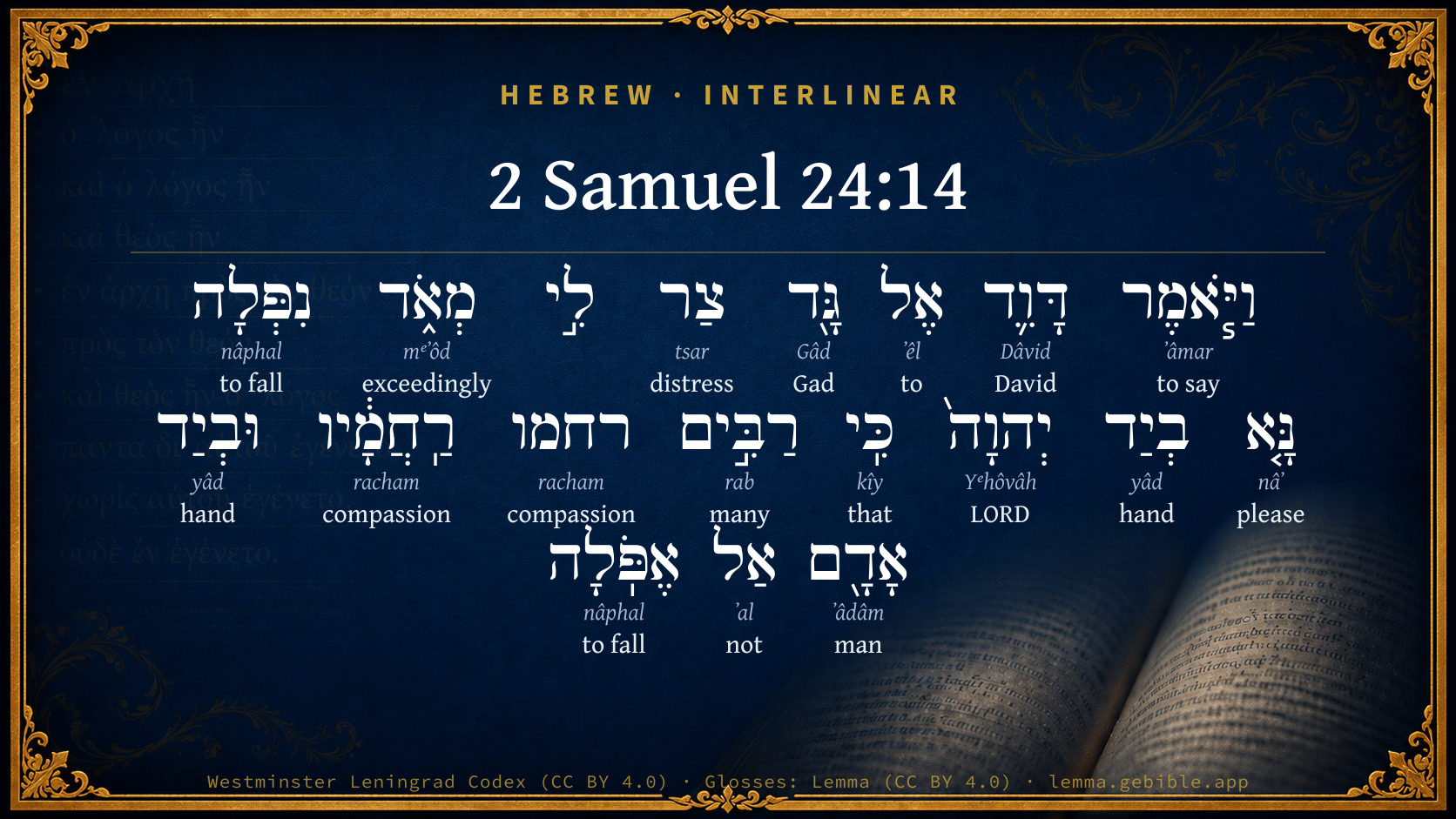
2 Samuel 24:14

Hebrew (Westminster Leningrad Codex) 2 Samuel 24:14 appears in the Hebrew Old Testament. The text above is from the Westminster Leningrad Codex. Each word links to its Strong’s number, a concise gloss, and parsing drawn from the Open Scriptures Hebrew Bible morphology. Click any word for its full Brown-Driver-Briggs (BDB) entry.
Download image
Cite this verse

2 Samuel 24:14 (World English Bible). Public Domain. Lemma interlinear Bible study tool, https://lemma.gebible.app/v/2-samuel/24/14.

Show BibTeX & RIS
BibTeX
RIS
English Translation
David said to Gad, I am in a great strait: let us fall now into the hand of Yahweh; for his mercies are great; and let me not fall into the hand of man.
World English Bible · Public Domain
Download a study sheet

One document with this verse’s original text, its word-by-word gloss line, the meaning frame, cross-references with their text, attributed commentary, and full source and license credits — printable, and it pastes into notes with its structure intact.

This verse Autodidact and up

Study sheet (.html) Plain text (.txt)

A passage Seminary Student

Up to 50 verses in one chapter. A passage sheet keeps up to 6 commentary sources and 12 cross-references per verse, in the order this page ranks them, and says so on the sheet whenever that leaves anything out. Ask for a single verse and you get the Autodidact verse sheet above.

Everything on this page stays free to read, with no account — the sheet is a download of what is already on screen, not access to it.

Want to remove ads? Support Godless Engineer
Compare translations 3

The same verse in 3 English versions, stacked beneath the original-language interlinear above. Click any original word for its lexicon entry.

Each is an independent rendering of the whole verse — the interlinear is not word-aligned to these translations.

Highlighted words mark where these versions differ — a whole-verse word diff, not a word-by-word alignment.

  • World English Bible Public Domain
    David said to Gad, I am in a great strait: let us fall now into the hand of Yahweh; for his mercies are great; and let me not fall into the hand of man.
  • King James Version Public Domain
    And David said unto Gad, I am in a great strait: let us fall now into the hand of the LORD; for his mercies are great: and let me not fall into the hand of man.
  • unfoldingWord Literal Text CC BY-SA 4.0
    And David said to Gad, “Great distress to me. Please, let us fall into the hand of Yahweh, for his mercies many, but into the hand of man, do not let me fall.”

unfoldingWord Literal Text — © unfoldingWord, licensed CC BY-SA 4.0. Word-aligned USFM3 via Door43 (git.door43.org/unfoldingWord/en_ult).

Versions to compare (up to 4)

3 of 4 selected

Show all 18 translations

Every available English version of this verse, each an independent rendering of the whole verse.

  • World English Bible Public Domain
    David said to Gad, I am in a great strait: let us fall now into the hand of Yahweh; for his mercies are great; and let me not fall into the hand of man.
  • Berean Standard Bible Public Domain
    David answered Gad, “I am deeply distressed. Please, let us fall into the hand of the LORD, for His mercies are great; but do not let me fall into the hands of men.”
  • Majority Standard Bible Public Domain
    David answered Gad, “I am deeply distressed. Please, let us fall into the hand of the LORD, for His mercies are great; but do not let me fall into the hands of men.”
  • King James Version Public Domain
    And David said unto Gad, I am in a great strait: let us fall now into the hand of the LORD; for his mercies are great: and let me not fall into the hand of man.
  • American Standard Version (1901) Public Domain
    And David said unto Gad, I am in a great strait: let us fall now into the hand of Jehovah; for his mercies are great; and let me not fall into the hand of man.
  • Revised Version (1885) Public Domain
    And David said unto Gad, I am in a great strait: let us fall now into the hand of the LORD; for his mercies are great: and let me not fall into the hand of man.
  • Geneva Bible (1599) Public Domain
    And Dauid said vnto Gad, I am in a wonderfull strait: let vs fall nowe into the hand of the Lord, (for his mercies are great) and let mee not fall into the hand of man.
  • Douay-Rheims (1899) Public Domain
    And David said to Gad: I am in a great strait: but it is better that I should fall into the hands of the Lord (for his mercies are many) than into the hands of men.
  • Young's Literal Translation Public Domain
    And David saith unto Gad, `I have great distress, let us fall, I pray thee, into the hand of Jehovah, for many `are' His mercies, and into the hand of man let me not fall.'
  • Literal Standard Version CC BY-SA 4.0
    And David says to Gad, “I have great distress; please let us fall into the hand of YHWH, for His mercies [are] many, but do not let me fall into the hand of man.”
  • Unlocked Literal Bible CC BY-SA 4.0
    Then David said to Gad, “I am in deep trouble. Let us fall into Yahweh's hands rather than into the hand of man, for his merciful actions are very great.”
  • unfoldingWord Literal Text CC BY-SA 4.0
    And David said to Gad, “Great distress to me. Please, let us fall into the hand of Yahweh, for his mercies many, but into the hand of man, do not let me fall.”
  • Darby Bible Public Domain
    And David said to Gad, I am in a great strait: let us fall, I pray thee, into the hand of Jehovah; for his mercies are great; but let me not fall into the hand of man.
  • World Messianic Bible Public Domain
    David said to Gad, “I am in distress. Let us fall now into the LORD’s hand, for his mercies are great. Let me not fall into man’s hand.”
  • Webster's Bible Public Domain
    And David said to Gad, I am in a great strait: let us fall now into the hand of the LORD; for his mercies are great: and let me not fall into the hand of man.
  • Free Bible Version CC BY-SA 4.0
    David replied to Gad, “This is an awful situation for me! Please, let the Lord decide my punishment, for he is merciful. Don't let me be punished by people.”
  • Bible in Basic English Public Domain
    And David said to Gad, This is a hard decision for me to make: let us come into the hands of the Lord, for great are his mercies: let me not come into the hands of men.
  • JPS Tanakh (1917) Public Domain
    And David said unto Gad: 'I am in a great strait; let us fall now into the hand of the LORD; for His mercies are great; and let me not fall into the hand of man.'

Literal Standard Version (2020), Covenant Press — licensed CC BY-SA 4.0. Text via the HelloAO Bible API (eBible.org). Unlocked Literal Bible (unfoldingWord) — licensed CC BY-SA 4.0. Text via the HelloAO Bible API (eBible.org). unfoldingWord Literal Text — © unfoldingWord, licensed CC BY-SA 4.0. Word-aligned USFM3 via Door43 (git.door43.org/unfoldingWord/en_ult). Free Bible Version, Dr. Jonathan Gallagher — licensed CC BY-SA 4.0. Text via the HelloAO Bible API (eBible.org).

Word by word

More ways to search: Search by grammar → Find every occurrence → Compare this word →

Practice this passage: Drill this verse → Learn its vocabulary →

רחמו
racham
H7356
“compassion · his”
Noun, Common, Masculine, Singular, Construct + Suffix, Personal, 3rd Person, Masculine, Singular
Part of Speech
Noun
Type
Common
Gender
Masculine
Number
Singular
State
Construct
Full BDB Definition

Origin: from H7355

TWOT: 2146a

womb (noun masculine) - compassion (noun masculine absolute plural intensive)
  1. וַיֹּ֧אמֶר ʼâmar H559 “and · to say” Conjunction + Verb, Qal, Sequential Imperfect, 3rd Person, Masculine, Singular
  2. דָּוִ֛ד Dâvid H1732 “David” Noun, Proper
  3. אֶל ʼêl H413 “to” Preposition
  4. גָּ֖ד Gâd H1410 “Gad” Noun, Proper
  5. צַר tsar H6862 “distress” Verb, Qal, Perfect, 3rd Person, Masculine, Singular
  6. מְאֹ֑ד mᵉʼôd H3966 “exceedingly” Adverb
  7. נִפְּלָה nâphal H5307 “to fall” Verb, Qal, Cohortative, 1st Person, Common, Plural
  8. נָּ֤א nâʼ H4994 “please” Particle, Interjection
  9. בְיַד yâd H3027 “in/at · hand of” Preposition + Noun, Common, Both, Singular, Construct
  10. יְהוָה֙ Yᵉhôvâh H3068 “LORD” Noun, Proper
  11. כִּֽי kîy H3588 “that” Conjunction
  12. רַבִּ֣ים rab H7227 “many” Adjective, Adjective, Masculine, Plural, Absolute
  13. רַֽחֲמָ֔יו racham H7356 “compassion · his” Noun, Common, Masculine, Plural, Construct + Suffix, Personal, 3rd Person, Masculine, Singular
  14. וּבְיַד yâd H3027 “and · in/at · hand of” Conjunction + Preposition + Noun, Common, Both, Singular, Construct
  15. אָדָ֖ם ʼâdâm H120 “man” Noun, Common, Masculine, Singular, Absolute
  16. אַל ʼal H408 “not” Particle, Negative
  17. אֶפֹּֽלָה nâphal H5307 “to fall” Verb, Qal, Cohortative, 1st Person, Common, Singular

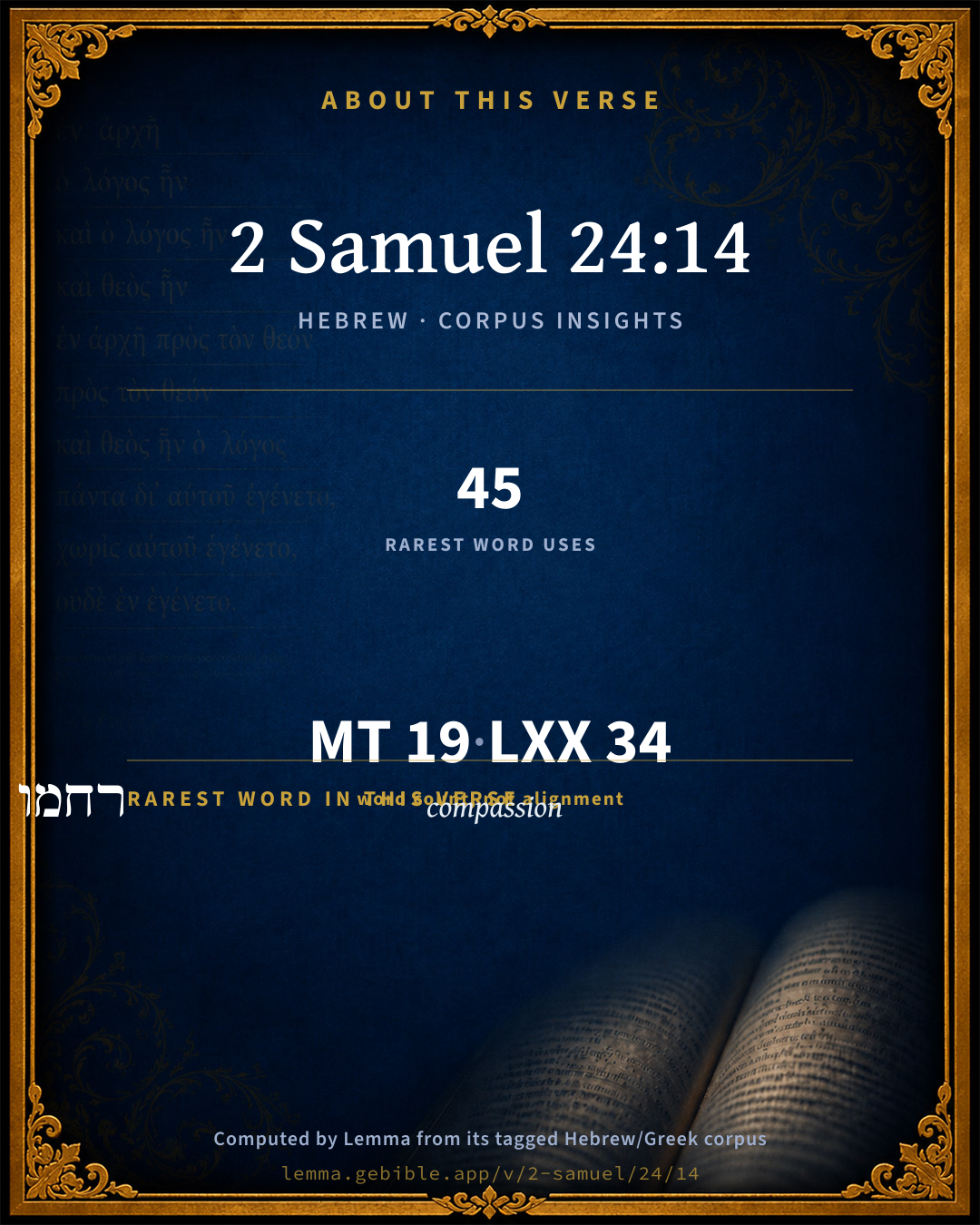
About this verse

These counts appear in no published source. They are computed here, from the morphology-tagged text and Lemma’s own curated glosses. What Lemma adds →

19
words
15
distinct lemmas
Historical
section

Shared distinctive vocabulary

רחמו compassion H7356 occurs in 44 verses of the Hebrew Bible. Also found in:

Grammatical profile

  • 4 verbs
  • 8 nouns
  • 1 adjective
  • 2 prepositions
  • 1 conjunction
  • 1 adverb
  • 2 particles

Verb forms

  • וַיֹּ֧אמֶר Qal · Sequential Imperfect
  • צַר Qal · Perfect
  • נִפְּלָה Qal · Cohortative
  • אֶפֹּֽלָה Qal · Cohortative

Repetition

Words recur within this verse — often emphatic in Hebrew:

  • נִפְּלָה to fall H5307 ×2
  • בְיַד hand H3027 ×2
  • רחמו compassion H7356 ×2

Hebrew & Septuagint length

In English translation the verse runs 34 words from the Hebrew and 38 from the Septuagint (LXX English) — closely comparable.

A rough comparison of the two English renderings, which tokenize alike — not a word-level alignment.

Word counts can differ between the Hebrew and the Greek without any difference in meaning — e.g. the Hebrew direct-object marker אֵת has no separate Greek word, and Greek often adds the article ὁ.

In the original languages it is 19 Hebrew tokens and 34 Greek tokens — but the two are counted differently (Hebrew bundles its prefixes and suffixes into one token; the Greek is in lemma form), so that isn’t a like-for-like length.

Cross-references

22

Topical passages linked to 2 Samuel 24:14 in the Treasury of Scripture Knowledge — connected by theme and wording, ordered by reader-vote popularity; previews shown in the World English Bible.

  • Psalms 119:156 Great are your tender mercies, Yahweh. Revive me according to your ordinances.
  • Psalms 51:1 Have mercy on me, God, according to your loving kindness. According to the multitude of your tender mercies, blot out my transgressions.
  • 1 Chronicles 21:13 David said to Gad, I am in a great strait: let me fall, I pray, into the hand of Yahweh; for very great are his mercies: and let me not fall into the hand of man.
  • Jonah 4:2 He prayed to Yahweh, and said, "Please, Yahweh, wasn't this what I said when I was still in my own country? Therefore I hurried to flee to Tarshish, for I knew that you are a gracious God, and merciful, slow to anger, and abundant in loving kindness, and you repent of the evil.
  • Psalms 86:15 But you, Lord, are a merciful and gracious God, Slow to anger, and abundant in loving kindness and truth.
  • Psalms 103:8–14 Yahweh is merciful and gracious, Slow to anger, and abundant in loving kindness.
  • Psalms 106:41–42 He gave them into the hand of the nations. Those who hated them ruled over them.
  • Psalms 130:4 But there is forgiveness with you, Therefore you are feared.
  • Psalms 145:9 Yahweh is good to all. His tender mercies are over all his works.
  • Isaiah 55:7 let the wicked forsake his way, and the unrighteous man his thoughts; and let him return to Yahweh, and he will have mercy on him; and to our God, for he will abundantly pardon.
  • Exodus 34:6–7 Yahweh passed by before him, and proclaimed, "Yahweh! Yahweh, a merciful and gracious God, slow to anger, and abundant in loving kindness and truth,
  • 1 Samuel 13:6 When the men of Israel saw that they were in a strait (for the people were distressed), then the people did hide themselves in caves, and in thickets, and in rocks, and in coverts, and in pits.
  • 2 Kings 6:15 When the servant of the man of God was risen early, and gone forth, behold, a host with horses and chariots was round about the city. His servant said to him, Alas, my master! how shall we do?
  • 2 Kings 13:3–7 The anger of Yahweh was kindled against Israel, and he delivered them into the hand of Hazael king of Syria, and into the hand of Benhadad the son of Hazael, continually.
  • 2 Chronicles 28:5–9 Therefore Yahweh his God delivered him into the hand of the king of Syria; and they struck him, and carried away of his a great multitude of captives, and brought them to Damascus. He was also delivered into the hand of the king of Israel, who struck him with a great slaughter.
  • Psalms 86:5 For you, Lord, are good, and ready to forgive; Abundant in loving kindness to all those who call on you.
  • Proverbs 12:10 A righteous man regards the life of his animal, But the tender mercies of the wicked are cruel.
  • Isaiah 47:6 I was angry with my people, I profaned my inheritance, and gave them into your hand: you did show them no mercy; on the aged have you very heavily laid your yoke.
  • Micah 7:18 Who is a God like you, who pardons iniquity, And passes over the disobedience of the remnant of his heritage? He doesn't retain his anger forever, Because he delights in loving kindness.
  • Zechariah 1:15 I am very angry with the nations that are at ease; for I was but a little displeased, but they added to the calamity."
  • John 12:27 "Now my soul is troubled. What shall I say? 'Father, save me from this time?' But for this cause I came to this time.
  • Philippians 1:23 But I am in a dilemma between the two, having the desire to depart and be with Christ, which is far better.

Cross-references courtesy of OpenBible.info (CC BY 4.0).

Hebrew and Greek witnesses Masoretic Hebrew ↔ Greek Septuagint

The same verse in the two great witnesses to the Old Testament, shown verse-for-verse.

These are two independent witnesses, not word-aligned to each other, and the Septuagint is shown in lemma (dictionary) form.

Hebrew 2 Samuel 24:14 Masoretic · Westminster Leningrad Codex

וַיֹּ֧אמֶר דָּוִ֛ד אֶל גָּ֖ד צַר לִ֣י מְאֹ֑ד נִפְּלָה נָּ֤א בְיַד יְהוָה֙ כִּֽי רַבִּ֣ים רחמו רַֽחֲמָ֔יו וּבְיַד אָדָ֖ם אַל אֶפֹּֽלָה

David said to Gad, I am in a great strait: let us fall now into the hand of Yahweh; for his mercies are great; and let me not fall into the hand of man.

World English Bible · Public Domain

Greek LXX 2 Samuel 24:14 Septuagint · lemma form

καί εἶπον δαυίδ πρός γαδ στενός ἐγώ πάντοθεν σφόδρα εἰμί ἐνπίπτω δή ἐν χείρ κύριος ὅτι πολύς ὁ οἰκτιρμός αὐτός σφόδρα εἰς δέ χείρ ἄνθρωπος οὐ μή ἐνπίπτω καί ἐκλέγω ἑαυτοῦ δαυίδ ὁ θάνατος

And David said to Gad, On every side I am much straitened: let me fall now into the hands of the Lord, for his compassions are very many; and let me not fall into the hands of man.

LXX2012 (modern English Septuagint) · Public Domain

On this verse, The Pulpit Commentary discusses the Septuagint’s reading. Read the note in Commentary ↓

Hebrew: Westminster Leningrad Codex (CC BY 4.0). Greek: Septuagint (public domain); English from LXX2012 (modern English Septuagint) (Public Domain). How the Septuagint differs from the Hebrew →

Targum (Aramaic paraphrase)

1

The Targum is the ancient Jewish Aramaic paraphrase of the Hebrew Scriptures — an interpretive translation, not the Hebrew text itself. Onkelos (literal) and Pseudo-Jonathan (expansive) render the Torah, and Jonathan the Prophets. Coverage is partial: where no permissively-licensed English translation exists for a verse, only the Aramaic is shown. This is verse-level text, not a word-by-word alignment to the Hebrew.

  1. Targum Jonathan Prophets (Joshua–Malachi)
    וַאֲמַר דָוִד לְגָד עָקַת לִי לַחֲדָא נִתְמְסַר כְּעַן בְּיַד מֵימְרָא דַייָ אֲרֵי סַגִיאִין רַחֲמוֹהִי וּבִידָא דֶאֱנָשָׁא לָא אִתְמְסָר:

    (no public-domain English translation for this verse)

    Targum Jonathan — Aramaic: “Mikraot Gedolot” (public domain). English: “Sefaria Community Translation” (CC0 1.0 (public-domain dedication)); “London "Chaldee Paraphrase," 1871” (public domain). Text via Sefaria.

Commentary

Notes on 2 Samuel 24:14 from classic Christian and Jewish commentators (each source and its license shown beneath its notes). The classic Christian expositions comment on the surrounding passage and are grouped to its opening verse, so a note may address several verses; the Jewish commentaries on the Tanakh (Rashi and others) are per-verse, so they appear only where the commentator wrote on this verse.

Lemma curates 59 commentaries, every one of them public domain or Creative Commons licensed, each selected and text-cleaned for this edition rather than reprinted as found. About our sources →

Trapp's Complete Commentary

John Trapp

2Sa 24:14 And David said unto Gad, I am in a great strait: let us fall now into the hand of the LORD; for his mercies [are] great: and let me not fall into the hand of man.

Ver. 14. I am in a great strait.] Great sins bring great snares, as on Samson. And of the wicked Job saith, that "in the fulness of his sufficiency he is in straits."

Let us now fall into the hand of the Lord,] q.d., Let me be chastised rather by a Father, who is all heart, than by such as whose tender mercies are mere cruelties. It is indeed a fearful thing to fall into the punishing hands of the living God; {Heb 10:31} that is, when he taketh to do [with] rebels and reprobates, such as despite the Spirit of grace, and tread under foot the blood of the covenant. But hath he smitten any of his as he smote those that smote him? Or is he slain? &c. No; but "in measure" - in the branches only, not at the root - "thou wilt debate with it: he stayeth his rough wind, in the day of the east wind." {Isa 27:7-8}

John Trapp, A Commentary or Exposition upon All the Books of the Old and New Testament (1647–1656) — public domain. Text from a community e-Sword module.

The Biblical Illustrator

Joseph S. Exell

2Sa_24:14

I am in a great strait; let me fall now into the hand of the Lord.

Davids choice of a national calamity

The scene before us, while it is pregnant with interest on its own account, develops two opposite classes of principles, and furnishes a lesson both of seasonable direction and solemn warning.

I. It presents us with a sin into which David fell at the close of his life, and a judgment denounced upon him in consequence of that sin by the Almighty. He was at peace in his kingdom; he had recovered from all the troubles of his house, and his victorious sword had been lifted up above the heads of all his enemies round about. The state of his affairs, after long agitation, had subsided into a condition of peace and serenity, calling loudly for thankfulness to God for His favours. But such seasons of temporal prosperity, alas! are not favourable to the preservation of humility and good principles. Through the weakness and corruption of our nature they are apt to soften and enervate, to secularise and pollute, and thereby to render us accessible to the most perilous temptations. If the prosperity of fools destroys them, the prosperity of good men often does them incalculable injury. David, therefore, though so wise and pious, is now off his guard. His conscience, however, which had been enlightened by Divine grace, soon awoke out of the slumber into which it had fallen, and unbraided him. His heart smote him for what he had done, before he was left to prove his weakness by any outward disaster. It was well for him that his own ways reproved him, and that conscience sounded the first trumpet of alarm. This is characteristic of the regenerate. Thus Samsons heart smote him in the midst of the night for what he was doing, and he arose and carried away the gates of the city. Men who have no light of grace, no tenderness of conscience, must have their sin recalled to them by the circumstances which at once reveal its enormity and visit it with punishment; but the regenerate have an inward monitor that awaits not for these consequences to rouse its energy, but lights up the candle of the Lord within them, and will not let them rest after they have done amiss, till they have felt compunction and made confession. Their sin and their sorrow are near together. No circumstance can keep them long apart. Let us not wonder at a judgment so severe for a sin that appears to us so comparatively trifling. It is only to us that it seems trifling. We are apt to be more terrified at outward sins, and individual acts of atrocity between man and man; but sins of the heart and of the spirit committed against the majesty, and the purity, and the goodness of God, for which we feel but little conscious guilt, are surely of far greater enormity and more especially offensive to God. We are, moreover, to bring into account Davids relation to God. He was a man after His own heart; he stood high in His favour: when he was a child, God loved him and brought him into covenant with him; adopted him into His family, made him most magnificent promises, and poured His favours upon him. And does the near relation in which a man stands to God and the surpassing favours which he has received, lessen his sin? Iris rather heightened in its enormity, aggravated in its guilt, by such considerations.

II. Observe the evils which the history represents to us as proposed to the kings choice. They are three of the most dreadful that can befall a country or a nation. But yet in the permission of a choice among them, a singular test was presented of the return of Davids heart to a proper sense of dependence and submission. Each of them is a terrific scourge, but united, as they sometimes are, and naturally may be, they form a three-fold plague, whose horrors are indescribable. But the one which David chose, brought him and his people more immediately into conflict with the sovereign hand of the Almighty than either of the others would have done. Nothing could be here ascribed to second causes. Against God directly and exclusively had David sinned, and from Gods hand visibly and directly, and by sad preference, must come the punishment. If famine spread extensively among nations, affecting more countries than one at the same time, the condition of that which is its chief seat, or which, from other circumstances, is shut out from foreign aid, will soon become desperate. New and disgusting modes of supporting existence will be resorted to; the natural instincts will be overpowered; all feelings will be subdued before the cravings of hunger and the love of life. War, accompanied with defeat, is an equally dreadful calamity to a country that is the seat of it. The most diabolical passions of human nature are awakened and stimulated by war. But pestilence, in some respects, is yet a more dreadful calamity than either. It is more silent in its approach, and less horrible in its outward array; hut it is an evil preying upon the heart of a nation. It is the destruction of its soul and spirit. Other evils may be seen at a distance, and be guarded against; there valour may hope to defend, prudence to resin, flight to escape. But no place exempts from the attacks of this enemy; he gives no notice of his approach; his motion is silent and sure; he steals upon us in the dead of night, as well as in the day; triumphantly and secretly he rides upon the wings of the wind, and treacherously destroys us by the breezes which we court for refreshment, or the air which we inspire for life. We are not sensible of his presence till we feel his fangs, and are inevitably within his grasp. At one and the same moment he is heard of by us at the distance of leagues, and felt in our own bosoms. We are unconscious that the shaft has flown, or found its mark, till we feel its venom boiling through our veins.

III. But we have here The choice he made, with the reasons of it. Let us attend to the wisdom and piety that dictated it and to the merciful relief afforded him under it, in consequence of it pleasing God.

1. But we may see in this preference the most exalted patriotism. David, though a king, was too much identified with his subjects to think of saving himself at their expense. If it must be a calamity, let it be one that shall involve me with them. I and my people will survive or perish together. Noble resolution, full of magnanimity, and demanding our admiration!

2. There was penitence also in this preference. Slight thoughts of his sin, in comparison with the sins of his people, would have dictated the choice of a calamity that might have left him free, while for them there was no possibility of escape. But he was too sensible of the guilt of his preposterous pride and presumption not to choose a judgment to which himself might be as liable as any of the inhabitants of the land.

3. Nor is the piety that led to this preference less evident and operative. There was piety in consulting by it the honour and interests of religion, which in either of the other calamities would have very much suffered. And there was piety in Davids choice, from the confidence it evinced in the Divine compassion. He knew that God was provoked, but he could expect mercy from Him in that state, sooner than from man whom he had not injured at all. Conclusion:

1. In attempting some improvement, our desert of the judgments of the Almighty because of our secret sins first occurs to us. A judgment worse than war, pestilence, and famine awaits every such sinner. He stands exposed to wrath that will destroy both body and soul in hell.

2. There is a retributive Providence. The punishment of Gods people often grows out of their sin, and that so conspicuously and so instructively as to convince them of it, and induce them to deplore and renounce it. (J. Leifchild.)

Choice of David under anticipated judgments

What comparison is there between the evils that moral creatures can inflict upon us, and those which we have to fear from a God immortal and omnipotent? What comparison between those who kill the body, and after that have nothing else that they can do, and him who can cast both body and soul into hell? But if we consider the woes of the present life, if we compare the compassions of God with those of men, then we must change our language, and the penitent sinner, even at the moment when he sees heaven angry for his crimes, will exclaim, Let me fall into the hands of the Lord, for very great are His mercies, but let me not fall into the hands of men. But, you ask, did David reason justly? When we are suffering under war, or any other calamity whatever, are we not in the hands of God? Are not the different agents of the universe, men, angels, elements, equally the ministers of His justice, or of His mercy? Yes; and no one more fully or explicitly acknowledged this universality of Providence than did David. He always, without justifying the wickedness of the instruments, bowed submissively to the disposals of God in all His persecutions. But still, there is a wide difference between those afflictions which come to us directly from the hand of God, and those which come by the intervention of mere When men are the immediate authors of our sorrows, though it is always true that it is God who permits them; that it depends only upon His pleasure to arrest them; still, in the sufferings which they cause us to endure, it is they whom we first behold; it is their unkindness or enmity which first strikes us; and this view irritates the wounds of our souls, and agitates our afflicted hearts. It is often with difficulty that we elevate our eyes to the Supreme Governor of all, to acknowledge His sovereign justice in those same sufferings that are unjustly inflicted by our fellow men. Besides, the malignity of the principle whence our woes proceed, when they come from men, permits us to hope neither for bounds nor mitigation to them, because the hatred and passions which produced them still may continue. The heart then feels the present with bitterness, while it beholds no resource in the future. All these visible causes affect our senses and our mind, and hide from us more or less the invisible hand of God. What a difference when our afflictions proceed immediately from heaven! Then the believing soul sees only its God; it, adores with submission the paternal hand which chastens it. Through His just anger, it discerns His infinite goodness. Penitent sinner! how many motives are there to induce you to adopt this language, and imitate this example.

1. Let me fall into the hands of God, for He is my Owner and Proprietor; to Him I unreservedly belong.

2. Because mercy is His darling attribute: He loves to glorify it in the forgiveness of the penitent.

3. Because he reads my heart. He has be held my secret groans, and prayers, and tears.

4. Because He mingles with the strokes of His rod the consolations of grace, and chastens as a Father.

5. For the design of His chastisements is merciful; they are intended not to destroy, but to benefit.

6. From reflecting on the advantages that myself, that thousands of the redeemed, have experienced from His chastisements. Let such be your language and your feelings when penetrated by a sense of guilt. Bend to that hand which supports while it smites.

Lessons:

1. This subject, in connection with the history of which our text is a part, teaches us that sin may be pardoned, and yet punished with temporal afflictions.

2. This subject should excite in us the tenderest love to God.

3. This subject teaches us where the soul may find a refuge from the unkindness and cruelties of men. (H. Kollock, D. D.)

In the hand of God

David had learned from the history of his nation and his own personal experience the blessedness of all who put their trust in the living God. Let us notice a twofold train of thought, suggested by our text, peculiarly appropriate for the new year.

I. Why fear mingles with our greeting of the new year.

1. We are confronted by sorrowful memories of the past. Frailties, failures, sins of omission and of commission, broken vows, ideals not reached, prayer restrained--unprofitable servants; we have fallen short of the glory of God.

2. Painful consciousness of present feebleness. No reserve of strength, imperfectly equipped, hands hanging down, knees feeble, heart faint, mind weary. We cannot pierce the impenetrable veil and see what battles we may have to fig]it, what storms we may have to encounter, what burdens we may have to bear, what sufferings to endure. Our only refuge is to fall into the hands of the Lord.

II. How faith may subdue fear in our greeting of the new year.

1. Faith in the unseen God. In His

(1) Power; that is, He is able to do for us exceeding abundantly above all that we can ask or think.

(2) Wisdom--to guide as well as guard amid the vicissitudes and mysteries of our earthly pilgrimage.

(3) Faithfulness--that He will never leave nor forsake, never falsify His Word.

(4) Goodness--To supply our ever returning wants, to withhold from us no good thing and make all things work together for our good.

(5) Mercy--to bear with our ingratitude and proneness to forget and wander from Him. Such faith in God stimulated and sustained the Old Testament heroes and New Testament saints; they all endured as seeing Him, who is invisible, realising His glorious and gracious presence ever with them.

III. Faith in the unseen world. David felt that if desolation and death overtook him he would be safe if, when leaving this life, he fell into the hand of the Lord. With home in view, pilgrimage will be cheered, the heart will be calmed and comforted. With the eternal God for our refuge and the eternal arms underneath us, forward may be our fearless watchword. Into the infinite, unfailing hand of the Lord let us commit ourselves. (Homilist.)

Davids choice of the plague

War would place the nation at the mercy of its enemies; famine would make it dependent on corn merchants, who might greatly aggravate the miseries of scarcity; only in the pestilence some form of plague sudden and mysterious in its attack, and baffling the medical knowledge of the time--would the punishment come directly from God, and depend immediately upon his will. (A. F. Kirkpatrick, M. A.)

The stroke of God preferred

David prefers what was usually designated The stroke of God. Let us fall, says lie, now into the hand of the Lord; for his mercies are great; and let me not fall into the hand of man. A saying of Gordon (it was among his last) may be recalled--were not the two men in many respects moulded alike?: I have the Shekinah, and I do like trusting to Him and not to men. (J. R. Macduff, D. D.)

The greatness of Gods unfailing, mercy

A well-known minister tells us lie once visited the ruins of a noble city that had been built on a desert oasis. Mighty columns of roofless temples stood in unbroken file. Halls in which kings and satraps had feasted two thousand years ago were represented by solitary walls. Gateways of richly-carved stone led to a paradise of bats and owls. All was ruin. But past the dismantled city, brooks, which had once flowed through gorgeous flower gardens and at the foot of marble halls, still swept on in undying music and unwasted freshness. The waters were just as sweet as when queens quaffed them two thousand years ago. A few hours before they had been melted from the snows of the distant mountains. And so Gods love and mercy flow in ever-renewed, form through the wreck of the past. Past vows and past covenants and noble purposes may be represented by solitary columns and broken arches and scattered foundations that are crumbling into dust; yet through the scene of ruin fresh grace is ever flowing from His great heart on high.

The Biblical Illustrator, edited by Joseph S. Exell (c. 1880s–1900s) — public domain. Text from a community e-Sword module.

Joseph Benson's Commentary

2Sa 24:14. Let us fall now into the hand of the Lord — Let us receive punishment from his immediate stroke, that is, by famine or pestilence, but chiefly by the latter. For though the sword and the famine be also from God’s hand, yet there is also the hand of man, or other creatures, in them. The reason of this choice was partly his confidence in God’s great goodness; partly, because the other judgments, especially the sword, would have been more dishonourable, not only to David, but also to God, and his people; and partly, because he, having sinned himself, thought it just to choose a plague, to which he was as obnoxious as his people; whereas, he had better defences for himself against the sword and famine than they had. And let me not fall, &c. — True, it is a fearful thing to fall into the hands of the living God! Fearful indeed for those who have, by their impenitence, shut themselves out from his mercy. But a penitent dares cast himself into God’s hand, knowing that his mercies are great.

Joseph Benson's Commentary on the Old and New Testaments (1811–1818) — public domain. Text from a community e-Sword module.

Jamieson, Fausset & Brown

Robert Jamieson, A. R. Fausset & David Brown

David said, . . . Let us fall now into the hand of the Lord--His overwhelming sense of his sin led him to acquiesce in the punishment denounced, notwithstanding its apparent excess of severity. He proceeded on a good principle in choosing the pestilence. In pestilence he was equally exposed, as it was just and right he should be, to danger as his people, whereas, in war and famine, he possessed means of protection superior to them. Besides, he thereby showed his trust, founded on long experience, in the divine goodness.

Jamieson, Fausset & Brown — Commentary Critical and Explanatory on the Whole Bible (1871) — public domain (CC PDM 1.0). Text via the HelloAO Bible API.

Adam Clarke's Commentary

Verse 14. I am in a great strait: let us fall now into the hand of the Lord] David acted nobly in this business. Had he chosen war, his own personal safety was in no danger, because there was already an ordinance preventing him from going to battle. Had he chosen famine, his own wealth would have secured his and his own family's support. But he showed the greatness of his mind in choosing the pestilence, to the ravages of which himself and household were exposed equally with the meanest of his subjects.

Adam Clarke's Commentary on the Bible (1810–1826) — public domain. Text from a community e-Sword/MySword module.

Ellicott's Commentary for English Readers

(14) Let us fall now into the hand of the Lord. Here the spirit of David in his earlier years reappears; he chooses that form of punishment which seems to him most directly and immediately dependent upon God Himself. He places himself in His hands rather than suffer those other punishments in which the will of man seemed to have a greater share. And it may be noticed also that he chooses that form of punishment from which his own royal position would afford him no immunity.

A Bible Commentary for English Readers, edited by Charles John Ellicott (1878–1897) — public domain. Text from a community e-Sword module.

The Cambridge Bible for Schools and Colleges

gen. ed. J. J. S. Perowne

14. his mercies are great] Cp. Psa_51:1; and the reference to this passage in Sir_2:17-18 : “They that fear the Lord will prepare their hearts, and humble their souls in his sight, saying, We will fall into the hands of the Lord, and not into the hands of men: for as his majesty is, so is his mercy.”

The Sept. adds at the close of the verse: “And David chose him the pestilence (lit. death). And it was the days of wheat harvest.” War would place the nation at the mercy of its enemies: famine would make it dependent on corn-merchants, who might greatly aggravate the miseries of scarcity: only in the pestilence—some form of plague sudden and mysterious in its attack, and baffling the medical knowledge of the time—would the punishment come directly from God, and depend immediately upon His Will.

The Cambridge Bible for Schools and Colleges (gen. ed. J. J. S. Perowne; Cambridge University Press, 1878–1918) — public domain. Text from a community e-Sword module.

John Gill's Exposition

And David said unto Gad, I am in a great strait,.... Not knowing well which to choose, each of them being so grievous, and an answer being to be returned immediately; but by his next words, and by the event, it seems he chose the pestilence, though that is not expressly said:

let us fall now into the hand of the Lord; the Targum in Ch1 21:13, is"into the hand of the Word of the Lord:"

(for his mercies are great), and let me not fall into the hand of men; indeed all the three judgments mentioned are by the hand of the Lord whenever they come; but in the pestilence the hand of the Lord is more visible, it coming immediately from his hand, as especially this was to do, and did; it did not arise from second causes, a noxious air, &c. but by means of an angel of God: David chose this, because he and his people would have nothing to do with men, as in famine they must have gone into other countries for food, and in war flee before their enemies, and lie at their mercy, and either of them more disgraceful than this; and which he might the rather choose on his own account, that his people might not be able to say he sought himself and his own interest; for had he chosen famine, as his people had been lately distressed that way already, they might, besides urging that, say, that he could lay up stores for himself and family; or had he chosen war, they might observe he had fortified places to flee to, one after another, and shelter himself; but for the arrows of the pestilence he was as likely a mark as the meanest of his subjects: but what seems to have moved him chiefly to make this choice is, that it would not only be the soonest over, but that it wholly depended on the pleasure of God what use he would make of it in that time; and chiefly because he knew God was gracious and merciful, and it was upon his great mercy he cast himself and his people.

John Gill's Exposition of the Whole Bible (1746–1763) — public domain (CC PDM 1.0). Text via the HelloAO Bible API.

Haydock's Catholic Bible Commentary

Lord, and be exposed to the violence of pestilence, which attacks both rich and poor; whereas the rich can frequently escape the dangers of war, or of famine. (Calmet) --- David knew that he had sinned, and he did not wish to screen himself from suffering the temporal punishment due to sin. (Haydock) --- God punishes us equally by the hand of men, as by other means; but the king thus intimates, that he looks upon Him as an indulgent father, who is less severe than the ministers of justice. (Menochius)

George Leo Haydock (1774–1849), Haydock's Catholic Family Bible and Commentary, 1859 edition — public domain. Excludes Psalms (Douay-Rheims chapter numbering differs from Protestant) and Deuterocanonical books (Catholic canon only).

Matthew Poole's English Annotations

Into the hand of the Lord, to wit, his immediate stroke, which is chiefly in the pestilence; for though the sword and famine be also God’s hand, yet there is also the hand of man or other creatures in them. The reason of this choice was partly his experience in and confidence of God’s great goodness; partly, because the other judgments, especially the sword, had been more dishonourable, not only to David, but also to God, and to his people, and to the true religion; and partly, because he having sinned himself, thought it just and reasonable to choose such a plague to which he was as obnoxious as his people; whereas he had better fences for himself against sword and famine than they had. For his mercies are great; and therefore will not exceed measure in his strokes, as men will do.

Matthew Poole's English Annotations on the Holy Bible (1683–1685) — public domain. Text from a community e-Sword/MySword module.

Whedon's Commentary on the Bible

Daniel D. Whedon

14. Let us fall now into the hand of the Lord — Wise and noble choice, and the utterance of a “high prophetic truth which finds a response in the nobler souls of every age. Better any external calamity than those which are embittered by human violence and weakness.” — Stanley.

Daniel D. Whedon (gen. ed.), Commentary on the Old and New Testaments (1874–1909) — public domain. Text from a community e-Sword module.

The Pulpit Commentary

Let us fall now into the hand of Jehovah. David had sinned against God, and to God he humbly submitted himself. There would thus be nothing to come between the soul and God, and prevent the chastisement from having its due effect upon the heart. A famine would indeed equally come from God, but would necessitate effort and exertion on man"s part. In the pestilence he would wait patiently, nor look to anything but prayer for averting God"s judgment. In Psa_51:1 David refers to God"s mercies, in much the same way as here, as being a motive to repentance.

Ver. 14 (THE KING"S PALACE.) (1Ch_21:13)

Submission to Divine chastisement.

us now fall into the hand of Jehovah." Already David had been convinced of his sin. He had also confessed it and sought forgiveness. Nor had he done so in vain. But, as formerly, (2Sa_12:10-12) so now, the (temporal) penalties of sin must follow. Throughout he exhibited a spirit the exact reverse of that in which he had numbered. the people. Consider

I THE CHASTISEMENT OF SIN which was laid before him. I It was consequent upon his sin, and adapted to its correction. A vain glorious pride and warlike policy result (in the providence of God, sometimes by means which can be clearly seen) in the destruction of human life; not only directly by war, (Mat_26:52) but also by famine (through lack of proper cultivation of the soil, wasting consumption of its produce, etc.) and by pestilence (to which both contribute); and are rebuked and chastised thereby. (Rev_6:4-8)

1. It was a necessity, from which there was no escape. He and his people must suffer, according to the fixed and just method of the Divine procedure, for the vindication of the honour of God and the promotion of their own welfare. Herein no choice is left.

1. But it was also optional, within certain limits. (Jer_34:17) "Every example, public or private, of a sin brought face to face with its

2. suffering, presents an aspect of choice as well as of compulsion. The mere question of confession or denial, with the consequences of either, is such an alternative in the case of individual wrong doing. The adoption of this expedient rather than that, in the way of avoidance or mitigation of consequences, is an alternative" (C.J. Vaughan). Why was such a choice submitted to him? To test his character; to deepen his sense of sin, by the consideration of its terrible effects; to induce the open acknowledgment of his guilt; to perfect his submission; "to give him some encouragement under the correction, letting him know that God did not cast him cut of communion with himself, but that still his secret was with him; and in afflicting him he considered his frame, and what he could best bear" (Matthew Henry).

3. And it caused him great distress; all the greater because he was required, not merely to submit passively to chastisement, but to choose the form thereof, and thus make it, in some sense, his own. "All chastening seemeth for the present to be not joyous, but grievous," etc.. (Heb_12:11)

II THE SPIRIT OF SUBMISSION which he displayed. "Is it a choice made? or, is it a choice referred back to the offerer? Is it, "I choose pestilence"? or is it, "Let God choose"? Whatever the application, the principle stands steadfast In everything let me be in God"s hand; whether for the choice of my punishment, or for the infliction of it, he shall be my Judge; for his mercies are great greater than man"s; the more free his choice, the more direct his dealing, the better is it for the man, the better is it for the nation that must suffer." "And David chose for himself the mortality death" (LXX); "that affliction which is common to kings and to their subjects, and in which the fear was equal on all sides" (Josephus). Of famine and war, with their untold miseries, he had had experience, not of pestilence. By the former he would become dependent on men (for the sustaining or the sparing of life); by the latter, more directly on God; and whilst "the tender mercies of the wicked are cruel," his "anger endureth but a moment", (Psa_30:5) and "his mercies are great." The spirit evinced is one of:

1. Self-abasement, before the majesty of the supreme King and Judge.

2. Self-abnegation; with noble disinterestedness, setting aside all care forhis personal safety, and enduring, in common with the meanest of his subjects, the just chastisement of Heaven. His position might secure him against suffering and death by famine and "the sword of his enemies;" not by "the sword of the Lord" (1Ch_21:12)

The pestilence that walketh in darkness, And the sickness that wasteth at noonday. (Psa_91:6)

3. Self-surrender; the sacrifice of his own will to the will of God (1Sa_3:18; 2Sa_15:23-29 Ps 131)

And in his will is our tranquillity: It is the mighty ocean, whither tends Whatever it creates and nature makes. (Dante, "Par.," 3.)

"Though he slay me," etc.. (Job_13:15) "If Christ stood with a drawn sword in his hand pointed at my breast, yet would I rush into his arms" (Luther).

4. Confidence in the abounding mercy of God. For he is not like man,ignorant, inconsiderate, unjust, wilful, selfish, cruel, and malicious; but knows all things (the secrets of the heart, the force of temptation, the sincerity of penitence, the reality of love), is considerate (of human infirmities, (Isa_57:16) righteous, "merciful, and gracious," etc., (Exo_34:6) very pitiful, (Psa_103:13, Psa_103:14) mitigates affliction, (Isa_27:8) mingles with it many consolations, and "repents him of the evil". (Jon_4:4; 1Sa_15:29; ver. 16) Such trust is the spring of true submission, and it is fully justified by the event.

1. Cooperation with the merciful and holy purposes of God in relation tothe moral welfare of those whom he afflicts. The selfishness of men in famine and their cruelty in war tend to evoke rebellion, wrath, and retaliation; the recognition of "the mighty hand of God" (Jam_4:10 1Pe_5:6) tends to produce lowly obedience, tenderness, and kindness.

2. Concern for the welfare of the nation, which would suffer less by the lastthan by the first two of the calamities; and:

3. Zeal for the interests of religion and the glory of God. "Let thy Name bemagnified forever" (ch. 7:26). "When the apostle said to the Hebrews that it is a fearful thing to fall into the hands of the living God, does it not contradict the decision of David? By no means. The apostle meant to speak of those who fall without repentance into the hands of God for punishment; but, in a penitent disposition, nothing is so sweet as to fall into the loving and most gracious hands of the living God" (Du Bose). D.

God"s treatment preferred to man"s.

David had good reasons for the choice he made. He knew well, from his own treatment of defeated enemies (2Sa_12:31; 1Ch_20:3) how fearfully cruel were conquerors in war in those days, what an awful scourge to his subjects would be the ravages of a victorious invading army. He also doubtless dreaded the disgrace and permanent damage to the kingdom which would be thus wrought, and the dishonour, in the view of the heathen, which would be cast on the Name of Jehovah its God. (see Jos_7:8, Jos_7:9) Taking the words wider application, they express what will be the natural preference of good men.

I GROUNDS OF THE PREFERENCE HERE EXPRESSED.

1. The great mercy of God and the unmercifulness, or limited mercy, of men.

2. The righteousness of God and the unrighteousness of men. We can never be sure that in a particular case righteousness will guide human proceedings; we know that the Divine are always thus guided. Many men are utterly regardless of what is right where their own interests, inclinations, or passions are concerned; and even the best men are liable to fail in respect to pure and constant regard for rectitude.

3. The knowledge and wisdom of God, and the ignorance and folly of men. Much of the misconduct and untrustworthiness of men springs from ignorance and folly. When they mean well, they often do ill through not knowing the actual state of the affairs with which they are called to deal, not taking the trouble, perhaps, to ascertain it; or, when they know it, not understanding how to treat it. But the Divine knowledge and wisdom are perfect.

4. The power of God and the weakness of men. Men are often incapable of doing the good they know, and even strongly desire to do; and their weakness often causes them to do mischief while endeavouring to do good. God is Almighty to effect what his wisdom, mercy, and rectitude prompt.

5. The relation of God to good men. Their Father, their covenant God. The certainty that he will honour those that honour him, and turn all things, including his own chastisement of them, to their good, and ultimately bring them to eternal glory. The preference will be strong in proportion to the actual contrast between the men with whom we have to do and God. There are some men who are so God like that we should not be averse to falling into their hands in a considerable variety of circumstances. It would be to a limited extent like falling into the hands of God.

II CASES IN WHICH THE PREFERENCE WOULD BE EXERCISED.

1. The endurance of suffering. As in the text. It is better to suffer from disease than from human violence. The suffering will be easier to bear, more likely to profit, less likely to excite resentment and other evil passions. The infliction will be more tempered with mercy, and promote in a greater degree the ends of mercy.

2. Judgment of character and actions. To be judged by God is preferable to being judged by men. Men are often fond of passing judgment, but for the most part very incapable. They commonly judge ignorantly, or from prejudice, and therefore unjustly. They are apt to be wrong alike in their favourable and unfavourable opinions of others. When condemned by them, it is well if we can appeal with confidence to the judgment of God, which is always just.

3. Forgiveness. Men forgive reluctantly, in a limited measure, with reserves; and soon grow weary of pardoning the same offender. To pardon "seven times," much more "seventy times seven", (Mat_18:21, Mat_18:22) seems to them an impossibility. Indeed, repeated offences, as they appear incompatible with real repentance, may justify hesitation to pardon repeatedly, since the state of the offender"s heart cannot be known. But God, who knows the heart, discerns where it is true, notwithstanding frequent falls; and, pitying human weakness, forgives many times a day. And his pardons are full and complete. Add that forgiveness from men does not ensure forgiveness from God, and that having the latter we can, if need be, dispense with the former. There is then abundant reason why, in the matter of pardon, we should prefer to have to do with God rather than men.

4. Spiritual guidance and help. God has appointed that men should instruct and aid their fellow men in matters of religion and morals. But those who offer themselves as spiritual guides are fallible, and they differ widely on important points. It is then encouraging and assuring that Divine guidance and help are available. By the devout study of God"s holy Word, and earnest prayer for the Holy Spirit, whose aid is promised to those who seek, (Luk_11:13) all may obtain such heavenly wisdom and strength as shall ensure them against serious error and failure. And after listening to the conflicting statements of human teachers, and their denunciation of those who decline their counsel, a religious inquirer may in many instances wisely turn from them to God, saying, "Let me fall into the hand of the Lord rather than of man.

In conclusion:

1. It is a great comfort to sincere Christians to know that they are ever in the hand of the Lord. When they seem to be most left to the will of arbitrary, unjust, and cruel men, God is over all, controlling, overruling, sanctifying, compelling their most malignant foes to promote their real and lasting good. He will rectify and compensate for all the injustice and injury which he permits men to inflict upon them.

2. Impenitent sinners might well prefer to fall into the hands of men ratherthan of God. The limited knowledge and power of men, as well as their feeble hatred of sin, would be in their favour; at the worst, they can only "kill the body." But God abhors sin with a perfect hatred, knows fully the guilt of each sinner, and "hath power to cast into hell". (Luk_12:4, Luk_12:5) "Who knoweth the power of thine anger? G.W. (Psa_90:11)

The Pulpit Commentary (1880–1919), ed. H.D.M. Spence-Jones & Joseph S. Exell — public domain. Text from a community e-Sword module.

Rashi

Rabbi Shlomo Yitzchaki (Rashi)

I am in great anguish. The least of them is very difficult.

Let us fall into the hand of Adonoy. I.e. Pestilence and not the sword nor famine because it [famine] is also controlled by the rich who have store houses of produce. Rabbi Alexandri said, Dovid reasoned, "If I choose the sword then [the people of] Yisroel will say [about me], 'he is relying on his strength to save himself from death but others will die', and if I choose famine they will say, He is relying on his wealth [to save himself]. I will choose pestilence against which everyone is equal."

Rashi on the Tanakh — English translations: “The Judaica Press complete Tanach with Rashi, translated by A. J. Rosenberg” (CC BY 4.0); “Pentateuch with Rashi's commentary by M. Rosenbaum and A.M. Silbermann, 1929-1934” (public domain); “The Metsudah Tanach series, Lakewood, N.J” (CC BY 4.0); and “The Book of Joshua, Metsudah Publications, 1997” (CC BY 4.0). Text via Sefaria.

Lesson kit

Teaching starters — assembled from the data on this page, not authored interpretation. Every prompt links to the verse data it draws on. Edit before teaching.

2 Samuel, in the Historical, opens this verse with 19 words (15 distinct Hebrew lemmas). Its most distinctive word is racham (“compassion”). A historical commentator’s framing appears above. Read the whole chapter for the surrounding context.

Discussion questions

  1. What does “compassion” (racham) contribute to the verse as a whole?
  2. Genesis 43:14 shares the word «compassion» with this verse. How do the two illuminate each other?
  3. “to fall” occurs 2× in this one verse. What is the effect of the repetition?
  4. The translations on this page render this verse differently — a whole-verse word diff, not a word-by-word alignment. What might account for the different wordings?
  5. The verb «וַיֹּ֧אמֶר» is Qal Sequential Imperfect. How does its form color the action?
  6. Reading how Trapp's Complete Commentary and The Biblical Illustrator read this verse, where do the two commentators agree and where do they part?

Things to notice

Reading settings

Reading text

Shown beneath each verse's original-language words.

Old Testament
Old Testament edition

Read the OT as the Masoretic Hebrew (MT) or the Greek Septuagint (LXX).

English shown for the Greek Septuagint (in the Hebrew ↔ Greek comparison).

Comparing translations? Open the Compare panel on any verse page to stack up to four side by side.