
Job 33:15

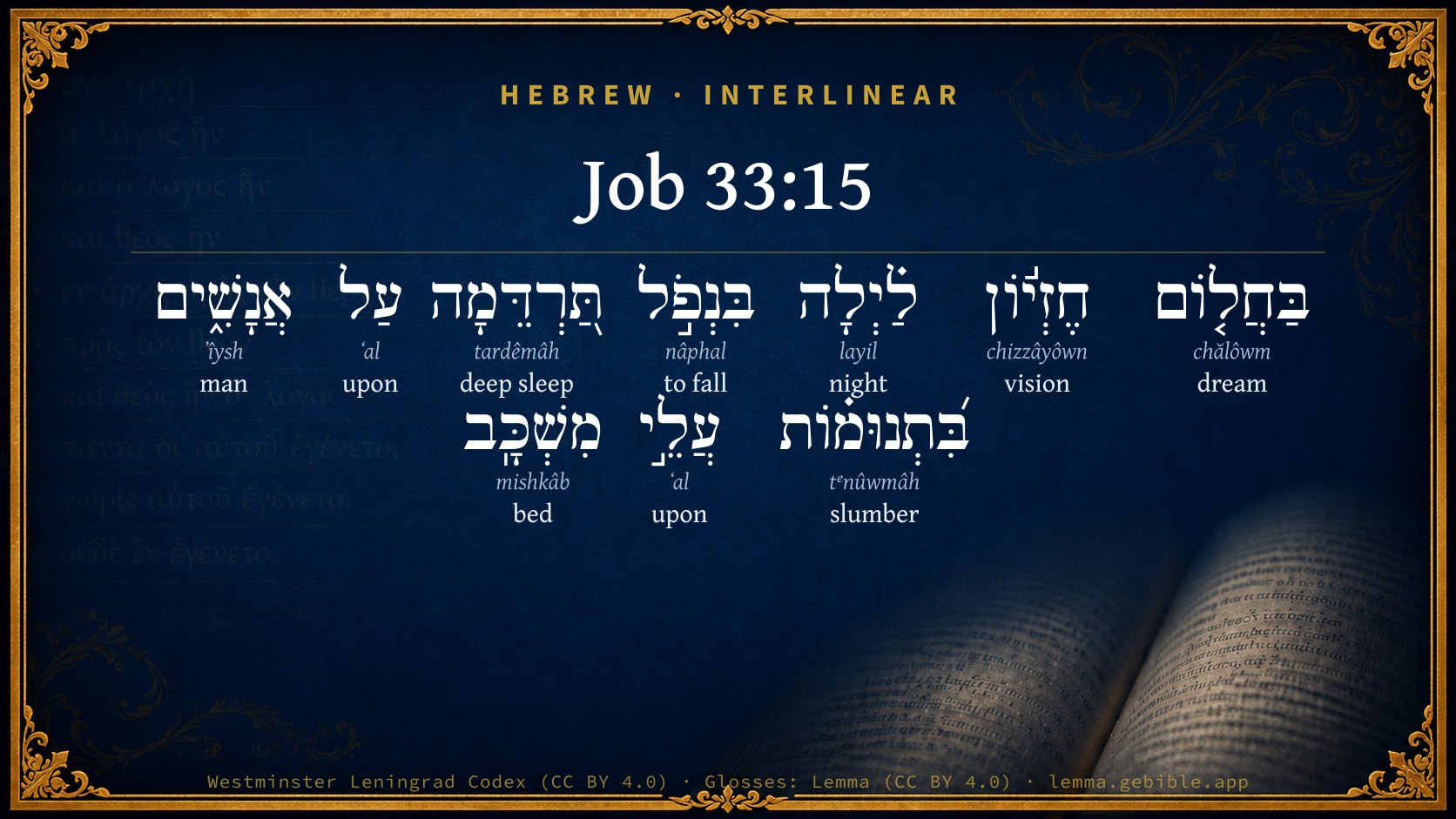
Hebrew (Westminster Leningrad Codex) Job 33:15 appears in the Hebrew Old Testament. The text above is from the Westminster Leningrad Codex. Each word links to its Strong’s number, a concise gloss, and parsing drawn from the Open Scriptures Hebrew Bible morphology. Click any word for its full Brown-Driver-Briggs (BDB) entry.
Download image
Cite this verse

Job 33:15 (World English Bible). Public Domain. Lemma interlinear Bible study tool, https://lemma.gebible.app/v/job/33/15.

Show BibTeX & RIS
BibTeX
RIS
English Translation
In a dream, in a vision of the night, When deep sleep falls on men, In slumbering on the bed;
World English Bible · Public Domain
Highlights
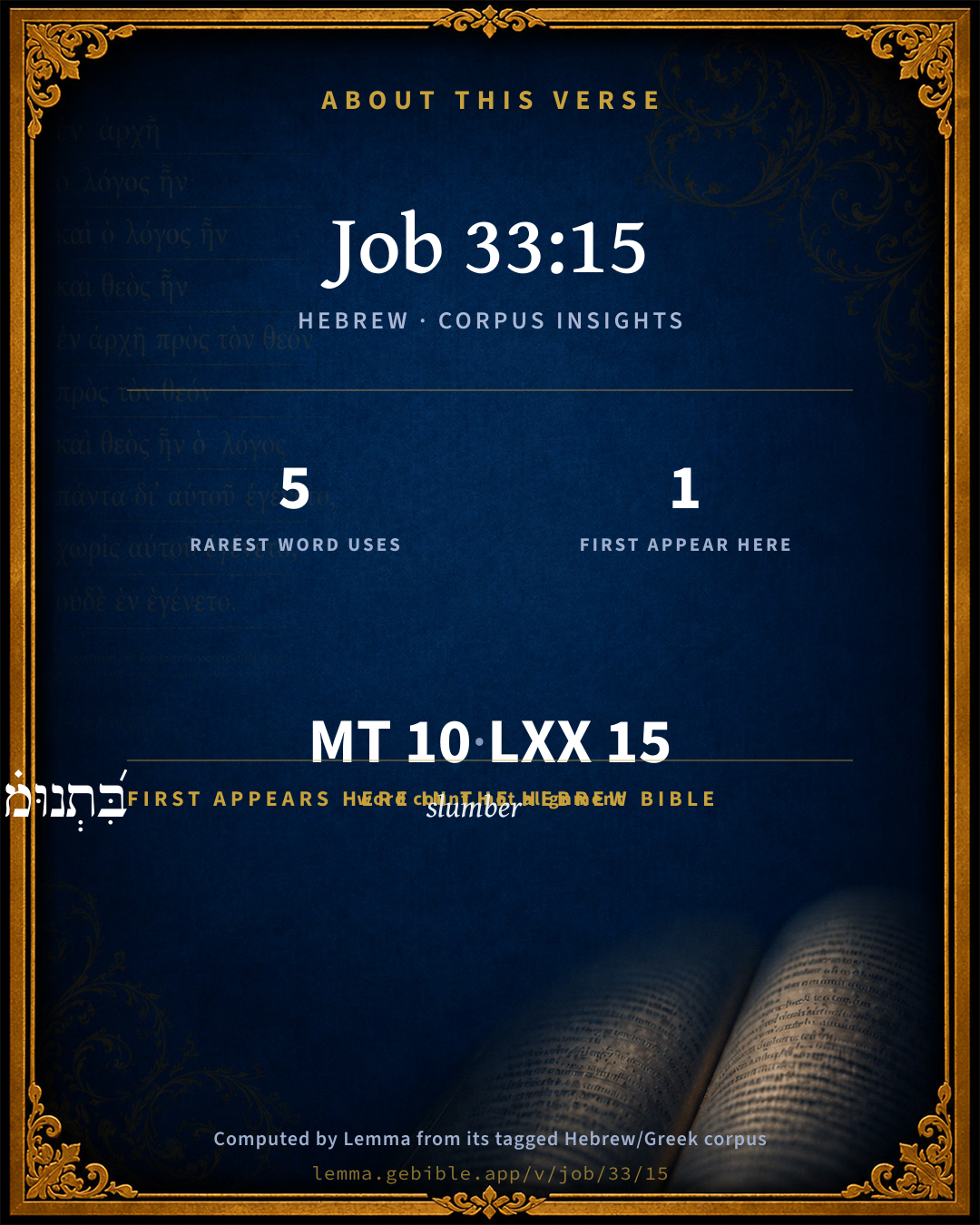
  • 1 first appearance in the Hebrew Bible
Full analysis ↓
Download a study sheet

One document with this verse’s original text, its word-by-word gloss line, the meaning frame, cross-references with their text, attributed commentary, and full source and license credits — printable, and it pastes into notes with its structure intact.

This verse Autodidact and up

Study sheet (.html) Plain text (.txt)

A passage Seminary Student

Up to 50 verses in one chapter. A passage sheet keeps up to 6 commentary sources and 12 cross-references per verse, in the order this page ranks them, and says so on the sheet whenever that leaves anything out. Ask for a single verse and you get the Autodidact verse sheet above.

Everything on this page stays free to read, with no account — the sheet is a download of what is already on screen, not access to it.

Want to remove ads? Support Godless Engineer
Compare translations 3

The same verse in 3 English versions, stacked beneath the original-language interlinear above. Click any original word for its lexicon entry.

Each is an independent rendering of the whole verse — the interlinear is not word-aligned to these translations.

Highlighted words mark where these versions differ — a whole-verse word diff, not a word-by-word alignment.

  • World English Bible Public Domain
    In a dream, in a vision of the night, When deep sleep falls on men, In slumbering on the bed;
  • King James Version Public Domain
    In a dream, in a vision of the night, when deep sleep falleth upon men, in slumberings upon the bed;
  • unfoldingWord Literal Text CC BY-SA 4.0
    In a dream, in a vision of the night, in the falling of deep sleep upon men, in slumbers upon a bed,

unfoldingWord Literal Text — © unfoldingWord, licensed CC BY-SA 4.0. Word-aligned USFM3 via Door43 (git.door43.org/unfoldingWord/en_ult).

Versions to compare (up to 4)

3 of 4 selected

Show all 18 translations

Every available English version of this verse, each an independent rendering of the whole verse.

  • World English Bible Public Domain
    In a dream, in a vision of the night, When deep sleep falls on men, In slumbering on the bed;
  • Berean Standard Bible Public Domain
    In a dream, in a vision in the night, when deep sleep falls upon men as they slumber on their beds,
  • Majority Standard Bible Public Domain
    In a dream, in a vision in the night, when deep sleep falls upon men as they slumber on their beds,
  • King James Version Public Domain
    In a dream, in a vision of the night, when deep sleep falleth upon men, in slumberings upon the bed;
  • American Standard Version (1901) Public Domain
    In a dream, in a vision of the night, When deep sleep falleth upon men, In slumberings upon the bed;
  • Revised Version (1885) Public Domain
    In a dream, in a vision of the night, when deep sleep falleth upon men, in slumberings upon the bed;
  • Geneva Bible (1599) Public Domain
    In dreames and visions of the night, when sleepe falleth vpon men, and they sleepe vpon their beds,
  • Douay-Rheims (1899) Public Domain
    By a dream in a vision by night, when deep sleep falleth upon men, and they are sleeping in their beds:
  • Young's Literal Translation Public Domain
    In a dream -- a vision of night, In the falling of deep sleep on men, In slumberings on a bed.
  • Literal Standard Version CC BY-SA 4.0
    In a dream—a vision of night, || In the falling of deep sleep on men, || In slumberings on a bed.
  • Unlocked Literal Bible CC BY-SA 4.0
    In a dream, in a vision of the night, when deep sleep falls upon men, in slumber on the bed—
  • unfoldingWord Literal Text CC BY-SA 4.0
    In a dream, in a vision of the night, in the falling of deep sleep upon men, in slumbers upon a bed,
  • Darby Bible Public Domain
    In a dream, in a vision of the night, when deep sleep falleth upon men, in slumberings upon the bed;
  • World Messianic Bible Public Domain
    In a dream, in a vision of the night, when deep sleep falls on men, in slumbering on the bed,
  • Webster's Bible Public Domain
    In a dream, in a vision of the night, when deep sleep falleth upon men, in slumberings upon the bed;
  • Free Bible Version CC BY-SA 4.0
    Through dreams and visions in the night, when people fall into deep sleep, resting on their beds,
  • Bible in Basic English Public Domain
    In a dream, in a vision of the night, when deep sleep comes on men, while they take their rest on their beds;
  • JPS Tanakh (1917) Public Domain
    In a dream, in a vision of the night, when deep sleep falleth upon men, in slumberings upon the bed;

Literal Standard Version (2020), Covenant Press — licensed CC BY-SA 4.0. Text via the HelloAO Bible API (eBible.org). Unlocked Literal Bible (unfoldingWord) — licensed CC BY-SA 4.0. Text via the HelloAO Bible API (eBible.org). unfoldingWord Literal Text — © unfoldingWord, licensed CC BY-SA 4.0. Word-aligned USFM3 via Door43 (git.door43.org/unfoldingWord/en_ult). Free Bible Version, Dr. Jonathan Gallagher — licensed CC BY-SA 4.0. Text via the HelloAO Bible API (eBible.org).

Word by word

More ways to search: Search by grammar → Find every occurrence → Compare this word →

Practice this passage: Drill this verse → Learn its vocabulary →

About this verse

These counts appear in no published source. They are computed here, from the morphology-tagged text and Lemma’s own curated glosses. What Lemma adds →

10
words
9
distinct lemmas
Wisdom
section

Notable vocabulary

The rarest word here is בִּ֝תְנוּמ֗וֹת slumber H8572 — appearing just 5 times in the whole Hebrew Bible.

First appearance in Scripture

This word makes its first canonical appearance in the Hebrew Bible here:

  • בִּ֝תְנוּמ֗וֹת slumber H8572

Shared distinctive vocabulary

בִּ֝תְנוּמ֗וֹת slumber H8572 occurs in 5 verses of the Hebrew Bible. Also found in:

Grammatical profile

  • 1 verb
  • 7 nouns
  • 2 prepositions

Verb forms

  • בִּנְפֹ֣ל Qal · Infinitive Construct

Repetition

A word recurs within this verse — often emphatic in Hebrew:

Hebrew & Septuagint length

In English translation the verse runs 20 words from the Hebrew and 25 from the Septuagint (LXX English) — closely comparable.

A rough comparison of the two English renderings, which tokenize alike — not a word-level alignment.

Word counts can differ between the Hebrew and the Greek without any difference in meaning — e.g. the Hebrew direct-object marker אֵת has no separate Greek word, and Greek often adds the article ὁ.

In the original languages it is 10 Hebrew tokens and 15 Greek tokens — but the two are counted differently (Hebrew bundles its prefixes and suffixes into one token; the Greek is in lemma form), so that isn’t a like-for-like length.

Cross-references

9

Topical passages linked to Job 33:15 in the Treasury of Scripture Knowledge — connected by theme and wording, ordered by reader-vote popularity; previews shown in the World English Bible.

  • Numbers 12:6 He said, Hear now my words: if there be a prophet among you, I Yahweh will make myself known to him in a vision, I will speak with him in a dream.
  • Job 4:13 In thoughts from the visions of the night, When deep sleep falls on men,
  • Genesis 20:3 But God came to Abimelech in a dream of the night, and said to him, "Behold, you are a dead man, because of the woman whom you have taken. For she is a man's wife."
  • Genesis 31:24 God came to Laban, the Syrian, in a dream of the night, and said to him, "Take heed to yourself that you don't speak to Jacob either good or bad."
  • Daniel 4:5 I saw a dream which made me afraid; and the thoughts on my bed and the visions of my head troubled me.
  • Jeremiah 23:28 The prophet who has a dream, let him tell a dream; and he who has my word, let him speak my word faithfully. What is the straw to the wheat? says Yahweh.
  • Daniel 8:18 Now as he was speaking with me, I fell into a deep sleep with my face toward the ground; but he touched me, and set me upright.
  • Genesis 15:12 When the sun was going down, a deep sleep fell on Abram. Now terror and great darkness fell on him.
  • Hebrews 1:1 God, having in the past spoken to the fathers through the prophets at many times and in various ways,

Cross-references courtesy of OpenBible.info (CC BY 4.0).

Hebrew and Greek witnesses Masoretic Hebrew ↔ Greek Septuagint

The same verse in the two great witnesses to the Old Testament, shown verse-for-verse.

These are two independent witnesses, not word-aligned to each other, and the Septuagint is shown in lemma (dictionary) form.

Hebrew Job 33:15 Masoretic · Westminster Leningrad Codex

בַּחֲל֤וֹם חֶזְי֬וֹן לַ֗יְלָה בִּנְפֹ֣ל תַּ֭רְדֵּמָה עַל אֲנָשִׁ֑ים בִּ֝תְנוּמ֗וֹת עֲלֵ֣י מִשְׁכָּֽב

In a dream, in a vision of the night, When deep sleep falls on men, In slumbering on the bed;

World English Bible · Public Domain

Greek LXX Job 33:15 Septuagint · lemma form

ἤ ἐν μελέτη νυκτερινός ὡς ὅταν ἐπιπίπτω δεινός φόβος ἐπί ἄνθρωπος ἐπί νύσταγμα ἐπί κοίτη

sending a dream, or in the meditation of the night; (as when a dreadful alarm happens to fall upon men, in slumberings on the bed:)

LXX2012 (modern English Septuagint) · Public Domain

On this verse, Albert Barnes' Notes on the Bible discusses the Septuagint’s reading. Read the note in Commentary ↓

Hebrew: Westminster Leningrad Codex (CC BY 4.0). Greek: Septuagint (public domain); English from LXX2012 (modern English Septuagint) (Public Domain). How the Septuagint differs from the Hebrew →

Commentary

Notes on Job 33:15 from classic Christian and Jewish commentators (each source and its license shown beneath its notes). The classic Christian expositions comment on the surrounding passage and are grouped to its opening verse, so a note may address several verses; the Jewish commentaries on the Tanakh (Rashi and others) are per-verse, so they appear only where the commentator wrote on this verse.

Lemma curates 59 commentaries, every one of them public domain or Creative Commons licensed, each selected and text-cleaned for this edition rather than reprinted as found. About our sources →

Trapp's Complete Commentary

John Trapp

Job 33:15 In a dream, in a vision of the night, when deep sleep falleth upon men, in slumberings upon the bed;

Ver. 15. In a dream, in a vision of the night] At sundry times and in various manners. God delivered his mind to men of old by dreams in the night, by visions in the day time, imprinting upon their minds what by them he would have understood, or uttered to others. This he did, especially before the law written, whereof therefore here is made no mention. See Num 12:6. Indeed with Moses, by a specialty of his favour, he spake mouth to mouth; even apparently (as a man doth to his friend), and not in dark speeches; the similitude of the Lord did he bebold, sed non absque aliquo Maiestatis eius involucro, but not without some overshadowing of his Majesty, which none can see and live, Exo 33:20, he must needs be oppressed and swallowed up of it, as the sight of the eye is dazzled with the sun, or a crystal glass broken with the fire.

When deep sleep falleth upon men, in slumberings upon the bed] When men, plunged in sleep, are neither in the number of the living nor the dead. Then many times the reasonable soul cometh into the shop of phantasy, and there doth strange works, which are vented in our dreams. And sometimes God, by an angel, or otherwise, causeth men to dream, and thereby admonisheth them with weighty matters; as he did Abimelech, Gen 20:3-7; Jacob, Gen 28:12-15; Joseph, Gen 40:5-11; the other Joseph, Mat 1:20-24; the wise men, Mat 2:12; Pilate’s wife, Mat 27:19, which, though some think it came from the devil, to hinder man’s redemption, yet others think it came from God, for the clearing of Christ’s innocence, and, as Theophylaet holdeth, for the salvation of this woman’s soul. ’Eπεχω. Of the several sorts of dreams, natural, divine, and diabolical. {See Trapp on "Gen 20:3"}

John Trapp, A Commentary or Exposition upon All the Books of the Old and New Testament (1647–1656) — public domain. Text from a community e-Sword module.

The Biblical Illustrator

Joseph S. Exell

Job_33:15-18

In a dream.

A hard case

How persevering is Divine love. God has voices which He uses in such a way that men must and shall hear.

I. So, then, first, let us begin with what is a very humbling consideration, namely, that man is very hard to influence for good. Can the Ethiopian change his skin, or the leopard his spots? According to the text, before God Himself can save men, He has to open their ears: Then He openeth the ears of men. Towards God, mens ears are often stopped. Original sin engenders in men great carelessness about Divine things. How quickly they are aroused by talk about politics! Their ears are stopped by carelessness. Often, too, there is another form of stopping, which is very hard to get out of the ear; that is, worldliness. I am too busy to attend to religion! In some cases the ear is stopped by prejudice. It would be a foolish thing for a man to prejudice himself into rags and beggary; but it is far worse when a man prejudices himself out of life eternal into everlasting woe. With a great many more the ear seems to be doubly sealed up by unbelief. They will not believe that which God Himself has spoken. It may also be stopped by self-sufficiency; when a man has enough in himself to satisfy him, he wants nothing of Christ. Then there is another difficulty. If we get through the ear, and the man is influenced to listen, his heart does not retain that which is good, he so soon forgets it. Hence the text says of the Lord, He openeth the ears of men, and sealeth their instruction. Ah! we think the child, the man, the woman, has learned that truth at last; but it is much as if we had written it on a blackboard, it is soon wiped out. How shall men be saved? We cannot impress them; or, if we do impress them, how often it ends in nothing! Another difficulty must be noticed: that is, the purpose of so many men; indeed, the secret purpose of all men; and from this purpose men have to be withdrawn. The purpose of most men is to seek after happiness, and their notion is that they will find it by having their own way. Ay, and there is one thing more which is, perhaps, the greatest barrier of all. It is not merely their deafness of ear, and their unretentiveness of spirit, and their resoluteness of purpose; but it is their pride of heart. Oh, this is like adamant; where shall we find the diamond that can cut a thing so hard as mans pride? God save us from that sin! It needs God to do so, for only He can hide pride from man.

II. Now, secondly, though man is hard to influence, God knows how to come at him, and He does it in many ways. According to the text, He sometimes does it in a dream, in a vision of the night, when deep sleep falleth upon men in slumberings upon the bed. I have no doubt that many, many times, mens sleeping thoughts have been the beginnings of better things for them. You see, reason holds the helm of the vessel when we are awake, and as a consequence it keeps conscience down in the hold, and will not let him speak; but in our dreams, reason has quitted the helm, and then, sometimes, conscience comes up, and in his own wild way he begins to sound such an alarm that the man starts up in the night. Did you ever notice how God aroused Nebuchadnezzar, that greatest man, perhaps, of his age? Why, in a dream! God gets at other men in a different way, namely, by affliction, or by the death of others. So have I known men aroused by strange providences. If God does not come at men by strange providences, how often He does it by singular words from the preacher! Then God has a way of coming to mens hearts by personal visitations, without dream, without speech, without voice.

III. When God does get at men He accomplishes great purposes. His purpose is, first, to withdraw man from his own purpose. That He may withdraw man from his purpose. Sometimes a man has proposed at a certain moment to commit a sin, and God stops him from doing it. He also withdraws men from their general purpose of continuing in sin. I find the translation may be, that God withdraweth man from his work, from that which has been his life work; from the whole run and tenor of his conversation, God withdraws him. A man goes out after having received the Word of the Lord, and he is a different man from that hour. Then what else does God do? He hides pride from man. That is a very strange expression, certainly, to hide pride from man. Did none of you ever hide away a knife from a child? Have you never hidden away fruit from your little children when they have had enough, and they would have eaten more if they could find it? God often hides pride from men because, if man can find anything to be proud of, he will be. Then lastly, He thus secures mans salvation from destruction. He keepeth back his soul from the pit, and his life from perishing by the sword. How wonderfully has God kept some of us back from what would have been our destruction if we had gone on! (C. H. Spurgeon.)

Dreams-their philosophy and use

All dream, and each knows what a dream is better than he can be told.

I. Their philosophy.

1. What originates a dream? Probably it has more causes than one, and different kinds of dreams have different causes. The cause of some may be found in the state of body at the time. The cause of others may be found in something that has made more than ordinary impression on the mind. A dream, says the wise man, cometh from a multitude of business.

2. Why do thoughts take such grotesque forms in dreams? The reason may be this,--the mind in sleep is left uncontrolled by the will. If the thought is of an unnatural kind, it will go on producing the unnatural and the monstrous. In dreams the mind is like a vessel without a rudder. The laws of association heave her about in all directions.

II. Their uses.

1. They serve to throw some light on our spiritual constitution.

(1) They show the souls power for involuntary action; action in which the will is not concerned. There are two kinds of involuntary action. In obvious peril, we involuntarily seek safety. In the presence of axiomatical truths we involuntarily believe; in the view of the truly beautiful, we involuntarily admire and love. There is an involuntary action that is wrong. It arises from a thorough infirmity of the will, through the indulgence of the passions, and long habits of sin.

(2) The souls power for vivid realisation. In dreams the spirit sees the objects with all the vividness of reality. When awake, we see outward objects through our sensations; but the objects which come to us in dreams we see directly face to face.

(3) The souls power of rapid movement.

(4) The souls power of uncorporeal action.

(5) The souls power of moral character.

2. They are sometimes the organs of Divine communication. The subject teaches that we are fearfully and wonderfully made. (Homilist.)

The Biblical Illustrator, edited by Joseph S. Exell (c. 1880s–1900s) — public domain. Text from a community e-Sword module.

Joseph Benson's Commentary

Job 33:15. In a dream, in a vision, or, in a vision of the night — This he mentions as one usual way of God’s revealing his mind and will to men in those days, before God’s word was committed to writing; (Gen 20:6; Gen 41:1; Gen 41:28;) when deep sleep falleth upon men — When men’s outward senses are bound up, and their minds are free from all distracting cares and business of the world, and wholly at leisure to receive divine impressions; in slumberings upon the bed — This is added because, in this case, man is like one that slumbereth, or is between sleeping and waking, or uncertain in which state he is, as Paul, when he was in his ecstasy, could not tell whether he was in the body or out of the body.

Joseph Benson's Commentary on the Old and New Testaments (1811–1818) — public domain. Text from a community e-Sword module.

Tyndale Open Study Notes

Tyndale Open Resources

33:15 He speaks in dreams: See, e.g., Gen 15:12; 20:3; 31:24; 40:1–41:36; Dan 2:1-45; Joel 2:28; Acts 16:9-10.

Tyndale Open Study Notes — © Tyndale Open Resources, licensed CC BY-SA 4.0. Text via the HelloAO Bible API.

Geneva Bible (1599)

Geneva Bible translators

God saith he, speaketh commonly, either by visions to teach us the cause of his judgments, or else by afflictions, or by his messenger.

Geneva Bible (1599) marginal notes — public domain. Text via Bolls.life.

Jamieson, Fausset & Brown

Robert Jamieson, A. R. Fausset & David Brown

slumberings--light is opposed to "deep sleep." Elihu has in view Eliphaz (Job 4:13), and also Job himself (Job 7:14). "Dreams" in sleep, and "visions" of actual apparitions, were among the ways whereby God then spake to man (Gen 20:3).

Jamieson, Fausset & Brown — Commentary Critical and Explanatory on the Whole Bible (1871) — public domain (CC PDM 1.0). Text via the HelloAO Bible API.

Adam Clarke's Commentary

Verse 15.

I. In a DREAM - when deep sleep falleth upon men] Many, by such means, have had the most salutary warnings; and to decry all such, because there are many vain dreams, would be nearly as much wisdom as to deny the Bible, because there are many foolish books, the authors of which supposed they were under a Divine influence while composing them.

II. In a VISION of the night-in slumberings upon the bed] Visions or images presented in the imagination during slumber, when men are betwixt sleeping and waking, or when, awake and in bed, they are wrapt up in deep contemplation, the darkness of the night having shut out all objects from their sight, so that the mind is not diverted by images of earthly things impressed on the senses. Many warnings in this way have come from God; and the impression they made, and the good effect they produced, were the proofs of their Divine origin. To deny this would be to call into doubt the testimony of the best, wisest, and holiest men in all ages of the Church. Of one of these visions we have a remarkable account in this book, Job 4:12-21. And this vision seems to have taken place in the night season, when Eliphaz awoke from a deep sleep. There is this difference between the accidents of the dream and the vision: the former takes place when deep sleep falleth upon men; the latter, in the night, in or after slumberings upon the bed.

Adam Clarke's Commentary on the Bible (1810–1826) — public domain. Text from a community e-Sword/MySword module.

The Cambridge Bible for Schools and Colleges

gen. ed. J. J. S. Perowne

15. The language recalls the vision of Eliphaz, ch. Job_4:13 seq.

The Cambridge Bible for Schools and Colleges (gen. ed. J. J. S. Perowne; Cambridge University Press, 1878–1918) — public domain. Text from a community e-Sword module.

John Gill's Exposition

In a dream, in a vision of the night,.... That is, God speaks to men in this way, and which in those times was his most usual way; see Job 4:12; sometimes he spake to a prophet, a person in public office, and made known his mind and will in this manner to him, that he might deliver it to others, Num 12:6; and sometimes directly and immediately to persons themselves, as he did to Abimelech and Laban, Gen 20:3;

when deep sleep lieth upon men, in slumberings upon the bed; the former denotes a fast, heavy, and sound sleep, when the senses are all locked up, and there is not the least attention to any outward object; the latter a slight sleep, when a man is between sleeping and waking; and now at such a time, when he was laid on his bed in the night season, it was usual for God to come to him in a visionary way, and impress things on his mind; when it was called off front worldly and earthly thoughts and cares, and was calm and serene, and so fit to receive what intimations and instructions might be given this way; see Psa 4:4. Job had his dreams and night visions, though he seems not to have had any benefit by them, or to have understood them, but was scared and terrified with them, Job 7:14; to which Elihu may have some respect.

John Gill's Exposition of the Whole Bible (1746–1763) — public domain (CC PDM 1.0). Text via the HelloAO Bible API.

Albert Barnes' Notes on the Bible

In a dream - This was one of the methods by which the will of God was made known in the early periods of the world; see the notes at Job 4:12-17. And for a fuller account of this method of communicating the divine will, see the introduction to Isaiah, Section 7 (2).

In a vision of the night - Notes, Job 4:13; compare the introduction to Isaiah, Section 7 (4).

When deep sleep falleth upon men - This may be designed to intimate more distinctly that it was from God. It was not the effect of disturbed and broken rest; not such fancies as come into the mind between sleeping and waking, but the visitations of the divine Spirit in the profoundest repose of the night. The word rendered “deep sleep” (תרדמה tardêmâh) is one that denotes the most profound repose. It is not merely sleep, but it is sleep of the soundest kind - that kind when we do not usually dream; see the notes at Job 4:13. The Chaldee has here rendered it correctly, עמקתא שינתא - sleep that is deep. The Septuagint renders it, δεινὸς φόβος deinos phobos - dread horror. The Syriac renders this verse, “Not by the lips does he teach; by dreams and visions of the night,” etc.

In slumberings upon the bed - The word rendered “slumberings” (בתנומה bitenûmâh) means a light sleep, as contradistinguished from very profound repose. Our word slumber conveys the exact idea. The meaning of the whole is, that God speaks to people when their senses are locked in repose - alike in the profound sleep when they do not ordinarily dream, and in the gentle and light slumbers when the sleep is easily broken. In what way, however, they were to distinguish such communications from ordinary dreams, we have no information. It is scarcely necessary to remark that what is here and elsewhere said in the Scriptures about dreams, is no warrant for putting any confidence in them now as if they were revelations from heaven.

Albert Barnes' Notes on the Bible (1834–1885) — public domain. Text from a community e-Sword/MySword module.

Haydock's Catholic Bible Commentary

Beds. It seems prophetic dreams were not then uncommon.

George Leo Haydock (1774–1849), Haydock's Catholic Family Bible and Commentary, 1859 edition — public domain. Excludes Psalms (Douay-Rheims chapter numbering differs from Protestant) and Deuterocanonical books (Catholic canon only).

Matthew Poole's English Annotations

In a dream: this he mentions, as the usual way of God’s revealing his mind and will to men in those days, before God’s word was committed to writing, as Gen 20:6; 41:1,28.

In a vision of the night: this is added by way of explication and limitation, to show that he speaks not of every dream, but of those Divine dreams in which God was pleased to vouchsafe some vision or representation of his will to the mind of a man.

When deep sleep falleth upon men; when men’s senses are bound up, and their minds free from all distracting cares and business of the world, and wholly at leisure to receive Divine impressions.

In slumberings: this is added, because in this case the man is like one that slumbereth, or between sleeping and waking, or uncertain in which state he is, as Paul could not tell whether he was in the body, or out of the body, when he was in his ecstasy, 2Co 12:1,2.

Matthew Poole's English Annotations on the Holy Bible (1683–1685) — public domain. Text from a community e-Sword/MySword module.

Whedon's Commentary on the Bible

Daniel D. Whedon

15. In a vision of the night — See note only, Job_33:13-15. The vision supposed to have been seen by Colonel Gardiner, and ending in his conversion, is a case in point; also, the cases of Schubert, Newton, etc. The taking up and adopting of the dream of Eliphaz not only compliments “the old gentleman,” as Scott calls him, but shrewdly reproves Job for not having given it more attention.

Daniel D. Whedon (gen. ed.), Commentary on the Old and New Testaments (1874–1909) — public domain. Text from a community e-Sword module.

The Pulpit Commentary

In a dream, in a vision of the sight. So God spoke to Abimelech, (Gen_20:3-7) to Jacob, (Gen_31:11) to Laban, (Gen_31:24) to Joseph, (Gen_38:5, Gen_38:9) to the Pharaoh whom Joseph served, (Gen_41:1-7) to Solomon, (1Ki_3:5) to Daniel, (Dan_2:19) to Nebuchadnezzar, (Dan_2:28 Dan_4:5-18) and to many others. Sometimes men recognized such visions as Divine communications; but sometimes, probably quite as often, they regarded them as mere dreams, fancies, fantasies, unworthy of any attention. Elihu seems to hold that Divine visions came only when deep sleep falleth upon men; and similarly Eliphaz, in Job_4:13. This method of revelation seems to belong especially to the more primitive times, and the earlier stages of God"s dealings with men. In the New Testament dreams scarcely form any part of the economy of grace. In slumberings upon the bed. A pleonastic addition, which must not be regarded as diminishing from the force of the precedent clause.

The Pulpit Commentary (1880–1919), ed. H.D.M. Spence-Jones & Joseph S. Exell — public domain. Text from a community e-Sword module.

Lesson kit

Teaching starters — assembled from the data on this page, not authored interpretation. Every prompt links to the verse data it draws on. Edit before teaching.

Job, in the Wisdom, opens this verse with 10 words (9 distinct Hebrew lemmas). Its most distinctive word is tᵉnûwmâh (“slumber”). A historical commentator’s framing appears above. Read the whole chapter for the surrounding context.

Discussion questions

  1. The word tᵉnûwmâh carries the sense “slumber.” How does it shape the verse?
  2. This is the first place “slumber” appears in Scripture (first appears here). What does its debut here establish?
  3. How does Psalms 132:4, which shares the word «slumber», read alongside this verse?
  4. What does the repetition of “upon” (2× in this one verse) do in this verse?
  5. These translations render this verse differently. What is at stake in choosing one wording over another?
  6. «בִּנְפֹ֣ל» is a Qal Infinitive Construct verb. How does that grammatical form shape the action described?
  7. Compare how Trapp's Complete Commentary and The Biblical Illustrator read this verse. Where do they agree or differ?

Things to notice

Reading settings

Reading text

Shown beneath each verse's original-language words.

Old Testament
Old Testament edition

Read the OT as the Masoretic Hebrew (MT) or the Greek Septuagint (LXX).

English shown for the Greek Septuagint (in the Hebrew ↔ Greek comparison).

Comparing translations? Open the Compare panel on any verse page to stack up to four side by side.