
2 Chronicles 15:9

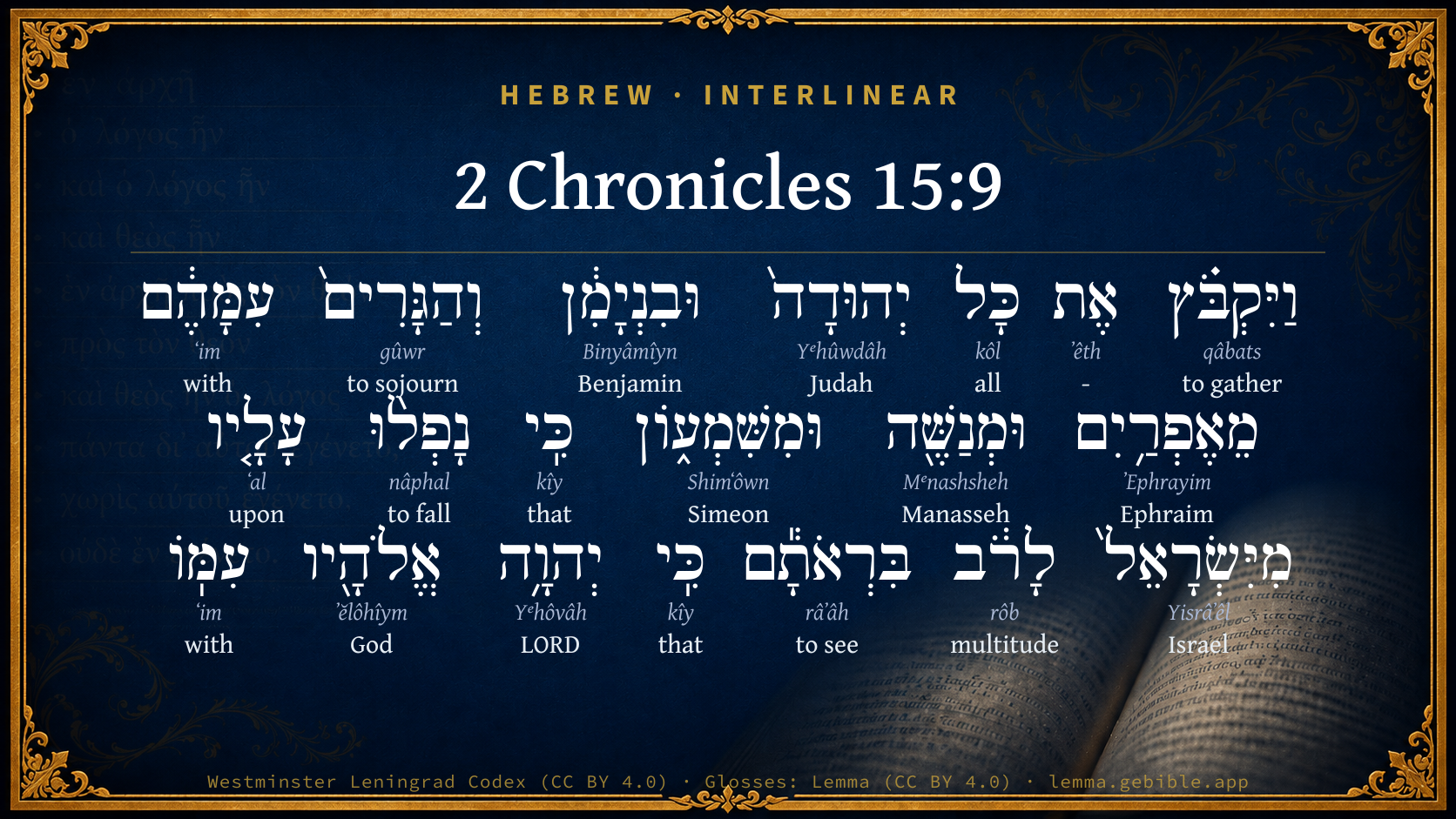
Hebrew (Westminster Leningrad Codex) 2 Chronicles 15:9 appears in the Hebrew Old Testament. The text above is from the Westminster Leningrad Codex. Each word links to its Strong’s number, a concise gloss, and parsing drawn from the Open Scriptures Hebrew Bible morphology. Click any word for its full Brown-Driver-Briggs (BDB) entry.
Download image
Cite this verse

2 Chronicles 15:9 (World English Bible). Public Domain. Lemma interlinear Bible study tool, https://lemma.gebible.app/v/2-chronicles/15/9.

Show BibTeX & RIS
BibTeX
RIS
English Translation
He gathered all Judah and Benjamin, and those who sojourned with them out of Ephraim and Manasseh, and out of Simeon: for they fell to him out of Israel in abundance, when they saw that Yahweh his God was with him.
World English Bible · Public Domain
Download a study sheet

One document with this verse’s original text, its word-by-word gloss line, the meaning frame, cross-references with their text, attributed commentary, and full source and license credits — printable, and it pastes into notes with its structure intact.

This verse Autodidact and up

Study sheet (.html) Plain text (.txt)

A passage Seminary Student

Up to 50 verses in one chapter. A passage sheet keeps up to 6 commentary sources and 12 cross-references per verse, in the order this page ranks them, and says so on the sheet whenever that leaves anything out. Ask for a single verse and you get the Autodidact verse sheet above.

Everything on this page stays free to read, with no account — the sheet is a download of what is already on screen, not access to it.

Want to remove ads? Support Godless Engineer
Compare translations 3

The same verse in 3 English versions, stacked beneath the original-language interlinear above. Click any original word for its lexicon entry.

Each is an independent rendering of the whole verse — the interlinear is not word-aligned to these translations.

Highlighted words mark where these versions differ — a whole-verse word diff, not a word-by-word alignment.

  • World English Bible Public Domain
    He gathered all Judah and Benjamin, and those who sojourned with them out of Ephraim and Manasseh, and out of Simeon: for they fell to him out of Israel in abundance, when they saw that Yahweh his God was with him.
  • King James Version Public Domain
    And he gathered all Judah and Benjamin, and the strangers with them out of Ephraim and Manasseh, and out of Simeon: for they fell to him out of Israel in abundance, when they saw that the LORD his God was with him.
  • unfoldingWord Literal Text CC BY-SA 4.0
    And he gathered all Judah and Benjamin, and the sojourners with them from Ephraim and Manasseh, and from Simeon; for they fell on him from Israel in abundance when they saw that Yahweh his God was with him.

unfoldingWord Literal Text — © unfoldingWord, licensed CC BY-SA 4.0. Word-aligned USFM3 via Door43 (git.door43.org/unfoldingWord/en_ult).

Versions to compare (up to 4)

3 of 4 selected

Show all 18 translations

Every available English version of this verse, each an independent rendering of the whole verse.

  • World English Bible Public Domain
    He gathered all Judah and Benjamin, and those who sojourned with them out of Ephraim and Manasseh, and out of Simeon: for they fell to him out of Israel in abundance, when they saw that Yahweh his God was with him.
  • Berean Standard Bible Public Domain
    And he assembled all Judah and Benjamin, along with those from the tribes of Ephraim, Manasseh, and Simeon who had settled among them, for great numbers had come over to him from Israel when they saw that the LORD his God was with him.
  • Majority Standard Bible Public Domain
    And he assembled all Judah and Benjamin, along with those from the tribes of Ephraim, Manasseh, and Simeon who had settled among them, for great numbers had come over to him from Israel when they saw that the LORD his God was with him.
  • King James Version Public Domain
    And he gathered all Judah and Benjamin, and the strangers with them out of Ephraim and Manasseh, and out of Simeon: for they fell to him out of Israel in abundance, when they saw that the LORD his God was with him.
  • American Standard Version (1901) Public Domain
    And he gathered all Judah and Benjamin, and them that sojourned with them out of Ephraim and Manasseh, and out of Simeon: for they fell to him out of Israel in abundance, when they saw that Jehovah his God was with him.
  • Revised Version (1885) Public Domain
    And he gathered all Judah and Benjamin, and them that sojourned with them out of Ephraim and Manasseh, and out of Simeon: for they fell to him out of Israel in abundance, when they saw that the LORD his God was with him.
  • Geneva Bible (1599) Public Domain
    And he gathered all Iudah and Beniamin, and the strangers with them out of Ephraim, and Manasseh, and out of Simeon: for there fell many to him out of Israel, when they sawe that the Lord his God was with him.
  • Douay-Rheims (1899) Public Domain
    And he gathered together all Juda and Benjamin, and the strangers with them of Ephraim, and Manasses, and Simeon: for many were come over to him out of Israel, seeing that the Lord his God was with him.
  • Young's Literal Translation Public Domain
    and gathereth all Judah and Benjamin, and the sojourners with them out of Ephraim, and Manasseh, and out of Simeon -- for they have fallen unto him from Israel in abundance, in their seeing that Jehovah his God `is' with him.
  • Literal Standard Version CC BY-SA 4.0
    and gathers all Judah and Benjamin, and the sojourners with them out of Ephraim, and Manasseh, and out of Simeon—for they have defected to him from Israel in abundance, in their seeing that his God YHWH [is] with him.
  • Unlocked Literal Bible CC BY-SA 4.0
    He gathered all Judah and Benjamin, and those who stayed with them—people from of Ephraim and Manasseh, and from Simeon. For they came from Israel to him in great numbers, when they saw that Yahweh his God was with him.
  • unfoldingWord Literal Text CC BY-SA 4.0
    And he gathered all Judah and Benjamin, and the sojourners with them from Ephraim and Manasseh, and from Simeon; for they fell on him from Israel in abundance when they saw that Yahweh his God was with him.
  • Darby Bible Public Domain
    And he assembled all Judah and Benjamin, and the strangers with them out of Ephraim and Manasseh, and out of Simeon; for they fell away to him out of Israel in abundance, when they saw that Jehovah his God was with him.
  • World Messianic Bible Public Domain
    He gathered all Judah and Benjamin, and those who lived with them out of Ephraim, Manasseh, and Simeon; for they came to him out of Israel in abundance when they saw that the LORD his God was with him.
  • Webster's Bible Public Domain
    And he gathered all Judah and Benjamin, and the strangers with them out of Ephraim and Manasseh, and out of Simeon: for they resorted to him out of Israel in multitudes, when they saw that the LORD his God was with him.
  • Free Bible Version CC BY-SA 4.0
    Then Asa summoned all of Judah and Benjamin, along with those Israelites from the tribes of Ephraim, Manasseh, and Simeon who were living among them, for many people had deserted Israel and come over to Asa when they saw that the Lord his God was with him.
  • Bible in Basic English Public Domain
    And he got together all Judah and Benjamin and those of Ephraim and Manasseh and Simeon who were living with them; for numbers of them came to him out of Israel when they saw that the Lord his God was with him.
  • JPS Tanakh (1917) Public Domain
    And he gathered all Judah and Benjamin, and them that sojourned with them out of Ephraim and Manasseh, and out of Simeon; for they fell to him out of Israel in abundance, when they saw that the LORD his God was with him.

Literal Standard Version (2020), Covenant Press — licensed CC BY-SA 4.0. Text via the HelloAO Bible API (eBible.org). Unlocked Literal Bible (unfoldingWord) — licensed CC BY-SA 4.0. Text via the HelloAO Bible API (eBible.org). unfoldingWord Literal Text — © unfoldingWord, licensed CC BY-SA 4.0. Word-aligned USFM3 via Door43 (git.door43.org/unfoldingWord/en_ult). Free Bible Version, Dr. Jonathan Gallagher — licensed CC BY-SA 4.0. Text via the HelloAO Bible API (eBible.org).

Word by word

More ways to search: Search by grammar → Find every occurrence → Compare this word →

Practice this passage: Drill this verse → Learn its vocabulary →

וּמִשִּׁמְע֑וֹן
Shimʻôwn
H8095
“and · from · Simeon”
Conjunction + Preposition + Noun, Proper
Part of Speech
Conjunction + Preposition + Noun
Type
Proper
Full BDB Definition

Origin: from H8085

TWOT: None

Simeon or Shimeon = "heard" - the 2nd son of Jacob by his wife Leah and progenitor of the tribe of Simeon - an Israelite of the sons of Bani who had a foreign wife in the time of Ezra
  1. וַיִּקְבֹּ֗ץ qâbats H6908 “and · to gather” Conjunction + Verb, Qal, Sequential Imperfect, 3rd Person, Masculine, Singular
  2. אֶת ʼêth H853 “-” Particle, Direct Object
  3. כָּל kôl H3605 “all of” Noun, Common, Masculine, Singular, Construct
  4. יְהוּדָה֙ Yᵉhûwdâh H3063 “Judah” Noun, Proper
  5. וּבִנְיָמִ֔ן Binyâmîyn H1144 “and · Benjamin” Conjunction + Noun, Proper
  6. וְהַגָּרִים֙ gûwr H1481 “and · the · sojourning” Conjunction + Particle, Definite Article + Verb, Qal, Participle Active, Masculine, Plural, Absolute
  7. עִמָּהֶ֔ם ʻim H5973 “with · them” Preposition + Suffix, Personal, 3rd Person, Masculine, Plural
  8. מֵאֶפְרַ֥יִם ʼEphrayim H669 “from · Ephraim” Preposition + Noun, Proper
  9. וּמְנַשֶּׁ֖ה Mᵉnashsheh H4519 “and · Manasseh” Conjunction + Noun, Proper
  10. כִּֽי kîy H3588 “that” Conjunction
  11. נָפְל֨וּ nâphal H5307 “to fall” Verb, Qal, Perfect, 3rd Person, Common, Plural
  12. עָלָ֤יו ʻal H5921 “upon · him” Preposition + Suffix, Personal, 3rd Person, Masculine, Singular
  13. מִיִּשְׂרָאֵל֙ Yisrâʼêl H3478 “from · Israel” Preposition + Noun, Proper
  14. לָרֹ֔ב rôb H7230 “to/for · multitude” Preposition + Noun, Common, Both, Singular, Absolute
  15. בִּרְאֹתָ֕ם râʼâh H7200 “in/at · to see · them” Preposition + Verb, Qal, Infinitive Construct + Suffix, Personal, 3rd Person, Masculine, Plural
  16. כִּֽי kîy H3588 “that” Conjunction
  17. יְהוָ֥ה Yᵉhôvâh H3068 “LORD” Noun, Proper
  18. אֱלֹהָ֖יו ʼĕlôhîym H430 “God(s) · his” Noun, Common, Masculine, Plural, Construct + Suffix, Personal, 3rd Person, Masculine, Singular
  19. עִמּֽוֹ ʻim H5973 “with · him” Preposition + Suffix, Personal, 3rd Person, Masculine, Singular

About this verse

These counts appear in no published source. They are computed here, from the morphology-tagged text and Lemma’s own curated glosses. What Lemma adds →

20
words
18
distinct lemmas
Historical
section

Shared distinctive vocabulary

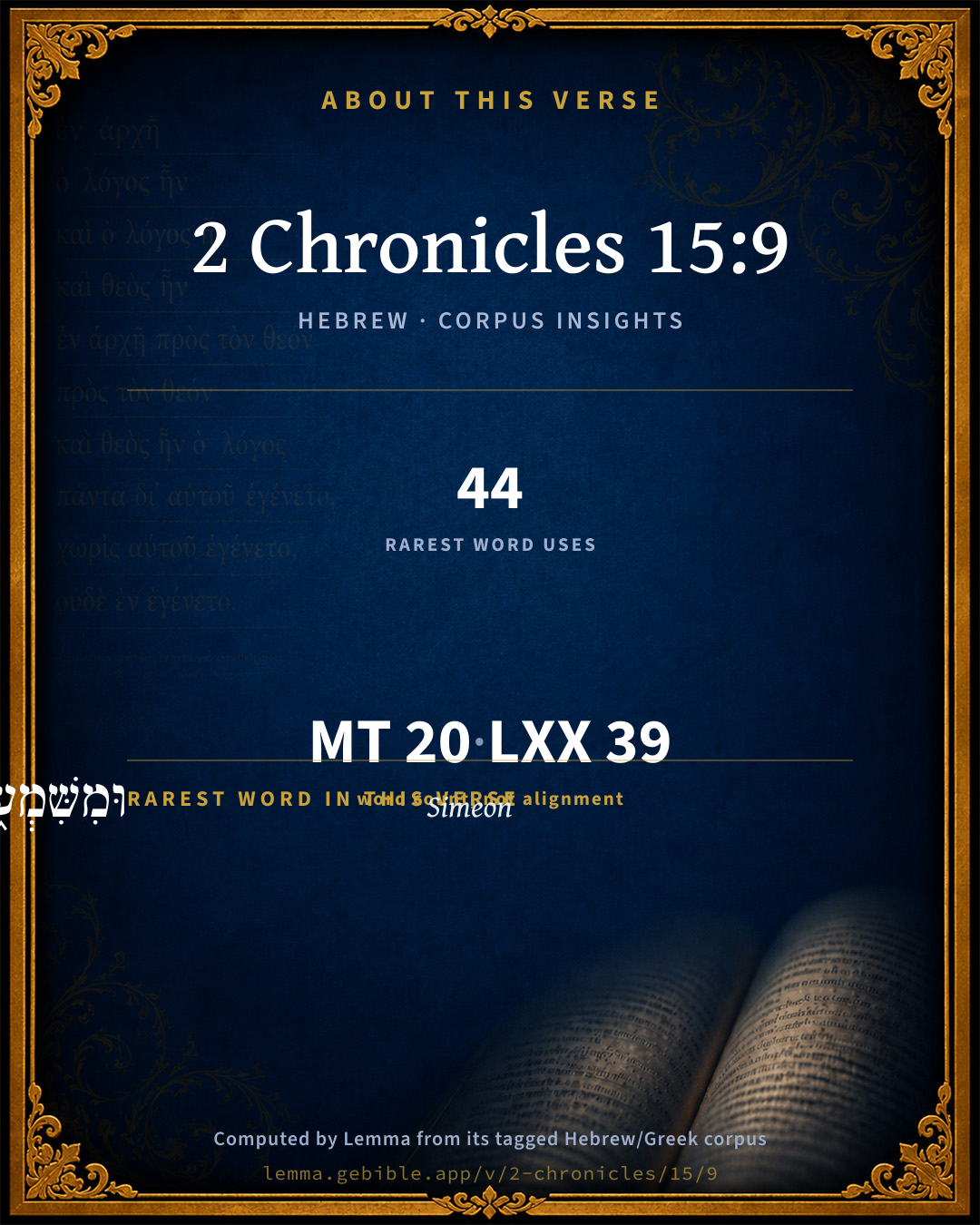
וּמִשִּׁמְע֑וֹן Simeon H8095 occurs in 39 verses of the Hebrew Bible. Also found in:

Grammatical profile

  • 4 verbs
  • 10 nouns
  • 3 prepositions
  • 2 conjunctions
  • 1 particle

Verb forms

  • וַיִּקְבֹּ֗ץ Qal · Sequential Imperfect
  • וְהַגָּרִים֙ Qal · Participle Active
  • נָפְל֨וּ Qal · Perfect
  • בִּרְאֹתָ֕ם Qal · Infinitive Construct

Repetition

Words recur within this verse — often emphatic in Hebrew:

  • עִמָּהֶ֔ם with H5973 ×2
  • כִּֽי that H3588 ×2

Hebrew & Septuagint length

In English translation the verse runs 41 words from the Hebrew and 40 from the Septuagint (LXX English) — closely comparable.

A rough comparison of the two English renderings, which tokenize alike — not a word-level alignment.

Word counts can differ between the Hebrew and the Greek without any difference in meaning — e.g. the Hebrew direct-object marker אֵת has no separate Greek word, and Greek often adds the article ὁ.

In the original languages it is 20 Hebrew tokens and 39 Greek tokens — but the two are counted differently (Hebrew bundles its prefixes and suffixes into one token; the Greek is in lemma form), so that isn’t a like-for-like length.

Cross-references

11

Topical passages linked to 2 Chronicles 15:9 in the Treasury of Scripture Knowledge — connected by theme and wording, ordered by reader-vote popularity; previews shown in the World English Bible.

  • 2 Chronicles 11:16 After them, out of all the tribes of Israel, such as set their hearts to seek Yahweh, the God of Israel, came to Jerusalem to sacrifice to Yahweh, the God of their fathers.
  • Acts 9:31 So the assemblies throughout all Judea and Galilee and Samaria had peace, and were built up. They were multiplied, walking in the fear of the Lord and in the comfort of the Holy Spirit.
  • Zechariah 8:21–23 and the inhabitants of one shall go to another, saying, 'Let us go speedily to entreat the favor of Yahweh, and to seek Yahweh of Hosts. I will go also.'
  • Genesis 39:3 His master saw that Yahweh was with him, and that Yahweh made all that he did prosper in his hand.
  • 1 Samuel 18:28 Saul saw and knew that Yahweh was with David; and Michal, Saul's daughter, loved him.
  • 1 Kings 3:28 All Israel heard of the judgment which the king had judged; and they feared the king: for they saw that the wisdom of God was in him, to do justice.
  • 1 Kings 12:19 So Israel rebelled against the house of David to this day.
  • 1 Chronicles 12:19 Of Manasseh also there fell away some to David, when he came with the Philistines against Saul to battle: but they didn't help them; for the lords of the Philistines sent him away after consultation, saying, He will fall away to his master Saul to the jeopardy of our heads.
  • 2 Chronicles 30:1–11 Hezekiah sent to all Israel and Judah, and wrote letters also to Ephraim and Manasseh, that they should come to the house of Yahweh at Jerusalem, to keep the Passover to Yahweh, the God of Israel.
  • 2 Chronicles 30:25 All the assembly of Judah, with the priests and the Levites, and all the assembly who came out of Israel, and the foreigners who came out of the land of Israel, and who lived in Judah, rejoiced.
  • Acts 7:9–10 "The patriarchs, moved with jealousy against Joseph, sold him into Egypt. God was with him,

Cross-references courtesy of OpenBible.info (CC BY 4.0).

Hebrew and Greek witnesses Masoretic Hebrew ↔ Greek Septuagint

The same verse in the two great witnesses to the Old Testament, shown verse-for-verse.

These are two independent witnesses, not word-aligned to each other, and the Septuagint is shown in lemma (dictionary) form.

Hebrew 2 Chronicles 15:9 Masoretic · Westminster Leningrad Codex

וַיִּקְבֹּ֗ץ אֶת כָּל יְהוּדָה֙ וּבִנְיָמִ֔ן וְהַגָּרִים֙ עִמָּהֶ֔ם מֵאֶפְרַ֥יִם וּמְנַשֶּׁ֖ה וּמִשִּׁמְע֑וֹן כִּֽי נָפְל֨וּ עָלָ֤יו מִיִּשְׂרָאֵל֙ לָרֹ֔ב בִּרְאֹתָ֕ם כִּֽי יְהוָ֥ה אֱלֹהָ֖יו עִמּֽוֹ

He gathered all Judah and Benjamin, and those who sojourned with them out of Ephraim and Manasseh, and out of Simeon: for they fell to him out of Israel in abundance, when they saw that Yahweh his God was with him.

World English Bible · Public Domain

Greek LXX 2 Chronicles 15:9 Septuagint · lemma form

καί ἐκκλησιάζω ὁ ἰούδας καί βενιαμίν καί ὁ προσήλυτος ὁ παραοἰκέω μετά αὐτός ἀπό ἐφράιμ καί ἀπό μανασσή καί ἀπό συμεων ὅτι προςτίθημι πρός αὐτός πολύς ὁ ἰσραήλ ἐν ὁ ὁράω αὐτός ὅτι κύριος ὁ θεός αὐτός μετά αὐτός

And he assembled Juda and Benjamin, and the strangers that lived with him, of Ephraim, and of Manasse, and of Symeon: for many of Israel were joined to him, when they saw that the Lord his God was with him.

LXX2012 (modern English Septuagint) · Public Domain

Hebrew: Westminster Leningrad Codex (CC BY 4.0). Greek: Septuagint (public domain); English from LXX2012 (modern English Septuagint) (Public Domain). How the Septuagint differs from the Hebrew →

Commentary

Notes on 2 Chronicles 15:9 from classic Christian and Jewish commentators (each source and its license shown beneath its notes). The classic Christian expositions comment on the surrounding passage and are grouped to its opening verse, so a note may address several verses; the Jewish commentaries on the Tanakh (Rashi and others) are per-verse, so they appear only where the commentator wrote on this verse.

Lemma curates 59 commentaries, every one of them public domain or Creative Commons licensed, each selected and text-cleaned for this edition rather than reprinted as found. About our sources →

Trapp's Complete Commentary

John Trapp

2Ch 15:9 And he gathered all Judah and Benjamin, and the strangers with them out of Ephraim and Manasseh, and out of Simeon: for they fell to him out of Israel in abundance, when they saw that the LORD his God [was] with him.

Ver. 9. And the strangers with them, &c.] Strangers they had made themselves by their revolt with the rest, but now they repented and returned, being looked upon by their "brethren in iniquity" as apostates, like as was Luther by the Papists. An apostate he confessed himself, sed beatum et sanctum, "but happy and holy," but such a one as had not kept touch with the devil.

John Trapp, A Commentary or Exposition upon All the Books of the Old and New Testament (1647–1656) — public domain. Text from a community e-Sword module.

Joseph Benson's Commentary

2Ch 15:9. And out of Simeon — For the generality of this tribe, though they had their inheritance out of the portion of Judah, revolted to Jeroboam with the other tribes, as appears from many passages of Scripture. This they might conveniently do, because, as their portion bordered, on one side, on the tribe of Judah, so, on the other, it touched on that of Dan, and therefore could easily join with the one or the other. For they fell to him out of Israel in abundance — Namely, from the king of Israel.

Joseph Benson's Commentary on the Old and New Testaments (1811–1818) — public domain. Text from a community e-Sword module.

Tyndale Open Study Notes

Tyndale Open Resources

15:9 the people of Ephraim, Manasseh: The Chronicler always included the northern tribes in his accounts of spiritual reform (cp. 30:1-11). • The territory of Simeon was absorbed into Judah.

Tyndale Open Study Notes — © Tyndale Open Resources, licensed CC BY-SA 4.0. Text via the HelloAO Bible API.

Jamieson, Fausset & Brown

Robert Jamieson, A. R. Fausset & David Brown

he gathered all Judah and Benjamin--Not satisfied with these minor measures of purification and improvement, Asa meditated a grand scheme which was to pledge his whole kingdom to complete the work of reformation, and with this in view he waited for a general assembly of the people.

and the strangers with them out of Ephraim and Manasseh--The population of Asa's kingdom had been vastly increased by the continued influx of strangers, who, prompted by motives either of interest or of piety, sought in his dominions that security and freedom which they could not enjoy amid the complicated troubles which distracted Israel.

and out of Simeon--Although a portion of that tribe, located within the territory of Judah, were already subjects of the southern kingdom, the general body of the Simeonites had joined in forming the northern kingdom of Israel. But many of them now returned of their own accord.

Jamieson, Fausset & Brown — Commentary Critical and Explanatory on the Whole Bible (1871) — public domain (CC PDM 1.0). Text via the HelloAO Bible API.

Adam Clarke's Commentary

Verse 9. And the strangers] Many out of the different tribes, particularly out of Simeon, Ephraim, and Manasseh, having reflected that the Divine blessing was promised to the house of David, and finding the government of Jeroboam founded in idolatry, would naturally, through a spirit of piety, leave their own country, and go where they might enjoy the worship of the true God.

Adam Clarke's Commentary on the Bible (1810–1826) — public domain. Text from a community e-Sword/MySword module.

Ellicott's Commentary for English Readers

(9) The strangers—i.e., the non-Judæans; members of the northern kingdom. A similar accession to the southern kingdom had taken place under Rehoboam (2Ch_11:16); and another yet is related in the reign of Hezekiah (2Ch_30:11; 2Ch_30:18).

And out of Simeon.—This tribe is again mentioned along with Ephraim and Manasseh in 2Ch_34:6, although its territory lay “within the inheritance of the children of Judah” (Jos_19:1). Perhaps a portion of the tribe had migrated northward (comp. Judges 18), and some of these now settled again in Judah. Gen_49:7 speaks of Simeon as “divided in Jacob, and scattered in Israel.”

Another solution is, that although politically one with Judah, the tribe of Simeon was religiously isolated by its illegal worship established at Beersheba, similar to that at Bethel and Dan (Amo_4:4; Amo_5:5; Amo_8:14). But this hardly agrees with the next clause: “They fell to him out of Israel.”

They fell to him.—(1Ch_12:19; 2Ki_7:4.)

When they saw that the Lord.—They had heard of his great deliverance from Zerah.

In the fifteenth year of the reign of Asa.—This seems to indicate that the Cushite invasion took place not long before, perhaps in the spring of the same year (see Note on 1Ch_20:1).

A Bible Commentary for English Readers, edited by Charles John Ellicott (1878–1897) — public domain. Text from a community e-Sword module.

The Cambridge Bible for Schools and Colleges

gen. ed. J. J. S. Perowne

9. the strangers with them] R.V. them that sojourned with them; cp. 2Ch_10:17; 2Ch_11:16-17; 2Ch_16:1.

Simeon] The territory of this tribe lay in the South and it is natural to think that at the disruption Simeon followed Judah in allegiance to the house of David. It may be however that Simeon at first held aloof.

The Cambridge Bible for Schools and Colleges (gen. ed. J. J. S. Perowne; Cambridge University Press, 1878–1918) — public domain. Text from a community e-Sword module.

John Gill's Exposition

And he gathered all Judah and Benjamin, and the strangers with them,.... The proselytes of the gate:

out of Ephraim and Manasseh, and out of Simeon: out of all the places in those tribes that had come off to him, or had been taken by him; for otherwise these belonged to the ten tribes under the government of Jeroboam, and his successors, and the next clause explains it:

for they fell to him out of Israel abundance, when they saw that the Lord his God was with him; as was clear by the victory he gave him over the Ethiopians; after that time many in the above tribes came over to him; the Targum is,"when they saw the Word of the Lord his God was his help.''

John Gill's Exposition of the Whole Bible (1746–1763) — public domain (CC PDM 1.0). Text via the HelloAO Bible API.

Albert Barnes' Notes on the Bible

Strangers ... - i. e. “Israelites of the tribes of Ephraim and Manasseh.” The separation of the two kingdoms had made their Israelite brethren “strangers,” or “foreigners,” to Judah.

Albert Barnes' Notes on the Bible (1834–1885) — public domain. Text from a community e-Sword/MySword module.

Haydock's Catholic Bible Commentary

Simeon. This tribe was intimately connected with that of Juda, though many had revolted. Some afterwards returned, as they did from other parts, actuated either by motives of interest or of religion, chap. xxxiv. 6., and 3 Kings xi. 13. (Calmet)

George Leo Haydock (1774–1849), Haydock's Catholic Family Bible and Commentary, 1859 edition — public domain. Excludes Psalms (Douay-Rheims chapter numbering differs from Protestant) and Deuterocanonical books (Catholic canon only).

Matthew Poole's English Annotations

Out of Simeon; which tribe, though they had their inheritance out of the portion of Judah, did for the generality of them revolt to Jeroboam with the other tribes, as appears from many passages of Scripture; which they might conveniently do, because their portion bordered, as on one side upon that of Judah, so on the other side upon that of Dan; and therefore might indifferently join with the one or other, as they saw fit.

They fell to him, to wit, from the king of Israel.

Matthew Poole's English Annotations on the Holy Bible (1683–1685) — public domain. Text from a community e-Sword/MySword module.

Whedon's Commentary on the Bible

Daniel D. Whedon

9. The strangers with them out of Ephraim and Manasseh — The Israelites of these leading tribes of the northern kingdom are here spoken of as strangers. Such estrangement had secession wrought, Many of the more pious Israelites out of the various tribes joined the kingdom of Judah in the days of Rehoboam, but multitudes more came now when they saw that the Lord his God was with Asa.

And out of Simeon — Most of the tribe of Simeon probably fell to the southern kingdom from the first, but not all the tribe, for there were not a few whose jealousy of Judah and Jerusalem led them to cast in their fortunes with the majority of the nation. Keil remarks that “the Simeonites, though politically united with Judah, yet in religious matters were not so, but had set up in Beersheba a worship of their own similar to that in Beth-el and Dan. In such a case the more earnest and thoughtful people from Simeon, as well as from Ephraim and Manasseh, may have gone to Jerusalem to the sacrificial festival prepared by Asa. In favour of this last supposition we may adduce the fact that the prophet Amos (1Ch_4:4; 1Ch_5:5; 1Ch_8:14) mentions Beer-sheba, along with Beth-el and Gilgal, as a place to which pilgrimages were made by the idolatrous Israelites.”

Daniel D. Whedon (gen. ed.), Commentary on the Old and New Testaments (1874–1909) — public domain. Text from a community e-Sword module.

The Pulpit Commentary

He gathered. As the following verses go on to show, Ass wisely gathered all beneath his sway, with a view to sacrifice and to record anew hallowed resolve as a nation. The strangers. It is a significant comment on the estranging effect of religious schism (for the schism was religious even beyond what it was national) that so comparatively soon these of the tribes of Israel should have become called "strangers" by the side of Judah and Benjamin. They fell to him in abundance. Another significant comment on the sameness of human nature in all time; the weak and the multitude will see, learn, do duty, less under pure conviction of right, than under the strong commanding influence of observation of where and with whom success goes, even if that success necessitate the owning of the Divine blessing as its cause 2Ch_11:16 and 1Ch_12:19. It should be noted, not for the sake of satire of human nature, but for the inculcation of the infinite importance of godly influence and example. Out of Simeon. (see also 2Ch_34:6) The "lines" of the Simeonites fell to them originally (Jos_19:1) within Judah. The difficulty suggested by their being called, apparently, "strangers," and being certainly classed with the comers from "Ephraim and Manasseh," may be variously overcome, either by supposing that they had become more estranged from Judah in religious position than it was possible to them to have become in merely geographical; or that they had in some degree outgrown their own proper habitat, and had to some extent colonized a more northerly region; (Gen_49:7) or that, though, indeed, our compiler"s composition undoubtedly places the Simeonites summoned, among the strangers, through mentioning them after Ephraim and Manasseh, yet this location of their name be held accidental, rather than due to special design.

The Pulpit Commentary (1880–1919), ed. H.D.M. Spence-Jones & Joseph S. Exell — public domain. Text from a community e-Sword module.

Lesson kit

Teaching starters — assembled from the data on this page, not authored interpretation. Every prompt links to the verse data it draws on. Edit before teaching.

2 Chronicles, in the Historical, opens this verse with 20 words (18 distinct Hebrew lemmas). Its most distinctive word is Shimʻôwn (“Simeon”). A historical commentator’s framing appears above. Read the whole chapter for the surrounding context.

Discussion questions

  1. The word Shimʻôwn carries the sense “Simeon.” How does it shape the verse?
  2. How does Genesis 29:33, which shares the word «Simeon», read alongside this verse?
  3. What does the repetition of “with” (2× in this one verse) do in this verse?
  4. These translations render this verse differently; the difference is in the English rendering, not the original. What questions does that raise?
  5. «וַיִּקְבֹּ֗ץ» is a Qal Sequential Imperfect verb. How does that grammatical form shape the action described?
  6. Compare how Trapp's Complete Commentary and Joseph Benson's Commentary read this verse. Where do they agree or differ?

Things to notice

Reading settings

Reading text

Shown beneath each verse's original-language words.

Old Testament
Old Testament edition

Read the OT as the Masoretic Hebrew (MT) or the Greek Septuagint (LXX).

English shown for the Greek Septuagint (in the Hebrew ↔ Greek comparison).

Comparing translations? Open the Compare panel on any verse page to stack up to four side by side.