
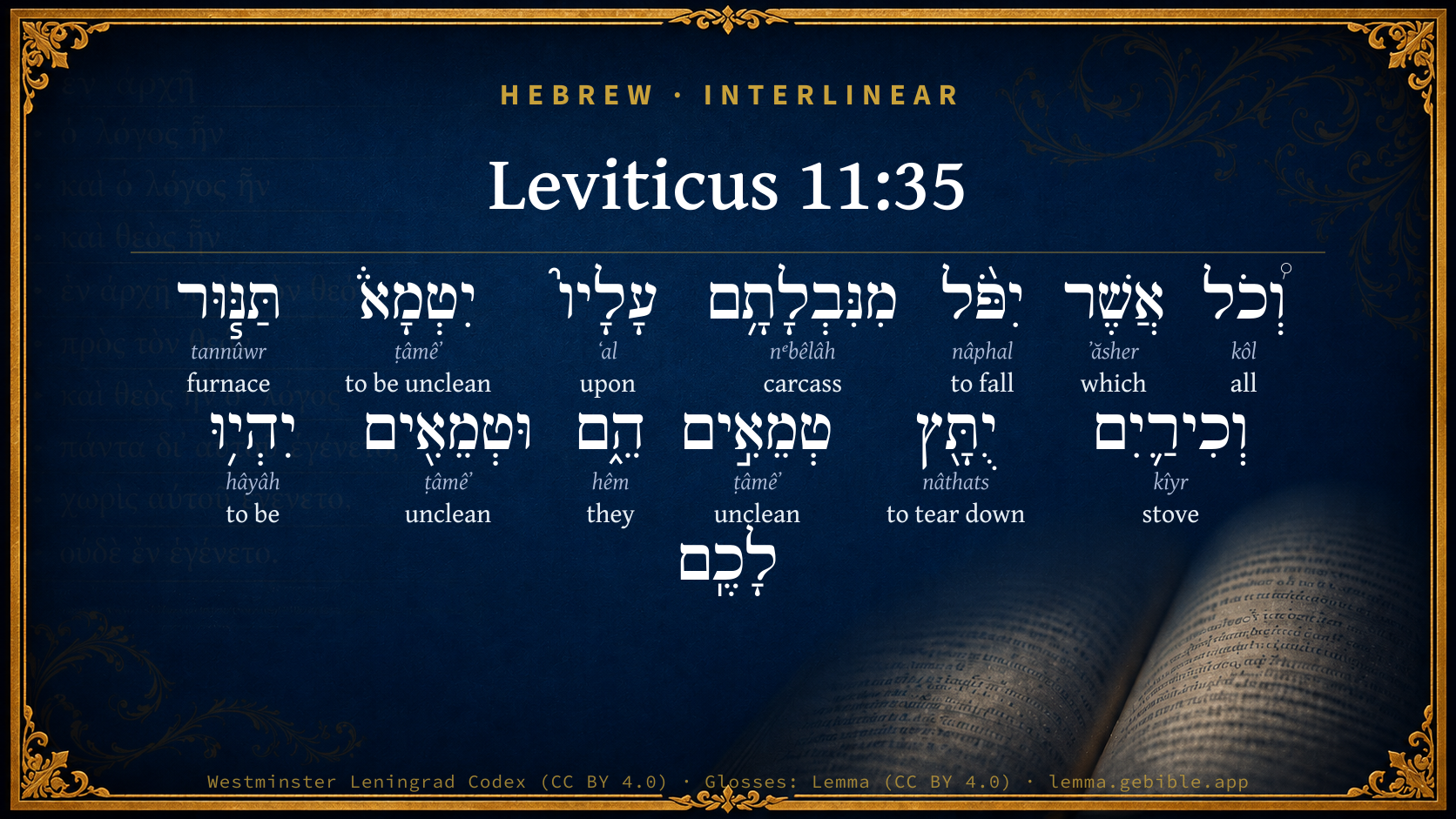
Leviticus 11:35

Hebrew (Westminster Leningrad Codex) Leviticus 11:35 appears in the Hebrew Old Testament. The text above is from the Westminster Leningrad Codex. Each word links to its Strong’s number, a concise gloss, and parsing drawn from the Open Scriptures Hebrew Bible morphology. Click any word for its full Brown-Driver-Briggs (BDB) entry.
Download image
Cite this verse

Leviticus 11:35 (World English Bible). Public Domain. Lemma interlinear Bible study tool, https://lemma.gebible.app/v/leviticus/11/35.

Show BibTeX & RIS
BibTeX
RIS
English Translation
Everything whereupon part of their carcass falls shall be unclean; whether oven, or range for pots, it shall be broken in pieces: they are unclean, and shall be unclean to you.
World English Bible · Public Domain
Highlights
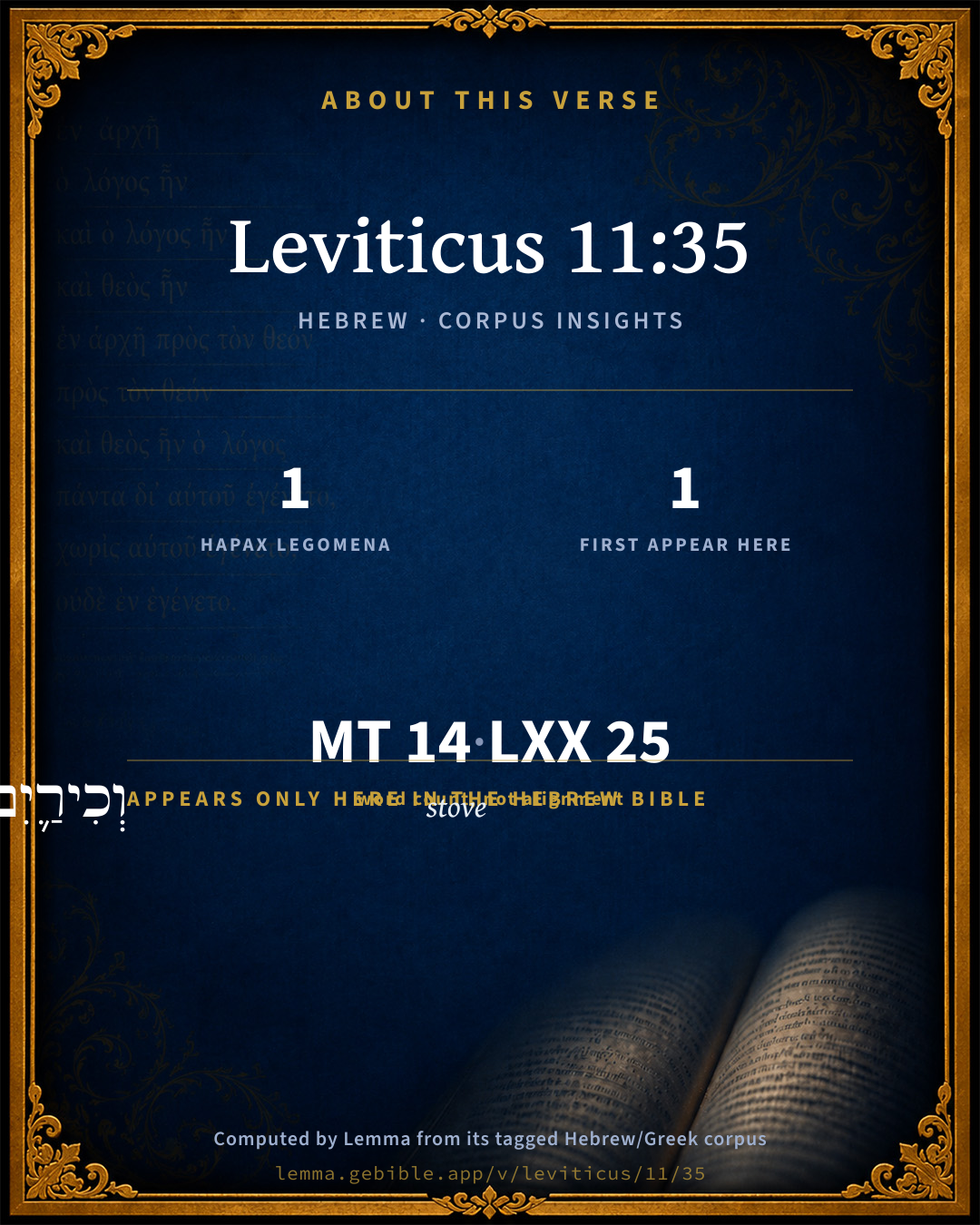
  • 1 hapax legomenon — only here in the Hebrew Bible
  • 1 first appearance in the Hebrew Bible
Full analysis ↓
Download a study sheet

One document with this verse’s original text, its word-by-word gloss line, the meaning frame, cross-references with their text, attributed commentary, and full source and license credits — printable, and it pastes into notes with its structure intact.

This verse Autodidact and up

Study sheet (.html) Plain text (.txt)

A passage Seminary Student

Up to 50 verses in one chapter. A passage sheet keeps up to 6 commentary sources and 12 cross-references per verse, in the order this page ranks them, and says so on the sheet whenever that leaves anything out. Ask for a single verse and you get the Autodidact verse sheet above.

Everything on this page stays free to read, with no account — the sheet is a download of what is already on screen, not access to it.

Want to remove ads? Support Godless Engineer
Compare translations 3

The same verse in 3 English versions, stacked beneath the original-language interlinear above. Click any original word for its lexicon entry.

Each is an independent rendering of the whole verse — the interlinear is not word-aligned to these translations.

Highlighted words mark where these versions differ — a whole-verse word diff, not a word-by-word alignment.

  • World English Bible Public Domain
    Everything whereupon part of their carcass falls shall be unclean; whether oven, or range for pots, it shall be broken in pieces: they are unclean, and shall be unclean to you.
  • King James Version Public Domain
    And every thing whereupon any part of their carcass falleth shall be unclean; whether it be oven, or ranges for pots, they shall be broken down: for they are unclean and shall be unclean unto you.
  • unfoldingWord Literal Text CC BY-SA 4.0
    and anything on which of their carcasses falls will become unclean. An oven or stove shall be smashed. They unclean and they shall be unclean to you.

unfoldingWord Literal Text — © unfoldingWord, licensed CC BY-SA 4.0. Word-aligned USFM3 via Door43 (git.door43.org/unfoldingWord/en_ult).

Versions to compare (up to 4)

3 of 4 selected

Show all 18 translations

Every available English version of this verse, each an independent rendering of the whole verse.

  • World English Bible Public Domain
    Everything whereupon part of their carcass falls shall be unclean; whether oven, or range for pots, it shall be broken in pieces: they are unclean, and shall be unclean to you.
  • Berean Standard Bible Public Domain
    Anything upon which one of their carcasses falls will be unclean. If it is an oven or cooking pot, it must be smashed; it is unclean and will remain unclean for you.
  • Majority Standard Bible Public Domain
    Anything upon which one of their carcasses falls will be unclean. If it is an oven or cooking pot, it must be smashed; it is unclean and will remain unclean for you.
  • King James Version Public Domain
    And every thing whereupon any part of their carcass falleth shall be unclean; whether it be oven, or ranges for pots, they shall be broken down: for they are unclean and shall be unclean unto you.
  • American Standard Version (1901) Public Domain
    And every thing whereupon `any part' of their carcass falleth shall be unclean; whether oven, or range for pots, it shall be broken in pieces: they are unclean, and shall be unclean unto you.
  • Revised Version (1885) Public Domain
    And every thing whereupon any part of their carcase falleth shall be unclean; whether oven, or range for pots, it shall be broken in pieces: they are unclean, and shall be unclean unto you.
  • Geneva Bible (1599) Public Domain
    And euery thing that their carkeis fall vpon, shalbe vncleane: the fornais or the pot shalbe broken: for they are vncleane, and shalbe vncleane vnto you.
  • Douay-Rheims (1899) Public Domain
    And upon whatsoever thing any of these dead beasts shall fall, it shall be unclean: whether it be oven, or pots with feet, they shall be destroyed, and shall be unclean.
  • Young's Literal Translation Public Domain
    and anything on which `any' of their carcase falleth is unclean (oven or double pots), it is broken down, unclean they `are', yea, unclean they are to you.
  • Literal Standard Version CC BY-SA 4.0
    and anything on which [any] of their carcass falls is unclean; oven or double pots, it is broken down, they [are] unclean, indeed, they are unclean to you.
  • Unlocked Literal Bible CC BY-SA 4.0
    Anything that one of their carcasses falls on becomes unclean; if it is an oven or small stove, it must be broken to pieces. They are unclean and they must remain unclean to you.
  • unfoldingWord Literal Text CC BY-SA 4.0
    and anything on which of their carcasses falls will become unclean. An oven or stove shall be smashed. They unclean and they shall be unclean to you.
  • Darby Bible Public Domain
    And everything where upon [any part] of their carcase falleth shall be unclean; oven and hearth shall be broken down: they are unclean, and shall be unclean unto you.
  • World Messianic Bible Public Domain
    Everything whereupon part of their carcass falls shall be unclean; whether oven, or range for pots, it shall be broken in pieces. They are unclean, and shall be unclean to you.
  • Webster's Bible Public Domain
    And every thing on which any part of their carcass falleth, shall be unclean; whether an oven, or ranges for pots, they shall be broken down: for they are unclean, and shall be unclean to you.
  • Free Bible Version CC BY-SA 4.0
    Anything that one of their dead bodies falls on becomes unclean. If it's an oven or a stove, it must be smashed. It is permanently unclean for you.
  • Bible in Basic English Public Domain
    Any part of the dead body of one of these, falling on anything, will make it unclean; if it is an oven or a cooking-pot it will have to be broken: they are unclean and will be unclean to you.
  • JPS Tanakh (1917) Public Domain
    And every thing whereupon any part of their carcass falleth shall be unclean; whether oven, or range for pots, it shall be broken in pieces; they are unclean, and shall be unclean unto you.

Literal Standard Version (2020), Covenant Press — licensed CC BY-SA 4.0. Text via the HelloAO Bible API (eBible.org). Unlocked Literal Bible (unfoldingWord) — licensed CC BY-SA 4.0. Text via the HelloAO Bible API (eBible.org). unfoldingWord Literal Text — © unfoldingWord, licensed CC BY-SA 4.0. Word-aligned USFM3 via Door43 (git.door43.org/unfoldingWord/en_ult). Free Bible Version, Dr. Jonathan Gallagher — licensed CC BY-SA 4.0. Text via the HelloAO Bible API (eBible.org).

Word by word

More ways to search: Search by grammar → Find every occurrence → Compare this word →

Practice this passage: Drill this verse → Learn its vocabulary →

וְכִירַ֛יִם
kîyr
H3600
“and · stoves”
Conjunction + Noun, Common, Masculine, Dual, Absolute
Part of Speech
Conjunction + Noun
Type
Common
Gender
Masculine
Number
Dual
State
Absolute
Full BDB Definition

Origin: a form for H3564 (only in the dual)

TWOT: 967c

stove, range, cooking furnace
  1. וְ֠כֹל kôl H3605 “and · all” Conjunction + Noun, Common, Masculine, Singular, Absolute
  2. אֲשֶׁר ʼăsher H834 “which” Particle, Relative
  3. יִפֹּ֨ל nâphal H5307 “to fall” Verb, Qal, Imperfect, 3rd Person, Masculine, Singular
  4. מִנִּבְלָתָ֥ם nᵉbêlâh H5038 “from · carcass · their” Preposition + Noun, Common, Feminine, Singular, Construct + Suffix, Personal, 3rd Person, Masculine, Plural
  5. עָלָיו֮ ʻal H5921 “upon · him” Preposition + Suffix, Personal, 3rd Person, Masculine, Singular
  6. יִטְמָא֒ ṭâmêʼ H2930 “to be unclean” Verb, Qal, Imperfect, 3rd Person, Masculine, Singular
  7. תַּנּ֧וּר tannûwr H8574 “furnace” Noun, Common, Masculine, Singular, Absolute
  8. יֻתָּ֖ץ nâthats H5422 “to tear down” Verb, Hophal, Imperfect, 3rd Person, Masculine, Singular
  9. טְמֵאִ֣ים ṭâmêʼ H2931 “unclean” Adjective, Adjective, Masculine, Plural, Absolute
  10. הֵ֑ם hêm H1992 “they” Pronoun, Personal, 3rd Person, Masculine, Plural
  11. וּטְמֵאִ֖ים ṭâmêʼ H2931 “and · unclean” Conjunction + Adjective, Adjective, Masculine, Plural, Absolute
  12. יִהְי֥וּ hâyâh H1961 “to be” Verb, Qal, Imperfect, 3rd Person, Masculine, Plural

About this verse

These counts appear in no published source. They are computed here, from the morphology-tagged text and Lemma’s own curated glosses. What Lemma adds →

14
words
12
distinct lemmas
Pentateuch
section

Notable vocabulary

1 hapax legomenon — a word that appears only here in the entire Hebrew Bible:

  • וְכִירַ֛יִם stove H3600

First appearance in Scripture

This word makes its first canonical appearance in the Hebrew Bible here:

  • וְכִירַ֛יִם stove H3600

Shared distinctive vocabulary

תַּנּ֧וּר furnace H8574 occurs in 15 verses of the Hebrew Bible. Also found in:

Grammatical profile

  • 4 verbs
  • 4 nouns
  • 2 adjectives
  • 1 pronoun
  • 2 prepositions
  • 1 particle

Verb forms

  • יִפֹּ֨ל Qal · Imperfect
  • יִטְמָא֒ Qal · Imperfect
  • יֻתָּ֖ץ Hophal · Imperfect
  • יִהְי֥וּ Qal · Imperfect

Repetition

A word recurs within this verse — often emphatic in Hebrew:

  • טְמֵאִ֣ים unclean H2931 ×2

Hebrew & Septuagint length

In English translation the verse runs 31 words from the Hebrew and 34 from the Septuagint (LXX English) — closely comparable.

A rough comparison of the two English renderings, which tokenize alike — not a word-level alignment.

Word counts can differ between the Hebrew and the Greek without any difference in meaning — e.g. the Hebrew direct-object marker אֵת has no separate Greek word, and Greek often adds the article ὁ.

In the original languages it is 14 Hebrew tokens and 25 Greek tokens — but the two are counted differently (Hebrew bundles its prefixes and suffixes into one token; the Greek is in lemma form), so that isn’t a like-for-like length.

Cross-references

4

Topical passages linked to Leviticus 11:35 in the Treasury of Scripture Knowledge — connected by theme and wording, ordered by reader-vote popularity; previews shown in the World English Bible.

  • Leviticus 6:28 But the earthen vessel in which it is boiled shall be broken; and if it is boiled in a brazen vessel, it shall be scoured, and rinsed in water.
  • Leviticus 11:33 Every earthen vessel, into which any of them falls, all that is in it shall be unclean, and you shall break it.
  • Leviticus 15:12 "'The earthen vessel, which he who has the discharge touches, shall be broken; and every vessel of wood shall be rinsed in water.
  • 2 Corinthians 5:1–7 For we know that if the earthly house of our tent is dissolved, we have a building from God, a house not made with hands, eternal, in the heavens.

Cross-references courtesy of OpenBible.info (CC BY 4.0).

Hebrew and Greek witnesses Masoretic Hebrew ↔ Greek Septuagint

The same verse in the two great witnesses to the Old Testament, shown verse-for-verse.

These are two independent witnesses, not word-aligned to each other, and the Septuagint is shown in lemma (dictionary) form.

Hebrew Leviticus 11:35 Masoretic · Westminster Leningrad Codex

וְ֠כֹל אֲשֶׁר יִפֹּ֨ל מִנִּבְלָתָ֥ם עָלָיו֮ יִטְמָא֒ תַּנּ֧וּר וְכִירַ֛יִם יֻתָּ֖ץ טְמֵאִ֣ים הֵ֑ם וּטְמֵאִ֖ים יִהְי֥וּ לָכֶֽם

Everything whereupon part of their carcass falls shall be unclean; whether oven, or range for pots, it shall be broken in pieces: they are unclean, and shall be unclean to you.

World English Bible · Public Domain

Greek LXX Leviticus 11:35 Septuagint · lemma form

καί πᾶς ὅς ἐάν πίπτω ἀπό ὁ θνησιμαῖος αὐτός ἐπί αὐτός ἀκάθαρτος εἰμί κλίβανος καί κυθρόπους κατααἱρέω ἀκάθαρτος οὗτος εἰμί καί ἀκάθαρτος οὗτος σύ εἰμί

And every thing on which there shall fall of their dead bodies shall be unclean; ovens and stands for jars shall be broken down: these are unclean, and they shall be unclean to you.

LXX2012 (modern English Septuagint) · Public Domain

On this verse, The Cambridge Bible for Schools and Colleges discusses the Septuagint’s reading. Read the note in Commentary ↓

Hebrew: Westminster Leningrad Codex (CC BY 4.0). Greek: Septuagint (public domain); English from LXX2012 (modern English Septuagint) (Public Domain). How the Septuagint differs from the Hebrew →

Targum (Aramaic paraphrase)

2

The Targum is the ancient Jewish Aramaic paraphrase of the Hebrew Scriptures — an interpretive translation, not the Hebrew text itself. Onkelos (literal) and Pseudo-Jonathan (expansive) render the Torah, and Jonathan the Prophets. Coverage is partial: where no permissively-licensed English translation exists for a verse, only the Aramaic is shown. This is verse-level text, not a word-by-word alignment to the Hebrew.

  1. Targum Onkelos Torah (Genesis–Deuteronomy)
    וְכֹל דִי יִפֹּל מִנְבִלְתְּהוֹן עֲלוֹהִי יְהֵי מְסָאָב תַּנוּר וְכִירַיִם יִתָּרְעוּן מְסַאֲבִין אִנוּן וּמְסַאֲבִין יְהוֹן לְכוֹן

    (no public-domain English translation for this verse)

    Targum Onkelos — Aramaic: “Onkelos Genesis” (public domain); “Onkelos Exodus” (public domain); “Onkelos Leviticus” (public domain); “Onkelos Numbers” (public domain); “Onkelos Deuteronomy” (public domain). English: “Sefaria Community Translation” (CC0 1.0 (public-domain dedication)); “J.W. Etheridge. The Targums of Onkelos and Jonathan Ben Uzziel on the Pentateuch. London: Longmans, Green, 1862” (public domain). Text via Sefaria.

  2. Targum Pseudo-Jonathan Torah (Genesis–Deuteronomy)
    וְכָל מִדַעַם דְיַפִּיל מִנְבֵילְתְּהוֹן עֲלוֹי יְהֵי מְסָאָב תַּנוּרִין וְתַפְיַין יִסְתְּרוּן מְסָאָבִין הִינוּן וּמְסָאָבִין יְהוֹן לְכוֹן

    And any thing upon which a part of their carcass may fall shall be unclean, whether ovens or pans they shall be broken, they are defiled and shall be unclean to you.

    Targum Pseudo-Jonathan — Aramaic: “Targum Jonathan on Genesis” (public domain); “Targum Jonathan on Exodus” (public domain); “Targum Jonathan on Leviticus” (public domain); “Targum Jonathan on Numbers” (public domain); “Targum Jonathan on Deuteronomy” (public domain). English: “The Targum of Jonathan ben Uzziel, trans. J. W. Etheridge, London, 1862” (public domain). Text via Sefaria.

Commentary

Notes on Leviticus 11:35 from classic Christian and Jewish commentators (each source and its license shown beneath its notes). The classic Christian expositions comment on the surrounding passage and are grouped to its opening verse, so a note may address several verses; the Jewish commentaries on the Tanakh (Rashi and others) are per-verse, so they appear only where the commentator wrote on this verse.

Lemma curates 59 commentaries, every one of them public domain or Creative Commons licensed, each selected and text-cleaned for this edition rather than reprinted as found. About our sources →

Trapp's Complete Commentary

John Trapp

Lev 11:35 And every [thing] whereupon [any part] of their carcase falleth shall be unclean; [whether it be] oven, or ranges for pots, they shall be broken down: [for] they [are] unclean, and shall be unclean unto you.

Ver. 35. Whether it be oven, or ranges for pots.] All this, to teach them how strict they were to be, in avoiding the least pollution of sin.

John Trapp, A Commentary or Exposition upon All the Books of the Old and New Testament (1647–1656) — public domain. Text from a community e-Sword module.

Adam Clarke's Commentary

Verse 35. Ranges for pots] To understand this, we must observe that the Arabs dig a hole in their tent, about a foot and a half deep; three-fourths of this, says Rauwolff, they lay about with stones, and the fourth part is left open for the purpose of throwing in their fuel. This little temporary building is probably what is here designed by ranges for pots; and this was to be broken down when any unclean thing had fallen upon it. See Harmer, vol. 1., p. 464.

Adam Clarke's Commentary on the Bible (1810–1826) — public domain. Text from a community e-Sword/MySword module.

Ellicott's Commentary for English Readers

(35) And every thing.—That is, not only the above named garments and utensils become defiled by the said carcases, or any portion of them, falling on them, but also everything else is subject to the same pollution.

Oven, as the context shows, is an earthen vessel or baking-pot for making thin unleavened cakes, which, according to the ancient description of it, was wide at the bottom and narrow at the top, so formed to keep the heat in longer. (See Lev_2:4.)

Or ranges for pots.—According to the same ancient authorities this kind of oven was oblong, and was so made that two pots should be placed upon it, and that the fire should burn under both of them. Hence the rendering of the Authorised Version, “Ranges for pots.” This name, however, does not occur again in the Hebrew Scriptures.

They shall be broken down.—Because earthen vessels could not be made clean by washing. (See Lev_6:28.)

A Bible Commentary for English Readers, edited by Charles John Ellicott (1878–1897) — public domain. Text from a community e-Sword module.

The Cambridge Bible for Schools and Colleges

gen. ed. J. J. S. Perowne

35. If the carcase of any swarming thing come in contact with an oven, of small cooking stove, the vessel becomes unclean and must be broken.

The Heb word kîraim† probably means a small cooking stove. LXX. translate ‘pots with feet.’ The dual form is used either because the vessel consisted of two parts, or because two portions could be prepared in it; somewhat like a modern egg-boiler for two.

The Cambridge Bible for Schools and Colleges (gen. ed. J. J. S. Perowne; Cambridge University Press, 1878–1918) — public domain. Text from a community e-Sword module.

John Gill's Exposition

And everything whereupon any part of their carcass falleth shall be unclean,.... Before the Scripture seems to speak of anyone of the reptiles perfect, that falling upon anything should pollute it; but here of any part of them, though ever so small, which should, through any accident, fall and light upon anything, even that would render it unclean and unfit for use:

whether it be oven, or ranges of pots; the one to bake bread in, and the other to boil flesh in, as Aben Ezra observes:

they shall be broken down; and no more made use of for baking and boiling:

for they are unclean, and shall be unclean to you; were made hereby unfit for use, and should not be used: the Jewish writers (x) explain the phrase, "to you", to your necessity, that which they had need of, but now should not use nor receive advantage from; even "to you"; all men, women, and children, as Hiskuni interprets it: all this was ordered to create in them an abhorrence of these creatures, and to make them cautious of eating and touching them, and careful that they come not nigh, or touched, or fell upon anything, since it would give them so much trouble, as well as occasion loss. (x) Maimon. & Bartenora in Misn. Edaiot, c. 7. sect. 8.

John Gill's Exposition of the Whole Bible (1746–1763) — public domain (CC PDM 1.0). Text via the HelloAO Bible API.

Albert Barnes' Notes on the Bible

See Lev 2:4. The word rendered “ranges for pots” has been conjectured to mean either an excavated fireplace, fitted to receive a pair of ovens, or a support like a pair of andirons.

Albert Barnes' Notes on the Bible (1834–1885) — public domain. Text from a community e-Sword/MySword module.

Rashi

Rabbi Shlomo Yitzchaki (Rashi)

תנור וכרים OVEN OR RANGES FOR POTS — These are movable objects, and they are of earthenware, they have an interior and one places the pot over the opening of the hollow space (the cavity); both have their openings on top.

יתץ SHALL BE BROKEN DOWN — because for an earthenware article there can be no purification by immersion in water.

וטמאים יהיו לכם AND THEY SHALL BE UNCLEAN TO YOU — In order that you should not say, “I am under a command to break it down”, it therefore states וטמאים יהיו לכם — i. e. if one wishes to let them remain in their state of uncleanness (when they may still be used for חולין) one has the right to do so (Sifra, Shemini, Chapter 10 10). [יתץ therefore means: “should be broken down”, and the following words signify: “but though they are unclean (וטמאים) they may remain with you ‎(יהיו לכם‎)”].

Rashi on the Tanakh — English translations: “The Judaica Press complete Tanach with Rashi, translated by A. J. Rosenberg” (CC BY 4.0); “Pentateuch with Rashi's commentary by M. Rosenbaum and A.M. Silbermann, 1929-1934” (public domain); “The Metsudah Tanach series, Lakewood, N.J” (CC BY 4.0); and “The Book of Joshua, Metsudah Publications, 1997” (CC BY 4.0). Text via Sefaria.

Ramban (Nachmanides)

Rabbi Moshe ben Nachman (Ramban / Nachmanides)

AND EVERYTHING WHEREUPON ANY PART OF THEIR CARCASS FALLETH SHALL BE UNCLEAN; WHETHER OVEN, OR RANGE FOR POTS, ‘YUTATZ’ (IT SHALL BE BROKEN DOWN). Scripture teaches you here that the law of the oven and range for pots which are made of clay — in which fire is kindled and bread baked — is, [although they are] attached to the ground, like the law of earthenware pottery such as pots and jugs, which are burnt in a furnace and are movable objects, in that they too [oven and ranges], can become impure, and cannot [thereafter] be purified in an immersion-pool [in the same way that movable pottery cannot be purified]. Scripture states ‘yutatz’ (it shall be broken down) and does not say yishaber [“it shall be broken in pieces” — as it says in speaking of movable earthenware which has become impure,] in order to teach that the oven and range need not be broken so that there shall not be found among the pieces thereof a shard to take fire from the hearth, but instead they should be destroyed to the extent that they should no longer be capable of serving their [original] purpose. [The word ‘yutatz’ is] further used to teach that they become impure even though they are attached to the earth, and [the owner] must break down what he built, for the meaning of the term nethitzah is the breaking down of something built, such as the expressions: ‘vatitzu’ (and ye broke down)the houses;, 22:10. ‘v’nathatz’ (and he shall pull down) the house.

Ramban (Nachmanides) on the Tanakh — English translation: “Commentary on the Torah by Ramban (Nachmanides). Translated and annotated by Charles B. Chavel. New York, Shilo Pub. House, 1971-1976” (CC BY 4.0). Text via Sefaria.

Lesson kit

Teaching starters — assembled from the data on this page, not authored interpretation. Every prompt links to the verse data it draws on. Edit before teaching.

Leviticus, in the Pentateuch, opens this verse with 14 words (12 distinct Hebrew lemmas). Its most distinctive word is kîyr (“stove”). A historical commentator’s framing appears above. Read the whole chapter for the surrounding context.

Discussion questions

  1. How does “stove” (kîyr) shape what this verse is saying?
  2. This verse holds 1 word here found nowhere else in the Hebrew Bible. What might the rare word draw attention to?
  3. The word “stove” first appears here in Scripture. What is being introduced at this debut?
  4. Genesis 15:17 shares the word «furnace» with this verse. How do the two illuminate each other?
  5. “unclean” occurs 2× in this one verse. What is the effect of the repetition?
  6. These translations render this verse differently; the difference is in the English rendering, not the original. What questions does that raise?
  7. The verb «יִפֹּ֨ל» is Qal Imperfect. How does its form color the action?
  8. Reading how Trapp's Complete Commentary and Adam Clarke's Commentary read this verse, where do the two commentators agree and where do they part?

Things to notice

  • 1 word in this verse appears nowhere else in the Hebrew Bible.
  • 1 word makes its first canonical appearance in Scripture here.
  • This verse counts 14 Hebrew ↔ 25 Greek words.
  • These translations choose different wording for 23 words in this verse.
  • “unclean” occurs 2× in this single verse.

Reading settings

Reading text

Shown beneath each verse's original-language words.

Old Testament
Old Testament edition

Read the OT as the Masoretic Hebrew (MT) or the Greek Septuagint (LXX).

English shown for the Greek Septuagint (in the Hebrew ↔ Greek comparison).

Comparing translations? Open the Compare panel on any verse page to stack up to four side by side.