
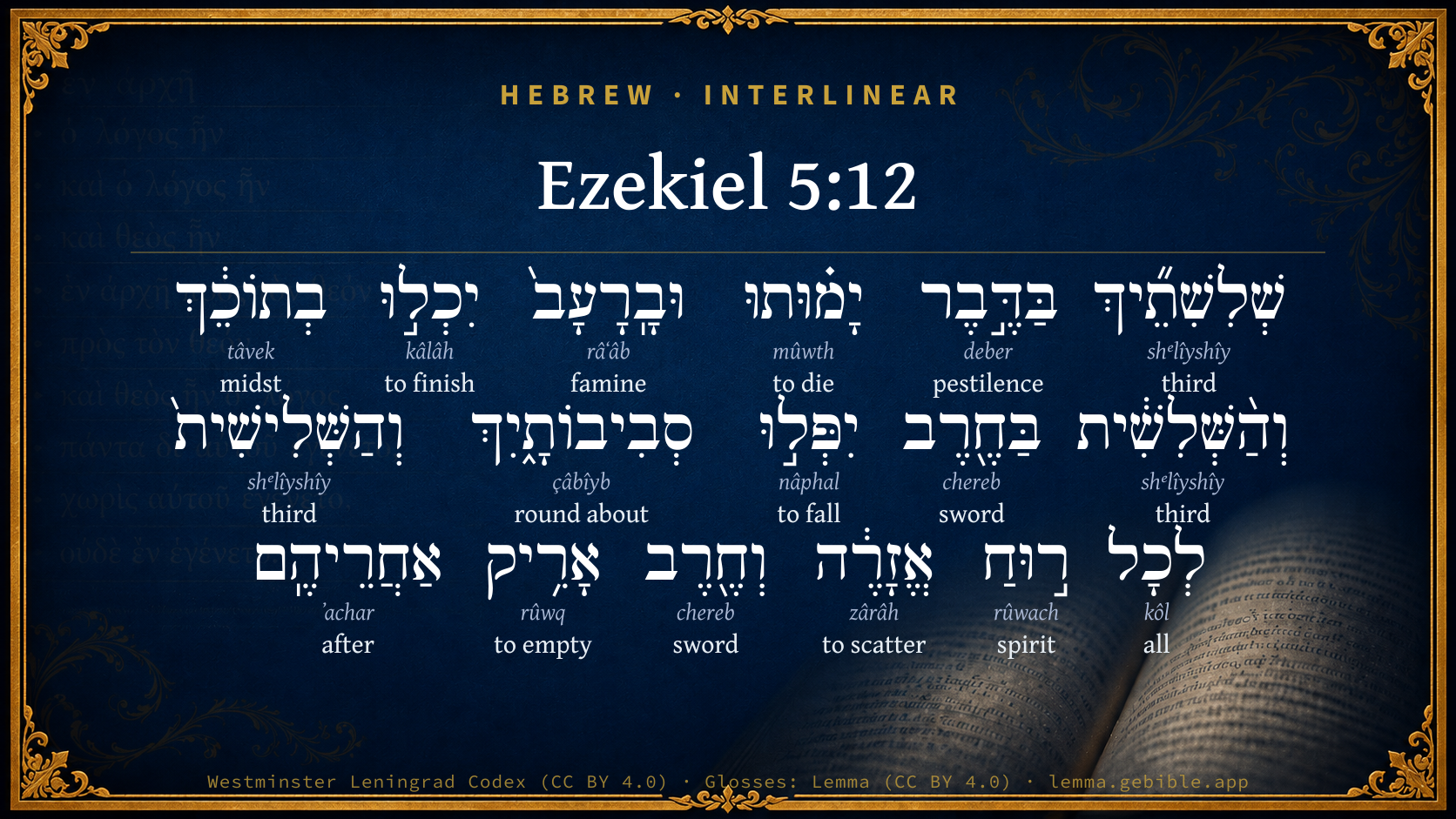
Ezekiel 5:12

Hebrew (Westminster Leningrad Codex) Ezekiel 5:12 appears in the Hebrew Old Testament. The text above is from the Westminster Leningrad Codex. Each word links to its Strong’s number, a concise gloss, and parsing drawn from the Open Scriptures Hebrew Bible morphology. Click any word for its full Brown-Driver-Briggs (BDB) entry.
Download image
Cite this verse

Ezekiel 5:12 (World English Bible). Public Domain. Lemma interlinear Bible study tool, https://lemma.gebible.app/v/ezekiel/5/12.

Show BibTeX & RIS
BibTeX
RIS
English Translation
A third part of you shall die with the pestilence, and with famine shall they be consumed in the midst of you; and a third part shall fall by the sword round about you; and a third part I will scatter to all the winds, and will draw out a sword after them.
World English Bible · Public Domain
Download a study sheet

One document with this verse’s original text, its word-by-word gloss line, the meaning frame, cross-references with their text, attributed commentary, and full source and license credits — printable, and it pastes into notes with its structure intact.

This verse Autodidact and up

Study sheet (.html) Plain text (.txt)

A passage Seminary Student

Up to 50 verses in one chapter. A passage sheet keeps up to 6 commentary sources and 12 cross-references per verse, in the order this page ranks them, and says so on the sheet whenever that leaves anything out. Ask for a single verse and you get the Autodidact verse sheet above.

Everything on this page stays free to read, with no account — the sheet is a download of what is already on screen, not access to it.

Want to remove ads? Support Godless Engineer
Compare translations 3

The same verse in 3 English versions, stacked beneath the original-language interlinear above. Click any original word for its lexicon entry.

Each is an independent rendering of the whole verse — the interlinear is not word-aligned to these translations.

Highlighted words mark where these versions differ — a whole-verse word diff, not a word-by-word alignment.

  • World English Bible Public Domain
    A third part of you shall die with the pestilence, and with famine shall they be consumed in the midst of you; and a third part shall fall by the sword round about you; and a third part I will scatter to all the winds, and will draw out a sword after them.
  • King James Version Public Domain
    A third part of thee shall die with the pestilence, and with famine shall they be consumed in the midst of thee: and a third part shall fall by the sword round about thee; and I will scatter a third part into all the winds, and I will draw out a sword after them.
  • unfoldingWord Literal Text CC BY-SA 4.0
    A third of you will die by plague, and they will be consumed by famine in your midst. A third will fall by the sword surrounding you. Then I will scatter a third in every direction, and draw out a sword to chase after them as well.

unfoldingWord Literal Text — © unfoldingWord, licensed CC BY-SA 4.0. Word-aligned USFM3 via Door43 (git.door43.org/unfoldingWord/en_ult).

Versions to compare (up to 4)

3 of 4 selected

Show all 18 translations

Every available English version of this verse, each an independent rendering of the whole verse.

  • World English Bible Public Domain
    A third part of you shall die with the pestilence, and with famine shall they be consumed in the midst of you; and a third part shall fall by the sword round about you; and a third part I will scatter to all the winds, and will draw out a sword after them.
  • Berean Standard Bible Public Domain
    A third of your people will die by plague or be consumed by famine within you, a third will fall by the sword outside your walls, and a third I will scatter to every wind and unleash a sword behind them.
  • Majority Standard Bible Public Domain
    A third of your people will die by plague or be consumed by famine within you, a third will fall by the sword outside your walls, and a third I will scatter to every wind and unleash a sword behind them.
  • King James Version Public Domain
    A third part of thee shall die with the pestilence, and with famine shall they be consumed in the midst of thee: and a third part shall fall by the sword round about thee; and I will scatter a third part into all the winds, and I will draw out a sword after them.
  • American Standard Version (1901) Public Domain
    A third part of thee shall die with the pestilence, and with famine shall they be consumed in the midst of thee; and a third part shall fall by the sword round about thee; and a third part I will scatter unto all the winds, and will draw out a sword after them.
  • Revised Version (1885) Public Domain
    A third part of thee shall die with the pestilence, and with famine shall they be consumed in the midst of thee; and a third part shall fall by the sword round about thee; and a third part I will scatter unto all the winds, and will draw out a sword after them.
  • Geneva Bible (1599) Public Domain
    The third part of thee shall die with the pestilence, and with famine shall they bee consumed in the middes of thee: and another third part shall fall by the sword round about thee: and I will scatter the last third part into all windes, and I will drawe out a sword after them.
  • Douay-Rheims (1899) Public Domain
    A third part of thee shall die with the pestilence, and shall be consumed with famine in the midst of thee: and a third part of thee shall fall by the sword round about thee: and a third part of thee will I scatter into every wind, and I will draw out a sword after them.
  • Young's Literal Translation Public Domain
    Thy third part -- by pestilence they die, And by famine are consumed in thy midst, And the third part, by sword they fall round about thee, And the third part, to every wind I scatter, And a sword I draw out after them.
  • Literal Standard Version CC BY-SA 4.0
    Your third part dies by pestilence, || And are consumed by famine in your midst, || And the third part fall by sword around you, || And the third part I scatter to every wind, || And I draw out a sword after them.
  • Unlocked Literal Bible CC BY-SA 4.0
    A third of you will die by plague, and they will be consumed by famine in your midst. A third will fall by the sword surrounding you. Then I will scatter a third in every direction, and draw out a sword to chase after them as well.
  • unfoldingWord Literal Text CC BY-SA 4.0
    A third of you will die by plague, and they will be consumed by famine in your midst. A third will fall by the sword surrounding you. Then I will scatter a third in every direction, and draw out a sword to chase after them as well.
  • Darby Bible Public Domain
    A third part of thee shall die by the pestilence, and shall be consumed by the famine in the midst of thee; and a third part shall fall by the sword round about thee; and I will scatter a third part to all the winds, and I will draw out a sword after them.
  • World Messianic Bible Public Domain
    A third part of you will die with the pestilence, and they will be consumed with famine within you. A third part will fall by the sword around you. A third part I will scatter to all the winds, and will draw out a sword after them.
  • Webster's Bible Public Domain
    A third part of thee shall die with the pestilence, and with famine shall they be consumed in the midst of thee: and a third part shall fall by the sword around thee; and I will scatter a third part into all the winds, and I will draw out a sword after them.
  • Free Bible Version CC BY-SA 4.0
    A third of your people will die from disease or starvation inside the city; a third will be killed by the sword outside the city walls; and a third I will scatter in the wind in all directions, and let loose a sword behind them to chase them.
  • Bible in Basic English Public Domain
    A third of you will come to death from disease, wasting away among you through need of food; a third will be put to the sword round about you; and a third I will send away to every wind, letting loose a sword after them.
  • JPS Tanakh (1917) Public Domain
    A third part of thee shall die with the pestilence, and with famine shall they be consumed in the midst of thee; and a third part shall fall by the sword round about thee; and a third part I will scatter unto all the winds, and will draw out a sword after them.

Literal Standard Version (2020), Covenant Press — licensed CC BY-SA 4.0. Text via the HelloAO Bible API (eBible.org). Unlocked Literal Bible (unfoldingWord) — licensed CC BY-SA 4.0. Text via the HelloAO Bible API (eBible.org). unfoldingWord Literal Text — © unfoldingWord, licensed CC BY-SA 4.0. Word-aligned USFM3 via Door43 (git.door43.org/unfoldingWord/en_ult). Free Bible Version, Dr. Jonathan Gallagher — licensed CC BY-SA 4.0. Text via the HelloAO Bible API (eBible.org).

Word by word

More ways to search: Search by grammar → Find every occurrence → Compare this word →

Practice this passage: Drill this verse → Learn its vocabulary →

אָרִ֥יק
rûwq
H7324
“to empty”
Verb, Hiphil, Imperfect, 1st Person, Common, Singular
Part of Speech
Verb
Stem
Hiphil
Form
Imperfect
Person
1st Person
Gender
Common
Number
Singular
Full BDB Definition

Origin: a primitive root

TWOT: 2161

to make empty, empty out - (Hiphil) - to empty, keep empty or hungry - to pour out or down - to empty out - (Hophal) to be emptied out
  1. שְׁלִשִׁתֵ֞יךְ shᵉlîyshîy H7992 “third · your” Adjective, Ordinal number, Feminine, Singular, Construct + Suffix, Personal, 2nd Person, Feminine, Singular
  2. בַּדֶּ֣בֶר deber H1698 “in/at the · pestilence” Preposition, Determined + Noun, Common, Masculine, Singular, Absolute
  3. יָמ֗וּתוּ mûwth H4191 “to die” Verb, Qal, Imperfect, 3rd Person, Masculine, Plural
  4. וּבָֽרָעָב֙ râʻâb H7458 “and · in/at the · famine” Conjunction + Preposition, Determined + Noun, Common, Masculine, Singular, Absolute
  5. יִכְל֣וּ kâlâh H3615 “to finish” Verb, Qal, Imperfect, 3rd Person, Masculine, Plural
  6. בְתוֹכֵ֔ךְ tâvek H8432 “in/at · midst · your” Preposition + Noun, Common, Masculine, Singular, Construct + Suffix, Personal, 2nd Person, Feminine, Singular
  7. וְהַ֨שְּׁלִשִׁ֔ית shᵉlîyshîy H7992 “and · the · third” Conjunction + Particle, Definite Article + Noun, Common, Feminine, Singular, Absolute
  8. בַּחֶ֖רֶב chereb H2719 “in/at the · sword” Preposition, Determined + Noun, Common, Feminine, Singular, Absolute
  9. יִפְּל֣וּ nâphal H5307 “to fall” Verb, Qal, Imperfect, 3rd Person, Masculine, Plural
  10. סְבִיבוֹתָ֑יִךְ çâbîyb H5439 “surroundings · your” Noun, Common, Both, Plural, Construct + Suffix, Personal, 2nd Person, Feminine, Singular
  11. וְהַשְּׁלִישִׁית֙ shᵉlîyshîy H7992 “and · the · third” Conjunction + Particle, Definite Article + Adjective, Ordinal number, Feminine, Singular, Absolute
  12. לְכָל kôl H3605 “to/for · all of” Preposition + Noun, Common, Masculine, Singular, Construct
  13. ר֣וּחַ rûwach H7307 “spirit” Noun, Common, Both, Singular, Absolute
  14. אֱזָרֶ֔ה zârâh H2219 “to scatter” Verb, Piel, Imperfect, 1st Person, Common, Singular
  15. וְחֶ֖רֶב chereb H2719 “and · sword” Conjunction + Noun, Common, Feminine, Singular, Absolute
  16. אַחֲרֵיהֶֽם ʼachar H310 “after · them” Preposition + Suffix, Personal, 3rd Person, Masculine, Plural

About this verse

These counts appear in no published source. They are computed here, from the morphology-tagged text and Lemma’s own curated glosses. What Lemma adds →

17
words
14
distinct lemmas
Prophets
section

Notable vocabulary

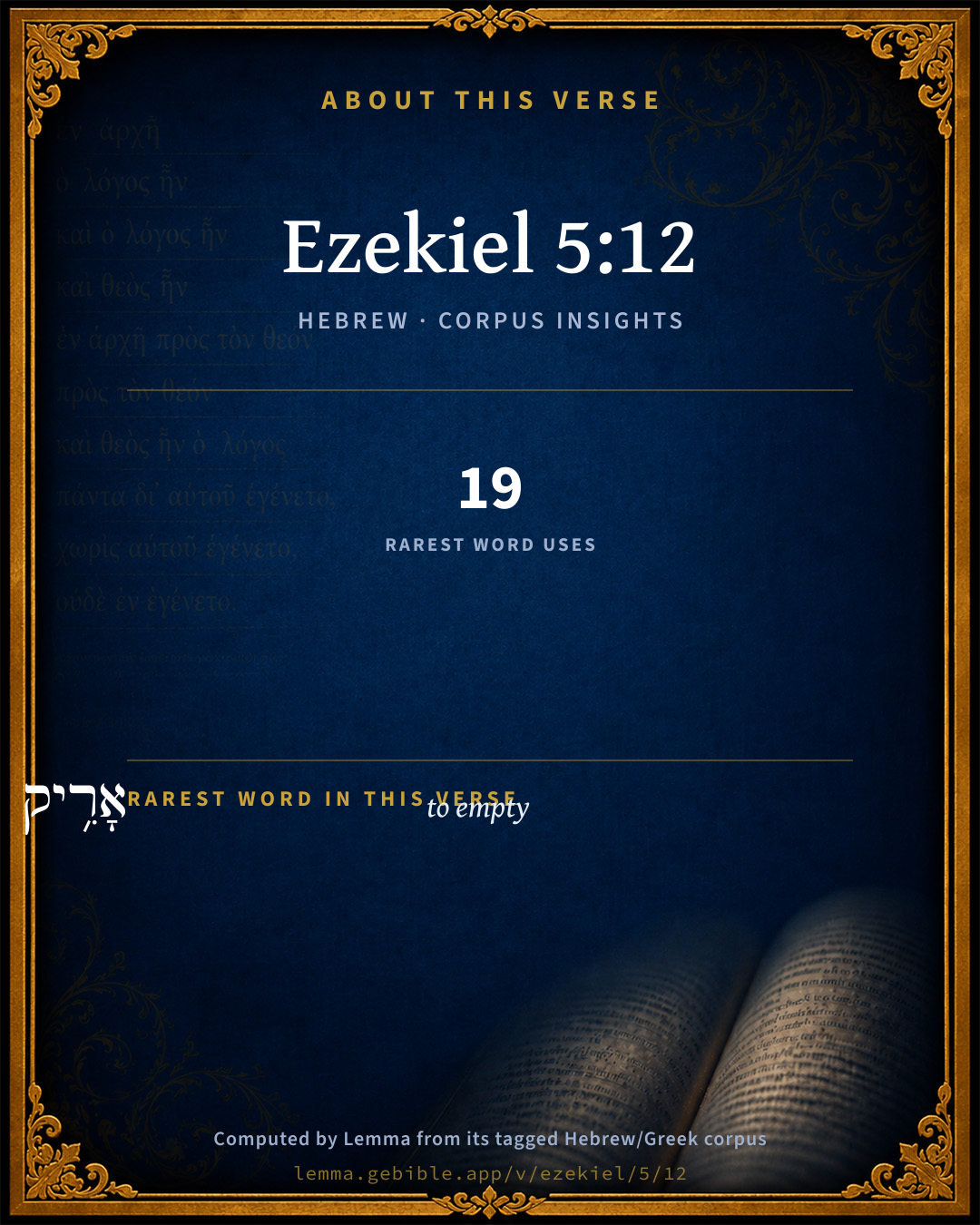
The rarest word here is אָרִ֥יק to empty H7324 — appearing just 19 times in the whole Hebrew Bible.

Shared distinctive vocabulary

אָרִ֥יק to empty H7324 occurs in 19 verses of the Hebrew Bible. Also found in:

Grammatical profile

  • 5 verbs
  • 9 nouns
  • 2 adjectives
  • 1 preposition

Verb forms

  • יָמ֗וּתוּ Qal · Imperfect
  • יִכְל֣וּ Qal · Imperfect
  • יִפְּל֣וּ Qal · Imperfect
  • אֱזָרֶ֔ה Piel · Imperfect
  • אָרִ֥יק Hiphil · Imperfect

Repetition

Words recur within this verse — often emphatic in Hebrew:

  • שְׁלִשִׁתֵ֞יךְ third H7992 ×3
  • בַּחֶ֖רֶב sword H2719 ×2

Hebrew & Septuagint length

In English translation the verse runs 53 words from the Hebrew and 64 from the Septuagint (LXX English) — closely comparable.

A rough comparison of the two English renderings, which tokenize alike — not a word-level alignment.

Word counts can differ between the Hebrew and the Greek without any difference in meaning — e.g. the Hebrew direct-object marker אֵת has no separate Greek word, and Greek often adds the article ὁ.

Cross-references

18

Topical passages linked to Ezekiel 5:12 in the Treasury of Scripture Knowledge — connected by theme and wording, ordered by reader-vote popularity; previews shown in the World English Bible.

  • Ezekiel 5:2 A third part shall you burn in the fire in the midst of the city, when the days of the siege are fulfilled; and you shall take a third part, and strike with the sword round about it; and a third part you shall scatter to the wind, and I will draw out a sword after them.
  • Jeremiah 15:2 It shall happen, when they tell you, Where shall we go forth? then you shall tell them, Thus says Yahweh: Such as are for death, to death; and such as are for the sword, to the sword; and such as are for the famine, to the famine; and such as are for captivity, to captivity.
  • Jeremiah 43:10–11 and tell them, Thus says Yahweh of Hosts, the God of Israel: Behold, I will send and take Nebuchadrezzar the king of Babylon, my servant, and will set his throne on these stones that I have hidden; and he shall spread his royal pavilion over them.
  • Jeremiah 21:9 He who remains in this city shall die by the sword, and by the famine, and by the pestilence; but he who goes out, and passes over to the Chaldeans who besiege you, he shall live, and his life shall be to him for a prey.
  • Ezekiel 12:14 I will scatter toward every wind all who are round about him to help him, and all his bands; and I will draw out the sword after them.
  • Jeremiah 44:27 Behold, I watch over them for evil, and not for good; and all the men of Judah who are in the land of Egypt shall be consumed by the sword and by the famine, until there be an end of them.
  • Ezekiel 5:10 Therefore the fathers shall eat the sons in the midst of you, and the sons shall eat their fathers; and I will execute judgments on you; and the whole remnant of you will I scatter to all the winds.
  • Ezekiel 6:11–12 Thus says the Lord Yahweh: Smite with your hand, and stamp with your foot, and say, Alas! because of all the evil abominations of the house of Israel; for they shall fall by the sword, by the famine, and by the pestilence.
  • Leviticus 26:33 I will scatter you among the nations, and I will draw out the sword after you: and your land will be a desolation, and your cities shall be a waste.
  • Deuteronomy 28:65 Among these nations shall you find no ease, and there shall be no rest for the sole of your foot: but Yahweh will give you there a trembling heart, and failing of eyes, and pining of soul;
  • Jeremiah 9:16 I will scatter them also among the nations, whom neither they nor their fathers have known; and I will send the sword after them, until I have consumed them.
  • Jeremiah 42:16–17 then it shall happen, that the sword, which you fear, shall overtake you there in the land of Egypt; and the famine, about which you are afraid, shall follow hard after you there in Egypt; and there you shall die.
  • Jeremiah 42:22 Now therefore know certainly that you shall die by the sword, by the famine, and by the pestilence, in the place where you desire to go to sojourn there.
  • Ezekiel 5:17 and I will send on you famine and evil animals, and they shall bereave you; and pestilence and blood shall pass through you; and I will bring the sword on you: I, Yahweh, have spoken it.
  • Ezekiel 6:8 Yet will I leave a remnant, in that you shall have some that escape the sword among the nations, when you shall be scattered through the countries.
  • Amos 9:4 Though they go into captivity before their enemies, there I will command the sword, and it will kill them. I will set my eyes on them for evil, and not for good.
  • Zechariah 7:14 "but I will scatter them with a whirlwind among all the nations which they have not known. Thus the land was desolate after them, so that no man passed through nor returned: for they made the pleasant land desolate."
  • Zechariah 13:7–9 "Awake, sword, against my shepherd, And against the man who is close to me," says Yahweh of Hosts. Strike the shepherd, and the sheep will be scattered; And I will turn my hand against the little ones.

Cross-references courtesy of OpenBible.info (CC BY 4.0).

Hebrew and Greek witnesses Masoretic Hebrew ↔ Greek Septuagint

The same verse in the two great witnesses to the Old Testament, shown verse-for-verse.

These are two independent witnesses, not word-aligned to each other, and the Septuagint is shown in lemma (dictionary) form.

Hebrew Ezekiel 5:12 Masoretic · Westminster Leningrad Codex

שְׁלִשִׁתֵ֞יךְ בַּדֶּ֣בֶר יָמ֗וּתוּ וּבָֽרָעָב֙ יִכְל֣וּ בְתוֹכֵ֔ךְ וְהַ֨שְּׁלִשִׁ֔ית בַּחֶ֖רֶב יִפְּל֣וּ סְבִיבוֹתָ֑יִךְ וְהַשְּׁלִישִׁית֙ לְכָל ר֣וּחַ אֱזָרֶ֔ה וְחֶ֖רֶב אָרִ֥יק אַחֲרֵיהֶֽם

A third part of you shall die with the pestilence, and with famine shall they be consumed in the midst of you; and a third part shall fall by the sword round about you; and a third part I will scatter to all the winds, and will draw out a sword after them.

World English Bible · Public Domain

Greek LXX Ezekiel 5:12 Septuagint · lemma form

ὁ τέταρτος σύ ἐν θάνατος ἀναἁλίσκω καί ὁ τέταρτος σύ ἐν λιμός συντελέω ἐν μέσος σύ καί ὁ τέταρτος σύ εἰς πᾶς ἄνεμος σκορπίζω αὐτός καί ὁ τέταρτος σύ ἐν ῥομφαία πίπτω κύκλος σύ καί μάχαιρα ἐκκενόω ὀπίσω αὐτός

A fourth part of you shall be cut off by pestilence, and a fourth part of you shall be consumed in the midst of you with famine: and as for another fourth part of you, I will scatter them to every wind; and a fourth part of you shall fall by sword round about you, and I will draw out a sword after them.

LXX2012 (modern English Septuagint) · Public Domain

On this verse, John Gill's Exposition discusses the Septuagint’s reading. Read the note in Commentary ↓

Hebrew: Westminster Leningrad Codex (CC BY 4.0). Greek: Septuagint (public domain); English from LXX2012 (modern English Septuagint) (Public Domain). How the Septuagint differs from the Hebrew →

Targum (Aramaic paraphrase)

1

The Targum is the ancient Jewish Aramaic paraphrase of the Hebrew Scriptures — an interpretive translation, not the Hebrew text itself. Onkelos (literal) and Pseudo-Jonathan (expansive) render the Torah, and Jonathan the Prophets. Coverage is partial: where no permissively-licensed English translation exists for a verse, only the Aramaic is shown. This is verse-level text, not a word-by-word alignment to the Hebrew.

  1. Targum Jonathan Prophets (Joshua–Malachi)
    תִּלְתִּיךְ בְּמוֹתָא יְמוּתוּן וּבְכַפְנָא יִשְׁתֵּיצוּן בְּגַוִיךְ וְתִלְתָּא בְּחַרְבָּא יִתְקַטְלוּן סַחֲרָנַיִךְ וְתִלְתָּא לְכָל רוּחַ אֲבַדַר וּדְקָטְלִין בְּחַרְבָּא אֱגָרֵי בַּתְרֵיהוֹן:

    (no public-domain English translation for this verse)

    Targum Jonathan — Aramaic: “Mikraot Gedolot” (public domain). English: “Sefaria Community Translation” (CC0 1.0 (public-domain dedication)); “London "Chaldee Paraphrase," 1871” (public domain). Text via Sefaria.

Commentary

Notes on Ezekiel 5:12 from classic Christian and Jewish commentators (each source and its license shown beneath its notes). The classic Christian expositions comment on the surrounding passage and are grouped to its opening verse, so a note may address several verses; the Jewish commentaries on the Tanakh (Rashi and others) are per-verse, so they appear only where the commentator wrote on this verse.

Lemma curates 59 commentaries, every one of them public domain or Creative Commons licensed, each selected and text-cleaned for this edition rather than reprinted as found. About our sources →

Trapp's Complete Commentary

John Trapp

Eze 5:12 A third part of thee shall die with the pestilence, and with famine shall they be consumed in the midst of thee: and a third part shall fall by the sword round about thee; and I will scatter a third part into all the winds, and I will draw out a sword after them.

Ver. 12. A third part of thee, &c.] See Eze 5:2.

John Trapp, A Commentary or Exposition upon All the Books of the Old and New Testament (1647–1656) — public domain. Text from a community e-Sword module.

Albert Barnes' Notes on the Bible

The judgments Eze 5:12-17 of “famine, pestilence,” and the “sword,” were precisely those which attended the coming siege of Jerusalem (Jer 15:2 ff). The “drawing out the sword after them” indicates that the anger of God will follow them even to the land of their exile (compare Jer 42:19-22; Lev 26:25), and that the horrors of the Babylonian siege are but the beginning of the sorrows of the nation.

Albert Barnes' Notes on the Bible (1834–1885) — public domain. Text from a community e-Sword/MySword module.

Matthew Poole's English Annotations

From this to the end of the chapter we have a particular and more express declaration how God would execute these severe judgments upon this people.

With pestilence; no doubt, though it were not mentioned or threatened, as Jer 34:17, we might conclude it could not but be in such a besieged city, where blood, putrifying carcasses, &c. annoy.

With famine; signified by fire, for it parcheth and withereth men.

Shall fall by the sword round about thee; as they did in their assailing the besiegers round about the walls, and as they did fall under the assault, when the enemy attempted to take the city, &c. See further Eze 5:12. of this chapter.

I will draw out a sword after them; when the Babylonians’ sword hath cut off all about Jerusalem, I will draw out my sword, and pursue the rest which Nebuchadnezzar could not reach.

Matthew Poole's English Annotations on the Holy Bible (1683–1685) — public domain. Text from a community e-Sword/MySword module.

Joseph Benson's Commentary

Eze 5:12-13. A third part of thee, &c. — In this verse is given an explication of what the burning of the hair, the smiting of it with a knife, &c., signified: see on Eze 5:2. And I will draw out a sword after them — My anger shall still pursue them, even into the countries whither they shall be banished and carried captives. As this was particularly fulfilled in those that went into Egypt, (see on Eze 5:4,) so it has been remarkably verified in the several persecutions and massacres they have undergone at different times in most of the countries of Europe, in latter ages: see note on Deu 28:65. Thus shall mine anger be accomplished — My anger shall be appeased toward them, after I have executed due punishment upon them for their sins. And I will cause my fury — Or rather, my wrath, or indignation, as, חמתיshould be rendered, for to apply the word fury to God, is highly improper and indecent: to rest upon them —

To be satisfied in punishing them. And I will be comforted — Here we have a strong instance of the metaphor called anthropopathia, by which the qualities of men are ascribed to God. As men sometimes find some sort of ease and rest in their minds upon venting their anger on just occasions, and bringing offenders to condign punishment; so God is here described as feeling ease and satisfaction in executing his justice on obstinate offenders: compare Eze 16:42; Eze 21:17; and see note on Isa 1:24. They shall know that I have spoken it in my zeal — Out of a just concern for my own honour and authority, which they have slighted and despised.

Joseph Benson's Commentary on the Old and New Testaments (1811–1818) — public domain. Text from a community e-Sword module.

Jamieson, Fausset & Brown

Robert Jamieson, A. R. Fausset & David Brown

Statement in plain terms of what was intended by the symbols (Eze 5:2; see Eze 6:12; Jer 15:2; Jer 21:9).

draw out . . . sword after them-- (Lev 26:33). Skeptics object; no such thing happened under Zedekiah, as is here foretold; namely, that a third part of the nation should die by pestilence, a third part by the sword, and a third be scattered unto all winds, and a sword sent after them. But the prophecy is not restricted to Zedekiah's time. It includes all that Israel suffered, or was still to suffer, for their sins, especially those committed at that period (Eze 17:21). It only received its primary fulfilment under Zedekiah: numbers then died by the pestilence and by the sword; and numbers were scattered in all quarters and not carried to Babylonia alone, as the objectors assert (compare Ezr 1:4; Est 3:8; Oba 1:14).

pestilence . . . and famine--signified by the symbol "fire" (Eze 5:2). Compare Isa 13:8; Lam 5:10; plague and famine burning and withering the countenance, as fire does.

Jamieson, Fausset & Brown — Commentary Critical and Explanatory on the Whole Bible (1871) — public domain (CC PDM 1.0). Text via the HelloAO Bible API.

Adam Clarke's Commentary

Verse 12. A third part of thee] See Clarke's notes on Eze 5:1-4.

Adam Clarke's Commentary on the Bible (1810–1826) — public domain. Text from a community e-Sword/MySword module.

John Calvin's Commentaries

Now he explains without a figure what he had previously proposed figuratively. For he had been commanded to shave off the hairs of his head and of his beard with a razor, and to divide them so that the pestilence should consume one part, the sword another, and the famine a third. Now he repeats the same thing but in another manner. Hence God explains why he had offered a vision of this kind to his servant. But he shortens what we formerly saw, because he omits the fourth member; for he was commanded to take some portion and to hide it under his armpit, or in the hem of his garment: but here there is no mention of that part, and yet it was not spoken in vain, but God speaks in various manners, and that by his own right. Meanwhile, both the figure and its application agree, because God was consuming the whole people by either famine, pestilence, or the sword. What was said concerning the fourth part was not in vain, but it was not necessary to repeat it. To this end then the Prophet tended, since some were survivors it might seem that they were exempt from the common slaughter: that he might take away that hope, he said, that they also, or at least many of them, should perish by burning, so that they should light up a fire in the whole people of Israel. For it happened through the unconquerable obstinacy of the people, that the wretched exiles were more hated; those who had already spared them began afresh to rage against them with cruelty, because the name of the people became detestable among all men. Because, therefore, the remnant of the citizens who remained at Jerusalem perished, hence it happened that the burning penetrated to the ten tribes, and to those wretched exiles who were captives in remote lands. But now our Prophet is silent on this point. In the meanwhile, he comprehends whatever we saw before, although more briefly: only that explanation was wanting, which, although it was formerly useful, yet ought not of necessity to be repeated. A third part, therefore, shall die by pestilence, and shall perish by hunger in the midst of thee; then a third part shall perish by the sword around thee, and a third part shall be scattered towards every wind: although God claims this for himself, I will scatter, says he, the third part, and draw out the sword after them, so that they also shall perish in their dispersion. Now that dispersion is by itself miserable, but God pronounces that he would not be content with that moderate punishment until he utterly consumed them. It follows —

John Calvin's Commentaries (1540-1563) — public domain. Text from the Calvin Translation Society English edition (1840s-50s) via the Christian Classics Ethereal Library (ccel.org). Calvin's coverage is partial (roughly two-thirds of the Bible); uncommented books and verses are honest gaps, never fabricated. The 19th-century editor's footnotes and remarks are omitted so the notes are faithfully Calvin's own voice.

The Cambridge Bible for Schools and Colleges

gen. ed. J. J. S. Perowne

12. Explanation of the symbol Eze_5:1-4.

The Cambridge Bible for Schools and Colleges (gen. ed. J. J. S. Perowne; Cambridge University Press, 1878–1918) — public domain. Text from a community e-Sword module.

John Gill's Exposition

A third part of them shall die with the pestilence,.... This, with what follows, explains the division of the hair into the three parts, and what was done with them; and shows that the burning of one third part denotes their being destroyed by the pestilence, mentioned along with burning coals, Hab 3:5; and by famine, as follows:

and with famine shall they be consumed in the midst of thee; and though there is no account of the former, yet there is of the latter; and no doubt but the pestilence raged, as well as the famine, at the siege of Jerusalem by Nebuchadnezzar:

and a third part shall fall by the sword round about thee; signified by the third part of the hair, smitten with a knife; and intends such as perished by the sword of the Chaldeans at the taking of the city, and when they fled out of it; and so are properly said to fall round about it:

and I will scatter a third part into all the winds; the greatest part of which were carried into Babylon, and others into other parts; See Gill on Eze 5:2;

and I will draw out a sword after them; particularly after them that went into Egypt. The Septuagint and Arabic versions read a "fourth part" in each clause, as before; and make it out thus, "a fourth part of thee shall be consumed with death (the pestilence); and a fourth part of thee shall be consumed with famine in the midst of thee; and a fourth part of thee I will scatter to every wind; and a fourth part of thee shall fall by the sword round about thee; and I will draw out the sword after them".

John Gill's Exposition of the Whole Bible (1746–1763) — public domain (CC PDM 1.0). Text via the HelloAO Bible API.

Haydock's Catholic Bible Commentary

Pestilence. Septuagint, "death;" so they usually denote pestilence. They add, "and a fourth part of thee shall be," &c., ver. 2. (Haydock)

George Leo Haydock (1774–1849), Haydock's Catholic Family Bible and Commentary, 1859 edition — public domain. Excludes Psalms (Douay-Rheims chapter numbering differs from Protestant) and Deuterocanonical books (Catholic canon only).

Whedon's Commentary on the Bible

Daniel D. Whedon

12. See Eze_5:1-4; compare Jer_15:2. Dav. Hein. Muller, Ezekiel Studien, 1893, has pointed out the very curious resemblance which this verse bears to many cuneiform inscriptions where sword, famine, and pestilence are joined together. For instance, Assur-banipal, who might almost be called a contemporary of Ezekiel, saw a divine decree written upon the disk of the moon: “By the iron sword, by the burning fire, by famine, and by pestilence I will make an end of his life.” Because of such coincidences Dr. Muller believes Ezekiel, even if he had not studied the cuneiform literature in detail, must at least have had some one “read to him the standard inscriptions.” His proof, however, hardly sustains his conclusions, while Eze_3:5-6, would intimate that Ezekiel was not well acquainted with the Babylonian language.

Daniel D. Whedon (gen. ed.), Commentary on the Old and New Testaments (1874–1909) — public domain. Text from a community e-Sword module.

The Pulpit Commentary

A third part of thee, etc. (see note on ver. 2). The strange symbolic act is now interpreted. I will draw out a sword, etc. The phrase recurs in Eze_12:14, and is found in Lev_26:33 an echo, like so many other passages in Ezekiel, from what seems to have been his favourite storehouse of thought and language (Leviticus 17-26.).

The Pulpit Commentary (1880–1919), ed. H.D.M. Spence-Jones & Joseph S. Exell — public domain. Text from a community e-Sword module.

Lesson kit

Teaching starters — assembled from the data on this page, not authored interpretation. Every prompt links to the verse data it draws on. Edit before teaching.

Ezekiel, in the Prophets, opens this verse with 17 words (14 distinct Hebrew lemmas). Its most distinctive word is rûwq (“to empty”). A historical commentator’s framing appears above. Read the whole chapter for the surrounding context.

Discussion questions

  1. How does “to empty” (rûwq) shape what this verse is saying?
  2. How does Genesis 14:14, which shares the word «to empty», read alongside this verse?
  3. What does the repetition of “third” (3× in this one verse) do in this verse?
  4. These translations render this verse differently. What is at stake in choosing one wording over another?
  5. «יָמ֗וּתוּ» is a Qal Imperfect verb. How does that grammatical form shape the action described?
  6. Compare how Trapp's Complete Commentary and Albert Barnes' Notes on the Bible read this verse. Where do they agree or differ?

Things to notice

Reading settings

Reading text

Shown beneath each verse's original-language words.

Old Testament
Old Testament edition

Read the OT as the Masoretic Hebrew (MT) or the Greek Septuagint (LXX).

English shown for the Greek Septuagint (in the Hebrew ↔ Greek comparison).

Comparing translations? Open the Compare panel on any verse page to stack up to four side by side.