
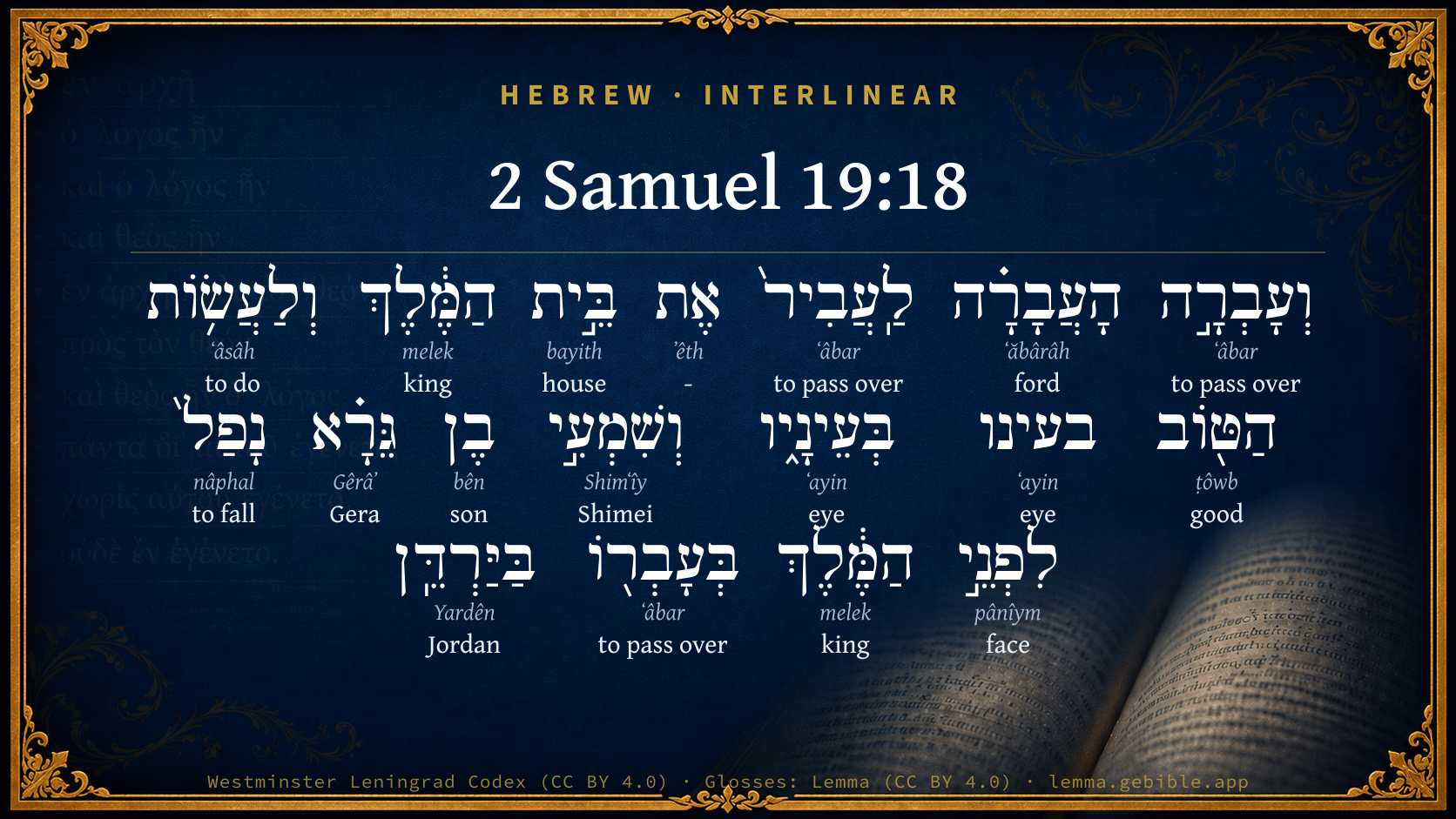
2 Samuel 19:18

Hebrew (Westminster Leningrad Codex) 2 Samuel 19:18 appears in the Hebrew Old Testament. The text above is from the Westminster Leningrad Codex. Each word links to its Strong’s number, a concise gloss, and parsing drawn from the Open Scriptures Hebrew Bible morphology. Click any word for its full Brown-Driver-Briggs (BDB) entry.
Download image
Cite this verse

2 Samuel 19:18 (World English Bible). Public Domain. Lemma interlinear Bible study tool, https://lemma.gebible.app/v/2-samuel/19/18.

Show BibTeX & RIS
BibTeX
RIS
English Translation
There went over a ferry-boat to bring over the king's household, and to do what he thought good. Shimei the son of Gera fell down before the king, when he was come over the Jordan.
World English Bible · Public Domain
Download a study sheet

One document with this verse’s original text, its word-by-word gloss line, the meaning frame, cross-references with their text, attributed commentary, and full source and license credits — printable, and it pastes into notes with its structure intact.

This verse Autodidact and up

Study sheet (.html) Plain text (.txt)

A passage Seminary Student

Up to 50 verses in one chapter. A passage sheet keeps up to 6 commentary sources and 12 cross-references per verse, in the order this page ranks them, and says so on the sheet whenever that leaves anything out. Ask for a single verse and you get the Autodidact verse sheet above.

Everything on this page stays free to read, with no account — the sheet is a download of what is already on screen, not access to it.

Want to remove ads? Support Godless Engineer
Compare translations 3

The same verse in 3 English versions, stacked beneath the original-language interlinear above. Click any original word for its lexicon entry.

Each is an independent rendering of the whole verse — the interlinear is not word-aligned to these translations.

Highlighted words mark where these versions differ — a whole-verse word diff, not a word-by-word alignment.

  • World English Bible Public Domain
    There went over a ferry-boat to bring over the king's household, and to do what he thought good. Shimei the son of Gera fell down before the king, when he was come over the Jordan.
  • King James Version Public Domain
    And there went over a ferry boat to carry over the king's household, and to do what he thought good. And Shimei the son of Gera fell down before the king, as he was come over Jordan;
  • unfoldingWord Literal Text CC BY-SA 4.0
    And they crossed the ford to bring over the house of the king and to do the good in his eyes. And Shimei, the son of Gera, fell to the face of the king when he crossed in the Jordan.

unfoldingWord Literal Text — © unfoldingWord, licensed CC BY-SA 4.0. Word-aligned USFM3 via Door43 (git.door43.org/unfoldingWord/en_ult).

Versions to compare (up to 4)

3 of 4 selected

Show all 18 translations

Every available English version of this verse, each an independent rendering of the whole verse.

  • World English Bible Public Domain
    There went over a ferry-boat to bring over the king's household, and to do what he thought good. Shimei the son of Gera fell down before the king, when he was come over the Jordan.
  • Berean Standard Bible Public Domain
    and crossed at the ford to carry over the king’s household and to do what was good in his sight. When Shimei son of Gera crossed the Jordan, he fell down before the king
  • Majority Standard Bible Public Domain
    and crossed at the ford to carry over the king’s household and to do what was good in his sight. When Shimei son of Gera crossed the Jordan, he fell down before the king
  • King James Version Public Domain
    And there went over a ferry boat to carry over the king's household, and to do what he thought good. And Shimei the son of Gera fell down before the king, as he was come over Jordan;
  • American Standard Version (1901) Public Domain
    And there went over a ferry-boat to bring over the king's household, and to do what he thought good. And Shimei the son of Gera fell down before the king, when he was come over the Jordan.
  • Revised Version (1885) Public Domain
    And there went over a ferry boat to bring over the king’s household, and to do what he thought good. And Shimei the son of Gera fell down before the king, when he was come over Jordan.
  • Geneva Bible (1599) Public Domain
    And there went ouer a boate to carie ouer the Kings houshold, and to do him pleasure. Then Shimei the sonne of Gera fell before the King, when he was come ouer Iorden,
  • Douay-Rheims (1899) Public Domain
    They passed the fords before the king, that they might help over the king's household, and do according to his commandment. And Semei the son of Gera falling down before the king, when he was come over the Jordan,
  • Young's Literal Translation Public Domain
    And passed over hath the ferry-boat to carry over the household of the king, and to do that which `is' good in his eyes, and Shimei son of Gera hath fallen before the king in his passing over into Jordan,
  • Literal Standard Version CC BY-SA 4.0
    And the ferry-boat has passed over to carry over the household of the king, and to do that which [is] good in his eyes, and Shimei son of Gera has fallen before the king in his passing over into the Jordan,
  • Unlocked Literal Bible CC BY-SA 4.0
    They crossed to bring over the king's family and to do whatever he thought good. Shimei son of Gera bowed down before the king just before he began to cross the Jordan.
  • unfoldingWord Literal Text CC BY-SA 4.0
    And they crossed the ford to bring over the house of the king and to do the good in his eyes. And Shimei, the son of Gera, fell to the face of the king when he crossed in the Jordan.
  • Darby Bible Public Domain
    And a ferry boat passed to and fro to carry over the king's household, and to do what he thought good. And Shimei the son of Gera fell down before the king as he was [just] crossing over the Jordan.
  • World Messianic Bible Public Domain
    A ferry boat went to bring over the king’s household, and to do what he thought good. Shimei the son of Gera fell down before the king when he had come over the Jordan.
  • Webster's Bible Public Domain
    And there went over a ferry-boat to carry over the king's household, and to do what he thought good. And Shimei the son of Gera fell down before the king, as he came over Jordan;
  • Free Bible Version CC BY-SA 4.0
    They crossed at the ford to bring the king's household over and whatever else he wanted. Shimei crossed the Jordan and fell facedown before the king.
  • Bible in Basic English Public Domain
    And kept going across the river to take the people of the king's house over, and to do whatever was desired by the king. And Shimei, the son of Gera, went down on his face in the dust before the king, when he was about to go over Jordan,
  • JPS Tanakh (1917) Public Domain
    (19-19) And the ferryboat passed to and fro to bring over the king's household, and to do what he thought good. And Shimei the son of Gera fell down before the king, when he would go over the Jordan.

Literal Standard Version (2020), Covenant Press — licensed CC BY-SA 4.0. Text via the HelloAO Bible API (eBible.org). Unlocked Literal Bible (unfoldingWord) — licensed CC BY-SA 4.0. Text via the HelloAO Bible API (eBible.org). unfoldingWord Literal Text — © unfoldingWord, licensed CC BY-SA 4.0. Word-aligned USFM3 via Door43 (git.door43.org/unfoldingWord/en_ult). Free Bible Version, Dr. Jonathan Gallagher — licensed CC BY-SA 4.0. Text via the HelloAO Bible API (eBible.org).

Word by word

More ways to search: Search by grammar → Find every occurrence → Compare this word →

Practice this passage: Drill this verse → Learn its vocabulary →

הָעֲבָרָ֗ה
ʻăbârâh
H5679
“the · ford”
Particle, Definite Article + Noun, Common, Feminine, Singular, Absolute
Part of Speech
Particle + Noun
Type
Common
Gender
Feminine
Number
Singular
State
Absolute
Full BDB Definition

Origin: from H5674

TWOT: 1556c

ford
  1. וְעָבְרָ֣ה ʻâbar H5674 “and · to pass over” Conjunction + Verb, Qal, Perfect, 3rd Person, Feminine, Singular
  2. לַֽעֲבִיר֙ ʻâbar H5674 “to pass over” Preposition + Verb, Hiphil, Infinitive Construct
  3. אֶת ʼêth H853 “-” Particle, Direct Object
  4. בֵּ֣ית bayith H1004 “house of” Noun, Common, Masculine, Singular, Construct
  5. הַמֶּ֔לֶךְ melek H4428 “the · king” Particle, Definite Article + Noun, Common, Masculine, Singular, Absolute
  6. וְלַעֲשׂ֥וֹת ʻâsâh H6213 “and · to do” Conjunction + Preposition + Verb, Qal, Infinitive Construct
  7. הַטּ֖וֹב ṭôwb H2896 “the · good” Particle, Definite Article + Adjective, Adjective, Masculine, Singular, Absolute
  8. בעינו ʻayin H5869 “in/at · eyes · his” Preposition + Noun, Common, Both, Dual, Construct + Suffix, Personal, 3rd Person, Masculine, Singular
  9. בְּעֵינָ֑יו ʻayin H5869 “in/at · eyes · his” Preposition + Noun, Common, Both, Dual, Construct + Suffix, Personal, 3rd Person, Masculine, Singular
  10. וְשִׁמְעִ֣י Shimʻîy H8096 “and · Shimei” Conjunction + Noun, Proper
  11. בֶן bên H1121 “son of” Noun, Common, Masculine, Singular, Construct
  12. גֵּרָ֗א Gêrâʼ H1617 “Gera” Noun, Proper
  13. נָפַל֙ nâphal H5307 “to fall” Verb, Qal, Perfect, 3rd Person, Masculine, Singular
  14. לִפְנֵ֣י pânîym H6440 “to/for · face(s) of” Preposition + Noun, Common, Both, Plural, Construct
  15. הַמֶּ֔לֶךְ melek H4428 “the · king” Particle, Definite Article + Noun, Common, Masculine, Singular, Absolute
  16. בְּעָבְר֖וֹ ʻâbar H5674 “in/at · to pass over · him” Preposition + Verb, Qal, Infinitive Construct + Suffix, Personal, 3rd Person, Masculine, Singular
  17. בַּיַּרְדֵּֽן Yardên H3383 “in/at the · Jordan” Preposition, Determined + Noun, Proper

About this verse

These counts appear in no published source. They are computed here, from the morphology-tagged text and Lemma’s own curated glosses. What Lemma adds →

18
words
14
distinct lemmas
Historical
section

Notable vocabulary

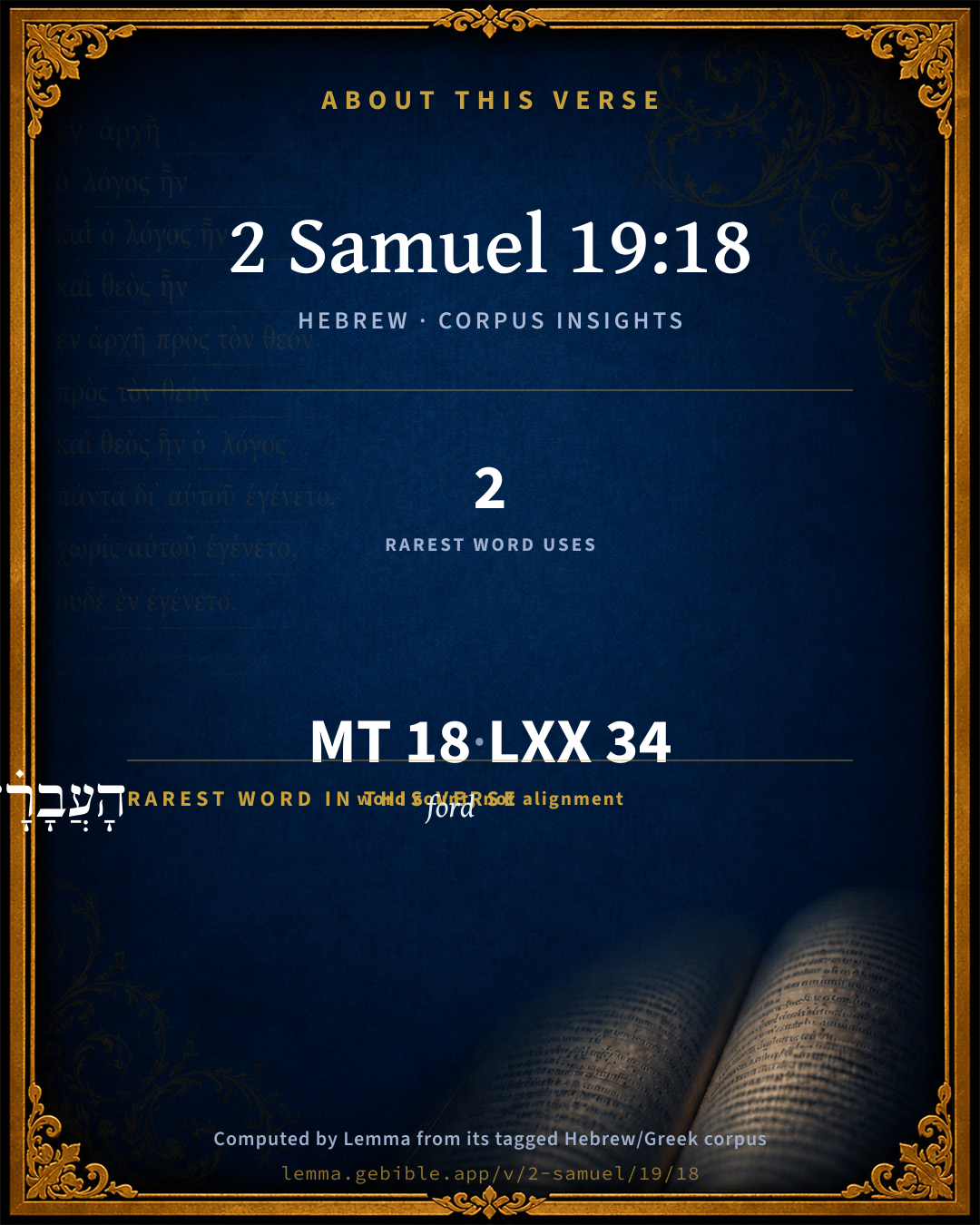
The rarest word here is הָעֲבָרָ֗ה ford H5679 — appearing just 2 times in the whole Hebrew Bible.

Shared distinctive vocabulary

הָעֲבָרָ֗ה ford H5679 occurs in 2 verses of the Hebrew Bible. Also found in:

Grammatical profile

  • 5 verbs
  • 11 nouns
  • 1 adjective
  • 1 particle

Verb forms

  • וְעָבְרָ֣ה Qal · Perfect
  • לַֽעֲבִיר֙ Hiphil · Infinitive Construct
  • וְלַעֲשׂ֥וֹת Qal · Infinitive Construct
  • נָפַל֙ Qal · Perfect
  • בְּעָבְר֖וֹ Qal · Infinitive Construct

Repetition

Words recur within this verse — often emphatic in Hebrew:

  • וְעָבְרָ֣ה to pass over H5674 ×3
  • הַמֶּ֔לֶךְ king H4428 ×2
  • בעינו eye H5869 ×2

Hebrew & Septuagint length

In English translation the verse runs 35 words from the Hebrew and 51 from the Septuagint (LXX English) — the Septuagint runs noticeably longer here. See the side-by-side →

A rough comparison of the two English renderings, which tokenize alike — not a word-level alignment.

Word counts can differ between the Hebrew and the Greek without any difference in meaning — e.g. the Hebrew direct-object marker אֵת has no separate Greek word, and Greek often adds the article ὁ.

In the original languages it is 18 Hebrew tokens and 34 Greek tokens — but the two are counted differently (Hebrew bundles its prefixes and suffixes into one token; the Greek is in lemma form), so that isn’t a like-for-like length.

Cross-references

3

Topical passages linked to 2 Samuel 19:18 in the Treasury of Scripture Knowledge — connected by theme and wording, ordered by reader-vote popularity; previews shown in the World English Bible.

  • Psalms 66:3 Tell God, "How awesome are your deeds! Through the greatness of your power, your enemies submit themselves to you.
  • Psalms 81:15 The haters of Yahweh would cringe before him, And their punishment would last forever.
  • Revelation 3:9 Behold, I give of the synagogue of Satan, of those who say they are Jews, and they are not, but lie. Behold, I will make them to come and worship before your feet, and to know that I have loved you.

Cross-references courtesy of OpenBible.info (CC BY 4.0).

Hebrew and Greek witnesses Masoretic Hebrew ↔ Greek Septuagint

The same verse in the two great witnesses to the Old Testament, shown verse-for-verse.

Here the Septuagint runs noticeably longer than the Hebrew — LXX2012 (modern English Septuagint) 51 words vs World English Bible 35. A rough length comparison of the two English translations, not a word-level alignment — read both below.

These are two independent witnesses, not word-aligned to each other, and the Septuagint is shown in lemma (dictionary) form.

Hebrew 2 Samuel 19:18 Masoretic · Westminster Leningrad Codex

וְעָבְרָ֣ה הָעֲבָרָ֗ה לַֽעֲבִיר֙ אֶת בֵּ֣ית הַמֶּ֔לֶךְ וְלַעֲשׂ֥וֹת הַטּ֖וֹב בעינו בְּעֵינָ֑יו וְשִׁמְעִ֣י בֶן גֵּרָ֗א נָפַל֙ לִפְנֵ֣י הַמֶּ֔לֶךְ בְּעָבְר֖וֹ בַּיַּרְדֵּֽן

There went over a ferry-boat to bring over the king's household, and to do what he thought good. Shimei the son of Gera fell down before the king, when he was come over the Jordan.

World English Bible · Public Domain

Greek LXX 2 Samuel 19:18 Septuagint · lemma form

καί χίλιοι ἀνήρ μετά αὐτός ἐκ ὁ βενιαμίν καί σιβα ὁ παιδάριον ὁ οἶκος σαούλ καί δέκα πέντε υἱός αὐτός μετά αὐτός καί εἴκοσι δοῦλος αὐτός μετά αὐτός καί ὁ ἰορδάνης ἔμπροσθεν ὁ βασιλεύς

and they performed the service of bringing the king over; and there went over a ferry-boat to remove the household of the king, and to do that which was right in his eyes. And Semei the son of Gera fell on his face before the king, as he went over Jordan;

LXX2012 (modern English Septuagint) · Public Domain

On this verse, Whedon's Commentary on the Bible discusses the Septuagint’s reading. Read the note in Commentary ↓

Hebrew: Westminster Leningrad Codex (CC BY 4.0). Greek: Septuagint (public domain); English from LXX2012 (modern English Septuagint) (Public Domain). How the Septuagint differs from the Hebrew →

Targum (Aramaic paraphrase)

1

The Targum is the ancient Jewish Aramaic paraphrase of the Hebrew Scriptures — an interpretive translation, not the Hebrew text itself. Onkelos (literal) and Pseudo-Jonathan (expansive) render the Torah, and Jonathan the Prophets. Coverage is partial: where no permissively-licensed English translation exists for a verse, only the Aramaic is shown. This is verse-level text, not a word-by-word alignment to the Hebrew.

  1. Targum Jonathan Prophets (Joshua–Malachi)
    וַאֲלַף גַבְרָא עִמֵיהּ מִשִׁבְטָא דְבִנְיָמִין וְצִיבָא עוּלֵימָא דְבֵית שָׁאוּל וְחַמְשַׁת עֲסַר בְּנוֹהִי וְעַשְׂרִין עַבְדוֹהִי עִמֵיהּ וְגָזוּ יַרְדְנָא קֳדָם מַלְכָּא:

    (no public-domain English translation for this verse)

    Targum Jonathan — Aramaic: “Mikraot Gedolot” (public domain). English: “Sefaria Community Translation” (CC0 1.0 (public-domain dedication)); “London "Chaldee Paraphrase," 1871” (public domain). Text via Sefaria.

Commentary

Notes on 2 Samuel 19:18 from classic Christian and Jewish commentators (each source and its license shown beneath its notes). The classic Christian expositions comment on the surrounding passage and are grouped to its opening verse, so a note may address several verses; the Jewish commentaries on the Tanakh (Rashi and others) are per-verse, so they appear only where the commentator wrote on this verse.

Lemma curates 59 commentaries, every one of them public domain or Creative Commons licensed, each selected and text-cleaned for this edition rather than reprinted as found. About our sources →

Trapp's Complete Commentary

John Trapp

2Sa 19:18 And there went over a ferry boat to carry over the king’s household, and to do what he thought good. And Shimei the son of Gera fell down before the king, as he was come over Jordan;

Ver. 18. And there went over a ferry boat.] Ponto. This boat the tribe of Judah had sent before, and Shimei with his company followed it, to make his peace with the king.

John Trapp, A Commentary or Exposition upon All the Books of the Old and New Testament (1647–1656) — public domain. Text from a community e-Sword module.

The Biblical Illustrator

Joseph S. Exell

2Sa_19:18

There went over a ferry boat to carry over the kings household.

The ferry-boat of the Jordan

This river Jordan, in all ages and among all Christian people, has been the symbol of the boundary line between earth and heaven. I want to show you to-day that there is a way over Jordan as well as through it. My text says: And there went over a ferry boat to carry over the kings household.

I. My subject, in the first place, impresses me with the fact that when we cross over from this world to the next, the boat will have to come from the other side. The tribe of Judah, we are informed, sent this ferry boat across to bring David and his household. Blessed be God, there is a boat coming from the other side. Transportation at last for our souls from the other shore. Everything about this Gospel of Mercy from the other shore. Pardon from the other shore. Mercy from the other shore. Pity from the other shore. Ministry of angels from the other shore. Power to work miracles from the other shore. Jesus Christ from the other shore. This is a faithful saying, and worthy of all acceptation: Christ Jesus came into the world to save sinners. I bless God that as the boat came from the other shore to take David and his men across, so, when we come to die, the boat of salvation will come from the same direction. God forbid that I should ever trust to anything that starts from this side.

II. When we cross over at the last, the king will be on board the boat. The king was on board the boat, and those women and children, and all the household of the king, knew that every care was taken to have that king pass in safety. When a soul goes to heaven, it does not go alone. The King is on board the boat. Was Paul alone in the last exigency? Hear the shout of the scarred missionary, as he cries out, I am now ready to be offered up, and the time of my departure is at hand. Was John Wesley alone in the last exigency? No. Hear him say: Best of all, God is with us. Here is the promise: When thou passeth through the waters, I will be with thee, and through the rivers, they shall not overflow thee. Christ at the sick pillow to take the soul out of the body; Christ to help the soul down the bank into the boat; Christs mid stream; Christ on the other side to help the soul up the beach. Be comforted about your departed friends. Be comforted about your own demise when the time shall come. Tell it to all the people under the sun that no Christian ever dies alone. The King is in the boat.

III. My text suggests that leaving this world for heaven is only crossing a ferry. Doctor Shaw estimates the average width of the Jordan to be about thirty yards. What, so narrow! Yes. There went over a ferry-boat to carry over the kings household. Yes, going to heaven is only a short trip. Only a ferry. That accounts for something you have never been able to understand. You never could have supposed that very nervous and timid Christian people could be so perfectly unexcited and placid in the last hour. The fact is, they were clear down on the bank, and they saw there was nothing to be frightened about. Such a short distance--only a ferry! With one ear they heard the funeral psalm in their memory, and with the other they heard the song of heavenly salutation. The willows on this side the Jordan, and the Lebanon cedars on the other, almost interlocked their branches. Only a ferry!

IV. My subject also suggests the fact that when we cross over at the last, we shall find a solid landing. The ferry-boat, as spoken of in my text, means a place to start from, and a place to land. David and his people did not find the eastern shore of the Jordan any more solid than the western shore where he landed, and yet, to a great many, heaven is not a real place. I never heard of any heaven I want to go to except St. Johns heaven. I believe I shall hear Mr. Toplady sing vet, and Isaac Watts recite hymns, and Mozart play. O, you say, where would you get the organ? The Lord will provide the organ. I believe I shall yet see David with a harp, and I will ask him to sing one of the Songs of Zion. My heaven is not a fog-bank. My eyes are unto the hills--the everlasting hills. The Kings ferry-boat starting from a wharf on this side will go to a solid landing-place on the other side.

V. My subject teaches that when we cross over at the last, we will be met at the landing. When David and his family went over in the ferry-boat spoken of in the text, they landed amid a nation that had come out to greet them. As they stepped from the deck of the boat to the shore, there were thousands of people who gathered around them trying to express a satisfaction that was beyond description. And so you and I will be met at the landing. Our arrival will not be like stepping ashore at Antwerp or Constantinople among a crowd of strangers; it will be among friends--good friends, warm-hearted friends, and all their friends. The poet Southey said he thought he should know Bishop Heber in heaven by the portraits he had seen of him in London; and Dr. Randolph said he thought he should know William Cowper, the poet, in heaven from the pictures he had seen of him in England; but we shall know our departed kindred by the portraits hung in the throne-room of our hearts. On starlight nights you look up--and I suppose it is so with any one who has friends in heaven--and you cannot help but think of those who have gone; and I suppose they look down and cannot but think of us. But they have the advantage of us. We know not just where their world of joy is. They know where we are. O, what a consolation this ought to be to those whose friends have gone away--how it ought to take off the sharp edge of their melancholy. The partings of earth solaced by the reunions of heaven t (T. De Witt Talmage.)

The kings ferry boats

There have been few scenes on the Jordan more interesting than that in which this ferry boat plays a part.

I. The Kings ferry boat carries us across the Jordan of our condemnation, and brings us to the land of forgiveness. Shimei made his peace with David that day. He had been, in the time of Davids great emergency, when he needed soldiers, a base and wicked traitor. So I bring to any poor sinner here the Kings ferry boat, on which you may safely ride across the Jordan of your sins to the blessed shore of forgiveness; it is surrender to God and unconditional acceptance of Christ Jesus as your Saviour.

II. God carries His people across the river of their needs. Gods Word assures us that the Lord is not unmindful of the necessities of our human lives. Christ says: Your Heavenly Father knoweth that ye have need of all these things. The man who trusts God is a great deal better taken care of than he who proposes to neglect God and look out for number one. We shall never reach the limit of Gods infinite grace and mercy by our most exaggerated dreams of good. Does not Paul assure us that God will supply all our need according to His riches in glory by Christ Jesus? The one ferry boat that is sure to float you across the river of lifes need is a genuine, wholehearted Christianity.

III. The Kings ferry boat across the river of trouble and sorrow. How abundant are the promises of God that those who join His household shall be ferried safely across all the sorrows and troubles of life!

IV. We may see also in this figure our Kings ferry boat across the river of death. God does not leave his saints to die alone. Two days before Mr. Moodys death there was placed in his room, unknown to him, a stenographer, who took every word that fell from the good mans lips. And in the last moments he said: Earth recedes. Heaven opens before me. You say this is death. There is nothing awful here; it is sweet, this place. Do not call me back. God is calling me, I must go. There is no valley here, it is all beautiful, beautiful. So Moody found, as millions of Gods people have found before, that the Kings ferry boat is roomy and splendid, and safe in carrying the Kings household across the Jordan of death to the shores of that beautiful country which eager hearts expect. The ferry boat will not be lonely in crossing any of these streams, for Christ is Captain, and there are no rules that keep us from speaking to him while he is on duty. We may hold sweet communion with him all the way. On the ferry boats which ply between Liverpool and the Cheshire side of the Mersey is the notice: Passengers are requested not to speak to the captain or steersman while crossing the river. (L. A. Banks, D. D.)

2Sa_19:18-23

And Shimei the son of Gera fell down before the king.

Characteristic forgiveness

One man will forgive a grievous wrong while another will not overlook a wry word. King John had most villainously treated his brother Richard in his absence. Was it likely that when he of the lions heart came home he would pass over his brothers offence? If you look at John, villain that he was, it was most unlikely that he should be forgiven; but then, if you consider the brave, high-souled Richard, the very flower of chivalry, you expect a generous deed. Base as John was, he was likely to be forgiven, because Richard was so free of heart, and accordingly pardon was right royally given by the great, hearted monarch. Had John only been half as guilty, if his brother Richard had been like himself, he would have made him lay his neck on the block. If John had been Richard and Richard had been John, no matter how small the offence, there would have been no likelihood of pardon at all. So it is in all matters of transgression and pardon. You must take the offence somewhat into account, it is true, but not one-half so much as the character of the person who has been offended. (C. H. Spurgeon.)

A wise king

Alphonsus, King of Naples and Sicily, justly celebrated in history for his leninecy and mercy, was once asked why he was so lenient to all, even the most wicked men. Because, said he, good men are won by justice, the bad by mercy. On another occasion some complained that he was too kind, even for a prince. What, then? cried the king; would you have lions and tigers to reign over you? Do you not know that cruelty is the property of wild beasts, mercy that of man?

The Biblical Illustrator, edited by Joseph S. Exell (c. 1880s–1900s) — public domain. Text from a community e-Sword module.

Joseph Benson's Commentary

2Sa 19:18-20. There went over a ferry-boat — Prepared, it is likely, by the men of Judah. Josephus says, it was a bridge, composed, perhaps, of many boats joined together. Shimei fell down before the king — That he might confess his guilt and perverseness, and implore forgiveness. Neither do thou remember that which thy servant did — So as to resent it deeply, and take revenge. Behold, I am come the first of all the house of Joseph — Shimei knew that a Benjamite, of the house of Saul, came but ill recommended to David under that character; and, therefore, he would not denominate himself from Benjamin, but from Joseph, his beloved brother.

Joseph Benson's Commentary on the Old and New Testaments (1811–1818) — public domain. Text from a community e-Sword module.

Jamieson, Fausset & Brown

Robert Jamieson, A. R. Fausset & David Brown

ferry boat--probably rafts, which are still used on that part of the river.

Jamieson, Fausset & Brown — Commentary Critical and Explanatory on the Whole Bible (1871) — public domain (CC PDM 1.0). Text via the HelloAO Bible API.

Adam Clarke's Commentary

Verse 18. There went over a ferry-boat] This is the first mention of any thing of the kind. Some think a bridge or raft is what is here intended.

Adam Clarke's Commentary on the Bible (1810–1826) — public domain. Text from a community e-Sword/MySword module.

Ellicott's Commentary for English Readers

(18) As he was come over.—Rather, as he was coming over, as he was about to cross. Shimei and Ziba met the king on the east of Jordan, and his crossing is not spoken of until 2Sa_19:31-40.

A Bible Commentary for English Readers, edited by Charles John Ellicott (1878–1897) — public domain. Text from a community e-Sword module.

The Cambridge Bible for Schools and Colleges

gen. ed. J. J. S. Perowne

18. And there went over a ferry-boat] And the ferry-boat was passing to and fro, placed at the service of the king by the men of Judah.

as he was come over Jordan] This probably means as David was crossing over the Jordan, i.e. during the general proceedings of the transit, not necessarily during the actual passage. Shimei seems to have crossed along with Ziba to meet the king on the eastern bank. David’s crossing is not mentioned till 2Sa_19:39.

The Cambridge Bible for Schools and Colleges (gen. ed. J. J. S. Perowne; Cambridge University Press, 1878–1918) — public domain. Text from a community e-Sword module.

John Gill's Exposition

And there went over a ferry boat to carry over the king's household,.... His wives and children, who could not so well ford the river on foot: some will have this to be a bridge of boats, a pontoon; and Abarbinel thinks it might be a company of men, who carried the women and children on their shoulders, one after another:

and to do what he thought good; to carry over whatever else the king pleased, besides his family:

and Shimei the son of Gera fell down before the king, as he was come over Jordan; or just as he was about to come over, when he came to Jordan to take the boat in order to come over; for he went over Jordan to meet him, and therefore would take the first opportunity of coming into his presence, and fall down before him, and make his submission to him.

John Gill's Exposition of the Whole Bible (1746–1763) — public domain (CC PDM 1.0). Text via the HelloAO Bible API.

Albert Barnes' Notes on the Bible

As he was come over Jordan - Render, “when he was crossing,” i. e., just embarking for the purpose of crossing. The scene still lies on the east bank. Shimei left nothing undone to soften, if possible, David’s resentment.

Albert Barnes' Notes on the Bible (1834–1885) — public domain. Text from a community e-Sword/MySword module.

Haydock's Catholic Bible Commentary

Fords. Hebrew also, "they took over the ferry-boat;" (Calmet) or, "there went across a ferry-boat to carry over the," &c.

George Leo Haydock (1774–1849), Haydock's Catholic Family Bible and Commentary, 1859 edition — public domain. Excludes Psalms (Douay-Rheims chapter numbering differs from Protestant) and Deuterocanonical books (Catholic canon only).

Matthew Poole's English Annotations

A ferry boat, made by the men of Judah for the king’s proper use; besides which there were doubtless many boats ready for the use of others.

As he was come over Jordan, or rather, as he was passing, or about to pass, over Jordan; but this was beyond Jordan; for as he went over Jordan to the king, 2Sa 19:17, so doubtless he fell down before him at his first coming into his presence there.

Matthew Poole's English Annotations on the Holy Bible (1683–1685) — public domain. Text from a community e-Sword/MySword module.

Whedon's Commentary on the Bible

Daniel D. Whedon

18. A ferryboat — The original word (עברה) means some instrument used for conveying persons across the river, but the manner of its construction and the method of using it are uncertain. The Septuagint translates it by διαβασις, a bridge.

As he was come over Jordan — Rather, at his crossing over the Jordan; that is, when he was about to cross.

Daniel D. Whedon (gen. ed.), Commentary on the Old and New Testaments (1874–1909) — public domain. Text from a community e-Sword module.

The Pulpit Commentary

And there went over a ferry boat; more correctly, and the ferry boat kept crossing, went backwards and forwards to bring the king"s household over. Shimei fell down before the king, as he was come over Jordan. If this translation were right, instead of fording the river, Shimei would have waited on the western bank. Some commentators do take this view, but it is contradicted by the latter part of ver. 17. Really the Hebrew words signify no more than "at his crossing the Jordan," that is, at some time or other during the passage. Shimei"s course was not only the boldest, but also the wisest. For, in the first place, his prompt surrender would commend itself to David"s generosity; and, secondly, had Abishai"s counsel been taken, it would have offended the thousand Benjamites who formed his escort, and also all the warriors present there from Israel (see ver. 40). Trouble and discontent would certainly have followed upon any attempt on David"s part to punish any of his enemies, and there might even have been armed resistance to his crossing.

The Pulpit Commentary (1880–1919), ed. H.D.M. Spence-Jones & Joseph S. Exell — public domain. Text from a community e-Sword module.

Rashi

Rabbi Shlomo Yitzchaki (Rashi)

They crossed the Yardein. They crossed it with their rafts.

Rashi on the Tanakh — English translations: “The Judaica Press complete Tanach with Rashi, translated by A. J. Rosenberg” (CC BY 4.0); “Pentateuch with Rashi's commentary by M. Rosenbaum and A.M. Silbermann, 1929-1934” (public domain); “The Metsudah Tanach series, Lakewood, N.J” (CC BY 4.0); and “The Book of Joshua, Metsudah Publications, 1997” (CC BY 4.0). Text via Sefaria.

Lesson kit

Teaching starters — assembled from the data on this page, not authored interpretation. Every prompt links to the verse data it draws on. Edit before teaching.

2 Samuel, in the Historical, opens this verse with 18 words (14 distinct Hebrew lemmas). Its most distinctive word is ʻăbârâh (“ford”). The Greek Septuagint runs longer here. A historical commentator’s framing appears above. Read the whole chapter for the surrounding context.

Discussion questions

  1. How does “ford” (ʻăbârâh) shape what this verse is saying?
  2. 2 Samuel 15:28 shares the word «ford» with this verse. How do the two illuminate each other?
  3. “to pass over” occurs 3× in this one verse. What is the effect of the repetition?
  4. Compared with the Hebrew, the Septuagint runs longer here. What questions does that raise?
  5. These translations render this verse differently. What is at stake in choosing one wording over another?
  6. The verb «וְעָבְרָ֣ה» is Qal Perfect. How does its form color the action?
  7. Reading how Trapp's Complete Commentary and The Biblical Illustrator read this verse, where do the two commentators agree and where do they part?

Things to notice

Reading settings

Reading text

Shown beneath each verse's original-language words.

Old Testament
Old Testament edition

Read the OT as the Masoretic Hebrew (MT) or the Greek Septuagint (LXX).

English shown for the Greek Septuagint (in the Hebrew ↔ Greek comparison).

Comparing translations? Open the Compare panel on any verse page to stack up to four side by side.