
1 Samuel 14:45

Hebrew (Westminster Leningrad Codex) 1 Samuel 14:45 appears in the Hebrew Old Testament. The text above is from the Westminster Leningrad Codex. Each word links to its Strong’s number, a concise gloss, and parsing drawn from the Open Scriptures Hebrew Bible morphology. Click any word for its full Brown-Driver-Briggs (BDB) entry.
Download image
Cite this verse

1 Samuel 14:45 (World English Bible). Public Domain. Lemma interlinear Bible study tool, https://lemma.gebible.app/v/1-samuel/14/45.

Show BibTeX & RIS
BibTeX
RIS
English Translation
The people said to Saul, Shall Jonathan die, who has worked this great salvation in Israel? Far from it: as Yahweh lives, there shall not one hair of his head fall to the ground; for he has worked with God this day. So the people rescued Jonathan, that he didn't die.
World English Bible · Public Domain
Download a study sheet

One document with this verse’s original text, its word-by-word gloss line, the meaning frame, cross-references with their text, attributed commentary, and full source and license credits — printable, and it pastes into notes with its structure intact.

This verse Autodidact and up

Study sheet (.html) Plain text (.txt)

A passage Seminary Student

Up to 50 verses in one chapter. A passage sheet keeps up to 6 commentary sources and 12 cross-references per verse, in the order this page ranks them, and says so on the sheet whenever that leaves anything out. Ask for a single verse and you get the Autodidact verse sheet above.

Everything on this page stays free to read, with no account — the sheet is a download of what is already on screen, not access to it.

Want to remove ads? Support Godless Engineer
Compare translations 3

The same verse in 3 English versions, stacked beneath the original-language interlinear above. Click any original word for its lexicon entry.

Each is an independent rendering of the whole verse — the interlinear is not word-aligned to these translations.

Highlighted words mark where these versions differ — a whole-verse word diff, not a word-by-word alignment.

  • World English Bible Public Domain
    The people said to Saul, Shall Jonathan die, who has worked this great salvation in Israel? Far from it: as Yahweh lives, there shall not one hair of his head fall to the ground; for he has worked with God this day. So the people rescued Jonathan, that he didn't die.
  • King James Version Public Domain
    And the people said unto Saul, Shall Jonathan die, who hath wrought this great salvation in Israel? God forbid: as the LORD liveth, there shall not one hair of his head fall to the ground; for he hath wrought with God this day. So the people rescued Jonathan, that he died not.
  • unfoldingWord Literal Text CC BY-SA 4.0
    But the people said to Saul, “Shall Jonathan die, who has done this great salvation in Israel? Profane! The life of Yahweh, if from the hair of his head should fall to the ground! For he has done with God this day.” So the people redeemed Jonathan, and he did not die.

unfoldingWord Literal Text — © unfoldingWord, licensed CC BY-SA 4.0. Word-aligned USFM3 via Door43 (git.door43.org/unfoldingWord/en_ult).

Versions to compare (up to 4)

3 of 4 selected

Show all 18 translations

Every available English version of this verse, each an independent rendering of the whole verse.

  • World English Bible Public Domain
    The people said to Saul, Shall Jonathan die, who has worked this great salvation in Israel? Far from it: as Yahweh lives, there shall not one hair of his head fall to the ground; for he has worked with God this day. So the people rescued Jonathan, that he didn't die.
  • Berean Standard Bible Public Domain
    But the people said to Saul, “Must Jonathan die—he who accomplished such a great deliverance for Israel? Never! As surely as the LORD lives, not a hair of his head will fall to the ground, for with God’s help he has accomplished this today.” So the people rescued Jonathan, and he did not die.
  • Majority Standard Bible Public Domain
    But the people said to Saul, “Must Jonathan die—he who accomplished such a great deliverance for Israel? Never! As surely as the LORD lives, not a hair of his head will fall to the ground, for with God’s help he has accomplished this today.” So the people rescued Jonathan, and he did not die.
  • King James Version Public Domain
    And the people said unto Saul, Shall Jonathan die, who hath wrought this great salvation in Israel? God forbid: as the LORD liveth, there shall not one hair of his head fall to the ground; for he hath wrought with God this day. So the people rescued Jonathan, that he died not.
  • American Standard Version (1901) Public Domain
    And the people said unto Saul, Shall Jonathan die, who hath wrought this great salvation in Israel? Far from it: as Jehovah liveth, there shall not one hair of his head fall to the ground; for he hath wrought with God this day. So the people rescued Jonathan, that he died not.
  • Revised Version (1885) Public Domain
    And the people said unto Saul, Shall Jonathan die, who hath wrought this great salvation in Israel? God forbid: as the LORD liveth, there shall not one hair of his head fall to the ground; for he hath wrought with God this day. So the people rescued Jonathan, that he died not.
  • Geneva Bible (1599) Public Domain
    And the people said vnto Saul, Shall Ionathan die, who hath so mightily deliuered Israel? God forbid. As the Lord liueth, there shall not one heare of his head fall to the ground: for he hath wrought with God this day. So the people deliuered Ionathan that he dyed not.
  • Douay-Rheims (1899) Public Domain
    And the people said to Saul: Shall Jonathan then die, who hath wrought this great salvation in Israel? This must not be. As the Lord liveth, there shall not one hair of his head fall to the ground, for he hath wrought with God this day. So the people delivered Jonathan, that he should not die.
  • Young's Literal Translation Public Domain
    And the people say unto Saul, `Doth Jonathan die who wrought this great salvation in Israel? -- a profanation! Jehovah liveth, if there falleth from the hair of his head to the earth, for with God he hath wrought this day;' and the people rescue Jonathan, and he hath not died.
  • Literal Standard Version CC BY-SA 4.0
    And the people say to Saul, “Does Jonathan die who worked this great salvation in Israel? Certainly not! YHWH lives, if there falls to the earth [even one] hair from his head, for with God he has worked this day”; and the people rescue Jonathan, and he has not died.
  • Unlocked Literal Bible CC BY-SA 4.0
    Then the people said to Saul, “Should Jonathan die, who has accomplished this great victory for Israel? Far from it! As Yahweh lives, not one hair of his head will fall to the ground, for he has worked with God today.” So the people rescued Jonathan so that he did not die.
  • unfoldingWord Literal Text CC BY-SA 4.0
    But the people said to Saul, “Shall Jonathan die, who has done this great salvation in Israel? Profane! The life of Yahweh, if from the hair of his head should fall to the ground! For he has done with God this day.” So the people redeemed Jonathan, and he did not die.
  • Darby Bible Public Domain
    And the people said to Saul, Shall Jonathan die, who has wrought this great salvation in Israel? Far be it! [as] Jehovah liveth, there shall not a hair of his head fall to the ground; for he has wrought with God this day. So the people delivered Jonathan, that he died not.
  • World Messianic Bible Public Domain
    The people said to Saul, “Shall Jonathan die, who has worked this great salvation in Israel? Far from it! As the LORD lives, there shall not one hair of his head fall to the ground, for he has worked with God today!” So the people rescued Jonathan, so he didn’t die.
  • Webster's Bible Public Domain
    And the people said to Saul, Shall Jonathan die, who hath wrought this great salvation in Israel? By no means: as the LORD liveth, there shall not one hair of his head fall to the ground; for he hath wrought with God this day. So the people rescued Jonathan, that he died not.
  • Free Bible Version CC BY-SA 4.0
    But the people told Saul, “Does Jonathan have to die, the one who achieved this great victory in Israel? Absolutely not! We swear on the life of the Lord, not a single hair of his head will fall to the ground, for it was with God's help that he achieved this today.” The people saved Jonathan, and he didn't die.
  • Bible in Basic English Public Domain
    And the people said to Saul, Is death to come to Jonathan, the worker of this great salvation for Israel? Let it not be so: by the living Lord, not one hair of his head is to be touched, for he has been working with God today. So the people kept Jonathan from death.
  • JPS Tanakh (1917) Public Domain
    And the people said unto Saul: 'Shall Jonathan die, who hath wrought this great salvation in Israel? Far from it; as the LORD liveth, there shall not one hair of his head fall to the ground; for he hath wrought with God this day.' So the people rescued Jonathan, that he died not.

Literal Standard Version (2020), Covenant Press — licensed CC BY-SA 4.0. Text via the HelloAO Bible API (eBible.org). Unlocked Literal Bible (unfoldingWord) — licensed CC BY-SA 4.0. Text via the HelloAO Bible API (eBible.org). unfoldingWord Literal Text — © unfoldingWord, licensed CC BY-SA 4.0. Word-aligned USFM3 via Door43 (git.door43.org/unfoldingWord/en_ult). Free Bible Version, Dr. Jonathan Gallagher — licensed CC BY-SA 4.0. Text via the HelloAO Bible API (eBible.org).

Word by word

More ways to search: Search by grammar → Find every occurrence → Compare this word →

Practice this passage: Drill this verse → Learn its vocabulary →

מִשַּׂעֲרַ֤ת
saʻărâh
H8185
“from · hair of”
Preposition + Noun, Common, Feminine, Singular, Construct
Part of Speech
Preposition + Noun
Type
Common
Gender
Feminine
Number
Singular
State
Construct
Full BDB Definition

Origin: from H8181

TWOT: 2274b

a single hair
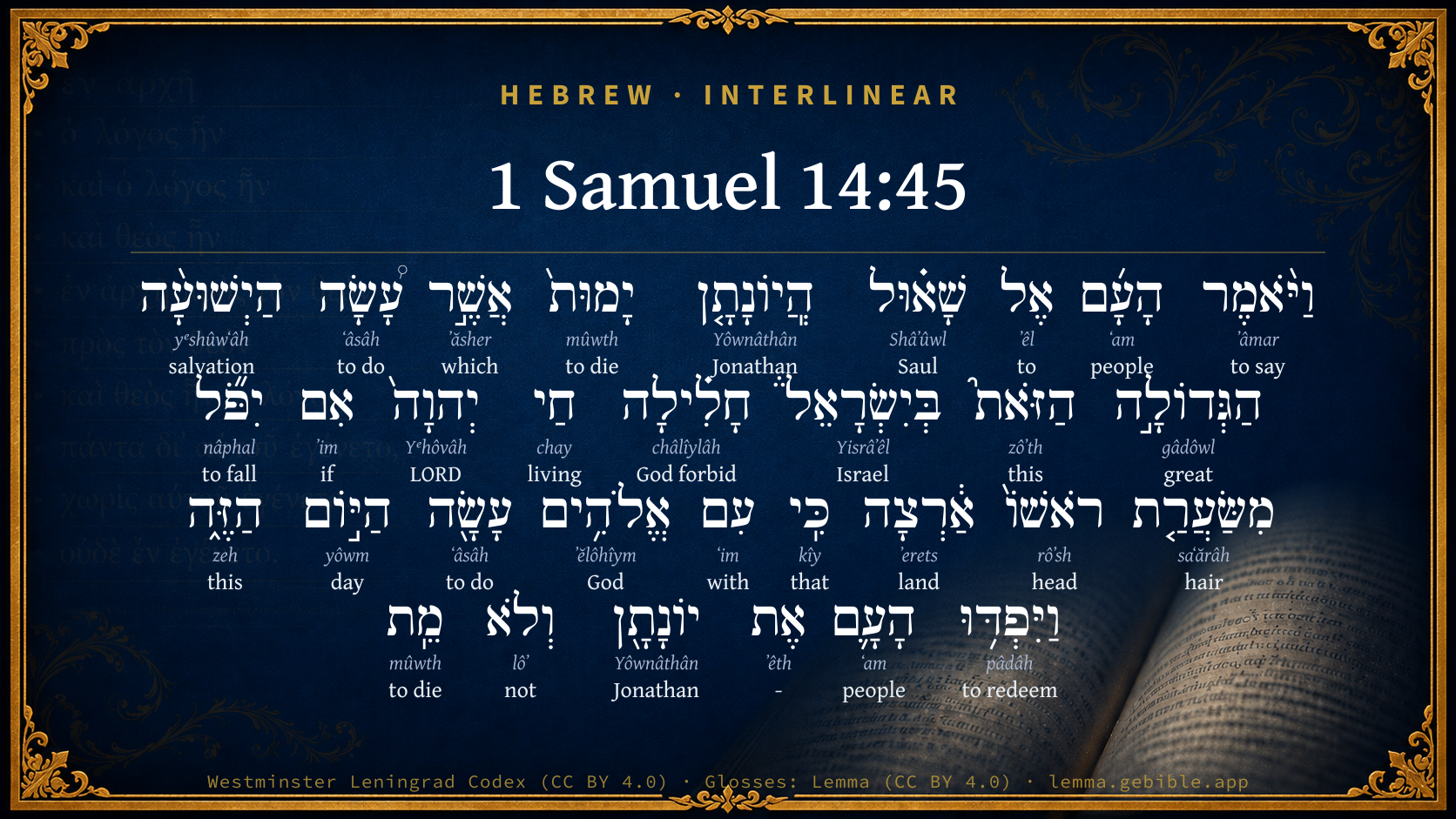
  1. וַיֹּ֨אמֶר ʼâmar H559 “and · to say” Conjunction + Verb, Qal, Sequential Imperfect, 3rd Person, Masculine, Singular
  2. הָעָ֜ם ʻam H5971 “the · people” Particle, Definite Article + Noun, Common, Masculine, Singular, Absolute
  3. אֶל ʼêl H413 “to” Preposition
  4. שָׁא֗וּל Shâʼûwl H7586 “Saul” Noun, Proper
  5. הֲֽיוֹנָתָ֤ן Yôwnâthân H3129 “Jonathan” Particle, Interrogative + Noun, Proper
  6. יָמוּת֙ mûwth H4191 “to die” Verb, Qal, Imperfect, 3rd Person, Masculine, Singular
  7. אֲשֶׁ֣ר ʼăsher H834 “which” Particle, Relative
  8. עָ֠שָׂה ʻâsâh H6213 “to do” Verb, Qal, Perfect, 3rd Person, Masculine, Singular
  9. הַיְשׁוּעָ֨ה yᵉshûwʻâh H3444 “the · salvation” Particle, Definite Article + Noun, Common, Feminine, Singular, Absolute
  10. הַגְּדוֹלָ֣ה gâdôwl H1419 “the · great” Particle, Definite Article + Adjective, Adjective, Feminine, Singular, Absolute
  11. הַזֹּאת֮ zôʼth H2063 “the · this” Particle, Definite Article + Pronoun, Demonstrative, Feminine, Singular
  12. בְּיִשְׂרָאֵל֒ Yisrâʼêl H3478 “in/at · Israel” Preposition + Noun, Proper
  13. חָלִ֗ילָה châlîylâh H2486 “God forbid” Particle, Interjection + Suffix, h
  14. חַי chay H2416 “living” Adjective, Adjective, Masculine, Singular, Absolute
  15. יְהוָה֙ Yᵉhôvâh H3068 “LORD” Noun, Proper
  16. אִם ʼim H518 “if” Conjunction
  17. יִפֹּ֞ל nâphal H5307 “to fall” Verb, Qal, Imperfect, 3rd Person, Masculine, Singular
  18. רֹאשׁוֹ֙ rôʼsh H7218 “head · his” Noun, Common, Masculine, Singular, Construct + Suffix, Personal, 3rd Person, Masculine, Singular
  19. אַ֔רְצָה ʼerets H776 “land · toward” Noun, Common, Both, Singular, Absolute + Suffix, Demonstrative
  20. כִּֽי kîy H3588 “that” Conjunction
  21. עִם ʻim H5973 “with” Preposition
  22. אֱלֹהִ֥ים ʼĕlôhîym H430 “God(s)” Noun, Common, Masculine, Plural, Absolute
  23. עָשָׂ֖ה ʻâsâh H6213 “to do” Verb, Qal, Perfect, 3rd Person, Masculine, Singular
  24. הַיּ֣וֹם yôwm H3117 “the · day” Particle, Definite Article + Noun, Common, Masculine, Singular, Absolute
  25. הַזֶּ֑ה zeh H2088 “the · this” Particle, Definite Article + Pronoun, Demonstrative, Masculine, Singular
  26. וַיִּפְדּ֥וּ pâdâh H6299 “and · to redeem” Conjunction + Verb, Qal, Sequential Imperfect, 3rd Person, Masculine, Plural
  27. הָעָ֛ם ʻam H5971 “the · people” Particle, Definite Article + Noun, Common, Masculine, Singular, Absolute
  28. אֶת ʼêth H853 “-” Particle, Direct Object
  29. יוֹנָתָ֖ן Yôwnâthân H3129 “Jonathan” Noun, Proper
  30. וְלֹא lôʼ H3808 “and · not” Conjunction + Particle, Negative
  31. מֵֽת mûwth H4191 “to die” Verb, Qal, Perfect, 3rd Person, Masculine, Singular

About this verse

These counts appear in no published source. They are computed here, from the morphology-tagged text and Lemma’s own curated glosses. What Lemma adds →

32
words
28
distinct lemmas
Historical
section

Notable vocabulary

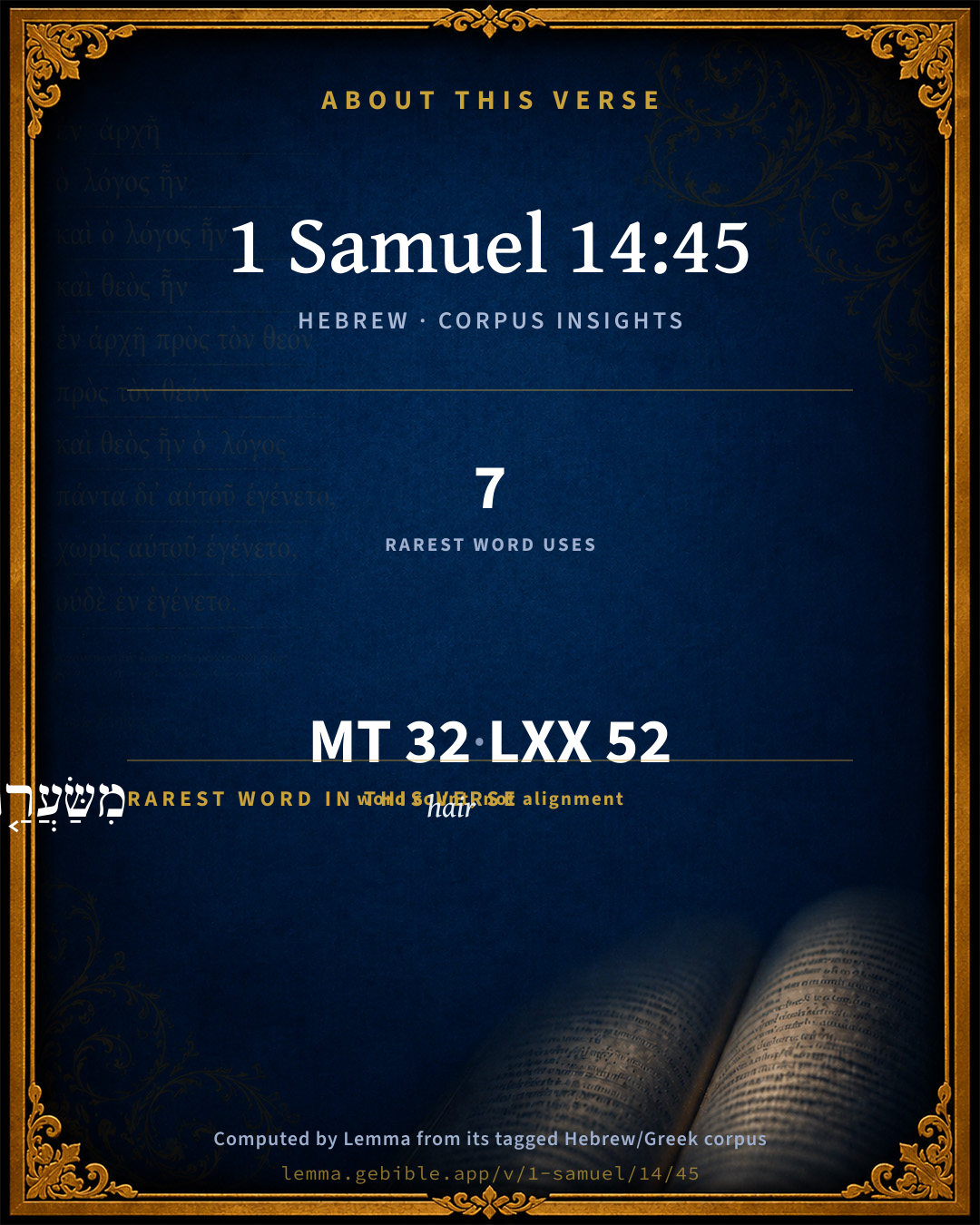
The rarest word here is מִשַּׂעֲרַ֤ת hair H8185 — appearing just 7 times in the whole Hebrew Bible.

Shared distinctive vocabulary

מִשַּׂעֲרַ֤ת hair H8185 occurs in 7 verses of the Hebrew Bible. Also found in:

Grammatical profile

  • 7 verbs
  • 13 nouns
  • 2 adjectives
  • 2 pronouns
  • 2 prepositions
  • 2 conjunctions
  • 4 particles

Verb forms

  • וַיֹּ֨אמֶר Qal · Sequential Imperfect
  • יָמוּת֙ Qal · Imperfect
  • עָ֠שָׂה Qal · Perfect
  • יִפֹּ֞ל Qal · Imperfect
  • עָשָׂ֖ה Qal · Perfect
  • וַיִּפְדּ֥וּ Qal · Sequential Imperfect
  • מֵֽת Qal · Perfect

Repetition

Words recur within this verse — often emphatic in Hebrew:

  • הָעָ֜ם people H5971 ×2
  • הֲֽיוֹנָתָ֤ן Jonathan H3129 ×2
  • יָמוּת֙ to die H4191 ×2
  • עָ֠שָׂה to do H6213 ×2

Hebrew & Septuagint length

In English translation the verse runs 51 words from the Hebrew and 63 from the Septuagint (LXX English) — closely comparable.

A rough comparison of the two English renderings, which tokenize alike — not a word-level alignment.

Word counts can differ between the Hebrew and the Greek without any difference in meaning — e.g. the Hebrew direct-object marker אֵת has no separate Greek word, and Greek often adds the article ὁ.

In the original languages it is 32 Hebrew tokens and 52 Greek tokens — but the two are counted differently (Hebrew bundles its prefixes and suffixes into one token; the Greek is in lemma form), so that isn’t a like-for-like length.

Cross-references

20

Topical passages linked to 1 Samuel 14:45 in the Treasury of Scripture Knowledge — connected by theme and wording, ordered by reader-vote popularity; previews shown in the World English Bible.

  • 2 Samuel 14:11 Then said she, Please let the king remember Yahweh your God, that the avenger of blood destroy not any more, lest they destroy my son. He said, As Yahweh lives, there shall not one hair of your son fall to the earth.
  • Luke 21:18 And not a hair of your head will perish.
  • Acts 27:34 Therefore I beg you to take some food, for this is for your safety; for not a hair will perish from any of your heads."
  • 1 Kings 1:52 Solomon said, If he shall show himself a worthy man, there shall not a hair of him fall to the earth; but if wickedness be found in him, he shall die.
  • Matthew 10:30 but the very hairs of your head are all numbered.
  • 2 Corinthians 6:1 Working together, we entreat also that you not receive the grace of God in vain,
  • Isaiah 29:20–21 For the terrible one is brought to nothing, and the scoffer ceases, and all those who watch for iniquity are cut off;
  • Acts 15:12 All the multitude kept silence, and they listened to Barnabas and Paul reporting what signs and wonders God had done among the Gentiles through them.
  • Acts 21:19 When he had greeted them, he reported one by one the things which God had worked among the Gentiles through his ministry.
  • Philippians 2:12–13 So then, my beloved, even as you have always obeyed, not only in my presence, but now much more in my absence, work out your own salvation with fear and trembling.
  • Revelation 17:14 These will war against the Lamb, and the Lamb will overcome them, for he is Lord of lords, and King of kings. They also will overcome who are with him, called and chosen and faithful."
  • Revelation 19:14 The armies which are in heaven followed him on white horses, clothed in white, pure, fine linen.
  • 1 Samuel 14:23 So Yahweh saved Israel that day: and the battle passed over by Beth Aven.
  • 1 Samuel 19:5 for he put his life in his hand, and struck the Philistine, and Yahweh worked a great victory for all Israel: you saw it, and did rejoice; why then will you sin against innocent blood, to kill David without a cause?
  • 2 Chronicles 19:11 Behold, Amariah the chief priest is over you in all matters of Yahweh; and Zebadiah the son of Ishmael, the ruler of the house of Judah, in all the king's matters: also the Levites shall be officers before you. Deal courageously, and Yahweh be with the good.
  • Nehemiah 9:27 Therefore you delivered them into the hand of their adversaries, who distressed them: and in the time of their trouble, when they cried to you, you heard from heaven; and according to your manifold mercies you gave them saviors who saved them out of the hand of their adversaries.
  • Isaiah 13:3 I have commanded my consecrated ones, yes, I have called my mighty men for my anger, even my proudly exulting ones.
  • Acts 14:27 When they had arrived, and had gathered the assembly together, they reported all the things that God had done with them, and that he had opened a door of faith to the Gentiles.
  • Romans 15:18 For I will not dare to speak of any things except those which Christ worked through me, for the obedience of the Gentiles, by word and deed,
  • 1 Corinthians 3:9 For we are God's fellow workers. You are God's farming, God's building.

Cross-references courtesy of OpenBible.info (CC BY 4.0).

Hebrew and Greek witnesses Masoretic Hebrew ↔ Greek Septuagint

The same verse in the two great witnesses to the Old Testament, shown verse-for-verse.

These are two independent witnesses, not word-aligned to each other, and the Septuagint is shown in lemma (dictionary) form.

Hebrew 1 Samuel 14:45 Masoretic · Westminster Leningrad Codex

וַיֹּ֨אמֶר הָעָ֜ם אֶל שָׁא֗וּל הֲֽיוֹנָתָ֤ן יָמוּת֙ אֲשֶׁ֣ר עָ֠שָׂה הַיְשׁוּעָ֨ה הַגְּדוֹלָ֣ה הַזֹּאת֮ בְּיִשְׂרָאֵל֒ חָלִ֗ילָה חַי יְהוָה֙ אִם יִפֹּ֞ל מִשַּׂעֲרַ֤ת רֹאשׁוֹ֙ אַ֔רְצָה כִּֽי עִם אֱלֹהִ֥ים עָשָׂ֖ה הַיּ֣וֹם הַזֶּ֑ה וַיִּפְדּ֥וּ הָעָ֛ם אֶת יוֹנָתָ֖ן וְלֹא מֵֽת

The people said to Saul, Shall Jonathan die, who has worked this great salvation in Israel? Far from it: as Yahweh lives, there shall not one hair of his head fall to the ground; for he has worked with God this day. So the people rescued Jonathan, that he didn't die.

World English Bible · Public Domain

Greek LXX 1 Samuel 14:45 Septuagint · lemma form

καί εἶπον ὁ λαός πρός σαούλ εἰ σήμερον θανατόω ὁ ποιέω ὁ σωτηρία ὁ μέγας οὗτος ἐν ἰσραήλ ζάω κύριος εἰ πίπτω ὁ θρίξ ὁ κεφαλή αὐτός ἐπί ὁ γῆ ὅτι ὁ λαός ὁ θεός ποιέω ὁ ἡμέρα οὗτος καί προςεὔχομαι ὁ λαός περί ιωναθαν ἐν ὁ ἡμέρα ἐκεῖνος καί οὐ ἀποθνήσκω

And the people said to Saul, Shall he that has wrought this great salvation in Israel be put to death this day? As the Lord lives, there shall not fall to the ground one of the hairs of his head; for the people of God have wrought successfully this day. And the people prayed for Jonathan in that day, and he died not.

LXX2012 (modern English Septuagint) · Public Domain

On this verse, Haydock's Catholic Bible Commentary discusses the Septuagint’s reading. Read the note in Commentary ↓

Hebrew: Westminster Leningrad Codex (CC BY 4.0). Greek: Septuagint (public domain); English from LXX2012 (modern English Septuagint) (Public Domain). How the Septuagint differs from the Hebrew →

Targum (Aramaic paraphrase)

1

The Targum is the ancient Jewish Aramaic paraphrase of the Hebrew Scriptures — an interpretive translation, not the Hebrew text itself. Onkelos (literal) and Pseudo-Jonathan (expansive) render the Torah, and Jonathan the Prophets. Coverage is partial: where no permissively-licensed English translation exists for a verse, only the Aramaic is shown. This is verse-level text, not a word-by-word alignment to the Hebrew.

  1. Targum Jonathan Prophets (Joshua–Malachi)
    וַאֲמַר עַמָא לְשָׁאוּל הַיוֹנָתָן יִתְקְטֵיל דִי עֲבַד פּוּרְקָנָא רַבָּא הָדֵין בְּיִשְׂרָאֵל חָס קַיָם הוּא יְיָ אִם יִפּוֹל מִסְעַר רֵישֵׁיהּ לְאַרְעָא אֲרֵי קֳדָם יְיָ גְלֵי דִבְשָׁלוּ עֲבַד יוֹמָא דֵין וּפְרָקוּ עַמָא יַת יוֹנָתָן וְלָא מִית:

    (no public-domain English translation for this verse)

    Targum Jonathan — Aramaic: “Mikraot Gedolot” (public domain). English: “Sefaria Community Translation” (CC0 1.0 (public-domain dedication)); “London "Chaldee Paraphrase," 1871” (public domain). Text via Sefaria.

Commentary

Notes on 1 Samuel 14:45 from classic Christian and Jewish commentators (each source and its license shown beneath its notes). The classic Christian expositions comment on the surrounding passage and are grouped to its opening verse, so a note may address several verses; the Jewish commentaries on the Tanakh (Rashi and others) are per-verse, so they appear only where the commentator wrote on this verse.

Lemma curates 59 commentaries, every one of them public domain or Creative Commons licensed, each selected and text-cleaned for this edition rather than reprinted as found. About our sources →

Trapp's Complete Commentary

John Trapp

1Sa 14:45 And the people said unto Saul, Shall Jonathan die, who hath wrought this great salvation in Israel? God forbid: [as] the LORD liveth, there shall not one hair of his head fall to the ground; for he hath wrought with God this day. So the people rescued Jonathan, that he died not.

Ver. 45. Shall Jonathan die?] By whose means we are yet alive: this were such an ill requital, as heaven and earth would be ashamed of.

As the Lord liveth, there shall not one hair of his head.] Here was oath against oath, and so sinning on both sides, as Chrysostom, a great inveigher against rash swearing, well observeth: like as boys pulling at a rope, some against others, do on both parts fall to the ground, if the rope breaketh.

For he hath wrought with God this day.] The Chaldee hath it, For it is manifest before the Lord, that he hath done it in ignorance this day. And this indeed was the best reason that could be given wherefore Jonathan hath not deserved to die. {a} A good soldier, and one that hath been very successful, may yet afterwards commit something that is worthy of death; as did Joab, and Marshal Biron lately in France.

So the people rescued Jonathan.] Which they should have done, not by force, but by humble supplication, as Chrysostom well observeth; since hereby might have followed civil dissensions and rebellion against the king.

{a} Peter Martyr.

John Trapp, A Commentary or Exposition upon All the Books of the Old and New Testament (1647–1656) — public domain. Text from a community e-Sword module.

The Biblical Illustrator

Joseph S. Exell

1Sa_14:45

And the people said unto Saul, shall Jonathan die.

Rights of the people

This historical fact was recorded for our instruction; and teaches us that when a people properly remonstrate against the unlawful, unjust, or cruel conduct of their rulers, they may reasonably hope to succeed.

I. I am to show, that a people have a right to remonstrate against the unlawful, unjust, or cruel conduct of their rulers. To remonstrate properly signifies, to make a strong representation, or to offer reasons, against something said, proposed, or done, which appears to be improper, unjust, unlawful, or cruel. This bare explanation of the term applies, that it is the natural and unalienable right of all mankind, to remonstrate whenever they think they are really abused by those in authority. The child has a natural and unalienable right to remonstrate against any treatment of his parents which appears to be cruel, or unjust, or ever: highly improper. The servant has a natural and unalienable right to remonstrate against the unlawful, unjust, or oppressive conduct of his civil ruler. This natural and unalienable right of remonstrance is essential to all civil liberty. The British Government certainly grants this right to the people, who have often and lately remonstrated with success. Our federal and state constitutions expressly allow the people to remonstrate, and they have exercised this right on many occasions. If we have not the right of remonstrance, we have no right at all. Any other people bare a right to remonstrate, or offer good reasons against the unlawful, unjust, or cruel conduct of their rulers. They are neither to be punished, nor even blamed for remonstrating in a proper manner, on any proper occasion.

II. This is not only their right, but their duty. Rulers are clothed with authority for the purpose of doing good, and not for the purpose of doing evil. Their civil powers are all derived and limited, and consequently they are responsible for their official conduct This is a duty which they owe to God and to one another. It was the duty of Judah to remonstrate against the unnatural and nefarious conduct of his brethren, who proposed to shed and conceal the innocent blood of Joseph. It was the duty of Ahimelech the priest to remonstrate against Souls slaying him and his fathers house, for his innocently and benevolently supplying Davids wants It was the duty of Esther to remonstrate against the fatal decree of Ahasuerus, and had she neglected or refused to remonstrate against it, she would have been guilty of bringing destruction upon herself, her friends, and her whole nation. After Jeremiah had been unjustly east into the dungeon, and taken out by Jedekiah the king, it was his duty to remonstrate against being remanded back again It was the duty of Stephen to remonstrate, with his dying breath, against the unrighteous and cruel conduct of his malignant persecutors. And it was a duty which Paul owed to himself, to remonstrate against the high priest, who commanded him to be smitten in an unjust and illegal manner. If it was the duty of the people of Israel to remonstrate against the maladministration of Saul and David, who were the Lords anointed, we may justly conclude, that it is the duty of the people of this day, to remonstrate against the unjust, unconstitutional, and oppressive measures of those, whom they have raised to places of power and trust.

III. that if a people do exercise their right and perform their duty, in properly remonstrating against the unlawful, unjust, and cruel conduct of their rulers, they may reasonably hope to succeed.

1. This mode of seeking redress of public and private grievances has often proved successful. It is not a vain thing for a people to lift up their united and powerful voice against public measures which they know and feel to be unconstitutional, unjust, and oppressive. There is always ground to hope that their proper and just remonstrances will have a powerful and salutary effect. For,

2. This mode of treating civil rulers has a natural tendency to impress their minds with a deep sense of their duty and interest to guard against or rectify their designed or undesigned errors. Reasonable remonstrances are suited to enlighten their understandings; just remonstrances are suited to awaken their consciences; tender remonstrances are suited to excite their tenderness and compassion; and bold and spirited remonstrances are suited to alarm their fears of losing their popularity, their places, their interests, and even their lives. Proper remonstrances are the best weapons to attack corrupt rulers in their most vulnerable parts. Though they may not feel the obligation of duty, yet they may feel the obligation of interest, to review their conduct, rectify their errors, and redress the grievances of which the people justly and unitedly complain.

3. A people may humbly hope that God will approve of their properly remonstrating against the corrupt conduct of their rulers. The righteous Lord loves righteousness, and abhors unrighteousness, oppression, and cruelty. God has the hearts of rulers in his hand, and can dispose them to treat their injured, oppressed, aggrieved subjects, with equity, condescension, and tenderness He disposed Pharaoh to regard the remonstrances of Moses, and to let his oppressed people go free. He disposed Cyrus to proclaim liberty to the captive Jews, and even to assist them in their return to their native land.

God still stands in the congregation of the mighty, and judges among the gods it now appears, I trust, that the leading sentiment in this discourse is true; and if it be true, it naturally suggests some things which deserve the serious regard of both rulers and subjects at the present dark and distressing day.

1. If a people have an unquestionable right to remonstrate against the unjust and oppressive conduct of their rulers, then it would be the indispensable duty of their rulers to hear their remonstrances, and grant them proper relief. Though they have a discretionary right to hear, or not to hear, any remonstrances of any part, or of the whole body of the people, yet they are responsible for the abuse of this discretionary power. Their civil authority does by no means dissolve their moral obligation to rule in justice. The right of the people to remonstrate necessarily involves the duty of rulers to hear their remonstrances with attention and impartiality.

2. If the people have the right to remonstrate against what they really believe to be oppressive and injurious in the administration of government; then it discovers a corrupt and tyrannical disposition in their rulers, to take away, or even to attempt to take away from them, this natural, unalienable, and important right. It has always been the policy of despotic rulers to suppress the liberty of speech upon political subjects. They may attempt to destroy the right of remonstrance, or restrain the liberty of speech respecting the public measures of public men, by sophistry, artifice, or threats. They may artfully insinuate that if the people privately complain, or publicly remonstrate, they manifest disaffection, disrespect, and disobedience towards those whom they ought to esteem, revere, and obey. If this sophistry fail of answering their purpose they may throw out terrible threats, and positively declare, that all complaints and remonstrances are the high crimes of treason and rebellion. This language ought to be alarming to a people in a free government, and put them upon their guard against those who would seduce or awe them into silence under all the evils and calamities which their unjust and arbitrary measures have brought upon the nation.

3. It clearly appears from what has been said that it is our present duty, as a people, to remonstrate with freedom and energy against those measures of our general government which have brought us to the brink of ruin.

4. That if we properly remonstrate against the conduct which has brought us into our wretched and dangerous situation we may reasonably hope to succeed, and speedily effect such a change of men and of measures as will restore peace, safety, and prosperity to our bleeding country. Decent, just, and spirited remonstrances have often made deep impressions upon the hearts and consciences of both good and bad rulers, and prevailed upon them to redress the grievances of their subjects. Haughty and arbitrary as the kings and parliaments of Great Britain may be supposed to have been, they have generally paid respect and attention to the opinions, the feelings, and the complaints of the nation.

5. We may fairly infer from what has been said that our men of eminence, who have uniformly and boldly remonstrated against the ill-concerted measures of government, have acted a noble and patriotic part, and deserve to be highly esteemed and applauded. Finally, this subject calls upon us to exercise unfeigned gratitude to God for the public and private favours which He has bestowed upon us in this trying and distressing day. We ought to be thankful that He has given us wise and faithful rulers, and by their instrumentality has preserved our rights and liberties, and restrained our powerful enemies from destroying our seaports, and spreading misery and destruction among us. Let us not lean to our own understandings, nor trust in our own hearts, but in the Lord Jehovah, in whom there is everlasting strength. Let us submissively commit ourselves and our country to his wise and holy disposal; and resolve that though he slay us, yet we will trust in him. (N. Emmons, D. D.)

.

The Biblical Illustrator, edited by Joseph S. Exell (c. 1880s–1900s) — public domain. Text from a community e-Sword module.

Tyndale Open Study Notes

Tyndale Open Resources

14:45 The people, aware of God’s blessing on the real hero of the day, were wiser than their king.

Tyndale Open Study Notes — © Tyndale Open Resources, licensed CC BY-SA 4.0. Text via the HelloAO Bible API.

Geneva Bible (1599)

Geneva Bible translators

The people thought it their duty to rescue him, who of ignorance had but broken a rash law, and by whom they had received so great a benefit.

Geneva Bible (1599) marginal notes — public domain. Text via Bolls.life.

Jamieson, Fausset & Brown

Robert Jamieson, A. R. Fausset & David Brown

the people rescued Jonathan, that he died not--When Saul became aware of Jonathan's transgression in regard to the honey, albeit it was done in ignorance and involved no guilt, he was, like Jephthah [Jdg 11:31, Jdg 11:35], about to put his son to death, in conformity with his vow [Sa1 14:44]. But the more enlightened conscience of the army prevented the tarnishing the glory of the day by the blood of the young hero, to whose faith and valor it was chiefly due.

Jamieson, Fausset & Brown — Commentary Critical and Explanatory on the Whole Bible (1871) — public domain (CC PDM 1.0). Text via the HelloAO Bible API.

Adam Clarke's Commentary

Verse 45. And the people said] "Shall Jonathan die, who hath wrought this great salvation in Israel? God forbid! As the Lord liveth, there shall not one hair of his head fall to the ground." Here was a righteous and impartial jury, who brought in a verdict according to the evidence: No man should die but for a breach of the law of God; but Jonathan hath not broken any law of God; therefore Jonathan should not die. And because he should not, therefore he shall not.

He hath wrought with God this day.] God has been commander-in-chief; Jonathan has acted under his directions.

So the people rescued Jonathan] And God testified no displeasure; and perhaps he permitted all this that he might correct Saul's propensity to rashness and precipitancy.

Adam Clarke's Commentary on the Bible (1810–1826) — public domain. Text from a community e-Sword/MySword module.

The Cambridge Bible for Schools and Colleges

gen. ed. J. J. S. Perowne

45. there shall not one hair of his head fall to the ground] See 2Sa_14:11; 1Ki_1:52; Mat_10:30; Luk_21:18; Act_27:34.

he hath wrought with God] Compare Jonathan’s own words in 1Sa_14:6.

the people rescued Jonathan] “There was now a freer and more understanding spirit in the nation at large. What was tolerated in the time of Jephthah, when every man did what was right in his own eyes, and when the obligation of such vows overrode all other considerations, was no longer tolerated now. The people interposed in Jonathan’s behalf. They recognised the religious aspect of his great exploit. They rallied round him with a zeal that overbore even the royal vow, and rescued Jonathan that he died not. It was the dawn of a better day. It was the national spirit now in advance of their chief, animated by the same Prophetic teaching, which through the voice of Samuel had now made itself felt; the conviction that there was a higher duty even than outward sacrifice or exact fulfilment of literal vows.” Stanley’s Lectures, II. 14.

A somewhat analogous story is told in Livy VIII. 35. Q. Fabius the Master of the Horse violated the commands of the Dictator Papirius Cursor by attacking the Samnites in his absence. He was ordered for instant execution by the dictator, but escaped through the intercession of the people.

The Cambridge Bible for Schools and Colleges (gen. ed. J. J. S. Perowne; Cambridge University Press, 1878–1918) — public domain. Text from a community e-Sword module.

John Gill's Exposition

And the people said unto Saul,.... Hearing such words, and filled with grief, pity, and sympathy for Jonathan, as Josephus (k) observes:

shall Jonathan die, who hath wrought this great salvation in Israel? no, he shall not; what, such a man as he die, who, under God, has been the instrument of so great deliverance, who first began it himself with one man only with him, and has proceeded in it to the finishing of it?

God forbid: this shall not be so; they speak of it with the utmost abhorrence and detestation, as a shocking piece of cruelty and ingratitude, unheard of, and not to be paralleled:

as the Lord liveth, there shall not one hair of his head fall to the ground; as Saul swore he should die, they also swear he should not, expressing their firm resolution to stand by him, and preserve his life; and so far should it be from him to have his life taken away, that an hair of his head should not be touched, or the least injury done to his person; for though they had yielded a ready obedience to all the orders and commands of Saul, which were distressing to themselves, they were determined to oppose him in this case of his son:

for he hath wrought with God this day; God has been with him, assisted him to do great things for Israel, and therefore should not die for a thing so trivial; and it being not done in disobedience to his father, nor in contempt of him, but through pure ignorance, as some of them well knew; so the Targum,"for it is known before the Lord, that in ignorance he did it this day:"

so the people rescued Jonathan, that he died not; not by force, but by their resolution and importunity; or "redeemed" him (l), by exposing their own lives to danger in opposing their king, and by their petitions to him for him; and, as Josephus says (m), by their prayers to God for him, that his fault might be forgiven.

(k) Antiqu. l. 6. c. 6. sect. 4. (l) "redemerunt", Pagninus, Montanus, &c. (m) Ut supra, (Antiqu. l. 6. c. 6.) sect. 5.

John Gill's Exposition of the Whole Bible (1746–1763) — public domain (CC PDM 1.0). Text via the HelloAO Bible API.

Haydock's Catholic Bible Commentary

The people, directed probably by the high priest, who pronounced the oath null. (Salien) --- Ground. He shall not be hurt. (Menochius) --- With God. He has been visibly "the minister of God’s mercy." (Septuagint) --- Die. They obtained his pardon. They ought not to have permitted the king’s oath to be put in execution, as it was so horribly unjust. (Grotius, Jur. ii. 13, 6.) (Calmet)

George Leo Haydock (1774–1849), Haydock's Catholic Family Bible and Commentary, 1859 edition — public domain. Excludes Psalms (Douay-Rheims chapter numbering differs from Protestant) and Deuterocanonical books (Catholic canon only).

Matthew Poole's English Annotations

With God, i.e. in concurrence with God, or by God’s help he had wrought this salvation. God is so far from being offended with Jonathan, as thou apprehendest, that he hath graciously owned and assisted him in the great service of this day.

Matthew Poole's English Annotations on the Holy Bible (1683–1685) — public domain. Text from a community e-Sword/MySword module.

The Pulpit Commentary

The people said. They had hitherto shown their disapproval of Saul"s conduct by their silence; now they decide that Jonathan shall not die, and their decision was right and godly. Saul might feel bound by his rash oath, but the consciences of the people told them that an oath to commit a crime is an oath to be repented of as a sin, and not to be performed as a duty. They do not say, however, God forbid, but "Far be it." The name of the Deity is constantly taken in vain in the A.V without adding either beauty or energy to the word of God. But even if it did, what right have translators to add energy to the word of God? He hath wrought with God this day. The argument of the people is wise and good. Jonathan"s whole conduct on that day proved an especial presence of God with him. It would be morally wrong and an offence against religion to condemn that which God approved, and the people therefore set their oath against the king"s oath, and prevail.

Ver. 45. (AJALON.)

Remonstrance with rulers.

The obedience which subjects owe to the commands of a ruler is not absolute, but limited by their obligation to a higher law. When he determines on measures which are not good they have a right to remonstrate, and are sometimes bound to do so. Concerning the remonstrance of the people with Saul (after yielding notable obedience in other things vers. 26, 34, 36), observe that it was

I JUST; in opposition to an unreasonable, arbitrary, and cruel decision (ver. 44), in defence of the innocent, and impelled by "an enlightened conscience and generous enthusiasm.

II DEVOUT; recognising the hand of God in the victory of Jonathan, testifying their gratitude for the deliverance wrought through him, and obeying a higher will, thereby indicated, in preference to that of the king.

III RESOLUTE; whilst stating the ground of their determination, manifesting a disposition to carry it into effect, and binding themselves by a united and solemn oath to do so.

IV SUCCESSFUL. They prevailed, Jonathan was rescued, a great crime was prevented, and Saul was checked and warned in his despotic career. When the people remonstrate in the same manner they may expect the same success. D.

Ver. 45. (AJALON.)

Cooperation with God.

hath wrought with God this day." Apart from the power of God man can do nothing. In opposition to it he is defeated and crushed. Only in cooperation with it can he accomplish anything great or good. As in the material, so in the moral and spiritual world it is our wisdom, strength, and dignity to be "labourers together with God" (1Co_3:9; 2Co_6:1) Notice

I THE AIM of this cooperation.

1. To overcome sin and misery amongst men.

2. To promote righteousness and happiness in ourselves and others.

3. To extend the kingdom and glory of God.

II THE MEANS.

1. Studying the laws or modes of God"s working (Ecc_3:14) and the manifold intimations of his will.

2. Trusting in him, firmly resting on his promises, and patiently waitingtheir fulfilment. Oftentimes "our strength is to sit still.

3. Using with diligence the strength he gives, still depending on him "whoworketh all in all". (1Co_12:6; Php_2:13; Isa_26:12)

III THE RESULT.

1. Conscious approbation of God.

2. Effectual aid.

3. Certain achievement. "In due season we shall reap if we faint not. D.

The Pulpit Commentary (1880–1919), ed. H.D.M. Spence-Jones & Joseph S. Exell — public domain. Text from a community e-Sword module.

John Wesley's Explanatory Notes

With God - In concurrence with God, he hath wrought this salvation. God is so far from being offended with Jonathan, that he hath graciously owned him in the great service of this day.

John Wesley, Explanatory Notes Upon the Whole Bible (1754–1765) — public domain. Text via the GEBible commentary corpus.

unfoldingWord translationNotes

Door43 World Missions Community

General Information:

The Army defends and protects Jonathan from Saul.

Should Jonathan die, who has accomplished this great victory for Israel? Far from it!

The people scold Saul. This rhetorical question can be translated as a statement. AT: "Jonathan has just accomplished this great victory for Israel. He should surely not die." (See: Rhetorical Question)

As Yahweh lives

The people were expressing their certainty that they would not let anything happen to Jonathan.

not one hair of his head will fall to the ground

This exaggeration shows how the people of Israel would protect Jonathan and keep him safe. This litotes can be stated in a positive form. AT: "we will protect him from any harm" (See: Hyperbole and Generalization and Litotes)

translationWords

Israel

works

Philistines

unfoldingWord translationNotes — © Distant Shores Media and the Door43 World Missions Community, licensed CC BY-SA 4.0. Source: git.door43.org/Door43/en_tn.

Rashi

Rabbi Shlomo Yitzchaki (Rashi)

The people redeemed [Yonoson]. They nullified Shaul's oath.

Rashi on the Tanakh — English translations: “The Judaica Press complete Tanach with Rashi, translated by A. J. Rosenberg” (CC BY 4.0); “Pentateuch with Rashi's commentary by M. Rosenbaum and A.M. Silbermann, 1929-1934” (public domain); “The Metsudah Tanach series, Lakewood, N.J” (CC BY 4.0); and “The Book of Joshua, Metsudah Publications, 1997” (CC BY 4.0). Text via Sefaria.

Lesson kit

Teaching starters — assembled from the data on this page, not authored interpretation. Every prompt links to the verse data it draws on. Edit before teaching.

1 Samuel, in the Historical, opens this verse with 32 words (28 distinct Hebrew lemmas). Its most distinctive word is saʻărâh (“hair”). A historical commentator’s framing appears above. Read the whole chapter for the surrounding context.

Discussion questions

  1. The word saʻărâh carries the sense “hair.” How does it shape the verse?
  2. Judges 20:16 shares the word «hair» with this verse. How do the two illuminate each other?
  3. “people” occurs 2× in this one verse. What is the effect of the repetition?
  4. These translations render this verse differently. What is at stake in choosing one wording over another?
  5. The verb «וַיֹּ֨אמֶר» is Qal Sequential Imperfect. How does its form color the action?
  6. Reading how Trapp's Complete Commentary and The Biblical Illustrator read this verse, where do the two commentators agree and where do they part?

Things to notice

Reading settings

Reading text

Shown beneath each verse's original-language words.

Old Testament
Old Testament edition

Read the OT as the Masoretic Hebrew (MT) or the Greek Septuagint (LXX).

English shown for the Greek Septuagint (in the Hebrew ↔ Greek comparison).

Comparing translations? Open the Compare panel on any verse page to stack up to four side by side.