
Judges 4:22

Hebrew (Westminster Leningrad Codex) Judges 4:22 appears in the Hebrew Old Testament. The text above is from the Westminster Leningrad Codex. Each word links to its Strong’s number, a concise gloss, and parsing drawn from the Open Scriptures Hebrew Bible morphology. Click any word for its full Brown-Driver-Briggs (BDB) entry.
Download image
Cite this verse

Judges 4:22 (World English Bible). Public Domain. Lemma interlinear Bible study tool, https://lemma.gebible.app/v/judges/4/22.

Show BibTeX & RIS
BibTeX
RIS
English Translation
Behold, as Barak pursued Sisera, Jael came out to meet him, and said to him, Come, and I will show you the man whom you seek. He came to her; and, behold, Sisera lay dead, and the tent-pin was in his temples.
World English Bible · Public Domain
Download a study sheet

One document with this verse’s original text, its word-by-word gloss line, the meaning frame, cross-references with their text, attributed commentary, and full source and license credits — printable, and it pastes into notes with its structure intact.

This verse Autodidact and up

Study sheet (.html) Plain text (.txt)

A passage Seminary Student

Up to 50 verses in one chapter. A passage sheet keeps up to 6 commentary sources and 12 cross-references per verse, in the order this page ranks them, and says so on the sheet whenever that leaves anything out. Ask for a single verse and you get the Autodidact verse sheet above.

Everything on this page stays free to read, with no account — the sheet is a download of what is already on screen, not access to it.

Want to remove ads? Support Godless Engineer
Compare translations 3

The same verse in 3 English versions, stacked beneath the original-language interlinear above. Click any original word for its lexicon entry.

Each is an independent rendering of the whole verse — the interlinear is not word-aligned to these translations.

Highlighted words mark where these versions differ — a whole-verse word diff, not a word-by-word alignment.

  • World English Bible Public Domain
    Behold, as Barak pursued Sisera, Jael came out to meet him, and said to him, Come, and I will show you the man whom you seek. He came to her; and, behold, Sisera lay dead, and the tent-pin was in his temples.
  • King James Version Public Domain
    And, behold, as Barak pursued Sisera, Jael came out to meet him, and said unto him, Come, and I will show thee the man whom thou seekest. And when he came into her tent, behold, Sisera lay dead, and the nail was in his temples.
  • unfoldingWord Literal Text CC BY-SA 4.0
    And behold, Barak was pursuing Sisera, and Jael came out to meet him, and she said to him, “Come, and I will show you the man whom you are seeking.” So he came to her, and behold, Sisera had fallen dead, and the peg in his temple.

unfoldingWord Literal Text — © unfoldingWord, licensed CC BY-SA 4.0. Word-aligned USFM3 via Door43 (git.door43.org/unfoldingWord/en_ult).

Versions to compare (up to 4)

3 of 4 selected

Show all 18 translations

Every available English version of this verse, each an independent rendering of the whole verse.

  • World English Bible Public Domain
    Behold, as Barak pursued Sisera, Jael came out to meet him, and said to him, Come, and I will show you the man whom you seek. He came to her; and, behold, Sisera lay dead, and the tent-pin was in his temples.
  • Berean Standard Bible Public Domain
    When Barak arrived in pursuit of Sisera, Jael went out to greet him and said to him, “Come, and I will show you the man you are seeking.” So he went in with her, and there lay Sisera dead, with a tent peg through his temple.
  • Majority Standard Bible Public Domain
    When Barak arrived in pursuit of Sisera, Jael went out to greet him and said to him, “Come, and I will show you the man you are seeking.” So he went in with her, and there lay Sisera dead, with a tent peg through his temple.
  • King James Version Public Domain
    And, behold, as Barak pursued Sisera, Jael came out to meet him, and said unto him, Come, and I will show thee the man whom thou seekest. And when he came into her tent, behold, Sisera lay dead, and the nail was in his temples.
  • American Standard Version (1901) Public Domain
    And, behold, as Barak pursued Sisera, Jael came out to meet him, and said unto him, Come, and I will show thee the man whom thou seekest. And he came unto her; and, behold, Sisera lay dead, and the tent-pin was in his temples.
  • Revised Version (1885) Public Domain
    And, behold, as Barak pursued Sisera, Jael came out to meet him, and said unto him, Come, and I will shew thee the man whom thou seekest. And he came unto her; and, behold, Sisera lay dead, and the tent-pin was in his temples.
  • Geneva Bible (1599) Public Domain
    And behold, as Barak pursued after Sisera, Iael came out to meete him, and sayd vnto him, Come, and I wil shewe thee the man, whome thou seekest: and when he came into her tent, behold, Sisera lay dead, and the nayle in his temples.
  • Douay-Rheims (1899) Public Domain
    And behold Barac came pursuing after Sisara: and Jahel went out to meet him, and said to him: Come, and I will shew thee, the man whom thou seekest. And when he came into her tent, be saw Sisara lying dead, and the nail fastened in his temples.
  • Young's Literal Translation Public Domain
    And lo, Barak is pursuing Sisera, and Jael cometh out to meet him, and saith to him, `Come, and I shew thee the man whom thou art seeking;' and he cometh in unto her, and lo, Sisera is fallen -- dead, and the pin in his temples.
  • Literal Standard Version CC BY-SA 4.0
    And behold, Barak is pursuing Sisera, and Jael comes out to meet him, and says to him, “Come, and I show you the man whom you are seeking”; and he comes to her, and behold, Sisera is fallen—dead, and the pin [is] in his temples.
  • Unlocked Literal Bible CC BY-SA 4.0
    As Barak was pursuing Sisera, Jael want out to meet him and said to him, “Come, I will show you the man you are looking for.” So he went in with her, and there lay Sisera dead, with the tent peg in the side of his head.
  • unfoldingWord Literal Text CC BY-SA 4.0
    And behold, Barak was pursuing Sisera, and Jael came out to meet him, and she said to him, “Come, and I will show you the man whom you are seeking.” So he came to her, and behold, Sisera had fallen dead, and the peg in his temple.
  • Darby Bible Public Domain
    And behold, as Barak pursued Sis'era, Ja'el went out to meet him, and said to him, "Come, and I will show you the man whom you are seeking." So he went in to her tent; and there lay Sis'era dead, with the tent peg in his temple.
  • World Messianic Bible Public Domain
    Behold, as Barak pursued Sisera, Jael came out to meet him, and said to him, “Come, and I will show you the man whom you seek.” He came to her; and behold, Sisera lay dead, and the tent peg was in his temples.
  • Webster's Bible Public Domain
    And behold, as Barak pursued Sisera, Jael came out to meet him, and said to him, Come, and I will show thee the man whom thou seekest. And when he came into her tent, behold, Sisera lay dead, and the nail was in his temples.
  • Free Bible Version CC BY-SA 4.0
    So when Barak came past, hunting for Sisera, Jael went out to meet him, and said, “Come here, and I'll show you the man you're looking for.” He went in with her, and there lay Sisera, dead, with the tent peg through his temple.
  • Bible in Basic English Public Domain
    Then Jael went out, and meeting Barak going after Sisera, said to him, Come, and I will let you see the man you are searching for. So he came into her tent and saw, and there was Sisera stretched out dead with the tent-pin in his head.
  • JPS Tanakh (1917) Public Domain
    And, behold, as Barak pursued Sisera, Jael came out to meet him, and said unto him: 'Come, and I will show thee the man whom thou seekest.' And he came unto her; and, behold, Sisera lay dead, and the tent-pin was in his temples.

Literal Standard Version (2020), Covenant Press — licensed CC BY-SA 4.0. Text via the HelloAO Bible API (eBible.org). Unlocked Literal Bible (unfoldingWord) — licensed CC BY-SA 4.0. Text via the HelloAO Bible API (eBible.org). unfoldingWord Literal Text — © unfoldingWord, licensed CC BY-SA 4.0. Word-aligned USFM3 via Door43 (git.door43.org/unfoldingWord/en_ult). Free Bible Version, Dr. Jonathan Gallagher — licensed CC BY-SA 4.0. Text via the HelloAO Bible API (eBible.org).

Word by word

More ways to search: Search by grammar → Find every occurrence → Compare this word →

Practice this passage: Drill this verse → Learn its vocabulary →

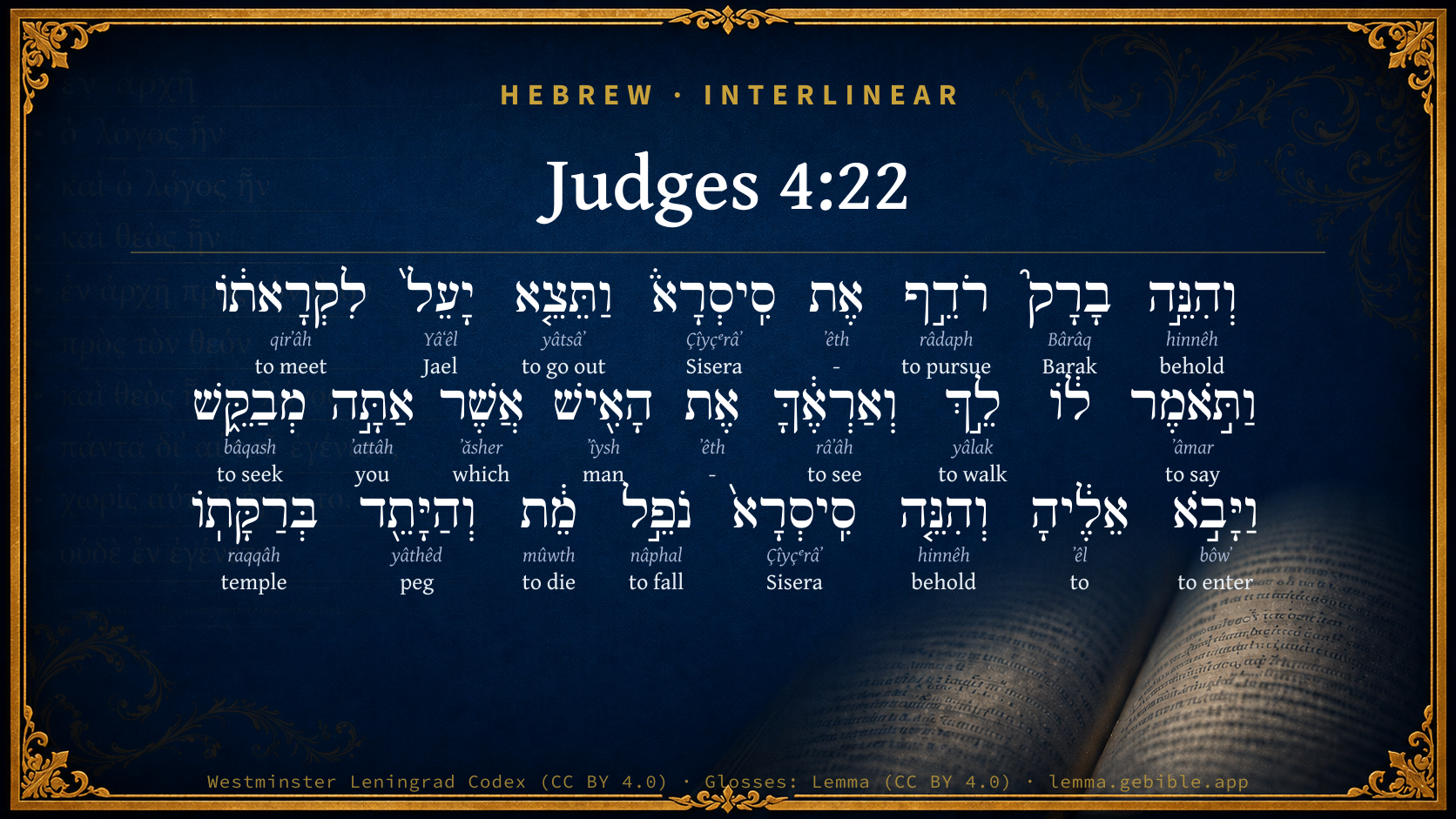
בְּרַקָּתֽוֹ
raqqâh
H7541
“in/at · temple · his”
Preposition + Noun, Common, Feminine, Singular, Construct + Suffix, Personal, 3rd Person, Masculine, Singular
Part of Speech
Preposition + Noun
Type
Common
Gender
Feminine
Number
Singular
State
Construct
Full BDB Definition

Origin: from H7534

TWOT: 2218c

temple, the temple (of the head)
  1. וְהִנֵּ֣ה hinnêh H2009 “and · behold” Conjunction + Particle, Demonstrative
  2. בָרָק֮ Bârâq H1301 “Barak” Noun, Proper
  3. רֹדֵ֣ף râdaph H7291 “pursuing” Verb, Qal, Participle Active, Masculine, Singular, Absolute
  4. אֶת ʼêth H853 “-” Particle, Direct Object
  5. סִֽיסְרָא֒ Çîyçᵉrâʼ H5516 “Sisera” Noun, Proper
  6. וַתֵּצֵ֤א yâtsâʼ H3318 “and · to go out” Conjunction + Verb, Qal, Sequential Imperfect, 3rd Person, Feminine, Singular
  7. יָעֵל֙ Yâʻêl H3278 “Jael” Noun, Proper
  8. לִקְרָאת֔וֹ qirʼâh H7125 “to meet · him” Preposition + Verb, Qal, Infinitive Construct + Suffix, Personal, 3rd Person, Masculine, Singular
  9. וַתֹּ֣אמֶר ʼâmar H559 “and · to say” Conjunction + Verb, Qal, Sequential Imperfect, 3rd Person, Feminine, Singular
  10. לֵ֣ךְ yâlak H3212 “walk” Verb, Qal, Imperative, 2nd Person, Masculine, Singular
  11. וְאַרְאֶ֔ךָּ râʼâh H7200 “and · to see · you” Conjunction + Verb, Hiphil, Cohortative, 1st Person, Common, Singular + Suffix, Personal, 2nd Person, Masculine, Singular
  12. אֶת ʼêth H853 “-” Particle, Direct Object
  13. הָאִ֖ישׁ ʼîysh H376 “the · man” Particle, Definite Article + Noun, Common, Masculine, Singular, Absolute
  14. אֲשֶׁר ʼăsher H834 “which” Particle, Relative
  15. אַתָּ֣ה ʼattâh H859 “you” Pronoun, Personal, 2nd Person, Masculine, Singular
  16. מְבַקֵּ֑שׁ bâqash H1245 “seeking” Verb, Piel, Participle Active, Masculine, Singular, Absolute
  17. וַיָּבֹ֣א bôwʼ H935 “and · to enter” Conjunction + Verb, Qal, Sequential Imperfect, 3rd Person, Masculine, Singular
  18. אֵלֶ֔יהָ ʼêl H413 “to · her” Preposition + Suffix, Personal, 3rd Person, Feminine, Singular
  19. וְהִנֵּ֤ה hinnêh H2009 “and · behold” Conjunction + Particle, Demonstrative
  20. סִֽיסְרָא֙ Çîyçᵉrâʼ H5516 “Sisera” Noun, Proper
  21. נֹפֵ֣ל nâphal H5307 “falling” Verb, Qal, Participle Active, Masculine, Singular, Absolute
  22. מֵ֔ת mûwth H4191 “dying” Verb, Qal, Participle Active, Masculine, Singular, Absolute
  23. וְהַיָּתֵ֖ד yâthêd H3489 “and · the · peg” Conjunction + Particle, Definite Article + Noun, Common, Feminine, Singular, Absolute

About this verse

These counts appear in no published source. They are computed here, from the morphology-tagged text and Lemma’s own curated glosses. What Lemma adds →

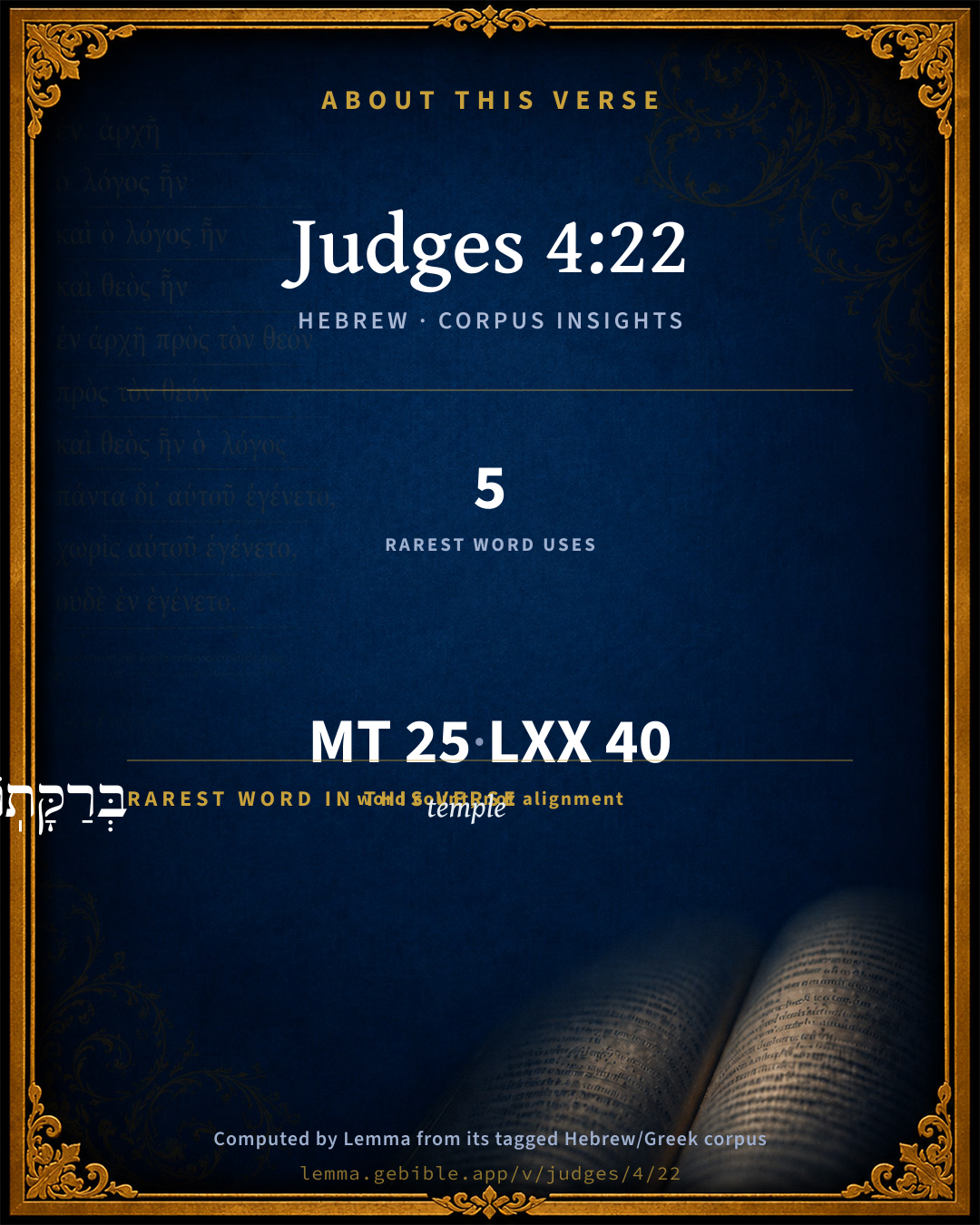
25
words
21
distinct lemmas
Historical
section

Notable vocabulary

The rarest word here is בְּרַקָּתֽוֹ temple H7541 — appearing just 5 times in the whole Hebrew Bible.

Shared distinctive vocabulary

בְּרַקָּתֽוֹ temple H7541 occurs in 5 verses of the Hebrew Bible. Also found in:

Grammatical profile

  • 10 verbs
  • 7 nouns
  • 1 pronoun
  • 2 prepositions
  • 5 particles

Verb forms

  • רֹדֵ֣ף Qal · Participle Active
  • וַתֵּצֵ֤א Qal · Sequential Imperfect
  • לִקְרָאת֔וֹ Qal · Infinitive Construct
  • וַתֹּ֣אמֶר Qal · Sequential Imperfect
  • לֵ֣ךְ Qal · Imperative
  • וְאַרְאֶ֔ךָּ Hiphil · Cohortative
  • מְבַקֵּ֑שׁ Piel · Participle Active
  • וַיָּבֹ֣א Qal · Sequential Imperfect
  • נֹפֵ֣ל Qal · Participle Active
  • מֵ֔ת Qal · Participle Active

Repetition

Words recur within this verse — often emphatic in Hebrew:

  • וְהִנֵּ֣ה behold H2009 ×2
  • סִֽיסְרָא֒ Sisera H5516 ×2

Hebrew & Septuagint length

In English translation the verse runs 42 words from the Hebrew and 48 from the Septuagint (LXX English) — closely comparable.

A rough comparison of the two English renderings, which tokenize alike — not a word-level alignment.

Word counts can differ between the Hebrew and the Greek without any difference in meaning — e.g. the Hebrew direct-object marker אֵת has no separate Greek word, and Greek often adds the article ὁ.

In the original languages it is 25 Hebrew tokens and 40 Greek tokens — but the two are counted differently (Hebrew bundles its prefixes and suffixes into one token; the Greek is in lemma form), so that isn’t a like-for-like length.

Cross-references

2

Topical passages linked to Judges 4:22 in the Treasury of Scripture Knowledge — connected by theme and wording, ordered by reader-vote popularity; previews shown in the World English Bible.

  • 2 Samuel 17:3 and I will bring back all the people to you: the man whom you seek is as if all returned: [so] all the people shall be in peace.
  • 2 Samuel 17:10–15 Even he who is valiant, whose heart is as the heart of a lion, will utterly melt; for all Israel knows that your father is a mighty man, and those who are with him are valiant men.

Cross-references courtesy of OpenBible.info (CC BY 4.0).

Hebrew and Greek witnesses Masoretic Hebrew ↔ Greek Septuagint

The same verse in the two great witnesses to the Old Testament, shown verse-for-verse.

These are two independent witnesses, not word-aligned to each other, and the Septuagint is shown in lemma (dictionary) form.

Hebrew Judges 4:22 Masoretic · Westminster Leningrad Codex

וְהִנֵּ֣ה בָרָק֮ רֹדֵ֣ף אֶת סִֽיסְרָא֒ וַתֵּצֵ֤א יָעֵל֙ לִקְרָאת֔וֹ וַתֹּ֣אמֶר ל֔וֹ לֵ֣ךְ וְאַרְאֶ֔ךָּ אֶת הָאִ֖ישׁ אֲשֶׁר אַתָּ֣ה מְבַקֵּ֑שׁ וַיָּבֹ֣א אֵלֶ֔יהָ וְהִנֵּ֤ה סִֽיסְרָא֙ נֹפֵ֣ל מֵ֔ת וְהַיָּתֵ֖ד בְּרַקָּתֽוֹ

Behold, as Barak pursued Sisera, Jael came out to meet him, and said to him, Come, and I will show you the man whom you seek. He came to her; and, behold, Sisera lay dead, and the tent-pin was in his temples.

World English Bible · Public Domain

Greek LXX Judges 4:22 Septuagint · lemma form

καί ἰδού βαρακ διώκω ὁ σισαρα καί ἐκἔρχομαι ιαηλ εἰς συνάντησις αὐτός καί εἶπον αὐτός δεῦρο καί δεικνύω σύ ὁ ἀνήρ ὅς σύ ζητέω καί εἰςἔρχομαι πρός αὐτός καί ἰδού σισαρα ῥίπτω νεκρός καί ὁ πάσσαλος ἐν ὁ κρόταφος αὐτός

And, behold, Barac was pursuing Sisara: and Jael went out to meet him, and she said to him, Come, and I will show you the man whom you seek: and he went in to her; and, behold, Sisara was fallen dead, and the pin was in his temple.

LXX2012 (modern English Septuagint) · Public Domain

Hebrew: Westminster Leningrad Codex (CC BY 4.0). Greek: Septuagint (public domain); English from LXX2012 (modern English Septuagint) (Public Domain). How the Septuagint differs from the Hebrew →

Targum (Aramaic paraphrase)

1

The Targum is the ancient Jewish Aramaic paraphrase of the Hebrew Scriptures — an interpretive translation, not the Hebrew text itself. Onkelos (literal) and Pseudo-Jonathan (expansive) render the Torah, and Jonathan the Prophets. Coverage is partial: where no permissively-licensed English translation exists for a verse, only the Aramaic is shown. This is verse-level text, not a word-by-word alignment to the Hebrew.

  1. Targum Jonathan Prophets (Joshua–Malachi)
    וְהָא בָרָק רְדַף יַת סִיסְרָא וְנַפְקַת יָעֵל לִקְדָמוּתֵיהּ וַאֲמַרַת לֵיהּ אִיתָא וְאַחֲזִינָךְ יַת גַבְרָא דְאַתְּ בָּעֵי וְעַל לְוָתָהּ וְהָא סִיסְרָא טָרִיף וּמִית וְסִכְּתָא נְעִיצָא בְּצִדְעֵיהּ:

    (no public-domain English translation for this verse)

    Targum Jonathan — Aramaic: “Mikraot Gedolot” (public domain). English: “Sefaria Community Translation” (CC0 1.0 (public-domain dedication)); “London "Chaldee Paraphrase," 1871” (public domain). Text via Sefaria.

Commentary

Notes on Judges 4:22 from classic Christian and Jewish commentators (each source and its license shown beneath its notes). The classic Christian expositions comment on the surrounding passage and are grouped to its opening verse, so a note may address several verses; the Jewish commentaries on the Tanakh (Rashi and others) are per-verse, so they appear only where the commentator wrote on this verse.

Lemma curates 59 commentaries, every one of them public domain or Creative Commons licensed, each selected and text-cleaned for this edition rather than reprinted as found. About our sources →

Trapp's Complete Commentary

John Trapp

Jdg 4:22 And, behold, as Barak pursued Sisera, Jael came out to meet him, and said unto him, Come, and I will shew thee the man whom thou seekest. And when he came into her [tent], behold, Sisera lay dead, and the nail [was] in his temples.

Ver. 22. Sisera lay dead.] By the hand of woman, which those warriors take for no small disgrace. {Jdg 9:54} Heber was perhaps in the army of the Israelites. We read of a brave Hungarian woman whose courage far exceeded the weakness of her sex: for at the siege of Buda, she thrusting in amongst the soldiers upon the top of the fort, with a great scythe in her hand, at one blow struck off two of the Turks’ heads, as they were climbing up the rampart. {a}

{a} Turk. Hist., 741.

John Trapp, A Commentary or Exposition upon All the Books of the Old and New Testament (1647–1656) — public domain. Text from a community e-Sword module.

Geneva Bible (1599)

Geneva Bible translators

So he saw that a woman had the honor, as Deborah prophesied.

Geneva Bible (1599) marginal notes — public domain. Text via Bolls.life.

Adam Clarke's Commentary

Verse 22. Behold, Sisera lay dead] What impression this made on the victorious Barak is not said: it could not give him much pleasure, especially when he learned the circumstances of his death.

Adam Clarke's Commentary on the Bible (1810–1826) — public domain. Text from a community e-Sword/MySword module.

Ellicott's Commentary for English Readers

(22) Behold, Sisera lay dead.—Thus the glory, such as it was, of having slain the general of the enemy passed to a woman (Jdg_4:9). The scene which thus describes the undaunted murderess standing in the tent between the dead and the living chieftains—and glorying in the decision which had led her to fling to the winds every rule of Eastern morality and decorum—is a very striking one.

A Bible Commentary for English Readers, edited by Charles John Ellicott (1878–1897) — public domain. Text from a community e-Sword module.

The Cambridge Bible for Schools and Colleges

gen. ed. J. J. S. Perowne

22. And, behold, as Barak pursued] hardly does justice to the original, ‘lo Barak, in pursuit of Sisera’; a remarkable coincidence! cf. Jdg_11:34, Gen_29:6. According to Jdg_4:16 Barak with his tribesmen pursued the Canaanites to Harosheth; Sisera’s hiding-place must have lain more or less on the route. On the difficulties of the narrative as it stands see above Jdg_4:17 n.

23, 24 give Rd’s conclusion of the story; Jdg_5:31 b is the finishing touch.

God subdued] Instead of God (Elohim) the narrative uses regularly the Lord (Jehovah). For subdued see on Jdg_3:30. It is generally supposed that the stories of the Judges were closed with a brief notice of the subjugation of the oppressors, before the Dtc. redactor expanded these conclusions in his own manner; perhaps the words Elohim subdued … formed part of this pre-Deuteronomic editorial work.

Jabin the king of Canaan] See on Jdg_4:2.

prevailed more and more against] bore harder and harder upon, cf. Jdg_3:10.

The Cambridge Bible for Schools and Colleges (gen. ed. J. J. S. Perowne; Cambridge University Press, 1878–1918) — public domain. Text from a community e-Sword module.

John Gill's Exposition

And, behold, as Barak pursued Sisera,.... Knowing the way he took, at least as he supposed:

Jael came out to meet him; as she did Sisera, but with greater pleasure:

and said unto him, come, and I will show thee the man whom thou seekest; for she full well knew whom he was in pursuit of:

and when he came into her tent; at her invitation:

behold, Sisera lay dead, and the nail was in his temples: which she did not attempt to draw out, but left it there, that it might be seen in what way she had dispatched him.

John Gill's Exposition of the Whole Bible (1746–1763) — public domain (CC PDM 1.0). Text via the HelloAO Bible API.

Whedon's Commentary on the Bible

Daniel D. Whedon

22. Behold, Sisera lay dead — As Barak gazed on the bloody sight, and saw that Sisera had perished by a woman’s hand, he realized the fulfilment of Deborah’s words, (Jdg_4:9,) “The journey shall not be for thine honour, for the Lord shall sell Sisera into the hand of a woman.”

Daniel D. Whedon (gen. ed.), Commentary on the Old and New Testaments (1874–1909) — public domain. Text from a community e-Sword module.

Rashi

Rabbi Shlomo Yitzchaki (Rashi)

In his forehead.בְּצִידֽעֵיה, "tenplia" in old French. She had penetrated his forehead and the ground.

Rashi on the Tanakh — English translations: “The Judaica Press complete Tanach with Rashi, translated by A. J. Rosenberg” (CC BY 4.0); “Pentateuch with Rashi's commentary by M. Rosenbaum and A.M. Silbermann, 1929-1934” (public domain); “The Metsudah Tanach series, Lakewood, N.J” (CC BY 4.0); and “The Book of Joshua, Metsudah Publications, 1997” (CC BY 4.0). Text via Sefaria.

Lesson kit

Teaching starters — assembled from the data on this page, not authored interpretation. Every prompt links to the verse data it draws on. Edit before teaching.

Judges, in the Historical, opens this verse with 25 words (21 distinct Hebrew lemmas). Its most distinctive word is raqqâh (“temple”). A historical commentator’s framing appears above. Read the whole chapter for the surrounding context.

Discussion questions

  1. What does “temple” (raqqâh) contribute to the verse as a whole?
  2. Judges 4:21 shares the word «temple» with this verse. How do the two illuminate each other?
  3. “behold” occurs 2× in this one verse. What is the effect of the repetition?
  4. These translations render this verse differently; the difference is in the English rendering, not the original. What questions does that raise?
  5. The verb «רֹדֵ֣ף» is Qal Participle Active. How does its form color the action?
  6. Reading how Trapp's Complete Commentary and Geneva Bible (1599) read this verse, where do the two commentators agree and where do they part?

Things to notice

Reading settings

Reading text

Shown beneath each verse's original-language words.

Old Testament
Old Testament edition

Read the OT as the Masoretic Hebrew (MT) or the Greek Septuagint (LXX).

English shown for the Greek Septuagint (in the Hebrew ↔ Greek comparison).

Comparing translations? Open the Compare panel on any verse page to stack up to four side by side.