
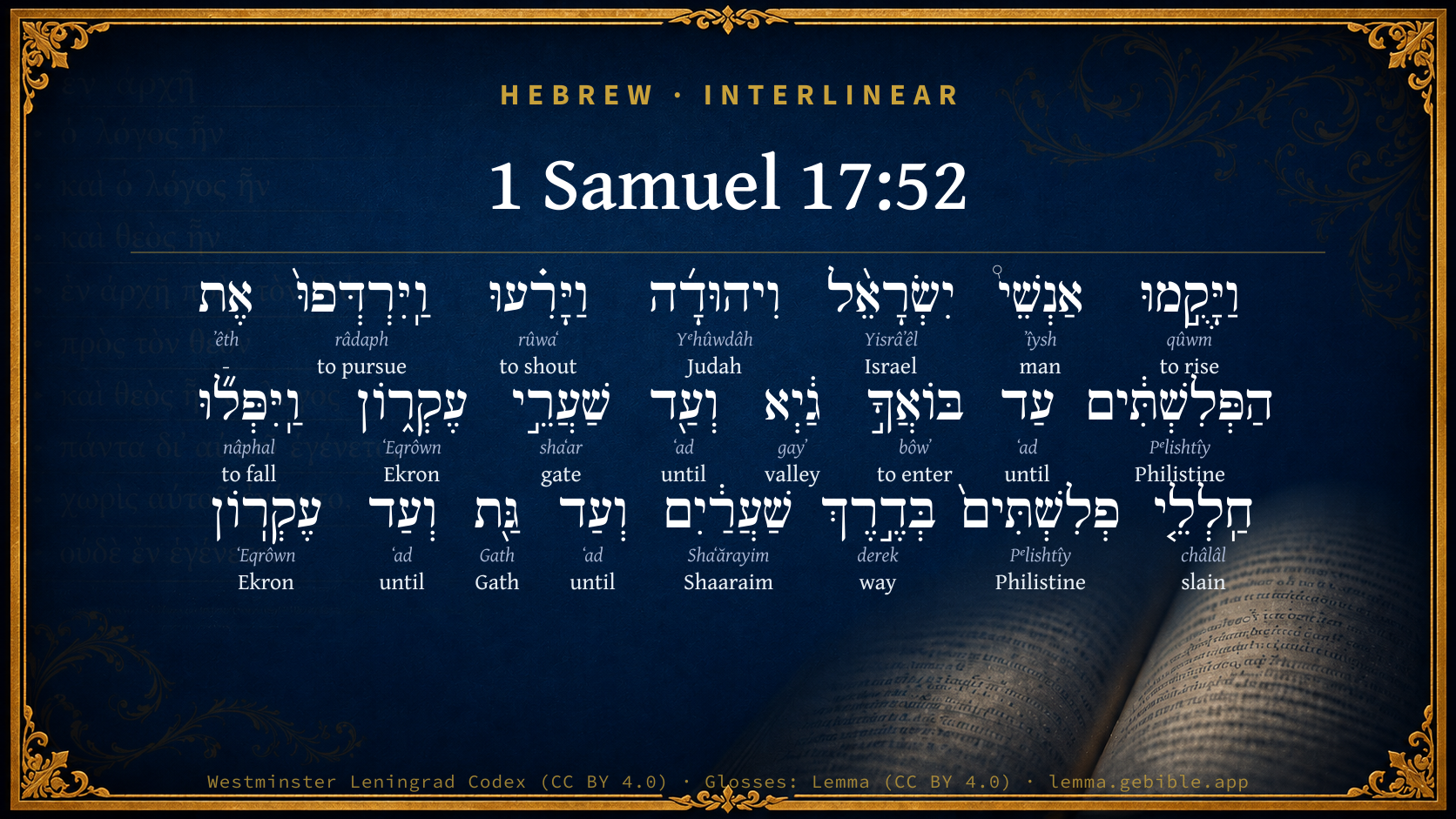
1 Samuel 17:52

Hebrew (Westminster Leningrad Codex) 1 Samuel 17:52 appears in the Hebrew Old Testament. The text above is from the Westminster Leningrad Codex. Each word links to its Strong’s number, a concise gloss, and parsing drawn from the Open Scriptures Hebrew Bible morphology. Click any word for its full Brown-Driver-Briggs (BDB) entry.
Download image
Cite this verse

1 Samuel 17:52 (World English Bible). Public Domain. Lemma interlinear Bible study tool, https://lemma.gebible.app/v/1-samuel/17/52.

Show BibTeX & RIS
BibTeX
RIS
English Translation
The men of Israel and of Judah arose, and shouted, and pursued the Philistines, until you come to Gai, and to the gates of Ekron. The wounded of the Philistines fell down by the way to Shaaraim, even to Gath, and to Ekron.
World English Bible · Public Domain
Download a study sheet

One document with this verse’s original text, its word-by-word gloss line, the meaning frame, cross-references with their text, attributed commentary, and full source and license credits — printable, and it pastes into notes with its structure intact.

This verse Autodidact and up

Study sheet (.html) Plain text (.txt)

A passage Seminary Student

Up to 50 verses in one chapter. A passage sheet keeps up to 6 commentary sources and 12 cross-references per verse, in the order this page ranks them, and says so on the sheet whenever that leaves anything out. Ask for a single verse and you get the Autodidact verse sheet above.

Everything on this page stays free to read, with no account — the sheet is a download of what is already on screen, not access to it.

Want to remove ads? Support Godless Engineer
Compare translations 3

The same verse in 3 English versions, stacked beneath the original-language interlinear above. Click any original word for its lexicon entry.

Each is an independent rendering of the whole verse — the interlinear is not word-aligned to these translations.

Highlighted words mark where these versions differ — a whole-verse word diff, not a word-by-word alignment.

  • World English Bible Public Domain
    The men of Israel and of Judah arose, and shouted, and pursued the Philistines, until you come to Gai, and to the gates of Ekron. The wounded of the Philistines fell down by the way to Shaaraim, even to Gath, and to Ekron.
  • King James Version Public Domain
    And the men of Israel and of Judah arose, and shouted, and pursued the Philistines, until thou come to the valley, and to the gates of Ekron. And the wounded of the Philistines fell down by the way to Shaaraim, even unto Gath, and unto Ekron.
  • unfoldingWord Literal Text CC BY-SA 4.0
    And the men of Israel and Judah arose, and they shouted and pursued the Philistines unto your coming the valley and to the gates of Ekron. And the pierced of the Philistines fell on the way of Shaaraim and unto Gath and unto Ekron.

unfoldingWord Literal Text — © unfoldingWord, licensed CC BY-SA 4.0. Word-aligned USFM3 via Door43 (git.door43.org/unfoldingWord/en_ult).

Versions to compare (up to 4)

3 of 4 selected

Show all 18 translations

Every available English version of this verse, each an independent rendering of the whole verse.

  • World English Bible Public Domain
    The men of Israel and of Judah arose, and shouted, and pursued the Philistines, until you come to Gai, and to the gates of Ekron. The wounded of the Philistines fell down by the way to Shaaraim, even to Gath, and to Ekron.
  • Berean Standard Bible Public Domain
    Then the men of Israel and Judah charged forward with a shout and pursued the Philistines to the entrance of Gath and to the gates of Ekron. And the bodies of the Philistines were strewn along the Shaaraim road to Gath and Ekron.
  • Majority Standard Bible Public Domain
    Then the men of Israel and Judah charged forward with a shout and pursued the Philistines to the entrance of Gath and to the gates of Ekron. And the bodies of the Philistines were strewn along the Shaaraim road to Gath and Ekron.
  • King James Version Public Domain
    And the men of Israel and of Judah arose, and shouted, and pursued the Philistines, until thou come to the valley, and to the gates of Ekron. And the wounded of the Philistines fell down by the way to Shaaraim, even unto Gath, and unto Ekron.
  • American Standard Version (1901) Public Domain
    And the men of Israel and of Judah arose, and shouted, and pursued the Philistines, until thou comest to Gai, and to the gates of Ekron. And the wounded of the Philistines fell down by the way to Shaaraim, even unto Gath, and unto Ekron.
  • Revised Version (1885) Public Domain
    And the men of Israel and of Judah arose, and shouted, and pursued the Philistines, until thou comest to Gai, and to the gates of Ekron. And the wounded of the Philistines fell down by the way to Shaaraim, even unto Gath, and unto Ekron.
  • Geneva Bible (1599) Public Domain
    And the men of Israel and Iudah arose, and shouted, and followed after the Philistims, vntill they came to the valley, and vnto the gates of Ekron: and the Philistims fell downe wounded by the way of Shaaraim, euen to Gath and to Ekron.
  • Douay-Rheims (1899) Public Domain
    And the men of Israel and Juda rising up shouted, and pursued after the Philistines till they came to the valley and to the gates of Accaron, and there fell many wounded of the Philistines in the way of Saraim, and as far as Geth, and as far as Accaron.
  • Young's Literal Translation Public Domain
    And the men of Israel rise -- also Judah -- and shout, and pursue the Philistines till thou enter the valley, and unto the gates of Ekron, and the wounded of the Philistines fall in the way of Shaaraim, even unto Gath, and unto Ekron,
  • Literal Standard Version CC BY-SA 4.0
    And the men of Israel rise—also Judah—and shout, and pursue the Philistines until you enter the valley, and to the gates of Ekron, and the wounded of the Philistines fall in the way of Shaaraim, even to Gath, and to Ekron,
  • Unlocked Literal Bible CC BY-SA 4.0
    Then the men of Israel and of Judah rose with a shout, and chased after the Philistines as far as the valley and the gates of Ekron. The dead Philistines lay along the way to Shaaraim, all the way to Gath and Ekron.
  • unfoldingWord Literal Text CC BY-SA 4.0
    And the men of Israel and Judah arose, and they shouted and pursued the Philistines unto your coming the valley and to the gates of Ekron. And the pierced of the Philistines fell on the way of Shaaraim and unto Gath and unto Ekron.
  • Darby Bible Public Domain
    And the men of Israel and of Judah arose, and shouted, and pursued the Philistines, until thou comest to the ravine and to the gates of Ekron. And the wounded of the Philistines fell down on the way to Shaaraim, even to Gath, and to Ekron.
  • World Messianic Bible Public Domain
    The men of Israel and of Judah arose and shouted, and pursued the Philistines as far as Gai and to the gates of Ekron. The wounded of the Philistines fell down by the way to Shaaraim, even to Gath and to Ekron.
  • Webster's Bible Public Domain
    And the men of Israel and of Judah arose, and shouted, and pursued the Philistines to the entrance of the valley, and to the gates of Ekron. And the wounded of the Philistines fell down by the way to Shaaraim, even to Gath, and to Ekron.
  • Free Bible Version CC BY-SA 4.0
    Then the men of Israel and Judah rushed forward shouting the war cry and chased the Philistines all the way to Gath and to the gates of Ekron. Their bodies were scattered along the Shaaraim road to Gath and Ekron.
  • Bible in Basic English Public Domain
    And the men of Israel and of Judah got up, and gave a cry, and went after the Philistines as far as Gath and the town doors of Ekron. And the wounded of the Philistines were falling down by the road from Shaaraim all the way to Gath and Ekron.
  • JPS Tanakh (1917) Public Domain
    And the men of Israel and of Judah arose, and shouted, and pursued the Philistines, until thou comest to Gai, and to the gates of Ekron. And the wounded of the Philistines fell down by the way to Shaaraim, even unto Gath, and unto Ekron.

Literal Standard Version (2020), Covenant Press — licensed CC BY-SA 4.0. Text via the HelloAO Bible API (eBible.org). Unlocked Literal Bible (unfoldingWord) — licensed CC BY-SA 4.0. Text via the HelloAO Bible API (eBible.org). unfoldingWord Literal Text — © unfoldingWord, licensed CC BY-SA 4.0. Word-aligned USFM3 via Door43 (git.door43.org/unfoldingWord/en_ult). Free Bible Version, Dr. Jonathan Gallagher — licensed CC BY-SA 4.0. Text via the HelloAO Bible API (eBible.org).

Word by word

More ways to search: Search by grammar → Find every occurrence → Compare this word →

Practice this passage: Drill this verse → Learn its vocabulary →

שַׁעֲרַ֔יִם
Shaʻărayim
H8189
“Shaaraim”
Noun, Proper
Part of Speech
Noun
Type
Proper
Full BDB Definition

Origin: dual of H8179

TWOT: None

Shaaraim = "double gate" - a town in Judah - a town in Simeon
  1. וַיָּקֻ֣מוּ qûwm H6965 “and · to rise” Conjunction + Verb, Qal, Sequential Imperfect, 3rd Person, Masculine, Plural
  2. אַנְשֵׁי֩ ʼîysh H376 “men of” Noun, Common, Masculine, Plural, Construct
  3. יִשְׂרָאֵ֨ל Yisrâʼêl H3478 “Israel” Noun, Proper
  4. וִיהוּדָ֜ה Yᵉhûwdâh H3063 “and · Judah” Conjunction + Noun, Proper
  5. וַיָּרִ֗עוּ rûwaʻ H7321 “and · to shout” Conjunction + Verb, Hiphil, Sequential Imperfect, 3rd Person, Masculine, Plural
  6. וַֽיִּרְדְּפוּ֙ râdaph H7291 “and · to pursue” Conjunction + Verb, Qal, Sequential Imperfect, 3rd Person, Masculine, Plural
  7. אֶת ʼêth H853 “-” Particle, Direct Object
  8. הַפְּלִשְׁתִּ֔ים Pᵉlishtîy H6430 “the · Philistines” Particle, Definite Article + Noun, Gentilic, Masculine, Plural, Absolute
  9. עַד ʻad H5704 “until” Preposition
  10. בּוֹאֲךָ֣ bôwʼ H935 “to enter · you” Verb, Qal, Infinitive Construct + Suffix, Personal, 2nd Person, Masculine, Singular
  11. גַ֔יְא gayʼ H1516 “valley” Noun, Common, Both, Singular, Absolute
  12. וְעַ֖ד ʻad H5704 “and · until” Conjunction + Preposition
  13. שַׁעֲרֵ֣י shaʻar H8179 “gates of” Noun, Common, Masculine, Plural, Construct
  14. עֶקְר֑וֹן ʻEqrôwn H6138 “Ekron” Noun, Proper
  15. וַֽיִּפְּל֞וּ nâphal H5307 “and · to fall” Conjunction + Verb, Qal, Sequential Imperfect, 3rd Person, Masculine, Plural
  16. חַֽלְלֵ֤י châlâl H2491 “slain of” Adjective, Adjective, Masculine, Plural, Construct
  17. פְלִשְׁתִּים֙ Pᵉlishtîy H6430 “Philistines” Noun, Gentilic, Masculine, Plural, Absolute
  18. בְּדֶ֣רֶךְ derek H1870 “in/at · way of” Preposition + Noun, Common, Both, Singular, Construct
  19. וְעַד ʻad H5704 “and · until” Conjunction + Preposition
  20. גַּ֖ת Gath H1661 “Gath” Noun, Proper
  21. וְעַד ʻad H5704 “and · until” Conjunction + Preposition
  22. עֶקְרֽוֹן ʻEqrôwn H6138 “Ekron” Noun, Proper

About this verse

These counts appear in no published source. They are computed here, from the morphology-tagged text and Lemma’s own curated glosses. What Lemma adds →

23
words
18
distinct lemmas
Historical
section

Notable vocabulary

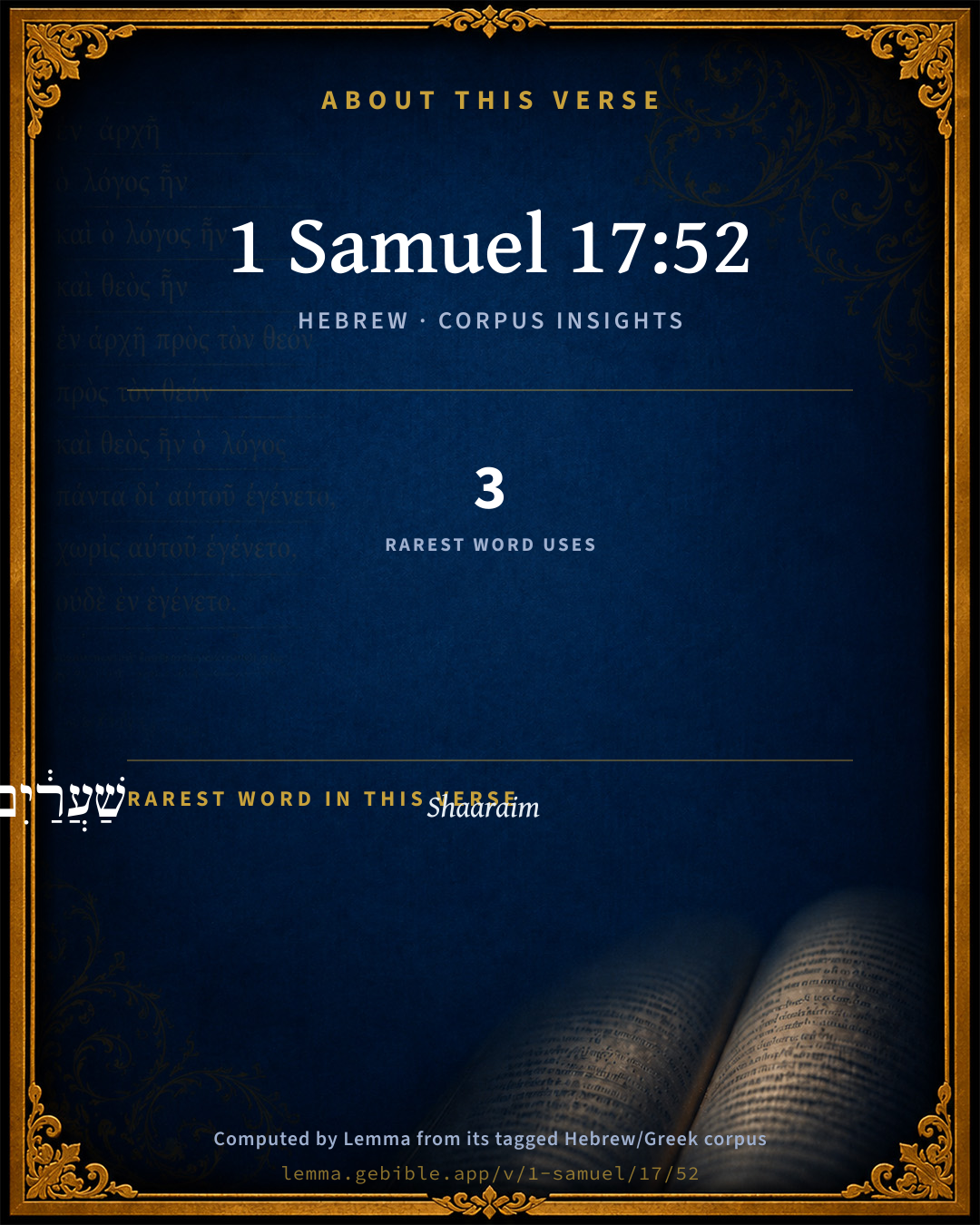
The rarest word here is שַׁעֲרַ֔יִם Shaaraim H8189 — appearing just 3 times in the whole Hebrew Bible.

Shared distinctive vocabulary

שַׁעֲרַ֔יִם Shaaraim H8189 occurs in 3 verses of the Hebrew Bible. Also found in:

Grammatical profile

  • 5 verbs
  • 12 nouns
  • 1 adjective
  • 4 prepositions
  • 1 particle

Verb forms

  • וַיָּקֻ֣מוּ Qal · Sequential Imperfect
  • וַיָּרִ֗עוּ Hiphil · Sequential Imperfect
  • וַֽיִּרְדְּפוּ֙ Qal · Sequential Imperfect
  • בּוֹאֲךָ֣ Qal · Infinitive Construct
  • וַֽיִּפְּל֞וּ Qal · Sequential Imperfect

Repetition

Words recur within this verse — often emphatic in Hebrew:

  • עַד until H5704 ×4
  • הַפְּלִשְׁתִּ֔ים Philistine H6430 ×2
  • עֶקְר֑וֹן Ekron H6138 ×2

Hebrew & Septuagint length

In English translation the verse runs 43 words from the Hebrew and 48 from the Septuagint (LXX English) — closely comparable.

A rough comparison of the two English renderings, which tokenize alike — not a word-level alignment.

Word counts can differ between the Hebrew and the Greek without any difference in meaning — e.g. the Hebrew direct-object marker אֵת has no separate Greek word, and Greek often adds the article ὁ.

Cross-references

6

Topical passages linked to 1 Samuel 17:52 in the Treasury of Scripture Knowledge — connected by theme and wording, ordered by reader-vote popularity; previews shown in the World English Bible.

  • Joshua 15:11 and the border went out to the side of Ekron northward; and the border extended to Shikkeron, and passed along to Mount Baalah, and went out at Jabneel; and the goings out of the border were at the sea.
  • Joshua 15:33–36 In the lowland, Eshtaol, and Zorah, and Ashnah,
  • Joshua 15:45–46 Ekron, with its towns and its villages;
  • Judges 7:23 The men of Israel were gathered together out of Naphtali, and out of Asher, and out of all Manasseh, and pursued after Midian.
  • 1 Samuel 14:21–22 Now the Hebrews who were with the Philistines as before, and who went up with them into the camp, [from the country] round about, even they also [turned] to be with the Israelites who were with Saul and Jonathan.
  • 2 Samuel 23:10 He arose, and struck the Philistines until his hand was weary, and his hand froze to the sword; and Yahweh worked a great victory that day; and the people returned after him only to take spoil.

Cross-references courtesy of OpenBible.info (CC BY 4.0).

Hebrew and Greek witnesses Masoretic Hebrew ↔ Greek Septuagint

The same verse in the two great witnesses to the Old Testament, shown verse-for-verse.

These are two independent witnesses, not word-aligned to each other, and the Septuagint is shown in lemma (dictionary) form.

Hebrew 1 Samuel 17:52 Masoretic · Westminster Leningrad Codex

וַיָּקֻ֣מוּ אַנְשֵׁי֩ יִשְׂרָאֵ֨ל וִיהוּדָ֜ה וַיָּרִ֗עוּ וַֽיִּרְדְּפוּ֙ אֶת הַפְּלִשְׁתִּ֔ים עַד בּוֹאֲךָ֣ גַ֔יְא וְעַ֖ד שַׁעֲרֵ֣י עֶקְר֑וֹן וַֽיִּפְּל֞וּ חַֽלְלֵ֤י פְלִשְׁתִּים֙ בְּדֶ֣רֶךְ שַׁעֲרַ֔יִם וְעַד גַּ֖ת וְעַד עֶקְרֽוֹן

The men of Israel and of Judah arose, and shouted, and pursued the Philistines, until you come to Gai, and to the gates of Ekron. The wounded of the Philistines fell down by the way to Shaaraim, even to Gath, and to Ekron.

World English Bible · Public Domain

Greek LXX 1 Samuel 17:52 Septuagint · lemma form
And the men of Israel and Juda arose, and shouted and pursued them as far as the entrance to Geth, and as far as the gate of Ascalon: and the slain men of the Philistines fell in the way of the gates, both to Geth, and to Accaron.

LXX2012 (modern English Septuagint) · Public Domain

On this verse, Ellicott's Commentary for English Readers discusses the Septuagint’s reading. Read the note in Commentary ↓

Hebrew: Westminster Leningrad Codex (CC BY 4.0). Greek: Septuagint (public domain); English from LXX2012 (modern English Septuagint) (Public Domain). How the Septuagint differs from the Hebrew →

Targum (Aramaic paraphrase)

1

The Targum is the ancient Jewish Aramaic paraphrase of the Hebrew Scriptures — an interpretive translation, not the Hebrew text itself. Onkelos (literal) and Pseudo-Jonathan (expansive) render the Torah, and Jonathan the Prophets. Coverage is partial: where no permissively-licensed English translation exists for a verse, only the Aramaic is shown. This is verse-level text, not a word-by-word alignment to the Hebrew.

  1. Targum Jonathan Prophets (Joshua–Malachi)
    וְקָמוּ אֱנָשֵׁי יִשְׂרָאֵל וִיהוּדָה וְיַבִּיבוּ וּרְדָפוּ יַת פְּלִשְׁתָּאֵי עַד מַעֲלָנָא דְגַיְא וְעַד תַּרְעֵי עֶקְרוֹן וּנְפַלוּ קָטוֹלֵי פְלִשְׁתָּאֵי בְּאוֹרַח שַׁעֲרַיִם וְעַד גַת וְעַד עֶקְרוֹן:

    (no public-domain English translation for this verse)

    Targum Jonathan — Aramaic: “Mikraot Gedolot” (public domain). English: “Sefaria Community Translation” (CC0 1.0 (public-domain dedication)); “London "Chaldee Paraphrase," 1871” (public domain). Text via Sefaria.

Commentary

Notes on 1 Samuel 17:52 from classic Christian and Jewish commentators (each source and its license shown beneath its notes). The classic Christian expositions comment on the surrounding passage and are grouped to its opening verse, so a note may address several verses; the Jewish commentaries on the Tanakh (Rashi and others) are per-verse, so they appear only where the commentator wrote on this verse.

Lemma curates 59 commentaries, every one of them public domain or Creative Commons licensed, each selected and text-cleaned for this edition rather than reprinted as found. About our sources →

Trapp's Complete Commentary

John Trapp

1Sa 17:52 And the men of Israel and of Judah arose, and shouted, and pursued the Philistines, until thou come to the valley, and to the gates of Ekron. And the wounded of the Philistines fell down by the way to Shaaraim, even unto Gath, and unto Ekron.

Ver. 52. And the wounded of the Philistines fell down.] Their fears betrayed them, as it commonly doth those that flee, into the hand of death. Semper in bello his maximum est periculum qui maxime timent; audacia est pro mare. {a}

{a} Sallust.

John Trapp, A Commentary or Exposition upon All the Books of the Old and New Testament (1647–1656) — public domain. Text from a community e-Sword module.

The Biblical Illustrator

Joseph S. Exell

1Sa_17:52-53

And the men of Israel and of Judah arose, and shouted and pursued the Philistines.

Keeping the victory

When General Wolfe was mortally wounded at the battle of Quebec, he said after his third injury, Hold me up; do not let my brave boys see I am wounded. A little later, as his blood was fast ebbing away, he said, in faint tones, The victory is ours! Oh! keep it. So, when our Lord died for our sins on the cross, He virtually said to His redeemed ones, The victory is ours. Oh! keep it. And this is the victory that makes His victory ours, and overcometh the world, even our faith. There must be no surrender by sin or unbelief of what He has obtained for us. (H. O. Mackey.)

The Biblical Illustrator, edited by Joseph S. Exell (c. 1880s–1900s) — public domain. Text from a community e-Sword module.

Tyndale Open Study Notes

Tyndale Open Resources

17:52 The Israelites chased the Philistines to Gath, some six miles to the west. • Ekron was a Philistine city five miles north of Gath. • Shaaraim was a city of Judah near Azekah (17:1).

Tyndale Open Study Notes — © Tyndale Open Resources, licensed CC BY-SA 4.0. Text via the HelloAO Bible API.

Geneva Bible (1599)

Geneva Bible translators

Or, Gath the city.

Geneva Bible (1599) marginal notes — public domain. Text via Bolls.life.

Jamieson, Fausset & Brown

Robert Jamieson, A. R. Fausset & David Brown

Shaaraim--(See Jos 15:36).

Jamieson, Fausset & Brown — Commentary Critical and Explanatory on the Whole Bible (1871) — public domain (CC PDM 1.0). Text via the HelloAO Bible API.

Ellicott's Commentary for English Readers

(52) To the valley.—More accurately, to a valley; there is no article in the Hebrew. This want of the article at once suggests that the “valley” here spoken of so indefinitely was not that well-known valley or ravine which divided the two armies; besides which, it is nowhere suggested that the Philistines had ever crossed the valley or ravine.

Keil remarks that it is strange that no further mention is made of this “valley of the pursuit. The LXX. render, instead of “to a valley,” “to Gath.” These Greek translators probably then had before them the true text: Gath, instead of gai, a valley. Gath is mentioned in the next sentence.

The way to Shaaraim.—This was a town in the lowlands of Judah (see Jos_15:36); the name has probably been preserved in the modern Kefr Zakariya. The LXX., however,” do not understand Shaaraim as a city at all, but render, instead of “by the way to Shaaraim,” “in the way of the gates.” The “gates” of Ekron are mentioned as one of the notable places of the flight in the preceding sentence.

If the LXX. interpretation be adopted, we must understand by this expression the space between the outer and the inner gates of Ekron.

A Bible Commentary for English Readers, edited by Charles John Ellicott (1878–1897) — public domain. Text from a community e-Sword module.

The Cambridge Bible for Schools and Colleges

gen. ed. J. J. S. Perowne

52. until thou come to the valley] Heb. gai, “the ravine,” as in 1Sa_17:3. But the ravine which separated the armies could not tie the terminus of the Philistine flight, and it seems most probable that gai is a copyist’s error for Gath, which is the reading of the Sept. (B). Shaaraim is mentioned in Jos_15:35-36 in connexion with Sochoh and Azekah among the towns of Judah. It is perhaps to be placed at Tell-Zakarîya, a conspicuous hill on the southern side of the main valley, between Shuweikeh (Sochoh) and Tell-es-Sâfi (Gath), exactly in the line which the Philistine flight would naturally take. It must originally have been an important outpost for Judah against Gath, but was now no doubt in the hands of the Philistines.

The Cambridge Bible for Schools and Colleges (gen. ed. J. J. S. Perowne; Cambridge University Press, 1878–1918) — public domain. Text from a community e-Sword module.

John Gill's Exposition

And the men of Israel and of Judah arose,.... From their encampment and entrenchment, or they prepared for a pursuit:

and shouted, and pursued the Philistines; shouted when they first set out, and continued shouting as they pursued, to animate their own troops, and terrify the enemy:

until thou come to the valley, and to the gates of Ekron; which was one of the five principalities of the Philistines; so that they pursued them to their own cities, and to the very gates of them:

and the wounded of the Philistines fell down by the way to Shaaraim; a city in the tribe of Judah, and seems to be the same with Sharaim; see Gill on Jos 15:36. Josephus says (n), there were killed of the Philistines thirty thousand, and twice as many wounded:

even unto Gath, and unto Ekron; Josephus (o) has it, to the borders of Gath, and to the gates of Ashkelon, which were two other principalities of the Philistines; according to Bunting (p), the whole chase was this, to the valley and river Sorek four miles; from thence to Ekron eight miles; to Ashkelon twenty miles, and to Gath twenty four miles; that is, from the place where Goliath was killed.

(n) Antiqu. l. 6. c. 9. sect. 5. (o) Ibid. (p) Travels of the Patriarchs, &c. p. 128.

John Gill's Exposition of the Whole Bible (1746–1763) — public domain (CC PDM 1.0). Text via the HelloAO Bible API.

Albert Barnes' Notes on the Bible

The men of Israel and Judah - See 1Sa 15:4 note.

Shaaraim - A town of Judah in the Shephelah (see the marginal reference), at this time probably in the possession of the Philistines.

Albert Barnes' Notes on the Bible (1834–1885) — public domain. Text from a community e-Sword/MySword module.

Whedon's Commentary on the Bible

Daniel D. Whedon

52. The valley — Where the Wady es-Sumt opens into the great western plain of Philistia.

Shaaraim — The site of this place is unknown. It is probably to be looked for somewhere between Gath and Ekron. On the two last named cities, see notes on 1Sa_5:8; 1Sa_5:10.

Daniel D. Whedon (gen. ed.), Commentary on the Old and New Testaments (1874–1909) — public domain. Text from a community e-Sword module.

The Pulpit Commentary

Vers. 52, 53. To the valley. Hebrew, gai. As we have seen, there was a gai or ravine between the two armies, but in the Hebrew there is no article, and the Israelites must also cross this before any fighting began. The panic which struck the Philistines when they saw their champion fall enabled the Israelites to do so, but the pursuit only then commenced. The Septuagint reads Gath, a very probable emendation, for, as we saw in the passage quoted from Condor on ver. 2, Gath was situated at the mouth of the terebinth valley. The Syriac and Vulgate retain valley, but the former understands it of the mouth of the valley of Elah. Shaaraim was a town assigned to Judah (Jos_15:36) in the Shephelah (see on ver. 1), but was now held by the Philistines. They spoiled their tents. More correctly, "their comp.

Vers. 52-58.

Unknown and yet well known.

The facts are

1. Stimulated by the exploit of David, the people complete their victoryover the Philistines.

2. David leaves his weapons in his tent and carries Goliath"s head toJerusalem.

3. During the conflict Saul inquires who David was, but obtains noinformation, till, on presentation, David declares himself to be the son of Jesse. The summary of events here given brings out incidentally a fair illustration of general truths.

I MULTITUDES ARE INSPIRED TO VIGOROUS ACTION BY THE INFLUENCE OF INDIVIDUAL HEROISM. The force of David"s character passed beyond the death of Goliath: it infused fear into the Philistines and aroused the spirit of his countrymen. In this stimulating power we have one of the prime qualities of true leadership. The value of our actions lies much in this moral force. One of the difficulties of conflict in a good cause is to arouse enthusiasm, nourish courage, and incline men to exchange their lethargy for action. In the cause of Christ we have need to pray that he would raise up men fitted, by their heroic spirit, to arouse the slumbering energies of his people.

II FORMER FRIENDS REAPPEAR UNDER A NEW GUISE. The stripling who befriended Saul in his military difficulties was the same as comforted him in his private sorrows. The deft fingers that once drew sweet music from the harp now used the stone that brought Saul"s enemy to the earth. This was the second of the many acts of kindness rendered by the future to the present king, though Saul recognised not his quondam comforter under the new guise of chivalry. It is a happy circumstance when a man can enrich others by the exercise of diverse and unlooked for gifts, even when not recognised. By such merciful providences does God sometimes mitigate the misfortunes even of the undeserving.

III THERE IS SOMETIMES IGNORANCE IN HIGH PLACES OF PERSONS AND QUALITIES WORTH KNOWING. For some time David had, next to Samuel, been the most beautiful character in Israel. This is a just inference from his choice and anointing by Samuel, the sweet charm of his music and song, his noble endurance of Eliab"s base imputation (vers. 28, 29), the simple story of the lion and bear, the tone of his address to Goliath, and the entire spirit displayed through the day. If moral and high spiritual qualities are of greatest permanent value to a nation, then David was, next to Samuel, Israel"s greatest benefactor. And yet Saul and his officers knew him not. Concerned with the arm of flesh and the framework of national life, great authorities are often unaware of the presence of persons most important on account of their elevation of character. This will ever be true until the time comes when moral and spiritual considerations have their proper place in the councils of kings and princes. But though "unknown" in earthly courts, the holy and Christly have their record in the court of heaven, and are held in everlasting remembrance by him who delighteth in his saints and guards them as the apple of his eye.

General lessons:

1. We should pray God that the spirit of his chosen servants may become more prevalent in the Church.

2. If our goodness is real, it will find out new forms of manifestation, andnot refrain because men see not the personality that blesses.

3. It may be useful to foster courage and hope for future conflicts in life bya frequent reminder of past victories, for the giant"s head in Jerusalem was not without moral intent.

4. It will be an encouragement to constancy in goodness to remember thatwhile "unknown" we are "well known". (2Co_5:9)

The Pulpit Commentary (1880–1919), ed. H.D.M. Spence-Jones & Joseph S. Exell — public domain. Text from a community e-Sword module.

unfoldingWord translationNotes

Door43 World Missions Community

The dead Philistines lay along the way to Shaaraim

It can be stated clearly that the Israelites were killing the Philistines as they chased them. AT: "And they killed the Philistines as they chased them, and the bodies of the dead Philistines were on the ground along the way to Shaaraim" (See: Assumed Knowledge and Implicit Information)

they plundered their camp

"the Israelites plundered the Philistines' camp"

he put his armor in his tent

"he put Goliath's armor in his own tent"

translationWords

Israel

Judah

Philistines

gate

Ekron

Gath

people group

Jerusalem

armor

tent

unfoldingWord translationNotes — © Distant Shores Media and the Door43 World Missions Community, licensed CC BY-SA 4.0. Source: git.door43.org/Door43/en_tn.

Lesson kit

Teaching starters — assembled from the data on this page, not authored interpretation. Every prompt links to the verse data it draws on. Edit before teaching.

1 Samuel, in the Historical, opens this verse with 23 words (18 distinct Hebrew lemmas). Its most distinctive word is Shaʻărayim (“Shaaraim”). A historical commentator’s framing appears above. Read the whole chapter for the surrounding context.

Discussion questions

  1. The word Shaʻărayim carries the sense “Shaaraim.” How does it shape the verse?
  2. How does Joshua 15:36, which shares the word «Shaaraim», read alongside this verse?
  3. What does the repetition of “until” (4× in this one verse) do in this verse?
  4. These translations render this verse differently; the difference is in the English rendering, not the original. What questions does that raise?
  5. «וַיָּקֻ֣מוּ» is a Qal Sequential Imperfect verb. How does that grammatical form shape the action described?
  6. Compare how Trapp's Complete Commentary and The Biblical Illustrator read this verse. Where do they agree or differ?

Things to notice

Reading settings

Reading text

Shown beneath each verse's original-language words.

Old Testament
Old Testament edition

Read the OT as the Masoretic Hebrew (MT) or the Greek Septuagint (LXX).

English shown for the Greek Septuagint (in the Hebrew ↔ Greek comparison).

Comparing translations? Open the Compare panel on any verse page to stack up to four side by side.