
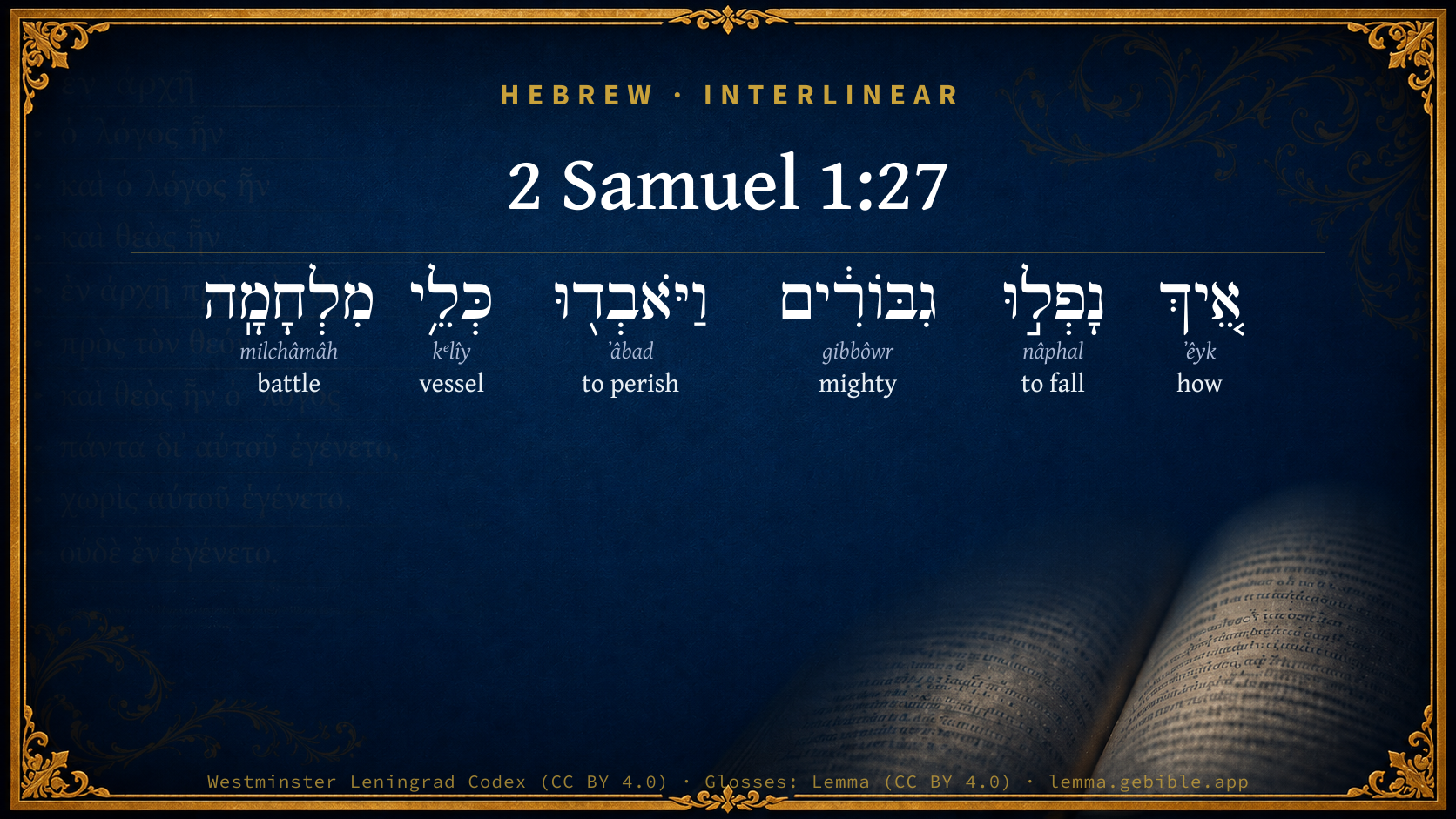
2 Samuel 1:27

Hebrew (Westminster Leningrad Codex) 2 Samuel 1:27 appears in the Hebrew Old Testament. The text above is from the Westminster Leningrad Codex. Each word links to its Strong’s number, a concise gloss, and parsing drawn from the Open Scriptures Hebrew Bible morphology. Click any word for its full Brown-Driver-Briggs (BDB) entry.
Download image
Cite this verse

2 Samuel 1:27 (World English Bible). Public Domain. Lemma interlinear Bible study tool, https://lemma.gebible.app/v/2-samuel/1/27.

Show BibTeX & RIS
BibTeX
RIS
English Translation
How are the mighty fallen, The weapons of war perished!
World English Bible · Public Domain
Download a study sheet

One document with this verse’s original text, its word-by-word gloss line, the meaning frame, cross-references with their text, attributed commentary, and full source and license credits — printable, and it pastes into notes with its structure intact.

This verse Autodidact and up

Study sheet (.html) Plain text (.txt)

A passage Seminary Student

Up to 50 verses in one chapter. A passage sheet keeps up to 6 commentary sources and 12 cross-references per verse, in the order this page ranks them, and says so on the sheet whenever that leaves anything out. Ask for a single verse and you get the Autodidact verse sheet above.

Everything on this page stays free to read, with no account — the sheet is a download of what is already on screen, not access to it.

Want to remove ads? Support Godless Engineer
Compare translations 3

The same verse in 3 English versions, stacked beneath the original-language interlinear above. Click any original word for its lexicon entry.

Each is an independent rendering of the whole verse — the interlinear is not word-aligned to these translations.

Highlighted words mark where these versions differ — a whole-verse word diff, not a word-by-word alignment.

  • World English Bible Public Domain
    How are the mighty fallen, The weapons of war perished!
  • King James Version Public Domain
    How are the mighty fallen, and the weapons of war perished!
  • unfoldingWord Literal Text CC BY-SA 4.0
    How the mighty have fallen and the weapons of war have perished!”

unfoldingWord Literal Text — © unfoldingWord, licensed CC BY-SA 4.0. Word-aligned USFM3 via Door43 (git.door43.org/unfoldingWord/en_ult).

Versions to compare (up to 4)

3 of 4 selected

Show all 17 translations

Every available English version of this verse, each an independent rendering of the whole verse.

  • World English Bible Public Domain
    How are the mighty fallen, The weapons of war perished!
  • Berean Standard Bible Public Domain
    How the mighty have fallen and the weapons of war have perished!”
  • Majority Standard Bible Public Domain
    How the mighty have fallen, and the weapons of war have perished!”
  • King James Version Public Domain
    How are the mighty fallen, and the weapons of war perished!
  • American Standard Version (1901) Public Domain
    How are the mighty fallen, And the weapons of war perished!
  • Revised Version (1885) Public Domain
    How are the mighty fallen, and the weapons of war perished!
  • Douay-Rheims (1899) Public Domain
    How are the valiant fallen, and the weapons of war perished?
  • Young's Literal Translation Public Domain
    How have the mighty fallen, Yea, the weapons of war perish!'
  • Literal Standard Version CC BY-SA 4.0
    How the mighty have fallen, || Indeed, the weapons of war perish!”
  • Unlocked Literal Bible CC BY-SA 4.0
    How the mighty have fallen, and the weapons of war perished!”
  • unfoldingWord Literal Text CC BY-SA 4.0
    How the mighty have fallen and the weapons of war have perished!”
  • Darby Bible Public Domain
    How are the mighty fallen, and the instruments of war perished!
  • World Messianic Bible Public Domain
    How the mighty have fallen, and the weapons of war have perished!”
  • Webster's Bible Public Domain
    How have the mighty fallen, and the weapons of war perished!
  • Free Bible Version CC BY-SA 4.0
    How the mighty have fallen! The weapons of war are gone!”
  • Bible in Basic English Public Domain
    How have the great ones been made low, and the arms of war broken!
  • JPS Tanakh (1917) Public Domain
    How are the mighty fallen, and the weapons of war perished!

Literal Standard Version (2020), Covenant Press — licensed CC BY-SA 4.0. Text via the HelloAO Bible API (eBible.org). Unlocked Literal Bible (unfoldingWord) — licensed CC BY-SA 4.0. Text via the HelloAO Bible API (eBible.org). unfoldingWord Literal Text — © unfoldingWord, licensed CC BY-SA 4.0. Word-aligned USFM3 via Door43 (git.door43.org/unfoldingWord/en_ult). Free Bible Version, Dr. Jonathan Gallagher — licensed CC BY-SA 4.0. Text via the HelloAO Bible API (eBible.org).

Word by word

More ways to search: Search by grammar → Find every occurrence → Compare this word →

Practice this passage: Drill this verse → Learn its vocabulary →

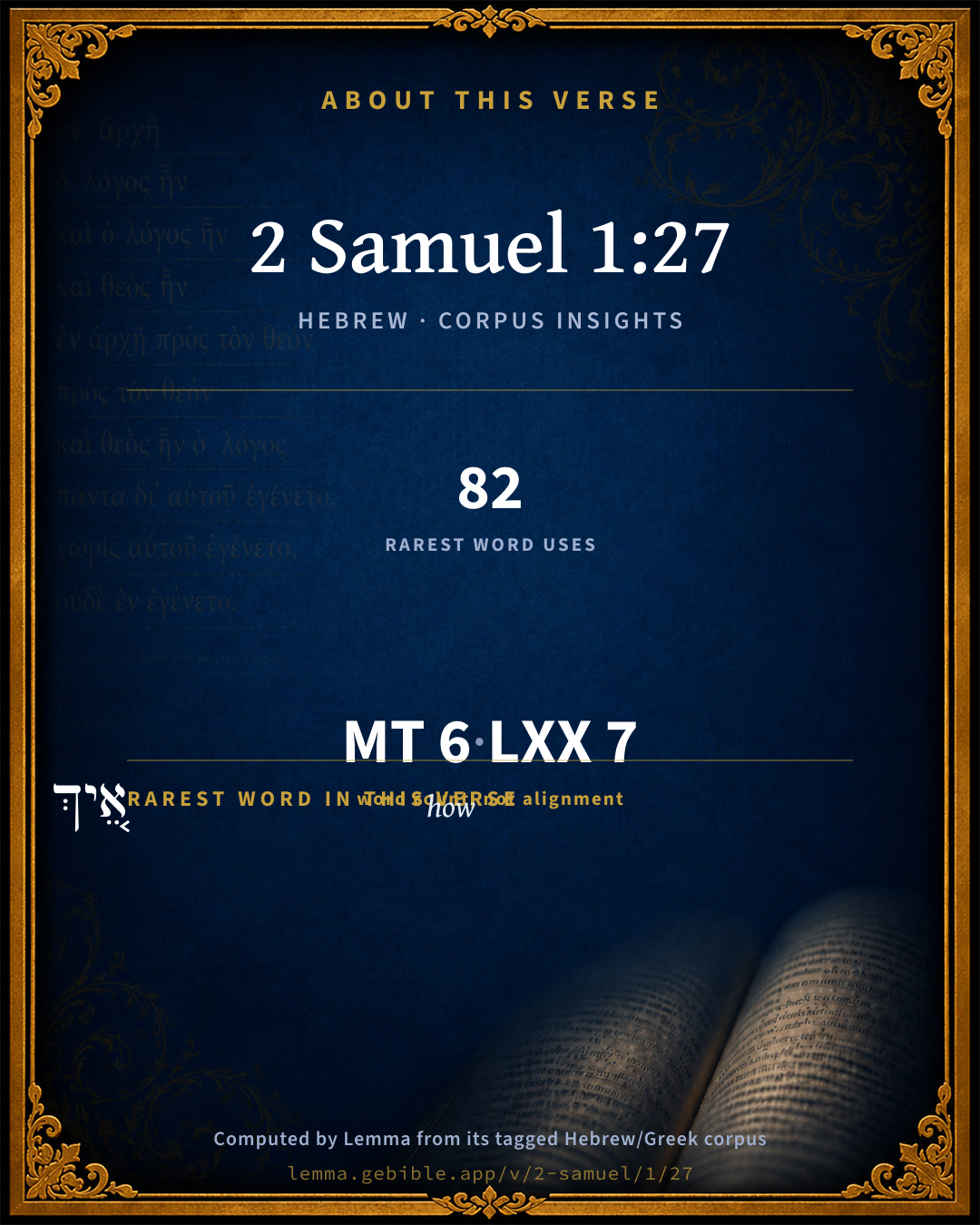
About this verse

These counts appear in no published source. They are computed here, from the morphology-tagged text and Lemma’s own curated glosses. What Lemma adds →

6
words
6
distinct lemmas
Historical
section

Grammatical profile

  • 2 verbs
  • 2 nouns
  • 1 adjective
  • 1 particle

Verb forms

  • נָפְל֣וּ Qal · Perfect
  • וַיֹּאבְד֖וּ Qal · Sequential Imperfect

Hebrew & Septuagint length

In English translation the verse runs 10 words from the Hebrew and 11 from the Septuagint (LXX English) — closely comparable.

A rough comparison of the two English renderings, which tokenize alike — not a word-level alignment.

Word counts can differ between the Hebrew and the Greek without any difference in meaning — e.g. the Hebrew direct-object marker אֵת has no separate Greek word, and Greek often adds the article ὁ.

In the original languages it is 6 Hebrew tokens and 7 Greek tokens — but the two are counted differently (Hebrew bundles its prefixes and suffixes into one token; the Greek is in lemma form), so that isn’t a like-for-like length.

Cross-references

6

Topical passages linked to 2 Samuel 1:27 in the Treasury of Scripture Knowledge — connected by theme and wording, ordered by reader-vote popularity; previews shown in the World English Bible.

  • 2 Samuel 1:25 How are the mighty fallen in the midst of the battle! Jonathan is slain on your high places.
  • 2 Samuel 1:19 Your glory, Israel, is slain on your high places! How are the mighty fallen!
  • 2 Kings 2:12 Elisha saw it, and he cried, My father, my father, the chariots of Israel and the horsemen of it! He saw him no more: and he took hold of his own clothes, and tore them in two pieces.
  • Psalms 46:9 He makes wars cease to the end of the earth. He breaks the bow, and shatters the spear. He burns the chariots in the fire.
  • Ezekiel 39:9–10 Those who dwell in the cities of Israel shall go forth, and shall make fires of the weapons and burn them, both the shields and the bucklers, the bows and the arrows, and the war clubs, and the spears, and they shall make fires of them seven years;
  • 2 Kings 13:14 Now Elisha was fallen sick of his sickness of which he died: and Joash the king of Israel came down to him, and wept over him, and said, My father, my father, the chariots of Israel and the horsemen of it!

Cross-references courtesy of OpenBible.info (CC BY 4.0).

Hebrew and Greek witnesses Masoretic Hebrew ↔ Greek Septuagint

The same verse in the two great witnesses to the Old Testament, shown verse-for-verse.

These are two independent witnesses, not word-aligned to each other, and the Septuagint is shown in lemma (dictionary) form.

Hebrew 2 Samuel 1:27 Masoretic · Westminster Leningrad Codex

אֵ֚יךְ נָפְל֣וּ גִבּוֹרִ֔ים וַיֹּאבְד֖וּ כְּלֵ֥י מִלְחָמָֽה

How are the mighty fallen, The weapons of war perished!

World English Bible · Public Domain

Greek LXX 2 Samuel 1:27 Septuagint · lemma form

πῶς πίπτω δυνατός καί ἀποὀλλύω σκεῦος πολεμικός

How are the mighty fallen, and the weapons of war perished!

LXX2012 (modern English Septuagint) · Public Domain

On this verse, The Cambridge Bible for Schools and Colleges discusses the Septuagint’s reading. Read the note in Commentary ↓

Hebrew: Westminster Leningrad Codex (CC BY 4.0). Greek: Septuagint (public domain); English from LXX2012 (modern English Septuagint) (Public Domain). How the Septuagint differs from the Hebrew →

Targum (Aramaic paraphrase)

1

The Targum is the ancient Jewish Aramaic paraphrase of the Hebrew Scriptures — an interpretive translation, not the Hebrew text itself. Onkelos (literal) and Pseudo-Jonathan (expansive) render the Torah, and Jonathan the Prophets. Coverage is partial: where no permissively-licensed English translation exists for a verse, only the Aramaic is shown. This is verse-level text, not a word-by-word alignment to the Hebrew.

  1. Targum Jonathan Prophets (Joshua–Malachi)
    אֵיכְדֵין אִתְקְטָלוּ גִבָּרַיָא וַאֲבָדוּ מָנֵי קְרָבָא:

    (no public-domain English translation for this verse)

    Targum Jonathan — Aramaic: “Mikraot Gedolot” (public domain). English: “Sefaria Community Translation” (CC0 1.0 (public-domain dedication)); “London "Chaldee Paraphrase," 1871” (public domain). Text via Sefaria.

Commentary

Notes on 2 Samuel 1:27 from classic Christian and Jewish commentators (each source and its license shown beneath its notes). The classic Christian expositions comment on the surrounding passage and are grouped to its opening verse, so a note may address several verses; the Jewish commentaries on the Tanakh (Rashi and others) are per-verse, so they appear only where the commentator wrote on this verse.

Lemma curates 59 commentaries, every one of them public domain or Creative Commons licensed, each selected and text-cleaned for this edition rather than reprinted as found. About our sources →

Trapp's Complete Commentary

John Trapp

2Sa 1:27 How are the mighty fallen, and the weapons of war perished!

Ver. 27. How are the mighty fallen!] See 2Sa 1:19.

And the weapons of war perished!] Yea, together with Saul and Jonathan, all the warlike glory of Israel is gone.

John Trapp, A Commentary or Exposition upon All the Books of the Old and New Testament (1647–1656) — public domain. Text from a community e-Sword module.

Keil & Delitzsch

C. F. Keil & F. Delitzsch

The third strophe (Sa2 1:27) contains simply a brief aftertone of sorrow, in which the ode does away:

Oh how are the mighty fallen,

The instruments of war perished!

"The instruments of war" are not the weapons; but the expression is a figurative one, referring to the heroes by whom war was carried on (vid., Isa 13:5). Luther has adopted this rendering (die Streitbaren).

Keil & Delitzsch — Biblical Commentary on the Old Testament (1861–1891) — public domain (CC PDM 1.0). Text via the HelloAO Bible API. (Old Testament only.)

The Cambridge Bible for Schools and Colleges

gen. ed. J. J. S. Perowne

27. How are the mighty fallen] This thrice-repeated refrain sounds the keynote of the elegy. Cp. Psa_42:5; Psa_42:11; Psa_43:5; Psa_107:8; Psa_107:15; Psa_107:21; Psa_107:31.

the weapons of war] Metaphorically, of Saul and Jonathan as the instruments of battle for the nation. Cp. Isa_13:5, Act_9:15 (σκεῦος as in the LXX. here). To understand it literally of swords and spears would close the most pathetic of elegies with an incredible bathos.

Dean Stanley observes that “Over the portal of the sepulchral chapel of the most famous of mediaeval heroes—the tomb of the Cid near Burgos—we find inscribed the words of David “How are the mighty fallen and the weapons of war perished,” “Quomodo ceciderunt robusti, et perierunt arma bellica” (Lect. II. 31).

It is needless to dwell on the poetic beauty, the chivalrous loyalty, the tender love, which characterize this most pathetic of funeral odes.

“Saul had fallen with all his sins upon his head, fallen in the bitterness of despair, and as it might have seemed to mortal eye, under the shadow of the curse of God. But not only is there in David’s lament no revengeful feeling at the death of his persecutor.… but he dwells with unmixed love on the brighter recollections of the departed. He speaks only of the Saul of earlier times, the mighty conqueror, the delight of his people, the father of his beloved and faithful friend; like him in life, united with him in death. Such expressions … may fairly be taken as justifying the irrepressible instinct of humanity which compels us to dwell on the best qualities of those who have just departed.” Stanley, Lect. II. 30. See too a noble passage to the same effect in Maurice’s Prophets and Kings, Serm. II., p. 32.

The Cambridge Bible for Schools and Colleges (gen. ed. J. J. S. Perowne; Cambridge University Press, 1878–1918) — public domain. Text from a community e-Sword module.

John Gill's Exposition

How are the mighty fallen,.... This is the burden of this elegiac song, being the third time it is mentioned:

and the weapons of war perished! not only the valiant soldiers were killed, but their arms were lost; and particularly he may mean Saul and Jonathan, who as they were the shields of the people, so they were the true weapons and instruments of war, and with them all military glory perished; which must be understood as a poetical figure, exaggerating their military characters; otherwise David, and many mighty men with him, remained, and who revived and increased the military glory of Israel, as the following history shows.

Next: 2 Samuel Chapter 2

John Gill's Exposition of the Whole Bible (1746–1763) — public domain (CC PDM 1.0). Text via the HelloAO Bible API.

Haydock's Catholic Bible Commentary

Perished, falling into the hands of the enemy; though Saul and Jonathan may be styled the arms, as well as the shield, of Israel. (Menochius) --- No character could be more worthy of praise than the latter. His breast was never agitated by envy, though he seemed to be the most interested to destroy David. Even Saul had many excellent qualities; which makes Ven. Bede compare him in those respects with Jesus Christ; as most of the memorable persons and events of the Old Testament had a view to Christ on the one hand, and to the Synagogue on the other. Saul is one of the most striking figures of the reprobation and conduct of the Jewish church. As he was adorned with many glorious prerogatives, and chosen by God, yet he no sooner beheld the rising merit of David, than he began to persecute him: so the Jews had been instructed by the prophets, and had been selected as God’s peculiar inheritance; and nevertheless took occasion from the virtues and miracles of the Son of God, to conspire his ruin. The Romans were sent to punish the Jews, who are now become the most abject of all mankind, and are filled with rage, seeing the exaltation of the Christian Church, as Saul was reduced by the Philistines to the greatest distress, and his children were forced to implore the protection of the man whom he had so cruelly persecuted, &c. (Calmet) --- Saul and Judas may be a warning to us, that no person ought to live without fear, since they perished so miserably, though they had been elevated by the hand of God. (St. Ambrose, &c.) (Haydock)

George Leo Haydock (1774–1849), Haydock's Catholic Family Bible and Commentary, 1859 edition — public domain. Excludes Psalms (Douay-Rheims chapter numbering differs from Protestant) and Deuterocanonical books (Catholic canon only).

Matthew Poole's English Annotations

Either,

1. Metaphorically so called, to wit, Saul and Jonathan, and the brave commanders and soldiers of Israel; who might have been called the chariots of Israel, and the horsemen thereof. Or rather,

2. Properly; for, together with the men, their arms were lost, which was a very great aggravation of their loss, and that loss seems to be at this time more irrecoverable and dangerous than the loss of their men.

Matthew Poole's English Annotations on the Holy Bible (1683–1685) — public domain. Text from a community e-Sword/MySword module.

Whedon's Commentary on the Bible

Daniel D. Whedon

27. Implements of war — The shields and other implements that were vilely cast away. 2Sa_1:21. Some understand here, not the weapons of war but the heroes, considered figuratively as the instruments by whom the war was carried on, and Isa_13:5, is referred to as a parallel. But though persons are sometimes in this sense termed instruments, we nowhere find them called instruments of war; and as this elegy makes mention of military weapons as cast away with abhorrence, we feel obliged to adhere to the most obvious signification of the word.

Daniel D. Whedon (gen. ed.), Commentary on the Old and New Testaments (1874–1909) — public domain. Text from a community e-Sword module.

The Pulpit Commentary

How are the mighty fallen! This lament, which occurs three times, is the central thought of the elegy. Glorious and noble in their pest lives, the heroes had now fallen, not as Wolfe fell at Quebec, with the shout of victory in his ears, but in the lost battle. And David seeks relief for his distress in dwelling upon the sad contrast between the splendid victories which Saul had won for Israel when first chosen to be king, and the terrible defeat by which life and kingdom had now been lost.

The Pulpit Commentary (1880–1919), ed. H.D.M. Spence-Jones & Joseph S. Exell — public domain. Text from a community e-Sword module.

Rashi

Rabbi Shlomo Yitzchaki (Rashi)

The weapons of war. [Referring to] Shaul and Yohanasan who were Yisroel's weapons.

Rashi on the Tanakh — English translations: “The Judaica Press complete Tanach with Rashi, translated by A. J. Rosenberg” (CC BY 4.0); “Pentateuch with Rashi's commentary by M. Rosenbaum and A.M. Silbermann, 1929-1934” (public domain); “The Metsudah Tanach series, Lakewood, N.J” (CC BY 4.0); and “The Book of Joshua, Metsudah Publications, 1997” (CC BY 4.0). Text via Sefaria.

Lesson kit

Teaching starters — assembled from the data on this page, not authored interpretation. Every prompt links to the verse data it draws on. Edit before teaching.

2 Samuel, in the Historical, opens this verse with 6 words (6 distinct Hebrew lemmas). Its most distinctive word is ʼêyk (“how”). A historical commentator’s framing appears above. Read the whole chapter for the surrounding context.

Discussion questions

  1. What does “how” (ʼêyk) contribute to the verse as a whole?
  2. How does 2 Samuel 1:25, which shares this passage’s theme, read alongside this verse?
  3. The translations on this page render this verse differently — a whole-verse word diff, not a word-by-word alignment. What might account for the different wordings?
  4. «נָפְל֣וּ» is a Qal Perfect verb. How does that grammatical form shape the action described?
  5. Compare how Trapp's Complete Commentary and Keil & Delitzsch read this verse. Where do they agree or differ?

Things to notice

Reading settings

Reading text

Shown beneath each verse's original-language words.

Old Testament
Old Testament edition

Read the OT as the Masoretic Hebrew (MT) or the Greek Septuagint (LXX).

English shown for the Greek Septuagint (in the Hebrew ↔ Greek comparison).

Comparing translations? Open the Compare panel on any verse page to stack up to four side by side.