Deuteronomy 27:26

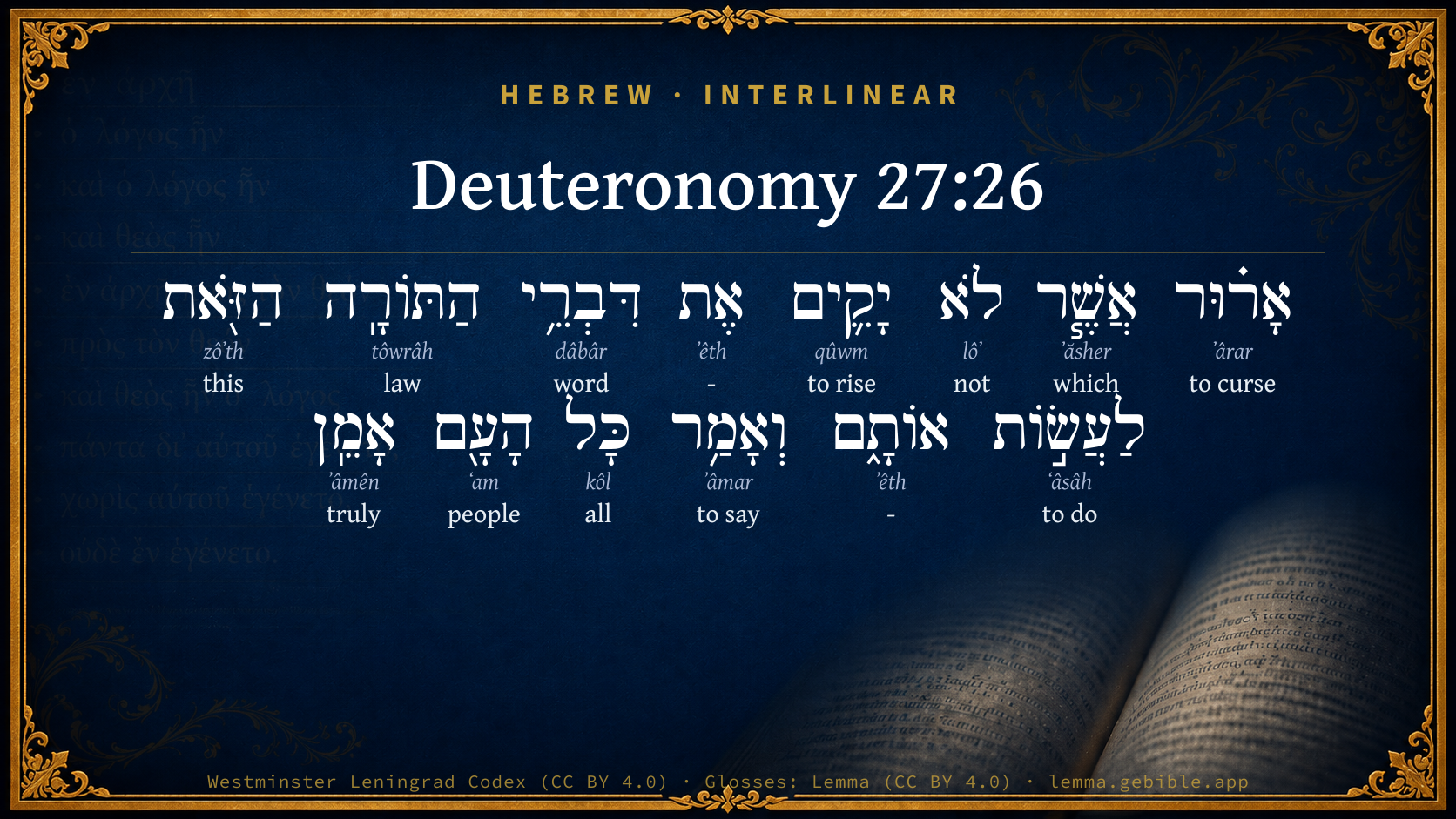
Hebrew (Westminster Leningrad Codex) Deuteronomy 27:26 appears in the Hebrew Old Testament. The text above is from the Westminster Leningrad Codex. Each word links to its Strong’s number, a concise gloss, and parsing drawn from the Open Scriptures Hebrew Bible morphology. Click any word for its full Brown-Driver-Briggs (BDB) entry.
Download image
Cite this verse

Deuteronomy 27:26 (World English Bible). Public Domain. Lemma interlinear Bible study tool, https://lemma.gebible.app/v/deuteronomy/27/26.

Show BibTeX & RIS
BibTeX
RIS
English Translation
Cursed be he who doesn't confirm the words of this law to do them. All the people shall say, Amen.
World English Bible · Public Domain
Download a study sheet

One document with this verse’s original text, its word-by-word gloss line, the meaning frame, cross-references with their text, attributed commentary, and full source and license credits — printable, and it pastes into notes with its structure intact.

This verse Autodidact and up

Study sheet (.html) Plain text (.txt)

A passage Seminary Student

Up to 50 verses in one chapter. A passage sheet keeps up to 6 commentary sources and 12 cross-references per verse, in the order this page ranks them, and says so on the sheet whenever that leaves anything out. Ask for a single verse and you get the Autodidact verse sheet above.

Everything on this page stays free to read, with no account — the sheet is a download of what is already on screen, not access to it.

Want to remove ads? Support Godless Engineer
Compare translations 3

The same verse in 3 English versions, stacked beneath the original-language interlinear above. Click any original word for its lexicon entry.

Each is an independent rendering of the whole verse — the interlinear is not word-aligned to these translations.

Highlighted words mark where these versions differ — a whole-verse word diff, not a word-by-word alignment.

  • World English Bible Public Domain
    Cursed be he who doesn't confirm the words of this law to do them. All the people shall say, Amen.
  • King James Version Public Domain
    Cursed be he that confirmeth not all the words of this law to do them. And all the people shall say, Amen.
  • unfoldingWord Literal Text CC BY-SA 4.0
    ‘Cursed is the one who does not keep the words of this law, to do them.’ And all the people shall say, ‘Amen.’

unfoldingWord Literal Text — © unfoldingWord, licensed CC BY-SA 4.0. Word-aligned USFM3 via Door43 (git.door43.org/unfoldingWord/en_ult).

Versions to compare (up to 4)

3 of 4 selected

Show all 18 translations

Every available English version of this verse, each an independent rendering of the whole verse.

  • World English Bible Public Domain
    Cursed be he who doesn't confirm the words of this law to do them. All the people shall say, Amen.
  • Berean Standard Bible Public Domain
    ‘Cursed is he who does not put the words of this law into practice.’ And let all the people say, ‘Amen!’
  • Majority Standard Bible Public Domain
    ‘Cursed is he who does not put the words of this law into practice.’ And let all the people say, ‘Amen!’
  • King James Version Public Domain
    Cursed be he that confirmeth not all the words of this law to do them. And all the people shall say, Amen.
  • American Standard Version (1901) Public Domain
    Cursed be he that confirmeth not the words of this law to do them. And all the people shall say, Amen.
  • Revised Version (1885) Public Domain
    Cursed be he that confirmeth not the words of this law to do them. And all the people shall say, Amen.
  • Geneva Bible (1599) Public Domain
    Cursed be he that confirmeth not all the wordes of this Law, to do them: And all the people shall say: So be it.
  • Douay-Rheims (1899) Public Domain
    Cursed be he that abideth not in the words of this law, and fulfilleth them not in work: and all the people shall say: Amen.
  • Young's Literal Translation Public Domain
    `Cursed `is' he who doth not establish the words of this law, to do them, -- and all the people have said, Amen.
  • Literal Standard Version CC BY-SA 4.0
    “Cursed [is] he who does not establish the words of this law, to do them.” And all the people have said, “Amen.”
  • Unlocked Literal Bible CC BY-SA 4.0
    'May the man be cursed who does not confirm the words of this law, that he will obey them.' Then all the people must say, 'Amen.'
  • unfoldingWord Literal Text CC BY-SA 4.0
    ‘Cursed is the one who does not keep the words of this law, to do them.’ And all the people shall say, ‘Amen.’
  • Darby Bible Public Domain
    Cursed be he that confirmeth not the words of this law to do them! And all the people shall say, Amen.
  • World Messianic Bible Public Domain
    ‘Cursed is he who doesn’t uphold the words of this law by doing them.’ All the people shall say, ‘Amen.’”
  • Webster's Bible Public Domain
    Cursed be he that confirmeth not all the words of this law to do them: and all the people shall say, Amen.
  • Free Bible Version CC BY-SA 4.0
    “A curse on anyone who doesn't carefully obey all these laws by keeping them!” Everyone says “Amen!”
  • Bible in Basic English Public Domain
    Cursed is he who does not take this law to heart to do it. And let all the people say, So be it.
  • JPS Tanakh (1917) Public Domain
    Cursed be he that confirmeth not the words of this law to do them. And all the people shall say: Amen.'

Literal Standard Version (2020), Covenant Press — licensed CC BY-SA 4.0. Text via the HelloAO Bible API (eBible.org). Unlocked Literal Bible (unfoldingWord) — licensed CC BY-SA 4.0. Text via the HelloAO Bible API (eBible.org). unfoldingWord Literal Text — © unfoldingWord, licensed CC BY-SA 4.0. Word-aligned USFM3 via Door43 (git.door43.org/unfoldingWord/en_ult). Free Bible Version, Dr. Jonathan Gallagher — licensed CC BY-SA 4.0. Text via the HelloAO Bible API (eBible.org).

Word by word

More ways to search: Search by grammar → Find every occurrence → Compare this word →

Practice this passage: Drill this verse → Learn its vocabulary →

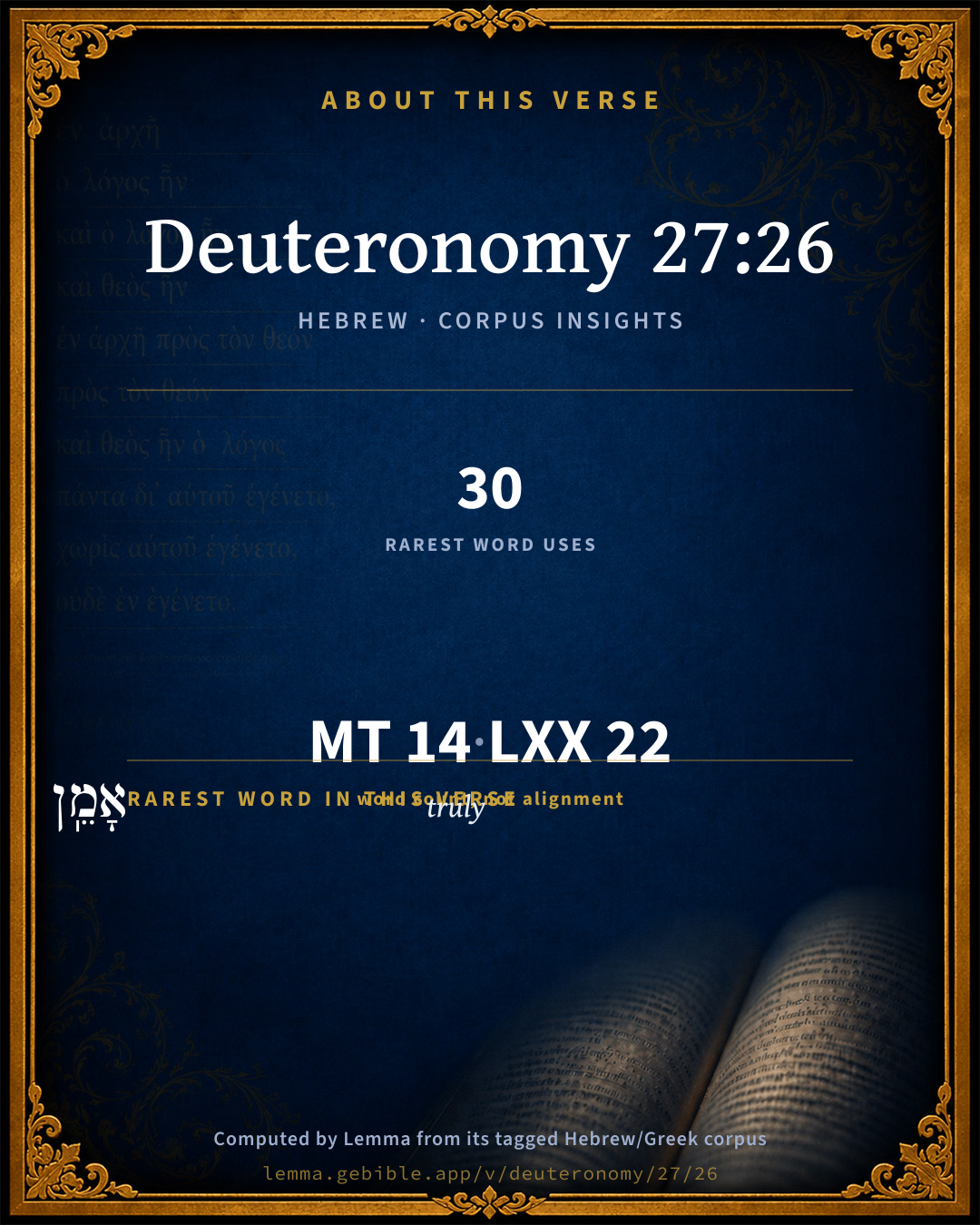
אָמֵֽן
ʼâmên
H543
“truly”
Adverb
Part of Speech
Adverb
Full BDB Definition

Origin: from H539

TWOT: 116b

verily, truly, amen, so be it
  1. אָר֗וּר ʼârar H779 “cursed” Verb, Qal, Participle Passive, Masculine, Singular, Absolute
  2. אֲשֶׁ֧ר ʼăsher H834 “which” Particle, Relative
  3. לֹא lôʼ H3808 “not” Particle, Negative
  4. יָקִ֛ים qûwm H6965 “to rise” Verb, Hiphil, Imperfect, 3rd Person, Masculine, Singular
  5. אֶת ʼêth H853 “-” Particle, Direct Object
  6. דִּבְרֵ֥י dâbâr H1697 “words of” Noun, Common, Masculine, Plural, Construct
  7. הַתּוֹרָֽה tôwrâh H8451 “the · law” Particle, Definite Article + Noun, Common, Feminine, Singular, Absolute
  8. הַזֹּ֖את zôʼth H2063 “the · this” Particle, Definite Article + Pronoun, Demonstrative, Feminine, Singular
  9. לַעֲשׂ֣וֹת ʻâsâh H6213 “to do” Preposition + Verb, Qal, Infinitive Construct
  10. אוֹתָ֑ם ʼêth H853 “- · them” Particle, Direct Object + Suffix, Personal, 3rd Person, Masculine, Plural
  11. וְאָמַ֥ר ʼâmar H559 “and · to say” Conjunction + Verb, Qal, Sequential Perfect, 3rd Person, Masculine, Singular
  12. כָּל kôl H3605 “all of” Noun, Common, Masculine, Singular, Construct
  13. הָעָ֖ם ʻam H5971 “the · people” Particle, Definite Article + Noun, Common, Masculine, Singular, Absolute

About this verse

These counts appear in no published source. They are computed here, from the morphology-tagged text and Lemma’s own curated glosses. What Lemma adds →

14
words
13
distinct lemmas
Pentateuch
section

Shared distinctive vocabulary

אָמֵֽן truly H543 occurs in 24 verses of the Hebrew Bible. Also found in:

Grammatical profile

  • 4 verbs
  • 4 nouns
  • 1 pronoun
  • 1 adverb
  • 4 particles

Verb forms

  • אָר֗וּר Qal · Participle Passive
  • יָקִ֛ים Hiphil · Imperfect
  • לַעֲשׂ֣וֹת Qal · Infinitive Construct
  • וְאָמַ֥ר Qal · Sequential Perfect

Hebrew & Septuagint length

In English translation the verse runs 20 words from the Hebrew and 26 from the Septuagint (LXX English) — closely comparable.

A rough comparison of the two English renderings, which tokenize alike — not a word-level alignment.

Word counts can differ between the Hebrew and the Greek without any difference in meaning — e.g. the Hebrew direct-object marker אֵת has no separate Greek word, and Greek often adds the article ὁ.

In the original languages it is 14 Hebrew tokens and 22 Greek tokens — but the two are counted differently (Hebrew bundles its prefixes and suffixes into one token; the Greek is in lemma form), so that isn’t a like-for-like length.

Cross-references

10

Topical passages linked to Deuteronomy 27:26 in the Treasury of Scripture Knowledge — connected by theme and wording, ordered by reader-vote popularity; previews shown in the World English Bible.

  • Galatians 3:10 For as many as are of the works of the law are under a curse. For it is written, "Cursed is everyone who doesn't continue in all things that are written in the book of the law, to do them."
  • Deuteronomy 28:15–68 But it shall come to pass, if you will not listen to the voice of Yahweh your God, to observe to do all his commandments and his statutes which I command you this day, that all these curses shall come on you, and overtake you.
  • Romans 10:5 For Moses writes about the righteousness of the law, "The one who does them will live by them."
  • Psalms 119:21 You have rebuked the proud who are cursed, Who wander from your commandments.
  • Ezekiel 18:24 But when the righteous turns away from his righteousness, and commits iniquity, and does according to all the abominations that the wicked man does, shall he live? None of his righteous deeds that he has done shall be remembered: in his trespass that he has trespassed, and in his sin that he has sinned, in them shall he die.
  • Deuteronomy 27:15 Cursed be the man who makes an engraved or molten image, an abomination to Yahweh, the work of the hands of the craftsman, and sets it up in secret. All the people shall answer and say, Amen.
  • Jeremiah 11:3–5 and say you to them, Thus says Yahweh, the God of Israel: Cursed be the man who doesn't hear the words of this covenant,
  • Matthew 25:41 Then he will say also to those on the left hand, 'Depart from me, you cursed, into the eternal fire which is prepared for the devil and his angels;
  • Romans 3:19–20 Now we know that whatever things the law says, it speaks to those who are under the law, that every mouth may be closed, and all the world may be brought under the judgment of God.
  • 1 Corinthians 16:22 If any man doesn't love the Lord Jesus Christ, let him be accursed. Come, Lord!

Cross-references courtesy of OpenBible.info (CC BY 4.0).

Hebrew and Greek witnesses Masoretic Hebrew ↔ Greek Septuagint

The same verse in the two great witnesses to the Old Testament, shown verse-for-verse.

These are two independent witnesses, not word-aligned to each other, and the Septuagint is shown in lemma (dictionary) form.

Hebrew Deuteronomy 27:26 Masoretic · Westminster Leningrad Codex

אָר֗וּר אֲשֶׁ֧ר לֹא יָקִ֛ים אֶת דִּבְרֵ֥י הַתּוֹרָֽה הַזֹּ֖את לַעֲשׂ֣וֹת אוֹתָ֑ם וְאָמַ֥ר כָּל הָעָ֖ם אָמֵֽן

Cursed be he who doesn't confirm the words of this law to do them. All the people shall say, Amen.

World English Bible · Public Domain

Greek LXX Deuteronomy 27:26 Septuagint · lemma form

ἐπικατάρατος πᾶς ἄνθρωπος ὅς οὐ ἐνμένω ἐν πᾶς ὁ λόγος ὁ νόμος οὗτος ὁ ποιέω αὐτός καί εἶπον πᾶς ὁ λαός γίγνομαι

Cursed is every man that continues not in all the words of this law to do them: and all the people shall say, So be it.

LXX2012 (modern English Septuagint) · Public Domain

On this verse, Adam Clarke's Commentary discusses the Septuagint’s reading. Read the note in Commentary ↓

Hebrew: Westminster Leningrad Codex (CC BY 4.0). Greek: Septuagint (public domain); English from LXX2012 (modern English Septuagint) (Public Domain). How the Septuagint differs from the Hebrew →

Targum (Aramaic paraphrase)

2

The Targum is the ancient Jewish Aramaic paraphrase of the Hebrew Scriptures — an interpretive translation, not the Hebrew text itself. Onkelos (literal) and Pseudo-Jonathan (expansive) render the Torah, and Jonathan the Prophets. Coverage is partial: where no permissively-licensed English translation exists for a verse, only the Aramaic is shown. This is verse-level text, not a word-by-word alignment to the Hebrew.

  1. Targum Onkelos Torah (Genesis–Deuteronomy)
    לִיט דִי לָא יְקַיַם יָת פִּתְגָמֵי אוֹרַיְתָא הָדָא לְמֶעְבַּד יָתְהוֹן וְיֵימַר כָּל עַמָא אָמֵן

    (no public-domain English translation for this verse)

    Targum Onkelos — Aramaic: “Onkelos Genesis” (public domain); “Onkelos Exodus” (public domain); “Onkelos Leviticus” (public domain); “Onkelos Numbers” (public domain); “Onkelos Deuteronomy” (public domain). English: “Sefaria Community Translation” (CC0 1.0 (public-domain dedication)); “J.W. Etheridge. The Targums of Onkelos and Jonathan Ben Uzziel on the Pentateuch. London: Longmans, Green, 1862” (public domain). Text via Sefaria.

  2. Targum Pseudo-Jonathan Torah (Genesis–Deuteronomy)
    תַּרְתֵּיסְרֵי שִׁבְטַיָא כָּל חַד וְחַד הֲוָה אָמַר בִּרְכָתָא בִּכְלָלָא וּלְוָוטַיָא בִּכְלָלָא מְבָרְכַיָא הֲווֹן הָפְכִין אַפֵּיהוֹן לְכָל מִילָא וּמִילָא כֻּלוֹ קֳבֵיל טַוְורָא דִגְרִיזִים וְאָמְרִין בְּרִיךְ יֶהֱוֵי גַבְרָא דִי יְקִים יַת פִּתְגָמֵי אוֹרַיְיתָא הֲדָא לְמֶעֱבַדְהוֹן מְלַטְטַיָא הָפְכִין אַפֵּיהוֹן כֻּלוֹ קֳבֵיל טַוְורָא דְעֵיבָל וְאָמְרִין לִיט יֶהֱוֵי גַבְרָא דְלָא יְקִים יַת פִּתְגָמֵי אוֹרַיְיתָא הֲדָא לְמֶעֱבַדְהוֹן הֲווֹן עַנְיַין כֻּלְהוֹן כַּחֲדָא וְאָמְרִין אָמֵן פִּתְגָמַיָא אִלֵין אִתְאַמָרוּ בְּסִינַי וְאִתַּנְייוּ בְּמַשְׁכַּן זִמְנָא וְאִיתְלֵיתוּן בְּמֵישְׁרֵי מוֹאָב תַּרְתֵּיסְרֵי מִלִין מִן מִלְתָא לְכָל שִׁבְטַיָא וְעַל כָּל פִּיקוּדָא וּפִיקוּדָא אִתְגְזַר עֲלָהּ תְּלָתִין וְשִׁית קַיָמִין

    The twelve tribes, each and every, shall pronounce the blessings altogether, and the curses altogether. In blessing, they shall turn their faces (in pronouncing) word by word towards Mount Gerezim, and shall say: Blessed is the man who confirmeth the words of this law to perform them. In cursing, they shall turn their faces towards Mount Ebal, and say: Accursed is the man who confirmeth not the words of this law to perform them. And all shall answer together, and say, Amen. These words were spoken at Sinai, and repeated in the tabernacle of ordinance, and (again) the third time on the plains of Moab, in twelve sentences (words), as the word of every tribe; and each several commandment (was thus) ratified by thirty and six adjurations.

    Targum Pseudo-Jonathan — Aramaic: “Targum Jonathan on Genesis” (public domain); “Targum Jonathan on Exodus” (public domain); “Targum Jonathan on Leviticus” (public domain); “Targum Jonathan on Numbers” (public domain); “Targum Jonathan on Deuteronomy” (public domain). English: “The Targum of Jonathan ben Uzziel, trans. J. W. Etheridge, London, 1862” (public domain). Text via Sefaria.

Commentary

Notes on Deuteronomy 27:26 from classic Christian and Jewish commentators (each source and its license shown beneath its notes). The classic Christian expositions comment on the surrounding passage and are grouped to its opening verse, so a note may address several verses; the Jewish commentaries on the Tanakh (Rashi and others) are per-verse, so they appear only where the commentator wrote on this verse.

Lemma curates 59 commentaries, every one of them public domain or Creative Commons licensed, each selected and text-cleaned for this edition rather than reprinted as found. About our sources →

Trapp's Complete Commentary

John Trapp

Deu 27:26 Cursed [be] he that confirmeth not [all] the words of this law to do them. And all the people shall say, Amen.

Ver. 26. Cursed.] Aut faciendum, aut patiendum. Men must either have the direction of the law, or the correction.

John Trapp, A Commentary or Exposition upon All the Books of the Old and New Testament (1647–1656) — public domain. Text from a community e-Sword module.

Joseph Benson's Commentary

Deu 27:26. Confirmeth not — Or, performeth not. To this we must all say, Amen! Owning ourselves to be under the curse, and that we must have perished for ever, if Christ had not redeemed us from the curse of the law, by being made a curse for us.

Joseph Benson's Commentary on the Old and New Testaments (1811–1818) — public domain. Text from a community e-Sword module.

Adam Clarke's Commentary

Verse 26. That confirmeth not all the words of this law] The word כל col, ALL, is not found in any printed copy of the Hebrew text; but the Samaritan preserves it, and so do six MSS. in the collections of Kennicott and De Rossi, besides several copies of the Chaldee Targum. The Septuagint also, and St. Paul in his quotation of this place, Ga 3:10. St. Jerome says that the Jews suppressed the word, that it might not appear that they were bound to fulfil ALL the precepts in the law of Moses.

1. Dr. KENNICOTT, who contends that it was the Decalogue that was written on the stones mentioned in this chapter, says, "If we examine these twelve curses, they will appear to contain a strong enforcement of the ten commands; and it is highly probable that the curses were here proclaimed principally to secure obedience to the commandments, as will be made more clear by the following table: -

The first, second, third, and fourth Commandments

-Verse 15. Cursed be the man that maketh any graven or molten image, an abomination to the Lord, c.

The fifth Commandment

-Verse 16. Cursed be he that setteth light by his father or his mother.

The sixth Commandment

-Verse 25. Cursed be he that taketh reward to slay an innocent person.

-Verse 24. Cursed be he that smiteth his neighbour secretly.

-Verse 18. Cursed be he that maketh the blind to wander out of the way.

The seventh Commandment

-Verse 20. Cursed be he that lieth with his father's wife.

-Verse 21. Cursed be he that lieth with any beast.

-Verse 22. Cursed be he that lieth with his sister.

-Verse 23. Cursed be he that lieth with his mother-in-law.

The eighth Commandment

-Verse 17. Cursed be he that removeth his neighbour's landmark.

The ninth Commandment

-Verse 19. Cursed be he that perverteth the judgment of the stranger, fatherless, and widow.

The tenth Commandment

-Verse 26. Cursed be he that confirmeth not all the words of this law to do them."

Many will think this arrangement fanciful and the analogy far from being natural.

2. In pronouncing these blessings and curses, the Talmud says, six tribes went up towards the top of Mount Gerizim, and six towards the top of Mount Ebal; and the priests and the Levites, and the ark stood beneath in the midst. The priests encompassed the ark, and the Levites stood around about the priests; and all Israel on this side and on that; see Jos 8:33. Then they turned their faces towards Mount Gerizim and pronounced the blessings, Blessed be the man, c., and those on each side answered AMEN! then they turned their faces towards Mount Ebal, and pronounced the curse, Cursed be the man, c., and those on each side answered AMEN! till they had finished the blessings and the curses and afterwards they brought stones and built an altar. Some suppose that the Levites were divided into two grand bodies, part standing at or on Mount Gerizim, and part on Mount Ebal, and that with each division were some of the priests. The whole Dr. Parry supposes to have been arranged in the following manner: -

3. It is worthy of remark that Moses assigns to the children of Rachel and Leah, the two mothers of the family, the office of blessing the people, as being the most honourable and these he places on Mount Gerizim. On the contrary, he assigns the office of cursing the people to the sons of Zilpah and Bilhah, as being the least honourable office; but with these he joins Zebulun, the youngest of Leah's sons, and Reuben, the eldest. As there must be six tribes on each mountain, it was necessary that while six of the sons of Rachel and Leah, the legitimate wives, should be employed in blessing, two tribes descending from the same mothers should be joined to the other four who proceeded from the handmaids in order to make up the number six. The question is, which two of the more honourable tribes should be joined to the four least honourable, in order to complete the number six? Zebulun is chosen, because being the sixth and youngest of all Leah's sons, he was the least honourable of those who proceeded from the free woman; and Reuben is chosen, who, though the eldest of Jacob's sons, and entitled to the birthright, had lost it by his transgression. And hence he, in his posterity, was degraded, and was obliged to pronounce the curse, Cursed is he that lieth with his father's wife. See Ge 49:3-4, and Ge 35:22, and the notes on both places.

4. It is strange how long the disgrace consequent on some flagrant transaction of a parent may cleave to his posterity! See this exemplified in the posterity of Reuben. Hence, with great propriety we may pray, Remember not, Lord, our offences, nor the offences of our forefathers; neither take thou vengeance of our sins." - Litany. For the offences of our forefathers may be so remembered against their posterity, that God, in the course of his providence, may still keep up a controversy in secular matters with the descendants (though even pious) of unholy ancestors; for as all men are seminally included in the parents, they come into the world depraved with their depravity, and in some sort liable to their curses, though not so far as to affect their eternal interests without the addition of their own personal offences. Thus God may be said to visit the sins of the fathers upon the children, even unto the third and fourth generation; as he may have a controversy with the land for the evil which has been done in it, and for which no proper atonement has been made. Why is it that at this moment Spain is suffering the most afflictive and cruel desolations? What has she done to merit all this? Is she more wicked than all the European nations because she suffers such things? Here is the mystery: Nations, as such, can only be punished in this world. Look at the torrents of innocent blood shed by their ancestors in South America 300 years ago; and see now and adore the awful hand of retributive justice! (December, 1811.) We often see persons tried and afflicted, for whose distresses we can give no legitimate reason. We find others who, though they rise early, sit up late, work hard, eat the bread of carefulness, and have a full knowledge of their business, yet never get on in life. Who can account for this? Shall we say that some injustice in their ancestors has brought down the displeasure of God upon the earthly possessions that descended in that line, so that the goods ill gotten shall never be permitted to multiply? I knew an honest man, dead many years since, who by great diligence, punctuality, and integrity in his business, had acquired considerable property. Some time before his death, having by will divided his substance among his sons and his daughters, he expressed himself thus: "Children, you need not fear the curse of God on this property; every penny of it was honestly earned." Many years have since elapsed, and the blessing of God has been in the basket and in the store of all his children. Parents! leave nothing behind you that you cannot say before your God, with a clear conscience, "This has been honestly earned." If all bequests of a contrary description were to be deducted from last wills and testaments, the quantum of descending property would be, in many cases, small indeed.

Adam Clarke's Commentary on the Bible (1810–1826) — public domain. Text from a community e-Sword/MySword module.

Ellicott's Commentary for English Readers

(26) Cursed be he that confirmeth not all the words of this law to do them.—“Here he sums up the whole Law, all of it, and they took it upon them with a curse and an oath” (Rashi). From this verse St. Paul also reasons that “as many as are of the works of the law are under a curse.” For no man can do all of them. And therefore it is impossible to secure the blessing of Gerizim except through Him who bare the curse of Ebal. “Christ hath redeemed us from the curse of the law, being made a curse for us, as it is written, cursed is every one that hangeth on a tree.” In all these curses the verb is wanting. “Cursed is he,” would be a more correct translation in modern English. These curses are not imprecations so much as declarations of fact.

A Bible Commentary for English Readers, edited by Charles John Ellicott (1878–1897) — public domain. Text from a community e-Sword module.

The Cambridge Bible for Schools and Colleges

gen. ed. J. J. S. Perowne

26. confirmeth] Lit. establisheth, 2Ki_23:3; 2Ki_23:24 of Josiah and the Book of the Law, Heb. Tôrah, as in Deu_1:5, Deu_31:9, which see.

The Cambridge Bible for Schools and Colleges (gen. ed. J. J. S. Perowne; Cambridge University Press, 1878–1918) — public domain. Text from a community e-Sword module.

John Gill's Exposition

Cursed be he that confirmeth not all the words of this law to do them,.... That is, who does not perfectly perform all that the law requires, and continues to do so; for the law requires obedience, and that perfect and constant, and in failure thereof curses, in proof of which the apostle produces this passage; see Gill on Gal 3:10, for the reconciliation of these Scriptures, as to what seeming difference there is between them:

and all the people shall say, Amen; See Gill on Deu 27:15; See Gill on Deu 27:16.

Next: Deuteronomy Chapter 28

John Gill's Exposition of the Whole Bible (1746–1763) — public domain (CC PDM 1.0). Text via the HelloAO Bible API.

Haydock's Catholic Bible Commentary

In the. The Samaritan, Septuagint, and St. Paul (Galatians iii. 10) read, in all the words, &c., which must probably be understood of the principal points of the law, specified in the preceding verses. (Calmet) See ver. 4. --- The Jews could derive no advantage from the omission of the word all, as the general proposition would be equivalent. (Capellus.) --- Some are of opinion, that the blessings which Moses ordered to be proclaimed, were the reverse of these curses, ver. 12. But, is that man truly blessed who observes one point of the law, while he perhaps is transgressing the rest? At this rate, the same man might be blessed and cursed at the same time. (Kennicott) --- They are more probably, therefore, expressed in the following chapter, where the observance of all the commandments is previously required. The curses are denounced indefinitely, to imply that those who transgress the law, must stand before an unerring Judge, to receive an adequate punishment in eternity for their crying sins against the law, which was given on Mount Horeb, chap. xxix. 1. Against such criminals the preceding curses are levelled. But those recorded in the ensuing chapter, are of a temporary nature, and to be publicly inflicted without delay upon those who refuse to adhere to the service of the Lord. "God had made such a covenant with the Israelites, says Houbigant, that he would so long uphold their republic as they should worship the true God." (Haydock) --- The foregoing curses may thus refer to the ten commandments; ver. 15, denounces vengeance against all who transgress the first table of the law, which relates to God; ver. 16, sanctions the honour due to parents; ver. 18, 24, and 25, condemn those who injure or kill; as ver. 20, 21, 22, and 23, do those who are guilty of impurity; ver. 17, curseth those who steal; and ver. 19, those who bear false witness; ver. 26, is intended as a general sanction of the law, as the two last commandments secure the observance of it most effectually, by forbidding even the thought or desire of doing evil. See Kennicott, Dis. ii. p. 86. (Haydock)

George Leo Haydock (1774–1849), Haydock's Catholic Family Bible and Commentary, 1859 edition — public domain. Excludes Psalms (Douay-Rheims chapter numbering differs from Protestant) and Deuterocanonical books (Catholic canon only).

Matthew Poole's English Annotations

Confirmeth not, i.e. performeth not; for he that transgresseth doth in some sort destroy and make void the law of God, as to the main end for which it was given, even to the regulation of his life and actions, and as far as lies in him disannuls the authority and force of God’s law.

Matthew Poole's English Annotations on the Holy Bible (1683–1685) — public domain. Text from a community e-Sword/MySword module.

The Pulpit Commentary

cf. Deu_28:15; Jer_11:3, 4

The Pulpit Commentary (1880–1919), ed. H.D.M. Spence-Jones & Joseph S. Exell — public domain. Text from a community e-Sword module.

John Wesley's Explanatory Notes

Confirmeth not - Or, performeth not. To this we must all say, Amen! Owning ourselves to be under the curse, and that we must have perished forever, if Christ had not redeemed us from the curse of the law, by being made a curse for us.

John Wesley, Explanatory Notes Upon the Whole Bible (1754–1765) — public domain. Text via the GEBible commentary corpus.

unfoldingWord translationNotes

Door43 World Missions Community

General Information:

Moses continues telling the Levites and the people what they must say.

May the man be cursed

This may be stated in active form. See how you translated this in Deuteronomy 27:16. AT: "May Yahweh curse the man" (See: Active or Passive)

translationWords

curse

confirm

word

law

obey

unfoldingWord translationNotes — © Distant Shores Media and the Door43 World Missions Community, licensed CC BY-SA 4.0. Source: git.door43.org/Door43/en_tn.

Rashi

Rabbi Shlomo Yitzchaki (Rashi)

אשר לא יקים [CURSED BE] HE THAT DOES NOT UPHOLD [ALL THE WORDS OF THIS LAW TO DO] — Here (in these words) he included the entire Torah under a curse and they took it upon them pledging themselves by an execration and an oath.

Rashi on the Tanakh — English translations: “The Judaica Press complete Tanach with Rashi, translated by A. J. Rosenberg” (CC BY 4.0); “Pentateuch with Rashi's commentary by M. Rosenbaum and A.M. Silbermann, 1929-1934” (public domain); “The Metsudah Tanach series, Lakewood, N.J” (CC BY 4.0); and “The Book of Joshua, Metsudah Publications, 1997” (CC BY 4.0). Text via Sefaria.

Ramban (Nachmanides)

Rabbi Moshe ben Nachman (Ramban / Nachmanides)

CURSED BE HE THAT CONFIRMETH NOT THE WORDS OF THIS LAW. “Here [in these words] he included the entire Torah and they took it upon themselves with an imprecation and an oath [to observe all the commandments thereof].” This is Rashi’s language. In my opinion this “acceptance” requires that one avow the commandments in his heart and consider them as the truth, believe that he who observes them will be requited with the best of rewards and he who transgresses them will be punished, and if someone denies any of them, or considers it annulled forever he will be cursed. However, if one transgressed any commandment, such as eating swine or some abominable thing because of his desire, or he did not make a Booth or take the palm-branch [on the Festival of Tabernacles] because of laziness, he is not included within this ban, for Scripture did not say “who does not perform the words of this Law” but it states that ‘confirmeth’ not the words of this Law to do them, similar to the expression the Jews ordained, and took upon them [and upon their seed … so as it should not fail, that they would keep these two days — of Purim — according to the writing thereof]. Thus the verse [before us] is the ban on those who rebel [against the authority of the Torah] and who deny [its validity].Now, I have seen the following text in Yerushalmi Sotah: “Asher lo yakim [literally: ‘that does not stand up’ — the words of this Law]. But is there ‘a falling Law?’ Rabbi Shimon ben Yakim says, This refers to the officer [of the Synagogue, as explained further on]. Rabbi Shimon ben Chalafta says, This is the court on earth, because Rav Yehudah and Rav Hunah in the name of Shmuel said: Due to this verse [asher lo yakim (that confirmeth not)] King Josiah rent his clothes, (ibid). The question now arises as to which particular verse affected the king to rend his clothes? Rav Hunah in the name of Shmuel said that it was the verse before us, asher lo yakim — ‘that confirmeth not’ the words of this Law, and since he was king, he felt it his responsibility to re-institute the authority of the Law. saying, ‘The duty is upon me to stand up [the Law].’ Rabbi Asi in the name of Rabbi Tanchum the son of Chiya said, [Even if a person] learned and taught [Torah], observed and fulfilled [its commandments], but had the means to enable [others to study the Torah] and did not do so — he is included within the curse” [mentioned in the verse before us]. Thus the Rabbis [in the above Yerushalmi] interpretated this “standing up” [of the Torah] as referring to the royal house and that of the Nasi [the Prince of the Sanhedrin] who have the power to uphold [the authority of] the Torah over those who annul it. And even if he was a perfectly righteous man in his own deeds, but he could have strengthened the Torah against the power of the wicked ones who annul it [but failed to do so], he is accursed. This is close to the subject that we have explained.And by way of a homily the Rabbis [in the above Yerushalmi] said: “This refers to the sexton of the Synagogue who does not stand up the Scroll of the Law to set it up properly so that it should not fall.” It appears to me that it [the Yerushalmi] refers to the sexton who does not stand up the Scroll of the Law before the public to show the face of its writing to all people as it is explained in Tractate Sofrim that “they lift the Torah high and show the face of its writing to the people who stand there to the right and left thereof and turns it frontwise and backwards, for it is incumbent upon all men and women to see the written words and bend the knee and say And this is the Law which Moses set before the children of Israel,” and such is the custom.

Ramban (Nachmanides) on the Tanakh — English translation: “Commentary on the Torah by Ramban (Nachmanides). Translated and annotated by Charles B. Chavel. New York, Shilo Pub. House, 1971-1976” (CC BY 4.0). Text via Sefaria.

Lesson kit

Teaching starters — assembled from the data on this page, not authored interpretation. Every prompt links to the verse data it draws on. Edit before teaching.

Deuteronomy, in the Pentateuch, opens this verse with 14 words (13 distinct Hebrew lemmas). Its most distinctive word is ʼâmên (“truly”). A historical commentator’s framing appears above. Read the whole chapter for the surrounding context.

Discussion questions

  1. How does “truly” (ʼâmên) shape what this verse is saying?
  2. Numbers 5:22 shares the word «truly» with this verse. How do the two illuminate each other?
  3. The translations on this page render this verse differently — a whole-verse word diff, not a word-by-word alignment. What might account for the different wordings?
  4. The verb «אָר֗וּר» is Qal Participle Passive. How does its form color the action?
  5. Reading how Trapp's Complete Commentary and Joseph Benson's Commentary read this verse, where do the two commentators agree and where do they part?

Things to notice

Reading settings

Reading text

Shown beneath each verse's original-language words.

Old Testament
Old Testament edition

Read the OT as the Masoretic Hebrew (MT) or the Greek Septuagint (LXX).

English shown for the Greek Septuagint (in the Hebrew ↔ Greek comparison).

Comparing translations? Open the Compare panel on any verse page to stack up to four side by side.