
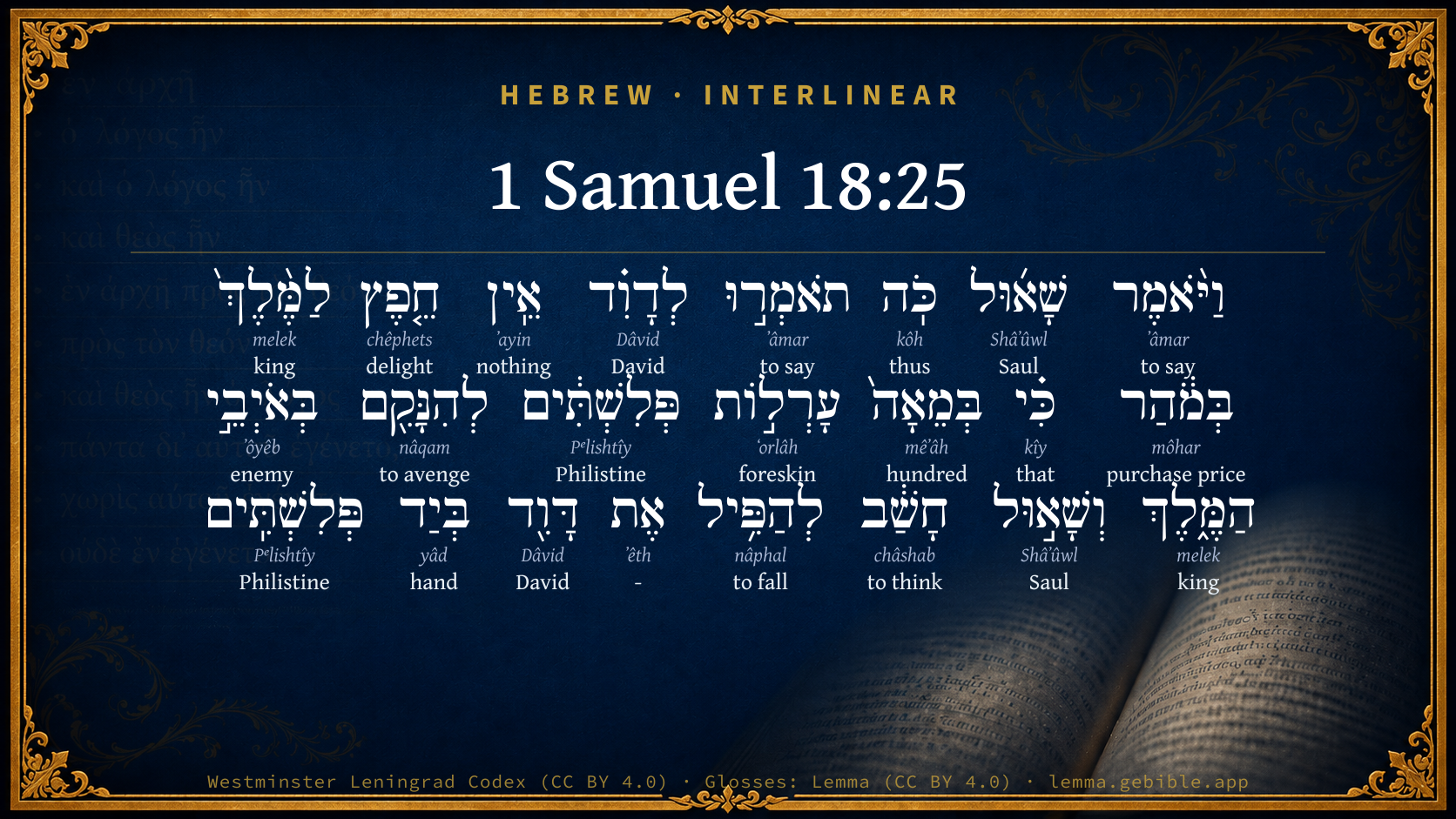
1 Samuel 18:25

Hebrew (Westminster Leningrad Codex) 1 Samuel 18:25 appears in the Hebrew Old Testament. The text above is from the Westminster Leningrad Codex. Each word links to its Strong’s number, a concise gloss, and parsing drawn from the Open Scriptures Hebrew Bible morphology. Click any word for its full Brown-Driver-Briggs (BDB) entry.
Download image
Cite this verse

1 Samuel 18:25 (World English Bible). Public Domain. Lemma interlinear Bible study tool, https://lemma.gebible.app/v/1-samuel/18/25.

Show BibTeX & RIS
BibTeX
RIS
English Translation
Saul said, Thus shall you tell David, The king desires no dowry except one hundred foreskins of the Philistines, to be avenged of the king's enemies. Now Saul thought to make David fall by the hand of the Philistines.
World English Bible · Public Domain
Download a study sheet

One document with this verse’s original text, its word-by-word gloss line, the meaning frame, cross-references with their text, attributed commentary, and full source and license credits — printable, and it pastes into notes with its structure intact.

This verse Autodidact and up

Study sheet (.html) Plain text (.txt)

A passage Seminary Student

Up to 50 verses in one chapter. A passage sheet keeps up to 6 commentary sources and 12 cross-references per verse, in the order this page ranks them, and says so on the sheet whenever that leaves anything out. Ask for a single verse and you get the Autodidact verse sheet above.

Everything on this page stays free to read, with no account — the sheet is a download of what is already on screen, not access to it.

Want to remove ads? Support Godless Engineer
Compare translations 3

The same verse in 3 English versions, stacked beneath the original-language interlinear above. Click any original word for its lexicon entry.

Each is an independent rendering of the whole verse — the interlinear is not word-aligned to these translations.

Highlighted words mark where these versions differ — a whole-verse word diff, not a word-by-word alignment.

  • World English Bible Public Domain
    Saul said, Thus shall you tell David, The king desires no dowry except one hundred foreskins of the Philistines, to be avenged of the king's enemies. Now Saul thought to make David fall by the hand of the Philistines.
  • King James Version Public Domain
    And Saul said, Thus shall ye say to David, The king desireth not any dowry, but an hundred foreskins of the Philistines, to be avenged of the king's enemies. But Saul thought to make David fall by the hand of the Philistines.
  • unfoldingWord Literal Text CC BY-SA 4.0
    And Saul said, “Thus you shall say to David, ‘ no desire to the king for a bride-price except for a hundred foreskins of Philistines, to be avenged against the enemies of the king.’” (Now Saul thought to make David fall by the hand of the Philistines.)

unfoldingWord Literal Text — © unfoldingWord, licensed CC BY-SA 4.0. Word-aligned USFM3 via Door43 (git.door43.org/unfoldingWord/en_ult).

Versions to compare (up to 4)

3 of 4 selected

Show all 18 translations

Every available English version of this verse, each an independent rendering of the whole verse.

  • World English Bible Public Domain
    Saul said, Thus shall you tell David, The king desires no dowry except one hundred foreskins of the Philistines, to be avenged of the king's enemies. Now Saul thought to make David fall by the hand of the Philistines.
  • Berean Standard Bible Public Domain
    Saul replied, “Say to David, ‘The king desires no other dowry but a hundred Philistine foreskins as revenge on his enemies.’” But Saul intended to cause David’s death at the hands of the Philistines.
  • Majority Standard Bible Public Domain
    Saul replied, “Say to David, ‘The king desires no other dowry but a hundred Philistine foreskins as revenge on his enemies.’” But Saul intended to cause David’s death at the hands of the Philistines.
  • King James Version Public Domain
    And Saul said, Thus shall ye say to David, The king desireth not any dowry, but an hundred foreskins of the Philistines, to be avenged of the king's enemies. But Saul thought to make David fall by the hand of the Philistines.
  • American Standard Version (1901) Public Domain
    And Saul said, Thus shall ye say to David, The king desireth not any dowry, but a hundred foreskins of the Philistines, to be avenged of the king's enemies. Now Saul thought to make David fall by the hand of the Philistines.
  • Revised Version (1885) Public Domain
    And Saul said, Thus shall ye say to David, The king desireth not any dowry, but an hundred foreskins of the Philistines, to be avenged of the king’s enemies. Now Saul thought to make David fall by the hand of the Philistines.
  • Geneva Bible (1599) Public Domain
    And Saul sayd, This wise shall ye say to Dauid, The King desireth no dowrie, but an hundred foreskinnes of the Philistims, to bee auenged of the Kings enemies: for Saul thought to make Dauid fall into the handes of the Philistims.
  • Douay-Rheims (1899) Public Domain
    And Saul said: Speak thus to David: The king desireth not any dowry, but only a hundred foreskins of the Philistines, to be avenged of the king's enemies. Now Saul thought to deliver David into the hands of the Philistines.
  • Young's Literal Translation Public Domain
    And Saul saith, `Thus do ye say to David, There is no delight to the king in dowry, but in a hundred foreskins of the Philistines -- to be avenged on the enemies of the king;' and Saul thought to cause David to fall by the hand of the Philistines.
  • Literal Standard Version CC BY-SA 4.0
    And Saul says, “Thus you say to David, There is no delight for the king in dowry, but in one hundred foreskins of the Philistines—to be avenged on the enemies of the king”; and Saul thought to cause David to fall by the hand of the Philistines.
  • Unlocked Literal Bible CC BY-SA 4.0
    Then Saul said, “Say this to David, 'The king does not desire any price for the bride except a hundred foreskins of the Philistines, to be avenged from the king's enemies.'” Now Saul thought to make David fall by the hand of the Philistines.
  • unfoldingWord Literal Text CC BY-SA 4.0
    And Saul said, “Thus you shall say to David, ‘ no desire to the king for a bride-price except for a hundred foreskins of Philistines, to be avenged against the enemies of the king.’” (Now Saul thought to make David fall by the hand of the Philistines.)
  • Darby Bible Public Domain
    And Saul said, Thus shall ye say to David: The king does not desire any dowry, but a hundred foreskins of the Philistines, to be avenged of the king's enemies. But Saul thought to make David fall by the hand of the Philistines.
  • World Messianic Bible Public Domain
    Saul said, “Tell David, ‘The king desires no dowry except one hundred foreskins of the Philistines, to be avenged of the king’s enemies.’” Now Saul thought he would make David fall by the hand of the Philistines.
  • Webster's Bible Public Domain
    And Saul said, Thus shall ye say to David, The king desireth not any dower, but a hundred foreskins of the Philistines, to be avenged of the king's enemies. But Saul thought to make David fall by the hand of the Philistines.
  • Free Bible Version CC BY-SA 4.0
    Saul told them, “Tell David, ‘The only dowry the king wants for the bride is one hundred foreskins of dead Philistines as a way of taking revenge on his enemies.’” Saul's plan was to have David be killed by the Philistines.
  • Bible in Basic English Public Domain
    And Saul said, Then say to David, The king has no desire for any bride-price, but only for the private parts of a hundred Philistines so that the king may get the better of his haters. But it was in Saul's mind that David might come to his end by the hands of the Philistines.
  • JPS Tanakh (1917) Public Domain
    And Saul said: 'Thus shall ye say to David: The king desireth not any dowry, but a hundred foreskins of the Philistines, to be avenged of the king's enemies.' For Saul thought to make David fall by the hand of the Philistines.

Literal Standard Version (2020), Covenant Press — licensed CC BY-SA 4.0. Text via the HelloAO Bible API (eBible.org). Unlocked Literal Bible (unfoldingWord) — licensed CC BY-SA 4.0. Text via the HelloAO Bible API (eBible.org). unfoldingWord Literal Text — © unfoldingWord, licensed CC BY-SA 4.0. Word-aligned USFM3 via Door43 (git.door43.org/unfoldingWord/en_ult). Free Bible Version, Dr. Jonathan Gallagher — licensed CC BY-SA 4.0. Text via the HelloAO Bible API (eBible.org).

Word by word

More ways to search: Search by grammar → Find every occurrence → Compare this word →

Practice this passage: Drill this verse → Learn its vocabulary →

בְּמֹ֔הַר
môhar
H4119
“in/at · purchase price”
Preposition + Noun, Common, Masculine, Singular, Absolute
Part of Speech
Preposition + Noun
Type
Common
Gender
Masculine
Number
Singular
State
Absolute
Full BDB Definition

Origin: from H4117

TWOT: 1153a

purchase price for wife, wedding money
  1. וַיֹּ֨אמֶר ʼâmar H559 “and · to say” Conjunction + Verb, Qal, Sequential Imperfect, 3rd Person, Masculine, Singular
  2. שָׁא֜וּל Shâʼûwl H7586 “Saul” Noun, Proper
  3. כֹּֽה kôh H3541 “thus” Adverb
  4. תֹאמְר֣וּ ʼâmar H559 “to say” Verb, Qal, Imperfect, 2nd Person, Masculine, Plural
  5. לְדָוִ֗ד Dâvid H1732 “to/for · David” Preposition + Noun, Proper
  6. אֵֽין ʼayin H369 “nothing” Particle, Negative
  7. חֵ֤פֶץ chêphets H2656 “delight” Noun, Common, Masculine, Singular, Absolute
  8. לַמֶּ֨לֶךְ֙ melek H4428 “to/for the · king” Preposition, Determined + Noun, Common, Masculine, Singular, Absolute
  9. כִּ֗י kîy H3588 “that” Conjunction
  10. בְּמֵאָה֙ mêʼâh H3967 “in/at · hundred” Preposition + Adjective, Cardinal number, Both, Singular, Absolute
  11. עָרְל֣וֹת ʻorlâh H6190 “foreskins of” Noun, Common, Feminine, Plural, Construct
  12. פְּלִשְׁתִּ֔ים Pᵉlishtîy H6430 “Philistines” Noun, Gentilic, Masculine, Plural, Absolute
  13. לְהִנָּקֵ֖ם nâqam H5358 “to avenge” Preposition + Verb, Niphal, Infinitive Construct
  14. בְּאֹיְבֵ֣י ʼôyêb H341 “in/at · enemy” Preposition + Verb, Qal, Participle Active, Masculine, Plural, Construct
  15. הַמֶּ֑לֶךְ melek H4428 “the · king” Particle, Definite Article + Noun, Common, Masculine, Singular, Absolute
  16. וְשָׁא֣וּל Shâʼûwl H7586 “and · Saul” Conjunction + Noun, Proper
  17. חָשַׁ֔ב châshab H2803 “to think” Verb, Qal, Perfect, 3rd Person, Masculine, Singular
  18. לְהַפִּ֥יל nâphal H5307 “to fall” Preposition + Verb, Hiphil, Infinitive Construct
  19. אֶת ʼêth H853 “-” Particle, Direct Object
  20. דָּוִ֖ד Dâvid H1732 “David” Noun, Proper
  21. בְּיַד yâd H3027 “in/at · hand of” Preposition + Noun, Common, Both, Singular, Construct
  22. פְּלִשְׁתִּֽים Pᵉlishtîy H6430 “Philistines” Noun, Gentilic, Masculine, Plural, Absolute

About this verse

These counts appear in no published source. They are computed here, from the morphology-tagged text and Lemma’s own curated glosses. What Lemma adds →

23
words
18
distinct lemmas
Historical
section

Notable vocabulary

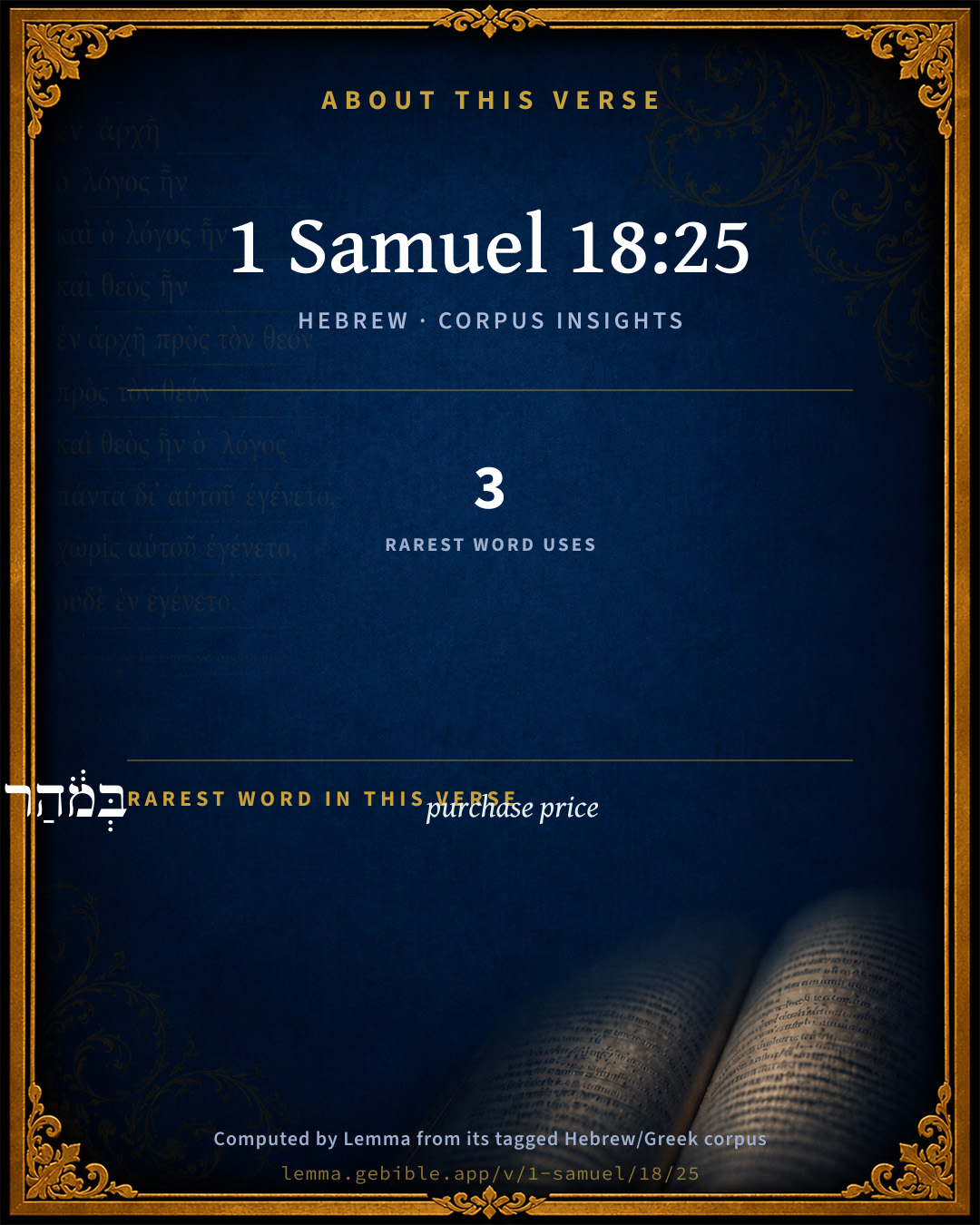
The rarest word here is בְּמֹ֔הַר purchase price H4119 — appearing just 3 times in the whole Hebrew Bible.

Shared distinctive vocabulary

בְּמֹ֔הַר purchase price H4119 occurs in 3 verses of the Hebrew Bible. Also found in:

Grammatical profile

  • 6 verbs
  • 12 nouns
  • 1 adjective
  • 1 conjunction
  • 1 adverb
  • 2 particles

Verb forms

  • וַיֹּ֨אמֶר Qal · Sequential Imperfect
  • תֹאמְר֣וּ Qal · Imperfect
  • לְהִנָּקֵ֖ם Niphal · Infinitive Construct
  • בְּאֹיְבֵ֣י Qal · Participle Active
  • חָשַׁ֔ב Qal · Perfect
  • לְהַפִּ֥יל Hiphil · Infinitive Construct

Repetition

Words recur within this verse — often emphatic in Hebrew:

  • וַיֹּ֨אמֶר to say H559 ×2
  • שָׁא֜וּל Saul H7586 ×2
  • לְדָוִ֗ד David H1732 ×2
  • לַמֶּ֨לֶךְ֙ king H4428 ×2
  • פְּלִשְׁתִּ֔ים Philistine H6430 ×2

Hebrew & Septuagint length

In English translation the verse runs 39 words from the Hebrew and 40 from the Septuagint (LXX English) — closely comparable.

A rough comparison of the two English renderings, which tokenize alike — not a word-level alignment.

Word counts can differ between the Hebrew and the Greek without any difference in meaning — e.g. the Hebrew direct-object marker אֵת has no separate Greek word, and Greek often adds the article ὁ.

Cross-references

10

Topical passages linked to 1 Samuel 18:25 in the Treasury of Scripture Knowledge — connected by theme and wording, ordered by reader-vote popularity; previews shown in the World English Bible.

  • Genesis 34:12 Ask me a great amount for a dowry, and I will give whatever you ask of me, but give me the young lady as a wife."
  • 1 Samuel 14:24 The men of Israel were distressed that day; for Saul had adjured the people, saying, Cursed be the man who eats any food until it be evening, and I be avenged on my enemies. So none of the people tasted food.
  • 1 Samuel 18:17 Saul said to David, Behold, my elder daughter Merab, her will I give you as wife: only be valiant for me, and fight Yahweh's battles. For Saul said, Don't let my hand be on him, but let the hand of the Philistines be on him.
  • Genesis 17:11–14 You shall be circumcised in the flesh of your foreskin. It will be a token of a covenant between me and you.
  • Genesis 29:18 Jacob loved Rachel. He said, "I will serve you seven years for Rachel, your younger daughter."
  • Exodus 22:16–17 "If a man entices a virgin who isn't pledged to be married, and lies with her, he shall surely pay a dowry for her to be his wife.
  • Joshua 5:3 Joshua made himself flint knives, and circumcised the children of Israel at the hill of the foreskins.
  • 1 Samuel 17:26 David spoke to the men who stood by him, saying, What shall be done to the man who kills this Philistine, and takes away the reproach from Israel? for who is this uncircumcised Philistine, that he should defy the armies of the living God?
  • 1 Samuel 17:36 Your servant struck both the lion and the bear: and this uncircumcised Philistine shall be as one of them, seeing he has defied the armies of the living God.
  • 2 Samuel 17:8–11 Hushai said moreover, You know your father and his men, that they are mighty men, and they are fierce in their minds, as a bear robbed of her cubs in the field; and your father is a man of war, and will not lodge with the people.

Cross-references courtesy of OpenBible.info (CC BY 4.0).

Hebrew and Greek witnesses Masoretic Hebrew ↔ Greek Septuagint

The same verse in the two great witnesses to the Old Testament, shown verse-for-verse.

These are two independent witnesses, not word-aligned to each other, and the Septuagint is shown in lemma (dictionary) form.

Hebrew 1 Samuel 18:25 Masoretic · Westminster Leningrad Codex

וַיֹּ֨אמֶר שָׁא֜וּל כֹּֽה תֹאמְר֣וּ לְדָוִ֗ד אֵֽין חֵ֤פֶץ לַמֶּ֨לֶךְ֙ בְּמֹ֔הַר כִּ֗י בְּמֵאָה֙ עָרְל֣וֹת פְּלִשְׁתִּ֔ים לְהִנָּקֵ֖ם בְּאֹיְבֵ֣י הַמֶּ֑לֶךְ וְשָׁא֣וּל חָשַׁ֔ב לְהַפִּ֥יל אֶת דָּוִ֖ד בְּיַד פְּלִשְׁתִּֽים

Saul said, Thus shall you tell David, The king desires no dowry except one hundred foreskins of the Philistines, to be avenged of the king's enemies. Now Saul thought to make David fall by the hand of the Philistines.

World English Bible · Public Domain

Greek LXX 1 Samuel 18:25 Septuagint · lemma form
And Saul said, Thus shall you⌃ speak to David, The king wants no gift but one hundred foreskins of the Philistines, to avenge himself on the kings enemies. Now Saul thought to cast him into the hands of the Philistines.

LXX2012 (modern English Septuagint) · Public Domain

Hebrew: Westminster Leningrad Codex (CC BY 4.0). Greek: Septuagint (public domain); English from LXX2012 (modern English Septuagint) (Public Domain). How the Septuagint differs from the Hebrew →

Targum (Aramaic paraphrase)

1

The Targum is the ancient Jewish Aramaic paraphrase of the Hebrew Scriptures — an interpretive translation, not the Hebrew text itself. Onkelos (literal) and Pseudo-Jonathan (expansive) render the Torah, and Jonathan the Prophets. Coverage is partial: where no permissively-licensed English translation exists for a verse, only the Aramaic is shown. This is verse-level text, not a word-by-word alignment to the Hebrew.

  1. Targum Jonathan Prophets (Joshua–Malachi)
    וַאֲמַר שָׁאוּל כְּדֵין תֵּימְרוּן לְדָוִד לָא רַעֲוָא לְמַלְכָּא בְּמוֹהֲרִין אֱלָהֵין בְּמֵאָה עָרְלַת פְּלִשְׁתָּאֵי לְאִתְפְּרָעָא בְּשַׂנְאֵי מַלְכָּא וְשָׁאוּל חָשִׁיב לְמִמְסַר יַת דָוִד בִּידָא דִפְלִשְׁתָּאֵי:

    (no public-domain English translation for this verse)

    Targum Jonathan — Aramaic: “Mikraot Gedolot” (public domain). English: “Sefaria Community Translation” (CC0 1.0 (public-domain dedication)); “London "Chaldee Paraphrase," 1871” (public domain). Text via Sefaria.

Commentary

Notes on 1 Samuel 18:25 from classic Christian and Jewish commentators (each source and its license shown beneath its notes). The classic Christian expositions comment on the surrounding passage and are grouped to its opening verse, so a note may address several verses; the Jewish commentaries on the Tanakh (Rashi and others) are per-verse, so they appear only where the commentator wrote on this verse.

Lemma curates 59 commentaries, every one of them public domain or Creative Commons licensed, each selected and text-cleaned for this edition rather than reprinted as found. About our sources →

Trapp's Complete Commentary

John Trapp

1Sa 18:25 And Saul said, Thus shall ye say to David, The king desireth not any dowry, but an hundred foreskins of the Philistines, to be avenged of the king’s enemies. But Saul thought to make David fall by the hand of the Philistines.

Ver. 25. !!An hundred foreskins of the Philistines.] Not a hundred heads, as Josephus hath it, but foreskins; the more to enrage the Philistines against David: for besides the loss of so many men, they would take it for a foul disgrace and despite done to their whole nation: as also that this victory might be the more ignominious.

John Trapp, A Commentary or Exposition upon All the Books of the Old and New Testament (1647–1656) — public domain. Text from a community e-Sword module.

Joseph Benson's Commentary

1Sa 18:25. The king desireth not any dowry — It was customary in those times for the husband to give a present, or, as it is rendered, a dowry, to his father-in-law when he received his wife. But a hundred foreskins of the Philistines — Saul made this demand of David, probably thinking that the necessity he would be under of attacking the Philistines at a disadvantage, or, at all hazards, in order to get the proposed number of foreskins within the time limited, would bring him into such dangerous encounters, as he could scarcely escape from. It is likely that Saul required the foreskins rather than the heads of the Philistines, to take away all possibility of David’s deceiving him, by bringing the heads of such of his own men as might fall in battle, and passing them on him for the heads of the Philistines.

Joseph Benson's Commentary on the Old and New Testaments (1811–1818) — public domain. Text from a community e-Sword module.

Jamieson, Fausset & Brown

Robert Jamieson, A. R. Fausset & David Brown

The king desireth not any dowry--In Eastern countries the husband purchases his wife either by gifts or services. As neither David nor his family were in circumstances to give a suitable dowry for a princess, the king intimated that he would be graciously pleased to accept some gallant deed in the public service.

a hundred foreskins of the Philistines--Such mutilations on the bodies of their slain enemies were commonly practised in ancient war, and the number told indicated the glory of the victory. Saul's willingness to accept a public service had an air of liberality, while his choice of so difficult and hazardous a service seemed only putting a proper value on gaining the hand of a king's daughter. But he covered unprincipled malice against David under this proposal, which exhibited a zeal for God and the covenant of circumcision.

Jamieson, Fausset & Brown — Commentary Critical and Explanatory on the Whole Bible (1871) — public domain (CC PDM 1.0). Text via the HelloAO Bible API.

Adam Clarke's Commentary

Verse 25. But a hundred foreskins] That is, Thou shalt slay one hundred Philistines, and thou shalt produce their foreskins, as a proof, not only that thou hast killed one hundred men, but that these are of the uncircumcised. A custom similar to this still prevails among the Abyssinians, according to Bruce. See his Travels.

Adam Clarke's Commentary on the Bible (1810–1826) — public domain. Text from a community e-Sword/MySword module.

Ellicott's Commentary for English Readers

(25) An hundred foreskins.—Wordsworth’s note here, which he derives from Theodoret, is curious. Foreskins! why not heads? Here is a sign of Saul’s suspicious and malignant spirit. He, judging for himself, impiously suspects that David would go forth and destroy some of the Israelites—Saul’s own subjects—as he himself desired to destroy David, his own deliverer; and the foreskins were required as a proof that they who were killed were not Israelites. Josephus, however, with a strange exaggeration, mentions 600 heads as the price of Michal.

A Bible Commentary for English Readers, edited by Charles John Ellicott (1878–1897) — public domain. Text from a community e-Sword module.

John Gill's Exposition

Wherefore David arose and went, he and his men, and slew of the Philistines two hundred men,.... This he did himself, for the verb is singular, and which were an hundred more than required; this he did to show his regard to the orders of Saul, and his obedience to him, and to testify the sincerity of his afflictions to his daughter, for whose sake he risked his life in this expedition, as well as to express his zeal for God, and his country, against their avowed enemies; the Greek version has only one hundred men, see Sa2 3:14,

and David brought their foreskins; along with him to Saul's court, having taken them off when slain. Josephus says (z) he cut off their heads, and brought them to him, and he makes the number to be six hundred; neither are according to the text, but to make his history more agreeable to the Gentiles, see Sa1 18:21; an Arabic writer (a) makes mention of a people, that cut off the genital parts of men, and gave them to their wives for their dowry:

and they gave them in full tale to the king; the messengers David sent in with them, even the full tale of two hundred, which were as many more as were demanded:

that he might be the king's son in law; being now as desirous of it as the king was:

and Saul gave him Michal his daughter to wife; which he could not in honour refuse to do, seeing he had performed the condition he had required. David's marriage of the younger sister, when upon various considerations it might have been expected that he should have married the elder, may be an emblem of Christ's espousing the Gentile church, when the Jewish church, her elder sister, is neglected by him, she having rejected him.

(z) Antiqu. l. 6. c. 10. sect. 3. (a) Alcamus apud Bochart. Hierozoic. par. 2. l. 1. c. 19. col. 130.

John Gill's Exposition of the Whole Bible (1746–1763) — public domain (CC PDM 1.0). Text via the HelloAO Bible API.

Albert Barnes' Notes on the Bible

An hundred foreskins - This is merely another expression of the spirit which led to the constant application of the epithet uncircumcised to the Philistines 1Sa 14:6.

Albert Barnes' Notes on the Bible (1834–1885) — public domain. Text from a community e-Sword/MySword module.

Haydock's Catholic Bible Commentary

Dowry. Among the Hebrews, the man had to purchase his wife. --- Philistines. They were the nearest nation of those who were not circumcised; and thus Saul would prove that David had attacked them, which would greatly irritate them against him. (Calmet) --- Josephus specifies six hundred heads, (Haydock) falsely, (Horn) as he frequently disguises what might give his readers offence, as being either mean or incredible. (Calmet) --- Hundred is not specified in the original Hebrew copies, (Capel, iii. 17,) and David gives 200, ver. 27. But Saul only stipulated for 100. See 2 Kings iii. 14. (Calmet) --- Wife, "thinking it mean to be guilty of an untruth," &c., says Josephus; "yet his disposition was not altered. He resolved, therefore, to take away his life, and wished Jonathan and his most trusty servants to put his designs in execution." He then mentions the friendship of these two. But he takes no notice of the proffered marriage of Merob, and he seems not to have known that she was ever promised. See ver. 17., and 19., and chap. xvii. 12. (Haydock)

George Leo Haydock (1774–1849), Haydock's Catholic Family Bible and Commentary, 1859 edition — public domain. Excludes Psalms (Douay-Rheims chapter numbering differs from Protestant) and Deuterocanonical books (Catholic canon only).

Matthew Poole's English Annotations

An hundred foreskins: these he desires rather than their heads; partly, for the greater convenience of bringing them, and presenting them before him; partly, to cover his malice against David with a pretence of zeal for God, and for his people, and for the covenant of circumcision; and partly, that the Philistines might be the more enraged against David for this reproachful and barbarous usage of them, and might therefore watch all opportunities to destroy him.

Matthew Poole's English Annotations on the Holy Bible (1683–1685) — public domain. Text from a community e-Sword/MySword module.

Whedon's Commentary on the Bible

Daniel D. Whedon

25. A hundred foreskins — This demand savours of the spirit and manners of that age, and reminds one of the American Indians preserving as trophies the scalps of their victims.

Daniel D. Whedon (gen. ed.), Commentary on the Old and New Testaments (1874–1909) — public domain. Text from a community e-Sword module.

unfoldingWord translationNotes

Door43 World Missions Community

The king does not desire any price for the bride except a hundred foreskins

The verb for the second phrase may be supplied from the first. AT: "The king does not desire any price for the bride; he desires only that you bring to him 100 foreskins" (See: Ellipsis and Numbers)

foreskins

The foreskin is a fold of skin on a man's private part that is removed during circumcision.

to be avenged from the king's enemies

This can be stated in active form. AT: "to get revenge on the king's enemies" (See: Active or Passive)

to make David fall by the hand of the Philistines

Here "fall" means to die. The phrase "by the hand" is an idiom that tells us the means by which something will happen, in this case, David will be killed by the Philistines. This can be stated in active form. AT: "to have the Philistines kill David" (See: Euphemism and Idiom and Active or Passive)

translationWords

Philistines

avenge

adversary

hand

unfoldingWord translationNotes — © Distant Shores Media and the Door43 World Missions Community, licensed CC BY-SA 4.0. Source: git.door43.org/Door43/en_tn.

Lesson kit

Teaching starters — assembled from the data on this page, not authored interpretation. Every prompt links to the verse data it draws on. Edit before teaching.

1 Samuel, in the Historical, opens this verse with 23 words (18 distinct Hebrew lemmas). Its most distinctive word is môhar (“purchase price”). A historical commentator’s framing appears above. Read the whole chapter for the surrounding context.

Discussion questions

  1. What does “purchase price” (môhar) contribute to the verse as a whole?
  2. Genesis 34:12 shares the word «purchase price» with this verse. How do the two illuminate each other?
  3. “to say” occurs 2× in this one verse. What is the effect of the repetition?
  4. The translations on this page render this verse differently — a whole-verse word diff, not a word-by-word alignment. What might account for the different wordings?
  5. The verb «וַיֹּ֨אמֶר» is Qal Sequential Imperfect. How does its form color the action?
  6. Reading how Trapp's Complete Commentary and Joseph Benson's Commentary read this verse, where do the two commentators agree and where do they part?

Things to notice

Reading settings

Reading text

Shown beneath each verse's original-language words.

Old Testament
Old Testament edition

Read the OT as the Masoretic Hebrew (MT) or the Greek Septuagint (LXX).

English shown for the Greek Septuagint (in the Hebrew ↔ Greek comparison).

Comparing translations? Open the Compare panel on any verse page to stack up to four side by side.