
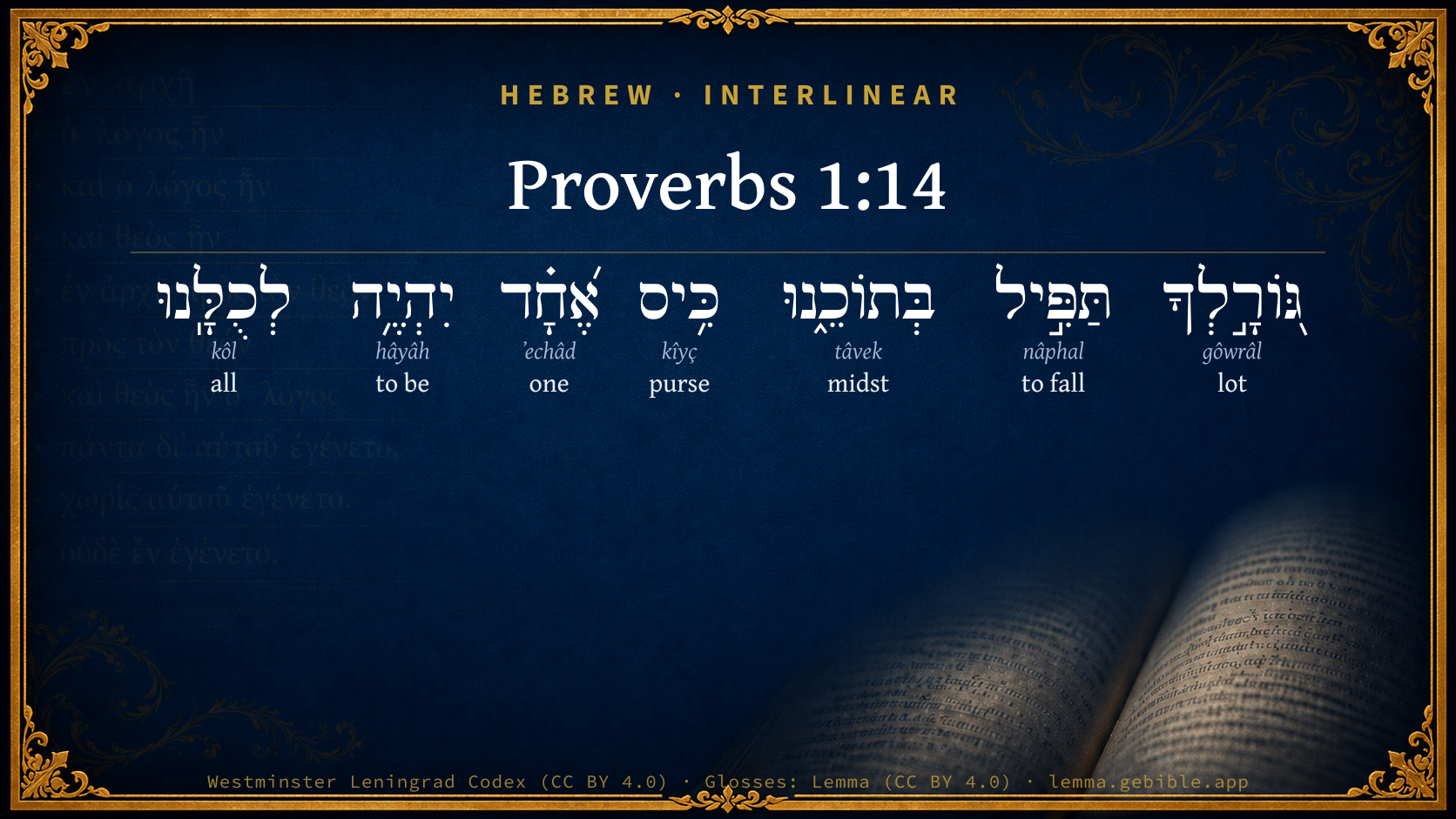
Proverbs 1:14

Hebrew (Westminster Leningrad Codex) Proverbs 1:14 appears in the Hebrew Old Testament. The text above is from the Westminster Leningrad Codex. Each word links to its Strong’s number, a concise gloss, and parsing drawn from the Open Scriptures Hebrew Bible morphology. Click any word for its full Brown-Driver-Briggs (BDB) entry.
Download image
Cite this verse

Proverbs 1:14 (World English Bible). Public Domain. Lemma interlinear Bible study tool, https://lemma.gebible.app/v/proverbs/1/14.

Show BibTeX & RIS
BibTeX
RIS
English Translation
You shall cast your lot among us. We'll all have one purse."
World English Bible · Public Domain
Download a study sheet

One document with this verse’s original text, its word-by-word gloss line, the meaning frame, cross-references with their text, attributed commentary, and full source and license credits — printable, and it pastes into notes with its structure intact.

This verse Autodidact and up

Study sheet (.html) Plain text (.txt)

A passage Seminary Student

Up to 50 verses in one chapter. A passage sheet keeps up to 6 commentary sources and 12 cross-references per verse, in the order this page ranks them, and says so on the sheet whenever that leaves anything out. Ask for a single verse and you get the Autodidact verse sheet above.

Everything on this page stays free to read, with no account — the sheet is a download of what is already on screen, not access to it.

Want to remove ads? Support Godless Engineer
Compare translations 3

The same verse in 3 English versions, stacked beneath the original-language interlinear above. Click any original word for its lexicon entry.

Each is an independent rendering of the whole verse — the interlinear is not word-aligned to these translations.

Highlighted words mark where these versions differ — a whole-verse word diff, not a word-by-word alignment.

  • World English Bible Public Domain
    You shall cast your lot among us. We'll all have one purse."
  • King James Version Public Domain
    Cast in thy lot among us; let us all have one purse:
  • unfoldingWord Literal Text CC BY-SA 4.0
    You must cause your lot to fall in our midst; one purse will be for all of us.”

unfoldingWord Literal Text — © unfoldingWord, licensed CC BY-SA 4.0. Word-aligned USFM3 via Door43 (git.door43.org/unfoldingWord/en_ult).

Versions to compare (up to 4)

3 of 4 selected

Show all 18 translations

Every available English version of this verse, each an independent rendering of the whole verse.

  • World English Bible Public Domain
    You shall cast your lot among us. We'll all have one purse."
  • Berean Standard Bible Public Domain
    Throw in your lot with us; let us all share one purse”—
  • Majority Standard Bible Public Domain
    Throw in your lot with us; let us all share one purse”—
  • King James Version Public Domain
    Cast in thy lot among us; let us all have one purse:
  • American Standard Version (1901) Public Domain
    Thou shalt cast thy lot among us; We will all have one purse:
  • Revised Version (1885) Public Domain
    Thou shalt cast thy lot among us; we will all have one purse:
  • Geneva Bible (1599) Public Domain
    Cast in thy lot among vs: we will all haue one purse:
  • Douay-Rheims (1899) Public Domain
    Cast in thy lot with us, let us all have one purse.
  • Young's Literal Translation Public Domain
    Thy lot thou dost cast among us, One purse is -- to all of us.'
  • Literal Standard Version CC BY-SA 4.0
    You cast your lot among us, || One purse is—to all of us.”
  • Unlocked Literal Bible CC BY-SA 4.0
    Throw in your lot with us; we will all have one purse together.”
  • unfoldingWord Literal Text CC BY-SA 4.0
    You must cause your lot to fall in our midst; one purse will be for all of us.”
  • Darby Bible Public Domain
    cast in thy lot among us; we will all have one purse:
  • World Messianic Bible Public Domain
    You shall cast your lot among us. We’ll all have one purse”—
  • Webster's Bible Public Domain
    Cast in thy lot among us; let us all have one purse:
  • Free Bible Version CC BY-SA 4.0
    Come and join us and we'll all share what we get!”
  • Bible in Basic English Public Domain
    Take your chance with us, and we will all have one money-bag:
  • JPS Tanakh (1917) Public Domain
    Cast in thy lot among us; let us all have one purse' —

Literal Standard Version (2020), Covenant Press — licensed CC BY-SA 4.0. Text via the HelloAO Bible API (eBible.org). Unlocked Literal Bible (unfoldingWord) — licensed CC BY-SA 4.0. Text via the HelloAO Bible API (eBible.org). unfoldingWord Literal Text — © unfoldingWord, licensed CC BY-SA 4.0. Word-aligned USFM3 via Door43 (git.door43.org/unfoldingWord/en_ult). Free Bible Version, Dr. Jonathan Gallagher — licensed CC BY-SA 4.0. Text via the HelloAO Bible API (eBible.org).

Word by word

More ways to search: Search by grammar → Find every occurrence → Compare this word →

Practice this passage: Drill this verse → Learn its vocabulary →

About this verse

These counts appear in no published source. They are computed here, from the morphology-tagged text and Lemma’s own curated glosses. What Lemma adds →

7
words
7
distinct lemmas
Wisdom
section

Notable vocabulary

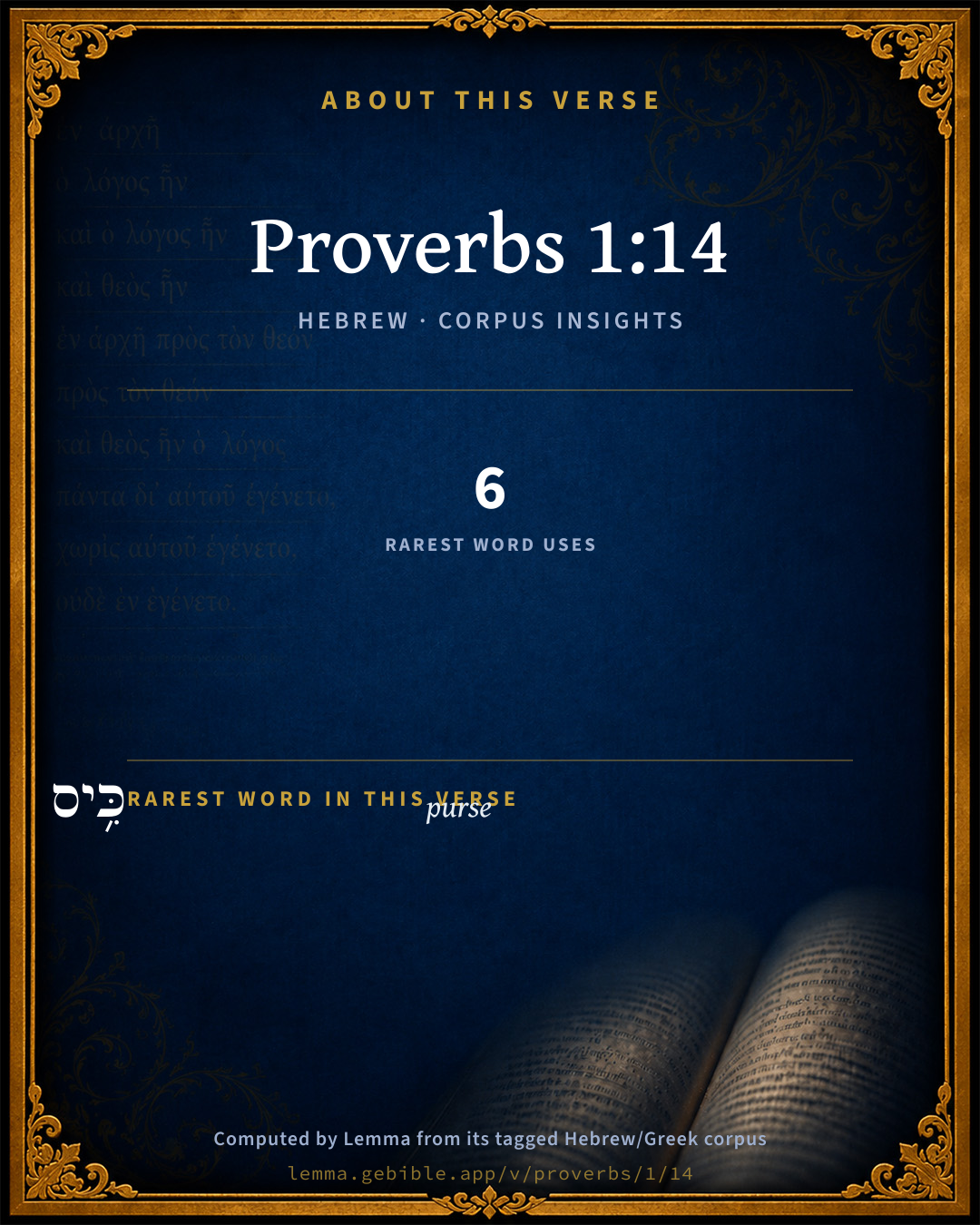
The rarest word here is כִּ֥יס purse H3599 — appearing just 6 times in the whole Hebrew Bible.

Shared distinctive vocabulary

כִּ֥יס purse H3599 occurs in 6 verses of the Hebrew Bible. Also found in:

Grammatical profile

  • 2 verbs
  • 4 nouns
  • 1 adjective

Verb forms

  • תַּפִּ֣יל Hiphil · Imperfect
  • יִהְיֶ֥ה Qal · Imperfect

Hebrew & Septuagint length

In English translation the verse runs 12 words from the Hebrew and 23 from the Septuagint (LXX English) — the Septuagint runs noticeably longer here. See the side-by-side →

A rough comparison of the two English renderings, which tokenize alike — not a word-level alignment.

Word counts can differ between the Hebrew and the Greek without any difference in meaning — e.g. the Hebrew direct-object marker אֵת has no separate Greek word, and Greek often adds the article ὁ.

Hebrew and Greek witnesses Masoretic Hebrew ↔ Greek Septuagint

The same verse in the two great witnesses to the Old Testament, shown verse-for-verse.

Here the Septuagint runs noticeably longer than the Hebrew — LXX2012 (modern English Septuagint) 23 words vs World English Bible 12. A rough length comparison of the two English translations, not a word-level alignment — read both below.

These are two independent witnesses, not word-aligned to each other, and the Septuagint is shown in lemma (dictionary) form.

Hebrew Proverbs 1:14 Masoretic · Westminster Leningrad Codex

גּ֭וֹרָ֣לְךָ תַּפִּ֣יל בְּתוֹכֵ֑נוּ כִּ֥יס אֶ֝חָ֗ד יִהְיֶ֥ה לְכֻלָּֽנוּ

You shall cast your lot among us. We'll all have one purse."

World English Bible · Public Domain

Greek LXX Proverbs 1:14 Septuagint · lemma form

ὁ δέ σός κλῆρος βάλλω ἐν ἐγώ κοινός δέ βαλλάντιον κτάομαι πᾶς καί μαρσίππιον εἷς γίγνομαι ἐγώ

but do you cast in your lot with us, and let us all provide a common purse, and let us have one pouch:

LXX2012 (modern English Septuagint) · Public Domain

On this verse, The Pulpit Commentary discusses the Septuagint’s reading. Read the note in Commentary ↓

Hebrew: Westminster Leningrad Codex (CC BY 4.0). Greek: Septuagint (public domain); English from LXX2012 (modern English Septuagint) (Public Domain). How the Septuagint differs from the Hebrew →

Commentary

Notes on Proverbs 1:14 from classic Christian and Jewish commentators (each source and its license shown beneath its notes). The classic Christian expositions comment on the surrounding passage and are grouped to its opening verse, so a note may address several verses; the Jewish commentaries on the Tanakh (Rashi and others) are per-verse, so they appear only where the commentator wrote on this verse.

Lemma curates 59 commentaries, every one of them public domain or Creative Commons licensed, each selected and text-cleaned for this edition rather than reprinted as found. About our sources →

Trapp's Complete Commentary

John Trapp

Pro 1:14 Cast in thy lot among us; let us all have one purse:

Ver. 14. Let us all have one purse.] How much better were a wallet to beg from door to door, than such a cursed hoard of evil gotten goods!

John Trapp, A Commentary or Exposition upon All the Books of the Old and New Testament (1647–1656) — public domain. Text from a community e-Sword module.

Geneva Bible (1599)

Geneva Bible translators

He showeth whereby the wicked are allured to join together, because they have every one part of the spoil of the innocent.

Geneva Bible (1599) marginal notes — public domain. Text via Bolls.life.

Adam Clarke's Commentary

Verse 14. Cast in thy lot] Be a frater conjuratus, a sworn brother, and thou shalt have an equal share of all the spoil.

Common sense must teach us that the words here used are such as must be spoken when a gang of cutthroats, pickpockets, &c., are associated together.

Adam Clarke's Commentary on the Bible (1810–1826) — public domain. Text from a community e-Sword/MySword module.

The Cambridge Bible for Schools and Colleges

gen. ed. J. J. S. Perowne

14. Cast in thy lot] and so R.V. marg. But, Thou shall cast thy lot among us, R.V. text: i.e. Thou shalt share our gains, as the 2nd clause of the verse explains, “We will all have one purse,” R.V.

The Cambridge Bible for Schools and Colleges (gen. ed. J. J. S. Perowne; Cambridge University Press, 1878–1918) — public domain. Text from a community e-Sword module.

John Gill's Exposition

Cast in thy lot among us,.... Or "thou shall cause thy lot to fall among us" (u); though just entered, as soon as any booty is taken thou shalt cast lots with us, and have thy full share with those that have been longer engaged;

let us all have one purse; or "we will all have one purse" (w); will throw all our booty, taken by us into one common stock, and live upon it comfortably and merrily. Jarchi represents it as putting it to the young man's option, to do which he would, either to cast lots and take his share separately, or let it be put altogether, and so partake jointly with the rest. According to Gersom the sense is, that there should be such an exact division made, that there should not be more in one purse than in another; their shares should be equally divided by lot, and their purses should be alike; one should not have more than another: these are the arguments used by wicked men to allure and ensnare young men to join with them in their sinful ways and practices; from which they are dehorted, as follows.

(u) "sortem tuam conjicies", Junius & Tremellius; "projicies", Mercerus, Baynus; "jacies", Cocceius, Michaelis, Schultens. (w) "erit nobis omnibus", Pagninus, Montanus, Tigurine version; so Cocceius, Schultens, and the Targum.

John Gill's Exposition of the Whole Bible (1746–1763) — public domain (CC PDM 1.0). Text via the HelloAO Bible API.

Matthew Poole's English Annotations

Cast in thy lot among us, i.e. put in thy money into our stock. Or rather,

thou shalt cast thy lot amongst us, i.e. thou shalt have a share with us, and that equally and by lot, although thou art but a novice, and we veterans. This agrees best with their design, which was to allure him by the promise of advantage.

Let us all have one purse; or,

we will have, & c. One purse shall receive all our profits, and furnish us with all expenses. So we shall live with great facility and true friendship.

Matthew Poole's English Annotations on the Holy Bible (1683–1685) — public domain. Text from a community e-Sword/MySword module.

Whedon's Commentary on the Bible

Daniel D. Whedon

14. Cast in — Better, in the indicative, thou shalt cast in. An invitation to join this community of thieves and murderers, with promise of equal dividend.

Let us all have one purse — Better, we will all have, etc.

Daniel D. Whedon (gen. ed.), Commentary on the Old and New Testaments (1874–1909) — public domain. Text from a community e-Sword module.

The Pulpit Commentary

Cast in thy lot among us. The fourth and last enticement put forward, viz. honourable union and frank and open hearted generosity. It has distinct reference to the preceding verse, and shows how the prospect of immediate wealth is to be realized (see Delitzsch, Wardlaw). Cast in thy lot cannot mean, as Mercerus, "cast in your inheritance with us, so that we all may use it in common," though lrwOG (goral) does mean "inheritance" in the sense of that which comes to any one by lot (Jud_1:3) (Gesenius), since that would be no inducement to youth to join the robbers. Goral properly is "a little stone or pebble," klhrov , especially such as were used in casting lots, and so equivalent to a "lot" here that with which the distribution was made, as in Lev_16:8 Neh_10:34; and the custom of freebooters dividing the spoil by lot is here alluded to (Holden); comp. Psa_22:18 in illustration of the practice of casting lots, "They part my garments among them, and cast lots upon my vesture." The sense is, "you shall equally with the others cast lots for your share of the spoil" (Zockler, Delitzsch). Let us all have one parse. Purse; syKi (kis), the balantion of the LXX, the marsupium of the Vulgate, is the receptacle in which money is placed for security. In Pro_15:11 it is used for the bag in which traders kept their weights, "the weights of the bag;" and in Pro_23:31 it is translated "cup," the wine cup. It here signifies the common stock, the aggregate of the gains of the robbers contributed to a common fund. The booty captured by each or any is to be thrown into one common stock, to form one purse, to be divided by lot among all the members of the band. On this community of goods among robbers, compare the Hebrew proverb, In localis, in poculis, in ira. Community of goods among the wicked carries with it community in crime, just as the community of goods among the early Christians implied community in good works and in the religious sentiments of the Christian body or Church. The Rabbi Salomon Isacides offers another explanation (which leaves the choice open to youth either to share in the spoil by lot, or to live at the expense of a common fund, as he may prefer): "Si voles, nobiscum spolia partieris, si etiam magis placebit, sociali communique marsupio nobiscum vives thou wilt, thou shalt share with us the booty; ay, if it like thee more, thou,halt live with us on a confederate and common purse" (see Cornelius a Lapide).

The Pulpit Commentary (1880–1919), ed. H.D.M. Spence-Jones & Joseph S. Exell — public domain. Text from a community e-Sword module.

Rashi

Rabbi Shlomo Yitzchaki (Rashi)

Cast your lot among us If you wish, you may share; if you wish, it will be common property.

we will all have one purse together.

Rashi on the Tanakh — English translations: “The Judaica Press complete Tanach with Rashi, translated by A. J. Rosenberg” (CC BY 4.0); “Pentateuch with Rashi's commentary by M. Rosenbaum and A.M. Silbermann, 1929-1934” (public domain); “The Metsudah Tanach series, Lakewood, N.J” (CC BY 4.0); and “The Book of Joshua, Metsudah Publications, 1997” (CC BY 4.0). Text via Sefaria.

Lesson kit

Teaching starters — assembled from the data on this page, not authored interpretation. Every prompt links to the verse data it draws on. Edit before teaching.

Proverbs, in the Wisdom, opens this verse with 7 words (7 distinct Hebrew lemmas). Its most distinctive word is kîyç (“purse”). The Greek Septuagint runs longer here. A historical commentator’s framing appears above. Read the whole chapter for the surrounding context.

Discussion questions

  1. What does “purse” (kîyç) contribute to the verse as a whole?
  2. How does Deuteronomy 25:13, which shares the word «purse», read alongside this verse?
  3. The Septuagint runs longer here than the Hebrew. What might account for the difference?
  4. These translations render this verse differently. What is at stake in choosing one wording over another?
  5. «תַּפִּ֣יל» is a Hiphil Imperfect verb. How does that grammatical form shape the action described?
  6. Compare how Trapp's Complete Commentary and Geneva Bible (1599) read this verse. Where do they agree or differ?

Things to notice

Reading settings

Reading text

Shown beneath each verse's original-language words.

Old Testament
Old Testament edition

Read the OT as the Masoretic Hebrew (MT) or the Greek Septuagint (LXX).

English shown for the Greek Septuagint (in the Hebrew ↔ Greek comparison).

Comparing translations? Open the Compare panel on any verse page to stack up to four side by side.