
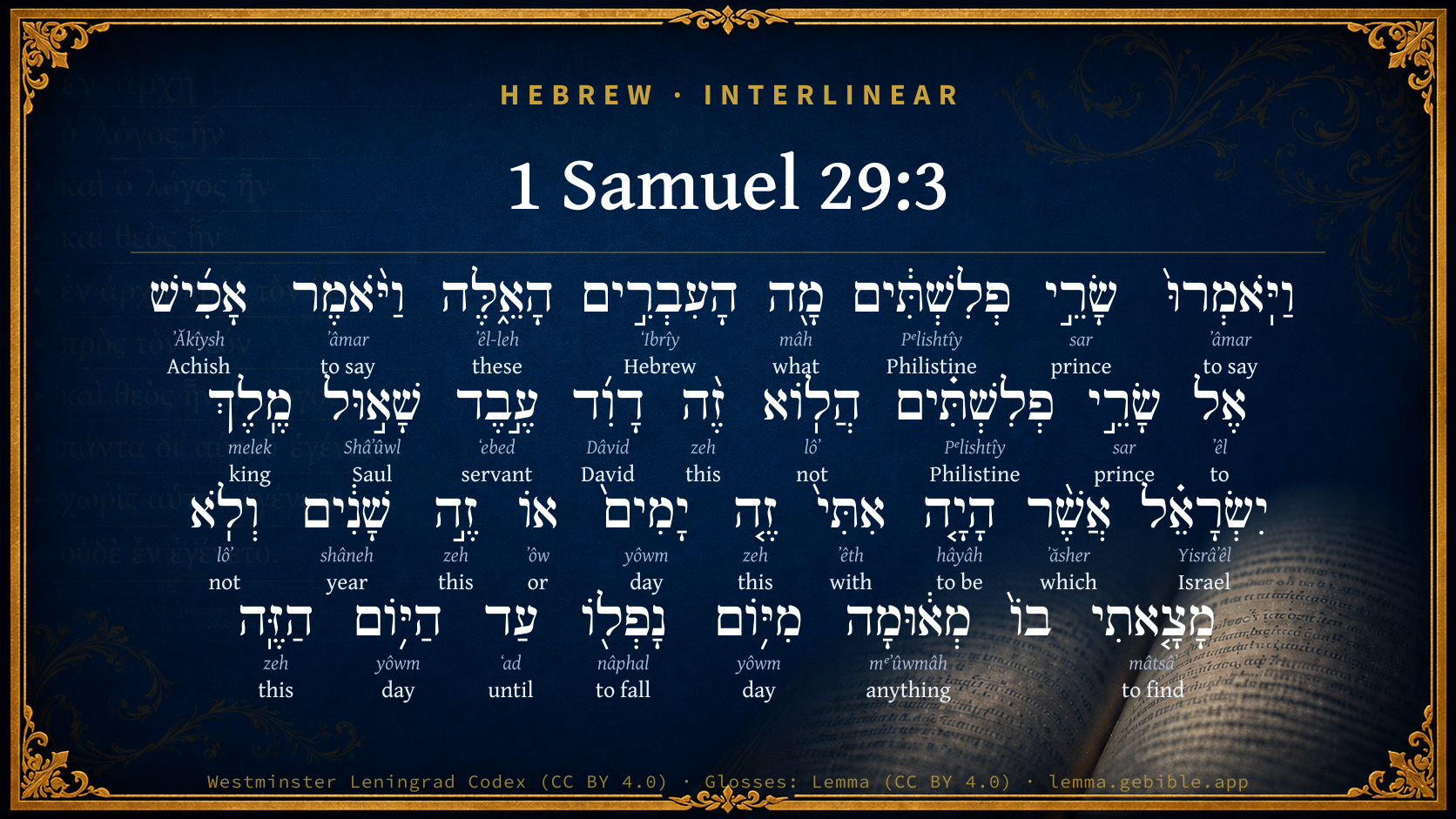
1 Samuel 29:3

Hebrew (Westminster Leningrad Codex) 1 Samuel 29:3 appears in the Hebrew Old Testament. The text above is from the Westminster Leningrad Codex. Each word links to its Strong’s number, a concise gloss, and parsing drawn from the Open Scriptures Hebrew Bible morphology. Click any word for its full Brown-Driver-Briggs (BDB) entry.
Download image
Cite this verse

1 Samuel 29:3 (World English Bible). Public Domain. Lemma interlinear Bible study tool, https://lemma.gebible.app/v/1-samuel/29/3.

Show BibTeX & RIS
BibTeX
RIS
English Translation
Then said the princes of the Philistines, What [do] these Hebrews [here]? Achish said to the princes of the Philistines, Isn't this David, the servant of Saul the king of Israel, who has been with me these days, or [rather] these years, and I have found no fault in him since he fell away [to me] to this day?
World English Bible · Public Domain
Download a study sheet

One document with this verse’s original text, its word-by-word gloss line, the meaning frame, cross-references with their text, attributed commentary, and full source and license credits — printable, and it pastes into notes with its structure intact.

This verse Autodidact and up

Study sheet (.html) Plain text (.txt)

A passage Seminary Student

Up to 50 verses in one chapter. A passage sheet keeps up to 6 commentary sources and 12 cross-references per verse, in the order this page ranks them, and says so on the sheet whenever that leaves anything out. Ask for a single verse and you get the Autodidact verse sheet above.

Everything on this page stays free to read, with no account — the sheet is a download of what is already on screen, not access to it.

Want to remove ads? Support Godless Engineer
Compare translations 3

The same verse in 3 English versions, stacked beneath the original-language interlinear above. Click any original word for its lexicon entry.

Each is an independent rendering of the whole verse — the interlinear is not word-aligned to these translations.

Highlighted words mark where these versions differ — a whole-verse word diff, not a word-by-word alignment.

  • World English Bible Public Domain
    Then said the princes of the Philistines, What [do] these Hebrews [here]? Achish said to the princes of the Philistines, Isn't this David, the servant of Saul the king of Israel, who has been with me these days, or [rather] these years, and I have found no fault in him since he fell away [to me] to this day?
  • King James Version Public Domain
    Then said the princes of the Philistines, What do these Hebrews here? And Achish said unto the princes of the Philistines, Is not this David, the servant of Saul the king of Israel, which hath been with me these days, or these years, and I have found no fault in him since he fell unto me unto this day?
  • unfoldingWord Literal Text CC BY-SA 4.0
    And the lords of the Philistines said, “What these Hebrews?” And Achish said to the lords of the Philistines, “ this not David, the servant of Saul the king of Israel, who has been with me these days, or these years? And I have not found anything in him from the day of his falling to this day.”

unfoldingWord Literal Text — © unfoldingWord, licensed CC BY-SA 4.0. Word-aligned USFM3 via Door43 (git.door43.org/unfoldingWord/en_ult).

Versions to compare (up to 4)

3 of 4 selected

Show all 18 translations

Every available English version of this verse, each an independent rendering of the whole verse.

  • World English Bible Public Domain
    Then said the princes of the Philistines, What [do] these Hebrews [here]? Achish said to the princes of the Philistines, Isn't this David, the servant of Saul the king of Israel, who has been with me these days, or [rather] these years, and I have found no fault in him since he fell away [to me] to this day?
  • Berean Standard Bible Public Domain
    Then the commanders of the Philistines asked, “What about these Hebrews?” Achish replied, “Is this not David, the servant of King Saul of Israel? He has been with me all these days, even years, and from the day he defected until today I have found no fault in him.”
  • Majority Standard Bible Public Domain
    Then the commanders of the Philistines asked, “What about these Hebrews?” Achish replied, “Is this not David, the servant of King Saul of Israel? He has been with me all these days, even years, and from the day he defected until today I have found no fault in him.”
  • King James Version Public Domain
    Then said the princes of the Philistines, What do these Hebrews here? And Achish said unto the princes of the Philistines, Is not this David, the servant of Saul the king of Israel, which hath been with me these days, or these years, and I have found no fault in him since he fell unto me unto this day?
  • American Standard Version (1901) Public Domain
    Then said the princes of the Philistines, What `do' these Hebrews `here'? And Achish said unto the princes of the Philistines, Is not this David, the servant of Saul the king of Israel, who hath been with me these days, or `rather' these years, and I have found no fault in him since he fell away `unto me' unto this day?
  • Revised Version (1885) Public Domain
    Then said the princes of the Philistines, What do these Hebrews here? And Achish said unto the princes of the Philistines, Is not this David, the servant of Saul the king of Israel, which hath been with me these days or these years, and I have found no fault in him since he fell away unto me unto this day?
  • Geneva Bible (1599) Public Domain
    Then saide the princes of the Philistims, What doe these Ebrewes here? And Achish said vnto the princes of the Philistims, Is not this Dauid the seruant of Saul the King of Israel, who hath bene with me these dayes, or these yeeres, and I haue found nothing in him, since he dwelt with me vnto this day?
  • Douay-Rheims (1899) Public Domain
    And the princes of the Philistines said to Achis: What mean these Hebrews? And Achis said to the princes of the Philistines: Do you not know David, who was the servant of Saul the king of Israel, and hath been with me many days, or years, and I have found no fault in him, since the day that he fled over to me until this day?
  • Young's Literal Translation Public Domain
    And the heads of the Philistines say, `What `are' these Hebrews?' and Achish saith unto the heads of the Philistines, `Is not this David servant of Saul king of Israel, who hath been with me these days or these years, and I have not found in him anything `wrong' from the day of his falling away till this day.'
  • Literal Standard Version CC BY-SA 4.0
    And the heads of the Philistines say, “What [are] these Hebrews?” And Achish says to the heads of the Philistines, “Is this not David, servant of Saul king of Israel, who has been with me these days or these years, and I have not found anything in him [wrong] from the day of his falling away until this day?”
  • Unlocked Literal Bible CC BY-SA 4.0
    Then the princes of the Philistines said, “What are these Hebrews doing here?” Achish said to the other princes of the Philistines, “Is not this David, the servant of Saul, the king of Israel, who has been with me these days, or rather these years, and I have found no fault with him since he came away to me to this day?”
  • unfoldingWord Literal Text CC BY-SA 4.0
    And the lords of the Philistines said, “What these Hebrews?” And Achish said to the lords of the Philistines, “ this not David, the servant of Saul the king of Israel, who has been with me these days, or these years? And I have not found anything in him from the day of his falling to this day.”
  • Darby Bible Public Domain
    And the princes of the Philistines said, What are these Hebrews? And Achish said to the princes of the Philistines, Is not this David, the servant of Saul the king of Israel, who has been with me these days, or these years, and I have found nothing in him since the day of his falling away [to me] to this day?
  • World Messianic Bible Public Domain
    Then the princes of the Philistines said, “What about these Hebrews?” Achish said to the princes of the Philistines, “Isn’t this David, the servant of Saul the king of Israel, who has been with me these days, or rather these years? I have found no fault in him since he fell away until today.”
  • Webster's Bible Public Domain
    Then said the princes of the Philistines, What do these Hebrews here? And Achish said to the princes of the Philistines, Is not this David, the servant of Saul the king of Israel, who hath been with me these days, or these years, and I have found no fault in him since he fell to me to this day?
  • Free Bible Version CC BY-SA 4.0
    But the Philistine commanders asked, “What are these Hebrews doing here?” Achish replied to the Philistine commanders, “That's David, an officer of King Saul of Israel. He's been with me for a long time, years even, and I haven't found any fault in him since the day he came over to our side up till now.”
  • Bible in Basic English Public Domain
    Then the rulers of the Philistines said, What are these Hebrews doing here? And Achish said to the rulers of the Philistines, Is this not David, the servant of Saul the king of Israel, who has been with me for a year or two, and I have never seen any wrong in him from the time when he came to me till now?
  • JPS Tanakh (1917) Public Domain
    Then said the princes of the Philistines: 'What do these Hebrews here?' And Achish said unto the princes of the Philistines: 'Is not this David, the servant of Saul the king of Israel, who hath been with me these days or these years, and I have found no fault in him since he fell away unto me unto this day?'

Literal Standard Version (2020), Covenant Press — licensed CC BY-SA 4.0. Text via the HelloAO Bible API (eBible.org). Unlocked Literal Bible (unfoldingWord) — licensed CC BY-SA 4.0. Text via the HelloAO Bible API (eBible.org). unfoldingWord Literal Text — © unfoldingWord, licensed CC BY-SA 4.0. Word-aligned USFM3 via Door43 (git.door43.org/unfoldingWord/en_ult). Free Bible Version, Dr. Jonathan Gallagher — licensed CC BY-SA 4.0. Text via the HelloAO Bible API (eBible.org).

Word by word

More ways to search: Search by grammar → Find every occurrence → Compare this word →

Practice this passage: Drill this verse → Learn its vocabulary →

אָכִ֜ישׁ
ʼĂkîysh
H397
“Achish”
Noun, Proper
Part of Speech
Noun
Type
Proper
Full BDB Definition

Origin: of uncertain derivation

TWOT: None

Achish = "I will blacken (or terrify)" or " only a man" - Philistine king of Gath
  1. וַיֹּֽאמְרוּ֙ ʼâmar H559 “and · to say” Conjunction + Verb, Qal, Sequential Imperfect, 3rd Person, Masculine, Plural
  2. שָׂרֵ֣י sar H8269 “princes of” Noun, Common, Masculine, Plural, Construct
  3. פְלִשְׁתִּ֔ים Pᵉlishtîy H6430 “Philistines” Noun, Gentilic, Masculine, Plural, Absolute
  4. מָ֖ה mâh H4100 “what” Particle, Interrogative
  5. הָעִבְרִ֣ים ʻIbrîy H5680 “the · Hebrews” Particle, Definite Article + Noun, Gentilic, Masculine, Plural, Absolute
  6. הָאֵ֑לֶּה ʼêl-leh H428 “the · these” Particle, Definite Article + Pronoun, Demonstrative, Common, Plural
  7. וַיֹּ֨אמֶר ʼâmar H559 “and · to say” Conjunction + Verb, Qal, Sequential Imperfect, 3rd Person, Masculine, Singular
  8. אֶל ʼêl H413 “to” Preposition
  9. שָׂרֵ֣י sar H8269 “princes of” Noun, Common, Masculine, Plural, Construct
  10. פְלִשְׁתִּ֗ים Pᵉlishtîy H6430 “Philistines” Noun, Gentilic, Masculine, Plural, Absolute
  11. הֲלֽוֹא lôʼ H3808 “not” Particle, Interrogative + Particle, Negative
  12. זֶ֨ה zeh H2088 “this” Pronoun, Demonstrative, Masculine, Singular
  13. דָוִ֜ד Dâvid H1732 “David” Noun, Proper
  14. עֶ֣בֶד ʻebed H5650 “servant of” Noun, Common, Masculine, Singular, Construct
  15. שָׁא֣וּל Shâʼûwl H7586 “Saul” Noun, Proper
  16. מֶֽלֶךְ melek H4428 “king of” Noun, Common, Masculine, Singular, Construct
  17. יִשְׂרָאֵ֗ל Yisrâʼêl H3478 “Israel” Noun, Proper
  18. אֲשֶׁ֨ר ʼăsher H834 “which” Particle, Relative
  19. הָיָ֤ה hâyâh H1961 “to be” Verb, Qal, Perfect, 3rd Person, Masculine, Singular
  20. אִתִּי֙ ʼêth H854 “with · me” Preposition + Suffix, Personal, 1st Person, Common, Singular
  21. זֶ֤ה zeh H2088 “this” Pronoun, Demonstrative, Masculine, Singular
  22. יָמִים֙ yôwm H3117 “days” Noun, Common, Masculine, Plural, Absolute
  23. אוֹ ʼôw H176 “or” Conjunction
  24. זֶ֣ה zeh H2088 “this” Pronoun, Demonstrative, Masculine, Singular
  25. שָׁנִ֔ים shâneh H8141 “years” Noun, Common, Feminine, Plural, Absolute
  26. וְלֹֽא lôʼ H3808 “and · not” Conjunction + Particle, Negative
  27. מָצָ֤אתִי mâtsâʼ H4672 “to find” Verb, Qal, Perfect, 1st Person, Common, Singular
  28. מְא֔וּמָה mᵉʼûwmâh H3972 “anything” Noun, Common, Feminine, Singular, Absolute
  29. מִיּ֥וֹם yôwm H3117 “from · day of” Preposition + Noun, Common, Masculine, Singular, Construct
  30. נָפְל֖וֹ nâphal H5307 “to fall · him” Verb, Qal, Infinitive Construct + Suffix, Personal, 3rd Person, Masculine, Singular
  31. עַד ʻad H5704 “until” Preposition
  32. הַיּ֥וֹם yôwm H3117 “the · day” Particle, Definite Article + Noun, Common, Masculine, Singular, Absolute
  33. הַזֶּֽה zeh H2088 “the · this” Particle, Definite Article + Pronoun, Demonstrative, Masculine, Singular

About this verse

These counts appear in no published source. They are computed here, from the morphology-tagged text and Lemma’s own curated glosses. What Lemma adds →

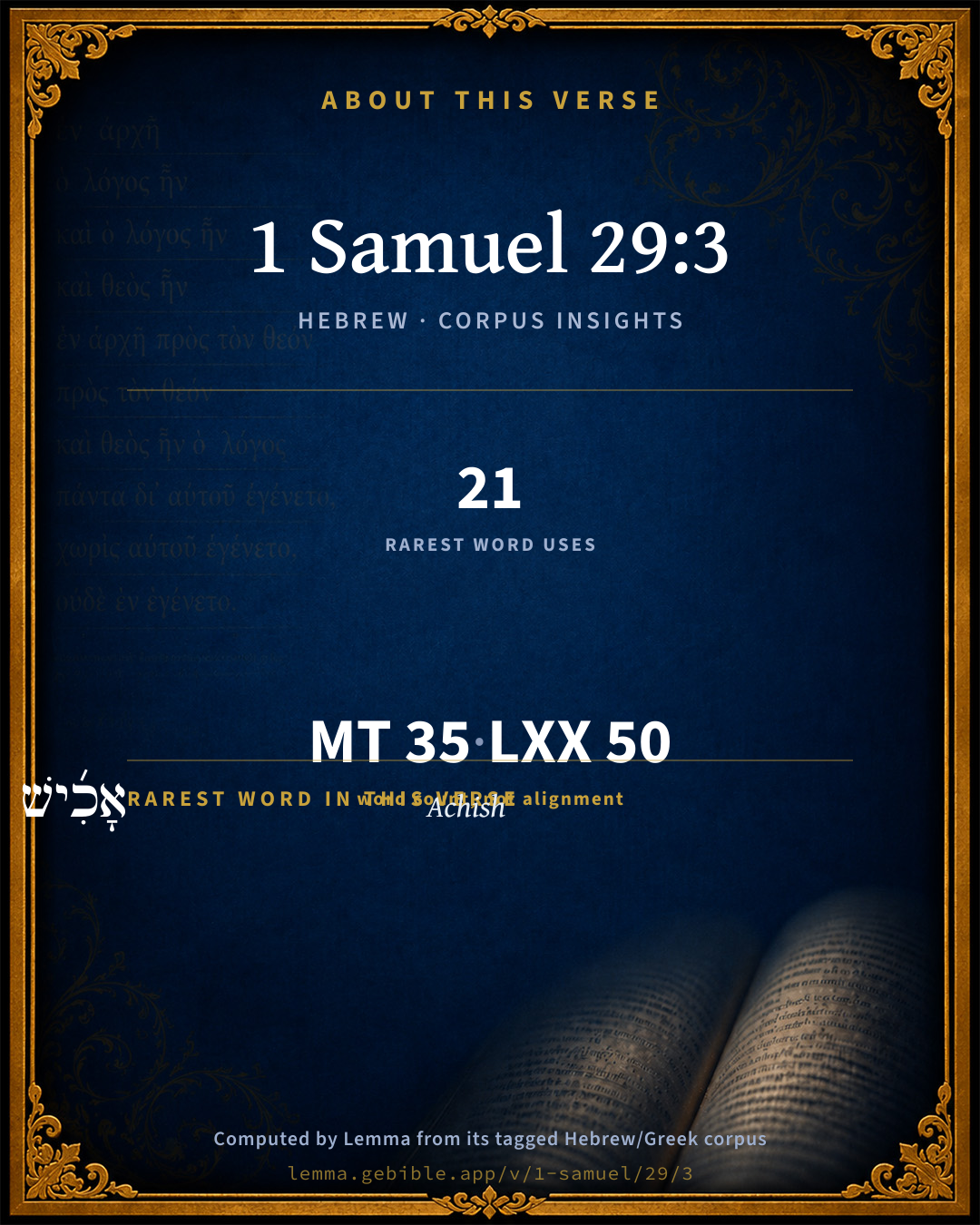
35
words
25
distinct lemmas
Historical
section

Notable vocabulary

The rarest word here is אָכִ֜ישׁ Achish H397 — appearing just 21 times in the whole Hebrew Bible.

Shared distinctive vocabulary

אָכִ֜ישׁ Achish H397 occurs in 20 verses of the Hebrew Bible. Also found in:

Grammatical profile

  • 5 verbs
  • 16 nouns
  • 5 pronouns
  • 4 prepositions
  • 1 conjunction
  • 4 particles

Verb forms

  • וַיֹּֽאמְרוּ֙ Qal · Sequential Imperfect
  • וַיֹּ֨אמֶר Qal · Sequential Imperfect
  • הָיָ֤ה Qal · Perfect
  • מָצָ֤אתִי Qal · Perfect
  • נָפְל֖וֹ Qal · Infinitive Construct

Repetition

Words recur within this verse — often emphatic in Hebrew:

  • יָמִים֙ day H3117 ×3
  • וַיֹּֽאמְרוּ֙ to say H559 ×2
  • שָׂרֵ֣י prince H8269 ×2
  • פְלִשְׁתִּ֔ים Philistine H6430 ×2
  • זֶ֨ה this H2088 ×4
  • הֲלֽוֹא not H3808 ×2

Hebrew & Septuagint length

In English translation the verse runs 59 words from the Hebrew and 66 from the Septuagint (LXX English) — closely comparable.

A rough comparison of the two English renderings, which tokenize alike — not a word-level alignment.

Word counts can differ between the Hebrew and the Greek without any difference in meaning — e.g. the Hebrew direct-object marker אֵת has no separate Greek word, and Greek often adds the article ὁ.

In the original languages it is 35 Hebrew tokens and 50 Greek tokens — but the two are counted differently (Hebrew bundles its prefixes and suffixes into one token; the Greek is in lemma form), so that isn’t a like-for-like length.

Cross-references

6

Topical passages linked to 1 Samuel 29:3 in the Treasury of Scripture Knowledge — connected by theme and wording, ordered by reader-vote popularity; previews shown in the World English Bible.

  • 1 Samuel 27:7 The number of the days that David lived in the country of the Philistines was a full year and four months.
  • Daniel 6:5 Then said these men, We shall not find any occasion against this Daniel, except we find it against him concerning the law of his God.
  • 1 Samuel 25:28 Please forgive the trespass of your handmaid: for Yahweh will certainly make my lord a sure house, because my lord fights the battles of Yahweh; and evil shall not be found in you all your days.
  • John 19:6 When therefore the chief priests and the officers saw him, they shouted, saying, "Crucify! Crucify!" Pilate said to them, "Take him yourselves, and crucify him, for I find no basis for a charge against him."
  • Romans 12:17 Repay no one evil for evil. Respect what is honorable in the sight of all men.
  • 1 Peter 3:16 having a good conscience; that, while you are spoken against as evildoers, they may be disappointed who curse your good manner of life in Christ.

Cross-references courtesy of OpenBible.info (CC BY 4.0).

Hebrew and Greek witnesses Masoretic Hebrew ↔ Greek Septuagint

The same verse in the two great witnesses to the Old Testament, shown verse-for-verse.

These are two independent witnesses, not word-aligned to each other, and the Septuagint is shown in lemma (dictionary) form.

Hebrew 1 Samuel 29:3 Masoretic · Westminster Leningrad Codex

וַיֹּֽאמְרוּ֙ שָׂרֵ֣י פְלִשְׁתִּ֔ים מָ֖ה הָעִבְרִ֣ים הָאֵ֑לֶּה וַיֹּ֨אמֶר אָכִ֜ישׁ אֶל שָׂרֵ֣י פְלִשְׁתִּ֗ים הֲלֽוֹא זֶ֨ה דָוִ֜ד עֶ֣בֶד שָׁא֣וּל מֶֽלֶךְ יִשְׂרָאֵ֗ל אֲשֶׁ֨ר הָיָ֤ה אִתִּי֙ זֶ֤ה יָמִים֙ אוֹ זֶ֣ה שָׁנִ֔ים וְלֹֽא מָצָ֤אתִי בוֹ֙ מְא֔וּמָה מִיּ֥וֹם נָפְל֖וֹ עַד הַיּ֥וֹם הַזֶּֽה

Then said the princes of the Philistines, What [do] these Hebrews [here]? Achish said to the princes of the Philistines, Isn't this David, the servant of Saul the king of Israel, who has been with me these days, or [rather] these years, and I have found no fault in him since he fell away [to me] to this day?

World English Bible · Public Domain

Greek LXX 1 Samuel 29:3 Septuagint · lemma form

καί εἶπον ὁ σατράπης ὁ ἀλλόφυλος τίς ὁ διαπορεύομαι οὗτος καί εἶπον αγχους πρός ὁ στρατηγός ὁ ἀλλόφυλος οὐ οὗτος δαυίδ ὁ δοῦλος σαούλ βασιλεύς ἰσραήλ γίγνομαι μετά ἐγώ ἡμέρα οὗτος δεύτερος ἔτος καί οὐ εὑρίσκω ἐν αὐτός οὐδείς ἀπό ὅς ἡμέρα ἐνπίπτω πρός ἐγώ καί ἕως ὁ ἡμέρα οὗτος

And the lords of the Philistines said, Who are these that pass by? And Anchus said to the captains of the Philistines, Is not this David the servant of Saul king of Israel? He has been with us some time, even this second year, and I have not found any fault in him from the day that he attached himself to me even until this day.

LXX2012 (modern English Septuagint) · Public Domain

On this verse, Ellicott's Commentary for English Readers discusses the Septuagint’s reading. Read the note in Commentary ↓

Hebrew: Westminster Leningrad Codex (CC BY 4.0). Greek: Septuagint (public domain); English from LXX2012 (modern English Septuagint) (Public Domain). How the Septuagint differs from the Hebrew →

Targum (Aramaic paraphrase)

1

The Targum is the ancient Jewish Aramaic paraphrase of the Hebrew Scriptures — an interpretive translation, not the Hebrew text itself. Onkelos (literal) and Pseudo-Jonathan (expansive) render the Torah, and Jonathan the Prophets. Coverage is partial: where no permissively-licensed English translation exists for a verse, only the Aramaic is shown. This is verse-level text, not a word-by-word alignment to the Hebrew.

  1. Targum Jonathan Prophets (Joshua–Malachi)
    וַאֲמַרוּ רַבְרְבֵי פְּלִשְׁתָּאֵי מָה יְהוּדָאֵי הָאִלֵין וַאֲמַר אָכִישׁ לְרַבְרְבֵי פְלִשְׁתָּאֵי הֲלָא דֵין דָוִד עַבְדָא דְשָׁאוּל מַלְכָּא דְיִשְׂרָאֵל דַהֲוָה עִמִי דְנַן יוֹמִין אוֹ דְנַן שְׁנִין וְלָא אַשְׁכָּחִית בֵּיהּ מִדַעַם בִּישׁ מִיוֹמָא דְאִתְפְרַשׁ לְוָתִי עַד יוֹמָא הָדֵין:

    (no public-domain English translation for this verse)

    Targum Jonathan — Aramaic: “Mikraot Gedolot” (public domain). English: “Sefaria Community Translation” (CC0 1.0 (public-domain dedication)); “London "Chaldee Paraphrase," 1871” (public domain). Text via Sefaria.

Commentary

Notes on 1 Samuel 29:3 from classic Christian and Jewish commentators (each source and its license shown beneath its notes). The classic Christian expositions comment on the surrounding passage and are grouped to its opening verse, so a note may address several verses; the Jewish commentaries on the Tanakh (Rashi and others) are per-verse, so they appear only where the commentator wrote on this verse.

Lemma curates 59 commentaries, every one of them public domain or Creative Commons licensed, each selected and text-cleaned for this edition rather than reprinted as found. About our sources →

Trapp's Complete Commentary

John Trapp

1Sa 29:3 Then said the princes of the Philistines, What [do] these Hebrews [here]? And Achish said unto the princes of the Philistines, [Is] not this David, the servant of Saul the king of Israel, which hath been with me these days, or these years, and I have found no fault in him since he fell [unto me] unto this day?

Ver. 3. What do these Hebrews here?] A people ever as much hated by the heathens for their religion, as afterwards the Christians were: but now more than ordinarily by these Philistines, because their mortal enemies.

And I have found no fault in him.] Faults David had not a few, {Psa 19:12} and if the best man’s faults were written in his forehead, it would make him pull his hat over his eyes, but God had hid them from public notice; which was to him a greater mercy than it is to us, that the filth and stench that is within us annoyeth us not. If Seneca could say of Cato, that he was the lively image of all virtues: and Valerius Maximus of Scipio, that he was the man whom God would have [to be] born, ut esset in quo virtus per omnes numeros hominibus efficaciter se ostenderet, that he might be a perfect pattern to men of unblamable conversation: how much more might the same be said of the holy David?

John Trapp, A Commentary or Exposition upon All the Books of the Old and New Testament (1647–1656) — public domain. Text from a community e-Sword module.

The Biblical Illustrator

Joseph S. Exell

1Sa_29:3

What do these Hebrews here?

One question with two meanings

David was almost at the lowest point of his fortunes when he fled into foreign territory. The Philistine commanders, very naturally, were suspicious of these allies, just as Englishmen would have been if, the night before Waterloo, a brigade of Frenchmen had deserted and offered their help to fight, Napoleon. So the question, What, do these Hebrews here?--amongst our ranks--was an extremely natural one, and it was answered in the only possible way, by the subsequent departure of David and his men from the unnatural and ill-omened alliance. Now, that suggests to us that Christian people are out of their places, even in the eyes of worldly people, when they are fighting shoulder to shoulder with them in certain causes; and it suggests the propriety of keeping apart. Come ye out from among them, and be ye separate, saith the Lord. What do these Hebrews here? is a question that, Philistia often asks. But now turn to the other question. Elijah had fallen into the mood of depression which so often follows great nervous tension. The usually undaunted prophet, in the reaction after the great effort, was fearful for his life, and deserted his work, and flung himself into solitude, and shook the dust off his feet against Israel. Was that not just doing what I have been saying that Christian people ought to do--separating himself from the world? In a sense yes, and the voice came, What dost thou here, Elijah? Go back to your work; to Ahab, to Jezebel. Go back to death if need be. Do not shirk your duty on the pretence of separating yourself from the world. So we put the two questions together. They limit one another, and they suggest the via media, the course between, and lead me to say one or two plain things about that duty of Christian separation from an evil world.

I. The first thing I would suggest to you is the inevitable intermingling, which is the law of God, and therefore can never be broken with impunity. Christs parable about the Kingdom of Heaven in the world being like a man that sowed good seed in his field, which sprung up intermingled with tares, contains the lesson, not so much of the purity or non-purity of the Church as of the inseparable intertwining in the world of Christian people with others. Society at present, and the earthly form of the Kingdom of God, are not organised on the basis of religious affinity, but upon a great many other things, such as family, kindred, business, a thousand ties of all sorts. There are types of Christian life today unwholesomely self-engrossed, and too much occupied with their own spiritual condition, to realize and discharge the duty of witnessing, in the world. Wherever you find a Christian man that tries more to keep himself apart, in the enjoyment and cultivation of his own religious life, than to fling himself into the midst of the worlds worst evil, in order to fight and to cure it, you get a man who is sharing in Elijahs transgression, and needs Elijahs rebuke. The intermingling is inevitable in the present state of things.

II. And now let me say a word about the second thing, and that is--the imperative separation. What do these Israelites here? is the question. What do we do when we are left to do as we like? Where do we go? When the half-cwt fastened by the bit of string is taken off the sapling it starts back to its original uprightedness. Is that what, your Christianity does? Let us look at the spirit. Where do I turn to? What do I like to do? Where are my chosen companions? What are my recreations? Is my life of such a sort as that the world will turn to ms and say, What! you here! A man is known by the company he keeps, says an old Latin proverb, and I am bound to say that I do not think it is a good sign of the depth of a Christian professors religion if he feels himself more at home in the company of the people that do not share his religion than in the company of those that do. There are two questions which every Christian professor ought to ask himself about such subjects. One is, Can I ask God to bless this, and my doing it? And the other is, Does this help or hinder my religion?

III. Now there is one last suggestion that I wish to make, and that is the double questioning that we shall have to stand. The lords of the Philistines said, What do these Hebrews here? They saw the inconsistency, if David and his men did not. They were sharp to detect it, and David and his band did not rise in their opinion. So let me tell you, you will neither recommend your religion nor yourselves to men of the world, by inconsistently trying to identify yourselves with them. The world respects an out-and-out Christian; and neither God nor the world respects an inconsistent one. But there is another question, and another questioner--What dost, thou hers, Elijah? That question is put to us all in the moment when we are truest to our professions and ourselves. What do you think you would say if, in some of these moments of unnecessary intermingling with questionable things and doubtful people, you were brought suddenly to this, that you had to formulate into some kind of plausibility your reason for being there? Let us cleave to Christ, and that will separate us from the world. If we cleave to the world, that will separate us from Christ. (A. Maclaren, D. D.)

.

The Biblical Illustrator, edited by Joseph S. Exell (c. 1880s–1900s) — public domain. Text from a community e-Sword module.

Joseph Benson's Commentary

1Sa 29:3. Then said the princes — The lords of the other eminent cities, who were confederate with Achish in this expedition. These days, or years — That is, did I say days? I might have said years. He hath now been with me a full year and four months, 1Sa 27:7. Since he fell — Revolted, or left his own king to turn to me.

Joseph Benson's Commentary on the Old and New Testaments (1811–1818) — public domain. Text from a community e-Sword module.

MacLaren's Expositions of Holy Scripture

Alexander MacLaren

1 Samuel

WHAT DOEST THOU HERE?

1Sa 29:3. - 1Ki 19:9.

I have put these two verses together, not only because of their identity in form, though that is striking, but because they bear upon one and the same subject, as will appear, if, in a word or two, I set each of them in its setting. David was almost at the lowest point of his fortunes when he fled into foreign territory, and for awhile took service under one of the kings of the Philistines. He served him faithfully, and so, when the last great fight, in which Saul lost his life, was about to be waged between Philistia and Israel, David and his men came as a contingent to the army of the former. The Philistine commanders, very naturally, were suspicious of these allies, just as Englishmen would have been if, on the night before Waterloo, a brigade of Frenchmen had deserted and offered their help to fight Napoleon. So the question ‘What do these Hebrews here?’-amongst our ranks-was an extremely natural one, and it was answered in the only possible way, by the subsequent departure of David and his men from the unnatural and ill-omened alliance.

Now, that suggests to us that Christian people are out of their places, even in the eyes of worldly people, when they are fighting shoulder to shoulder with them in certain causes; and it suggests the propriety of keeping apart. ‘Come ye out from among them, and be ye separate, saith the Lord’ ‘What do these Hebrews here?’ is a question that Philistia often asks. But now turn to the other question. Elijah had fallen into the mood of depression which so often follows great nervous tension. He had just offered the sacrifice on Carmel, and brought all Israel back to the Lord, and Jezebel had flamed out and threatened his life. The usually undaunted prophet, in the reaction after his great effort, was fearful for his life and deserted his work, flung himself into solitude and shook the dust off his feet against Israel. Was that not just doing what I have been saying that Christian people ought to do-separating himself from the world? In a sense, yes, but the voice came, ‘What dost thou here, Elijah?’ ‘Go back to your work; to Ahab, to Jezebel. Go back to death if need be. Do not shirk your duty on the pretence of separating yourself from the world.’

So we put the two questions together. They limit one another, and they suggest the via media, the course between, and lead me to say one or two plain things about that duty of Christian separation from an evil world.

I. The first thing that I would suggest to you is the inevitable intermingling, which is the law of God, and therefore can never be broken with impunity.

Christ’s parable about the Kingdom of Heaven in the world being like a man that sowed good seed in his field, which sprung up intermingled with tares, contains the lesson, not so much of the purity or nonpurity of the Church as of the inseparable intertwining in the world of Christian people with others. The roots are matted together, and you cannot pull up a tare without danger of pulling up a wheat-stalk that has got interlaced with it. That is but to say that Society at present, and the earthly form of the Kingdom of God, are not organised on the basis of religious affinity, but upon a great many other things, such as family, kindred, business, a thousand ties of all sorts which mat men together, and make it undesirable, impossible, contrary to God’s intention, that the good people should club themselves together, and leave the bad ones to rot and stink. The two are meant to be in close contact. ‘Let both grow together till the harvest.’ If any Christian man were to do as the monks of old did, fly into solitude to look after his own soul, then the question which came to Elijah would be suitable to him, ‘What doest thou here?’ Is there not work enough for you out there, in that wicked world? Is that not the place for you? Where is the place for the ‘salt’? Where the meat is in danger of putrefaction. Rub it in! That is what it was meant for. ‘Ye are the light of the world.’ That suggests the picture of a lamp upon a pedestal that it may send out its rays, but itself remains apart. But the companion metaphor suggests the closest possible contact, and such contact is duty for us Christian people. Elijah ran away from his work. There are types of Christian life to-day unwholesomely self-engrossed, and too much occupied with their own spiritual condition, to realise and discharge the duty of witnessing in the world. Wherever you find a Christian man -whether he is a monk with bare foot, and a rope round his brown robe, and shaven head, or whether he is in the garb of modern Protestantism- that tries more to keep himself apart, in the enjoyment and cultivation of his own religious life, than to fling himself into the midst of the world’s worst evil, in order to fight and to cure it, you get a man who is sharing in Elijah’s transgression, and needs Elijah’s rebuke. The intermingling is inevitable in the present state of things; and family, kindred, business, social and political movements, all require that Christian people should work side by side with men who are not possessors of ‘like precious faith.’ If ever there have been individuals or communities that have tried to traverse that law, they have developed narrowness and bitterness and stunted growth, and a hundred evils that we all know.

II. And now let me say a word about the second thing, and that is-the imperative separation.

‘What do these Israelites here?’ is the question. Much of all our lives lies outside these necessary connections with the world, of which I have been speaking. And the question for each of us is, What do we do when we are left to do as we like? Where do we go? When the iron weight fastened by the bit of string is taken off the sapling, it starts back to its original uprightness. Is that what your Christianity does for you? When you are left to yourself, when you have done all the work that is required, and you are free, where do you turn naturally? It is of no use to lay down special regulations. There has been far too much regulation and red-tape in our Christianity all along. Do not let us put so much stress upon individual acts. Let us look at the spirit. Whither do I turn? What do I like to do? Who are my chosen companions? What are my recreations? Is my life of such a sort as that the world will point to me, and say, ‘What! you here I a professing Christian; what are you doing here?’

I remember that in the autobiography of Mr. Spurgeon, there is a story told about what he did when a child, and living with his grandfather, the pastor of a little country church. There was a very prominent member of that church who was in the habit of going into the public-house occasionally; and the small boy stepped into the sanded parlour where this inconsistent man was sitting, walked up to him, and said, ‘What doest thou here, Elijah?’ It was the turning-point of the man’s life. That is the question that I desire us all to ask ourselves-where do we go, and what sort of lives do we live in the moments when our own voluntary choice determines our action?

‘A man is known by the company he keeps,’ says an old Latin proverb, and I am bound to say that I do not think that it is a good sign of the depth of a Christian professor’s religion if he feels himself more at home in the company of people who do not share his religion than in the company of those that do. I do not wish to be strait-laced and narrow, but I do not wish, either, to be so broad as to obliterate altogether the distinction between Christian people and others. The fact of the case is this, dear friends; if we are Christ’s servants we have more in common with the most uncongenial Christians than we have with the most congenial man who is not a Christian. And if we were nearer our Master we should feel that it was so. ‘Being let go they went to their own company.’ Where do you go when you can make your choice?

I am not going to speak in detail about occupations or recreations. I can quite believe that the theatre might be made an instrument of morality. I can quite believe that a race-course might be a perfectly innocent place. I can quite believe that there may be no harm in a dance. All that I say is that there are two questions which every Christian professor ought to ask himself about such subjects. One is, Can I ask God to bless this thing, and my doing it? And the other is, Does this help or hinder my religion? If we will take these two questions with us as tests of conduct and companionship, I do not think that we shall go far wrong, either in the choice of our companions, or in the choice of our surroundings of any kind, or in the choice of our recreations and our occupations. But if we do not, then I am quite sure that we shall go wrong in them all. ‘What communion hath light with darkness?’ ‘What agreement hath the temple of God with idols? Come ye out from among them, and be ye separate, saith the Lord.’

The main question is, do I grasp the aim of life with clearness and decision as being to make myself by God’s help such a character as God has pleasure in? If I do I shall regulate all these things thereby.

III. Now there is one last suggestion that I wish to make, and that is the double questioning that we shall have to stand.

The lords of the Philistines said, ‘What do these Hebrews here?’ They saw the inconsistency, if David and his men did not. They were sharp to detect it, and David and his band did not rise in their opinion, but decidedly went down, when they saw them marching there, in such an unnatural place as ‘behind Achish,’ and ready to flesh their swords in the blood of their brethren. So let me tell you, you will neither recommend your religion nor yourselves to men of the world, by inconsistently trying to identify yourselves with them. There are a great many professing Christians nowadays whose mouths are full of the word ‘liberality,’ and who seem to try to show how absolutely identical with a godless man’s a God-fearing one’s life may be made. Do you think that the world respects that type of Christian, or regards his religion as the kind of thing to be admired? No; the question that they fling at such people is the question which David was humiliated by having pitched at his head-’What do these Hebrews here?’ ‘Let them go back to their mountains. This is no place for them.’ The world respects an out-and-out Christian; but neither God nor the world respects an inconsistent one.

But there is another question, and another Questioner-’What doest thou here, Elijah?’ God did not ask Elijah the question because he did not know the answer; but because he wished to make Elijah put his mood into words, since then Elijah would understand it a little better, and, when he found the tremendous difficulty of making a decent excuse, would begin to suspect that the conduct that wanted so much glozing was not exactly the conduct fit for a prophet. And so let us think that God is looking down upon us, in all our occupation of our free time, and that He is wishing us to put into words what we are about, and why we are where we are.

What do you think you would say if, in some of these moments of unnecessary intermingling with questionable things and doubtful people, you were brought suddenly to this, that you had to formulate into some kind of plausibility your reason for being there? I am afraid it would be a very lame and ragged set of reasons that many of us would have to give. Well! better that we should now have to answer the question ‘What doest thou here?’ than that we should have to fail in answering the future question, after we have done with the world: ‘What didst thou there?’

Dear brethren, let us cleave to Christ, and that will separate us from the world. If we cleave to the world, that will separate us from Christ. I do not insist on details of conduct, but I do beseech you, professing Christians, to recognise that you are set in the world in order to grow like your Master, and that their tendency to help you to that likeness is the one test of all occupations, recreations, and companionships, by which we may know whether we are in or out of the place that pleases Him. And if we are in it, that blessed hope which is held forth in the parable to which I have already referred, will come full of sweetness and of strength to us, that, yonder, men will be grouped according to their moral and religious character; that the tares will be taken away from the wheat, and, that as Christ says, ‘Then shall the righteous flame as the sun in their heavenly Father’s Kingdom.’

Alexander MacLaren, Expositions of Holy Scripture (1904–1910) — public domain. Text from a community e-Sword module.

Tyndale Open Study Notes

Tyndale Open Resources

29:3 servant of King Saul: To Achish, David was a valued defector. The other Philistine rulers suspected that David was a plant, planning to mount an attack from within the Philistine defenses. • never found a single fault: This was the first of three times that Achish defended David (see also 29:6, 9). Yet David had been deceiving Achish the whole time (see 27:1-12).

Tyndale Open Study Notes — © Tyndale Open Resources, licensed CC BY-SA 4.0. Text via the HelloAO Bible API.

Geneva Bible (1599)

Geneva Bible translators

Hebrew, fell, as Gen. 25:18.

Meaning, a long time, that is, four months and certain days, 1 Sam. 27:7.

Geneva Bible (1599) marginal notes — public domain. Text via Bolls.life.

Jamieson, Fausset & Brown

Robert Jamieson, A. R. Fausset & David Brown

these days, or these years--He had now been with the Philistines a full year and four months (Sa1 27:7), and also some years before. It has been thought that David kept up a private correspondence with this Philistine prince, either on account of his native generosity, or in the anticipation that an asylum in his territories would sooner or later be needed.

Jamieson, Fausset & Brown — Commentary Critical and Explanatory on the Whole Bible (1871) — public domain (CC PDM 1.0). Text via the HelloAO Bible API.

Adam Clarke's Commentary

Verse 3. These days, or these years] I suppose these words to mark no definite time, and may be understood thus: "Is not this David, who has been with me for a considerable time?"

Adam Clarke's Commentary on the Bible (1810–1826) — public domain. Text from a community e-Sword/MySword module.

Ellicott's Commentary for English Readers

(3) These days, or these years.—An indefinite expression of time. The versions have translated it in various ways. The English Version here is literal. The Syrlac singularly renders, “this time, and time, and months.” The LXX. is not very easy to understand here, but it apparently took the expression as signifying “two years.” Maurer would translate, “who has been with me alway, for days, or rather for years.”

A Bible Commentary for English Readers, edited by Charles John Ellicott (1878–1897) — public domain. Text from a community e-Sword module.

The Cambridge Bible for Schools and Colleges

gen. ed. J. J. S. Perowne

3. princes] The Hebrew equivalent for the special title Seren rendered lord.

Hebrews] See on 1Sa_4:6.

these days, or these years] Lit. “now days (= a year) or now years,’ i.e. for a considerable time, sufficient to test his fidelity. Cp. 1Sa_27:7.

since he fell unto me] i.e. deserted and came over to me. Cp. 1Ch_12:19-20.

The Cambridge Bible for Schools and Colleges (gen. ed. J. J. S. Perowne; Cambridge University Press, 1878–1918) — public domain. Text from a community e-Sword module.

John Gill's Exposition

Then said the princes of the Philistines,.... To Achish; not those of the court of Achish, who were his subjects, but the confederate princes with him in this war, the lords of the other principalities, as appears by the freedom they took with him, Sa1 29:4,

what do these Hebrews here? or Jews, as the Targum; what hast thou to do with them, or they to be with thee? men of another nation and religion, and known enemies to the Philistines:

and Achish said unto the princes of the Philistines; in order to soften them, and reconcile them to these men, and their being with him:

is not this David the servant of Saul the king of Israel; between whom there had been a quarrel, and the former had fled from the latter to him:

which hath been with me these days, or these years; had been with him many days, and he might say years, as he had been with him one whole year, and part of another, see Sa1 27:7; and he might have known him longer, if he was the same Achish David first fled to; Kimchi interprets it, that he knew him as well as if he had been with him as many years as days:

and I have found no fault in him since he fell unto me unto this day? the affair of David's going against the Geshurites, &c. not being yet known by him, or, if it was, he approved of it, they being enemies of his; this shows that David behaved with a great deal of prudence to have such a character as this from a king of the Philistines.

John Gill's Exposition of the Whole Bible (1746–1763) — public domain (CC PDM 1.0). Text via the HelloAO Bible API.

Albert Barnes' Notes on the Bible

He fell unto me - The regular word for deserting and going over to the other side. See Jer 37:13; Jer 38:19.

Albert Barnes' Notes on the Bible (1834–1885) — public domain. Text from a community e-Sword/MySword module.

Haydock's Catholic Bible Commentary

Know David. It seems they were not unacquainted with him, since they knew that Achis had given him a place, (ver. 4,) or city. (Haydock) --- But they prudently judged that it would be very hazardous to employ him on this occasion. Providence thus brought him honourably out of the scrape, as he could not have remained even inactive, among the troops of the Philistines, without rendering himself suspected both to them and to his own people. (Calmet) --- Years. Abulensis thinks that Achis told an untruth, to persuade the lords that he had been long witness of David’s fidelity. He might also allude to the first time, when he came to his court, or the four months specified [in] chap. xxvii. 9, might fall into different years. Septuagint, "he has been with us days, this is the second year." (Menochius) --- Syriac, "two years (Arabic, "one year," and some months." (Calmet) --- The true term was only four months. (Worthington)

George Leo Haydock (1774–1849), Haydock's Catholic Family Bible and Commentary, 1859 edition — public domain. Excludes Psalms (Douay-Rheims chapter numbering differs from Protestant) and Deuterocanonical books (Catholic canon only).

Matthew Poole's English Annotations

The princes of the Philistines; the lords of the other eminent cities and territories, who were confederate with him in this expedition.

These days, or these years: q.d. Did I say days? I might have said years; either because he hath now been with me a full year and four months, 1Sa 27:7, or because he was with me some years ago, 1Sa 21:10, and since that time hath been known to me. And it is not improbable but David, after his escape from thence, might hold some correspondence with Achish, as finding him to be a man of more generous temper than the rest of the Philistines, and supposing that he might have need of him for a refuge in case Saul continued to seek his life. Since he fell into me, i. e. since he revolted or left his own king to turn to me; for that sense Achish put upon this escape of David, (as it is called 1Sa 27:1) and so is the phrase of falling to a party elsewhere used, Jer 37:13,14.

Matthew Poole's English Annotations on the Holy Bible (1683–1685) — public domain. Text from a community e-Sword/MySword module.

Whedon's Commentary on the Bible

Daniel D. Whedon

3. These days, or these years — That is, a time sufficiently long to convince him of David’s loyalty.

Daniel D. Whedon (gen. ed.), Commentary on the Old and New Testaments (1874–1909) — public domain. Text from a community e-Sword module.

John Wesley's Explanatory Notes

The princes - The Lords of the other eminent cities, who were confederate with him in this expedition. These days or years - That is, did I say days? I might have said years. He hath now been with me a full year and four months, chap. xxvii, 7, and he was with me some years ago, chap. xxi, 10, and since their time hath been known to me. And it is not improbable, but David, after his escape from thence, might hold some correspondence with Achish, as finding him to be a man of a more generous temper than the rest of the Philistines, and supposing that he might have need of him for a refuge, in case Saul continued to seek his life. Since he fell - Revolted, or left his own king to turn to me.

John Wesley, Explanatory Notes Upon the Whole Bible (1754–1765) — public domain. Text via the GEBible commentary corpus.

unfoldingWord translationNotes

Door43 World Missions Community

What are these Hebrews doing here?

Possible ways to translate this rhetorical question as a statement are AT: 1) "You should not have allowed these Hebrews, our enemies, to be here with us." or 2) "Tell us who these Hebrews are." (See: Rhetorical Question)

Is not this David ... these years, and I have found ... this day?

Another possible translation is "Is not this David, ... these years? I have found ... this day." The rhetorical question can be translated as a statement. AT: "You should know that this is David ... these years. I have found ... this day." (See: Rhetorical Question)

I have found no fault with him

This can be stated in positive form. AT: "I know of nothing that he has done wrong" or "I am very pleased with him" (See: Litotes)

translationWords

prince

Philistines

Hebrew

David

servant

Saul (OT)

king

Israel

unfoldingWord translationNotes — © Distant Shores Media and the Door43 World Missions Community, licensed CC BY-SA 4.0. Source: git.door43.org/Door43/en_tn.

Rashi

Rabbi Shlomo Yitzchaki (Rashi)

From the day he settled. From the day of his camping with me.

Rashi on the Tanakh — English translations: “The Judaica Press complete Tanach with Rashi, translated by A. J. Rosenberg” (CC BY 4.0); “Pentateuch with Rashi's commentary by M. Rosenbaum and A.M. Silbermann, 1929-1934” (public domain); “The Metsudah Tanach series, Lakewood, N.J” (CC BY 4.0); and “The Book of Joshua, Metsudah Publications, 1997” (CC BY 4.0). Text via Sefaria.

Lesson kit

Teaching starters — assembled from the data on this page, not authored interpretation. Every prompt links to the verse data it draws on. Edit before teaching.

1 Samuel, in the Historical, opens this verse with 35 words (25 distinct Hebrew lemmas). Its most distinctive word is ʼĂkîysh (“Achish”). A historical commentator’s framing appears above. Read the whole chapter for the surrounding context.

Discussion questions

  1. What does “Achish” (ʼĂkîysh) contribute to the verse as a whole?
  2. 1 Samuel 21:10 shares the word «Achish» with this verse. How do the two illuminate each other?
  3. “day” occurs 3× in this one verse. What is the effect of the repetition?
  4. These translations render this verse differently. What is at stake in choosing one wording over another?
  5. The verb «וַיֹּֽאמְרוּ֙» is Qal Sequential Imperfect. How does its form color the action?
  6. Reading how Trapp's Complete Commentary and The Biblical Illustrator read this verse, where do the two commentators agree and where do they part?

Things to notice

Reading settings

Reading text

Shown beneath each verse's original-language words.

Old Testament
Old Testament edition

Read the OT as the Masoretic Hebrew (MT) or the Greek Septuagint (LXX).

English shown for the Greek Septuagint (in the Hebrew ↔ Greek comparison).

Comparing translations? Open the Compare panel on any verse page to stack up to four side by side.