Joshua 21:45

Hebrew (Westminster Leningrad Codex) Joshua 21:45 appears in the Hebrew Old Testament. The text above is from the Westminster Leningrad Codex. Each word links to its Strong’s number, a concise gloss, and parsing drawn from the Open Scriptures Hebrew Bible morphology. Click any word for its full Brown-Driver-Briggs (BDB) entry.
Download image
Cite this verse

Joshua 21:45 (World English Bible). Public Domain. Lemma interlinear Bible study tool, https://lemma.gebible.app/v/joshua/21/45.

Show BibTeX & RIS
BibTeX
RIS
English Translation
There failed not anything of any good thing which Yahweh had spoken to the house of Israel; all came to pass.
World English Bible · Public Domain
Download a study sheet

One document with this verse’s original text, its word-by-word gloss line, the meaning frame, cross-references with their text, attributed commentary, and full source and license credits — printable, and it pastes into notes with its structure intact.

This verse Autodidact and up

Study sheet (.html) Plain text (.txt)

A passage Seminary Student

Up to 50 verses in one chapter. A passage sheet keeps up to 6 commentary sources and 12 cross-references per verse, in the order this page ranks them, and says so on the sheet whenever that leaves anything out. Ask for a single verse and you get the Autodidact verse sheet above.

Everything on this page stays free to read, with no account — the sheet is a download of what is already on screen, not access to it.

Want to remove ads? Support Godless Engineer
Compare translations 3

The same verse in 3 English versions, stacked beneath the original-language interlinear above. Click any original word for its lexicon entry.

Each is an independent rendering of the whole verse — the interlinear is not word-aligned to these translations.

Highlighted words mark where these versions differ — a whole-verse word diff, not a word-by-word alignment.

  • World English Bible Public Domain
    There failed not anything of any good thing which Yahweh had spoken to the house of Israel; all came to pass.
  • King James Version Public Domain
    There failed not ought of any good thing which the LORD had spoken unto the house of Israel; all came to pass.
  • unfoldingWord Literal Text CC BY-SA 4.0
    A word did not fall from every good word that Yahweh had spoken to the house of Israel. The whole came.

unfoldingWord Literal Text — © unfoldingWord, licensed CC BY-SA 4.0. Word-aligned USFM3 via Door43 (git.door43.org/unfoldingWord/en_ult).

Versions to compare (up to 4)

3 of 4 selected

Show all 17 translations

Every available English version of this verse, each an independent rendering of the whole verse.

  • World English Bible Public Domain
    There failed not anything of any good thing which Yahweh had spoken to the house of Israel; all came to pass.
  • Berean Standard Bible Public Domain
    Not one of all the LORD’s good promises to the house of Israel had failed; everything was fulfilled.
  • Majority Standard Bible Public Domain
    Not one of all the LORD’s good promises to the house of Israel had failed; everything was fulfilled.
  • King James Version Public Domain
    There failed not ought of any good thing which the LORD had spoken unto the house of Israel; all came to pass.
  • American Standard Version (1901) Public Domain
    There failed not aught of any good thing which Jehovah had spoken unto the house of Israel; all came to pass.
  • Revised Version (1885) Public Domain
    There failed not aught of any good thing which the LORD had spoken unto the house of Israel; all came to pass.
  • Geneva Bible (1599) Public Domain
    There failed nothing of all the good things, which the Lord hath sayde vnto the house of Israel, but all came to passe.
  • Young's Literal Translation Public Domain
    there hath not fallen a thing of all the good thing which Jehovah spake unto the house of Israel -- the whole hath come.
  • Literal Standard Version CC BY-SA 4.0
    there has not fallen a thing of all the good thing which YHWH spoke to the house of Israel—the whole has come.
  • Unlocked Literal Bible CC BY-SA 4.0
    Not one thing among all the good promises that Yahweh had spoken to the house of Israel failed to come true. All of them came to be.
  • unfoldingWord Literal Text CC BY-SA 4.0
    A word did not fall from every good word that Yahweh had spoken to the house of Israel. The whole came.
  • Darby Bible Public Domain
    There failed nothing of all the good things that Jehovah had spoken to the house of Israel: all came to pass.
  • World Messianic Bible Public Domain
    Nothing failed of any good thing which the LORD had spoken to the house of Israel. All came to pass.
  • Webster's Bible Public Domain
    There failed not aught of any good thing which the LORD had spoken to the house of Israel; all came to pass.
  • Free Bible Version CC BY-SA 4.0
    Not a single one of the good things the Lord promised Israel had failed; everything had come true.
  • Bible in Basic English Public Domain
    The Lord kept faith with the house of Israel about all the good which he said he would do for them, and all his words came true.
  • JPS Tanakh (1917) Public Domain
    There failed not aught of any good thing which the LORD had spoken unto the house of Israel; all came to pass.

Literal Standard Version (2020), Covenant Press — licensed CC BY-SA 4.0. Text via the HelloAO Bible API (eBible.org). Unlocked Literal Bible (unfoldingWord) — licensed CC BY-SA 4.0. Text via the HelloAO Bible API (eBible.org). unfoldingWord Literal Text — © unfoldingWord, licensed CC BY-SA 4.0. Word-aligned USFM3 via Door43 (git.door43.org/unfoldingWord/en_ult). Free Bible Version, Dr. Jonathan Gallagher — licensed CC BY-SA 4.0. Text via the HelloAO Bible API (eBible.org).

Word by word

More ways to search: Search by grammar → Find every occurrence → Compare this word →

Practice this passage: Drill this verse → Learn its vocabulary →

נָפַ֣ל
nâphal
H5307
“to fall”
Verb, Qal, Perfect, 3rd Person, Masculine, Singular
Part of Speech
Verb
Stem
Qal
Form
Perfect
Person
3rd Person
Gender
Masculine
Number
Singular
Full BDB Definition

Origin: a primitive root

TWOT: 1392

to fall, lie, be cast down, fail - (Qal) - to fall - to fall (of violent death) - to fall prostrate, prostrate oneself before - to fall upon, attack, desert, fall away to, go away to, fall into the hand of - to fall short, fail, fall out, turn out, result - to settle, waste away, be offered, be inferior to - to lie, lie prostrate - (Hiphil) - to cause to fall, fell, throw down, knock out, lay prostrate - to overthrow - to make the lot fall, assign by lot, apportion by lot - to let drop, cause to fail (figuratively) - to cause to fall - (Hithpael) - to throw or prostrate oneself, throw oneself upon - to lie prostrate, prostrate oneself - (Pilel) to fall

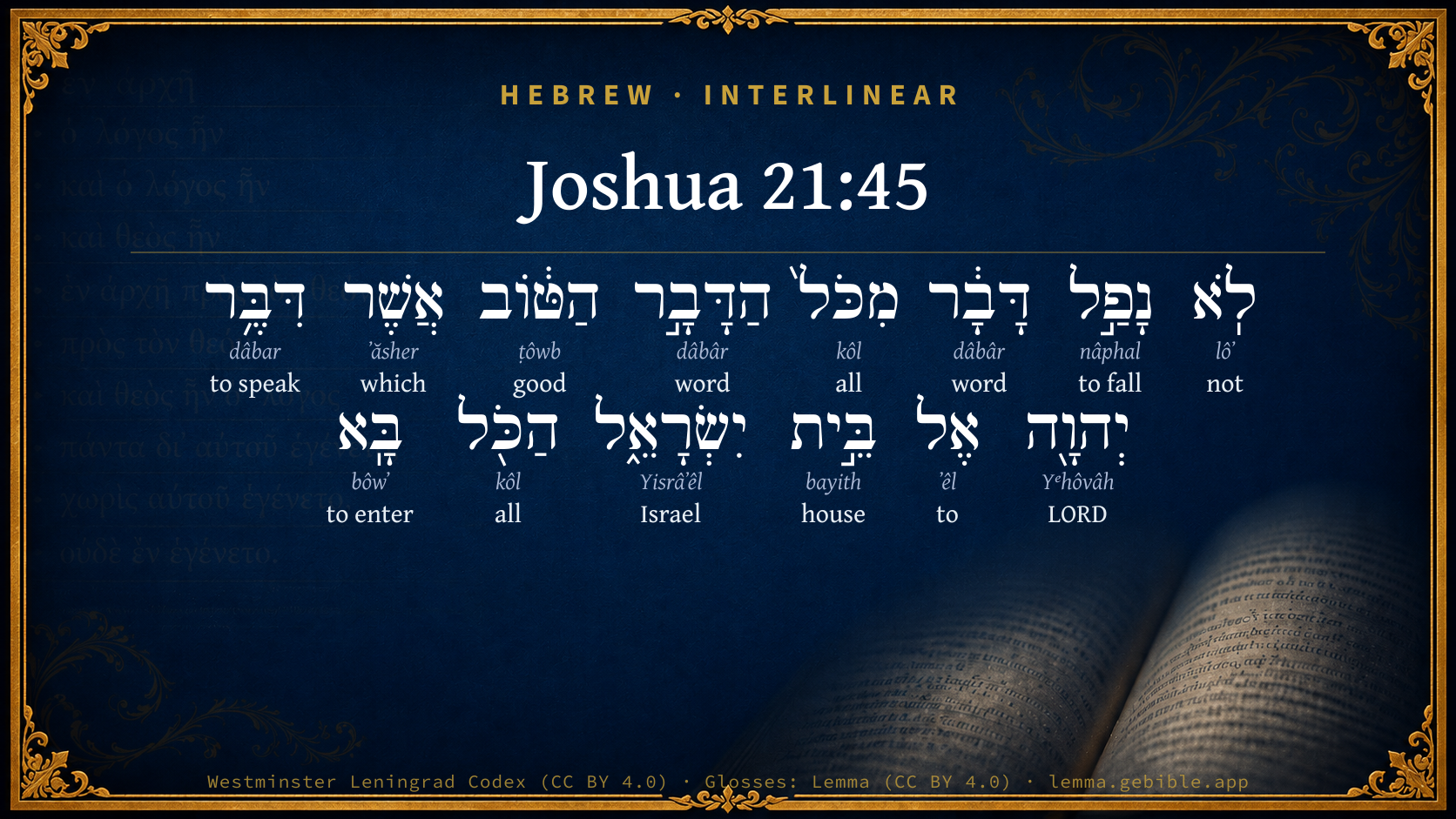
  1. לֹֽא lôʼ H3808 “not” Particle, Negative
  2. דָּבָ֔ר dâbâr H1697 “word” Noun, Common, Masculine, Singular, Absolute
  3. מִכֹּל֙ kôl H3605 “from · all of” Preposition + Noun, Common, Masculine, Singular, Construct
  4. הַדָּבָ֣ר dâbâr H1697 “the · word” Particle, Definite Article + Noun, Common, Masculine, Singular, Absolute
  5. הַטּ֔וֹב ṭôwb H2896 “the · good” Particle, Definite Article + Adjective, Adjective, Masculine, Singular, Absolute
  6. אֲשֶׁר ʼăsher H834 “which” Particle, Relative
  7. דִּבֶּ֥ר dâbar H1696 “to speak” Verb, Piel, Perfect, 3rd Person, Masculine, Singular
  8. יְהוָ֖ה Yᵉhôvâh H3068 “LORD” Noun, Proper
  9. אֶל ʼêl H413 “to” Preposition
  10. בֵּ֣ית bayith H1004 “house of” Noun, Common, Masculine, Singular, Construct
  11. יִשְׂרָאֵ֑ל Yisrâʼêl H3478 “Israel” Noun, Proper
  12. הַכֹּ֖ל kôl H3605 “the · all” Particle, Definite Article + Noun, Common, Masculine, Singular, Absolute
  13. בָּֽא bôwʼ H935 “to enter” Verb, Qal, Perfect, 3rd Person, Masculine, Singular

About this verse

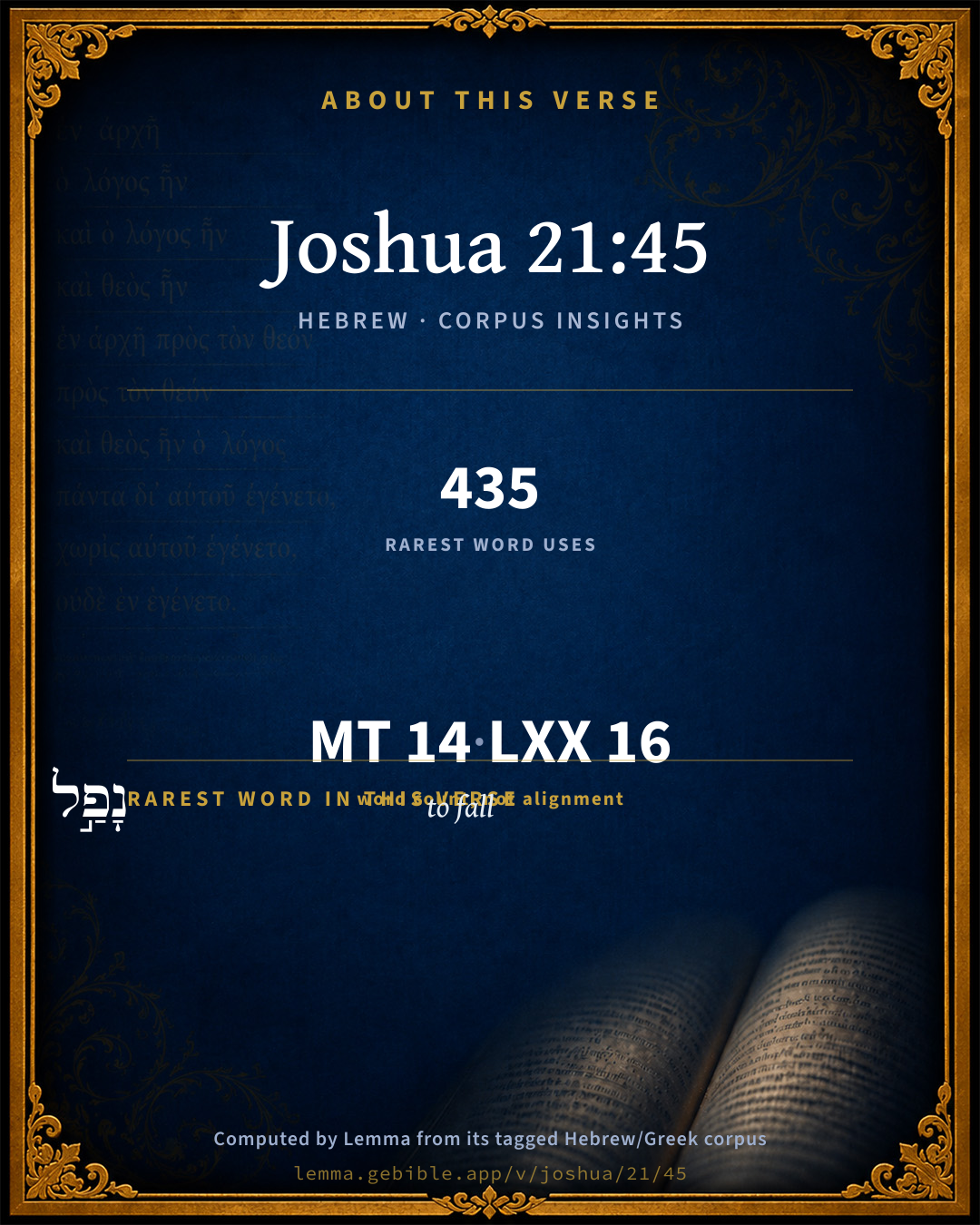
These counts appear in no published source. They are computed here, from the morphology-tagged text and Lemma’s own curated glosses. What Lemma adds →

14
words
12
distinct lemmas
Historical
section

Grammatical profile

  • 3 verbs
  • 7 nouns
  • 1 adjective
  • 1 preposition
  • 2 particles

Verb forms

  • נָפַ֣ל Qal · Perfect
  • דִּבֶּ֥ר Piel · Perfect
  • בָּֽא Qal · Perfect

Repetition

Words recur within this verse — often emphatic in Hebrew:

  • דָּבָ֔ר word H1697 ×2
  • מִכֹּל֙ all H3605 ×2

Hebrew & Septuagint length

In the original languages it is 14 Hebrew tokens and 16 Greek tokens — but the two are counted differently (Hebrew bundles its prefixes and suffixes into one token; the Greek is in lemma form), so that isn’t a like-for-like length.

Cross-references

7

Topical passages linked to Joshua 21:45 in the Treasury of Scripture Knowledge — connected by theme and wording, ordered by reader-vote popularity; previews shown in the World English Bible.

  • 1 Kings 8:56 Blessed be Yahweh, who has given rest to his people Israel, according to all that he promised: there has not failed one word of all his good promise, which he promised by Moses his servant.
  • Joshua 23:14–15 Behold, this day I am going the way of all the earth: and you know in all your hearts and in all your souls, that not one thing has failed of all the good things which Yahweh your God spoke concerning you; all are happen to you, not one thing has failed of it.
  • Numbers 23:19 God is not a man, that he should lie, Neither the son of man, that he should repent: Has he said, and will he not do it? Or has he spoken, and will he not make it good?
  • 1 Thessalonians 5:24 Faithful is he who calls you, who will also do it.
  • 1 Corinthians 1:9 God is faithful, through whom you were called into the fellowship of his Son, Jesus Christ, our Lord.
  • Hebrews 6:18 that by two immutable things, in which it is impossible for God to lie, we may have a strong encouragement, who have fled for refuge to take hold of the hope set before us.
  • Titus 1:2 in hope of eternal life, which God, who can't lie, promised before eternal times;

Cross-references courtesy of OpenBible.info (CC BY 4.0).

Hebrew and Greek witnesses Masoretic Hebrew ↔ Greek Septuagint

The same verse in the two great witnesses to the Old Testament, shown verse-for-verse.

These are two independent witnesses, not word-aligned to each other, and the Septuagint is shown in lemma (dictionary) form.

Hebrew Joshua 21:45 Masoretic · Westminster Leningrad Codex

לֹֽא נָפַ֣ל דָּבָ֔ר מִכֹּל֙ הַדָּבָ֣ר הַטּ֔וֹב אֲשֶׁר דִּבֶּ֥ר יְהוָ֖ה אֶל בֵּ֣ית יִשְׂרָאֵ֑ל הַכֹּ֖ל בָּֽא

There failed not anything of any good thing which Yahweh had spoken to the house of Israel; all came to pass.

World English Bible · Public Domain

Greek LXX Joshua 21:45 Septuagint · lemma form

οὐ διαπίπτω ἀπό πᾶς ὁ ῥῆμα ὁ καλός ὅς λαλέω κύριος ὁ υἱός ἰσραήλ πᾶς παραγίγνομαι

No English rendering of this Greek verse — the small residue in the structurally divergent books.

Hebrew: Westminster Leningrad Codex (CC BY 4.0). Greek: Septuagint (public domain); English from a public-domain English Septuagint. How the Septuagint differs from the Hebrew →

Targum (Aramaic paraphrase)

1

The Targum is the ancient Jewish Aramaic paraphrase of the Hebrew Scriptures — an interpretive translation, not the Hebrew text itself. Onkelos (literal) and Pseudo-Jonathan (expansive) render the Torah, and Jonathan the Prophets. Coverage is partial: where no permissively-licensed English translation exists for a verse, only the Aramaic is shown. This is verse-level text, not a word-by-word alignment to the Hebrew.

  1. Targum Jonathan Prophets (Joshua–Malachi)
    לָא בַטִיל פִּתְגָמָא מִכֹּל פִּתְגָמוֹהִי תַקְנַיָא דִי מַלֵיל יְיָ עַל בֵּית יִשְׂרָאֵל כּוּלְהוֹן אִתְקַיָימוּ:

    (no public-domain English translation for this verse)

    Targum Jonathan — Aramaic: “Mikraot Gedolot” (public domain). English: “Sefaria Community Translation” (CC0 1.0 (public-domain dedication)); “London "Chaldee Paraphrase," 1871” (public domain). Text via Sefaria.

Commentary

Notes on Joshua 21:45 from classic Christian and Jewish commentators (each source and its license shown beneath its notes). The classic Christian expositions comment on the surrounding passage and are grouped to its opening verse, so a note may address several verses; the Jewish commentaries on the Tanakh (Rashi and others) are per-verse, so they appear only where the commentator wrote on this verse.

Lemma curates 59 commentaries, every one of them public domain or Creative Commons licensed, each selected and text-cleaned for this edition rather than reprinted as found. About our sources →

Joseph Benson's Commentary

Jos 21:45. There failed not aught — Which they themselves, as Joshua afterward tells them, (Jos 23:14,) knew very well, and could not but confess. But it must be understood according to the explication given verse

43. For the time of fulfilling some part of the divine promises was not yet come, and the entire completion of what was already begun was partly conditional, and depended on their obedience to God. All came to pass — Such an acknowledgment as this, here subscribed by Joshua, in the name of all Israel, we afterward find made by Solomon; and all Israel did, in effect, say amen to it, 1Ki 8:56. The inviolable truth of God’s promise, and the performance of it to the uttermost, is what all believers in Christ have been always ready to bear their testimony to. And if in any thing it has seemed to come short, they have been as ready to take all the blame to themselves.

Joseph Benson's Commentary on the Old and New Testaments (1811–1818) — public domain. Text from a community e-Sword module.

Tyndale Open Study Notes

Tyndale Open Resources

21:45 God had made Israel many good promises, and not one had failed. He kept his promise to give Israel possession of the land and to save them from their surrounding enemies.

Tyndale Open Study Notes — © Tyndale Open Resources, licensed CC BY-SA 4.0. Text via the HelloAO Bible API.

The Cambridge Bible for Schools and Colleges

gen. ed. J. J. S. Perowne

45. There failed not] Comp. ch. Jos_23:14-15. None of the gracious promises of God to Israel remained unfulfilled.

any good thing] Or, aught of all the good word = the sum of the reiterated assurances which God had made to the nation. Of these the possession of the land of Canaan was regarded as the essence and central point, because this possession was to be for Israel the foundation of all further blessings, the pledge of the continued fulfilment of the rest of the promises of God.—See Keil’s Commentary.

The Cambridge Bible for Schools and Colleges (gen. ed. J. J. S. Perowne; Cambridge University Press, 1878–1918) — public domain. Text from a community e-Sword module.

John Gill's Exposition

There failed not ought of any good thing,.... Not only every good thing in general, but every part and particular of that good thing; that, with all that was included in it, or were appendages to it, or circumstances of it:

which the Lord had spoken to the house of Israel; as of their deliverance out of Egypt, and passage through the Red sea and wilderness, with all conveniences for them therein; so of their passage through Jordan, success of their arms, the conquest of their enemies, possession of their land, a land flowing with milk and honey:

all came to pass; exactly, precisely, and punctually, even everything relative to their temporal and spiritual good: so all that God promises to his spiritual Israel, with respect to their present comfort or everlasting happiness, all is exactly fulfilled, all his promises in Christ are yea and amen.

Next: Joshua Chapter 22

John Gill's Exposition of the Whole Bible (1746–1763) — public domain (CC PDM 1.0). Text via the HelloAO Bible API.

Whedon's Commentary on the Bible

Daniel D. Whedon

45. There failed not aught of any good — So far as Jehovah was concerned, for he had expressly said, “I will not drive them out from before thee in one year, lest the land become desolate, and the beast of the field multiply against thee. By little and little I will drive them out from before thee, until thou be increased, and inherit the land.” Exodus xxiii, 29, 30. Comp. Deu_7:22. Israel’s subsequent failure to possess all the land was, as the history itself shows, largely owing to their cowardice. Tribal jealousies also had much to do with their failure.

Daniel D. Whedon (gen. ed.), Commentary on the Old and New Testaments (1874–1909) — public domain. Text from a community e-Sword module.

The Pulpit Commentary

Ought of any good thing. Literally, a word from all the good word. This Keil regards as the "sum of all the gracious promises that God had made." But he should have added that rbd, beside signifying, as it does, "word," is also the word for "thing" in Hebrew, (see, for instance, Gen_15:1 Gen_20:10) and innumerable other passages, as well as the use of rbd alo for "nothing." The translation "thing" makes the best sense, and is more agreeable to the Hebrew idiom. All came to pass. The Hebrew is singular, the whole came, the word translated "came to pass "in our version being a different one from that usually so translated.

The record of God"s faithfulness.

A beautiful little word, recording a nation"s experience, and one adopted as the correct statement of the experience of multitudes that none can number! Look at it, and observe first

I GOD SPEAKS GOOD THINGS TO THE HOUSE OF ISRAEL. "Good things," i.e. , "of its future: exceeding great and precious promises words on which He causes us to hope." Man lives not in the present only. The past clings to him; the future presses on him. Especially this future near and further! Our bliss comes chiefly from its hopes, our sorrows from its fears. With the present it is easy to deal; its form is fixed, and we can determine at once how to meet it. But the future is filled with "maybes" so indefinite and changeful in their form that we cannot settle how to meet or what to do with them. In the case of Israel, God covered all this darkness with His good words of hope. He would go before them; they should be brought to a land flowing with milk and honey; no enemy should stand before them; vineyards they had not planted, cities they had not built, should be theirs. They should find an earthly dwelling place singularly suited for their habitation: fertile for their sustenance, secure for their safety, central for the diffusion of their truth. So God speaks to all His Israel. To every one some promise is given. Even His prodigal children have some promise to cheer them. His sun of promise rises on the evil and on the good; but on the good it sheds its richest warmth. There are great words given to us. Providential mercies are promised; support of the Spirit of all grace is assured us: the Voice behind saying, "This is the way, walk ye in it:" and that temptation s shall not overpower, nor inward weakness destroy us; that we shall be more than conquerors through Him that loved us; that death itself shall be a ministering angel, wrestling with us, but blessing us at "break of day;" that there will be an abundant entrance into the everlasting kingdom, a perfected likeness to our Lord, an occupation before the throne, in which all our power will find delight and all our capacities be filled with satisfaction. These are the pledges given us. It is well to realise how vast they are, how worthy of the generosity of the infinite God. Be not dismayed, there is no sorrow whose consolation is not pledged in some word of promise, and no perplexity the solution of which is not tendered in some other. Marvel not that the words seem too vast to belong to us. The dimensions of mercy are Divine. Put against every thought of fear these words of comfort and of hope. We are sad and fearful chiefly because we forget them. God speaks good things unto Israel. Observe secondly

II IT SEEMED IMPOSSIBLE THAT THESE WORDS SHOULD NOT FAIL. When Moses brought them, the people "believed not for anguish of splint and cruel bondage." How could such promises be redeemed? They, a nation of slaves, whose spirit was ground out of them; their oppressor having a standing army, strong in cavalry? Impossibilities multiplied as they advanced. By the route they took they found themselves hemmed in by ranges of hills on either hand, sea in front, foe behind them. How could they reach the other side? There were desert difficulties, or rather impossibilities, as to water and food. How could they possibly dispossess the Canaanitish nations, all of them stronger than themselves these peoples of Gilead in their fortresses, impregnable by nature, and rendered still more so by consummate art and by the marvellous vigour of the inhabitants? Without artillery of any kind, how could it be deemed a possibility to reduce the fenced cities of the Canaanites? How was Jordan to be crossed, with its deep ravine and swift stream that made it one of the strongest lines of defence that any nation ever had? Ten out of the twelve spies all of them of course chosen for their courage declared the task an utter impossibility. And it is worth our while to mark this, for there is a sort of family likeness running through all God"s promises; and almost all have this look of impossibility about them. I suppose all spies are apt to feel that the promises God has made to us cannot possibly be fulfilled. One battling with doubts deems continuance in saintly living impossible, though God promises grace sufficient. One battling with strong proneness to sin feels it impossible that a feeble seed of grace should survive and conquer forces so much stronger than itself. The promise of usefulness resulting from our labour seems impossible of fulfilment, so does the promise of answers to our prayers. The promise of some survival of death and of our fragile spirit weathering all storms, and reaching a perfect home, seems impossible to be fulfilled. It is well to mark exactly the force of the favourite promises. They are not poor probabilities. They are the grand impossibilities of life. The supernatural enters into all our hopes. They cannot be realised unless God troubles Himself about them. We must not try and eke out faith with the consideration of natural probabilities. The natural probabilities are all against any one of the grander promises being fulfilled. But thirdly observe

III ALL THE PROMISES WERE FULFILLED. "All came to pass." There failed not ought of any good thing the Lord had spoken. The sea was crossed; the desert had its food and water; Bashan was subdued; Jordan crossed; the whole land possessed. And all this took place easily, without any hitch whatever, so long as Israel was willing simply to go on. And from then till now the experience of the Church of Christ has, on a large scale and with invariable uniformity, been, that however impossible the fulfilment of God"s promises might seem, they have all been realised exceeding abundantly above all asked or thought. God is the same today as yesterday: not further from us in heart, not feebler in powers. His anointing is not exhausted; He is still fresh to do what He has promised. And if we faithfully follow on in the way in which He leads us, there will not fail ought of the good that God hath spoken to us. G.

HOMILIES BY J. WAITE Ver. 45. God"s faithfulness.

This cannot mean that the Divine plan in reference to Israel"s possession of the land was now in all respects completely fulfilled. The Canaanite still dwelt in certain parts of it, and was never really cast out. But in the main the work was done. The country, as a whole, was subdued, and the invaders no longer had any formidable opposition to contend with. Moreover, God"s part in the work was fully accomplished. Whatever partial failure there may have been was due to Israel"s faithlesssness and weakness. There was no failure in God. He had been inflexibly true to His purpose. His word had not been broken. "There failed not ought," etc. The absolute fidelity of God to His purposes and promises is our theme. Let us take a broad view of it.

I THE GENERAL CONSTITUTION AND ORDER OF THE UNIVERSE ILLUSTRATES THE DIVINE FAITHFULNESS. The universe of being is but an embodiment of the thought of God. A Divine purpose governs every part of it. His laws are not only expressions of His will, but are of the nature of pledges and promises, and no law is ever frustrated, no promise ever broken. They partake of the eternal steadfastness of His essential Being. "They stand fast for ever and ever, and are done in truth and uprightness.

(1) It is so in the material realm. Physical laws are simply the impress of the eternal mind on matter and the method by which that Mind sees fit to mould and govern it. The "course of nature" is but a continual unfolding of the steadfast thought and purpose of God. The world passed through many structural changes before it was trodden by the foot of man, and has passed through many since, but the laws that govern it have been the same from the beginning. Ages pass before those laws are discovered, but they existed of old. Great liberty of action is given to man within the natural order, but he cannot change it in one iota. It is a rock against which the waves of his self will and vain ambition only dash themselves in pieces so beneficent and yet so terrible in its inflexibility; rewarding his trust, yet rebuking his presumption; inflicting on his ignorance and feebleness so severe a penalty, and yet guarding and befriending it. Our place in this great system of things is that of learners. Our highest science and skill are but a feeble answer to its truth and certainty. Life proceeds on the principle of trust in the constancy of nature, which is but another name for the faithfulness of God.

(2) It is so in the moral sphere. The material order is but the shadow and reflection of the moral. Moral laws belong to a world not of shadows and appearances, but of substantial and enduring reality. "The things that are seen are temporal," etc. If there is fixity in the principles that govern the outer, how much more in those that govern the inner, life of man. Our earthly existence is a restless ebb and flow of circumstance and feeling. No two human histories, no two social situations, events, experiences, are alike. And yet there is "nothing new under the sun." "That which hath been is now" etc. (Ecc_3:15) As the kaleidoscope, out of a few simple shapes and colours, presents ever-changing forms of beauty to the eye, so does the revolution of our days and years embody in an endless variety of forms the primary principles and laws that govern our moral life. Those laws partake of the nature of the Lawgiver. They change not, "raft not," because He is "without variableness," etc. Whether as regards the threatening of evil or the promise of good, all infallibly "come to pass." Conceive it in a single case to be otherwise, and the whole moral system of things is involved in utter confusion and hopeless ruin.

II THE SPHERE OF FULFILLED PROPHECY ILLUSTRATES IT. Prophecy, as at once an inspiration and a revelation, is essentially supernatural, Divine. As regards its predictive element, it is as a passing gleam of light from the Infinite Intelligence, to which all things, past, present, and future, are alike "naked and opened." The prophet, as a seer, is one for whom God"s own hand has for a moment lifted the veil of the future. Every really prophetic word is thus a Divine pledge, and its fulfilment is the redemption of that pledge. Biblical revelations from the beginning breathe the spirit of prophecy, and biblical history is rich in the verification of it. What is the whole career of Israel its national existence, its captivities and deliverances, the advent of Messiah and His glorious kingdom, the after destiny of the Hebrew people but the translation of prophecy into history? Thus does age after age present some new testimony to the truth and faithfulness of God. Dispensations change, the generations come and go, but His purposes move on steadily to their accomplishment. "Not one faileth." Heaven and earth may pass away, but His word shall not pass away.

III THE COVENANT OF GRACE ILLUSTRATES IT. In this the covenant made with Abraham found its consummation. (Gen_22:18)

David died in the calm, glad faith of it. "Yet hath He made with me an everlasting covenant, ordered in all things and sure etc. (2Sa_23:5) Having its birth in the depths of a past eternity, being no mere after thought, it was manifested "in the fulness of time" in Him "in whom all the promises of God are yea and amen." His blood is the seal of the everlasting covenant. In Him God "performed the mercy promised to the fathers," and "the word that He spake by the mouth of His holy prophets since the world began." And as all foregoing ages foreshadowed it, so do the after ages give ever accumulating witness to its truth and certainty. Every earnest Christian life every reward of obedient faith, every answered prayer, every new victory over death confirms it. Our fathers trusted in it and were not put to shame. They passed peacefully away with its language on their lips, and the hope of immortality it enkindled in their hearts. We ourselves are learning more and more daily how worthy it is of our trust. And we know that when the tale of our changeful life is told, and we also shall have passed away, our children will enter into the inheritance of blessing with the "long interest" of added years: "heirs together with us of the grace" it reveals. "The words of God"s extensive love From age to age endure; The angel of the covenant proves And seals the blessing sure.

"All flesh is grass, and all the glory of man as the flower of grass. The grass withereth, and the flower thereof falleth away; but the word of the Lord endureth for ever. And this is the word which by the gospel is preached unto you". W. (1Pe_1:24, 1Pe_1:25)

The Pulpit Commentary (1880–1919), ed. H.D.M. Spence-Jones & Joseph S. Exell — public domain. Text from a community e-Sword module.

John Wesley's Explanatory Notes

All came to pass - Such an acknowledgment as this, here subscribed by Joshua, in the name of all Israel, we afterward find made by Solomon; and all Israel did in effect say amen to it, 1 Kings viii, 56. The inviolable truth of God's promise, and the performance of it to the uttermost, is what all believers in Christ have been always ready to bear their testimony to. And if in any thing it has seemed to come short, they have been as ready to take all the blame to themselves.

John Wesley, Explanatory Notes Upon the Whole Bible (1754–1765) — public domain. Text via the GEBible commentary corpus.

Lesson kit

Teaching starters — assembled from the data on this page, not authored interpretation. Every prompt links to the verse data it draws on. Edit before teaching.

Joshua, in the Historical, opens this verse with 14 words (12 distinct Hebrew lemmas). Its most distinctive word is nâphal (“to fall”). A historical commentator’s framing appears above. Read the whole chapter for the surrounding context.

Discussion questions

  1. How does “to fall” (nâphal) shape what this verse is saying?
  2. 1 Kings 8:56 shares this passage’s theme. How do the two illuminate each other?
  3. “word” occurs 2× in this one verse. What is the effect of the repetition?
  4. These translations render this verse differently. What is at stake in choosing one wording over another?
  5. The verb «נָפַ֣ל» is Qal Perfect. How does its form color the action?
  6. Reading how Joseph Benson's Commentary and Tyndale Open Study Notes read this verse, where do the two commentators agree and where do they part?

Things to notice

Reading settings

Reading text

Shown beneath each verse's original-language words.

Old Testament
Old Testament edition

Read the OT as the Masoretic Hebrew (MT) or the Greek Septuagint (LXX).

English shown for the Greek Septuagint (in the Hebrew ↔ Greek comparison).

Comparing translations? Open the Compare panel on any verse page to stack up to four side by side.