
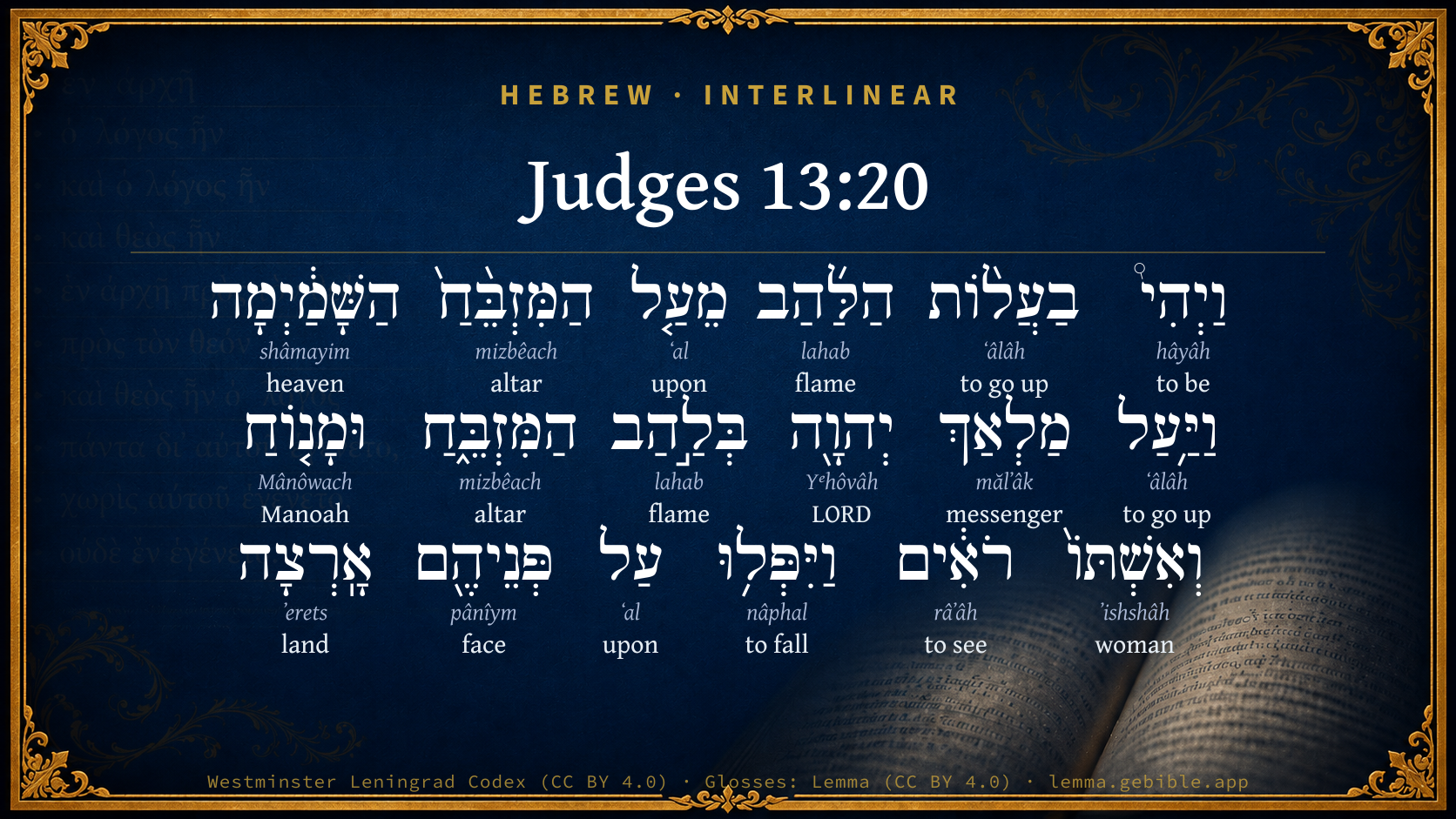
Judges 13:20

Hebrew (Westminster Leningrad Codex) Judges 13:20 appears in the Hebrew Old Testament. The text above is from the Westminster Leningrad Codex. Each word links to its Strong’s number, a concise gloss, and parsing drawn from the Open Scriptures Hebrew Bible morphology. Click any word for its full Brown-Driver-Briggs (BDB) entry.
Download image
Cite this verse

Judges 13:20 (World English Bible). Public Domain. Lemma interlinear Bible study tool, https://lemma.gebible.app/v/judges/13/20.

Show BibTeX & RIS
BibTeX
RIS
English Translation
For it happened, when the flame went up toward the sky from off the altar, that the angel of Yahweh ascended in the flame of the altar: and Manoah and his wife looked on; and they fell on their faces to the ground.
World English Bible · Public Domain
Download a study sheet

One document with this verse’s original text, its word-by-word gloss line, the meaning frame, cross-references with their text, attributed commentary, and full source and license credits — printable, and it pastes into notes with its structure intact.

This verse Autodidact and up

Study sheet (.html) Plain text (.txt)

A passage Seminary Student

Up to 50 verses in one chapter. A passage sheet keeps up to 6 commentary sources and 12 cross-references per verse, in the order this page ranks them, and says so on the sheet whenever that leaves anything out. Ask for a single verse and you get the Autodidact verse sheet above.

Everything on this page stays free to read, with no account — the sheet is a download of what is already on screen, not access to it.

Want to remove ads? Support Godless Engineer
Compare translations 3

The same verse in 3 English versions, stacked beneath the original-language interlinear above. Click any original word for its lexicon entry.

Each is an independent rendering of the whole verse — the interlinear is not word-aligned to these translations.

Highlighted words mark where these versions differ — a whole-verse word diff, not a word-by-word alignment.

  • World English Bible Public Domain
    For it happened, when the flame went up toward the sky from off the altar, that the angel of Yahweh ascended in the flame of the altar: and Manoah and his wife looked on; and they fell on their faces to the ground.
  • King James Version Public Domain
    For it came to pass, when the flame went up toward heaven from off the altar, that the angel of the LORD ascended in the flame of the altar. And Manoah and his wife looked on it, and fell on their faces to the ground.
  • unfoldingWord Literal Text CC BY-SA 4.0
    For it happened, in the going up of the flame from the altar toward the heavens, that the angel of Yahweh went up in the flame of the altar. And Manoah and his wife watching, and they fell on their faces to the ground.

unfoldingWord Literal Text — © unfoldingWord, licensed CC BY-SA 4.0. Word-aligned USFM3 via Door43 (git.door43.org/unfoldingWord/en_ult).

Versions to compare (up to 4)

3 of 4 selected

Show all 18 translations

Every available English version of this verse, each an independent rendering of the whole verse.

  • World English Bible Public Domain
    For it happened, when the flame went up toward the sky from off the altar, that the angel of Yahweh ascended in the flame of the altar: and Manoah and his wife looked on; and they fell on their faces to the ground.
  • Berean Standard Bible Public Domain
    When the flame went up from the altar to the sky, the angel of the LORD ascended in the flame. When Manoah and his wife saw this, they fell facedown to the ground.
  • Majority Standard Bible Public Domain
    When the flame went up from the altar to the sky, the angel of the LORD ascended in the flame. When Manoah and his wife saw this, they fell facedown to the ground.
  • King James Version Public Domain
    For it came to pass, when the flame went up toward heaven from off the altar, that the angel of the LORD ascended in the flame of the altar. And Manoah and his wife looked on it, and fell on their faces to the ground.
  • American Standard Version (1901) Public Domain
    For it came to pass, when the flame went up toward heaven from off the altar, that the angel of Jehovah ascended in the flame of the altar: and Manoah and his wife looked on; and they fell on their faces to the ground.
  • Revised Version (1885) Public Domain
    For it came to pass, when the flame went up toward heaven from off the altar, that the angel of the LORD ascended in the flame of the altar: and Manoah and his wife looked on; and they fell on their faces to the ground.
  • Geneva Bible (1599) Public Domain
    For when the flame came vp toward heauen from the altar, the Angel of the Lord ascended vp in the flame of the altar, and Manoah and his wife behelde it, and fell on their faces vnto the grounde.
  • Douay-Rheims (1899) Public Domain
    And when the flame from the altar went up towards heaven, the angel of the lord ascended also in the flame. And when Manue and his wife saw this, they fell flat on the ground.
  • Young's Literal Translation Public Domain
    and it cometh to pass, in the going up of the flame from off the altar toward the heavens, that the messenger of Jehovah goeth up in the flame of the altar, and Manoah and his wife are looking on, and they fall on their faces to the earth,
  • Literal Standard Version CC BY-SA 4.0
    and it comes to pass, in the going up of the flame from off the altar toward the heavens, that the Messenger of YHWH goes up in the flame of the altar, and Manoah and his wife are looking on, and they fall on their faces to the earth,
  • Unlocked Literal Bible CC BY-SA 4.0
    When the flame went up from the altar toward the sky, the angel of Yahweh went up in the flame of the altar. Manoah and his wife saw this and lay facedown on the ground.
  • unfoldingWord Literal Text CC BY-SA 4.0
    For it happened, in the going up of the flame from the altar toward the heavens, that the angel of Yahweh went up in the flame of the altar. And Manoah and his wife watching, and they fell on their faces to the ground.
  • Darby Bible Public Domain
    And when the flame went up toward heaven from the altar, the angel of the LORD ascended in the flame of the altar while Mano'ah and his wife looked on; and they fell on their faces to the ground.
  • World Messianic Bible Public Domain
    For when the flame went up toward the sky from off the altar, the LORD’s angel ascended in the flame of the altar. Manoah and his wife watched; and they fell on their faces to the ground.
  • Webster's Bible Public Domain
    For it came to pass, when the flame ascended towards heaven from off the altar, that the angel of the LORD ascended in the flame of the altar. And Manoah and his wife looked on it, and fell on their faces to the ground.
  • Free Bible Version CC BY-SA 4.0
    As the flame from the altar blazed up into the sky, the angel of the Lord ascended in the flame. Manoah and his wife saw what happened and fell with their faces to the ground.
  • Bible in Basic English Public Domain
    And when the flame went up to heaven from the altar, the angel of the Lord went up in the flame of the altar, while Manoah and his wife were looking on; and they went down on their faces to the earth.
  • JPS Tanakh (1917) Public Domain
    For it came to pass, when the flame went up toward heaven from off the altar, that the angel of the LORD ascended in the flame of the altar; and Manoah and his wife looked on; and they fell on their faces to the ground.

Literal Standard Version (2020), Covenant Press — licensed CC BY-SA 4.0. Text via the HelloAO Bible API (eBible.org). Unlocked Literal Bible (unfoldingWord) — licensed CC BY-SA 4.0. Text via the HelloAO Bible API (eBible.org). unfoldingWord Literal Text — © unfoldingWord, licensed CC BY-SA 4.0. Word-aligned USFM3 via Door43 (git.door43.org/unfoldingWord/en_ult). Free Bible Version, Dr. Jonathan Gallagher — licensed CC BY-SA 4.0. Text via the HelloAO Bible API (eBible.org).

Word by word

More ways to search: Search by grammar → Find every occurrence → Compare this word →

Practice this passage: Drill this verse → Learn its vocabulary →

הַלַּ֜הַב
lahab
H3851
“the · flame”
Particle, Definite Article + Noun, Common, Masculine, Singular, Absolute
Part of Speech
Particle + Noun
Type
Common
Gender
Masculine
Number
Singular
State
Absolute
Full BDB Definition

Origin: from an unused root meaning to gleam

TWOT: 1077 , 1077a

flame, blade - flame - of flashing point of spear or blade of sword
  1. וַיְהִי֩ hâyâh H1961 “and · to be” Conjunction + Verb, Qal, Sequential Imperfect, 3rd Person, Masculine, Singular
  2. בַעֲל֨וֹת ʻâlâh H5927 “in/at · to go up” Preposition + Verb, Qal, Infinitive Construct
  3. מֵעַ֤ל ʻal H5921 “from · upon” Preposition + Preposition
  4. הַמִּזְבֵּ֨חַ֙ mizbêach H4196 “the · altar” Particle, Definite Article + Noun, Common, Masculine, Singular, Absolute
  5. הַשָּׁמַ֔יְמָה shâmayim H8064 “the · heaven(s) · toward” Particle, Definite Article + Noun, Common, Masculine, Plural, Absolute + Suffix, Demonstrative
  6. וַיַּ֥עַל ʻâlâh H5927 “and · to go up” Conjunction + Verb, Qal, Sequential Imperfect, 3rd Person, Masculine, Singular
  7. מַלְאַךְ mălʼâk H4397 “messenger of” Noun, Common, Masculine, Singular, Construct
  8. יְהוָ֖ה Yᵉhôvâh H3068 “LORD” Noun, Proper
  9. בְּלַ֣הַב lahab H3851 “in/at · flame of” Preposition + Noun, Common, Masculine, Singular, Construct
  10. הַמִּזְבֵּ֑חַ mizbêach H4196 “the · altar” Particle, Definite Article + Noun, Common, Masculine, Singular, Absolute
  11. וּמָנ֤וֹחַ Mânôwach H4495 “and · Manoah” Conjunction + Noun, Proper
  12. וְאִשְׁתּוֹ֙ ʼishshâh H802 “and · woman · his” Conjunction + Noun, Common, Feminine, Singular, Construct + Suffix, Personal, 3rd Person, Masculine, Singular
  13. רֹאִ֔ים râʼâh H7200 “seeing” Verb, Qal, Participle Active, Masculine, Plural, Absolute
  14. וַיִּפְּל֥וּ nâphal H5307 “and · to fall” Conjunction + Verb, Qal, Sequential Imperfect, 3rd Person, Masculine, Plural
  15. עַל ʻal H5921 “upon” Preposition
  16. פְּנֵיהֶ֖ם pânîym H6440 “face(s) · their” Noun, Common, Both, Plural, Construct + Suffix, Personal, 3rd Person, Masculine, Plural
  17. אָֽרְצָה ʼerets H776 “land · toward” Noun, Common, Both, Singular, Absolute + Suffix, Demonstrative

About this verse

These counts appear in no published source. They are computed here, from the morphology-tagged text and Lemma’s own curated glosses. What Lemma adds →

18
words
14
distinct lemmas
Historical
section

Notable vocabulary

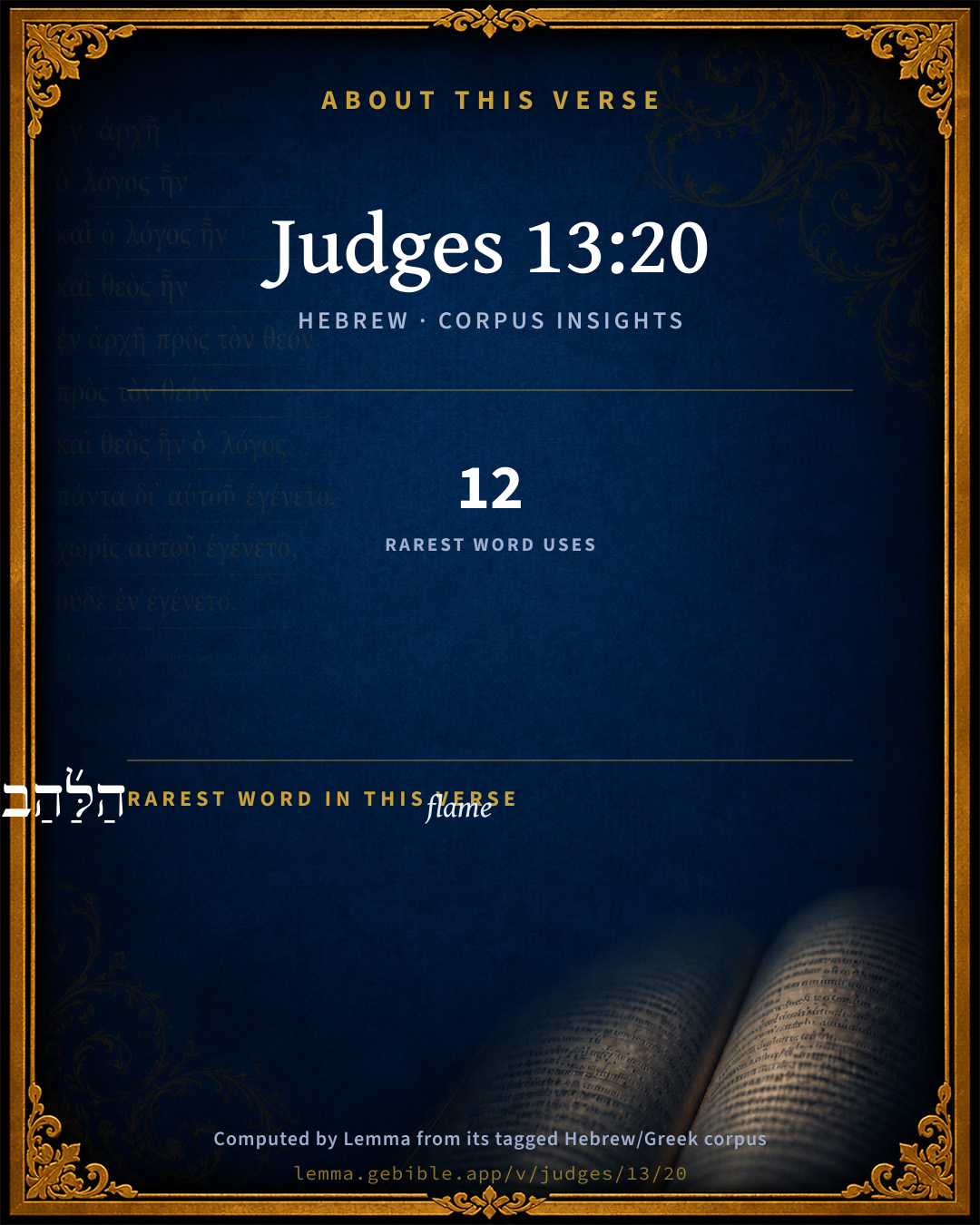
The rarest word here is הַלַּ֜הַב flame H3851 — appearing just 12 times in the whole Hebrew Bible.

Shared distinctive vocabulary

הַלַּ֜הַב flame H3851 occurs in 10 verses of the Hebrew Bible. Also found in:

Grammatical profile

  • 5 verbs
  • 11 nouns
  • 2 prepositions

Verb forms

  • וַיְהִי֩ Qal · Sequential Imperfect
  • בַעֲל֨וֹת Qal · Infinitive Construct
  • וַיַּ֥עַל Qal · Sequential Imperfect
  • רֹאִ֔ים Qal · Participle Active
  • וַיִּפְּל֥וּ Qal · Sequential Imperfect

Repetition

Words recur within this verse — often emphatic in Hebrew:

  • בַעֲל֨וֹת to go up H5927 ×2
  • הַלַּ֜הַב flame H3851 ×2
  • מֵעַ֤ל upon H5921 ×2
  • הַמִּזְבֵּ֨חַ֙ altar H4196 ×2

Hebrew & Septuagint length

In English translation the verse runs 43 words from the Hebrew and 42 from the Septuagint (LXX English) — closely comparable.

A rough comparison of the two English renderings, which tokenize alike — not a word-level alignment.

Word counts can differ between the Hebrew and the Greek without any difference in meaning — e.g. the Hebrew direct-object marker אֵת has no separate Greek word, and Greek often adds the article ὁ.

Cross-references

8

Topical passages linked to Judges 13:20 in the Treasury of Scripture Knowledge — connected by theme and wording, ordered by reader-vote popularity; previews shown in the World English Bible.

  • Leviticus 9:24 There came forth fire from before Yahweh, and consumed the burnt offering and the fat upon the altar: and when all the people saw it, they shouted, and fell on their faces.
  • 2 Kings 2:11 It happened, as they still went on, and talked, that behold, [there appeared] a chariot of fire, and horses of fire, which parted them both apart; and Elijah went up by a whirlwind into heaven.
  • 1 Chronicles 21:16 David lifted up his eyes, and saw the angel of Yahweh standing between earth and the sky, having a drawn sword in his hand stretched out over Jerusalem. Then David and the elders, clothed in sackcloth, fell on their faces.
  • Ezekiel 1:28 As the appearance of the bow that is in the cloud in the day of rain, so was the appearance of the brightness round about. This was the appearance of the likeness of the glory of Yahweh. When I saw it, I fell on my face, and I heard a voice of one that spoke.
  • Matthew 17:6 When the disciples heard it, they fell on their faces, and were very afraid.
  • Genesis 17:3 Abram fell on his face. God talked with him, saying,
  • 1 Chronicles 21:26 David built there an altar to Yahweh, and offered burnt offerings and peace-offerings, and called on Yahweh; and he answered him from the sky by fire on the altar of burnt offering.
  • Hebrews 1:3 His Son is the radiance of his glory, the very image of his substance, and upholding all things by the word of his power, when he had by himself made purification for our sins, sat down on the right hand of the Majesty on high;

Cross-references courtesy of OpenBible.info (CC BY 4.0).

Hebrew and Greek witnesses Masoretic Hebrew ↔ Greek Septuagint

The same verse in the two great witnesses to the Old Testament, shown verse-for-verse.

These are two independent witnesses, not word-aligned to each other, and the Septuagint is shown in lemma (dictionary) form.

Hebrew Judges 13:20 Masoretic · Westminster Leningrad Codex

וַיְהִי֩ בַעֲל֨וֹת הַלַּ֜הַב מֵעַ֤ל הַמִּזְבֵּ֨חַ֙ הַשָּׁמַ֔יְמָה וַיַּ֥עַל מַלְאַךְ יְהוָ֖ה בְּלַ֣הַב הַמִּזְבֵּ֑חַ וּמָנ֤וֹחַ וְאִשְׁתּוֹ֙ רֹאִ֔ים וַיִּפְּל֥וּ עַל פְּנֵיהֶ֖ם אָֽרְצָה

For it happened, when the flame went up toward the sky from off the altar, that the angel of Yahweh ascended in the flame of the altar: and Manoah and his wife looked on; and they fell on their faces to the ground.

World English Bible · Public Domain

Greek LXX Judges 13:20 Septuagint · lemma form

καί γίγνομαι ἐν ὁ ἀναβαίνω ὁ φλόξ ἐπάνω ὁ θυσιαστήριον ἕως ὁ οὐρανός καί ἀναβαίνω ὁ ἄγγελος κύριος ἐν ὁ φλόξ ὁ θυσιαστήριον καί μανωε καί ὁ γυνή αὐτός βλέπω καί πίπτω ἐπί πρόσωπον αὐτός ἐπί ὁ γῆ

And it came to pass when the flame went up above the altar toward heaven, that the angel of the Lord went up in the flame; and Manoe and his wife were looking, and they fell upon their face to the earth.

LXX2012 (modern English Septuagint) · Public Domain

Hebrew: Westminster Leningrad Codex (CC BY 4.0). Greek: Septuagint (public domain); English from LXX2012 (modern English Septuagint) (Public Domain). How the Septuagint differs from the Hebrew →

Targum (Aramaic paraphrase)

1

The Targum is the ancient Jewish Aramaic paraphrase of the Hebrew Scriptures — an interpretive translation, not the Hebrew text itself. Onkelos (literal) and Pseudo-Jonathan (expansive) render the Torah, and Jonathan the Prophets. Coverage is partial: where no permissively-licensed English translation exists for a verse, only the Aramaic is shown. This is verse-level text, not a word-by-word alignment to the Hebrew.

  1. Targum Jonathan Prophets (Joshua–Malachi)
    וַהֲוָה בְּמֵיסַק שַׁלְהוֹבִיתָא מֵעִלַוֵי מַדְבְּחָא לְצֵית שְׁמַיָא וּסְלֵיק מַלְאָכָא דַייָ בְּשַׁלְהוֹבִית מַדְבְּחָא וּמָנוֹחַ וְאִתְּתֵיהּ חָזָן וּנְפַלוּ עַל אַפֵּיהוֹן עַל אַרְעָא:

    (no public-domain English translation for this verse)

    Targum Jonathan — Aramaic: “Mikraot Gedolot” (public domain). English: “Sefaria Community Translation” (CC0 1.0 (public-domain dedication)); “London "Chaldee Paraphrase," 1871” (public domain). Text via Sefaria.

Commentary

Notes on Judges 13:20 from classic Christian and Jewish commentators (each source and its license shown beneath its notes). The classic Christian expositions comment on the surrounding passage and are grouped to its opening verse, so a note may address several verses; the Jewish commentaries on the Tanakh (Rashi and others) are per-verse, so they appear only where the commentator wrote on this verse.

Lemma curates 59 commentaries, every one of them public domain or Creative Commons licensed, each selected and text-cleaned for this edition rather than reprinted as found. About our sources →

Trapp's Complete Commentary

John Trapp

Jdg 13:20 For it came to pass, when the flame went up toward heaven from off the altar, that the angel of the LORD ascended in the flame of the altar. And Manoah and his wife looked on [it], and fell on their faces to the ground.

Ver. 20. When the flame went up toward heaven.] As it doth naturally. God can draw up our spirits as a heave offering. {Exo 29:27} As we see the flame ascend, we are to think of it as of a sheet let down by God from heaven, to take up our love and affections in, like the flame of this sacrifice wherein the angel ascended.

That the angel of the Lord ascended in the flame of the altar.] This did most sweetly represent and shadow forth, saith a grave interpreter, the office of Christ, whose work it is to present all our services before God, and to procure them to be graciously accepted of him.

And fell on their faces to the ground.] Partly through fear, and partly in way of thankfulness to God.

John Trapp, A Commentary or Exposition upon All the Books of the Old and New Testament (1647–1656) — public domain. Text from a community e-Sword module.

Ellicott's Commentary for English Readers

(20) From off the altar.—The rock (tsor) of Jdg_13:19 is now hallowed into an altar (mizbeach).

Fell on their faces.—Comp. Lev_9:24; Num_14:5; Eze_1:28.

A Bible Commentary for English Readers, edited by Charles John Ellicott (1878–1897) — public domain. Text from a community e-Sword module.

The Cambridge Bible for Schools and Colleges

gen. ed. J. J. S. Perowne

20. in the Flame of the altar] as though it were His native element, Exo_3:2. The sign may well have suggested a more spiritual view of Jehovah’s nature (Kittel l.c.). The flame is that kindled by Manoah; contrast Jdg_6:21.

The Cambridge Bible for Schools and Colleges (gen. ed. J. J. S. Perowne; Cambridge University Press, 1878–1918) — public domain. Text from a community e-Sword module.

John Gill's Exposition

For it came to pass, when the flame went up towards heaven from off the altar,.... That is, from the rock, which served instead of an altar, and from whence perhaps the fire sprung which consumed both the burnt offering and the meat offering, the flame of which went up to heaven; this rock or altar having no covering, but was "sub dio", open to the heavens:

that the angel of the Lord ascended in the flame of the altar; making use of the smoke, as Josephus (r) says, as a vehicle in which he openly went up to heaven:

and Manoah and his wife looked on it; on the flame and smoke, and the angel in it as he ascended; just as the disciples of Christ looked steadfastly on him as he went up to heaven, when a cloud received him out of their sight, Act 1:9.

and fell on their faces to the ground; with astonishment and surprise at what they saw, through fear and reverence of the divine Being, of whose presence they were now sensible, and as worshipping of him, and praying to him.

(r) Ibid. (Antiqu. l. 5. c. 8. sect. 3.)

John Gill's Exposition of the Whole Bible (1746–1763) — public domain (CC PDM 1.0). Text via the HelloAO Bible API.

Matthew Poole's English Annotations

The flame; either arising from the fire which Manoah brought for the offering, or produced by the angel out of the rock in a miraculous manner.

From off the altar, i.e. from that part of the rock which served instead of an altar, upon which the sacrifice was laid.

The angel ascended in the flame, to manifest his nature and essence to be spiritual, because not capable of hurt by the fire; and celestial.

Fell on their faces; partly in reverence to that glorious presence manifested in so wonderful a manner; and partly out of a religions horror and fear of death upon this occasion, as is expressed Jdg 13:22, for the prevention whereof they fell down in way of supplication to God.

Matthew Poole's English Annotations on the Holy Bible (1683–1685) — public domain. Text from a community e-Sword/MySword module.

The Pulpit Commentary

Looked on it. There is no occasion for the italic it, the phrase is identical with that at the close of ver. 19; but the rendering would be better, And when Manoah and his wife saw it, they fell, etc.

The Pulpit Commentary (1880–1919), ed. H.D.M. Spence-Jones & Joseph S. Exell — public domain. Text from a community e-Sword module.

John Wesley's Explanatory Notes

The altar - That is, from that part of the rock which served instead of an altar, upon which the sacrifice was laid. Ascended - To manifest his nature and essence to be spiritual. Fell - Partly in reverence to that glorious presence manifested in so wonderful a manner: and partly, out of a religious horror and fear of death; for the prevention thereof they fell down in way of supplication to God.

John Wesley, Explanatory Notes Upon the Whole Bible (1754–1765) — public domain. Text via the GEBible commentary corpus.

Lesson kit

Teaching starters — assembled from the data on this page, not authored interpretation. Every prompt links to the verse data it draws on. Edit before teaching.

Judges, in the Historical, opens this verse with 18 words (14 distinct Hebrew lemmas). Its most distinctive word is lahab (“flame”). A historical commentator’s framing appears above. Read the whole chapter for the surrounding context.

Discussion questions

  1. The word lahab carries the sense “flame.” How does it shape the verse?
  2. Judges 3:22 shares the word «flame» with this verse. How do the two illuminate each other?
  3. “to go up” occurs 2× in this one verse. What is the effect of the repetition?
  4. The translations on this page render this verse differently — a whole-verse word diff, not a word-by-word alignment. What might account for the different wordings?
  5. The verb «וַיְהִי֩» is Qal Sequential Imperfect. How does its form color the action?
  6. Reading how Trapp's Complete Commentary and Ellicott's Commentary for English Readers read this verse, where do the two commentators agree and where do they part?

Things to notice

Reading settings

Reading text

Shown beneath each verse's original-language words.

Old Testament
Old Testament edition

Read the OT as the Masoretic Hebrew (MT) or the Greek Septuagint (LXX).

English shown for the Greek Septuagint (in the Hebrew ↔ Greek comparison).

Comparing translations? Open the Compare panel on any verse page to stack up to four side by side.