
Ezekiel 30:22

Hebrew (Westminster Leningrad Codex) Ezekiel 30:22 appears in the Hebrew Old Testament. The text above is from the Westminster Leningrad Codex. Each word links to its Strong’s number, a concise gloss, and parsing drawn from the Open Scriptures Hebrew Bible morphology. Click any word for its full Brown-Driver-Briggs (BDB) entry.
Download image
Cite this verse

Ezekiel 30:22 (World English Bible). Public Domain. Lemma interlinear Bible study tool, https://lemma.gebible.app/v/ezekiel/30/22.

Show BibTeX & RIS
BibTeX
RIS
English Translation
Therefore thus says the Lord Yahweh: Behold, I am against Pharaoh king of Egypt, and will break his arms, the strong [arm], and that which was broken; and I will cause the sword to fall out of his hand.
World English Bible · Public Domain
Download a study sheet

One document with this verse’s original text, its word-by-word gloss line, the meaning frame, cross-references with their text, attributed commentary, and full source and license credits — printable, and it pastes into notes with its structure intact.

This verse Autodidact and up

Study sheet (.html) Plain text (.txt)

A passage Seminary Student

Up to 50 verses in one chapter. A passage sheet keeps up to 6 commentary sources and 12 cross-references per verse, in the order this page ranks them, and says so on the sheet whenever that leaves anything out. Ask for a single verse and you get the Autodidact verse sheet above.

Everything on this page stays free to read, with no account — the sheet is a download of what is already on screen, not access to it.

Want to remove ads? Support Godless Engineer
Compare translations 3

The same verse in 3 English versions, stacked beneath the original-language interlinear above. Click any original word for its lexicon entry.

Each is an independent rendering of the whole verse — the interlinear is not word-aligned to these translations.

Highlighted words mark where these versions differ — a whole-verse word diff, not a word-by-word alignment.

  • World English Bible Public Domain
    Therefore thus says the Lord Yahweh: Behold, I am against Pharaoh king of Egypt, and will break his arms, the strong [arm], and that which was broken; and I will cause the sword to fall out of his hand.
  • King James Version Public Domain
    Therefore thus saith the Lord GOD; Behold, I am against Pharaoh king of Egypt, and will break his arms, the strong, and that which was broken; and I will cause the sword to fall out of his hand.
  • unfoldingWord Literal Text CC BY-SA 4.0
    Therefore the Lord Yahweh says this, ‘Behold, I am against Pharaoh, the king of Egypt. For I will break his arm, both the strong one and the broken one, and I will make the sword fall from his hand.

unfoldingWord Literal Text — © unfoldingWord, licensed CC BY-SA 4.0. Word-aligned USFM3 via Door43 (git.door43.org/unfoldingWord/en_ult).

Versions to compare (up to 4)

3 of 4 selected

Show all 18 translations

Every available English version of this verse, each an independent rendering of the whole verse.

  • World English Bible Public Domain
    Therefore thus says the Lord Yahweh: Behold, I am against Pharaoh king of Egypt, and will break his arms, the strong [arm], and that which was broken; and I will cause the sword to fall out of his hand.
  • Berean Standard Bible Public Domain
    Therefore this is what the Lord GOD says: Behold, I am against Pharaoh king of Egypt. I will break his arms, both the strong one and the one already broken, and will make the sword fall from his hand.
  • Majority Standard Bible Public Domain
    Therefore this is what the Lord GOD says: Behold, I am against Pharaoh king of Egypt. I will break his arms, both the strong one and the one already broken, and will make the sword fall from his hand.
  • King James Version Public Domain
    Therefore thus saith the Lord GOD; Behold, I am against Pharaoh king of Egypt, and will break his arms, the strong, and that which was broken; and I will cause the sword to fall out of his hand.
  • American Standard Version (1901) Public Domain
    Therefore thus saith the Lord Jehovah: Behold, I am against Pharaoh king of Egypt, and will break his arms, the strong `arm', and that which was broken; and I will cause the sword to fall out of his hand.
  • Revised Version (1885) Public Domain
    Therefore thus saith the Lord GOD: Behold, I am against Pharaoh king of Egypt, and will break his arms, the strong, and that which was broken; and I will cause the sword to fall out of his hand.
  • Geneva Bible (1599) Public Domain
    Therefore thus saith the Lord God, Behold, I come against Pharaoh King of Egypt, and will breake his arme, that was strong, but is broken, and I will cause the sworde to fall out of his hande.
  • Douay-Rheims (1899) Public Domain
    Therefore, thus saith the Lord God: Behold, I come against Pharao king of Egypt, and I will break into pieces his strong arm, which is already broken: and I will cause the sword to fall out of his hand:
  • Young's Literal Translation Public Domain
    Therefore, thus said the Lord Jehovah: Lo, I `am' against Pharaoh, king of Egypt, And I have broken his arms, The strong one and the broken one, And have caused the sword to fall out of his hand,
  • Literal Standard Version CC BY-SA 4.0
    Therefore, thus said Lord YHWH: Behold, I [am] against Pharaoh, king of Egypt, || And I have broken his arms, || The strong one and the broken one, || And have caused the sword to fall out of his hand,
  • Unlocked Literal Bible CC BY-SA 4.0
    Therefore the Lord Yahweh says this, 'Behold, I am against Pharaoh, the king of Egypt. For I will break his arm, both the strong one and the broken one, and I will make the sword fall from his hand.
  • unfoldingWord Literal Text CC BY-SA 4.0
    Therefore the Lord Yahweh says this, ‘Behold, I am against Pharaoh, the king of Egypt. For I will break his arm, both the strong one and the broken one, and I will make the sword fall from his hand.
  • Darby Bible Public Domain
    Therefore thus saith the Lord Jehovah: Behold, I am against Pharaoh king of Egypt, and will break his arms, the strong one, and that which was broken; and I will cause the sword to fall out of his hand.
  • World Messianic Bible Public Domain
    Therefore the Lord GOD says: ‘Behold, I am against Pharaoh king of Egypt, and will break his arms, the strong arm, and that which was broken. I will cause the sword to fall out of his hand.
  • Webster's Bible Public Domain
    Therefore thus saith the Lord GOD; Behold, I am against Pharaoh king of Egypt, and will break his arms, the strong, and that which was broken; and I will cause the sword to fall out of his hand.
  • Free Bible Version CC BY-SA 4.0
    So this is what the Lord God says: Watch out, because I'm condemning Pharaoh king of Egypt! I will break his arms, both the one that's still good and the one already broken, and I will make him drop his sword.
  • Bible in Basic English Public Domain
    For this cause the Lord has said: See, I am against Pharaoh, king of Egypt, and by me his strong arm will be broken; and I will make the sword go out of his hand.
  • JPS Tanakh (1917) Public Domain
    Therefore thus saith the Lord GOD: Behold, I am against Pharaoh king of Egypt, and will break his arms, the strong, and that which was broken; and I will cause the sword to fall out of his hand.

Literal Standard Version (2020), Covenant Press — licensed CC BY-SA 4.0. Text via the HelloAO Bible API (eBible.org). Unlocked Literal Bible (unfoldingWord) — licensed CC BY-SA 4.0. Text via the HelloAO Bible API (eBible.org). unfoldingWord Literal Text — © unfoldingWord, licensed CC BY-SA 4.0. Word-aligned USFM3 via Door43 (git.door43.org/unfoldingWord/en_ult). Free Bible Version, Dr. Jonathan Gallagher — licensed CC BY-SA 4.0. Text via the HelloAO Bible API (eBible.org).

Word by word

More ways to search: Search by grammar → Find every occurrence → Compare this word →

Practice this passage: Drill this verse → Learn its vocabulary →

הַחֲזָקָ֖ה
châzâq
H2389
“the · strong”
Particle, Definite Article + Adjective, Adjective, Feminine, Singular, Absolute
Part of Speech
Particle + Adjective
Type
Adjective
Gender
Feminine
Number
Singular
State
Absolute
Full BDB Definition

Origin: from H2388

TWOT: 636a

strong, stout, mighty - strong - severe, sharp, hot - firm, hard - a strong one (substantive)
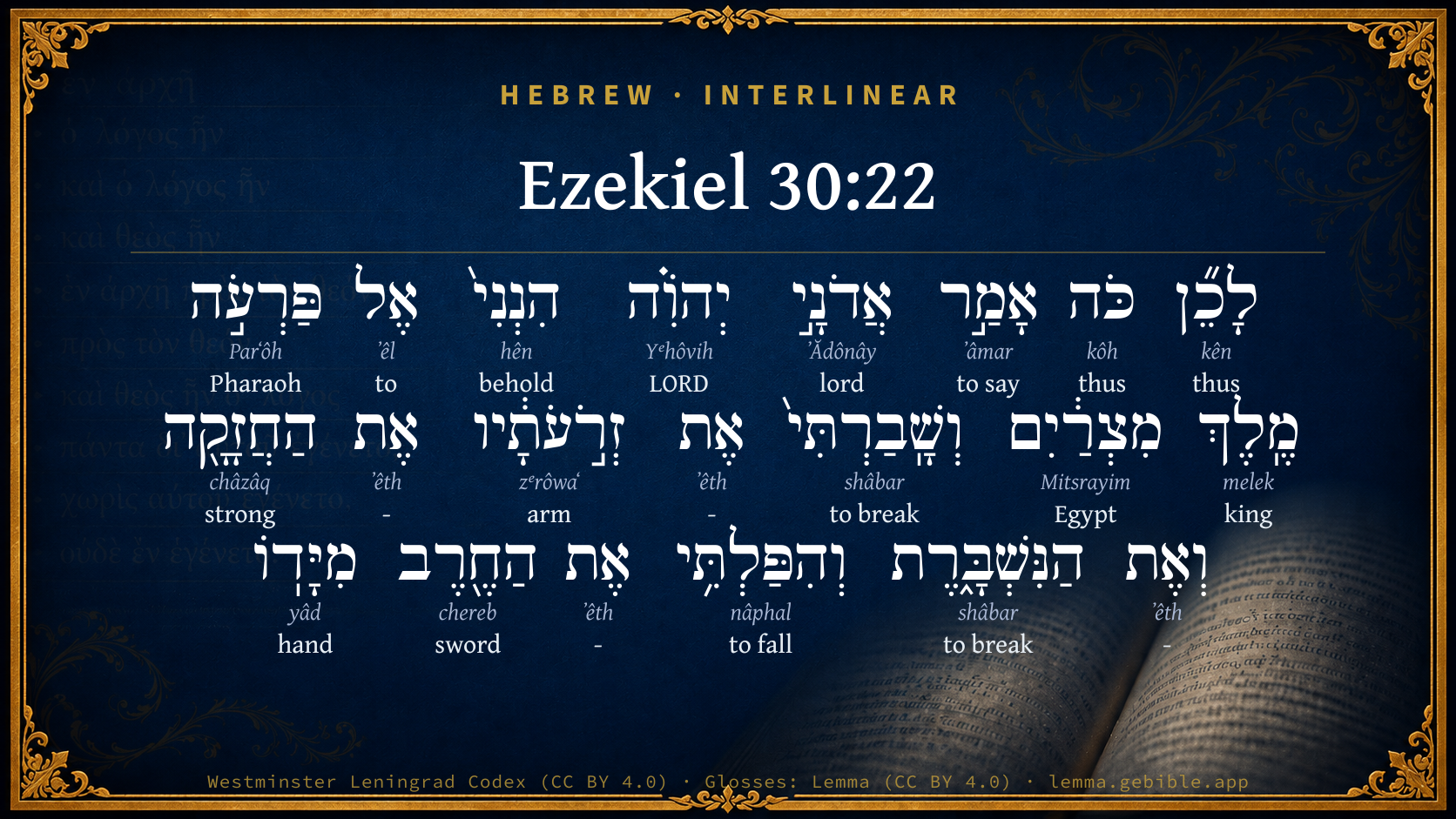
  1. לָכֵ֞ן kên H3651 “to/for · thus” Preposition + Adverb
  2. כֹּה kôh H3541 “thus” Adverb
  3. אָמַ֣ר ʼâmar H559 “to say” Verb, Qal, Perfect, 3rd Person, Masculine, Singular
  4. אֲדֹנָ֣י ʼĂdônây H136 “Lord · my” Noun, Common, Masculine, Plural, Construct + Suffix, Personal, 1st Person, Common, Singular
  5. יְהֹוִ֗ה Yᵉhôvih H3069 “LORD” Noun, Proper
  6. הִנְנִי֙ hên H2005 “behold · me” Particle, Demonstrative + Suffix, Personal, 1st Person, Common, Singular
  7. אֶל ʼêl H413 “to” Preposition
  8. פַּרְעֹ֣ה Parʻôh H6547 “Pharaoh” Noun, Proper
  9. מֶֽלֶךְ melek H4428 “king of” Noun, Common, Masculine, Singular, Construct
  10. מִצְרַ֔יִם Mitsrayim H4714 “Egypt” Noun, Proper
  11. וְשָֽׁבַרְתִּי֙ shâbar H7665 “and · to break” Conjunction + Verb, Qal, Sequential Perfect, 1st Person, Common, Singular
  12. אֶת ʼêth H853 “-” Particle, Direct Object
  13. זְרֹ֣עֹתָ֔יו zᵉrôwaʻ H2220 “arms · his” Noun, Common, Both, Plural, Construct + Suffix, Personal, 3rd Person, Masculine, Singular
  14. אֶת ʼêth H853 “-” Particle, Direct Object
  15. וְאֶת ʼêth H853 “and · -” Conjunction + Particle, Direct Object
  16. הַנִּשְׁבָּ֑רֶת shâbar H7665 “the · broken” Particle, Definite Article + Verb, Niphal, Participle Passive, Feminine, Singular, Absolute
  17. וְהִפַּלְתִּ֥י nâphal H5307 “and · to fall” Conjunction + Verb, Hiphil, Sequential Perfect, 1st Person, Common, Singular
  18. אֶת ʼêth H853 “-” Particle, Direct Object
  19. הַחֶ֖רֶב chereb H2719 “the · sword” Particle, Definite Article + Noun, Common, Feminine, Singular, Absolute
  20. מִיָּדֽוֹ yâd H3027 “from · hand · his” Preposition + Noun, Common, Both, Singular, Construct + Suffix, Personal, 3rd Person, Masculine, Singular

About this verse

These counts appear in no published source. They are computed here, from the morphology-tagged text and Lemma’s own curated glosses. What Lemma adds →

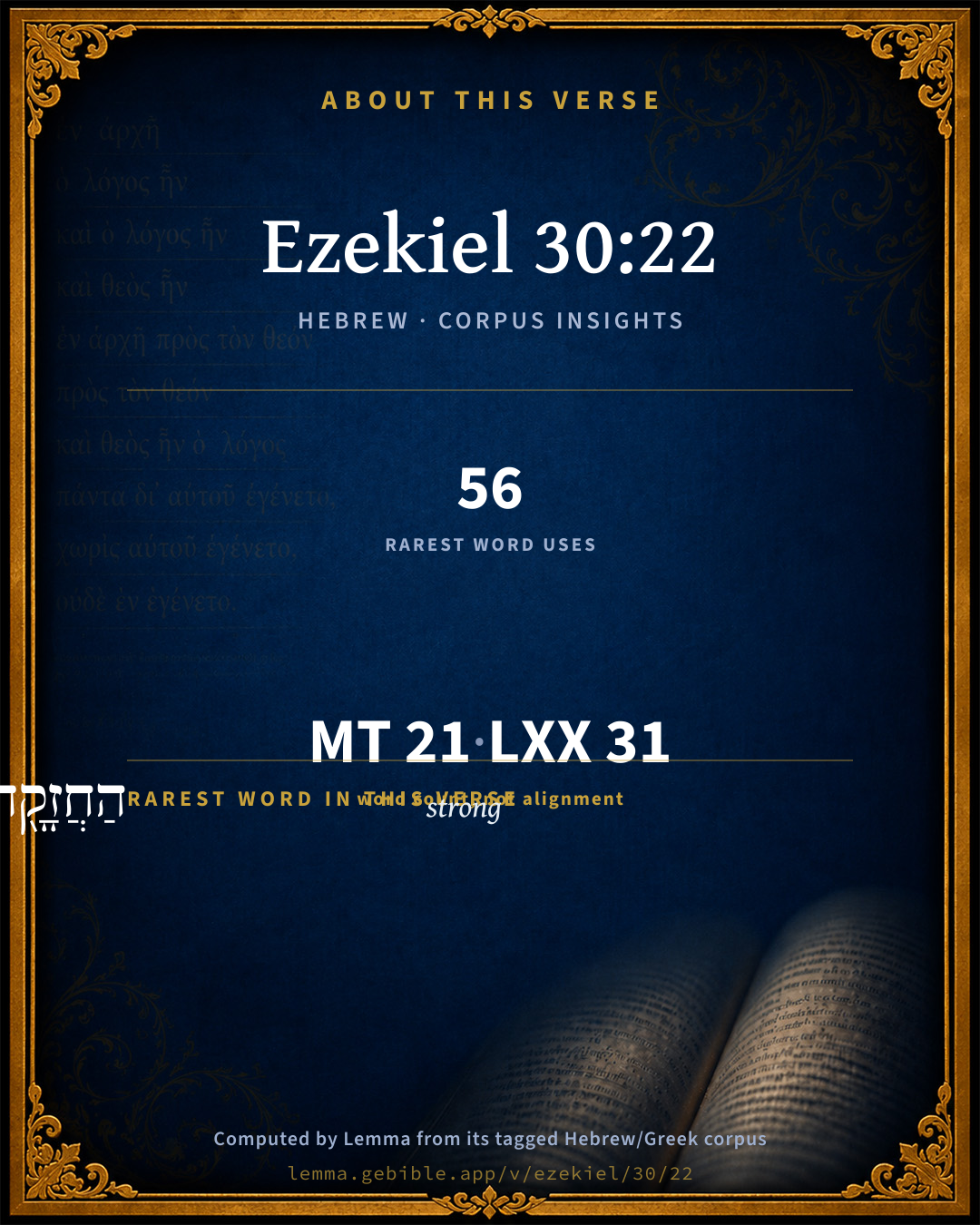
21
words
17
distinct lemmas
Prophets
section

Shared distinctive vocabulary

הַחֲזָקָ֖ה strong H2389 occurs in 54 verses of the Hebrew Bible. Also found in:

Grammatical profile

  • 4 verbs
  • 8 nouns
  • 1 adjective
  • 1 preposition
  • 2 adverbs
  • 5 particles

Verb forms

  • אָמַ֣ר Qal · Perfect
  • וְשָֽׁבַרְתִּי֙ Qal · Sequential Perfect
  • הַנִּשְׁבָּ֑רֶת Niphal · Participle Passive
  • וְהִפַּלְתִּ֥י Hiphil · Sequential Perfect

Repetition

A word recurs within this verse — often emphatic in Hebrew:

  • וְשָֽׁבַרְתִּי֙ to break H7665 ×2

Hebrew & Septuagint length

In English translation the verse runs 39 words from the Hebrew and 33 from the Septuagint (LXX English) — closely comparable.

A rough comparison of the two English renderings, which tokenize alike — not a word-level alignment.

Word counts can differ between the Hebrew and the Greek without any difference in meaning — e.g. the Hebrew direct-object marker אֵת has no separate Greek word, and Greek often adds the article ὁ.

In the original languages it is 21 Hebrew tokens and 31 Greek tokens — but the two are counted differently (Hebrew bundles its prefixes and suffixes into one token; the Greek is in lemma form), so that isn’t a like-for-like length.

Cross-references

7

Topical passages linked to Ezekiel 30:22 in the Treasury of Scripture Knowledge — connected by theme and wording, ordered by reader-vote popularity; previews shown in the World English Bible.

  • Psalms 37:17 For the arms of the wicked shall be broken, But Yahweh upholds the righteous.
  • 2 Kings 24:7 The king of Egypt didn't come again out of his land any more; for the king of Babylon had taken, from the brook of Egypt to the river Euphrates, all that pertained to the king of Egypt.
  • Jeremiah 37:7 Thus says Yahweh, the God of Israel, Thus shall you tell the king of Judah, who sent you to me to inquire of me: Behold, Pharaoh's army, which is come forth to help you, shall return to Egypt into their own land.
  • Ezekiel 29:3 speak, and say, Thus says the Lord Yahweh: Behold, I am against you, Pharaoh king of Egypt, the great monster that lies in the midst of his rivers, that has said, My river is my own, and I have made it for myself.
  • Jeremiah 46:1–12 The word of Yahweh which came to Jeremiah the prophet concerning the nations.
  • Jeremiah 46:21–25 Also her hired men in the midst of her are like calves of the stall; for they also are turned back, they are fled away together, they didn't stand: for the day of their calamity is come on them, the time of their visitation.
  • Ezekiel 34:16 I will seek that which was lost, and will bring back that which was driven away, and will bind up that which was broken, and will strengthen that which was sick: but the fat and the strong I will destroy; I will feed them in justice.

Cross-references courtesy of OpenBible.info (CC BY 4.0).

Hebrew and Greek witnesses Masoretic Hebrew ↔ Greek Septuagint

The same verse in the two great witnesses to the Old Testament, shown verse-for-verse.

These are two independent witnesses, not word-aligned to each other, and the Septuagint is shown in lemma (dictionary) form.

Hebrew Ezekiel 30:22 Masoretic · Westminster Leningrad Codex

לָכֵ֞ן כֹּה אָמַ֣ר אֲדֹנָ֣י יְהֹוִ֗ה הִנְנִי֙ אֶל פַּרְעֹ֣ה מֶֽלֶךְ מִצְרַ֔יִם וְשָֽׁבַרְתִּי֙ אֶת זְרֹ֣עֹתָ֔יו אֶת הַחֲזָקָ֖ה וְאֶת הַנִּשְׁבָּ֑רֶת וְהִפַּלְתִּ֥י אֶת הַחֶ֖רֶב מִיָּדֽוֹ

Therefore thus says the Lord Yahweh: Behold, I am against Pharaoh king of Egypt, and will break his arms, the strong [arm], and that which was broken; and I will cause the sword to fall out of his hand.

World English Bible · Public Domain

Greek LXX Ezekiel 30:22 Septuagint · lemma form

διά οὗτος ὅδε λέγω κύριος κύριος ἰδού ἐγώ ἐπί φαραώ βασιλεύς αἴγυπτος καί συντρίβω ὁ βραχίων αὐτός ὁ ἰσχυρός καί ὁ τείνω καί καταβάλλω ὁ μάχαιρα αὐτός ἐκ ὁ χείρ αὐτός

Therefore thus says the Lord God; Behold, I am against Pharao king of Egypt, and I will break his strong and outstretched arms, and will strike down his sword out of his hand.

LXX2012 (modern English Septuagint) · Public Domain

Hebrew: Westminster Leningrad Codex (CC BY 4.0). Greek: Septuagint (public domain); English from LXX2012 (modern English Septuagint) (Public Domain). How the Septuagint differs from the Hebrew →

Targum (Aramaic paraphrase)

1

The Targum is the ancient Jewish Aramaic paraphrase of the Hebrew Scriptures — an interpretive translation, not the Hebrew text itself. Onkelos (literal) and Pseudo-Jonathan (expansive) render the Torah, and Jonathan the Prophets. Coverage is partial: where no permissively-licensed English translation exists for a verse, only the Aramaic is shown. This is verse-level text, not a word-by-word alignment to the Hebrew.

  1. Targum Jonathan Prophets (Joshua–Malachi)
    בְּכֵן כִּדְנַן אֲמַר יְיָ אֱלֹהִים הָא אֲנָא שְׁלַח רוּגְזִי עַל פַּרְעֹה מַלְכָּא דְמִצְרַיִם וְאֶתְּבַר יַת סַעֲדוֹהִי וְיַת שִׁלְטוֹנוֹהִי תַקִיפַיָא דִבְהוֹן הוּא תְבַר יַת מַלְכְּוָתָא וְאֶרְמֵי יַת תּוּקְפָא מִנֵיהּ:

    (no public-domain English translation for this verse)

    Targum Jonathan — Aramaic: “Mikraot Gedolot” (public domain). English: “Sefaria Community Translation” (CC0 1.0 (public-domain dedication)); “London "Chaldee Paraphrase," 1871” (public domain). Text via Sefaria.

Commentary

Notes on Ezekiel 30:22 from classic Christian and Jewish commentators (each source and its license shown beneath its notes). The classic Christian expositions comment on the surrounding passage and are grouped to its opening verse, so a note may address several verses; the Jewish commentaries on the Tanakh (Rashi and others) are per-verse, so they appear only where the commentator wrote on this verse.

Lemma curates 59 commentaries, every one of them public domain or Creative Commons licensed, each selected and text-cleaned for this edition rather than reprinted as found. About our sources →

Trapp's Complete Commentary

John Trapp

Eze 30:22 Therefore thus saith the Lord GOD; Behold, I [am] against Pharaoh king of Egypt, and will break his arms, the strong, and that which was broken; and I will cause the sword to fall out of his hand.

Ver. 22. And will break his arms.] I will utterly disable him, and drive the field of him. He shall neither be able to defend himseff or offend his enemy. See Psa 37:17.

John Trapp, A Commentary or Exposition upon All the Books of the Old and New Testament (1647–1656) — public domain. Text from a community e-Sword module.

Geneva Bible (1599)

Geneva Bible translators

His force and power.

Geneva Bible (1599) marginal notes — public domain. Text via Bolls.life.

Jamieson, Fausset & Brown

Robert Jamieson, A. R. Fausset & David Brown

arms--Not only the "one arm" broken already (Eze 30:21) was not to be healed, but the other two should be broken. Not a corporal wound, but a breaking of the power of Pharaoh is intended.

cause . . . sword to fall out of . . . hand--deprive him of the resources of making war.

Not that Egypt was, like Assyria, utterly to cease to be, but it was, like Assyria, to lose its prominence in the empire of the world.

Next: Ezekiel Chapter 31

Jamieson, Fausset & Brown — Commentary Critical and Explanatory on the Whole Bible (1871) — public domain (CC PDM 1.0). Text via the HelloAO Bible API.

Adam Clarke's Commentary

Verse 22. I will cause the sword to fall out of his hand.] When the arm is broken, the sword will naturally fall. But these expressions show that the Egyptians would be rendered wholly useless to Zedekiah, and should never more recover their political strength. This was the case from the time of the rebellion of Amasis.

Adam Clarke's Commentary on the Bible (1810–1826) — public domain. Text from a community e-Sword/MySword module.

Ellicott's Commentary for English Readers

(22) The strong, and that which was broken—i.e., the whole power of Egypt, both in so far as already crippled, and in so far as it still retained strength.

A Bible Commentary for English Readers, edited by Charles John Ellicott (1878–1897) — public domain. Text from a community e-Sword module.

John Gill's Exposition

Therefore thus saith the Lord God, behold, I am against Pharaoh king of Egypt,.... The then present king of Egypt, whose name was Hophra or Apries, Jer 44:30,

and I will break his arms, the strong, and that which was broken: both his arms, the sound and the broken one, his whole power, strength, and dominion; meaning that that part of his kingdom which lay between the two rivers of Egypt and Euphrates, that had been taken away by the king of Babylon, should remain so; and the other part of his kingdom should fall a prey to him also:

and I will cause the sword to fall out of his hand; so that he should be so far from being so able to make use of the sword, that he should not be able to hold it; it should drop out of his hand; nor should he be able to take it up again, and make war, either offensive or defensive.

John Gill's Exposition of the Whole Bible (1746–1763) — public domain (CC PDM 1.0). Text via the HelloAO Bible API.

Matthew Poole's English Annotations

In the former verse God had broken the arm, in this he will break the arms of Pharaoh, he will show he is still against Pharaoh, and will break him more and more.

The strong; that part of his kingdom which remains entire.

That which was broken; that which was shattered before, that part of his kingdom in Syria, taken from him, from Euphrates to the river of Egypt; that once was a strong arm, but now is broken and useless to him: and Egypt, whatever strength it now hath, shall be as weak and useless too; thus all his power and strength shall be destroyed.

Matthew Poole's English Annotations on the Holy Bible (1683–1685) — public domain. Text from a community e-Sword/MySword module.

The Pulpit Commentary

Vers. 22-24. The strong, and that which was broken. The image is pressed yet further. A warrior whose sword-arm was broken might go on fighting with his left. Hophra might continue to struggle, though with diminished strength. Ezekiel"s words shut out the hope of any such struggle. The left arm also should be broken as the right had been. The Chaldean king should wax stronger and stronger. The sword of Nebuchadnezzar should be as truly "the sword of Jehovah," as that of Gideon had been. (Jud_1:7:18) Figuratively, he should stand before him groaning as a man wounded to the death. So in Jer_43:9 Jer_44:30 Jer_46:26, we have allusions to an invasion of Egypt by Nebuchadnezzar, which was to end in his sitting on his throne in the stronghold of Tahapanes.

The Pulpit Commentary (1880–1919), ed. H.D.M. Spence-Jones & Joseph S. Exell — public domain. Text from a community e-Sword module.

John Wesley's Explanatory Notes

His arms - Both his arms. The strong - That part of his kingdom which remains entire. Broken - That which was shattered before.

John Wesley, Explanatory Notes Upon the Whole Bible (1754–1765) — public domain. Text via the GEBible commentary corpus.

unfoldingWord translationNotes

Door43 World Missions Community

General Information:

God continues speaking of Pharaoh's army as if it were a broken arm. He also speaks of strengthening the army of Babylon as if it were the arms of the king of Babylon. (See: Parables)

the Lord Yahweh says this

See how you translated this in Ezekiel 3:11.

both the strong one and the broken one

"both the arm that is healthy and the arm that is already broken"

I will make the sword fall from his hand

"I will knock the sword out of Pharaoh's hand"

scatter Egypt among the nations and disperse them among the lands

These two phrases mean basically the same thing. See how you translated similar phrases in Ezekiel 12:15. (See: Parallelism)

among the lands

"among the places in which people live"

I will strengthen the arms of the king of Babylon

"I will make the arms of the king of Babylon strong"

He will groan before the king of Babylon

"When the king of Babylon comes to attack Egypt, Pharaoh will groan."

groan

A groan is a noise that people make when they have a lot of pain or are dying.

with the groans of a dying man

"as a man who is dying groans" or "like a man who is dying"

translationWords

Lord Yahweh

hand

nation

disperse

Babylon

die

unfoldingWord translationNotes — © Distant Shores Media and the Door43 World Missions Community, licensed CC BY-SA 4.0. Source: git.door43.org/Door43/en_tn.

Rashi

Rabbi Shlomo Yitzchaki (Rashi)

and I shall break his arms I shall break the second [arm], and both of them will be broken; i.e., the king of Babylon took from one side; I shall yet give him the entire kingdom.

Rashi on the Tanakh — English translations: “The Judaica Press complete Tanach with Rashi, translated by A. J. Rosenberg” (CC BY 4.0); “Pentateuch with Rashi's commentary by M. Rosenbaum and A.M. Silbermann, 1929-1934” (public domain); “The Metsudah Tanach series, Lakewood, N.J” (CC BY 4.0); and “The Book of Joshua, Metsudah Publications, 1997” (CC BY 4.0). Text via Sefaria.

Lesson kit

Teaching starters — assembled from the data on this page, not authored interpretation. Every prompt links to the verse data it draws on. Edit before teaching.

Ezekiel, in the Prophets, opens this verse with 21 words (17 distinct Hebrew lemmas). Its most distinctive word is châzâq (“strong”). A historical commentator’s framing appears above. Read the whole chapter for the surrounding context.

Discussion questions

  1. How does “strong” (châzâq) shape what this verse is saying?
  2. Exodus 3:19 shares the word «strong» with this verse. How do the two illuminate each other?
  3. “to break” occurs 2× in this one verse. What is the effect of the repetition?
  4. The translations on this page render this verse differently — a whole-verse word diff, not a word-by-word alignment. What might account for the different wordings?
  5. The verb «אָמַ֣ר» is Qal Perfect. How does its form color the action?
  6. Reading how Trapp's Complete Commentary and Geneva Bible (1599) read this verse, where do the two commentators agree and where do they part?

Things to notice

Reading settings

Reading text

Shown beneath each verse's original-language words.

Old Testament
Old Testament edition

Read the OT as the Masoretic Hebrew (MT) or the Greek Septuagint (LXX).

English shown for the Greek Septuagint (in the Hebrew ↔ Greek comparison).

Comparing translations? Open the Compare panel on any verse page to stack up to four side by side.