
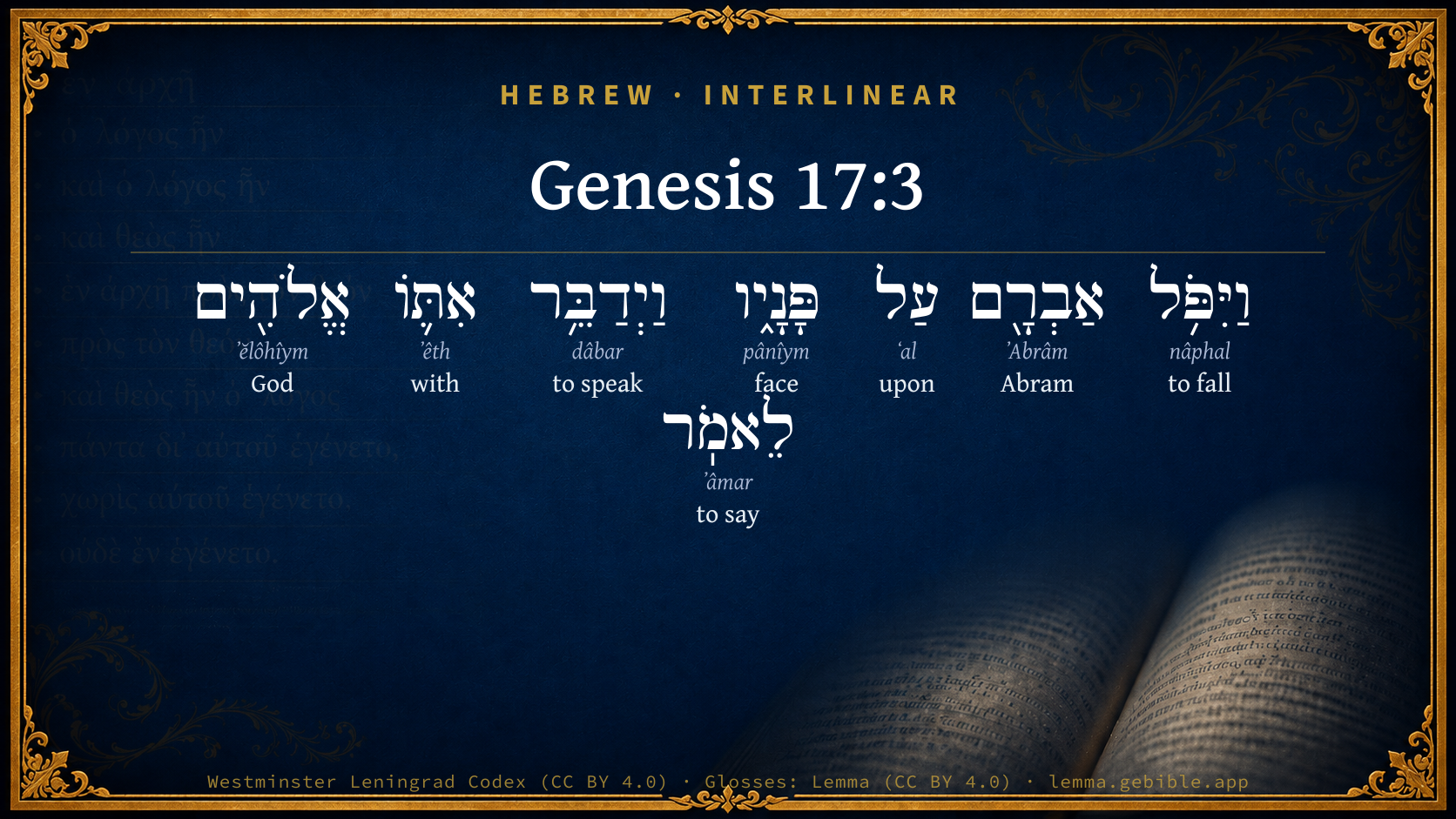
Genesis 17:3

Hebrew (Westminster Leningrad Codex) Genesis 17:3 appears in the Hebrew Old Testament. The text above is from the Westminster Leningrad Codex. Each word links to its Strong’s number, a concise gloss, and parsing drawn from the Open Scriptures Hebrew Bible morphology. Click any word for its full Brown-Driver-Briggs (BDB) entry.
Download image
Cite this verse

Genesis 17:3 (World English Bible). Public Domain. Lemma interlinear Bible study tool, https://lemma.gebible.app/v/genesis/17/3.

Show BibTeX & RIS
BibTeX
RIS
English Translation
Abram fell on his face. God talked with him, saying,
World English Bible · Public Domain
Download a study sheet

One document with this verse’s original text, its word-by-word gloss line, the meaning frame, cross-references with their text, attributed commentary, and full source and license credits — printable, and it pastes into notes with its structure intact.

This verse Autodidact and up

Study sheet (.html) Plain text (.txt)

A passage Seminary Student

Up to 50 verses in one chapter. A passage sheet keeps up to 6 commentary sources and 12 cross-references per verse, in the order this page ranks them, and says so on the sheet whenever that leaves anything out. Ask for a single verse and you get the Autodidact verse sheet above.

Everything on this page stays free to read, with no account — the sheet is a download of what is already on screen, not access to it.

Want to remove ads? Support Godless Engineer
Compare translations 3

The same verse in 3 English versions, stacked beneath the original-language interlinear above. Click any original word for its lexicon entry.

Each is an independent rendering of the whole verse — the interlinear is not word-aligned to these translations.

Highlighted words mark where these versions differ — a whole-verse word diff, not a word-by-word alignment.

  • World English Bible Public Domain
    Abram fell on his face. God talked with him, saying,
  • King James Version Public Domain
    And Abram fell on his face: and God talked with him, saying,
  • unfoldingWord Literal Text CC BY-SA 4.0
    Then Abram fell on his face, and God spoke with him, saying,

unfoldingWord Literal Text — © unfoldingWord, licensed CC BY-SA 4.0. Word-aligned USFM3 via Door43 (git.door43.org/unfoldingWord/en_ult).

Versions to compare (up to 4)

3 of 4 selected

Show all 18 translations

Every available English version of this verse, each an independent rendering of the whole verse.

  • World English Bible Public Domain
    Abram fell on his face. God talked with him, saying,
  • Berean Standard Bible Public Domain
    Then Abram fell facedown, and God said to him,
  • Majority Standard Bible Public Domain
    Then Abram fell facedown, and God said to him,
  • King James Version Public Domain
    And Abram fell on his face: and God talked with him, saying,
  • American Standard Version (1901) Public Domain
    And Abram fell on his face: and God talked with him, saying,
  • Revised Version (1885) Public Domain
    And Abram fell on his face: and God talked with him, saying,
  • Geneva Bible (1599) Public Domain
    Then Abram fell on his face, and God talked with him, saying,
  • Douay-Rheims (1899) Public Domain
    Abram tell flat on his face.
  • Young's Literal Translation Public Domain
    And Abram falleth upon his face, and God speaketh with him, saying,
  • Literal Standard Version CC BY-SA 4.0
    And Abram falls on his face, and God speaks with him, saying,
  • Unlocked Literal Bible CC BY-SA 4.0
    Abram bowed low with his face to the ground and God talked with him, saying,
  • unfoldingWord Literal Text CC BY-SA 4.0
    Then Abram fell on his face, and God spoke with him, saying,
  • Darby Bible Public Domain
    And Abram fell on his face; and God talked with him, saying,
  • World Messianic Bible Public Domain
    Abram fell on his face. God talked with him, saying,
  • Webster's Bible Public Domain
    And Abram fell on his face: and God talked with him, saying,
  • Free Bible Version CC BY-SA 4.0
    Abram bowed down with his face to the ground, and God told him,
  • Bible in Basic English Public Domain
    And Abram went down on his face on the earth, and the Lord God went on talking with him, and said,
  • JPS Tanakh (1917) Public Domain
    And Abram fell on his face; and God talked with him, saying:

Literal Standard Version (2020), Covenant Press — licensed CC BY-SA 4.0. Text via the HelloAO Bible API (eBible.org). Unlocked Literal Bible (unfoldingWord) — licensed CC BY-SA 4.0. Text via the HelloAO Bible API (eBible.org). unfoldingWord Literal Text — © unfoldingWord, licensed CC BY-SA 4.0. Word-aligned USFM3 via Door43 (git.door43.org/unfoldingWord/en_ult). Free Bible Version, Dr. Jonathan Gallagher — licensed CC BY-SA 4.0. Text via the HelloAO Bible API (eBible.org).

Word by word

More ways to search: Search by grammar → Find every occurrence → Compare this word →

Practice this passage: Drill this verse → Learn its vocabulary →

About this verse

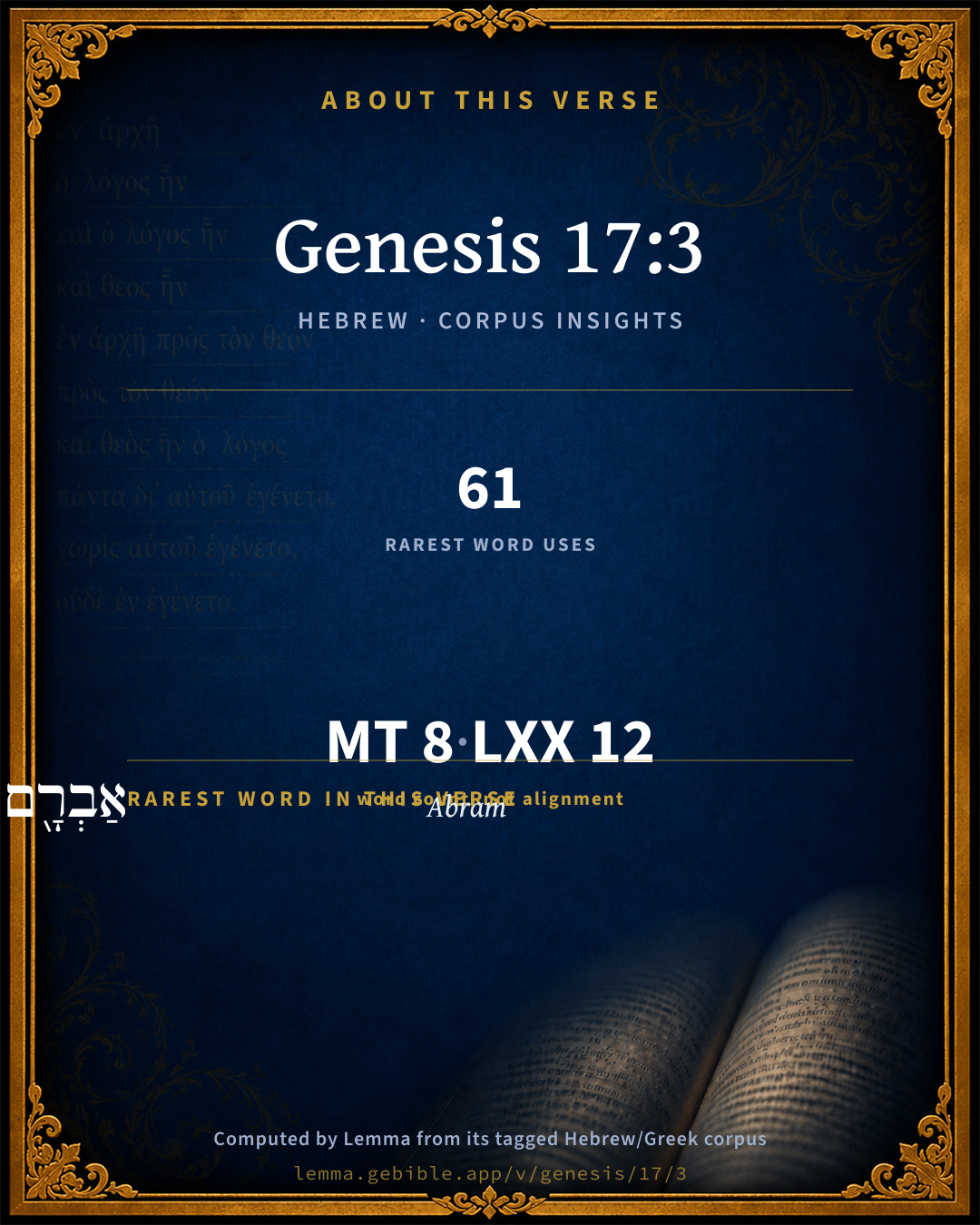
These counts appear in no published source. They are computed here, from the morphology-tagged text and Lemma’s own curated glosses. What Lemma adds →

8
words
8
distinct lemmas
Pentateuch
section

Grammatical profile

  • 3 verbs
  • 3 nouns
  • 2 prepositions

Verb forms

  • וַיִּפֹּ֥ל Qal · Sequential Imperfect
  • וַיְדַבֵּ֥ר Piel · Sequential Imperfect
  • לֵאמֹֽר Qal · Infinitive Construct

Hebrew & Septuagint length

In English translation the verse runs 10 words from the Hebrew and 12 from the Septuagint (LXX English) — closely comparable.

A rough comparison of the two English renderings, which tokenize alike — not a word-level alignment.

Word counts can differ between the Hebrew and the Greek without any difference in meaning — e.g. the Hebrew direct-object marker אֵת has no separate Greek word, and Greek often adds the article ὁ.

In the original languages it is 8 Hebrew tokens and 12 Greek tokens — but the two are counted differently (Hebrew bundles its prefixes and suffixes into one token; the Greek is in lemma form), so that isn’t a like-for-like length.

Cross-references

16

Topical passages linked to Genesis 17:3 in the Treasury of Scripture Knowledge — connected by theme and wording, ordered by reader-vote popularity; previews shown in the World English Bible.

  • Genesis 17:17 Then Abraham fell on his face, and laughed, and said in his heart, "Will a child be born to him who is one hundred years old? Will Sarah, who is ninety years old, give birth?"
  • Judges 13:20 For it happened, when the flame went up toward the sky from off the altar, that the angel of Yahweh ascended in the flame of the altar: and Manoah and his wife looked on; and they fell on their faces to the ground.
  • Numbers 16:45 Get away from among this congregation, that I may consume them in a moment. They fell on their faces.
  • Joshua 5:14 He said, No; but [as] prince of the host of Yahweh am I now come. Joshua fell on his face to the earth, and did worship, and said to him, What says my lord to his servant?
  • 1 Kings 18:39 When all the people saw it, they fell on their faces: and they said, Yahweh, he is God; Yahweh, he is God.
  • Matthew 17:6 When the disciples heard it, they fell on their faces, and were very afraid.
  • Revelation 1:17 When I saw him, I fell at his feet like a dead man. He laid his right hand on me, saying, "Don't be afraid. I am the first and the last,
  • Exodus 3:6 Moreover he said, "I am the God of your father, the God of Abraham, the God of Isaac, and the God of Jacob." Moses hid his face; for he was afraid to look at God.
  • Leviticus 9:23–24 Moses and Aaron went into the Tent of Meeting, and came out, and blessed the people: and the glory of Yahweh appeared to all the people.
  • Numbers 14:5 Then Moses and Aaron fell on their faces before all the assembly of the congregation of the children of Israel.
  • Numbers 16:22 They fell on their faces, and said, God, the God of the spirits of all flesh, shall one man sin, and will you be angry with all the congregation?
  • Ezekiel 1:28 As the appearance of the bow that is in the cloud in the day of rain, so was the appearance of the brightness round about. This was the appearance of the likeness of the glory of Yahweh. When I saw it, I fell on my face, and I heard a voice of one that spoke.
  • Ezekiel 3:23 Then I arose, and went forth into the plain: and, behold, the glory of Yahweh stood there, as the glory which I saw by the river Chebar; and I fell on my face.
  • Daniel 8:17–18 So he came near where I stood; and when he came, I was frightened, and fell on my face: but he said to me, Understand, son of man; for the vision belongs to the time of the end.
  • Daniel 10:9 Yet heard I the voice of his words; and when I heard the voice of his words, then was I fallen into a deep sleep on my face, with my face toward the ground.
  • Ezekiel 9:8 It happened, while they were smiting, and I was left, that I fell on my face, and cried, and said, Ah Lord Yahweh! will you destroy all the residue of Israel in your pouring out of your wrath on Jerusalem?

Cross-references courtesy of OpenBible.info (CC BY 4.0).

Hebrew and Greek witnesses Masoretic Hebrew ↔ Greek Septuagint

The same verse in the two great witnesses to the Old Testament, shown verse-for-verse.

These are two independent witnesses, not word-aligned to each other, and the Septuagint is shown in lemma (dictionary) form.

Hebrew Genesis 17:3 Masoretic · Westminster Leningrad Codex

וַיִּפֹּ֥ל אַבְרָ֖ם עַל פָּנָ֑יו וַיְדַבֵּ֥ר אִתּ֛וֹ אֱלֹהִ֖ים לֵאמֹֽר

Abram fell on his face. God talked with him, saying,

World English Bible · Public Domain

Greek LXX Genesis 17:3 Septuagint · lemma form

καί πίπτω αβραμ ἐπί πρόσωπον αὐτός καί λαλέω αὐτός ὁ θεός λέγω

And Abram fell upon his face, and God spoke to him, saying,

LXX2012 (modern English Septuagint) · Public Domain

Hebrew: Westminster Leningrad Codex (CC BY 4.0). Greek: Septuagint (public domain); English from LXX2012 (modern English Septuagint) (Public Domain). How the Septuagint differs from the Hebrew →

Targum (Aramaic paraphrase)

2

The Targum is the ancient Jewish Aramaic paraphrase of the Hebrew Scriptures — an interpretive translation, not the Hebrew text itself. Onkelos (literal) and Pseudo-Jonathan (expansive) render the Torah, and Jonathan the Prophets. Coverage is partial: where no permissively-licensed English translation exists for a verse, only the Aramaic is shown. This is verse-level text, not a word-by-word alignment to the Hebrew.

  1. Targum Onkelos Torah (Genesis–Deuteronomy)
    וּנְפַל אַבְרָם עַל אַפּוֹהִי וּמַלֵיל עִמֵהּ יְיָ לְמֵימָר

    (no public-domain English translation for this verse)

    Targum Onkelos — Aramaic: “Onkelos Genesis” (public domain); “Onkelos Exodus” (public domain); “Onkelos Leviticus” (public domain); “Onkelos Numbers” (public domain); “Onkelos Deuteronomy” (public domain). English: “Sefaria Community Translation” (CC0 1.0 (public-domain dedication)); “J.W. Etheridge. The Targums of Onkelos and Jonathan Ben Uzziel on the Pentateuch. London: Longmans, Green, 1862” (public domain). Text via Sefaria.

  2. Targum Pseudo-Jonathan Torah (Genesis–Deuteronomy)
    וְעַל דְלָא הֲוָה אַבְרָם גְזִיר לָא הֲוָה יָכִיל לְמֵיקַם וְנָפַל עַל אַנְפּוֹי וּמַלֵיל עִמֵיהּ יְיָ לְמֵימַר

    And because Abram was not circumcised, he was not able to stand, but he bowed himself upon his face; and the Lord spake with him, saying,

    Targum Pseudo-Jonathan — Aramaic: “Targum Jonathan on Genesis” (public domain); “Targum Jonathan on Exodus” (public domain); “Targum Jonathan on Leviticus” (public domain); “Targum Jonathan on Numbers” (public domain); “Targum Jonathan on Deuteronomy” (public domain). English: “The Targum of Jonathan ben Uzziel, trans. J. W. Etheridge, London, 1862” (public domain). Text via Sefaria.

Commentary

Notes on Genesis 17:3 from classic Christian and Jewish commentators (each source and its license shown beneath its notes). The classic Christian expositions comment on the surrounding passage and are grouped to its opening verse, so a note may address several verses; the Jewish commentaries on the Tanakh (Rashi and others) are per-verse, so they appear only where the commentator wrote on this verse.

Lemma curates 59 commentaries, every one of them public domain or Creative Commons licensed, each selected and text-cleaned for this edition rather than reprinted as found. About our sources →

Trapp's Complete Commentary

John Trapp

Gen 17:3 And Abram fell on his face: and God talked with him, saying,

Ver. 3. And Abram fell on his face.] It was fit he should, now that God talked with him. Such a posture of body befits us at the hearing of the word, as may best express our reverence, and further our attention. Balak is bid to rise up to hear Balaam’s parable. {Num 23:18} Eglon, though a fat unwieldy man, riseth up from his seat to hear God’s message from Ehud. {Jdg 3:20} The people in Nehemiah "stood up" {Neh 8:5} to hear the law read and expounded. Constantine the Great would not be entreated to sit down or be covered at a sermon: {a} no more would our Edward VI, whose custom was also to take notes of what he heard, which (together with his own applications of the word to himself) he wrote in Greek characters, that his servants might not read them. {b} The Thessalonians are commended for this, that they heard Paul’s preaching "as the word of God, and not of man". {1Th 2:13} Had Samuel thought it had been God that called to him (and not Eli), he would not have slept, but fallen on his face before the Lord, as Abram here, who was no novice, but knew well that though God loves to be acquainted with men in the walks of their obedience yet he takes state upon him in his ordinances, and will be trembled at in his word and judgments.

{a} Eusebius.

{b} Act. and Mon.

John Trapp, A Commentary or Exposition upon All the Books of the Old and New Testament (1647–1656) — public domain. Text from a community e-Sword module.

The Biblical Illustrator

Joseph S. Exell

Gen_17:3-8

My covenant is with thee, and thou shalt be a father of many nations

The second stage of the covenant

Already Jehovah, the Covenant God, had appeared thrice to Abram.

1. Simply to assure him that he should be blessed, and become a blessing Gen_12:7).

2. To give him the promise of a numerous progeny, as the dust of the earth for multitude (Gen_13:16).

3. To repeat this assurance, but now likening the number of his seed to the stars of heaven (Gen_15:5). This third vision was confirmed by a solemn sacrifice. In it God stands clearly out as the contracting party, conveying certain blessings to Abram, and requiring the performance of no distinct conditions on His part. Now the covenant has moved forwards another stage, and Abram is to take his own part in it by receiving the appointed sign--the sign and seal of the righteousness of the faith which he had, yet being uncircumcised (Rom_4:11). This second stage of the covenant was marked--

I. BY MORE DEFINITE AND CIRCUMSTANTIAL PROMISES. This law of progressive revelation has an illustration in the case of Abram. The original promise is renewed, but spread more out into details. Consider these promised blessings--

1. In their natural greatness. Though they have a higher meaning and importance, yet there are aspects of them which belong entirely to this present world.

2. In their spiritual significance. Their ultimate reference is above and beyond the things of time and sense. The sands on the sea shore, and the multitude of the stars, speak to us Christians of the number and extent of the true Church of God.

II. BY A CHANCED NAME. Abram had reached a new stage in his history, and this is indicated by a new name. With God, names are not empty designations, but represent the truth of things. To Abraham it was as a new life to find the promises growing more clear, the gifts of Gods goodness more palpable and evident.

III. BY SPECIAL ENGAGEMENT ON THE PART OF GOD. God is the fountain of the blessing, and the sole proposer of the terms. His covenant is the only foundation of all our hope. We can look for nothing but what is thus assured to us. To believers in covenant, God conveys the riches which are in Christ. They are bound to a life of faith and love, and He engages Himself to impart His fulness,

1. This should excite our gratitude.

2. It should stimulate our faith.

3. It should excite our reverence. (T. H. Leale.)

The ratification of the covenant

I. GODS TREATMENT OF ABRAHAM.

1. His revelation of Himself.

2. He changes the names of the patriarch and his wife.

3. An enlarged promise.

4. The promise of a son to Sarah.

5. Yet Ishmael is remembered for good.

II. ABRAHAMS CONDUCT.

1. He readily entered into the covenant.

2. He instantly submitted to the prescribed rite.

3. He included in the covenant all whom he could influence.

III. APPLICATION. God proposes to enter into covenant with us. He has given His Son as a sacrifice for our sins, and made us the most gracious and abundant promises. Now, we are required to take up the covenant and accept the conditions of it.

1. Look at the covenant on Gods part.

(1) He reveals Himself to us as the Almighty. Think of His greatness and power.

(2) He gives us a new name, He calls us His sons. He changes our nature, and makes us partakers of His own.

(3) He appoints us the sign and seal of baptism and the Lords

Supper, in token of our covenant relation to Him.

(4) He then lays upon us His great and holy command, in keeping of which we shall realize perfect safety and immortal blessedness.

2. Our duty.

(1) We are to walk before God, the Almighty.

(a) Remember His presence.

(b) Seek His guidance and approval in all we do.

(c) Look to Him for protection and reward.

(2) In this way we shall be perfect. Sincere and upright. Happy.

Safe. (The Congregational Pulpit.)

Gods everlasting covenant

I. THIS COVENANT IS THE SHEET ANCHOR OF CHRISTIAN FAITH. No fear of defeat or failure.

II. THIS COVENANT IS A PERPETUAL COVENANT. Everlasting is the period of its duration. It is for all ages, all dispensations, all believers in all the world to the end of time.

III. THIS COVENANT WAS MADE WITH ABRAM AND HIS SEED AFTER HIM. Parents do not make enough of it, or plead it with sufficient faith and persistency.

IV. THIS COVENANT IS GODS EVERLASTING ARM UNDERNEATH THE SAINT. Away, then, with fear. (J. M. Sherwood, D. D.)

Faith in Gods naked word

The more entirely thou canst rely on Gods naked word and promise, the stronger is thy faith; for then thou trustest Him on His own credit, without any bond from another; and this is faith indeed. He that walks without staff or crutch, is stronger than he that needs these to lean on. (W. Gurnall.)

Distrust of Gods promise

The awkwardness of our hearts to suffer comes much from distrust. An unbelieving soul treads upon the promise, as a man upon ice; at first going upon it he is full of fears, lest it should crack. (W. Gurnall.)

God talked with him

I. SATISFACTORY COMMUNION. The Rev. James Owen, of Shrewsbury, being asked, when on his death bed, whether he would have some of his friends sent for to keep him company, replied, My fellowship is with the Father, and with His Son Jesus Christ, and he that is not satisfied with that company doth not deserve it.

II. DEGREES OF COMMUNION. Some value the presence of their Saviour so highly that they cannot bear to be at any remove from Him. Even their work they will bring up, and do it in the light of His countenance, and, while engaged in it, will be seen constantly raising their eyes to Him, as if fearful of losing one beam of His light. Others who, to be sure, would not be content to live out of His presence, are yet less wholly absorbed by it than these, and may be seen, a little farther off, engaged here and there in their various callings, their eyes generally upon their work, but often looking up for the light which they love. A third class, beyond these, but yet within the light-giving rays, includes a double multitude, many of whom are so much engaged in their worldly schemes, that they may be seen standing sideways to Christ, looking mostly the other way, and only now and then turning their faces toward the light. (E. Payson, D. D.)

The Biblical Illustrator, edited by Joseph S. Exell (c. 1880s–1900s) — public domain. Text from a community e-Sword module.

Joseph Benson's Commentary

Gen 17:3. And Abram fell on his face while God talked with him — Either, 1st, As one overcome by the brightness of the divine glory; as Daniel and John also were. Or, 2d, As one ashamed of himself, and blushing to think of the honours done to one so unworthy. He looks upon himself with humility, and upon God with reverence; and, in token of both, falls on his face.

Joseph Benson's Commentary on the Old and New Testaments (1811–1818) — public domain. Text from a community e-Sword module.

The Preacher's Complete Homiletical Commentary

Joseph S. Exell (gen. ed.)

CRITICAL NOTES.—

Gen_17:3. God talked with him.] “We must notice here the expression Elohim, and the Dabbar (word). God, as the Author of the universe, begins a conversation with Abram, when he should become Abraham the father of a multitude of nations.” (Lange.)

Gen_17:4. As for Me.] Thus one party to and the originator of the covenant is here made prominent. Father of many nations. Fulfilled in a literal sense. The twelve tribes of Israel, many Arab tribes, the twelve princes of Ishmael, Keturah’s descendants, and the dukes of Edom sprang from him. But St. Paul teaches that this is also to be realised in a spiritual sense (Rom_4:16-17).

Gen_17:5. Abram.… Abraham.] The former name was composed of Ab (father) and ram (high, eminent). The name Abraham is formed by dropping the last letter, and inserting the first syllable of the word hamon (multitude). Abram-hamon is abbreviated into Abraham, the high father of a multitude. Have I made thee.] Heb. Have I given thee—appointed or constituted thee. The word used by St. Paul conveys exactly the same idea (τεθεικα) (Rom_4:17).

Gen_17:6. Kings.] “From him were descended the chief of the twelve tribes of the Hebrews, and after their separation, the kings of Judah as well as the kings of Israel. From him sprang the ancient monarchs of Edom, and the Saracen kings in Arabia, Babylon, and Egypt. If we pass from the literal to the spiritual fulfilment, we find the heavenly Messiah, the King of kings, descending from the same stock, and all true Christians, his seed, by faith ‘Kings and priests unto God’ ” (Rev_1:6). (Bush).

Gen_17:8. The land wherein thou art a stranger.] Heb. The land of thy sojournings, or wanderings.

MAIN HOMILETICS OF THE PARAGRAPH.—Gen_17:3-8

THE SECOND STAGE OF THE COVENANT

Already Jehovah, the Covenant God, had appeared thrice to Abram.

(1) Simply to assure him that he should be blessed, and become a blessing (ch. Gen_12:7).

(2) To give him the promise of a numerous progeny, as the dust of the earth for multitude (ch. Gen_13:16).

(3) To repeat this assurance, but now likening the number of his seed to the stars of heaven (ch. Gen_15:5). This third vision was confirmed by a solemn sacrifice. In it God stands clearly out as the contracting party, conveying certain blessings to Abram, and requiring the performance of no distinct conditions on his part. Now the Covenant has moved forwards another stage, and Abram is to take his own part in it by receiving the appointed sign—“the sign and seal of the righteousness of the faith which he had, yet being uncircumcised.” (Rom_4:11.) This second stage of the Covenant was marked—

I. By more definite and circumstantial promises. In the revelation of God’s will to mankind we can trace a gradual progress. Promises and prophecies, at first vague and mysterious, are succeeded by others which are clearer and more minute in their contents. As time moves on, the Divine purpose becomes more definitely revealed. Such were the prophecies concerning Christ, until the fulness of time was come. This law of progressive revelation has an illustration in the case of Abram. The original promise is renewed, but spread more out into details. Consider these promised blessings—

1. In their natural greatness. Though they have a higher meaning and importance, yet there are aspects of them which belong entirely to this present world. They speak of a numerous seed, of Abram as the fountain of the inextinguishable life of countless generations. They speak of him as the progenitor of kings and great nations, so that there was spread before him the vision of great lawgivers, and statesmen, and warriors, and all that belongs to the idea of a great civilisation. His seed would be great and distinguished, cared for in an especial manner by God, living under the immediate eye of Providence, and made to fill a prominent place in the history of mankind. Their continuance was assured by an unfailing covenant, by which God bound Himself to preserve them. They are the only nation of mankind whose history is written on the awful scroll of prophecy. Hence they still persist throughout human history—a remarkable evidence of the truth and stability of God’s word.

2. In their spiritual significance. Considering that it was God who made these promises, and in behalf of men who were destined to live for ever, they cannot be restricted to this present life, but look towards a higher and a spiritual world. Their ultimate reference is above and beyond the things of time and sense. The numerous seed represents a wider family, the children of Abram’s faith who are to be blessed with him. The sands on the sea-shore, and the multitude of the stars, speak to us Christians of the number and extent of the true Church of God. That, too, is possessed of an indestructible life—an energy which will remain unhurt by the wrongs of time. The spiritual privileges of the Church are secured by covenant. The true King of men—the rightful Monarch of human souls, has sprung from Abram, and He has gathered around Him a royal priesthood, a holy nation, a peculiar people. There is only one institution now in the world whose continued existence is assured, and that is the family of God named after the Lord Jesus Christ (Eph_3:14-15). Thus the life of Abram, speading and continuing through history, is a figure of the life of the Church of God. Also, the promise of the land to Abram for an everlasting possession points to a more glorious inheritance—the heavenly Canaan. In some way or other, Abram was to inherit the land; for so the grant runs, “I will give unto thee, and unto thy seed after thee, the land wherein thou art a stranger, all the land of Canaan for an everlasting possession” (Gen_17:8). Thus Abram himself had a vested right in this inheritance—a condition which was never fulfilled in this world, and which can only be satisfied by an inheritance incorruptible, undefiled, and that fadeth not away. God leads His people from the earthly to the heavenly, and through many disappointments He conducts them to some real and permanent good. The blessing in its highest form may for a while be hidden from them, but in the end it is revealed, and their souls are satisfied. Again: this second stage of the Covenant was marked—

II. By a changed name. Abram had reached a new stage in his history, and this is indicated by a new name. So the name Jacob was changed to that of “Israel,” which signifies Prevailer, in remembrance of his triumphant wrestling with the Angel of the Covenant, and as a gracious assurance of his future successes in prayer. The name Cephas was changed to that of Peter, to indicate that a stage of firm and unshaken faith had been reached. The sons of Zebedee were called Boanerges, to signify their new-born zeal and the earnest work which they were to do. With God, names are not empty designations, but represent the truth of things. They are the outward signs of reality. They are a form which encloses a substance. God gives a new name with a new nature. To Abraham it was as a new life to find the promises growing more clear, the gifts of God’s goodness more palpable and evident. His importance in the external history of nations, his spiritual connection with the Church in all ages, the deathless energy of the example of his life, all combined to make this time, as it were, a resurrection into a new state. All things had become new. Abraham’s faith had prevailed, and a new name was given to him as it shall be given to all who have overcome. This second stage in the Covenant was also marked,

III. By special engagements on the part of God. A covenant implies two parties, and among men takes the form of a bargain, or agreement, with conditions imposed. But with God it becomes a covenant of grace, which is virtually a command, founded upon God’s promises, and the advances of His love. “As for Me, behold, My covenant is with thee” (Gen_17:4). God is the fountain of the blessing, and the sole proposer of the terms. His covenant is the only foundation of all our hope. We can look for nothing but what is thus assured to us. God first engages Himself to us, and then we become bound to engage ourselves to Him. To believers in covenant, God conveys the riches which are in Christ. They are bound to a life of faith and love, and He engages Himself to impart His fulness.

1. This should excite our gratitude. As creatures, and especially as sinful creatures, we are not in a position to dictate to God or to lay any claims on His bounty. We, therefore, receive all as the gift of His grace, and the uppermost feeling in our hearts should be gratitude. When the Most High binds Himself down for our sakes, we can only adore His goodness with a thankful heart.

2. It should stimulate our faith. Every fresh blessing received is a confirmation of our past faith and an additional reason why we should trust for the future. Thus a long-tried faith, and a faith encouraged by fulfilled hopes, becomes to us as the certainties of knowledge. “I know whom I have believed.” As God’s engagements to bless come home more and more to our life and experience, a new impulse should be given to our faith in Him for all that is to come.

3. It should excite our reverence. When Jehovah appeared to announce His Covenant blessings, Abram “fell on his face” (Gen_17:3). He was oppressed with the sense of God’s Sovereign Majesty. The sublime Object of our worship appears in the greatness and freeness of His blessings. Such good and perfect gifts can only come from the Father of Lights. Profound reverence should be the posture of our souls when God appears, for reverence is the life of all religion and that habit of soul which prepares it for that heavenly state where one Supreme Will alone is loved and obeyed. The worship of reverence and praise is eternal. To be brought to the feet of God in humble adoration, and in the bliss of His presence, is our highest glory.

SUGGESTIVE COMMENTS ON THE VERSES

Gen_17:3. Like Abraham, we must learn to fall upon our faces before God as a preparation for receiving His promised blessings.

The first effect of a Divine manifestation is to overcome us, and thus an awe and silence are produced by which we are fitted to hear what God will say.

There is no playing in phrases or disputing about God when once He appears. All speculation and controversy are hushed, and we feel the greatness of His power and majesty.

This is the lowliest form of reverence, in which the worshipper leans on his knees and elbows, and his forehead approaches the ground. Prostration is still customary in the East. Abram has attained to loftier notions of God. God talked with him. Jehovah, El Shaddai, is here called God. The Supreme appears as the Author of existence, the Irresistible and Everlasting, in this stage of the Covenant relation.—(Murphy.)

God’s revelation of Himself is made to reverent minds.

It was fit that he should fall on his face, now that God talked with him. Such a posture of body befits us at the hearing of the word, as may best express our reverence, and further our attention. Balak is bid to rise up to hear Balaam’s parable. (Num_23:18.) Eglon, though a fat unwieldy man, riseth up from his seat to hear God’s message from Ehud. (Jdg_3:20.) The people in Nehemiah “stood up” (ch. Gen_8:5) to hear the law read and expounded. Constantine the Great would not be entreated to sit down or be covered at a sermon; no more would our Edward VI., whose custom was also to take notes of what he heard. The Thessalonians are commended for this, that they heard Paul’s preaching “as the word of God, and not of man.” (1Th_2:13.) Had Samuel thought it had been God that called to him (and not Eli), he would not have slept, but fallen on his face before the Lord, as Abram here, who was no novice, but knew well that though God loves to be acquainted with men in the walks of their obedience, yet He takes state upon Him in His ordinances, and will be trembled at in His word and judgments.—(Trapp.)

The speech of God to man makes up the substance of the Bible. We can know the nature of physical bodies by knowing their properties and relations, but we can only know the nature of a person when he speaks. He thus declares himself. Hence the necessity for revelation if we are to know anything of God.

Where did holy men of old get those sublime ideas of God and human duty and destiny—ideas which never could have arisen in the mind uninformed from a Divine source? The only answer is, that God talked with them.

Gen_17:4. The greatness of the Being from whom the Covenant proceeded imparted to it a surpassing value, grandeur, and excellence.

The assurance of God’s Covenant mercies console us after long trials, and revive our faith and devotion.

God might have formed gracious designs towards us, and yet have us ignorant of them. But He has revealed to us His gracious purpose in Christ Jesus. He hastens to console us, as He did to Abram, by telling us that His Covenant is with us and for our advantage. Our hope’s foundation lies in the word of God.

The living personality of the Divine Being lights up the pages of the Bible, and imparts the potency of life to its truths.

The living energy of the faith of this primitive and model believer pervades all history. Abraham, according to St. Paul, is “heir of the world.” All nations which have any future before them profess that same faith (though with added light) which was held by this first Father of the Church. To Abraham and his seed we Christians are indebted for all the religious privileges we enjoy.

Thus emphatically is the promise confirmed to Abraham; and the assurance is peculiarly well timed, and well fitted to sustain and revive his spiritual faith. What does he see before him? Not a long line of earthly monarchs, and a great variety of earthly communities, all tracing their natural descent from him as their common ancestor, but a great multitude which no man can number, of all nations and kindreds, and peoples, and tongues, gathered into one in Christ; all justified like Himself, by faith, and all rejoicing to be called His children, and to be blessed as such along with Him. The patriarch had indeed many sons after the flesh, for his second spouse bore him a numerous offspring, and of these sons many various nations sprung, over whom renowned kings reigned. But it was not such a patriarchal honour that Abraham chiefly valued. Himself a partaker of the righteousness that is by faith, he longed for a more illustrious distinction, and sought a more congenial family to arise and call him father. He saw the day of Christ afar off, and in Christ he saw the exceeding increase and fruitfulness of the great household of faith, the countless host of the elect, gathered into one out of all nations, united in the same holy faith and fellowship with himself; and finally, nations themselves and their kings converted to the knowledge of the Saviour in whom he believed, and so becoming His children indeed. What a prospect, to revive, to elevate, and to ennoble the patriarch; to break every worldly and carnal spell; to make the eye of his spiritual faith beam keen, and the pulse of his spiritual life beat warm, and high, and strong!—(Candlish).

This Covenant was not made with many nations, but with one man. They were to trace their natural and spiritual greatness to him: Thus it was intended that the world should grow familiar with the great principle upon which our salvation rests—redemption through One, even Christ. Not by laws of progress, or political systems, or philosophies, are mankind to be delivered, but by the Son of God, who has brought salvation.

Gen_17:5. It has been said that all our science consists ultimately in giving right names to things. God, who knows all, can give names which correspond to realities.

“God calleth those things which be not as though they were,” i.e., He called or denominated Abraham the father of a multitude, because he should finally become so, though now he had but one child, and he not the child of promise.—(Bush.)

A new name—

1. Is fitted for those who have new hopes and a clearer view of their inheritance. Abraham had now his hope turned in a new and unlooked-for direction. His inheritance in the future was more clearly marked out; the whole scene standing vividly before him, so as to affect his soul with the sense of new pleasures.

2. Is a stimulus to fulfil the high destiny signified by the changed name. That name would ever remind the patriarch of God’s calling and purpose.

By the exposition given of this promise in the New Testament (Rom_4:16-17), we are directed to understand it not only of those who sprang from Abraham’s body, though these were many nations; but also of all that should be of “the faith of Abraham.” It went to make him the Father of the Church of God in all future ages; or, as the Apostle calls him, “the heir of the world.” In this view he is the father of many, even of “a multitude of nations.” All that the Christian world enjoys, or ever will enjoy, it is indebted for it to Abraham and his seed. A high honour this, to be the Father of the Faithful, the stock from which the Messiah should spring, and on which the Church of God should grow. It was this honour that Esau despised, when he sold his birthright; and here lay the profaneness of that act, which involved a contempt of the most sacred of all objects—the Messiah, and His everlasting kingdom!—(Fuller.)

God has no relations to time (as we count it) and speaks of the future as here, and present before Him. We may well, therefore, trust His word against all appearances to the contrary.

The high father becomes the father of a multitude; thus God enlarges the portion of those who trust in Him.

Gen_17:6. God’s Providence ordains the sources of nations, and controls their destinies.

Nations and kings. Thus the history of mankind is to stand connected with political order.

The true king of men was to arise from the seed of Abraham. All kings shall fall down before Him.

God, in His Providence, ordered nations to arise with kings over them, with their laws and usages of government, in order that He might prepare mankind for the idea of a holy nation, presided over by the true priest-king.

The spiritual is founded on the natural, and is the goal of it. Abraham’s high distinction is that he is the spiritual father of a vast spiritual progeny, having a Divinely established order, and under one Supreme sovereignty.

Nations, though they may exist for ages, at length share the mortality of their founders. Kings reign for a few brief years, and then pass away. But the nation of true believers and their kingship are perpetual, for they belong to that realm of the Messiah which for ever lasts.

There was this sense existing in men’s hearts, showing itself in their acts, that the relations between man and man rest on something out of sight, that they are spiritual relations, not those of force, or fraud, or convenience—that men do not huddle together as cattle to keep themselves warm, nor band together as wild beasts, that they may hunt in company; that law is not the result of so much self-will which each man might have kept, yet for certain advantageous considerations throws into a common stock, but that rather there is a law of laws, anterior to and constituting the ground of each positive enactment. If men had any sense of this divine order, which they did not themselves constitute, but into which they entered—which to accept was good, which to deny and fight against was evil—if they did thus believe, in the words of the father of Roman philosophy, nos ad justitiam esse natos, then we have implicitly here an acknowledgment of, and a yearning after, the kingdom of God. They who believed this, believed in “the City which hath foundations,” in that only one which can have everlasting foundations, for it is the only one whose foundations are laid in perfect righteousness and perfect truth—the city “whose builder and maker is God”—the same that Abraham looked for, and because he looked for would take no portion in the cities of confusion round him, but dwelling in tents witnessed against them, and declared plainly that he sought a country—the city of which we already are made free, and which it was given to the latest seer of the New Covenant, ere the Book was sealed, to behold in the spirit coming down in its final glory from Heaven (Rev_21:2.)—(Trench).

Gen_17:7. The Abrahamic Covenant includes the seed of the parent along with himself. “Now to Abraham and his seed were the promises made.” The great chief personage contemplated in the seed is Jesus (Gal_3:16). But the seed does also include all who are in Christ (Gal_3:9). This household feature of the Covenant is perpetual. It was from the beginning the plan of God to propagate His Church by means of a pious posterity; and in His Covenant provision, He is pleased to compass in His arms of love not only the parent, but the infant children also. This was definitely fixed by the very terms of the Covenant, and in the very form of the Covenant seal. And it has thus always been a feature of the Church. And it comes down to us under the New Testament dispensation: “And if ye be Christ’s, then are ye Abraham’s seed and heirs according to the promise. For the promise is unto you, and to your children” (Gal_3:29; Act_2:39). The seed of Abram according to the flesh—the Jewish people—has great promises as a people (Romans 4).—(Jacobus.)

The great blessings of God’s Covenant were not intended to terminate in those who first received them, but to flow down though the generations of mankind. God gives as one who inherits all time.

Children may be partakers of God’s Covenant, though they are unconscious of its nature and blessings.

There were blessings of the Covenant which were intended to be partial and to endure only for a time, but in their higher meaning and intent they are eternal. God hath willed it that His greatest gifts to those who love Him shall be enjoyed for ever (Heb_13:20).

God’s gifts are kingly.

1. In their greatness. For He is Lord and possessor of all. He gives not according to our narrow, niggardly notions, but according to His fulness.

2. In their duration. He is King for ever, and therefore can bestow eternal good.

God is in covenant with every child of grace. Let witnesses be called. First, let Abraham appear. He was born in sin,—prone to evil,—the child of wrath, laden with iniquity, just as we are. But his evidence asserts that God thus communed with him, “I will establish My Covenant between thee, and thy seed after thee.” Let David next be heard. By natural descent he was as we are. But his truthful gratitude exclaims, “He hath made with me an everlasting Covenant, ordered in all things, and sure.” Thus far the point is clear. God covenants with man. But perhaps some trembling believer may doubt whether such grace extends beyond the favoured elders in the household of faith. Mercy speeds to give the reply. The Covenant is established with Abraham, and his seed after him (Gal_3:29). If you are Christ’s, you are a Covenant-child of God. In His majesty, God says, “I the Lord have called thee in righteousness, and will hold thy hand, and will keep thee, and give thee for a Covenant to the people.” We are here bade to gaze on Jesus, as Himself the Covenant. And such He is: for it has no being, no continuance, no power but in Him. He is its essence, its reality, its fulness, its all. It is founded, erected, concluded in Him. No Christ, no Covenant. Receive Him, and it is yours in all its truth and riches. Reject Him, and you perish, because you have not the shadow of a plea. He is the Covenant, because, as Jehovah’s fellow. He designs it, and wills it, and orders it, and frames it, and accepts it. He is the Covenant, because, as God-man, He takes it into His own hand, and works out its every condition.—(Archdeacon Law: “Christ in All.”)

The Covenant with Abraham’s Children by faith.

1. Christ is the messenger of it (Mal_3:1). He tells us that it is made, and informs us of its contents; by His word—His servants—His sealing ordinances.

2. Christ is the Surety of it (Heb_7:22). He engages to carry out its provisions, and by His Spirit to work in His people the fruits of righteousness.

3. Christ is the Mediator of it (Heb_12:24). He touches God and man, and they become one in Him. He is the Mediator by means of death (Heb_9:15). Thus it was sealed with His blood.

To be a God unto thee. Thus all God’s promises to His people, which seem to point to merely limited and temporal good, have their fruition in glory; we have only that one name for that happiness which is dealt out according to the full measures of the Divine riches.

What God is and what he has belongs to the whole generation of faithful believers.

All the privileges of the Covenant of mercy, its richest joys and most glorious hopes, are summed up in this assurance. He that comes within its scope, as does every believer, can desire nothing more to make him happy. It is as if He had said, “Whatever I am or have, or purpose in a way of grace to do, all that I will be to thee and to thy seed, all that shall be employed for thy protection, consolation, and salvation.”—(Bush.)

The force of language can no further go to express the bliss of God’s chosen; for what good can there be which is not in God? Therefore, blessed are they whose God is Jehovah (Psa_144:15).

Gen_17:8. The temporal and the spiritual are here brought together. The land of promise is made sure to the heir of promise for a perpetual possession, and God engages to be their God. The phrase “perpetual possession” has here two elements of meaning: first, that the possession in its coming form of a certain land shall last as long as the co-existing relations of things are continued; and, secondly, that the said possession, in all the variety of its ever grander phases, will last absolutely for ever. Each form will be perfectly adequate to each stage of a progressive humanity. But in all its forms, and at every stage, it will be their chief glory that God is their God.—(Murphy.)

They who possess God can never want any good thing. The blessings which are suited to them in this life last as long as they require them, while those which are specially suited to the habits and requirements of their spiritual nature last for ever.

God’s promises are fulfilled to believers in their lower sense, so that they might be prepared for their enjoyment in a higher. The land of Canaan was thus a type of heaven, that blessed country which shall be cleared of all enemies, and shall be the portion of God’s people for ever. They were once “strangers” to it, for it was not theirs by the inheritance of birth, but it has been given to them as the inheritance of faith—as the grant of grace, and not as coming of natural right.

The two expressions, “I will be a God unto thee,” and “I will be their God,” represent religion considered in two ways.

1. As personal. The soul comes face to face with the personal God. And God gives Himself entirely to the individual believer as if there were no other being besides that soul which He loves. He is not imperfect, as we are who can only bestow but a little of our thought and feeling upon others; for it is a necessity of His nature that He should love with all the directness and intensity of His being.

2. As the character of a corporate body. While we rejoice in the intimate and full relation in which God stands to our individual souls, we must not be unmindful of the spiritual interests of others—of the Church of God considered as a corporate body. God’s word teaches believers to give due regard both to public and to private interests. The infinite resources of God secure the perpetual bliss of the heavenly Canaan.

Abraham most certainly saw in this promise the hope of an inheritance with God, to be reached by a resurrection from the dead; an inheritance incorruptible, undefiled, and that fadeth not away. Compared with this—to be for ever possessed by himself, and by all like-minded with himself—how poor the prospect of the occupation of Canaan for a few brief centuries, by a nation—all born of him, it is true, but, alas, not all partakers of that faith by which alone he was justified, and by which alone he or they could be saved. That, assuredly, was not the hope of Abraham’s calling. No. He had lived by the power of the world to come, he rejoiced in hope of the glory to be revealed, and in this renewal of the Covenant he had his eye directed to no earthly prize but to heaven itself, and to God as constituting the blessedness of heaven—or, in a word, to the full enjoyment of God as his own and his children’s portion for ever. (Candlish.)

As the call of Abraham was the first Divine act towards the formation of a Church, so in this renewed Covenant God revives the long-tried faith of His servant by opening up a wide and glorious prospect before him.

1. Countless multitudes of believing children.

2. Their unity in Him who is the true seed. Thus they are bound together into one sovereignty—a holy nation, a people for God’s possession.

3. The intimate relation in which God stands to this true seed, and to all who are one with Him.

4. The glorious hope of an eternal inheritance, which they are to reach through the resurrection from the dead.

When Abraham was promised that his seed were to inherit the land, and that God was to be theirs for a perpetual possession, the thoughts of the patriarch would naturally be cast upon the future. He would feel that God was not granting to him blessings which vanish with life, but those which endure for ever. Thus would he be weaned from the world, and learn to fix the eye of his faith upon the larger prospect of the heavenly country.

The Preacher's Complete Homiletical Commentary (gen. ed. Joseph S. Exell; Funk & Wagnalls, c. 1892) — public domain (pre-1929). A full-Bible homiletical/sermon-outline anthology covering 65 of 66 books (2 John is absent from the source module). Text from a community e-Sword module.

Jamieson, Fausset & Brown

Robert Jamieson, A. R. Fausset & David Brown

Abram fell on his face--the attitude of profoundest reverence assumed by Eastern people. It consists in the prostrate body resting on the hands and knees, with the face bent till the forehead touches the ground. It is an expression of conscious humility and profound reverence.

Jamieson, Fausset & Brown — Commentary Critical and Explanatory on the Whole Bible (1871) — public domain (CC PDM 1.0). Text via the HelloAO Bible API.

Adam Clarke's Commentary

Verse 3. And Abram fell on his face] The eastern method of prostration was thus: the person first went down on his knees, and then lowered his head to his knees, and touched the earth with his forehead. A very painful posture, but significative of great humiliation and reverence.

Adam Clarke's Commentary on the Bible (1810–1826) — public domain. Text from a community e-Sword/MySword module.

John Calvin's Commentaries

3. And Abram fell on his face We know that this was the ancient rite of adoration. Moreover, Abram testifies, first, that he acknowledges God, in whose presence all flesh ought to keep silence, and to be humbled; and, secondly that he reverently receives and cordially embraces whatever God is about to speak. If, however, this was intended as a confession of faith, we must observe, that the faith which relies upon the grace of God cannot be disjoined from a pure conscience. God, in offering his grace to Abram, requires of him a sincere disposition to live justly and homily. Abram, in prostrating himself, declares that he obediently receives both. Let us therefore remember, that in one and the same bond of faith, the gratuitous adoption in which our salvation is placed, is to be combined with newness of life. And although Abram utters not a word, he declares more fully by his silence, than if he had spoken with a loud and sounding voice, that he yields obedience to the word of God.

John Calvin's Commentaries (1540-1563) — public domain. Text from the Calvin Translation Society English edition (1840s-50s) via the Christian Classics Ethereal Library (ccel.org). Calvin's coverage is partial (roughly two-thirds of the Bible); uncommented books and verses are honest gaps, never fabricated. The 19th-century editor's footnotes and remarks are omitted so the notes are faithfully Calvin's own voice.

John Gill's Exposition

And Abram fell on his face,.... At the sight of so glorious a Person that appeared to him, and in reverence of his majesty, and as sensible of his unworthiness of such a visit, and of having such favours bestowed upon him; and not because he was not as yet circumcised, as the Targum of Jonathan expresses it; and so other Jewish (f) writers observe, that before he was circumcised he fell, when God spoke to him, but afterwards he sat and stood, Gen 18:1; but it may be observed, that not only uncircumcised persons, as Balaam, Num 22:31, in whom Jarchi instances, but circumcised ones, as Ezekiel, Eze 1:28, Joshua, Jos 5:14, and others, have fallen on their faces at a divine appearance:

and God talked with him; after he was raised up, and was strengthened and encouraged to stand up before God, and hear what he had to say to him; for after this we read of his falling on his face again, Gen 17:17; which shows that he had been erect, after he first fell on his face: saying; as follows.

(f) Jarchi in loc. Pirke Eliezer, ut supra. (c. 29.)

John Gill's Exposition of the Whole Bible (1746–1763) — public domain (CC PDM 1.0). Text via the HelloAO Bible API.

Matthew Poole's English Annotations

Abram fell on his face, partly in self-abasement, and a humble sense of his own undeservedness of such favours; and partly in reverence and worship to God, and a thankful acknowledgment of his marvellous kindness. Compare Lev 9:24; Eze 43:3.

Matthew Poole's English Annotations on the Holy Bible (1683–1685) — public domain. Text from a community e-Sword/MySword module.

Whedon's Commentary on the Bible

Daniel D. Whedon

3. Abram fell on his face — Overwhelmed by the fulness and majesty of the revelation.

God talked with him — Here the word for God is Elohim, and so in the space of these three verses we have the three divine names, Jehovah, El-Shaddai, and Elohim — a strange anomaly in the Jehovistic and Elohistic document hypothesis. Compare Introd., pp. 51-54.

Daniel D. Whedon (gen. ed.), Commentary on the Old and New Testaments (1874–1909) — public domain. Text from a community e-Sword module.

The Pulpit Commentary

And Abram fell on his face in reverential awe and worship (vide Ver. 17; cf. Gen_24:52; Num_16:22; Mar_14:35) Other attitudes of devotion are mentioned (1Ki_8:54; 1Ti_2:8) And God Elohim, the third name for the Deity within the compass of as many verses, thus indicating identity of beingtalked with him, saying

The Pulpit Commentary (1880–1919), ed. H.D.M. Spence-Jones & Joseph S. Exell — public domain. Text from a community e-Sword module.

John Wesley's Explanatory Notes

And Abram fell on his face while God talked with him - Either,

1. As one overcome by the brightness of the Divine glory: Daniel and John did so likewise. Or.

2. As one ashamed of himself, and blushing to think of the honours done to one so unworthy. He looks upon himself with humility, and upon God with reverence, and, in token of both, falls on his face.

John Wesley, Explanatory Notes Upon the Whole Bible (1754–1765) — public domain. Text via the GEBible commentary corpus.

unfoldingWord translationNotes

Door43 World Missions Community

Abram bowed low with his face to the ground

"Abram threw himself face down on the ground" or "Abraham immediately lay down with his face to the ground." He did this to show that he respected God and would obey him.

As for me

God used this phrase to introduce what he would do for Abram as part of his covenant with Abram.

behold, my covenant is with you

The word "behold" here says that what comes next is certain: "my covenant is certainly with you."

the father of a multitude of nations

"the father of a great number of nations" or "the one after whom many nations name themselves"

Abraham

Translators may add the following footnote: The name "Abram" means "exalted father" and the name "Abraham" sounds like "father of a multitude."

I will make you exceedingly fruitful

"I will cause you to have very many descendants"

I will make nations of you

"I will cause your descendants to become nations"

kings will descend from you

"among your descendants there will be kings" or "some of your descendants will be kings"

translationWords

bow

covenant

nation

ancestor

nation

king

unfoldingWord translationNotes — © Distant Shores Media and the Door43 World Missions Community, licensed CC BY-SA 4.0. Source: git.door43.org/Door43/en_tn.

Rashi

Rabbi Shlomo Yitzchaki (Rashi)

ויפל אברם על פניו AND ABRAM FELL UPON HIS FACE through fear of the Shechinah, because before he was circumcised he did not have the strength to stand on his feet whilst the Holy Spirit stood over him; and it is to this that what is stated in the case of the heathen Balaam refers, (Numbers 24:4) “fallen down, yet with open eyes”. This is to be found in Baraitha of R. Eliezer (Pirkei DeRabbi Eliezer 29).

Rashi on the Tanakh — English translations: “The Judaica Press complete Tanach with Rashi, translated by A. J. Rosenberg” (CC BY 4.0); “Pentateuch with Rashi's commentary by M. Rosenbaum and A.M. Silbermann, 1929-1934” (public domain); “The Metsudah Tanach series, Lakewood, N.J” (CC BY 4.0); and “The Book of Joshua, Metsudah Publications, 1997” (CC BY 4.0). Text via Sefaria.

Ramban (Nachmanides)

Rabbi Moshe ben Nachman (Ramban / Nachmanides)

AND ABRAM FELL ON HIS FACE. The purpose of this expression was to direct his mind towards the prophecy. When the prophecy concerning the commandment of circumcision was completed, Abraham rose and stood. When the word from heaven came to him a second time, saying to him, As for Sarai thy wife, etc., he once again fell on his face to direct his mind towards the prophecy, and he also prayed concerning Ishmael. in line with the verses: And they fell upon their faces, and said, O G-d, the G-d of the spirits, etc.; That I may consume them in a moment. And they fell upon their faces., Verses 21-22.

Ramban (Nachmanides) on the Tanakh — English translation: “Commentary on the Torah by Ramban (Nachmanides). Translated and annotated by Charles B. Chavel. New York, Shilo Pub. House, 1971-1976” (CC BY 4.0). Text via Sefaria.

Radak

Rabbi David Kimhi (Radak)

ויפול אברם על פניו, he prostrated himself and thanked the Lord Who had told him that He would make this covenant with him, something he interpreted as a sign of G'd's love for him.

וידבר אתו אלוהים לאמור, He said the following word to him לאמור, in order for Avraham in turn to communicate them to the members of this household when he would meet them.

Radak on the Tanakh — English translations: “Sefaria Community Translation” (CC0 1.0 (public-domain dedication)); “Eliyahu Munk, HaChut Hameshulash” (CC BY 4.0); “Rabbi Mike Feuer, Jerusalem Anthology” (CC BY 4.0); and “R. David Kimhi on the first book of Psalms, Translated by R.G. Finch, London, 1919” (public domain). Text via Sefaria.

Lesson kit

Teaching starters — assembled from the data on this page, not authored interpretation. Every prompt links to the verse data it draws on. Edit before teaching.

Genesis, in the Pentateuch, opens this verse with 8 words (8 distinct Hebrew lemmas). Its most distinctive word is ʼAbrâm (“Abram”). A historical commentator’s framing appears above. Read the whole chapter for the surrounding context.

Discussion questions

  1. The word ʼAbrâm carries the sense “Abram.” How does it shape the verse?
  2. How does Genesis 17:17, which shares this passage’s theme, read alongside this verse?
  3. These translations render this verse differently; the difference is in the English rendering, not the original. What questions does that raise?
  4. «וַיִּפֹּ֥ל» is a Qal Sequential Imperfect verb. How does that grammatical form shape the action described?
  5. Compare how Trapp's Complete Commentary and The Biblical Illustrator read this verse. Where do they agree or differ?

Things to notice

Reading settings

Reading text

Shown beneath each verse's original-language words.

Old Testament
Old Testament edition

Read the OT as the Masoretic Hebrew (MT) or the Greek Septuagint (LXX).

English shown for the Greek Septuagint (in the Hebrew ↔ Greek comparison).

Comparing translations? Open the Compare panel on any verse page to stack up to four side by side.