Joshua 17:5

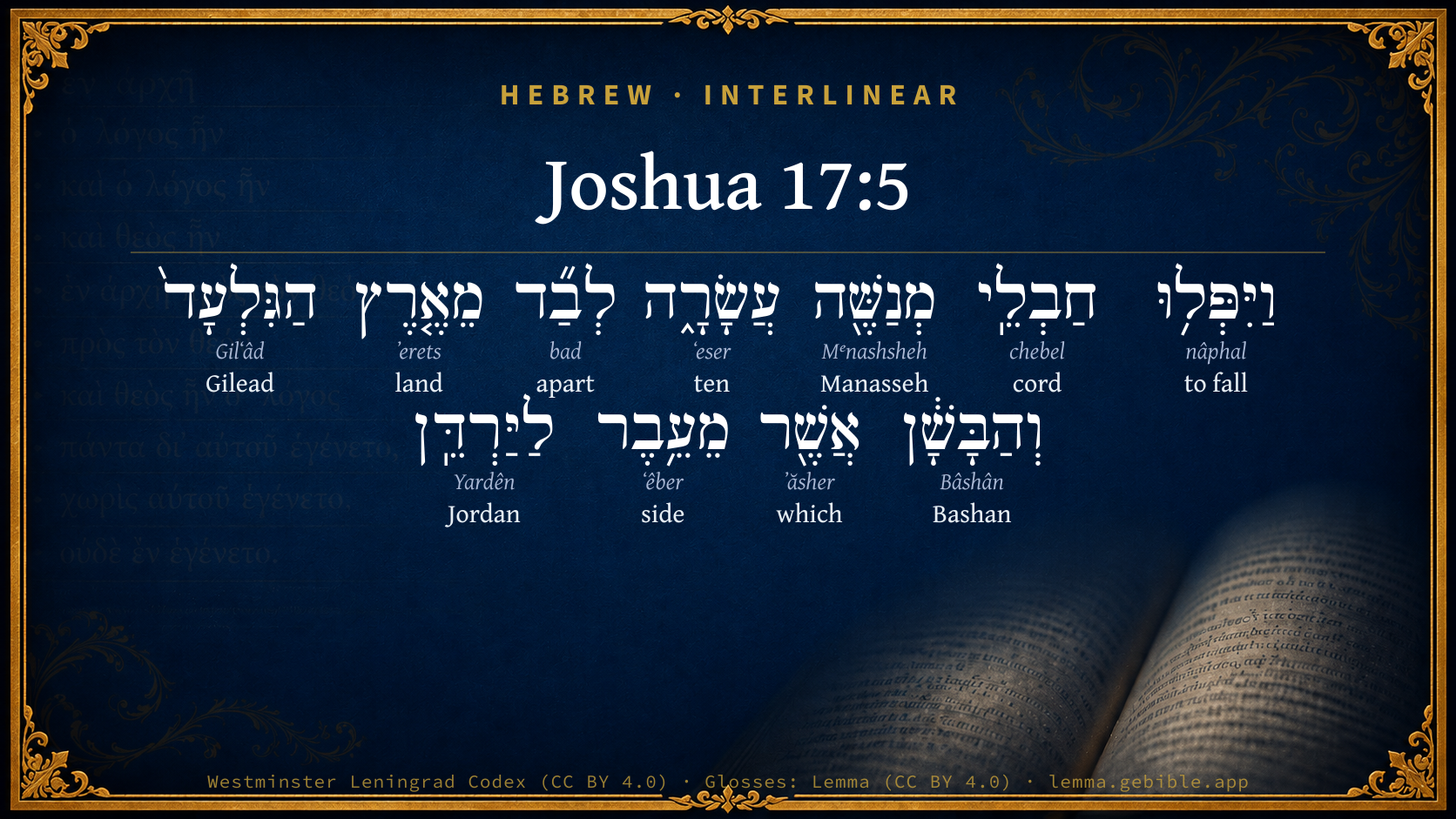
Hebrew (Westminster Leningrad Codex) Joshua 17:5 appears in the Hebrew Old Testament. The text above is from the Westminster Leningrad Codex. Each word links to its Strong’s number, a concise gloss, and parsing drawn from the Open Scriptures Hebrew Bible morphology. Click any word for its full Brown-Driver-Briggs (BDB) entry.
Download image
Cite this verse

Joshua 17:5 (World English Bible). Public Domain. Lemma interlinear Bible study tool, https://lemma.gebible.app/v/joshua/17/5.

Show BibTeX & RIS
BibTeX
RIS
English Translation
There fell ten parts to Manasseh, besides the land of Gilead and Bashan, which is beyond the Jordan;
World English Bible · Public Domain
Download a study sheet

One document with this verse’s original text, its word-by-word gloss line, the meaning frame, cross-references with their text, attributed commentary, and full source and license credits — printable, and it pastes into notes with its structure intact.

This verse Autodidact and up

Study sheet (.html) Plain text (.txt)

A passage Seminary Student

Up to 50 verses in one chapter. A passage sheet keeps up to 6 commentary sources and 12 cross-references per verse, in the order this page ranks them, and says so on the sheet whenever that leaves anything out. Ask for a single verse and you get the Autodidact verse sheet above.

Everything on this page stays free to read, with no account — the sheet is a download of what is already on screen, not access to it.

Want to remove ads? Support Godless Engineer
Compare translations 3

The same verse in 3 English versions, stacked beneath the original-language interlinear above. Click any original word for its lexicon entry.

Each is an independent rendering of the whole verse — the interlinear is not word-aligned to these translations.

Highlighted words mark where these versions differ — a whole-verse word diff, not a word-by-word alignment.

  • World English Bible Public Domain
    There fell ten parts to Manasseh, besides the land of Gilead and Bashan, which is beyond the Jordan;
  • King James Version Public Domain
    And there fell ten portions to Manasseh, beside the land of Gilead and Bashan, which were on the other side Jordan;
  • unfoldingWord Literal Text CC BY-SA 4.0
    So ten portions of Manasseh fell, apart from the land of Gilead and Bashan, which from the other side of the Jordan.

unfoldingWord Literal Text — © unfoldingWord, licensed CC BY-SA 4.0. Word-aligned USFM3 via Door43 (git.door43.org/unfoldingWord/en_ult).

Versions to compare (up to 4)

3 of 4 selected

Show all 18 translations

Every available English version of this verse, each an independent rendering of the whole verse.

  • World English Bible Public Domain
    There fell ten parts to Manasseh, besides the land of Gilead and Bashan, which is beyond the Jordan;
  • Berean Standard Bible Public Domain
    Thus ten shares fell to Manasseh, in addition to the land of Gilead and Bashan beyond the Jordan,
  • Majority Standard Bible Public Domain
    Thus ten shares fell to Manasseh, in addition to the land of Gilead and Bashan beyond the Jordan,
  • King James Version Public Domain
    And there fell ten portions to Manasseh, beside the land of Gilead and Bashan, which were on the other side Jordan;
  • American Standard Version (1901) Public Domain
    And there fell ten parts to Manasseh, besides the land of Gilead and Bashan, which is beyond the Jordan;
  • Revised Version (1885) Public Domain
    And there fell ten parts to Manasseh, beside the land of Gilead and Bashan, which is beyond Jordan;
  • Geneva Bible (1599) Public Domain
    And there fell ten portions to Manasseh, beside the land of Gilead and Bashan, which is on the other side Iorden,
  • Douay-Rheims (1899) Public Domain
    And there fell ten portions to Manasses, beside the land of Galaad and Basan beyond the Jordan.
  • Young's Literal Translation Public Domain
    And ten portions fall `to' Manasseh, apart from the land of Gilead and Bashan, which `are' beyond the Jordan;
  • Literal Standard Version CC BY-SA 4.0
    And ten portions fall [to] Manasseh, apart from the land of Gilead and Bashan, which [are] beyond the Jordan;
  • Unlocked Literal Bible CC BY-SA 4.0
    Ten parcels of land were assigned to Manasseh in Gilead and Bashan, which is on the other side of the Jordan,
  • unfoldingWord Literal Text CC BY-SA 4.0
    So ten portions of Manasseh fell, apart from the land of Gilead and Bashan, which from the other side of the Jordan.
  • Darby Bible Public Domain
    And there fell ten portions to Manasseh, besides the land of Gilead and Bashan, which are beyond the Jordan.
  • World Messianic Bible Public Domain
    Ten parts fell to Manasseh, in addition to the land of Gilead and Bashan, which is beyond the Jordan;
  • Webster's Bible Public Domain
    And there fell ten portions to Manasseh, besides the land of Gilead and Bashan, which were on the other side of Jordan;
  • Free Bible Version CC BY-SA 4.0
    Consequently Manasseh received ten shares of land beside the land of Gilead and Bashan on the other side of the Jordan,
  • Bible in Basic English Public Domain
    And ten parts were given to Manasseh, in addition to the land of Gilead and Bashan, which is on the other side of Jordan;
  • JPS Tanakh (1917) Public Domain
    And there fell ten parts to Manasseh, beside the land of Gilead and Bashan, which is beyond the Jordan;

Literal Standard Version (2020), Covenant Press — licensed CC BY-SA 4.0. Text via the HelloAO Bible API (eBible.org). Unlocked Literal Bible (unfoldingWord) — licensed CC BY-SA 4.0. Text via the HelloAO Bible API (eBible.org). unfoldingWord Literal Text — © unfoldingWord, licensed CC BY-SA 4.0. Word-aligned USFM3 via Door43 (git.door43.org/unfoldingWord/en_ult). Free Bible Version, Dr. Jonathan Gallagher — licensed CC BY-SA 4.0. Text via the HelloAO Bible API (eBible.org).

Word by word

More ways to search: Search by grammar → Find every occurrence → Compare this word →

Practice this passage: Drill this verse → Learn its vocabulary →

וְהַבָּשָׁ֔ן
Bâshân
H1316
“and · the · Bashan”
Conjunction + Particle, Definite Article + Noun, Proper
Part of Speech
Conjunction + Particle + Noun
Type
Proper
Full BDB Definition

Origin: of uncertain derivation

TWOT: None

Bashan = "fruitful" - a district east of the Jordan known for its fertility which was given to the half-tribe of Manasseh
  1. וַיִּפְּל֥וּ nâphal H5307 “and · to fall” Conjunction + Verb, Qal, Sequential Imperfect, 3rd Person, Masculine, Plural
  2. חַבְלֵֽי chebel H2256 “cords of” Noun, Common, Both, Plural, Construct
  3. מְנַשֶּׁ֖ה Mᵉnashsheh H4519 “Manasseh” Noun, Proper
  4. עֲשָׂרָ֑ה ʻeser H6235 “ten” Adjective, Cardinal number, Masculine, Singular, Absolute
  5. לְבַ֞ד bad H905 “to/for · apart” Preposition + Noun, Common, Masculine, Singular, Absolute
  6. מֵאֶ֤רֶץ ʼerets H776 “from · land of” Preposition + Noun, Common, Both, Singular, Construct
  7. הַגִּלְעָד֙ Gilʻâd H1568 “the · Gilead” Particle, Definite Article + Noun, Proper
  8. אֲשֶׁ֖ר ʼăsher H834 “which” Particle, Relative
  9. מֵעֵ֥בֶר ʻêber H5676 “from · side” Preposition + Noun, Common, Masculine, Singular, Absolute
  10. לַיַּרְדֵּֽן Yardên H3383 “to/for the · Jordan” Preposition, Determined + Noun, Proper

About this verse

These counts appear in no published source. They are computed here, from the morphology-tagged text and Lemma’s own curated glosses. What Lemma adds →

11
words
11
distinct lemmas
Historical
section

Shared distinctive vocabulary

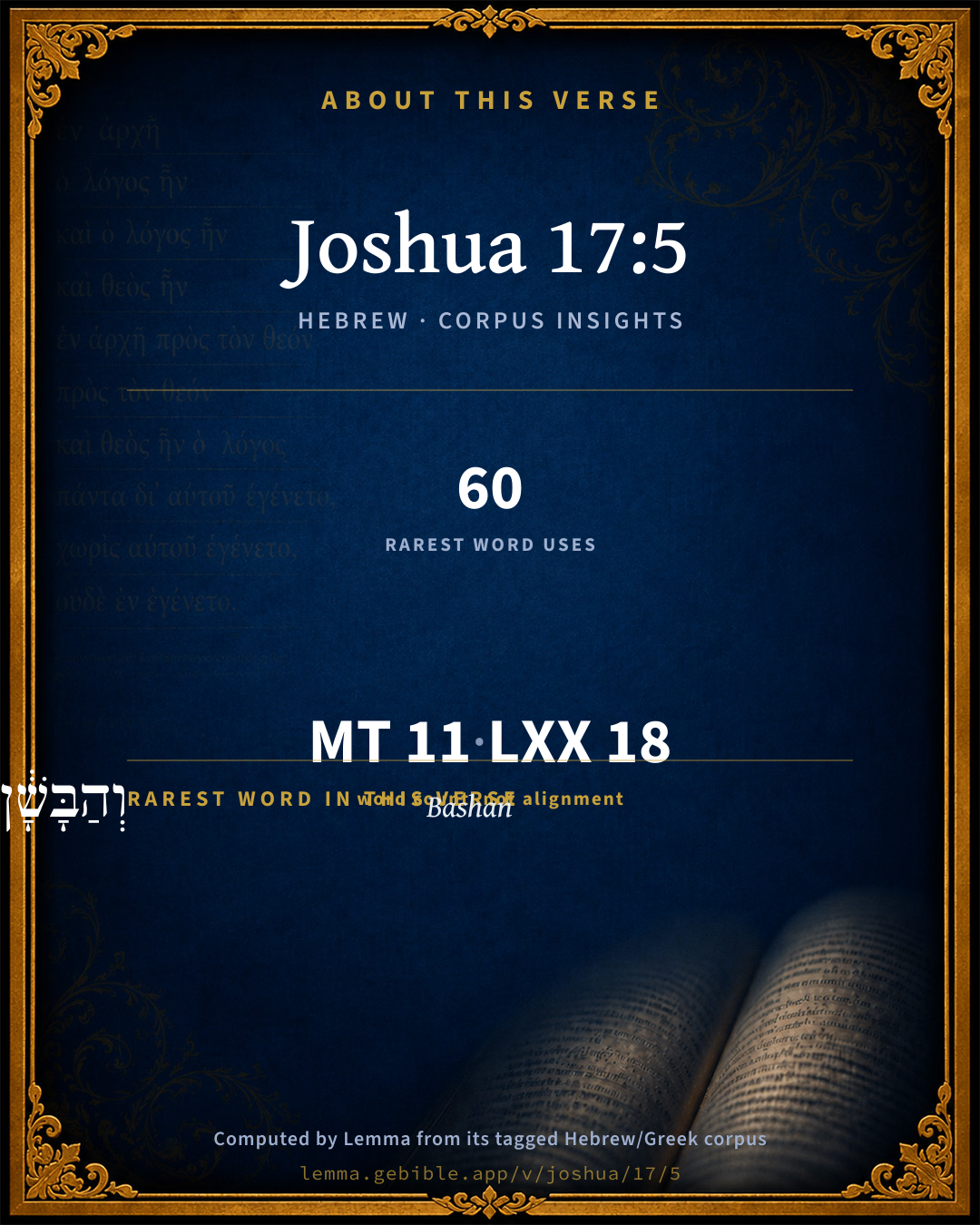
וְהַבָּשָׁ֔ן Bashan H1316 occurs in 53 verses of the Hebrew Bible. Also found in:

Grammatical profile

  • 1 verb
  • 8 nouns
  • 1 adjective
  • 1 particle

Verb forms

  • וַיִּפְּל֥וּ Qal · Sequential Imperfect

Hebrew & Septuagint length

In English translation the verse runs 18 words from the Hebrew and 23 from the Septuagint (LXX English) — closely comparable.

A rough comparison of the two English renderings, which tokenize alike — not a word-level alignment.

Word counts can differ between the Hebrew and the Greek without any difference in meaning — e.g. the Hebrew direct-object marker אֵת has no separate Greek word, and Greek often adds the article ὁ.

In the original languages it is 11 Hebrew tokens and 18 Greek tokens — but the two are counted differently (Hebrew bundles its prefixes and suffixes into one token; the Greek is in lemma form), so that isn’t a like-for-like length.

Cross-references

4

Topical passages linked to Joshua 17:5 in the Treasury of Scripture Knowledge — connected by theme and wording, ordered by reader-vote popularity; previews shown in the World English Bible.

  • Numbers 32:30–42 but if they will not pass over with you armed, they shall have possessions among you in the land of Canaan.
  • Joshua 13:29–31 Moses gave [inheritance] to the half-tribe of Manasseh: and it was for the half-tribe of the children of Manasseh according to their families.
  • Joshua 17:2–3 So [the lot] was for the rest of the children of Manasseh according to their families: for the children of Abiezer, and for the children of Helek, and for the children of Asriel, and for the children of Shechem, and for the children of Hepher, and for the children of Shemida: these were the male children of Manasseh the son of Joseph according to their families.
  • Joshua 17:14 The children of Joseph spoke to Joshua, saying, Why have you given me but one lot and one part for an inheritance, seeing I am a great people, because hitherto Yahweh has blessed me?

Cross-references courtesy of OpenBible.info (CC BY 4.0).

Hebrew and Greek witnesses Masoretic Hebrew ↔ Greek Septuagint

The same verse in the two great witnesses to the Old Testament, shown verse-for-verse.

These are two independent witnesses, not word-aligned to each other, and the Septuagint is shown in lemma (dictionary) form.

Hebrew Joshua 17:5 Masoretic · Westminster Leningrad Codex

וַיִּפְּל֥וּ חַבְלֵֽי מְנַשֶּׁ֖ה עֲשָׂרָ֑ה לְבַ֞ד מֵאֶ֤רֶץ הַגִּלְעָד֙ וְהַבָּשָׁ֔ן אֲשֶׁ֖ר מֵעֵ֥בֶר לַיַּרְדֵּֽן

There fell ten parts to Manasseh, besides the land of Gilead and Bashan, which is beyond the Jordan;

World English Bible · Public Domain

Greek LXX Joshua 17:5 Septuagint · lemma form

καί πίπτω ὁ σχοινισμός αὐτός ἀπό ανασσα καί πεδίον λαβεκ ἐκ ὁ γαλαάδ ὅς εἰμί πέραν ὁ ἰορδάνης

And their lot fell to them from Anassa, and to the plain of Labec of the land of Galaad, which is beyond Jordan.

LXX2012 (modern English Septuagint) · Public Domain

Hebrew: Westminster Leningrad Codex (CC BY 4.0). Greek: Septuagint (public domain); English from LXX2012 (modern English Septuagint) (Public Domain). How the Septuagint differs from the Hebrew →

Targum (Aramaic paraphrase)

1

The Targum is the ancient Jewish Aramaic paraphrase of the Hebrew Scriptures — an interpretive translation, not the Hebrew text itself. Onkelos (literal) and Pseudo-Jonathan (expansive) render the Torah, and Jonathan the Prophets. Coverage is partial: where no permissively-licensed English translation exists for a verse, only the Aramaic is shown. This is verse-level text, not a word-by-word alignment to the Hebrew.

  1. Targum Jonathan Prophets (Joshua–Malachi)
    וּנְפָלוּ עַדְבֵי מְנַשֶׁה עַסְרָא בַּר מֵאֲרְעָא דְגִלְעָד וּמַתְנָן דְמֵעִיבְרָא לְיַרְדְנָא:

    (no public-domain English translation for this verse)

    Targum Jonathan — Aramaic: “Mikraot Gedolot” (public domain). English: “Sefaria Community Translation” (CC0 1.0 (public-domain dedication)); “London "Chaldee Paraphrase," 1871” (public domain). Text via Sefaria.

Commentary

Notes on Joshua 17:5 from classic Christian and Jewish commentators (each source and its license shown beneath its notes). The classic Christian expositions comment on the surrounding passage and are grouped to its opening verse, so a note may address several verses; the Jewish commentaries on the Tanakh (Rashi and others) are per-verse, so they appear only where the commentator wrote on this verse.

Lemma curates 59 commentaries, every one of them public domain or Creative Commons licensed, each selected and text-cleaned for this edition rather than reprinted as found. About our sources →

Trapp's Complete Commentary

John Trapp

Jos 17:5 And there fell ten portions to Manasseh, beside the land of Gilead and Bashan, which [were] on the other side Jordan;

Ver. 5. And there fell ten portions to Manasseh.] Six to his six sons, {Jos 17:2} and the rest to Zelophehad’s daughters.

John Trapp, A Commentary or Exposition upon All the Books of the Old and New Testament (1647–1656) — public domain. Text from a community e-Sword module.

Geneva Bible (1599)

Geneva Bible translators

In the land of Canaan: five to the males: and other five to the daughters of Zelophehad.

Geneva Bible (1599) marginal notes — public domain. Text via Bolls.life.

Adam Clarke's Commentary

Verse 5. There fell ten portions to Manasseh] The Hebrew word חבלי chabley, which we translate portions, signifies literally cords or cables, and intimates that by means of a cord, cable, or what we call a chain, the land was divided. We have but little account of the arts and sciences of the Hebrews, yet from the sketches which we find in different parts of the Old Testament it appears that their minds were in many respects well cultivated; nor could the division, which is mentioned in this book, have been made without such a measure of geographical knowledge, as we find it difficult to grant them. Suppose even in this case, the land was not measured with a chain, which in some cases would have been impracticable, because the ancient inhabitants still occupied the places which were allotted to certain tribes or families; yet the allusion to this mode of measurement shows that it was well known among them.

As there were six sons and five daughters, among whom this division was to be made, there should be eleven portions; but Zelophehad, son of Hepher, having left five daughters in his place, neither he nor Hepher is reckoned. The lot of Manasseh therefore was divided into ten parts; five for the five sons of Gilead, who were Abiezer, Helek, Asriel, Shechem, and Shemida; and five for the five daughters of Zelophehad, viz., Mahlah, Noah, Hoglah, Milcah, and Tirzah.-CALMET.

Adam Clarke's Commentary on the Bible (1810–1826) — public domain. Text from a community e-Sword/MySword module.

John Calvin's Commentaries

5. And there fell ten portions to Manasseh, etc The children of Manasseh are in this passage classed under seven stems. Machir, the first-born, is placed apart; the other six follow. Here the question arises, How was the inheritance divided into ten parts? Some expositors cunningly disguise the difficulty; others, because they are unable to solve it, indulge in the merest trifling. It is certainly very absurd that four portions should be given to five daughters; and it is not a whit more congruous that their share should be doubled because their father was the first-born. It is beyond all controversy, that Gilead, son of Machir, and great-grandfather of the females of whom we are now speaking, chose his settlement in mount Gilead and Bashan. Therefore, seeing he had already obtained an inheritance by privilege without lot, he ought not to have obtained one by lot in the land of Canaan, unless perhaps he settled only a part of his family beyond the Jordan. For Hepher was one of his sons, but not the only one; and likewise the offspring of five other brothers might be distinguished into several heads according to the number of which the allocation by lot might be made. For it is not known in what degree families whose portion fell in the land of Canaan were taken. And all we read here is, that ten lots were east among the sons of Manasseh in addition to the country which they had formerly acquired for themselves beyond the Jordan. It is thus vain to dispute concerning the number, which cannot be ascertained with certainty from the present narrative, because the first thing necessary to be known is the exact number of families to whom the division was common. Nay, it is not impossible that the daughters of Selophead obtained their patrimony there. They are said, indeed, to have dwelt among the brethren of their father; but the place is not given. Be this as it may, I have no doubt that mutual equity was observed, and that after provision was made for others, the land which had been submitted to lot was distributed among ten families whose names are here omitted.

John Calvin's Commentaries (1540-1563) — public domain. Text from the Calvin Translation Society English edition (1840s-50s) via the Christian Classics Ethereal Library (ccel.org). Calvin's coverage is partial (roughly two-thirds of the Bible); uncommented books and verses are honest gaps, never fabricated. The 19th-century editor's footnotes and remarks are omitted so the notes are faithfully Calvin's own voice.

The Cambridge Bible for Schools and Colleges

gen. ed. J. J. S. Perowne

5. And there fell] The inheritance they claimed was now allotted them.

ten portions] The land allotted to the Manassites had to be divided into ten portions. The male descendants consisted of five families, and these five received five shares. The sixth family, that of Hepher, was again subdivided into five families, viz., those of his five granddaughters, the daughters of Zelophehad. They married husbands from the other families of their tribe (Num_36:1-12), and each now received her special share of the land. See Keil’s Commentary.

The Cambridge Bible for Schools and Colleges (gen. ed. J. J. S. Perowne; Cambridge University Press, 1878–1918) — public domain. Text from a community e-Sword module.

John Gill's Exposition

And there fell ten portions to Manasseh, beside the land of Gilead and Bashan, which were on the other side Jordan,.... The lot which fell to the half tribe of Manasseh was divided into ten parts: according to the Jewish writers, the six families before mentioned had six parts, and the daughters of Zelophehad had four parts; one on the account of Zelophehad their father, two on the account of their grandfather Hepher, who they say was the firstborn, and one on account of their uncle, their father's brother, who died in the wilderness without children; so Jarchi and Kimchi relate from the Talmud (k); but the true case seems to be this, there were six portions for the six families, but there being no sons in Hepher's family, his part was divided into five, and given to the five daughters of Zelophehad:

beside the land of Gilead and Bashan, which were on the other side Jordan: which were given to the other half tribe, as before observed, Jos 13:29.

(k) T. Bab. Bava Bathra, fol. 118. 2. & 119. 1.

John Gill's Exposition of the Whole Bible (1746–1763) — public domain (CC PDM 1.0). Text via the HelloAO Bible API.

Albert Barnes' Notes on the Bible

Ten portions - i. e. five for the five families descended from the male children of Gilead, and five others for the five daughters of Zelophehad, who represented the sixth family, the Hepherites.

Albert Barnes' Notes on the Bible (1834–1885) — public domain. Text from a community e-Sword/MySword module.

Haydock's Catholic Bible Commentary

Jordan. Some of the families, which had possessions there already, were permitted to have a share on the west side also. Here Manasses had ten portions, schœnus, or cords, which Herodotus (ii. 6,) reckons to contain each 60 stadia; so that he would have 600 stadia, (Calmet) or at least half of that quantity, chap. xv. 58. (Herodotus ii.) (Haydock) --- There were six sons and five daughters to be provided for. But the portion of Hepher, the father of Salphaad, being given to his granddaughters, his is not counted. (Masius) --- The Jews say the five daughters had only four portions, two for their grandfather, who, they say, was the eldest of the family; one for their father, and another for their uncle, who died without children. (Selden) --- But of this no proof is adduced. (Calmet) --- The five daughters would only have the one portion, which would have been enjoyed by the father. (Menochius) See 1 Paralipomenon v. 23.

George Leo Haydock (1774–1849), Haydock's Catholic Family Bible and Commentary, 1859 edition — public domain. Excludes Psalms (Douay-Rheims chapter numbering differs from Protestant) and Deuterocanonical books (Catholic canon only).

Matthew Poole's English Annotations

Ten portions; either,

1. Six portions for the six sons, whereof one was Hepher; and because he had no sons, his part was subdivided into five equal parts, for each of the daughters. Or,

2. Ten portions, five for the sons, and five for the daughters; for as for Hepher, both he and his son Zelophehad were dead, and that without sons, and therefore he had no portion; but his daughters had several portions allotted to them.

Matthew Poole's English Annotations on the Holy Bible (1683–1685) — public domain. Text from a community e-Sword/MySword module.

Whedon's Commentary on the Bible

Daniel D. Whedon

[5. Ten portions — Or, ten measurements, alluding to the custom of measuring off land with a line or a chain. Since each of the five daughters of Zelophehad obtained a portion, neither Hepher nor Zelophehad are reckoned.

Daniel D. Whedon (gen. ed.), Commentary on the Old and New Testaments (1874–1909) — public domain. Text from a community e-Sword module.

The Pulpit Commentary

And there fell ten portions. Literally, and the measured portions of Manasseh fell ten (in number). It will be observed that the descendants of Manasseh, exclusive of Hepher, are five in number. These, with the five portions allotted to the family of Zelophehad, the son of Hepher, made up ten.

The Pulpit Commentary (1880–1919), ed. H.D.M. Spence-Jones & Joseph S. Exell — public domain. Text from a community e-Sword module.

John Wesley's Explanatory Notes

Ten portions - Five for the sons, and five for the daughters; for as for Hepher, both he and his son Zelophehad was dead, and that without sons, and therefore had no portion; but his daughters had several portions allotted to them.

John Wesley, Explanatory Notes Upon the Whole Bible (1754–1765) — public domain. Text via the GEBible commentary corpus.

unfoldingWord translationNotes

Door43 World Missions Community

Ten parcels of land were assigned

This can be stated in active form. AT: "Joshua assigned ten parcels of land" (See: Active or Passive)

Ten parcels

"Ten portions"

received an inheritance

The land is spoken of as if it were an inheritance that they received as a permanent possession. AT: "received land as an inheritance" (See: Metaphor)

The land of Gilead was assigned

This can be stated in active form. AT: "Joshua assigned the land of Gilead" (See: Active or Passive)

translationWords

Manasseh

Gilead

Bashan

Jordan River

unfoldingWord translationNotes — © Distant Shores Media and the Door43 World Missions Community, licensed CC BY-SA 4.0. Source: git.door43.org/Door43/en_tn.

Rashi

Rabbi Shlomo Yitzchaki (Rashi)

Ten portions of land fell to Menashe. Six portions went to the family divisions mentioned above, and four went to the daughters of Tselophchod, not because each of them was considered an individual family division but rather because they took these four portions: the portion of their father who was one of those who went out of Egypt; since according to the number of those who went out of Egypt was the land divided; the portion their father shared with his brothers in the property of their father, Cheifer, since he too was one of those who went out of Egypt; and since their father, Tselophchod, was the firstborn, he received two portions [of Cheifer’s property]; and an additional portion from their father’s brother who died in the wilderness, without children and they received the inheritance of his share. This was stated by our Sages in Bava Basra. It was unnecessary for Scripture to relate to us the number of the daughters’ share, except to teach us that they took the share of the firstborn, and to inform us that Eretz Yisroel was an actual inheritance to them [since it was considered] the actual possession of their fathers, for the firstborn does not receive an extra portion in potential property as he does in actual property.

Rashi on the Tanakh — English translations: “The Judaica Press complete Tanach with Rashi, translated by A. J. Rosenberg” (CC BY 4.0); “Pentateuch with Rashi's commentary by M. Rosenbaum and A.M. Silbermann, 1929-1934” (public domain); “The Metsudah Tanach series, Lakewood, N.J” (CC BY 4.0); and “The Book of Joshua, Metsudah Publications, 1997” (CC BY 4.0). Text via Sefaria.

Lesson kit

Teaching starters — assembled from the data on this page, not authored interpretation. Every prompt links to the verse data it draws on. Edit before teaching.

Joshua, in the Historical, opens this verse with 11 words (11 distinct Hebrew lemmas). Its most distinctive word is Bâshân (“Bashan”). A historical commentator’s framing appears above. Read the whole chapter for the surrounding context.

Discussion questions

  1. What does “Bashan” (Bâshân) contribute to the verse as a whole?
  2. How does Numbers 21:33, which shares the word «Bashan», read alongside this verse?
  3. These translations render this verse differently; the difference is in the English rendering, not the original. What questions does that raise?
  4. «וַיִּפְּל֥וּ» is a Qal Sequential Imperfect verb. How does that grammatical form shape the action described?
  5. Compare how Trapp's Complete Commentary and Geneva Bible (1599) read this verse. Where do they agree or differ?

Things to notice

Reading settings

Reading text

Shown beneath each verse's original-language words.

Old Testament
Old Testament edition

Read the OT as the Masoretic Hebrew (MT) or the Greek Septuagint (LXX).

English shown for the Greek Septuagint (in the Hebrew ↔ Greek comparison).

Comparing translations? Open the Compare panel on any verse page to stack up to four side by side.