1 Kings 18:7

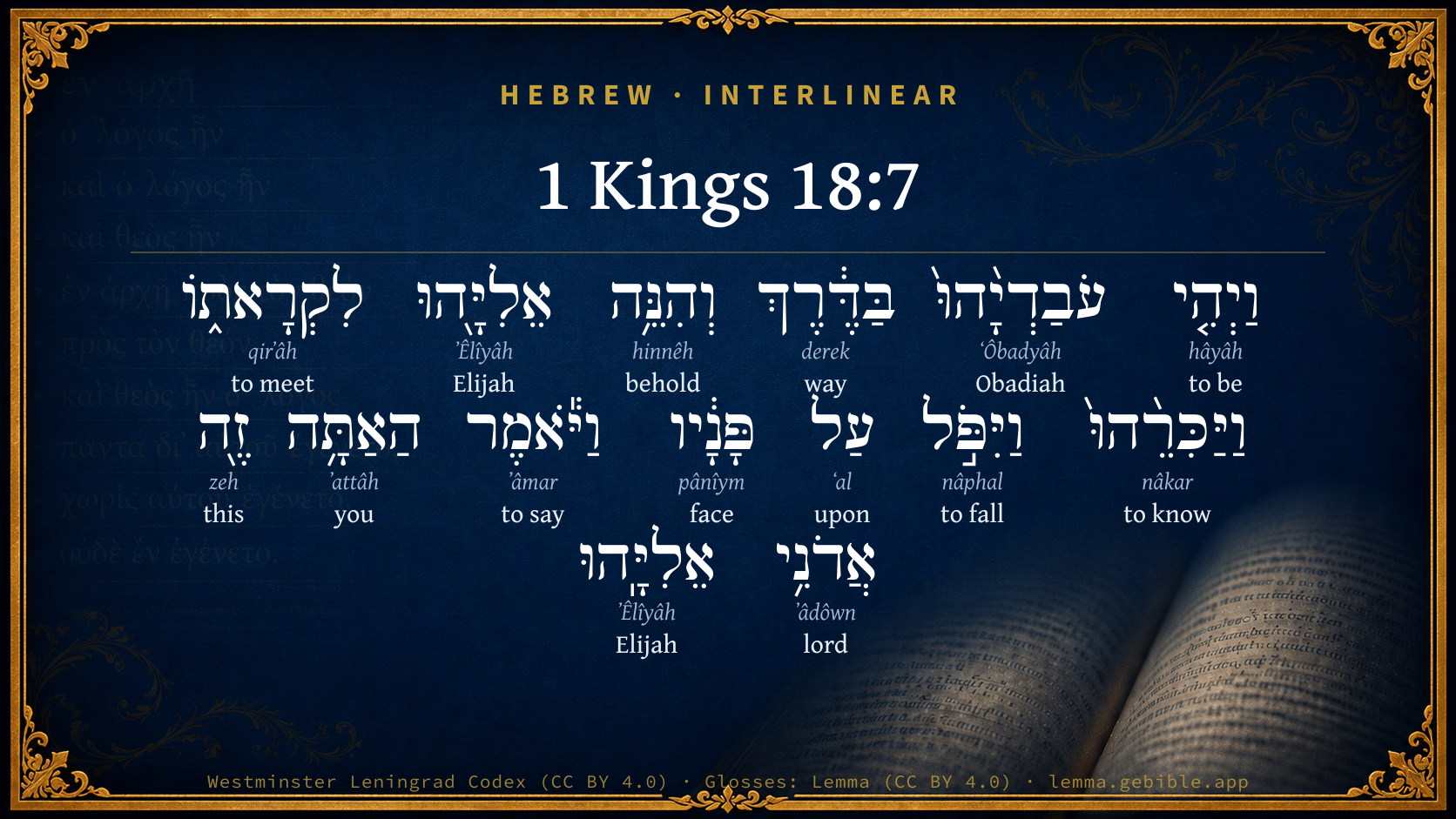
Hebrew (Westminster Leningrad Codex) 1 Kings 18:7 appears in the Hebrew Old Testament. The text above is from the Westminster Leningrad Codex. Each word links to its Strong’s number, a concise gloss, and parsing drawn from the Open Scriptures Hebrew Bible morphology. Click any word for its full Brown-Driver-Briggs (BDB) entry.
Download image
Cite this verse

1 Kings 18:7 (World English Bible). Public Domain. Lemma interlinear Bible study tool, https://lemma.gebible.app/v/1-kings/18/7.

Show BibTeX & RIS
BibTeX
RIS
English Translation
As Obadiah was in the way, behold, Elijah met him: and he knew him, and fell on his face, and said, Is it you, my lord Elijah?
World English Bible · Public Domain
Download a study sheet

One document with this verse’s original text, its word-by-word gloss line, the meaning frame, cross-references with their text, attributed commentary, and full source and license credits — printable, and it pastes into notes with its structure intact.

This verse Autodidact and up

Study sheet (.html) Plain text (.txt)

A passage Seminary Student

Up to 50 verses in one chapter. A passage sheet keeps up to 6 commentary sources and 12 cross-references per verse, in the order this page ranks them, and says so on the sheet whenever that leaves anything out. Ask for a single verse and you get the Autodidact verse sheet above.

Everything on this page stays free to read, with no account — the sheet is a download of what is already on screen, not access to it.

Want to remove ads? Support Godless Engineer
Compare translations 3

The same verse in 3 English versions, stacked beneath the original-language interlinear above. Click any original word for its lexicon entry.

Each is an independent rendering of the whole verse — the interlinear is not word-aligned to these translations.

Highlighted words mark where these versions differ — a whole-verse word diff, not a word-by-word alignment.

  • World English Bible Public Domain
    As Obadiah was in the way, behold, Elijah met him: and he knew him, and fell on his face, and said, Is it you, my lord Elijah?
  • King James Version Public Domain
    And as Obadiah was in the way, behold, Elijah met him: and he knew him, and fell on his face, and said, Art thou that my lord Elijah?
  • unfoldingWord Literal Text CC BY-SA 4.0
    And it happened that Obadiah on the road, and behold, Elijah met him. And he recognized him, and he fell on his face and said, “ this you, my lord Elijah?”

unfoldingWord Literal Text — © unfoldingWord, licensed CC BY-SA 4.0. Word-aligned USFM3 via Door43 (git.door43.org/unfoldingWord/en_ult).

Versions to compare (up to 4)

3 of 4 selected

Show all 18 translations

Every available English version of this verse, each an independent rendering of the whole verse.

  • World English Bible Public Domain
    As Obadiah was in the way, behold, Elijah met him: and he knew him, and fell on his face, and said, Is it you, my lord Elijah?
  • Berean Standard Bible Public Domain
    Now as Obadiah went on his way, Elijah suddenly met him. When Obadiah recognized him, he fell facedown and said, “Is it you, my lord Elijah?”
  • Majority Standard Bible Public Domain
    Now as Obadiah went on his way, Elijah suddenly met him. When Obadiah recognized him, he fell facedown and said, “Is it you, my lord Elijah?”
  • King James Version Public Domain
    And as Obadiah was in the way, behold, Elijah met him: and he knew him, and fell on his face, and said, Art thou that my lord Elijah?
  • American Standard Version (1901) Public Domain
    And as Obadiah was in the way, behold, Elijah met him: and he knew him, and fell on his face, and said, Is it thou, my lord Elijah?
  • Revised Version (1885) Public Domain
    And as Obadiah was in the way, behold, Elijah met him: and he knew him, and fell on his face, and said, Is it thou, my lord Elijah?
  • Geneva Bible (1599) Public Domain
    And as Obadiah was in the way, behold, Eliiah met him: and he knew him, and fell on his face, and said, Art not thou my lord Eliiah?
  • Douay-Rheims (1899) Public Domain
    And as Abdias was in the way, Elias met him: and he knew him, and fell on his face, and said: Art thou my lord Elias?
  • Young's Literal Translation Public Domain
    and Obadiah `is' in the way, and lo, Elijah -- to meet him; and he discerneth him, and falleth on his face, and saith, `Art thou he -- my lord Elijah?'
  • Literal Standard Version CC BY-SA 4.0
    and Obadiah [is] in the way, and behold, Elijah [is there] to meet him; and he discerns him, and falls on his face and says, “Are you he—my lord Elijah?”
  • Unlocked Literal Bible CC BY-SA 4.0
    As Obadiah was on the road, Elijah unexpectedly met him. Obadiah recognized him and lay facedown on the ground. He said, “Is it you, my master Elijah?”
  • unfoldingWord Literal Text CC BY-SA 4.0
    And it happened that Obadiah on the road, and behold, Elijah met him. And he recognized him, and he fell on his face and said, “ this you, my lord Elijah?”
  • Darby Bible Public Domain
    And as Obadiah was on the way, behold, Elijah met him; and he knew him, and fell on his face, and said, Is it indeed thou, my lord Elijah?
  • World Messianic Bible Public Domain
    As Obadiah was on the way, behold, Elijah met him. He recognized him, and fell on his face, and said, “Is it you, my lord Elijah?”
  • Webster's Bible Public Domain
    And as Obadiah was in the way, behold, Elijah met him: and he knew him, and fell on his face, and said, Art thou that my lord Elijah?
  • Free Bible Version CC BY-SA 4.0
    As Obadiah went on his way, Elijah came to meet him. Obadiah recognized him, bowed down to the ground, and said, “Is it you, my lord Elijah?”
  • Bible in Basic English Public Domain
    And while Obadiah was on his way, he came face to face with Elijah; and seeing who it was, he went down on his face and said, Is it you, my lord Elijah?
  • JPS Tanakh (1917) Public Domain
    And as Obadiah was in the way, behold, Elijah met him; and he knew him, and fell on his face, and said: 'Is it thou, my lord Elijah?'

Literal Standard Version (2020), Covenant Press — licensed CC BY-SA 4.0. Text via the HelloAO Bible API (eBible.org). Unlocked Literal Bible (unfoldingWord) — licensed CC BY-SA 4.0. Text via the HelloAO Bible API (eBible.org). unfoldingWord Literal Text — © unfoldingWord, licensed CC BY-SA 4.0. Word-aligned USFM3 via Door43 (git.door43.org/unfoldingWord/en_ult). Free Bible Version, Dr. Jonathan Gallagher — licensed CC BY-SA 4.0. Text via the HelloAO Bible API (eBible.org).

Word by word

More ways to search: Search by grammar → Find every occurrence → Compare this word →

Practice this passage: Drill this verse → Learn its vocabulary →

עֹבַדְיָ֨הוּ֙
ʻÔbadyâh
H5662
“Obadiah”
Noun, Proper
Part of Speech
Noun
Type
Proper
Full BDB Definition

Origin: act part of H5647 and H3050

TWOT: None

Obadiah = "servant of Jehovah" - the 4th of the 12 minor prophets; nothing personal is known of him but it is probable that he was contemporary with Jeremiah, Ezekiel, and Daniel - the prophetic book by him; prophesies against Edom - father of Ishmaiah, one of the chiefs of Zebulun in the time of David - a Merarite Levite overseer of the work of restoring the temple in the time of king Josiah of Judah - chief of the household of king Ahab of Israel; an devout worshipper of Jehovah who at risk to his own life hid over 100 prophets during the persecution of Jezebel - a descendant of David - a chief of the tribe of Issachar - a Benjamite, one of the 6 sons of Azel and a descendant of king Saul - a Levite, son of Shemaiah and a descendant of Jeduthun - a Gadite chief, the 2nd of the lion-faced Gadites who joined David at Ziklag - a prince of Judah in the time of king Jehoshaphat of Judah - a priest, son of Jehiel of the sons of Joab who returned from exile with Ezra - a gatekeeper in the time of Nehemiah - one of the men who sealed the covenant with Nehemiah - perhaps the same as 12
  1. וַיְהִ֤י hâyâh H1961 “and · to be” Conjunction + Verb, Qal, Sequential Imperfect, 3rd Person, Masculine, Singular
  2. בַּדֶּ֔רֶךְ derek H1870 “in/at the · way” Preposition, Determined + Noun, Common, Both, Singular, Absolute
  3. וְהִנֵּ֥ה hinnêh H2009 “and · behold” Conjunction + Particle, Demonstrative
  4. אֵלִיָּ֖הוּ ʼÊlîyâh H452 “Elijah” Noun, Proper
  5. לִקְרָאת֑וֹ qirʼâh H7125 “to meet · him” Preposition + Verb, Qal, Infinitive Construct + Suffix, Personal, 3rd Person, Masculine, Singular
  6. וַיַּכִּרֵ֨הוּ֙ nâkar H5234 “and · to know · him” Conjunction + Verb, Hiphil, Sequential Imperfect, 3rd Person, Masculine, Singular + Suffix, Personal, 3rd Person, Masculine, Singular
  7. וַיִּפֹּ֣ל nâphal H5307 “and · to fall” Conjunction + Verb, Qal, Sequential Imperfect, 3rd Person, Masculine, Singular
  8. עַל ʻal H5921 “upon” Preposition
  9. פָּנָ֔יו pânîym H6440 “face(s) · his” Noun, Common, Both, Plural, Construct + Suffix, Personal, 3rd Person, Masculine, Singular
  10. וַיֹּ֕אמֶר ʼâmar H559 “and · to say” Conjunction + Verb, Qal, Sequential Imperfect, 3rd Person, Masculine, Singular
  11. הַאַתָּ֥ה ʼattâh H859 “you” Particle, Interrogative + Pronoun, Personal, 2nd Person, Masculine, Singular
  12. זֶ֖ה zeh H2088 “this” Pronoun, Demonstrative, Masculine, Singular
  13. אֲדֹנִ֥י ʼâdôwn H113 “lord · my” Noun, Common, Masculine, Singular, Construct + Suffix, Personal, 1st Person, Common, Singular
  14. אֵלִיָּֽהוּ ʼÊlîyâh H452 “Elijah” Noun, Proper

About this verse

These counts appear in no published source. They are computed here, from the morphology-tagged text and Lemma’s own curated glosses. What Lemma adds →

15
words
14
distinct lemmas
Historical
section

Notable vocabulary

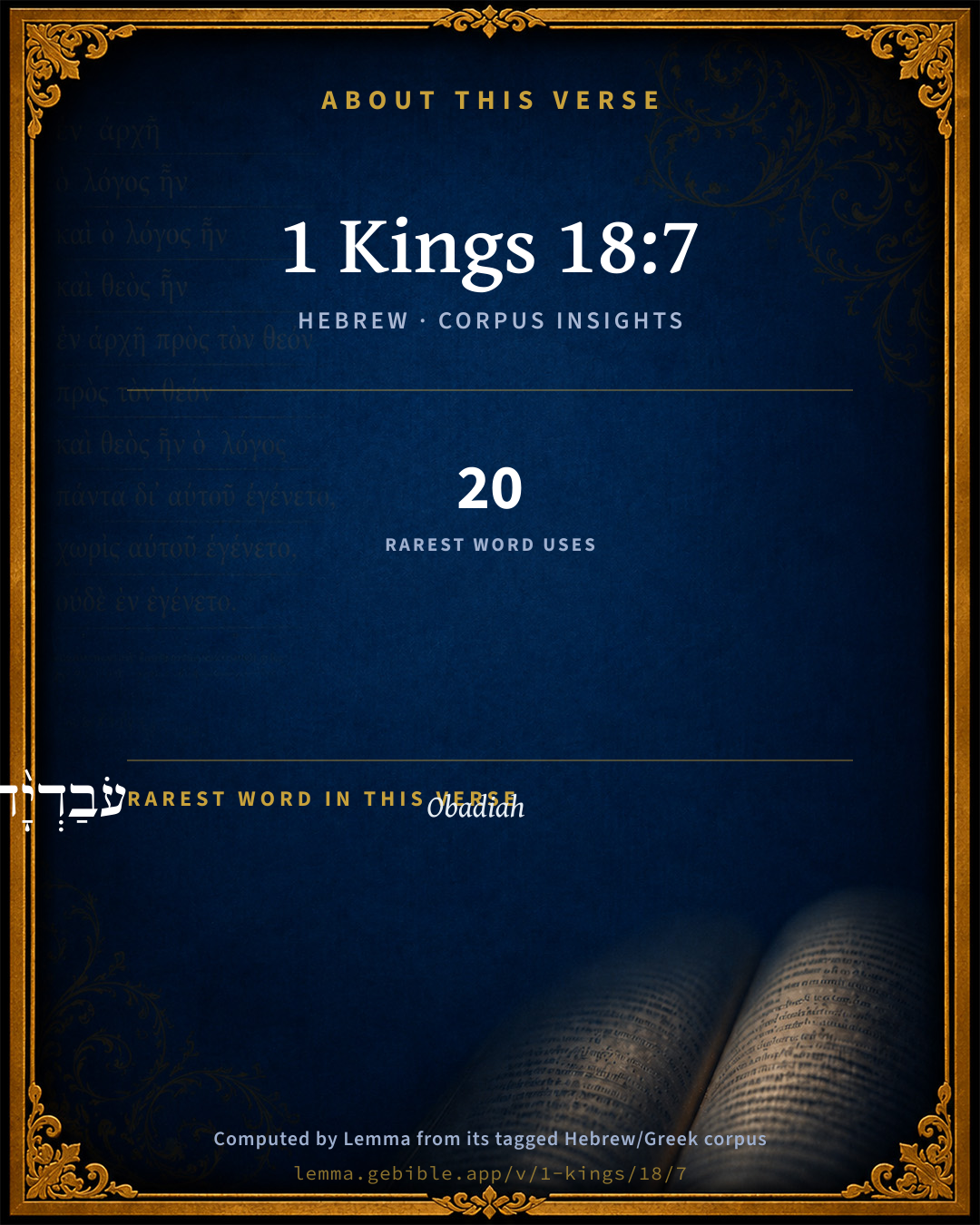
The rarest word here is עֹבַדְיָ֨הוּ֙ Obadiah H5662 — appearing just 20 times in the whole Hebrew Bible.

Shared distinctive vocabulary

עֹבַדְיָ֨הוּ֙ Obadiah H5662 occurs in 19 verses of the Hebrew Bible. Also found in:

Grammatical profile

  • 5 verbs
  • 6 nouns
  • 2 pronouns
  • 1 preposition
  • 1 particle

Verb forms

  • וַיְהִ֤י Qal · Sequential Imperfect
  • לִקְרָאת֑וֹ Qal · Infinitive Construct
  • וַיַּכִּרֵ֨הוּ֙ Hiphil · Sequential Imperfect
  • וַיִּפֹּ֣ל Qal · Sequential Imperfect
  • וַיֹּ֕אמֶר Qal · Sequential Imperfect

Repetition

A word recurs within this verse — often emphatic in Hebrew:

  • אֵלִיָּ֖הוּ Elijah H452 ×2

Hebrew & Septuagint length

In English translation the verse runs 27 words from the Hebrew and 31 from the Septuagint (LXX English) — closely comparable.

A rough comparison of the two English renderings, which tokenize alike — not a word-level alignment.

Word counts can differ between the Hebrew and the Greek without any difference in meaning — e.g. the Hebrew direct-object marker אֵת has no separate Greek word, and Greek often adds the article ὁ.

Cross-references

14

Topical passages linked to 1 Kings 18:7 in the Treasury of Scripture Knowledge — connected by theme and wording, ordered by reader-vote popularity; previews shown in the World English Bible.

  • 2 Kings 1:6–8 They said to him, There came up a man to meet us, and said to us, Go, turn again to the king who sent you, and tell him, Thus says Yahweh, Is it because there is no God in Israel, that you send to inquire of Baal Zebub, the god of Ekron? therefore you shall not come down from the bed where you are gone up, but shall surely die.
  • Genesis 18:2 He lifted up his eyes and looked, and saw that three men stood opposite him. When he saw them, he ran to meet them from the tent door, and bowed himself to the earth,
  • Genesis 18:12 Sarah laughed within herself, saying, "After I have grown old will I have pleasure, my lord being old also?"
  • Genesis 44:16 Judah said, "What will we tell my lord? What will we speak? Or how will we clear ourselves? God has found out the iniquity of your servants. Behold, we are my lord's bondservants, both we, and he also in whose hand the cup is found."
  • Genesis 44:20 We said to my lord, 'We have a father, an old man, and a child of his old age, a little one; and his brother is dead, and he alone is left of his mother; and his father loves him.'
  • Genesis 44:33 Now therefore, please let your servant stay instead of the boy, a bondservant to my lord; and let the boy go up with his brothers.
  • Genesis 50:18 His brothers also went and fell down before his face; and they said, "Behold, we are your servants."
  • 1 Samuel 20:41 As soon as the boy was gone, David arose out of [a place] toward the South, and fell on his face to the ground, and bowed himself three times: and they kissed one another, and wept one with another, until David exceeded.
  • 2 Samuel 19:18 There went over a ferry-boat to bring over the king's household, and to do what he thought good. Shimei the son of Gera fell down before the king, when he was come over the Jordan.
  • 1 Kings 11:29 It happened at that time, when Jeroboam went out of Jerusalem, that the prophet Ahijah the Shilonite found him in the way; now [Ahijah] had clad himself with a new garment; and they two were alone in the field.
  • Isaiah 60:14 The sons of those who afflicted you shall come bending to you; and all those who despised you shall bow themselves down at the soles of your feet; and they shall call you The city of Yahweh, The Zion of the Holy One of Israel.
  • Matthew 11:8 But what did you go out to see? A man in soft clothing? Behold, those who wear soft clothing are in king's houses.
  • Numbers 12:11 Aaron said to Moses, Oh, my lord, please don't lay sin on us, for that we have done foolishly, and for that we have sinned.
  • Matthew 3:4 Now John himself wore clothing made of camel's hair, with a leather belt around his waist. His food was locusts and wild honey.

Cross-references courtesy of OpenBible.info (CC BY 4.0).

Hebrew and Greek witnesses Masoretic Hebrew ↔ Greek Septuagint

The same verse in the two great witnesses to the Old Testament, shown verse-for-verse.

These are two independent witnesses, not word-aligned to each other, and the Septuagint is shown in lemma (dictionary) form.

Hebrew 1 Kings 18:7 Masoretic · Westminster Leningrad Codex

וַיְהִ֤י עֹבַדְיָ֨הוּ֙ בַּדֶּ֔רֶךְ וְהִנֵּ֥ה אֵלִיָּ֖הוּ לִקְרָאת֑וֹ וַיַּכִּרֵ֨הוּ֙ וַיִּפֹּ֣ל עַל פָּנָ֔יו וַיֹּ֕אמֶר הַאַתָּ֥ה זֶ֖ה אֲדֹנִ֥י אֵלִיָּֽהוּ

As Obadiah was in the way, behold, Elijah met him: and he knew him, and fell on his face, and said, Is it you, my lord Elijah?

World English Bible · Public Domain

Greek LXX 1 Kings 18:7 Septuagint · lemma form

καί εἰμί αβδιου ἐν ὁ ὁδός μόνος καί ἔρχομαι ηλιου εἰς συνάντησις αὐτός μόνος καί αβδιου σπεύδω καί πίπτω ἐπί πρόσωπον αὐτός καί εἶπον εἰ σύ εἰμί αὐτός κύριος ἐγώ ηλιου

And Abdiu was alone in the way; and Eliu came alone to meet him: and Abdiu hasted, and fell upon his face, and said, My lord Eliu, are you indeed he?

LXX2012 (modern English Septuagint) · Public Domain

On this verse, Ellicott's Commentary for English Readers discusses the Septuagint’s reading. Read the note in Commentary ↓

Hebrew: Westminster Leningrad Codex (CC BY 4.0). Greek: Septuagint (public domain); English from LXX2012 (modern English Septuagint) (Public Domain). How the Septuagint differs from the Hebrew →

Targum (Aramaic paraphrase)

1

The Targum is the ancient Jewish Aramaic paraphrase of the Hebrew Scriptures — an interpretive translation, not the Hebrew text itself. Onkelos (literal) and Pseudo-Jonathan (expansive) render the Torah, and Jonathan the Prophets. Coverage is partial: where no permissively-licensed English translation exists for a verse, only the Aramaic is shown. This is verse-level text, not a word-by-word alignment to the Hebrew.

  1. Targum Jonathan Prophets (Joshua–Malachi)
    וַהֲוָה עוֹבַדְיָהוּ אָזֵיל בְּאוֹרְחָא וְהָא אֵלִיָהוּ לָקֳדָמוּתֵיהּ וְאִשְׁתְּמוֹדָעֵיהּ וּנְפַל עַל אַפּוֹהִי וַאֲמַר הַאַתְּ דֵין רִבּוֹנִי אֵלִיָהוּ:

    (no public-domain English translation for this verse)

    Targum Jonathan — Aramaic: “Mikraot Gedolot” (public domain). English: “Sefaria Community Translation” (CC0 1.0 (public-domain dedication)); “London "Chaldee Paraphrase," 1871” (public domain). Text via Sefaria.

Commentary

Notes on 1 Kings 18:7 from classic Christian and Jewish commentators (each source and its license shown beneath its notes). The classic Christian expositions comment on the surrounding passage and are grouped to its opening verse, so a note may address several verses; the Jewish commentaries on the Tanakh (Rashi and others) are per-verse, so they appear only where the commentator wrote on this verse.

Lemma curates 59 commentaries, every one of them public domain or Creative Commons licensed, each selected and text-cleaned for this edition rather than reprinted as found. About our sources →

Trapp's Complete Commentary

John Trapp

1Ki 18:7 And as Obadiah was in the way, behold, Elijah met him: and he knew him, and fell on his face, and said, [Art] thou that my lord Elijah?

Ver. 7. And he knew him.] They were of old acquaintance, doubtless, so good a man, and so great a prophet. Mr Fox, when a great lord, and wicked, met him in the streets, and asked him, How do you, Mr Fox? he said little. When the great lord said, Do you not know me? No, not I, said Mr Fox. I am such a one, said he. Sir, I desire, said Mr Fox, to know none but Christ and him crucified. At another time being asked whether he knew such a godly poor man, he answered, I remember him well: I tell you, I forget lords and ladies to remember such.

John Trapp, A Commentary or Exposition upon All the Books of the Old and New Testament (1647–1656) — public domain. Text from a community e-Sword module.

Joseph Benson's Commentary

1Ki 18:7-8. He knew him, and fell on his face — Showing his great respect and love to him, by this profound reverence. Art thou that my lord Elijah? — As Obadiah had showed the tenderness of a father to the sons of the prophets, so he showed the reverence of a son to this father of the prophets; and by this he made it appear, that he did indeed fear the Lord greatly, in that he did such honour to one that was God’s extraordinary ambassador, and had a great interest in heaven. Go tell thy lord, Behold, Elijah is here — Thus, though Ahab was a very wicked man, he owns him for Obadiah’s lord and king; thereby instructing us, that the wickedness of kings doth not exempt their subjects from obedience to their lawful commands.

Joseph Benson's Commentary on the Old and New Testaments (1811–1818) — public domain. Text from a community e-Sword module.

Geneva Bible (1599)

Geneva Bible translators

God pitieth oft times the wicked for the godly’s sake, and causeth Elijah to meet with Obadiah, that the benefit might be known to be granted for God’s children’s sake.

Geneva Bible (1599) marginal notes — public domain. Text via Bolls.life.

Jamieson, Fausset & Brown

Robert Jamieson, A. R. Fausset & David Brown

Obadiah was in the way . . . Elijah met him--Deeming it imprudent to rush without previous intimation into Ahab's presence, the prophet solicited Obadiah to announce his return to Ahab. The commission, with a delicate allusion to the perils he had already encountered in securing others of God's servants, was, in very touching terms, declined, as unkind and peculiarly hazardous. But Elijah having dispelled all the apprehensions entertained about the Spirit's carrying him away, Obadiah undertook to convey the prophet's message to Ahab and solicit an interview. But Ahab, bent on revenge, or impatient for the appearance of rain, went himself to meet Elijah.

Jamieson, Fausset & Brown — Commentary Critical and Explanatory on the Whole Bible (1871) — public domain (CC PDM 1.0). Text via the HelloAO Bible API.

Ellicott's Commentary for English Readers

(7) Art thou that . . .—The sense is either (as the LXX. has it) “Is it thy very self, my lord Elijah?” or (perhaps more suitably to the context), “Thou here, my lord Elijah,” when all seek thy life? The prophet’s answer is still simpler in its original brevity, “Behold, Elijah!” standing in dignified contrast with the humble and almost servile address of Obadiah, which is clearly the offspring not only of reverence, but of fear.

A Bible Commentary for English Readers, edited by Charles John Ellicott (1878–1897) — public domain. Text from a community e-Sword module.

The Cambridge Bible for Schools and Colleges

gen. ed. J. J. S. Perowne

7–16. Meeting of Obadiah and Elijah (Not in Chronicles)

7. and he knew him] The prophet’s garb would probably make him easy to be recognized, and he must have been seen more than once in Samaria, and by Ahab’s household. The LXX. renders καὶ ἔσπευσε = and he hastened.

fell on his face] For to Obadiah Elijah would seem to be God’s special representative, and the champion of the cause of the true religion. Josephus, wrongly, represents Elijah as bowing down to Obadiah. The expressions ‘lord’ and ‘servant’ or rather ‘slave’ used by Obadiah are indexes of his fear of Elijah.

Art thou that my lord Elijah?] R.V. better, ‘Is it thou, my lord Elijah?’ The word which A.V. translates is merely an addition to render the pronoun emphatic. See note on 1Ki_17:2-7, where the emphatic particle is the same as in this verse.

The Cambridge Bible for Schools and Colleges (gen. ed. J. J. S. Perowne; Cambridge University Press, 1878–1918) — public domain. Text from a community e-Sword module.

John Gill's Exposition

And as Obadiah was in the way,.... In his district, making his observations:

behold, Elijah met him: where is not said; but he was, no doubt, upon the road from Zarephath to Samaria:

and he knew him that is, Obadiah knew Elijah, having seen him at Ahab's court before he absconded:

and fell on his face, and said, art thou that my lord Elijah? thus doing him honour and reverence both by words and gesture, as being an extraordinary prophet of the Lord.

John Gill's Exposition of the Whole Bible (1746–1763) — public domain (CC PDM 1.0). Text via the HelloAO Bible API.

Haydock's Catholic Bible Commentary

Face, to shew him a religious veneration, due to the servant of God. (Worthington)

George Leo Haydock (1774–1849), Haydock's Catholic Family Bible and Commentary, 1859 edition — public domain. Excludes Psalms (Douay-Rheims chapter numbering differs from Protestant) and Deuterocanonical books (Catholic canon only).

Matthew Poole's English Annotations

By this profound reverence showing his great respect and love to him.

Matthew Poole's English Annotations on the Holy Bible (1683–1685) — public domain. Text from a community e-Sword/MySword module.

Whedon's Commentary on the Bible

Daniel D. Whedon

7. Thou that my lord Elijah — His language, as well as his action, on meeting and recognising Elijah, was full of emotion and surprise. Is it thou, to find whom every royal device has been exhausted; thou, Elijah, in broad daylight, right here near the gates of Samaria!

Daniel D. Whedon (gen. ed.), Commentary on the Old and New Testaments (1874–1909) — public domain. Text from a community e-Sword module.

The Pulpit Commentary

And as Obadiah Was in the way, behold, Elijah met him Heb. to meet him: and he knew i.e., recognized. Same word, (Gen_27:23 Gen_43:7, etc.) him, and fell on his face, and said, Art thou that Heb. this, probably used adverbially (like hic) for here = Hz,b; my lord Elijah? The humble obeisance and the terms in which he addresses him alike show the profound reverence with which Obadiah regarded him, as well he might do, considering the terrible power he wielded. The whole land was, so to speak, at his mercy.

Vers. 7-16.

The Servant of the Lord.

Such is the meaning of Obadiah"s name; and so truly descriptive of his character is it that we may take him as a typical servant of God.

I HE FEARED THE LORD FROM HIS YOUTH.

1. Piety is not natural.

(1) On the contrary, we inherit a depraved heart (Gen_5:8; Psa_51:5; Rom_5:12; Eph_2:3)

(2) And this depravity is complete (Gen_6:5; Isa_1:5, Isa_1:6; Rom_3:9-19)

(3) Life is only tolerable through the meliorating influences of the "gospel of the grace of God." To these must be attributed whatever seems good in unconverted men. (Rom_1:28-32)

2. Grace is free.

(1) All are directly the subjects of its illuminations, restraints, and encouragements (Joh_1:9; 1Co_12:7)

(2) Some are indirectly specially favoured. Being surrounded by Christian influences. Being children of godly parents.

(3) These opportunities, if duly improved, will infallibly lead to salvation. (Tit_2:11-14)

3. Those who fear God from their youth have great advantages.

(1) They have not given evil habits time to consolidate into rigidity. Time is necessary to this, for habits are strengthened by repetition. The hard crystallization of bad habits renders the conversion of old sinners very difficult. Therefore, how few are such conversions, comparatively!

(2) They have a splendid opportunity of founding a strong character of goodness. When the habit of resisting temptation is formed, it becomes more and more natural and easy to resist. Hence, like Obadiah, who "feared the Lord from his youth," they will come to fear Him "greatly.

II HE FEARED THE LORD GREATLY. See the manifestation of this in his I Respect for the ambassador of God.

(1) He "knew Elijah." Probably he had been present when the prophet warned the king that his fire god would be made to punish his votaries in the absence of dew and rain. (1Ki_17:1) The godly, having sympathy with the ministers of God, are quick to recognize them.

(2) He "fell on his face before him." This was the form of a most respectful salutation. He honoured in him that God whose ambassador he was. Obadiah feared the Lord too greatly to give to any creature the homage due to God alone.

(3) He addressed him reverently, "My lord Elijah." And he spoke of himself as" thy servant." This was proper on his part; but we note how Elijah transferred the style to Ahab tell thy lord, Behold, Elijah is here.

2. Kindness to the servants of God.

(1) Through the sin of Jeroboam the priests and Levites went into Judah. (2Ch_11:18, 2Ch_11:14) To supply their lack in Ephraim, prophets" colleges were established. The students in these colleges were called "sons of the prophets". (see 2Ki_2:3, 2Ki_2:5, 2Ki_2:7)

(2) These, together with their masters, or "fathers," were probably the objects of Jezebel"s resentment when Elijah could not be found. They are called "prophets of the Lord". (ver. 13; compare 1Ki_22:35, 1Ki_22:38, 1Ki_22:41)

(3) At the time of that persecution Obadiah sheltered and fed one hundred of these. This he did at the hazard of his life. Because he feared the Lord greatly, he feared not the wrath of the king. (compare Heb_11:23, Heb_11:27)

3. Faith in the power of God.

(1) He believed that Jehovah might raise a wind that could carry Elijah away from the power of Ahab. He doubtless knew that Enoch had been translated into the heavens, and may have known of examples of translations from one locality to another, not recorded in the earlier Scriptures (compare 2Ki_2:11-16; Eze_3:14; Act_8:39)

(2) A being who could do such wonders, and whose power was now terribly manifest in the drought, was greatly to be feared. (see Matthew Luk_12:5)

(3) But while God is of all enemies the most formidable, He is an Almighty Friend.

III HE FAITHFULLY SERVED HIS KING.

1. God-fearing men make good citizens.

(1) Wicked as Ahab was, he preferred Obadiah to the courtiers of Jezebel in the high office of chamberlain.

(2) This is not a solitary case. Joseph over the house of Pharaoh. Daniel in the house of the kings of Babylon. Christians were in the household even of Nero.

(3) The qualities of a servant of the Lord truth, honour, diligence are those sought after for places of trust. "Godliness is profitable unto all things" (1Ti_4:8; Isa_58:14)

2. God preserves them in their faithfulness.

(1) Service in a licentious court Obadiah would not have chosen. But he is in it and maintains his integrity. They that fear the Lord need not go out of the world.

(2) They have a testimony for God.

(3) They have opportunities of serving the servants of the Lord.

Let us not murmur at our providential lot. God can change it if He see fit. If He does not change it, then He has a purpose in it which we should endeavor to fulfil. J.A.M.

HOMILIES BY J. WAITE Vers. 7-16.

Obadiah.

It is a proof of the extremity of distress to which the land had been reduced by famine that the king himself with one of his highest officers, the governor of his household, should have gone forth on this expedition in search of water and pasturage. The reverence the person of Elijah inspired is seen in the behaviour of Obadiah towards him when they met. The brief notice we have of this man is highly instructive.

I HIS FIDELITY. His name, Obadiah, "servant of Jehovah," is suggestive of the strength of his religious character. And it was probably no vain boast that he had always sustained it (ver. 12). It may seem strange that so good a man should have been willing to remain in the service of such a king, and of a state so demoralized and disorganized by the spirit of idolatry. But note

1. Religious fidelity wins respect even from those whose own life is most at variance with it. Ahab must have known that his servant remained true to the God of his fathers, and his being continued in such a post was a testimony to his moral and practical worth. Like Joseph in the court of Pharaoh, and Daniel in Babylon, "the Spirit of God was in him," and the king could find none more worthy of his trust. The fear of God is after all one of the highest qualifications for the secular businesses and responsibilities of life, and "when a man"s ways please the Lord he maketh even his enemies to be at peace with him". (Pro_16:7)

1. It is often a noble thing to stand at the post of duty, however uncongenial the moral atmosphere may be. We have no reason to believe that Obadiah retained his position by any kind of moral laxity. He did not violate his conscience in maintaining his secular allegiance. Naaman the Syrian, in the zeal of his new devotion to the God of Israel, asked a dispensation of forgiveness if he should bow with his master in the house

2. of Rimmon, (2Ki_5:18) but we have no evidence even of such a compromise as this in the case of Obadiah. There are times when religious principle itself dictates that men should refuse to relinquish positions of peculiar danger and difficulty; but when fidelity to an earthly master is absolutely incompatible with fidelity to God, an upright spirit will not long hesitate.

3. God may have some great purpose for His servant in such a case to fulfil. Obadiah"s mission may have been to mitigate as far as possible the horrors of the famine, to save as he did the lives of the sons of the prophets (ver. 13); to exert, perhaps, some kind of restraining influence over the conduct of the king. At all events the presence of such a man in one of the high places of the land would be a standing proof that God had not utterly abandoned His people. Every situation in life has its grand opportunities; when there is no possible way of turning it to good account we may well forsake it.

II HIS FEAR. "What have I sinned?" etc. Faithful as Obadiah was, there was an element of timidity in his nature. He shrank from the risk the commission of the prophet imposed on him. His timidity has two aspects.

1. So far as it meant distrust of Ahab it was natural. He knew only too well his capricious and despotic temper, and could not rely either on his justice or his clemency. "The tender mercies of the wicked are cruel". (Pro_12:10) "Let me not fall into the hands of man," etc.. (2Sa_24:14)

2. So far as it meant distrust of Elijah or of the protective providence of God it was wrong. Could he think that the prophet would abuse his confidence, or that God would be unmindful of him, and after allowing him, for no fault of his own, to be involved in danger, would leave him to his fate? This shows weakness, and was unworthy of the character he bore. The best of men have their seasons of weakness, and fail sometimes under the pressure of unwonted circumstances to maintain the very virtues for which they are most distinguished. The meek spirited Moses is impetuous; the saintly David fails a prey to grovelling passion; the brave Peter proves a coward.

III THE TRIUMPH OF HIS FIDELITY OVER HIS FEAR. The solemn asseveration of Elijah (ver. 15) rouses the braver spirit in him, and he responds to the call and goes to meet Ahab. When there is true nobility of character in a man, a word, a flash of light upon the realities of the situation, will often be enough to move him to put forth all his strength and shake off the spell of meaner feeling that may for a while have fallen upon him. W.

The Pulpit Commentary (1880–1919), ed. H.D.M. Spence-Jones & Joseph S. Exell — public domain. Text from a community e-Sword module.

John Wesley's Explanatory Notes

And fell - By this profound reverence, shewing his great respect and love to him.

John Wesley, Explanatory Notes Upon the Whole Bible (1754–1765) — public domain. Text via the GEBible commentary corpus.

unfoldingWord translationNotes

Door43 World Missions Community

master Elijah

Here the word "master" is used as a term of respect.

Go tell your master, 'Look, Elijah is here.'

Here the word "master" refers to Ahab.

Look, Elijah

"Pay attention, because what I am about to say is both true and important: Elijah"

translationWords

Elijah

lord

unfoldingWord translationNotes — © Distant Shores Media and the Door43 World Missions Community, licensed CC BY-SA 4.0. Source: git.door43.org/Door43/en_tn.

Lesson kit

Teaching starters — assembled from the data on this page, not authored interpretation. Every prompt links to the verse data it draws on. Edit before teaching.

1 Kings, in the Historical, opens this verse with 15 words (14 distinct Hebrew lemmas). Its most distinctive word is ʻÔbadyâh (“Obadiah”). A historical commentator’s framing appears above. Read the whole chapter for the surrounding context.

Discussion questions

  1. How does “Obadiah” (ʻÔbadyâh) shape what this verse is saying?
  2. How does 1 Kings 18:3, which shares the word «Obadiah», read alongside this verse?
  3. What does the repetition of “Elijah” (2× in this one verse) do in this verse?
  4. These translations render this verse differently; the difference is in the English rendering, not the original. What questions does that raise?
  5. «וַיְהִ֤י» is a Qal Sequential Imperfect verb. How does that grammatical form shape the action described?
  6. Compare how Trapp's Complete Commentary and Joseph Benson's Commentary read this verse. Where do they agree or differ?

Things to notice

Reading settings

Reading text

Shown beneath each verse's original-language words.

Old Testament
Old Testament edition

Read the OT as the Masoretic Hebrew (MT) or the Greek Septuagint (LXX).

English shown for the Greek Septuagint (in the Hebrew ↔ Greek comparison).

Comparing translations? Open the Compare panel on any verse page to stack up to four side by side.