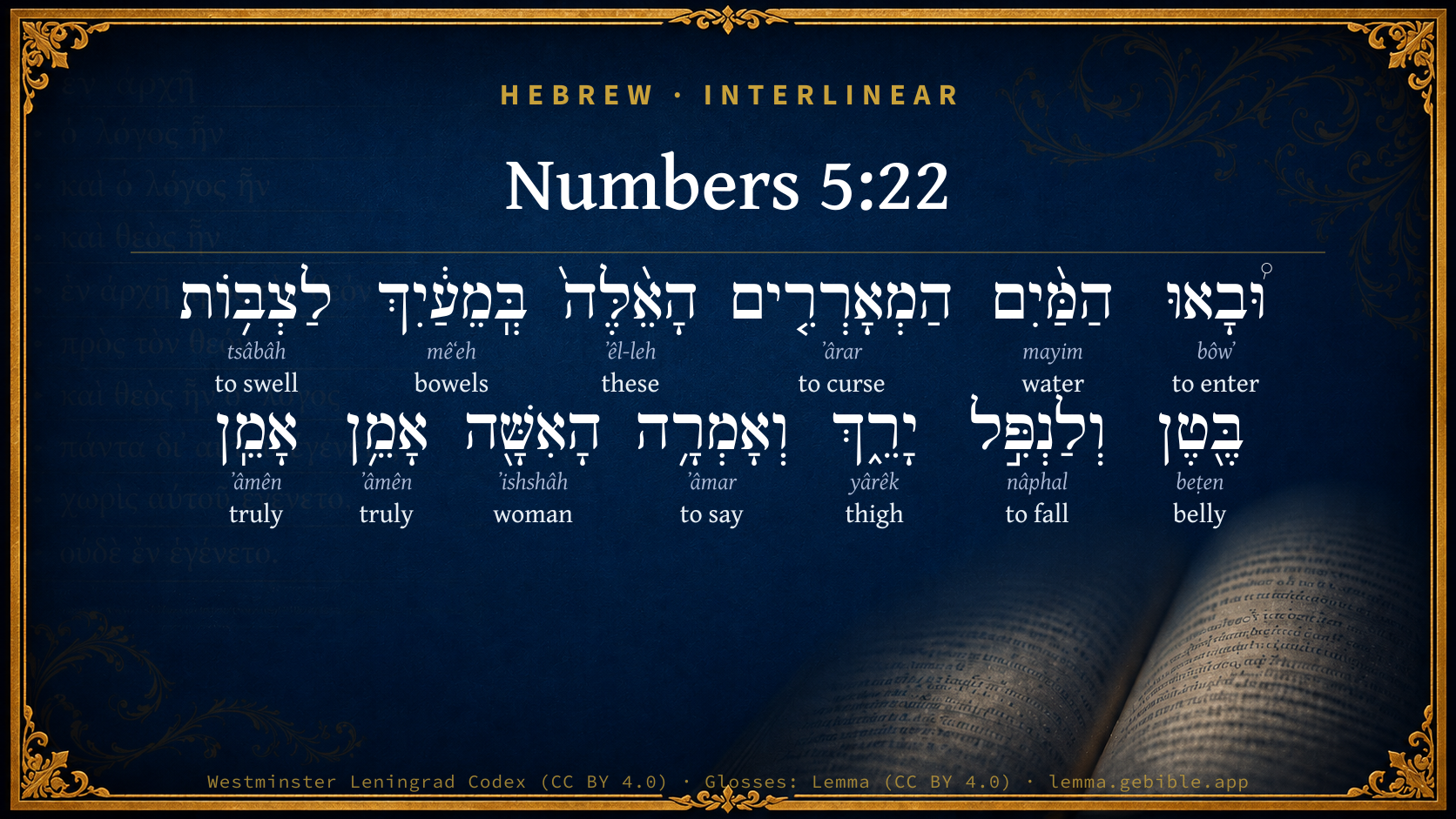
Numbers 5:22

Hebrew (Westminster Leningrad Codex) Numbers 5:22 appears in the Hebrew Old Testament. The text above is from the Westminster Leningrad Codex. Each word links to its Strong’s number, a concise gloss, and parsing drawn from the Open Scriptures Hebrew Bible morphology. Click any word for its full Brown-Driver-Briggs (BDB) entry.
Download image
Cite this verse

Numbers 5:22 (World English Bible). Public Domain. Lemma interlinear Bible study tool, https://lemma.gebible.app/v/numbers/5/22.

Show BibTeX & RIS
BibTeX
RIS
English Translation
and this water that brings a curse will go into your bowels, and make your body swell, and your thigh fall away.' The woman shall say, 'Amen, Amen.'
World English Bible · Public Domain
Highlights
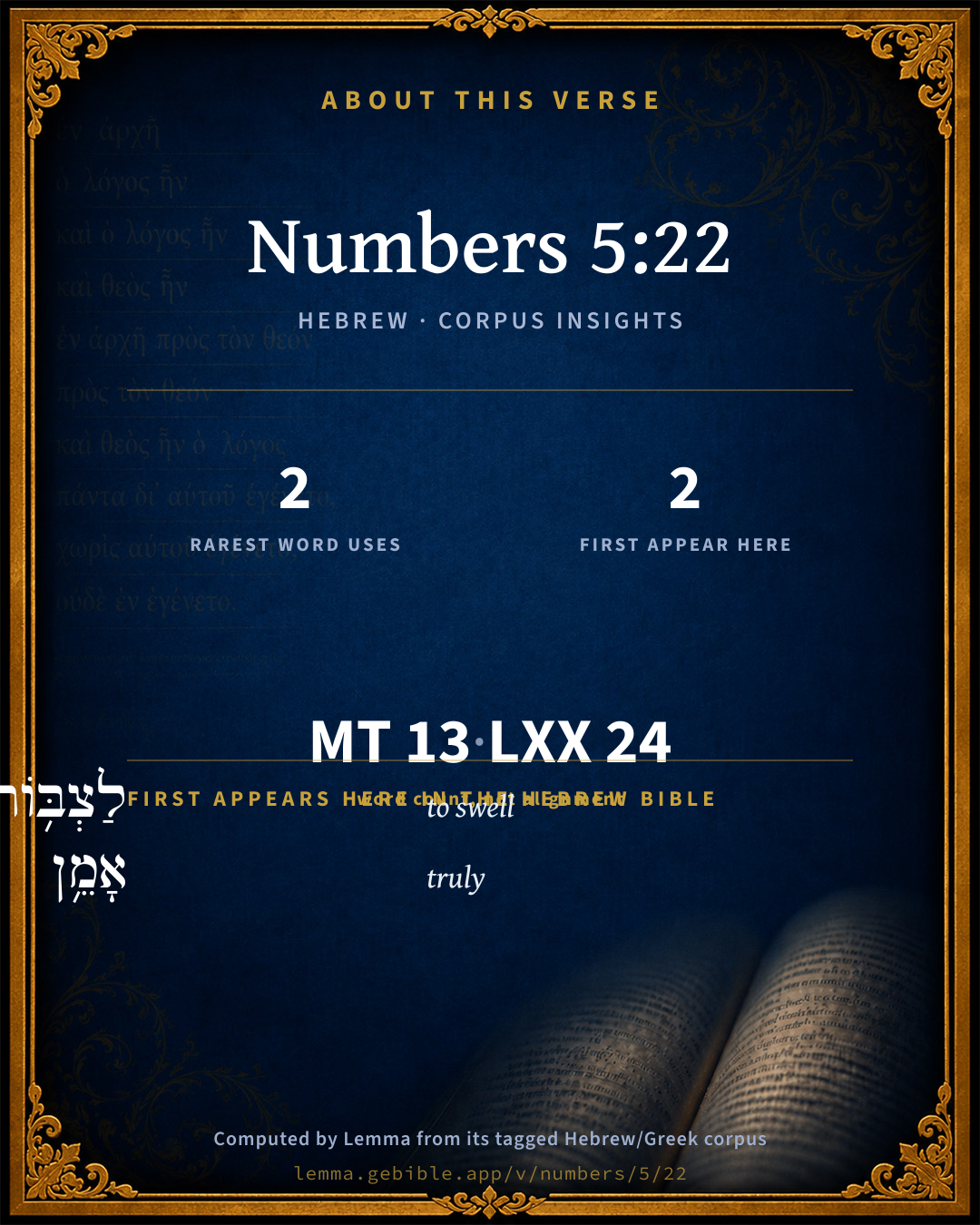
  • 2 first appearances in the Hebrew Bible
Full analysis ↓
Download a study sheet

One document with this verse’s original text, its word-by-word gloss line, the meaning frame, cross-references with their text, attributed commentary, and full source and license credits — printable, and it pastes into notes with its structure intact.

This verse Autodidact and up

Study sheet (.html) Plain text (.txt)

A passage Seminary Student

Up to 50 verses in one chapter. A passage sheet keeps up to 6 commentary sources and 12 cross-references per verse, in the order this page ranks them, and says so on the sheet whenever that leaves anything out. Ask for a single verse and you get the Autodidact verse sheet above.

Everything on this page stays free to read, with no account — the sheet is a download of what is already on screen, not access to it.

Want to remove ads? Support Godless Engineer
Compare translations 3

The same verse in 3 English versions, stacked beneath the original-language interlinear above. Click any original word for its lexicon entry.

Each is an independent rendering of the whole verse — the interlinear is not word-aligned to these translations.

Highlighted words mark where these versions differ — a whole-verse word diff, not a word-by-word alignment.

  • World English Bible Public Domain
    and this water that brings a curse will go into your bowels, and make your body swell, and your thigh fall away.' The woman shall say, 'Amen, Amen.'
  • King James Version Public Domain
    And this water that causeth the curse shall go into thy bowels, to make thy belly to swell, and thy thigh to rot: And the woman shall say, Amen, amen.
  • unfoldingWord Literal Text CC BY-SA 4.0
    And this water that brings a curse will go in your insides to cause belly to swell and to cause thigh to fall.” And the woman shall say, “Amen, amen.”

unfoldingWord Literal Text — © unfoldingWord, licensed CC BY-SA 4.0. Word-aligned USFM3 via Door43 (git.door43.org/unfoldingWord/en_ult).

Versions to compare (up to 4)

3 of 4 selected

Show all 18 translations

Every available English version of this verse, each an independent rendering of the whole verse.

  • World English Bible Public Domain
    and this water that brings a curse will go into your bowels, and make your body swell, and your thigh fall away.' The woman shall say, 'Amen, Amen.'
  • Berean Standard Bible Public Domain
    May this water that brings a curse enter your stomach and cause your belly to swell and your thigh to shrivel.’ Then the woman is to say, ‘Amen, Amen.’
  • Majority Standard Bible Public Domain
    May this water that brings a curse enter your stomach and cause your belly to swell and your thigh to shrivel.’ Then the woman is to say, ‘Amen, Amen.’
  • King James Version Public Domain
    And this water that causeth the curse shall go into thy bowels, to make thy belly to swell, and thy thigh to rot: And the woman shall say, Amen, amen.
  • American Standard Version (1901) Public Domain
    and this water that causeth the curse shall go into thy bowels, and make thy body to swell, and thy thigh to fall away. And the woman shall say, Amen, Amen.
  • Revised Version (1885) Public Domain
    and this water that causeth the curse shall go into thy bowels, and make thy belly to swell, and thy thigh to fall away: and the woman shall say, Amen, Amen.
  • Geneva Bible (1599) Public Domain
    And that this cursed water may goe into thy bowels, to cause thy belly to swell, and thy thigh to rot. Then the woman shall answere, Amen, Amen.
  • Douay-Rheims (1899) Public Domain
    Let the cursed waters enter into thy belly, and may thy womb swell and thy thigh rot. And the woman shall answer, Amen, amen.
  • Young's Literal Translation Public Domain
    and these waters which cause the curse have gone into thy bowels, to cause the belly to swell, and the thigh to fall; and the woman hath said, Amen, Amen.
  • Literal Standard Version CC BY-SA 4.0
    and these waters which cause the curse have gone into your bowels to cause the belly to swell and the thigh to fall; and the woman has said, Amen, Amen.
  • Unlocked Literal Bible CC BY-SA 4.0
    This water that brings the curse will go into your stomach and make your abdomen swell and your thighs waste away.' The woman is to reply, 'Yes, let that happen if I am guilty.'
  • unfoldingWord Literal Text CC BY-SA 4.0
    And this water that brings a curse will go in your insides to cause belly to swell and to cause thigh to fall.” And the woman shall say, “Amen, amen.”
  • Darby Bible Public Domain
    and this water that bringeth the curse shall enter into thy bowels, to make the belly to swell, and the thigh to shrink. And the woman shall say, Amen, amen.
  • World Messianic Bible Public Domain
    and this water that brings a curse will go into your bowels, and make your body swell, and your thigh fall away.” The woman shall say, “Amen, Amen.”
  • Webster's Bible Public Domain
    And this water that causeth the curse shall go into thy bowels, to make thy belly to swell, and thy thigh to perish. And the woman shall say, Amen, amen.
  • Free Bible Version CC BY-SA 4.0
    May this water that curses go into your stomach and make your belly swell up and your thighs shrink. The woman is to answer, ‘I agree, I agree.’
  • Bible in Basic English Public Domain
    And this water of the curse will go into your body, causing disease of your stomach and wasting of your legs: and the woman will say, So be it.
  • JPS Tanakh (1917) Public Domain
    and this water that causeth the curse shall go into thy bowels, and make thy belly to swell, and thy thigh to fall away'; and the woman shall say: 'Amen, Amen.'

Literal Standard Version (2020), Covenant Press — licensed CC BY-SA 4.0. Text via the HelloAO Bible API (eBible.org). Unlocked Literal Bible (unfoldingWord) — licensed CC BY-SA 4.0. Text via the HelloAO Bible API (eBible.org). unfoldingWord Literal Text — © unfoldingWord, licensed CC BY-SA 4.0. Word-aligned USFM3 via Door43 (git.door43.org/unfoldingWord/en_ult). Free Bible Version, Dr. Jonathan Gallagher — licensed CC BY-SA 4.0. Text via the HelloAO Bible API (eBible.org).

Word by word

More ways to search: Search by grammar → Find every occurrence → Compare this word →

Practice this passage: Drill this verse → Learn its vocabulary →

לַצְבּ֥וֹת
tsâbâh
H6638
“to swell”
Preposition + Verb, Hiphil, Infinitive Construct
Part of Speech
Preposition + Verb
Stem
Hiphil
Form
Infinitive Construct
Full BDB Definition

Origin: a primitive root

TWOT: 1868

to swell, swell up - (Qal) to swell (of adulteress' belly) - (Hiphil) to cause to swell (of adulteress' belly)
  1. וּ֠בָאוּ bôwʼ H935 “and · to enter” Conjunction + Verb, Qal, Sequential Perfect, 3rd Person, Common, Plural
  2. הַמַּ֨יִם mayim H4325 “the · water(s)” Particle, Definite Article + Noun, Common, Masculine, Plural, Absolute
  3. הַמְאָרְרִ֤ים ʼârar H779 “the · cursing” Particle, Definite Article + Verb, Piel, Participle Active, Masculine, Plural, Absolute
  4. הָאֵ֨לֶּה֙ ʼêl-leh H428 “the · these” Particle, Definite Article + Pronoun, Demonstrative, Common, Plural
  5. בְּֽמֵעַ֔יִךְ mêʻeh H4578 “in/at · bowels · your” Preposition + Noun, Common, Masculine, Plural, Construct + Suffix, Personal, 2nd Person, Feminine, Singular
  6. בֶּ֖טֶן beṭen H990 “belly” Noun, Common, Feminine, Singular, Absolute
  7. וְלַנְפִּ֣ל nâphal H5307 “and · to fall” Conjunction + Preposition + Verb, Hiphil, Infinitive Construct
  8. יָרֵ֑ךְ yârêk H3409 “thigh” Noun, Common, Feminine, Singular, Absolute
  9. וְאָמְרָ֥ה ʼâmar H559 “and · to say” Conjunction + Verb, Qal, Sequential Perfect, 3rd Person, Feminine, Singular
  10. הָאִשָּׁ֖ה ʼishshâh H802 “the · woman” Particle, Definite Article + Noun, Common, Feminine, Singular, Absolute
  11. אָמֵ֥ן ʼâmên H543 “truly” Adverb
  12. אָמֵֽן ʼâmên H543 “truly” Adverb

About this verse

These counts appear in no published source. They are computed here, from the morphology-tagged text and Lemma’s own curated glosses. What Lemma adds →

13
words
12
distinct lemmas
Pentateuch
section

Notable vocabulary

The rarest word here is לַצְבּ֥וֹת to swell H6638 — appearing just 2 times in the whole Hebrew Bible.

First appearance in Scripture

These words make their first canonical appearance in the Hebrew Bible here:

  • לַצְבּ֥וֹת to swell H6638
  • אָמֵ֥ן truly H543

Shared distinctive vocabulary

לַצְבּ֥וֹת to swell H6638 occurs in 2 verses of the Hebrew Bible. Also found in:

Grammatical profile

  • 5 verbs
  • 5 nouns
  • 1 pronoun
  • 2 adverbs

Verb forms

  • וּ֠בָאוּ Qal · Sequential Perfect
  • הַמְאָרְרִ֤ים Piel · Participle Active
  • לַצְבּ֥וֹת Hiphil · Infinitive Construct
  • וְלַנְפִּ֣ל Hiphil · Infinitive Construct
  • וְאָמְרָ֥ה Qal · Sequential Perfect

Repetition

A word recurs within this verse — often emphatic in Hebrew:

  • אָמֵ֥ן truly H543 ×2

Hebrew & Septuagint length

In English translation the verse runs 28 words from the Hebrew and 33 from the Septuagint (LXX English) — closely comparable.

A rough comparison of the two English renderings, which tokenize alike — not a word-level alignment.

Word counts can differ between the Hebrew and the Greek without any difference in meaning — e.g. the Hebrew direct-object marker אֵת has no separate Greek word, and Greek often adds the article ὁ.

In the original languages it is 13 Hebrew tokens and 24 Greek tokens — but the two are counted differently (Hebrew bundles its prefixes and suffixes into one token; the Greek is in lemma form), so that isn’t a like-for-like length.

Cross-references

15

Topical passages linked to Numbers 5:22 in the Treasury of Scripture Knowledge — connected by theme and wording, ordered by reader-vote popularity; previews shown in the World English Bible.

  • Psalms 109:18 He clothed himself also with cursing as with his garment. It came into his inward parts like water, Like oil into his bones.
  • Numbers 5:27 When he has made her drink the water, then it shall happen, if she is defiled, and has committed a trespass against her husband, that the water that causes the curse will enter into her and become bitter, and her body will swell, and her thigh will fall away: and the woman will be a curse among her people.
  • Deuteronomy 27:15–26 Cursed be the man who makes an engraved or molten image, an abomination to Yahweh, the work of the hands of the craftsman, and sets it up in secret. All the people shall answer and say, Amen.
  • Job 31:21–22 If I have lifted up my hand against the fatherless, Because I saw my help in the gate:
  • Job 31:39–40 If I have eaten the fruits of it without money, Or have caused the owners of it to lose their life:
  • Psalms 7:4–5 If I have rewarded evil to him who was at peace with me (Yes, I have delivered him who without cause was my adversary),
  • Psalms 41:13 Blessed be Yahweh, the God of Israel, From everlasting and to everlasting! Amen and amen.
  • Psalms 72:19 Blessed be his glorious name forever! Let the whole earth be filled with his glory! Amen and amen.
  • Psalms 89:52 Blessed be Yahweh forevermore. Amen, and Amen.
  • Proverbs 1:31 Therefore they will eat of the fruit of their own way, And be filled with their own schemes.
  • Ezekiel 3:3 He said to me, Son of man, cause your belly to eat, and fill your bowels with this scroll that I give you. Then did I eat it; and it was in my mouth as honey for sweetness.
  • John 3:3 Jesus answered him, "Most assuredly, I tell you, unless one is born anew, he can't see the Kingdom of God."
  • John 3:11 Most assuredly I tell you, we speak that which we know, and testify of that which we have seen, and you don't receive our witness.
  • John 5:24–25 "Most assuredly I tell you, he who hears my word, and believes him who sent me, has eternal life, and doesn't come into judgment, but has passed out of death into life.
  • John 6:53 Jesus therefore said to them, "Most assuredly I tell you, unless you eat the flesh of the Son of Man and drink his blood, you don't have life in yourselves.

Cross-references courtesy of OpenBible.info (CC BY 4.0).

Hebrew and Greek witnesses Masoretic Hebrew ↔ Greek Septuagint

The same verse in the two great witnesses to the Old Testament, shown verse-for-verse.

These are two independent witnesses, not word-aligned to each other, and the Septuagint is shown in lemma (dictionary) form.

Hebrew Numbers 5:22 Masoretic · Westminster Leningrad Codex

וּ֠בָאוּ הַמַּ֨יִם הַמְאָרְרִ֤ים הָאֵ֨לֶּה֙ בְּֽמֵעַ֔יִךְ לַצְבּ֥וֹת בֶּ֖טֶן וְלַנְפִּ֣ל יָרֵ֑ךְ וְאָמְרָ֥ה הָאִשָּׁ֖ה אָמֵ֥ן אָמֵֽן

and this water that brings a curse will go into your bowels, and make your body swell, and your thigh fall away.' The woman shall say, 'Amen, Amen.'

World English Bible · Public Domain

Greek LXX Numbers 5:22 Septuagint · lemma form

καί εἰςἔρχομαι ὁ ὕδωρ ὁ ἐπι καταἀράομαι οὗτος εἰς ὁ κοιλία σύ πρήθω γαστήρ καί διαπίπτω μηρός σύ καί εἶπον ὁ γυνή γίγνομαι γίγνομαι

and this water bringing the curse shall enter into your womb to cause your belly to swell, and your thigh to rot. And the woman shall say, So be it, So be it.

LXX2012 (modern English Septuagint) · Public Domain

On this verse, The Pulpit Commentary discusses the Septuagint’s reading. Read the note in Commentary ↓

Hebrew: Westminster Leningrad Codex (CC BY 4.0). Greek: Septuagint (public domain); English from LXX2012 (modern English Septuagint) (Public Domain). How the Septuagint differs from the Hebrew →

Targum (Aramaic paraphrase)

2

The Targum is the ancient Jewish Aramaic paraphrase of the Hebrew Scriptures — an interpretive translation, not the Hebrew text itself. Onkelos (literal) and Pseudo-Jonathan (expansive) render the Torah, and Jonathan the Prophets. Coverage is partial: where no permissively-licensed English translation exists for a verse, only the Aramaic is shown. This is verse-level text, not a word-by-word alignment to the Hebrew.

  1. Targum Onkelos Torah (Genesis–Deuteronomy)
    וְיֵעֲלוּן מַיָא מְלַטְטַיָא הָאִלֵין בִּמְעַיְכִי לַאֲפָחָא מְעִין וּלְאַמְסָאָה יַרְכָּא וְתֵימַר אִתְּתָא אָמֵן אָמֵן

    (no public-domain English translation for this verse)

    Targum Onkelos — Aramaic: “Onkelos Genesis” (public domain); “Onkelos Exodus” (public domain); “Onkelos Leviticus” (public domain); “Onkelos Numbers” (public domain); “Onkelos Deuteronomy” (public domain). English: “Sefaria Community Translation” (CC0 1.0 (public-domain dedication)); “J.W. Etheridge. The Targums of Onkelos and Jonathan Ben Uzziel on the Pentateuch. London: Longmans, Green, 1862” (public domain). Text via Sefaria.

  2. Targum Pseudo-Jonathan Torah (Genesis–Deuteronomy)
    וְיֵיעָלוּן מַיָא בְּדוּקַיָא הָאִלֵין בִּמְעַיְיכִי לִמְנַפְחָא כְּרֵיסָן וּלְמַסְיָא יַרְכִינוּן וְתַעֲנֶה אִתְּתָא וְתֵימַר אָמֵן אִין אִסְתְּאָבִית כַּד מֵאַרְסָא אָמֵן אִין אִסְתְּאָבִית כַּד נְסִיבְתָּא

    and may these waters of trial enter into thy bowels, to cause thy belly to swell, and thy thigh to corrupt. And the woman shall answer and say: Amen, if I was polluted when betrothed; Amen, if I have been polluted since my marriage.

    Targum Pseudo-Jonathan — Aramaic: “Targum Jonathan on Genesis” (public domain); “Targum Jonathan on Exodus” (public domain); “Targum Jonathan on Leviticus” (public domain); “Targum Jonathan on Numbers” (public domain); “Targum Jonathan on Deuteronomy” (public domain). English: “The Targum of Jonathan ben Uzziel, trans. J. W. Etheridge, London, 1862” (public domain). Text via Sefaria.

Commentary

Notes on Numbers 5:22 from classic Christian and Jewish commentators (each source and its license shown beneath its notes). The classic Christian expositions comment on the surrounding passage and are grouped to its opening verse, so a note may address several verses; the Jewish commentaries on the Tanakh (Rashi and others) are per-verse, so they appear only where the commentator wrote on this verse.

Lemma curates 59 commentaries, every one of them public domain or Creative Commons licensed, each selected and text-cleaned for this edition rather than reprinted as found. About our sources →

Trapp's Complete Commentary

John Trapp

Num 5:22 And this water that causeth the curse shall go into thy bowels, to make [thy] belly to swell, and [thy] thigh to rot: And the woman shall say, Amen, amen.

Ver. 22. Amen, amen.] Twice; to show the fervency of her zeal, the innocency of her cause, the uprightness of her conscience, and the purity of her heart.

John Trapp, A Commentary or Exposition upon All the Books of the Old and New Testament (1647–1656) — public domain. Text from a community e-Sword module.

Geneva Bible (1599)

Geneva Bible translators

That is, be it so, as thou wishest, as Ps. 41:23; Deut. 27:15.

Geneva Bible (1599) marginal notes — public domain. Text via Bolls.life.

Jamieson, Fausset & Brown

Robert Jamieson, A. R. Fausset & David Brown

the woman shall say, Amen, Amen--The Israelites were accustomed, instead of formally repeating the words of an oath merely to say, "Amen," a "so be it" to the imprecations it contained. The reduplication of the word was designed as an evidence of the woman's innocence, and a willingness that God would do to her according to her desert.

Jamieson, Fausset & Brown — Commentary Critical and Explanatory on the Whole Bible (1871) — public domain (CC PDM 1.0). Text via the HelloAO Bible API.

Adam Clarke's Commentary

Verse 22. Thy belly to swell, and thy thigh to rot] What is meant by these expressions cannot be easily ascertained. לנפל ירך lanpel yarech signifies literally thy thigh to fall. As the thigh, feet, c., were used among the Hebrews delicately to express the parts which nature conceals, (see Ge 46:26), the expression here is probably to be understood in this sense and the falling down of the thigh here must mean something similar to the prolapsus uteri, or falling down of the womb, which might be a natural effect of the preternatural distension of the abdomen. In 1Co 11:29, St. Paul seems to allude to the case of the guilty woman drinking the bitter cursed waters that caused her destruction: He who eateth and drinketh unworthily, eateth and drinketh damnation (κριμα, condemnation or judgment) to himself; and there is probably a reference to the same thing in Ps 109:18, and in Da 9:11.

And the woman shall say, Amen, amen.] This is the first place where this word occurs in the common form of a concluding wish in prayer. The root אמן aman signifies to be steady, true, permanent. And in prayer it signifies let it be so - make it steady - let it be ratified. Some have supposed that it is composed of the initial letters of אדני מלך נאמן Adonai Melech Neeman, My Lord the faithful King, but this derivation is both far-fetched and unnecessary.

Adam Clarke's Commentary on the Bible (1810–1826) — public domain. Text from a community e-Sword/MySword module.

John Gill's Exposition

And this water that causeth the curse,.... Upon the drinking of which the curse follows, if guilty:

shall go into thy bowels; and there operate and produce the above effects, which are repeated again to inject terror:

to make thy belly to swell, and thy thigh to rot; here ends the form of the oath, which begins Num 5:19,

and the woman shall say, amen, amen; so be it; let it be as pronounced, if I am guilty; which, as Aben Ezra observes, is repeated for the sake of confirmation; though the Jewish writers commonly understand it as respecting various things, the oath and the curse, the thing charged with, and the persons suspected of (x).

(x) Misn. ib. sect. 5. Targum Jon. & Jerus. & Jarchi in loc.

John Gill's Exposition of the Whole Bible (1746–1763) — public domain (CC PDM 1.0). Text via the HelloAO Bible API.

Haydock's Catholic Bible Commentary

Amen. Our Saviour often uses this form, to confirm what he says, verily, truly. The woman gives her assent to what had been proposed, "so be it." (Calmet)

George Leo Haydock (1774–1849), Haydock's Catholic Family Bible and Commentary, 1859 edition — public domain. Excludes Psalms (Douay-Rheims chapter numbering differs from Protestant) and Deuterocanonical books (Catholic canon only).

Matthew Poole's English Annotations

i.e. So let it be if I be guilty. The word is doubled by her as an evidence of her innocency, and ardent desire that God would deal with her according to her desert.

Matthew Poole's English Annotations on the Holy Bible (1683–1685) — public domain. Text from a community e-Sword/MySword module.

Whedon's Commentary on the Bible

Daniel D. Whedon

22. Amen, amen — True, true. Thus the guilty one appropriates the penalty to herself, and proclaims the righteousness of her sentence. Thus in the judgment day will the Divine rectitude shine out so brightly that the left-hand assembly will involuntarily say Amen, amen, to the curse which will abide through the duration of the soul. This is the first time that this word amen is used in the Bible. “It involves the ideas of swearing, acceptance, and truthfulness.”

Daniel D. Whedon (gen. ed.), Commentary on the Old and New Testaments (1874–1909) — public domain. Text from a community e-Sword module.

The Pulpit Commentary

Into thy bowels. Cf. Psa_109:18. Eiv than sou , Septuagint. It has been thought that these symptoms belonged to some known disease, such as dropsy (Josephus, "Ant.," 3:11, 6), or ovarian dropsy. But it is clear that the whole matter was outside the range of the known and of the natural. An innocent woman may suffer from dropsy, or any form of it; but this was a wholly peculiar infliction by direct visitation of God. The principle which underlay the infliction was, however, clear: di wn gaa dia toutwn h timwria the organs of sin are the seat of the plague. Amen, amen. Doubled here, as in the Gospel of John. The woman was to accept (if she dared) the awful ordeal and appeal to God by this response; if she dared not, she pronounced herself guilty.

The Pulpit Commentary (1880–1919), ed. H.D.M. Spence-Jones & Joseph S. Exell — public domain. Text from a community e-Sword module.

John Wesley's Explanatory Notes

Amen, amen - That is, so let it be if I be guilty. The word is doubled by her as an evidence of her innocency, and ardent desire that God would deal with her according to her desert.

John Wesley, Explanatory Notes Upon the Whole Bible (1754–1765) — public domain. Text via the GEBible commentary corpus.

Rashi

Rabbi Shlomo Yitzchaki (Rashi)

לצבות בטן is the same as לְהַצְבּוֹת בטן (the verb being the Hiphil infinitive). This is the usage of the Patach: that the “lamed” has it as its vowel instead of the ה having it (viz., that it is a contraction of לה). Similar is (Exodus 13:21) לַרְאתכם הדרך and (Deuteronomy 1:33) לַנְחֹתָם בדרך אשר הלכו בה (which are equivalent to לְהַרְאֹתְכֶם and לְהַנְחֹתָם). And so, too, in this verse, לַנְפִּל ירך, which is the same as לְהַנְפִּיל ירך. The meaning is: that the waters cause the belly to swell, and cause the thigh to fall.

לצבות בטן ולנפל ירך [AND THIS WATER THAT CAUSETH THE CURSE SHALL GO INTO THY BOWELS] TO MAKE THE BELLY TO SWELL AND THE THIGH TO WASTE — i.e. the belly and the thigh of the adulterer (Note that Scripture does not state here, as in the preceding verse, “thy thigh”, “thy belly”). Or perhaps this is not so, but it means those of the adulteress? But when it states, (v. 21) “[when the Lord doth make] thy thigh to waste and thy belly to swell”, you see, that those of the adulteress are mentioned already (Sotah 28a; cf. Sifrei Bamidbar 15:1).

אמן אמן [AND THE WOMAN SHALL SAY] AMEN, AMEN — The utterance of the word אמן by a person implies the acceptance of an oath which has been recited by another with reference to him. — The two words אמן (which may mean “It is so”, or, “May it be so”) respectively signify, “Amen” with reference to the curse invoked, and “Amen” with reference to the oath recited. Accordingly she declares: “Amen” (“may it be so” i. e., may the אלה “the curse” befall me) if I have received defilement from this man, and “Amen” if I have received defilement from any other man; “Amen” (“It is so” — the terms of the oath are true) that I have not gone astray either when I was betrothed to my husband or since I have been married to him; (or in the case of a woman who has married her deceased husband’s brother; cf. Deuteronomy 25:7, it implies), “either when I was awaiting marriage with my brother-in-law or after I was married to him” (Sotah 18a).

Rashi on the Tanakh — English translations: “The Judaica Press complete Tanach with Rashi, translated by A. J. Rosenberg” (CC BY 4.0); “Pentateuch with Rashi's commentary by M. Rosenbaum and A.M. Silbermann, 1929-1934” (public domain); “The Metsudah Tanach series, Lakewood, N.J” (CC BY 4.0); and “The Book of Joshua, Metsudah Publications, 1997” (CC BY 4.0). Text via Sefaria.

Lesson kit

Teaching starters — assembled from the data on this page, not authored interpretation. Every prompt links to the verse data it draws on. Edit before teaching.

Numbers, in the Pentateuch, opens this verse with 13 words (12 distinct Hebrew lemmas). Its most distinctive word is tsâbâh (“to swell”). A historical commentator’s framing appears above. Read the whole chapter for the surrounding context.

Discussion questions

  1. How does “to swell” (tsâbâh) shape what this verse is saying?
  2. 2 words make their first appearance in Scripture here. What does this debut establish?
  3. How does Numbers 5:27, which shares the word «to swell», read alongside this verse?
  4. What does the repetition of “truly” (2× in this one verse) do in this verse?
  5. These translations render this verse differently. What is at stake in choosing one wording over another?
  6. «וּ֠בָאוּ» is a Qal Sequential Perfect verb. How does that grammatical form shape the action described?
  7. Compare how Trapp's Complete Commentary and Geneva Bible (1599) read this verse. Where do they agree or differ?

Things to notice

Reading settings

Reading text

Shown beneath each verse's original-language words.

Old Testament
Old Testament edition

Read the OT as the Masoretic Hebrew (MT) or the Greek Septuagint (LXX).

English shown for the Greek Septuagint (in the Hebrew ↔ Greek comparison).

Comparing translations? Open the Compare panel on any verse page to stack up to four side by side.