Genesis 49:17

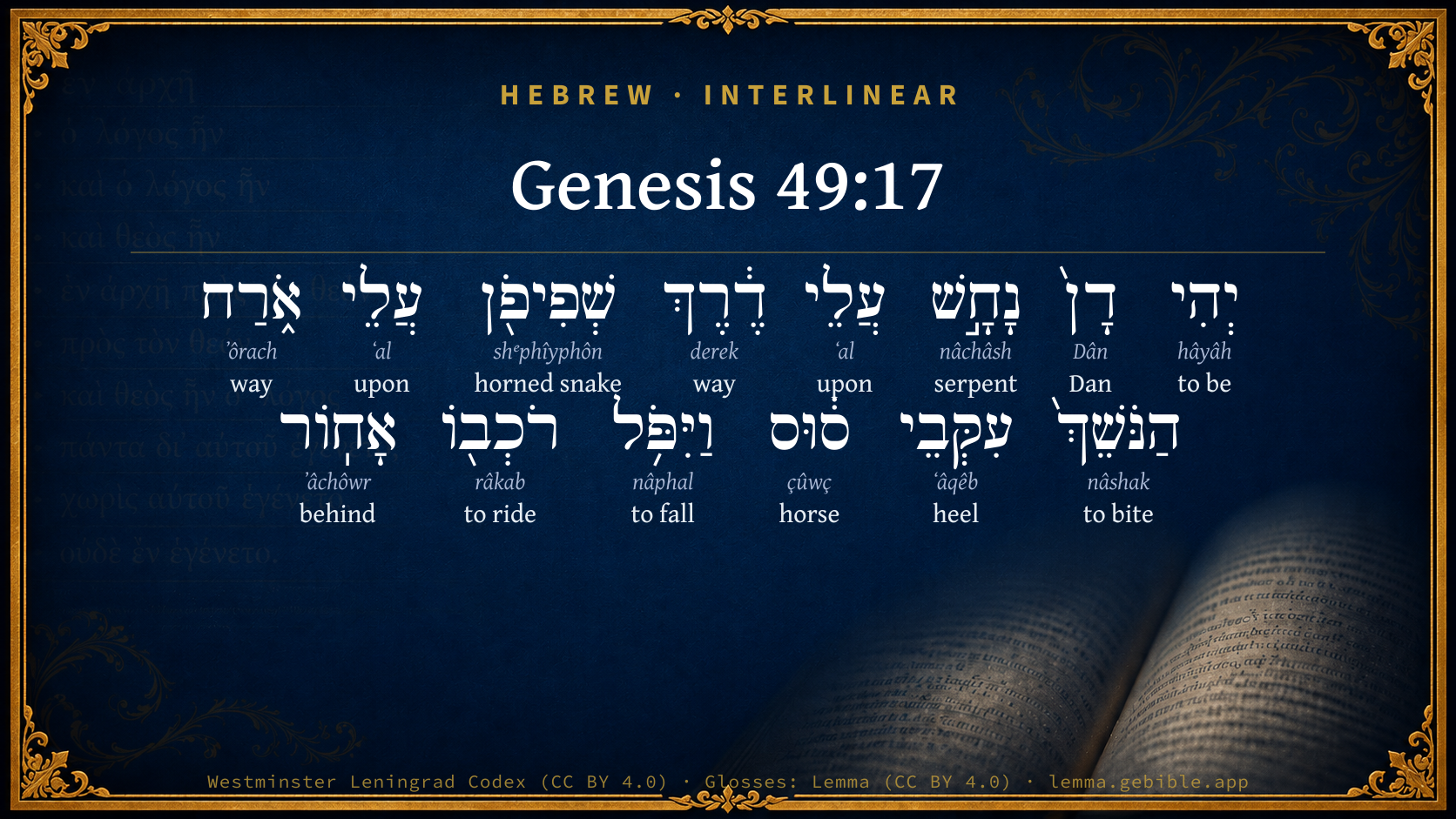
Hebrew (Westminster Leningrad Codex) Genesis 49:17 appears in the Hebrew Old Testament. The text above is from the Westminster Leningrad Codex. Each word links to its Strong’s number, a concise gloss, and parsing drawn from the Open Scriptures Hebrew Bible morphology. Click any word for its full Brown-Driver-Briggs (BDB) entry.
Download image
Cite this verse

Genesis 49:17 (World English Bible). Public Domain. Lemma interlinear Bible study tool, https://lemma.gebible.app/v/genesis/49/17.

Show BibTeX & RIS
BibTeX
RIS
English Translation
Dan will be a serpent in the way, An adder in the path, That bites the horse's heels, So that his rider falls backward.
World English Bible · Public Domain
Highlights
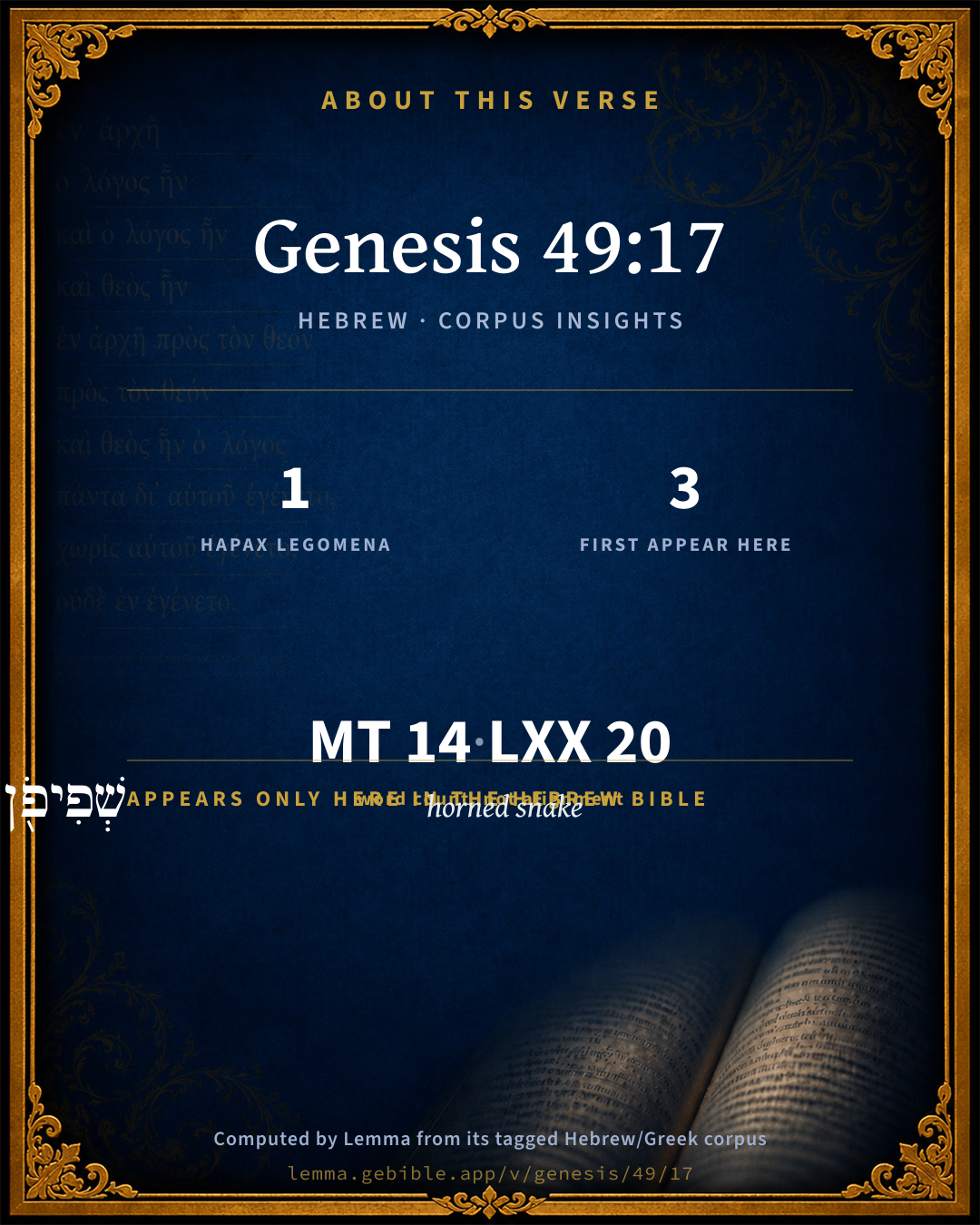
  • 1 hapax legomenon — only here in the Hebrew Bible
  • 3 first appearances in the Hebrew Bible
Full analysis ↓
Download a study sheet

One document with this verse’s original text, its word-by-word gloss line, the meaning frame, cross-references with their text, attributed commentary, and full source and license credits — printable, and it pastes into notes with its structure intact.

This verse Autodidact and up

Study sheet (.html) Plain text (.txt)

A passage Seminary Student

Up to 50 verses in one chapter. A passage sheet keeps up to 6 commentary sources and 12 cross-references per verse, in the order this page ranks them, and says so on the sheet whenever that leaves anything out. Ask for a single verse and you get the Autodidact verse sheet above.

Everything on this page stays free to read, with no account — the sheet is a download of what is already on screen, not access to it.

Want to remove ads? Support Godless Engineer
Compare translations 3

The same verse in 3 English versions, stacked beneath the original-language interlinear above. Click any original word for its lexicon entry.

Each is an independent rendering of the whole verse — the interlinear is not word-aligned to these translations.

Highlighted words mark where these versions differ — a whole-verse word diff, not a word-by-word alignment.

  • World English Bible Public Domain
    Dan will be a serpent in the way, An adder in the path, That bites the horse's heels, So that his rider falls backward.
  • King James Version Public Domain
    Dan shall be a serpent by the way, an adder in the path, that biteth the horse heels, so that his rider shall fall backward.
  • unfoldingWord Literal Text CC BY-SA 4.0
    Dan will be a snake beside the road, a viper beside the path, that bites the heels of a horse, and its rider falls off backward. q1

unfoldingWord Literal Text — © unfoldingWord, licensed CC BY-SA 4.0. Word-aligned USFM3 via Door43 (git.door43.org/unfoldingWord/en_ult).

Versions to compare (up to 4)

3 of 4 selected

Show all 17 translations

Every available English version of this verse, each an independent rendering of the whole verse.

  • World English Bible Public Domain
    Dan will be a serpent in the way, An adder in the path, That bites the horse's heels, So that his rider falls backward.
  • Berean Standard Bible Public Domain
    He will be a snake by the road, a viper in the path that bites the horse’s heels so that its rider tumbles backward.
  • Majority Standard Bible Public Domain
    He will be a snake by the road, a viper in the path that bites the horse’s heels so that its rider tumbles backward.
  • King James Version Public Domain
    Dan shall be a serpent by the way, an adder in the path, that biteth the horse heels, so that his rider shall fall backward.
  • American Standard Version (1901) Public Domain
    Dan shall be a serpent in the way, An adder in the path, That biteth the horse's heels, So that his rider falleth backward.
  • Revised Version (1885) Public Domain
    Dan shall be a serpent in the way, An adder in the path, That biteth the horse’s heels, So that his rider falleth backward.
  • Geneva Bible (1599) Public Domain
    Dan shall be a serpent by the way, an adder by the path, byting the horse heeles, so that his rider shall fall backward.
  • Young's Literal Translation Public Domain
    Dan is a serpent by the way, An adder by the path, Which is biting the horse's heels, And its rider falleth backward.
  • Literal Standard Version CC BY-SA 4.0
    Dan is a serpent by the way, a viper by the path, || Which is biting the horse’s heels, || And its rider falls backward.
  • Unlocked Literal Bible CC BY-SA 4.0
    Dan will be a snake beside the road, a poisonous snake in the path that bites the horse's heels, so that his rider falls backward.
  • unfoldingWord Literal Text CC BY-SA 4.0
    Dan will be a snake beside the road, a viper beside the path, that bites the heels of a horse, and its rider falls off backward. q1
  • Darby Bible Public Domain
    Dan will be a serpent on the way, A horned snake on the path, Which biteth the horse's heels, So that the rider falleth backwards.
  • World Messianic Bible Public Domain
    Dan will be a serpent on the trail, an adder in the path, that bites the horse’s heels, so that his rider falls backward.
  • Webster's Bible Public Domain
    Dan shall be a serpent by the way, an adder in the path, that biteth the horse-heels, so that his rider shall fall backward.
  • Free Bible Version CC BY-SA 4.0
    Dan will be as dangerous as a snake beside the road, a viper by the path that bites the horse's heel, throwing its rider off backwards.
  • Bible in Basic English Public Domain
    May Dan be a snake in the way, a horned snake by the road, biting the horse's foot so that the horseman has a fall.
  • JPS Tanakh (1917) Public Domain
    Dan shall be a serpent in the way, a horned snake in the path, that biteth the horse's heels, so that his rider falleth backward.

Literal Standard Version (2020), Covenant Press — licensed CC BY-SA 4.0. Text via the HelloAO Bible API (eBible.org). Unlocked Literal Bible (unfoldingWord) — licensed CC BY-SA 4.0. Text via the HelloAO Bible API (eBible.org). unfoldingWord Literal Text — © unfoldingWord, licensed CC BY-SA 4.0. Word-aligned USFM3 via Door43 (git.door43.org/unfoldingWord/en_ult). Free Bible Version, Dr. Jonathan Gallagher — licensed CC BY-SA 4.0. Text via the HelloAO Bible API (eBible.org).

Word by word

More ways to search: Search by grammar → Find every occurrence → Compare this word →

Practice this passage: Drill this verse → Learn its vocabulary →

שְׁפִיפֹ֖ן
shᵉphîyphôn
H8207
“horned snake”
Noun, Common, Masculine, Singular, Absolute
Part of Speech
Noun
Type
Common
Gender
Masculine
Number
Singular
State
Absolute
Full BDB Definition

Origin: from an unused root meaning the same as H7779

TWOT: 2448a

horned snake - (CLBL) a serpent, perhaps an adder or horned snake
  1. יְהִי hâyâh H1961 “to be” Verb, Qal, Imperfect, 3rd Person, Masculine, Singular
  2. דָן֙ Dân H1835 “Dan” Noun, Proper
  3. נָחָ֣שׁ nâchâsh H5175 “serpent” Noun, Common, Masculine, Singular, Absolute
  4. עֲלֵי ʻal H5921 “upon” Preposition
  5. דֶ֔רֶךְ derek H1870 “way” Noun, Common, Both, Singular, Absolute
  6. עֲלֵי ʻal H5921 “upon” Preposition
  7. אֹ֑רַח ʼôrach H734 “way” Noun, Common, Both, Singular, Absolute
  8. הַנֹּשֵׁךְ֙ nâshak H5391 “the · biting” Particle, Definite Article + Verb, Qal, Participle Active, Masculine, Singular, Absolute
  9. עִקְּבֵי ʻâqêb H6119 “heels of” Noun, Common, Masculine, Plural, Construct
  10. ס֔וּס çûwç H5483 “horse” Noun, Common, Masculine, Singular, Absolute
  11. וַיִּפֹּ֥ל nâphal H5307 “and · to fall” Conjunction + Verb, Qal, Sequential Imperfect, 3rd Person, Masculine, Singular
  12. רֹכְב֖וֹ râkab H7392 “riding · him” Verb, Qal, Participle Active, Masculine, Singular, Construct + Suffix, Personal, 3rd Person, Masculine, Singular
  13. אָחֽוֹר ʼâchôwr H268 “behind” Noun, Common, Masculine, Singular, Absolute

About this verse

These counts appear in no published source. They are computed here, from the morphology-tagged text and Lemma’s own curated glosses. What Lemma adds →

14
words
13
distinct lemmas
Pentateuch
section

Notable vocabulary

1 hapax legomenon — a word that appears only here in the entire Hebrew Bible:

  • שְׁפִיפֹ֖ן horned snake H8207

First appearance in Scripture

These words make their first canonical appearance in the Hebrew Bible here:

  • שְׁפִיפֹ֖ן horned snake H8207
  • הַנֹּשֵׁךְ֙ to bite H5391
  • אָחֽוֹר behind H268

Shared distinctive vocabulary

עִקְּבֵי heel H6119 occurs in 13 verses of the Hebrew Bible. Also found in:

Grammatical profile

  • 4 verbs
  • 8 nouns
  • 2 prepositions

Verb forms

  • יְהִי Qal · Imperfect
  • הַנֹּשֵׁךְ֙ Qal · Participle Active
  • וַיִּפֹּ֥ל Qal · Sequential Imperfect
  • רֹכְב֖וֹ Qal · Participle Active

Repetition

A word recurs within this verse — often emphatic in Hebrew:

  • עֲלֵי upon H5921 ×2

Hebrew & Septuagint length

In English translation the verse runs 24 words from the Hebrew and 24 from the Septuagint (LXX English) — the same length.

A rough comparison of the two English renderings, which tokenize alike — not a word-level alignment.

Word counts can differ between the Hebrew and the Greek without any difference in meaning — e.g. the Hebrew direct-object marker אֵת has no separate Greek word, and Greek often adds the article ὁ.

In the original languages it is 14 Hebrew tokens and 20 Greek tokens — but the two are counted differently (Hebrew bundles its prefixes and suffixes into one token; the Greek is in lemma form), so that isn’t a like-for-like length.

Cross-references

3

Topical passages linked to Genesis 49:17 in the Treasury of Scripture Knowledge — connected by theme and wording, ordered by reader-vote popularity; previews shown in the World English Bible.

  • Judges 18:22–31 When they were a good way from the house of Micah, the men who were in the houses near to Micah's house were gathered together, and overtook the children of Dan.
  • 1 Chronicles 12:35 Of the Danites who could set the battle in array, twenty-eight thousand six hundred.
  • Judges 14:1–15 Samson went down to Timnah, and saw a woman in Timnah of the daughters of the Philistines.

Cross-references courtesy of OpenBible.info (CC BY 4.0).

Hebrew and Greek witnesses Masoretic Hebrew ↔ Greek Septuagint

The same verse in the two great witnesses to the Old Testament, shown verse-for-verse.

These are two independent witnesses, not word-aligned to each other, and the Septuagint is shown in lemma (dictionary) form.

Hebrew Genesis 49:17 Masoretic · Westminster Leningrad Codex

יְהִי דָן֙ נָחָ֣שׁ עֲלֵי דֶ֔רֶךְ שְׁפִיפֹ֖ן עֲלֵי אֹ֑רַח הַנֹּשֵׁךְ֙ עִקְּבֵי ס֔וּס וַיִּפֹּ֥ל רֹכְב֖וֹ אָחֽוֹר

Dan will be a serpent in the way, An adder in the path, That bites the horse's heels, So that his rider falls backward.

World English Bible · Public Domain

Greek LXX Genesis 49:17 Septuagint · lemma form

καί γίγνομαι δαν ὄφις ἐπί ὁδός ἐν καταἧμαι ἐπί τρίβος δάκνω πτέρνα ἵππος καί πίπτω ὁ ἱππεύς εἰς ὁ ὀπίσω

And let Dan be a serpent in the way, besetting the path, biting the heel of the horse (and the rider shall fall backward),

LXX2012 (modern English Septuagint) · Public Domain

Hebrew: Westminster Leningrad Codex (CC BY 4.0). Greek: Septuagint (public domain); English from LXX2012 (modern English Septuagint) (Public Domain). How the Septuagint differs from the Hebrew →

Targum (Aramaic paraphrase)

2

The Targum is the ancient Jewish Aramaic paraphrase of the Hebrew Scriptures — an interpretive translation, not the Hebrew text itself. Onkelos (literal) and Pseudo-Jonathan (expansive) render the Torah, and Jonathan the Prophets. Coverage is partial: where no permissively-licensed English translation exists for a verse, only the Aramaic is shown. This is verse-level text, not a word-by-word alignment to the Hebrew.

  1. Targum Onkelos Torah (Genesis–Deuteronomy)
    יְהֵי גַבְרָא דְיִתְבְּחַר וִיקוּם מִדְּבֵית דָּן אֵימְתֵהּ תִּתְרְמֵי עַל עַמְמַיָּא וּמְחָתֵהּ תִּתְקֵף בִּפְלִשְׁתָּאֵי כְּחִיוֵי חוּרְמָן יִשְׁרֵי עַל אָרְחָא וּכְפִתְנָא יִכְמוֹן עַל שְׁבִילָא יְקַטֵּיל גִּבָּרֵי מַשִׁרְיַת פְּלִשְׁתָּאֵי פָּרָשִׁין עִם רַגְלָאִין יְעַקֵר סוּסָוָן וּרְתִכִּין וִימַגֵּר רוֹכְבֵיהוֹן לַאֲחוֹרָא

    (no public-domain English translation for this verse)

    Targum Onkelos — Aramaic: “Onkelos Genesis” (public domain); “Onkelos Exodus” (public domain); “Onkelos Leviticus” (public domain); “Onkelos Numbers” (public domain); “Onkelos Deuteronomy” (public domain). English: “Sefaria Community Translation” (CC0 1.0 (public-domain dedication)); “J.W. Etheridge. The Targums of Onkelos and Jonathan Ben Uzziel on the Pentateuch. London: Longmans, Green, 1862” (public domain). Text via Sefaria.

  2. Targum Pseudo-Jonathan Torah (Genesis–Deuteronomy)
    יְהֵי גַבְרָא דְיִתְבְּחַר וִיקוּם מִדְבֵית דָן מְדַמֵי לְחוּרְמָנָא דִרְבִיעַ עַל פַּרְשַׁת אוֹרְחָא וּלְרֵישֵׁיהּ חִיוְיַין דִכְמִין עַל שְׁבִילָא דִנְכֵית סוּסְיָא בְּעִיקְבֵיהּ וְנָצִיל מִן אֵימָתֵיהּ רְכָבֵיהּ מִתְפַּרְקִיד לַאֲחוֹרֵיהּ הֵיכְדֵין יַקְטִיל שִׁמְשׁוֹן בַּר מָנוֹחַ יַת כָּל גִבָּרֵי פְּלִשְׁתָּאֵי לְפַרְשְׁיָא וּלְרַגְלָאֵי וְיֶעֱקַר סוּסְוַתְהוֹן וּמְמַגֵר דְבָבֵהוֹן לַאֲחוֹרָא

    A chosen man shall arise from the house of Dan, like the basilisk which lieth at the dividing of the way, and the serpent's head which lurketh by the way, that biteth the horse in his heel, and the master from his terror is thrown backward. Even thus will Shimshon bar Manovach slay all the heroes of Philistia, the horsemen and the foot; he will hamstring their horses and hurl their riders backwards.

    Targum Pseudo-Jonathan — Aramaic: “Targum Jonathan on Genesis” (public domain); “Targum Jonathan on Exodus” (public domain); “Targum Jonathan on Leviticus” (public domain); “Targum Jonathan on Numbers” (public domain); “Targum Jonathan on Deuteronomy” (public domain). English: “The Targum of Jonathan ben Uzziel, trans. J. W. Etheridge, London, 1862” (public domain). Text via Sefaria.

Commentary

Notes on Genesis 49:17 from classic Christian and Jewish commentators (each source and its license shown beneath its notes). The classic Christian expositions comment on the surrounding passage and are grouped to its opening verse, so a note may address several verses; the Jewish commentaries on the Tanakh (Rashi and others) are per-verse, so they appear only where the commentator wrote on this verse.

Lemma curates 59 commentaries, every one of them public domain or Creative Commons licensed, each selected and text-cleaned for this edition rather than reprinted as found. About our sources →

Trapp's Complete Commentary

John Trapp

Gen 49:17 Dan shall be a serpent by the way, an adder in the path, that biteth the horse heels, so that his rider shall fall backward.

Ver. 17. Dan shall be a serpent by the way.] He shall subtly set upon his enemies, and suddenly surprise them: as they did the men of Laish; and as Samson, of this tribe, did the Philistines. Moses saith, "Dan is a lion’s whelp." {Deu 33:22} But when his lion’s hide would not serve his turn, he could piece it out with his fox skin or serpent’s slough; {a} he could, if not outfight his enemies, outwit them: and -

“ … dolus, an virtus, quis in hoste requirat?” - Virg.

Of Decebalus, king of Dacians, it is reported, to his singular commendation, that he could, optime insidias facere, proelium committere, optime uti victoria, et acceptam cladem ferre moderate. {b} All which were the parts and points of an excellent warrior.

{a} Leoninae pelli vulpinam assuere.

{b} καλως μεν νικη χρησασθαι, καλως δε και ητταν διαθειναι - Dio, in Vita Domit.

John Trapp, A Commentary or Exposition upon All the Books of the Old and New Testament (1647–1656) — public domain. Text from a community e-Sword module.

Joseph Benson's Commentary

Gen 49:17. An adder, שׁפיפוןshepipon — A cerastes, probably, or kind of horned serpent, of a subtle nature, which, according to Pliny, hides its whole body in the sand, showing only its horns to catch birds. This is intended to signify the subtlety of that tribe, which should conquer its enemies more by craft than by strength or force of arms, and by art, and policy, and surprise, gain advantages against them, like a serpent suddenly biting the heels of a traveller. “These words,” says Bishop Sherlock, “lead us to expect, in the history of this tribe, an account of some very dishonourable and perfidious transaction. And the history will justify this expectation,” for though the house of Israel were in general a stubborn and disobedient people, “yet it was the peculiar infamy of the tribe of Dan, to be the ringleaders in idolatry, the first who erected publicly a molten image in the land of promise, and, by their example and perseverance in this iniquity, infected all the tribes of Israel. This idolatry began soon after the days of Joshua, and continued till the day of the captivity of the land, Jdg 18:30.”

Joseph Benson's Commentary on the Old and New Testaments (1811–1818) — public domain. Text from a community e-Sword module.

Geneva Bible (1599)

Geneva Bible translators

That is, full of subtlety.

Geneva Bible (1599) marginal notes — public domain. Text via Bolls.life.

Jamieson, Fausset & Brown

Robert Jamieson, A. R. Fausset & David Brown

DAN--though the son of a secondary wife, was to be "as one of the tribes of Israel." (Gen 49:16-18)

Dan--"a judge."

a serpent . . . an adder--A serpent, an adder, implies subtlety and stratagem; such was pre-eminently the character of Samson, the most illustrious of its judges.

Jamieson, Fausset & Brown — Commentary Critical and Explanatory on the Whole Bible (1871) — public domain (CC PDM 1.0). Text via the HelloAO Bible API.

Adam Clarke's Commentary

Verse 17. Dan shall be a serpent] The original word is נחש nachash, and we have seen in Clarke's note "Ge 3:1" that this has a great variety of significations. It is probable that a serpent is here intended, but of what kind we know not; yet as the principal reference in the text is to guile, cunning, c., the same creature may be intended as in "Clarke's note "Ge 3:1".

A cerastes upon the track] The word שפיפון shephiphon, which is nowhere else to be found in the Bible, is thus translated by the Vulgate, and Bochart approves of the translation. The cerastes has its name from two little horns upon its head, and is remarkable for the property here ascribed to the shephiphon. The word ארח orach, which we translate path, signifies the track or rut made in the ground by the wheel of a cart, wagon, c. And the description that Nicander gives of this serpent in his Theriaca perfectly agrees with what is here said of the shephiphon.

εν δ' αμαθοισιν

Η και ἁματροχιῃσι παρα στιβον ενδυκες ανει. v. 262.

It lies under the sand, or in some cart rut by the way.

It is intimated that this tribe should gain the principal part of its conquests more by cunning and stratagem, than by valour and this is seen particularly in their conquest of Laish, Judges xviii., and even in some of the transactions of Samson, such as burning the corn of the Philistines, and at last pulling down their temple, and destroying three thousand at one time, see Jdg 16:26-30.

18. For thy salvation have I waited, O Lord!

This is a remarkable ejaculation, and seems to stand perfectly unconnected with all that went before and all that follows though it is probable that certain prophetic views which Jacob now had, and which he does not explain, gave rise to it; and by this he at once expressed both his faith and hope in God. Both Jewish and Christian commentators have endeavoured to find out the connection in which these words existed in the mind of the patriarch. The Targum of Jonathan expresses the whole thus: "When Jacob saw Gideon the son of Joash, and Samson the son of Manoah, which were to be saviours in a future age, he said: I do not wait for the salvation of Gideon, I do not expect the salvation of Samson, because their salvation is a temporal salvation; but I wait for and expect thy salvation, O Lord, because thy salvation is eternal." And the Jerusalem Targum much to the same purpose: "Our father Jacob said: Wait not, my soul, for the redemption of Gideon the son of Joash which is temporal, nor the redemption of Samson which is a created salvation; but for the salvation which thou hast said by THY WORD should come to thy people the children of Israel: my soul waits for this thy salvation." Indeed these Targums understand almost the whole of these prophecies of the Messiah, and especially what is said about Judah, every word of which they refer to him. Thus the ancient Jews convict the moderns of both false interpretations and vain expectations. As the tribe of Dan was the first that appears to have been seduced from the true worship of God, (see Jdg 18:30), some have thought that Jacob refers particularly to this, and sees the end of the general apostasy only in the redemption by Jesus Christ, considering the nachash above as the seducer, and the Messiah the promised seed.

19. Gad, an army shall attack him,

And he shall attack in return.

This is one of the most obscure prophecies in the whole chapter; and no two interpreters agree in the translation of the original words, which exhibit a most singular alliteration: -

גד גדוד יגודנו gad gedud yegudennu;

והוא יגד עקב vehu yagud akeb.

The prophecy seems to refer generally to the frequent disturbances to which this tribe should be exposed, and their hostile, warlike disposition, that would always lead them to repel every aggression. It is likely that the prophecy had an especial fulfillment when this tribe, in conjunction with that of Reuben and the half tribe of Manasseh, got a great victory over the Hagarites, taking captive one hundred thousand men, two thousand asses, fifty thousand camels, and two hundred and fifty thousand sheep; see 1Ch 5:18-22. Dr. Durell and others translate the last word עקב akeb, rear - "He shall invade their rear;" which contains almost no meaning, as it only seems to state that though the army that invaded Gad should be successful, yet the Gadites would harass their rear as they returned: but this could never be a subject sufficient consequence for a prophecy. The word עיב ekeb is frequently used as a particle, signifying in consequence, because of, on account of. After the Gadites had obtained the victory above mentioned, they continued to possess the land of their enemies till they were carried away captive. The Chaldee paraphrasts apply this to the Gadites going armed over Jordan before their brethren, discomfiting their enemies, and returning back with much spoil. See Jos 4:12-13, and Jos 22:1-2, Jos 22:8.

20. From Asher his bread shall be fat,

And he shall produce royal dainties.

This refers to the great fertility of the lot that fell to Asher, and which appears to have corresponded with the name, which signifies happy or blessed. His great prosperity is described by Moses in this figurative way: "Let Asher be blessed with children, let him be acceptable to his brethren, and let him dip his foot in oil;" De 33:24.

21. Naphtali is a spreading oak,

Producing beautiful branches.

This is Bochart's translation; and perhaps no man who understands the genius of the Hebrew language will attempt to dispute its propriety; it is as literal as it is correct. Our own translation scarcely gives any sense. The fruitfulness of this tribe in children may be here intended. From his four sons Jahzeel, Guni, Jezer, and Shillem, which he took down into Egypt, Ge 46:24, in the course of two hundred and fifteen years there sprang of effective men 53,400: but as great increase in this way was not an uncommon case in the descendants of Jacob, this may refer particularly to the fruitfulness of their soil, and the especial providential care and blessing of the Almighty; to which indeed Moses seems particularly to refer, De 33:23: O Naphtali, satisfied with favour, and full with the blessing of the Lord. So that he may be represented under the notion of a tree planted in a rich soil, growing to a prodigious size, extending its branches in all directions, and becoming a shade for men and cattle, and a harbour for the fowls of heaven.

Adam Clarke's Commentary on the Bible (1810–1826) — public domain. Text from a community e-Sword/MySword module.

The Cambridge Bible for Schools and Colleges

gen. ed. J. J. S. Perowne

17. shall be] Rather, “let Dan become.”

adder] or, horned snake. The horned snake, or κεράστης, is a small, dangerous, and venomous serpent. The simile is that of a small serpent disturbed, and suddenly with deadly fangs striking a horse from behind. Dan is dangerous to his foes by ambuscades, secret raids, and guerilla warfare; cf. Jdg_18:27. The mention of the horse and horseman indicates the more wealthy, warrior class of the enemy.

The Cambridge Bible for Schools and Colleges (gen. ed. J. J. S. Perowne; Cambridge University Press, 1878–1918) — public domain. Text from a community e-Sword module.

John Gill's Exposition

I have waited for thy salvation, O Lord. Jacob finding his spirits faint and flag, stops and breathes awhile before he proceeded any further in blessing the tribes; and as he found he was a dying man, and knew not how soon he should expire, expresses what he had been thoughtful of and concerned about in time past, and still was; that he had been waiting and hoping for, and expecting a state of happiness and bliss in another world, where he should be saved from sin and Satan, and the world, and from all his enemies, and out of all his troubles; and this he firmly believed he should enjoy, and hoped it would not be long ere he did; and especially he may have a regard to the Messiah, the promised Saviour, and salvation by him he had knowledge of, faith in, and expectation of; who may be truly called the salvation of God, because of his contriving, providing, and appointing, whom he had promised and spoken of by all the prophets; and whom in the fulness of time he would send into the world to work out salvation for his people; and to him all the Targums apply the words, which are to this purpose:"said our father Jacob, not for the salvation of Gideon, the son of Joash, which is a temporal salvation, do I wait; nor for the salvation of Samson the son of Manoah, which is a transitory salvation; but for the salvation of Messiah the son of David, (which is an everlasting one,) who shall bring the children of Israel to himself, and his salvation my soul desireth:''and though Jacob might be affected with the evils he foresaw would rise up in the tribe of Dan, he had last mentioned, and with the troubles that should come upon all the tribes; and had some pleasing sights of the deliverances and salvations, that should be wrought for them, by judges and saviours that should be raised up; yet his chief view was to the Messiah, and salvation by him.

I have waited for thy salvation, O Lord. Jacob finding his spirits faint and flag, stops and breathes awhile before he proceeded any further in blessing the tribes; and as he found he was a dying man, and knew not how soon he should expire, expresses what he had been thoughtful of and concerned about in time past, and still was; that he had been waiting and hoping for, and expecting a state of happiness and bliss in another world, where he should be saved from sin and Satan, and the world, and from all his enemies, and out of all his troubles; and this he firmly believed he should enjoy, and hoped it would not be long ere he did; and especially he may have a regard to the Messiah, the promised Saviour, and salvation by him he had knowledge of, faith in, and expectation of; who may be truly called the salvation of God, because of his contriving, providing, and appointing, whom he had promised and spoken of by all the prophets; and whom in the fulness of time he would send into the world to work out salvation for his people; and to him all the Targums apply the words, which are to this purpose:"said our father Jacob, not for the salvation of Gideon, the son of Joash, which is a temporal salvation, do I wait; nor for the salvation of Samson the son of Manoah, which is a transitory salvation; but for the salvation of Messiah the son of David, (which is an everlasting one,) who shall bring the children of Israel to himself, and his salvation my soul desireth:''and though Jacob might be affected with the evils he foresaw would rise up in the tribe of Dan, he had last mentioned, and with the troubles that should come upon all the tribes; and had some pleasing sights of the deliverances and salvations, that should be wrought for them, by judges and saviours that should be raised up; yet his chief view was to the Messiah, and salvation by him.

Genesis 49:19

gen 49:19

gen 49:19

gen 49:19Gad, a troop shall overcome him,.... There is a paronomasia, or an allusion to the name of Gad almost in every word of the verse, which signifies a troop: the whole is a prediction that this tribe would be a warlike one, and have the common fate of war, sometimes be conquered, and at other times conquer, but however should be at last entirely victorious; all the three Targums refer this to this tribe passing over Jordan at the head of the armies of Israel, into the land of Canaan, in Joshua's time, which, when they had subdued, they returned to their own inheritance on the other side Jordan, Jos 1:12 and so Jarchi; but it rather seems to refer to what befell them in their own tribe, which being seated on the other side Jordan was exposed to the incursions and spoils of the Moabites and Amonites; who came upon them like troops of robbers, and seized upon their possessions and retained them for some years; as in the times of the judges, see Jdg 10:7 and in after times we find the Ammonites in possession of their country, Jer 49:1 whereby this part of the prophecy had its accomplishment:

but he shall overcome at the last; as the Gadites with the Reubenites and half tribe of Manasseh did overcome the Hagarites and Arabians, the war being of God, and succeeded, and they dwelt in their stead until the captivity of the ten tribes, Ch1 5:18 and thus it is with the people of God in their present warfare state, who are often foiled with sin, Satan, and the world, their spiritual enemies; but at last they are more than conquerors over them all through Christ that has loved them.

John Gill's Exposition of the Whole Bible (1746–1763) — public domain (CC PDM 1.0). Text via the HelloAO Bible API.

Matthew Poole's English Annotations

An adder in the path, which covereth and hideth itself in the sand or dust of the highway, watching for men or beasts that pass that way. He notes the subtlety of that tribe, which should conquer their enemies more by craft and cmlning, than by strength or force of arms.

Matthew Poole's English Annotations on the Holy Bible (1683–1685) — public domain. Text from a community e-Sword/MySword module.

Whedon's Commentary on the Bible

Daniel D. Whedon

17. Let Dan become — The emphatic position of the verb יחיis best expressed by translating it thus imperatively. And the comparison with the serpent need not be construed as necessarily a curse or condemnation. The account in Judges xviii, of the Danite conquest in the north, illustrates the subtlety and prowess of this tribe; and so, also, does the whole history of Samson. His stratagems to overthrow his enemies might well be compared with the habits of the viper that hides by the wayside, and bites the horse’s heels, and causes him to throw his rider. The horned viper is generally regarded as the cerastes, “the very poisonous horned serpent, which is of the colour of the sand, and as it lies upon the ground merely stretching out its feelers, inflicts a fatal wound upon any who may tread upon it unawares. (Diod. Sic., 3:49; Pliny, 8:23.”) — Keil. Comp. also Deu_33:22.

Daniel D. Whedon (gen. ed.), Commentary on the Old and New Testaments (1874–1909) — public domain. Text from a community e-Sword module.

Rashi

Rabbi Shlomo Yitzchaki (Rashi)

שפיפן is another name for a נחש. I am of opinion that it is thus called because it hisses (נושף) when biting. Similarly we have, (Genesis 3:15) “and thou shalt bite (תשיפנו) at their heel” (cf. Rashi thereon).

הנשך עקבי סוס THAT BITETH THE HORSE’S HEELS — this is the manner of the serpent. Scripture compares him to a serpent that bites the horse’s heels ויפל רכבו אחור THAT HIS RIDER FALLETH BACKWARD without it (the serpent) having touched him at all. We find the analogy to this in the case of Samson with reference to whom this prophecy was made (Judges 16:29): “And Samson took fast hold of the two middle pillars etc.” — and those on the roof died though not directly attacked. Onkelos translates נחש by כחיוי חורמן, like the serpent “Churman”, which is the name of a kind of serpent the bite of which is incurable. It is the serpent which in Hebrew is called צפעוני. It is called a חורמן because it destroys (חרם) everything. The word וכפיתנא in the Targum means “and like a פתן” (like an asp). יכמון in the Targum means יארוב “he lies in wait”.

Rashi on the Tanakh — English translations: “The Judaica Press complete Tanach with Rashi, translated by A. J. Rosenberg” (CC BY 4.0); “Pentateuch with Rashi's commentary by M. Rosenbaum and A.M. Silbermann, 1929-1934” (public domain); “The Metsudah Tanach series, Lakewood, N.J” (CC BY 4.0); and “The Book of Joshua, Metsudah Publications, 1997” (CC BY 4.0). Text via Sefaria.

Ramban (Nachmanides)

Rabbi Moshe ben Nachman (Ramban / Nachmanides)

SH’PHIPHON (SERPENT). is the name of a snake which bites at the heel, with the second root-letter. being doubled. is shapha which means “hissing while biting,” except that the letter pei is here doubled. In the Jerusalem Talmud, Tractate Terumoth the Rabbis said, “It is a small kind of serpent, its name is sh’phiphon, and it is as thin as a hair,” with the earth being permitted to crack before it. Samson is compared to a snake because Samson did not wage war against his enemies as did the other judges and kings. Rather he alone went out against them, just as the viper which leaves his hole to attack travellers on the road, or the small species of serpent of which the traveller is not at all aware.

THAT BITETH THE HORSE’s HEEL.. This alludes to the two pillars upon which the house of Dagan, the Philistine god, rested, whereas the three thousand people who were upon its roof, Verse 27. are “the rider that falleth backward,” for when the snake bites the horse’s heels, the horse lifts its head and his forefeet, causing the rider to fall backward.

Ramban (Nachmanides) on the Tanakh — English translation: “Commentary on the Torah by Ramban (Nachmanides). Translated and annotated by Charles B. Chavel. New York, Shilo Pub. House, 1971-1976” (CC BY 4.0). Text via Sefaria.

Radak

Rabbi David Kimhi (Radak)

יהי דן, Yaakov compared Dan to different kinds of serpents which do not travel (hunt) in packs, but rely on their wits, killing many. Shimshon, the most prominent warrior of the tribe of Dan, was a loner, never involving others when he faced danger. Compare Judges 15,8 ויך אותם שוק על ירך וכלחי חמור הכה אלף איש, “he struck them leg as well as thigh, and with the jawbone of a donkey he killed one thousand men.” He saved the Israelites from the constant incursions of the Philistines before he engaged in his acts of daring. This is what prompted Yaakov to wish him success with the words: 'לישועתך קויתי ה, “your type of salvation for Israel, orchestrated by a single individual, is something that normally, only G’d Himself can orchestrate.” Some commentators (Rashi) view these words of Yaakov as his reaction when he foresaw with prophetic vision how Shimshon had his eyes blinded by the Philistines. The words לישועתך וגו' then are Yaakov’s prayer that G’d Himself would avenge what was done to Shimshon. This prophecy/prayer was also fulfilled, as we are told in Judges 16,30 that Shimshon killed more Philistines in dying than he had killed cumulatively while alive.

Radak on the Tanakh — English translations: “Sefaria Community Translation” (CC0 1.0 (public-domain dedication)); “Eliyahu Munk, HaChut Hameshulash” (CC BY 4.0); “Rabbi Mike Feuer, Jerusalem Anthology” (CC BY 4.0); and “R. David Kimhi on the first book of Psalms, Translated by R.G. Finch, London, 1919” (public domain). Text via Sefaria.

Lesson kit

Teaching starters — assembled from the data on this page, not authored interpretation. Every prompt links to the verse data it draws on. Edit before teaching.

Genesis, in the Pentateuch, opens this verse with 14 words (13 distinct Hebrew lemmas). Its most distinctive word is shᵉphîyphôn (“horned snake”). A historical commentator’s framing appears above. Read the whole chapter for the surrounding context.

Discussion questions

  1. The word shᵉphîyphôn carries the sense “horned snake.” How does it shape the verse?
  2. 1 word here appears nowhere else in the Hebrew Bible. Why might the author reach for such rare wording?
  3. 3 words make their first appearance in Scripture here. What does this debut establish?
  4. How does Genesis 3:15, which shares the word «heel», read alongside this verse?
  5. What does the repetition of “upon” (2× in this one verse) do in this verse?
  6. The translations on this page render this verse differently — a whole-verse word diff, not a word-by-word alignment. What might account for the different wordings?
  7. «יְהִי» is a Qal Imperfect verb. How does that grammatical form shape the action described?
  8. Compare how Trapp's Complete Commentary and Joseph Benson's Commentary read this verse. Where do they agree or differ?

Things to notice

  • 1 word in this verse appears nowhere else in the Hebrew Bible.
  • 3 words make their first canonical appearance in Scripture here.
  • This verse counts 14 Hebrew ↔ 20 Greek words.
  • These translations choose different wording for 17 words in this verse.
  • “upon” occurs 2× in this single verse.

Reading settings

Reading text

Shown beneath each verse's original-language words.

Old Testament
Old Testament edition

Read the OT as the Masoretic Hebrew (MT) or the Greek Septuagint (LXX).

English shown for the Greek Septuagint (in the Hebrew ↔ Greek comparison).

Comparing translations? Open the Compare panel on any verse page to stack up to four side by side.