
1 Samuel 28:20

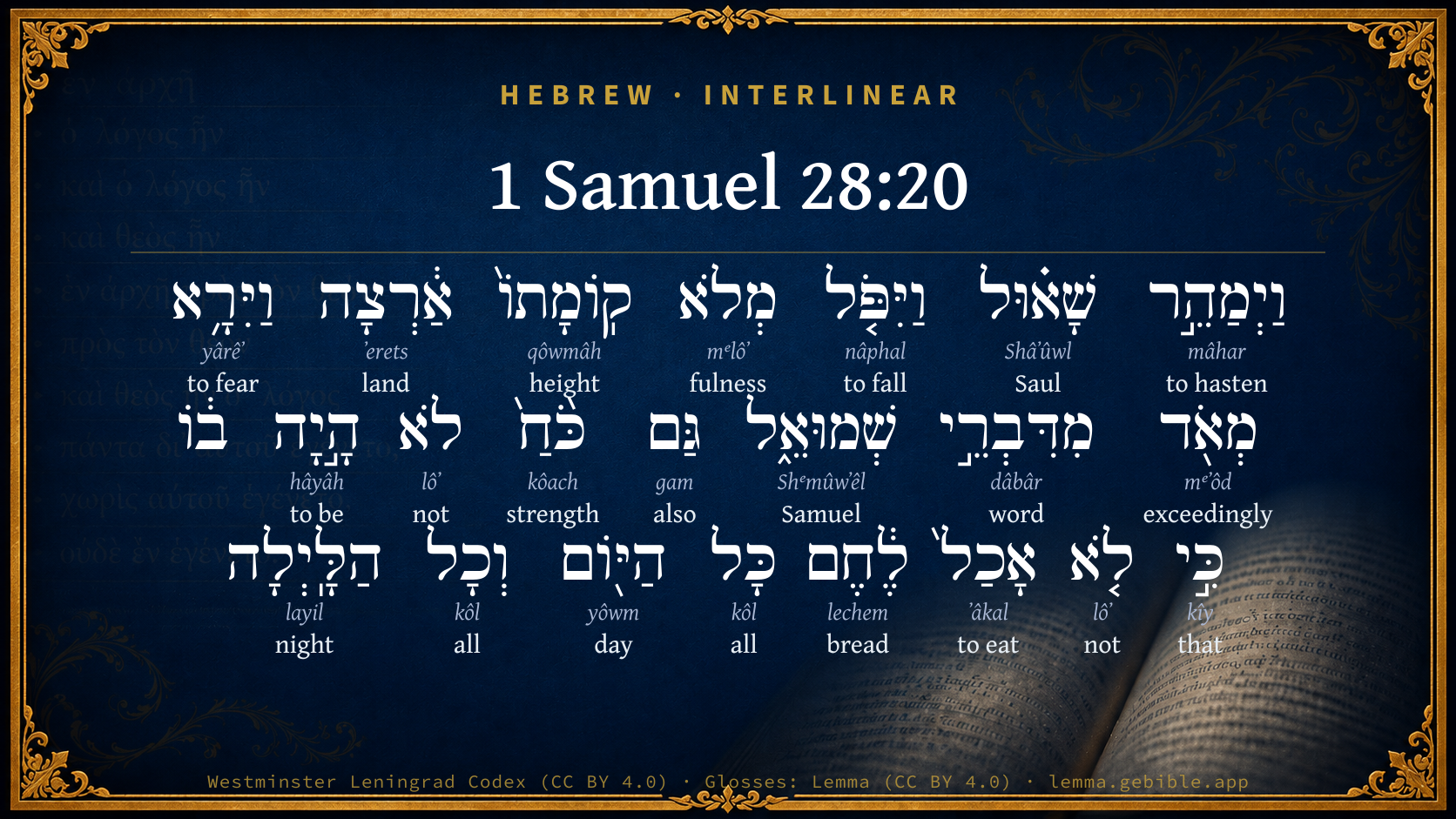
Hebrew (Westminster Leningrad Codex) 1 Samuel 28:20 appears in the Hebrew Old Testament. The text above is from the Westminster Leningrad Codex. Each word links to its Strong’s number, a concise gloss, and parsing drawn from the Open Scriptures Hebrew Bible morphology. Click any word for its full Brown-Driver-Briggs (BDB) entry.
Download image
Cite this verse

1 Samuel 28:20 (World English Bible). Public Domain. Lemma interlinear Bible study tool, https://lemma.gebible.app/v/1-samuel/28/20.

Show BibTeX & RIS
BibTeX
RIS
English Translation
Then Saul fell immediately his full length on the earth, and was sore afraid, because of the words of Samuel: and there was no strength in him; for he had eaten no bread all the day, nor all the night.
World English Bible · Public Domain
Download a study sheet

One document with this verse’s original text, its word-by-word gloss line, the meaning frame, cross-references with their text, attributed commentary, and full source and license credits — printable, and it pastes into notes with its structure intact.

This verse Autodidact and up

Study sheet (.html) Plain text (.txt)

A passage Seminary Student

Up to 50 verses in one chapter. A passage sheet keeps up to 6 commentary sources and 12 cross-references per verse, in the order this page ranks them, and says so on the sheet whenever that leaves anything out. Ask for a single verse and you get the Autodidact verse sheet above.

Everything on this page stays free to read, with no account — the sheet is a download of what is already on screen, not access to it.

Want to remove ads? Support Godless Engineer
Compare translations 3

The same verse in 3 English versions, stacked beneath the original-language interlinear above. Click any original word for its lexicon entry.

Each is an independent rendering of the whole verse — the interlinear is not word-aligned to these translations.

Highlighted words mark where these versions differ — a whole-verse word diff, not a word-by-word alignment.

  • World English Bible Public Domain
    Then Saul fell immediately his full length on the earth, and was sore afraid, because of the words of Samuel: and there was no strength in him; for he had eaten no bread all the day, nor all the night.
  • King James Version Public Domain
    Then Saul fell straightway all along on the earth, and was sore afraid, because of the words of Samuel: and there was no strength in him; for he had eaten no bread all the day, nor all the night.
  • unfoldingWord Literal Text CC BY-SA 4.0
    And Saul hurried and fell, the fullness of his height to the ground, for he feared greatly from the words of Samuel. Also strength was not in him, for he had not eaten bread all of the day and all of the night.

unfoldingWord Literal Text — © unfoldingWord, licensed CC BY-SA 4.0. Word-aligned USFM3 via Door43 (git.door43.org/unfoldingWord/en_ult).

Versions to compare (up to 4)

3 of 4 selected

Show all 18 translations

Every available English version of this verse, each an independent rendering of the whole verse.

  • World English Bible Public Domain
    Then Saul fell immediately his full length on the earth, and was sore afraid, because of the words of Samuel: and there was no strength in him; for he had eaten no bread all the day, nor all the night.
  • Berean Standard Bible Public Domain
    Immediately Saul fell flat on the ground, terrified by the words of Samuel. And his strength was gone, because he had not eaten anything all that day and night.
  • Majority Standard Bible Public Domain
    Immediately Saul fell flat on the ground, terrified by the words of Samuel. And his strength was gone, because he had not eaten anything all that day and night.
  • King James Version Public Domain
    Then Saul fell straightway all along on the earth, and was sore afraid, because of the words of Samuel: and there was no strength in him; for he had eaten no bread all the day, nor all the night.
  • American Standard Version (1901) Public Domain
    Then Saul fell straightway his full length upon the earth, and was sore afraid, because of the words of Samuel: and there was no strength in him; for he had eaten no bread all the day, nor all the night.
  • Revised Version (1885) Public Domain
    Then Saul fell straightway his full length upon the earth, and was sore afraid, because of the words of Samuel: and there was no strength in him; for he had eaten no bread all the day, nor all the night.
  • Geneva Bible (1599) Public Domain
    Then Saul fell streight way all along on the earth, and was sore afraide because of the wordes of Samuel, so that there was no strength in him: for he had eaten no bread all the day nor all the night.
  • Douay-Rheims (1899) Public Domain
    And forthwith Saul fell all along on the ground, for he was frightened with the words of Samuel, and there was no strength in him, for he had eaten no bread all that day.
  • Young's Literal Translation Public Domain
    And Saul hasteth and falleth -- the fulness of his stature -- to the earth, and feareth greatly because of the words of Samuel; also power was not in him, for he had not eaten bread all the day, and all the night.
  • Literal Standard Version CC BY-SA 4.0
    And Saul hurries and falls—the fullness of his stature—to the earth, and fears greatly because of the words of Samuel; also power was not in him, for he had not eaten bread all the day, and all the night.
  • Unlocked Literal Bible CC BY-SA 4.0
    Then Saul immediately fell his full length on the ground and was very afraid because of the words of Samuel. There was no strength in him, for he had eaten no food all that day, neither that whole night.
  • unfoldingWord Literal Text CC BY-SA 4.0
    And Saul hurried and fell, the fullness of his height to the ground, for he feared greatly from the words of Samuel. Also strength was not in him, for he had not eaten bread all of the day and all of the night.
  • Darby Bible Public Domain
    And Saul fell straightway his full length on the earth, and was sore afraid because of the words of Samuel; and there was no strength in him, for he had eaten no bread all the day nor all the night.
  • World Messianic Bible Public Domain
    Then Saul fell immediately his full length on the earth, and was terrified, because of Samuel’s words. There was no strength in him, for he had eaten no bread all day long or all night long.
  • Webster's Bible Public Domain
    Then Saul fell immediately all along on the earth, and was exceedingly afraid, because of the words of Samuel: and there was no strength in him; for he had eaten no bread all the day, nor all the night.
  • Free Bible Version CC BY-SA 4.0
    Saul collapsed facedown on the ground, terrified at what Samuel had said. He had no strength, because he hadn't eaten anything all that day and night.
  • Bible in Basic English Public Domain
    Then Saul went down flat on the earth, and was full of fear because of Samuel's words: and there was no strength in him, for he had taken no food all that day or all that night.
  • JPS Tanakh (1917) Public Domain
    Then Saul fell straightway his full length upon the earth, and was sore afraid, because of the words of Samuel; and there was no strength in him; for he had eaten no bread all the day, nor all the night.

Literal Standard Version (2020), Covenant Press — licensed CC BY-SA 4.0. Text via the HelloAO Bible API (eBible.org). Unlocked Literal Bible (unfoldingWord) — licensed CC BY-SA 4.0. Text via the HelloAO Bible API (eBible.org). unfoldingWord Literal Text — © unfoldingWord, licensed CC BY-SA 4.0. Word-aligned USFM3 via Door43 (git.door43.org/unfoldingWord/en_ult). Free Bible Version, Dr. Jonathan Gallagher — licensed CC BY-SA 4.0. Text via the HelloAO Bible API (eBible.org).

Word by word

More ways to search: Search by grammar → Find every occurrence → Compare this word →

Practice this passage: Drill this verse → Learn its vocabulary →

מְלֹא
mᵉlôʼ
H4393
“fulness of”
Noun, Common, Masculine, Singular, Construct
Part of Speech
Noun
Type
Common
Gender
Masculine
Number
Singular
State
Construct
Full BDB Definition

Origin: from H4390

TWOT: 1195b

fulness, that which fills - fulness, handful - mass, multitude - fulness, that which fills, entire contents - full length, full line
  1. וַיְמַהֵ֣ר mâhar H4116 “and · to hasten” Conjunction + Verb, Piel, Sequential Imperfect, 3rd Person, Masculine, Singular
  2. שָׁא֗וּל Shâʼûwl H7586 “Saul” Noun, Proper
  3. וַיִּפֹּ֤ל nâphal H5307 “and · to fall” Conjunction + Verb, Qal, Sequential Imperfect, 3rd Person, Masculine, Singular
  4. קֽוֹמָתוֹ֙ qôwmâh H6967 “height · his” Noun, Common, Feminine, Singular, Construct + Suffix, Personal, 3rd Person, Masculine, Singular
  5. אַ֔רְצָה ʼerets H776 “land · toward” Noun, Common, Both, Singular, Absolute + Suffix, Demonstrative
  6. וַיִּרָ֥א yârêʼ H3372 “and · to fear” Conjunction + Verb, Qal, Sequential Imperfect, 3rd Person, Masculine, Singular
  7. מְאֹ֖ד mᵉʼôd H3966 “exceedingly” Adverb
  8. מִדִּבְרֵ֣י dâbâr H1697 “from · words of” Preposition + Noun, Common, Masculine, Plural, Construct
  9. שְׁמוּאֵ֑ל Shᵉmûwʼêl H8050 “Samuel” Noun, Proper
  10. גַּם gam H1571 “also” Particle, Accusative
  11. כֹּ֨חַ֙ kôach H3581 “strength” Noun, Common, Masculine, Singular, Absolute
  12. לֹא lôʼ H3808 “not” Particle, Negative
  13. הָ֣יָה hâyâh H1961 “to be” Verb, Qal, Perfect, 3rd Person, Masculine, Singular
  14. כִּ֣י kîy H3588 “that” Conjunction
  15. לֹ֤א lôʼ H3808 “not” Particle, Negative
  16. אָכַל֙ ʼâkal H398 “to eat” Verb, Qal, Perfect, 3rd Person, Masculine, Singular
  17. לֶ֔חֶם lechem H3899 “bread” Noun, Common, Both, Singular, Absolute
  18. כָּל kôl H3605 “all of” Noun, Common, Masculine, Singular, Construct
  19. הַיּ֖וֹם yôwm H3117 “the · day” Particle, Definite Article + Noun, Common, Masculine, Singular, Absolute
  20. וְכָל kôl H3605 “and · all of” Conjunction + Noun, Common, Masculine, Singular, Construct
  21. הַלָּֽיְלָה layil H3915 “the · night” Particle, Definite Article + Noun, Common, Masculine, Singular, Absolute

About this verse

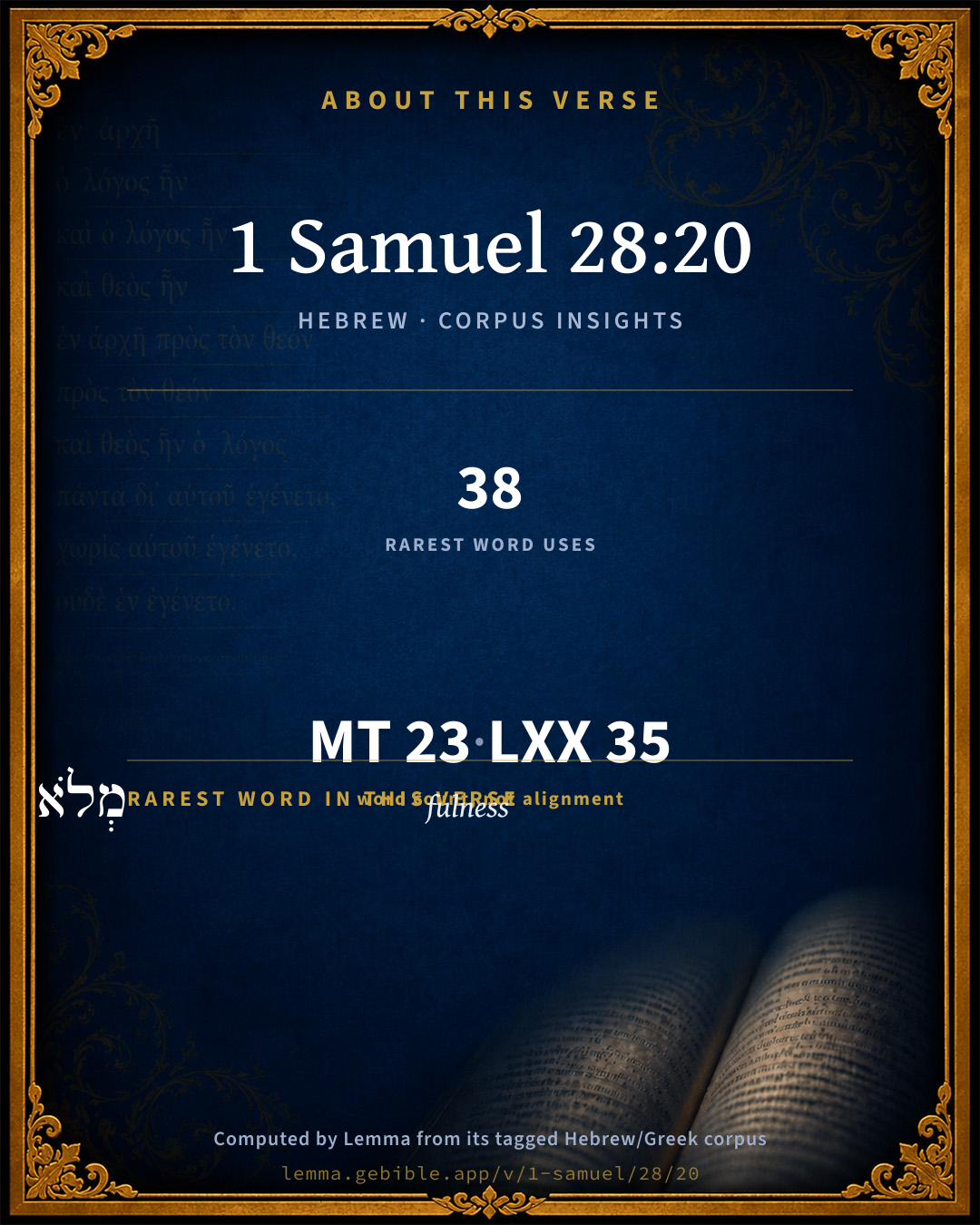
These counts appear in no published source. They are computed here, from the morphology-tagged text and Lemma’s own curated glosses. What Lemma adds →

23
words
20
distinct lemmas
Historical
section

Shared distinctive vocabulary

מְלֹא fulness H4393 occurs in 36 verses of the Hebrew Bible. Also found in:

Grammatical profile

  • 5 verbs
  • 12 nouns
  • 1 preposition
  • 1 conjunction
  • 1 adverb
  • 3 particles

Verb forms

  • וַיְמַהֵ֣ר Piel · Sequential Imperfect
  • וַיִּפֹּ֤ל Qal · Sequential Imperfect
  • וַיִּרָ֥א Qal · Sequential Imperfect
  • הָ֣יָה Qal · Perfect
  • אָכַל֙ Qal · Perfect

Repetition

Words recur within this verse — often emphatic in Hebrew:

Hebrew & Septuagint length

In English translation the verse runs 40 words from the Hebrew and 43 from the Septuagint (LXX English) — closely comparable.

A rough comparison of the two English renderings, which tokenize alike — not a word-level alignment.

Word counts can differ between the Hebrew and the Greek without any difference in meaning — e.g. the Hebrew direct-object marker אֵת has no separate Greek word, and Greek often adds the article ὁ.

In the original languages it is 23 Hebrew tokens and 35 Greek tokens — but the two are counted differently (Hebrew bundles its prefixes and suffixes into one token; the Greek is in lemma form), so that isn’t a like-for-like length.

Cross-references

5

Topical passages linked to 1 Samuel 28:20 in the Treasury of Scripture Knowledge — connected by theme and wording, ordered by reader-vote popularity; previews shown in the World English Bible.

  • 1 Samuel 25:37 It happened in the morning, when the wine was gone out of Nabal, that his wife told him these things, and his heart died within him, and he became as a stone.
  • 1 Samuel 28:5 When Saul saw the host of the Philistines, he was afraid, and his heart trembled greatly.
  • Job 15:20–24 The wicked man travails with pain all his days, Even the number of years that are laid up for the oppressor.
  • Job 26:2 "How have you helped him who is without power! How have you saved the arm that has no strength!
  • Psalms 50:21–22 You have done these things, and I kept silent. You thought that the "I AM" was just like you. I will rebuke you, and accuse you in front of your eyes.

Cross-references courtesy of OpenBible.info (CC BY 4.0).

Hebrew and Greek witnesses Masoretic Hebrew ↔ Greek Septuagint

The same verse in the two great witnesses to the Old Testament, shown verse-for-verse.

These are two independent witnesses, not word-aligned to each other, and the Septuagint is shown in lemma (dictionary) form.

Hebrew 1 Samuel 28:20 Masoretic · Westminster Leningrad Codex

וַיְמַהֵ֣ר שָׁא֗וּל וַיִּפֹּ֤ל מְלֹא קֽוֹמָתוֹ֙ אַ֔רְצָה וַיִּרָ֥א מְאֹ֖ד מִדִּבְרֵ֣י שְׁמוּאֵ֑ל גַּם כֹּ֨חַ֙ לֹא הָ֣יָה ב֔וֹ כִּ֣י לֹ֤א אָכַל֙ לֶ֔חֶם כָּל הַיּ֖וֹם וְכָל הַלָּֽיְלָה

Then Saul fell immediately his full length on the earth, and was sore afraid, because of the words of Samuel: and there was no strength in him; for he had eaten no bread all the day, nor all the night.

World English Bible · Public Domain

Greek LXX 1 Samuel 28:20 Septuagint · lemma form

καί σπεύδω σαούλ καί πίπτω ἵστημι ἐπί ὁ γῆ καί φοβέω σφόδρα ἀπό ὁ λόγος σαμουηλ καί ἰσχύς ἐν αὐτός οὐ εἰμί ἔτι οὐ γάρ ἐσθίω ἄρτος ὅλος ὁ ἡμέρα καί ὅλος ὁ νύξ ἐκεῖνος

And Saul instantly fell at his full length upon the earth, and was greatly afraid because of the words of Samuel; and there was no longer any strength in him, for he had eaten no bread all that day, and all that night.

LXX2012 (modern English Septuagint) · Public Domain

Hebrew: Westminster Leningrad Codex (CC BY 4.0). Greek: Septuagint (public domain); English from LXX2012 (modern English Septuagint) (Public Domain). How the Septuagint differs from the Hebrew →

Targum (Aramaic paraphrase)

1

The Targum is the ancient Jewish Aramaic paraphrase of the Hebrew Scriptures — an interpretive translation, not the Hebrew text itself. Onkelos (literal) and Pseudo-Jonathan (expansive) render the Torah, and Jonathan the Prophets. Coverage is partial: where no permissively-licensed English translation exists for a verse, only the Aramaic is shown. This is verse-level text, not a word-by-word alignment to the Hebrew.

  1. Targum Jonathan Prophets (Joshua–Malachi)
    וְאוֹחֵי שָׁאוּל וּנְפַל מְלֵי קוֹמָתֵיהּ לְאַרְעָא וּדְחִיל לַחֲדָא מִפִּתְגָמֵי שְׁמוּאֵל אַף חֵילָא לָא הֲוָה בֵיהּ אֲרֵי לָא אֲכָל לַחְמָא כָּל יוֹמָא וְכָל לֵילְיָא:

    (no public-domain English translation for this verse)

    Targum Jonathan — Aramaic: “Mikraot Gedolot” (public domain). English: “Sefaria Community Translation” (CC0 1.0 (public-domain dedication)); “London "Chaldee Paraphrase," 1871” (public domain). Text via Sefaria.

Commentary

Notes on 1 Samuel 28:20 from classic Christian and Jewish commentators (each source and its license shown beneath its notes). The classic Christian expositions comment on the surrounding passage and are grouped to its opening verse, so a note may address several verses; the Jewish commentaries on the Tanakh (Rashi and others) are per-verse, so they appear only where the commentator wrote on this verse.

Lemma curates 59 commentaries, every one of them public domain or Creative Commons licensed, each selected and text-cleaned for this edition rather than reprinted as found. About our sources →

Matthew Henry's Commentary

We are here told how Saul received this terrible message from the ghost he consulted. He desired to be told what he should do (Sa1 28:15), but was only told what he had not done and what should be done to him. Those that expect any good counsel or comfort otherwise than from God, and in the way of his institutions, will be as wretchedly disappointed as Saul here was. Observe,

I. How he sunk under the load, Sa1 28:20. He was indeed unfit to bear it, having eaten nothing all the day before, nor that night. He came fasting from the camp, and continued fasting; not for want of food, but for want of an appetite. The fear he was in of the power of the Philistines (Sa1 28:5) took away his appetite, or perhaps the struggle he had with his own conscience, after he had entertained the thought of consulting the witch, made him to nauseate even his necessary food, though ever so dainty. This made him an easy prey to this fresh terror that now came upon him like an armed man. He fell all along on the earth, as if the archers of the Philistines had already hit him, and there was no strength in him to bear up against these heavy tidings. Now he had enough of consulting witches, and found them miserable comforters. When God in his word speaks terror to sinners he opens to them, at the same time, a door of hope if they repent: but those that apply to the gates of hell for succour must there expect darkness without any glimpse of light.

II. With what difficulty he was persuaded to take so much relief as was necessary to carry him back to his post in the camp. The witch, it should seem, had left Saul alone with the spectre, to have his talk with him by himself; but perhaps hearing him fall and groan, and perceiving him to be in great agony, she came to him (Sa1 28:21), and was very importunate with him to take some refreshment, that he might be able to get clear from her house, fearing that if he should be ill, especially if he should die there, she should be punished for it as a traitor, though she had escaped punishment as a witch. This, it is probable, rather than any sentiment of kindness, made her solicitous to help him. But what a deplorable condition had he brought himself to when he needed so wretched a comforter! 1. She showed herself very importunate with him to take some refreshment. She pleaded (Sa1 28:21) that she had obeyed his voice to the endangering of her life, and why therefore should not he hearken to her voice for the relieving of his life? Sa1 28:22. She had a fat calf at hand (and the word signifies one that was made use of in treading out the corn, and therefore could the worse be spared); this she prepared for his entertainment, Sa1 28:24. Josephus is large in applauding the extraordinary courtesy and liberality of this woman, and recommending what she did as an example of compassion to the distressed, and readiness to communicate for their relief, though we have no prospect of being recompensed. 2. He showed himself very averse to it: He refused, and said, I will not eat (Sa1 28:23), choosing rather to die obscurely by famine than honourably by the sword. Had he laboured only under a defect of animal spirits, food might have helped him; but, alas! his case was out of the reach of such succours. What are dainty meats to a wounded conscience? As vinegar upon nitre, so is he that sings songs to a heavy heart, so disagreeable and unwelcome. 3. The woman at length, with the help of his servants, overpersuaded him, against his inclination and resolution, to take some refreshment. Not by force, but by friendly advice, they compelled him (Sa1 28:23), and of no other than such a rational and courteous compulsion are we to understand that in the parable, Compel them to come in, Luk 14:23. How forcible are right words, when men are pressed by them to that which is for their own interest! Job 6:25. Saul was somewhat revived with this entertainment; so that he and his servants, when they had eaten, rose up and went away before it was light (Sa1 28:25), that they might hasten to their business and that they might not be seen to come out of such a scandalous house. Josephus here much admires the bravery and magnanimity of Saul, that, though he was assured he should lose both his life and honour, yet he would not desert his army, but resolutely returned to the camp, and stood ready for an engagement. I wonder more at the hardness of his heart, that he did not again apply to God by repentance and prayer, in hopes yet to obtain at least a reprieve; but he desperately ran headlong upon his own ruin. Perhaps, indeed, now that rage and envy possessed him to the uttermost, he was the better reconciled to his hard fate, being told that his sons, and Jonathan among the rest, whom he hated for his affection to David, should die with him. If he must fall, he cared not what desolations of his family and kingdom accompanied his fall, hoping it would be the worse for his successor. Emou thanontos gaia michthetō puri - I care not if, when I am dead, the world should be set on fire. He begged not, as David, "Let thy hand be against me, but not against thy people."

Matthew Henry's Commentary on the Whole Bible (1708–1710) — public domain (CC PDM 1.0). Text via the HelloAO Bible API.

Trapp's Complete Commentary

John Trapp

1Sa 28:20 Then Saul fell straightway all along on the earth, and was sore afraid, because of the words of Samuel: and there was no strength in him; for he had eaten no bread all the day, nor all the night.

Ver. 20. Then Saul fell straightway all along.] Like an ox, totus totus, quantus quantus; Heb., In the fulness of his stature: and this he made haste to do. {a} Let such as run to witches look for no more comfort in distress: or else to any other like sinister practice. Clement V, Pope, sent to a wizard to know how it fared with a nephew of his, who had been his catamite, now that he was dead. The wizard assured the messenger that he had seen him in hell torments. The Pope was so troubled and terrified hereat, that he never looked up again, but died soon after. {b} Cicero {c} made lamentable moan in his misery, crying out, O me nunquam sapientem! &c. O meam cadamitosam et praecipitem senectutem! O turpem exacta dementique aetate canitiem!

For he had eaten no bread.] Haply, saith Martyr, because such as came to inquire of witches were to come fasting; as God will be sought to by fasting and prayer.

{a} Corruit ut erat erectus et stabat. - Vat.

{b} Jacob. Rev., in Vit. Pontif.

{c} Epist. ad Octav.

John Trapp, A Commentary or Exposition upon All the Books of the Old and New Testament (1647–1656) — public domain. Text from a community e-Sword module.

Joseph Benson's Commentary

1Sa 28:20. Then Saul fell straightway all along on the earth — Struck to the heart, as if the archers of the Philistines had already hit him, at the hearing this dreadful sentence pronounced upon himself, his family, and people; and overcome with astonishment and terror. And was sore afraid because of the words of Samuel — Observe, reader, the words of Samuel, says the inspired historian, and not the words of Satan, or any evil spirit personating Samuel. These words, which he now fully believed, and which were the more awful as being pronounced by a departed spirit, sent from the invisible world on purpose to pronounce them, even the spirit of a great and holy prophet, whom he had once highly revered, and to whom, under God, he had owed all his elevation; these words so operated upon his mind, weakened and oppressed with guilt, and upon his body, exhausted with fatigue and fasting, that no strength, or power of motion, was left in him; and he fell at his full length as dead upon the floor. Unhappy Saul! he now reaps the bitter fruits of forsaking God, and of being therefore forsaken by him, and of his many great and aggravated crimes. Vengeance, which had long hovered over him, and waited in long-suffering for his repentance, now advances with large and rapid strides, and his doom approaches. He is deeply sensible of it, and is overwhelmed with horror and dismay on the account thereof.

Joseph Benson's Commentary on the Old and New Testaments (1811–1818) — public domain. Text from a community e-Sword module.

Geneva Bible (1599)

Geneva Bible translators

The wicked when they hear God’s judgments, tremble and despair, but cannot seek for mercy by repentance.

Geneva Bible (1599) marginal notes — public domain. Text via Bolls.life.

Adam Clarke's Commentary

Verse 20. Then Saul fell straightway all along on the earth.] Literally, he fell with his own length, or with the fullness of his stature. He was so overwhelmed with this most dreadful message, that he swooned away, and thus fell at his own length upon the ground. The woman, being terrified, had probably withdrawn to some distance at the first appearance of the prophet; and Saul was left alone with Samuel. After some short time, the woman came again unto Saul, found him sore troubled, and offered him those succours which humanity dictated.

Adam Clarke's Commentary on the Bible (1810–1826) — public domain. Text from a community e-Sword/MySword module.

Ellicott's Commentary for English Readers

(20) Then Saul fell straightway all along on the earth.—Up to this period we must understand Saul listening to the prophet’s words in that attitude of humble reverence which he assumed when he perceived that he was in the presence of Samuel (1Sa_28:14); but now, on hearing the words of awful judgment, crushed with terror and dismay, and previously weakened by a long fast and the fatigue of the rough night walk from Mount Gilboa to En-dor, he fell prostrate to the earth.

A Bible Commentary for English Readers, edited by Charles John Ellicott (1878–1897) — public domain. Text from a community e-Sword module.

The Cambridge Bible for Schools and Colleges

gen. ed. J. J. S. Perowne

20–25. Saul entertained by the woman

20. all along] His full length, lit. “the fulness of his stature.” Terror of mind and exhaustion of body left him powerless.

The Cambridge Bible for Schools and Colleges (gen. ed. J. J. S. Perowne; Cambridge University Press, 1878–1918) — public domain. Text from a community e-Sword module.

John Gill's Exposition

Then Saul fell straightway all along on the earth,.... Fell at his full length at once, as if he had been thunderstruck, or pierced through with a dart or sword:

and was sore afraid, because of the words of Samuel; as he supposed they were, whose words never failed:

and there was no strength in him: to rise up again, he was quite dispirited and strengthless:

for he had eaten no bread all the day, nor all the night; which contributed the more to his weakness; not only his fears, but not eating any food, occasioned his weakness, and that through want of an appetite, by reason of the great concern of his mind in his present troubles.

John Gill's Exposition of the Whole Bible (1746–1763) — public domain (CC PDM 1.0). Text via the HelloAO Bible API.

Haydock's Catholic Bible Commentary

Day, through excessive anguish. (Haydock) --- He fainted away; upon which his attendants and the woman rushed in. (Salien)

George Leo Haydock (1774–1849), Haydock's Catholic Family Bible and Commentary, 1859 edition — public domain. Excludes Psalms (Douay-Rheims chapter numbering differs from Protestant) and Deuterocanonical books (Catholic canon only).

Matthew Poole's English Annotations

Saul fell along on the earth, being quite dispirited with these sad and surprising tidings, and so unable to stand.

Matthew Poole's English Annotations on the Holy Bible (1683–1685) — public domain. Text from a community e-Sword/MySword module.

Whedon's Commentary on the Bible

Daniel D. Whedon

20. Fell straightway all along — See margin. He was completely overwhelmed with fear.

Because of the words of Samuel — He believed that the words he had heard were the words of the holy Samuel. The witch was perfectly successful in making him believe that she had called up the holy prophet from his rest in hades.

No strength in him — Before his interview with the woman he must have been weak from his long fasting, and now these impressive oracles completely prostrate him

Daniel D. Whedon (gen. ed.), Commentary on the Old and New Testaments (1874–1909) — public domain. Text from a community e-Sword module.

The Pulpit Commentary

Vers. 20-25. Saul fell straightway all along, i.e. at full length, on the earth. He fainted, partly from mental distress, partly from bodily exhaustion, as he had gone all the day and all the night without food. It was this long continued violent emotion of feeling which had driven Saul to this rash enterprise; but fasting and agony of mind were the worst possible preparation for a visit to one used to cajole her victims by pretended magical arts, and gifted, as people of her class usually are, with great shrewdness. But practised as she was in deceit, yet even in her triumph over her enemy she felt, when she saw him swoon away, a natural sympathy for his misery and weakness, and urged him to take food. Perhaps she saw that without it he could never have got back to the Israelite comp. At first he refused, but the necessity of it was so plain, that when the two men with him also urged it, he at last consented. So he arose from the earth, and sat upon the bed. During this colloquy he had remained prostrate upon the ground, but now he seated himself, not on a bed, but upon the raised bank, or divan, which runs along the wall of an Oriental house, and is furnished with carpets and cushions for men to sit or lie upon. There he rested, a prey, we may well believe, to bitter thoughts, while the woman hastily prepared a meal, killing a calf and baking unleavened cakes, as there was no time to leaven the dough. And so "they ate, and rose up, and departed that night.

Vers. 20-25. (ENDOR.)

The witch of Endor.

According to Jewish tradition she was the mother of Abner, on which account perhaps she escaped when others were "put away;" and the two attendants of Saul, in his visit to her, were Abner and Amass. She dwelt at Endor (the fountain of habitation), a village four miles south of Mount. (Jos_17:11; Psa_83:10) "The calcareous cliffs around are filled with wide caverns, and some of the modern habitations are formed of front wails shutting in these caves," in one of which she may have dwelt and practised her forbidden art. This possessor or mistress of Ob (see vers. 7-10), although differing much from those who were accounted "witches," greatly abhorred and severely punished in more recent times, was a representative of many of them in

1. Perverted religiousness. Her history might have shown that she possessed a more than ordinary measure of the religious sentiment prevalent in women, and that it had been (as it often is) misdirected by the influences under which she fell. She was at first a victim of superstition, and afterwards, finding herself perhaps endowed with peculiar and mysterious susceptibilities, and looked up to by others on account of her superior "wisdom," practised on their superstitions fears, in part deceived and in part deceiving. The mischief of the perversion of the religious sentiment (in deception, bigotry, cruelty, etc.) is incalculable.

2. Secret criminality. If she had lived among the heathen from whom her art was derived, she might have been held in general repute, like the oracles of Greece. But in Israel necromancy was condemned as treason against the Divine King, an abomination associated with and promotive of the worship of idols, and she displayed a daring impiety in practising it even in secret. "The Hebrew witch, or she who communicated or attempted to communicate with an evil spirit, was justly punished with death, though her communication with the spiritual world might either not exist at all, or be of a nature much less intimate than has been ascribed to the witches of later days; nor does the existence of the law against the witches of the Old Testament sanction in any respect the severity of similar enactments, subsequent to the Christian revelation, against a different class of persons accused of a very different species of crime" (Sir W. Scott).

1. Unholy cupidity. The desire of gain, to which she may have been urged by necessitous circumstances, was probably her principal motive in

2. practising her art at the risk of life. The same desire leads to the basest actions, and even turns godliness into ungodliness. It is "a root of all evil.

3. Perpetual fear of discovery and suspicion of deception on the part of those to whose wishes she ministered, and of whose weaknesses she made traffic (ver. 9). The sword of justice hangs over the head of secret transgressors, and suffers them not to enjoy a moment"s peace.

1. Skilful deception. Saul thought to deceive her, but was himself deceived by her, and fatally deluded. Whatever may have been her power in magic, clairvoyance (Keil), and ventriloquism, (Isa_29:4) she certainly professed what she did not possess (ver. 11); employed it in "cunning craftiness," and became (whether designedly or undesignedly) accessory to his ruin. (1Ch_10:14) How much of the power which is now abused and made a curse might if properly used become a blessing!

2. Kindly sympathy and ministration. On observing his heavy fall (for she was apparently in the same room) she came to his side, and seeing that he was "sore troubled," felt a woman"s pity, spoke to him in soothing tones as to a wilful child, requested him to gratify her wishes in eating "a morsel of bread" to strengthen him, in return for her obeying his voice (with "a talkativeness characteristic of this class of women, and a certain humour"), perhaps called his servants, and with them constrained him. Her heart was not dead. "She had one calf that she was very fond of, and one that she took a great deal of care of, and fed it herself; for she was a woman that got her living by the labour of her own hands, and had no other possession but that one calf; this she killed, and made ready its flesh, and set it before his servants and himself. Now it is but just to recommend the generosity of this woman (Josephus).

3. Pitiable desolation. Saul is gone forth into the night to meet his fate. Left to herself, distrusted and distrustful, feared and fearful, without the consolations of religion, she is as much an object of pity as of blame. "We take leave of her, as she took leave of the ruined king, with a pitying heart. D.

The Pulpit Commentary (1880–1919), ed. H.D.M. Spence-Jones & Joseph S. Exell — public domain. Text from a community e-Sword module.

John Wesley's Explanatory Notes

Fell - As if the Archers of the Philistines had already hit him, and there was no strength in him, to bear up against these heavy tidings: especially, as we cannot doubt, but all his past sins were now brought to his remembrance and what authority has any man to affirm, that he felt no contrition all this time? Altho' it did not seem good to the holy ghost, to leave it upon record?

John Wesley, Explanatory Notes Upon the Whole Bible (1754–1765) — public domain. Text via the GEBible commentary corpus.

unfoldingWord translationNotes

Door43 World Missions Community

he had eaten no food all that day, neither that whole night

Saul had not eaten during the night before he traveled from Gilboa (1 Samuel 28:4) to Endor (1 Samuel 28:7), nor during the day as he journeyed, nor during the night on which he visited the woman.

I have put my life in my hand and have listened

This is an idiom. "I could die because I listened" or "Someone could kill me because I listened" (See: Idiom)

translationWords

Saul (OT)

fear

word

Samuel

strength

trouble

servant

voice

hand

unfoldingWord translationNotes — © Distant Shores Media and the Door43 World Missions Community, licensed CC BY-SA 4.0. Source: git.door43.org/Door43/en_tn.

Lesson kit

Teaching starters — assembled from the data on this page, not authored interpretation. Every prompt links to the verse data it draws on. Edit before teaching.

1 Samuel, in the Historical, opens this verse with 23 words (20 distinct Hebrew lemmas). Its most distinctive word is mᵉlôʼ (“fulness”). A historical commentator’s framing appears above. Read the whole chapter for the surrounding context.

Discussion questions

  1. What does “fulness” (mᵉlôʼ) contribute to the verse as a whole?
  2. Genesis 48:19 shares the word «fulness» with this verse. How do the two illuminate each other?
  3. “all” occurs 2× in this one verse. What is the effect of the repetition?
  4. These translations render this verse differently; the difference is in the English rendering, not the original. What questions does that raise?
  5. The verb «וַיְמַהֵ֣ר» is Piel Sequential Imperfect. How does its form color the action?
  6. Reading how Matthew Henry's Commentary and Trapp's Complete Commentary read this verse, where do the two commentators agree and where do they part?

Things to notice

Reading settings

Reading text

Shown beneath each verse's original-language words.

Old Testament
Old Testament edition

Read the OT as the Masoretic Hebrew (MT) or the Greek Septuagint (LXX).

English shown for the Greek Septuagint (in the Hebrew ↔ Greek comparison).

Comparing translations? Open the Compare panel on any verse page to stack up to four side by side.