
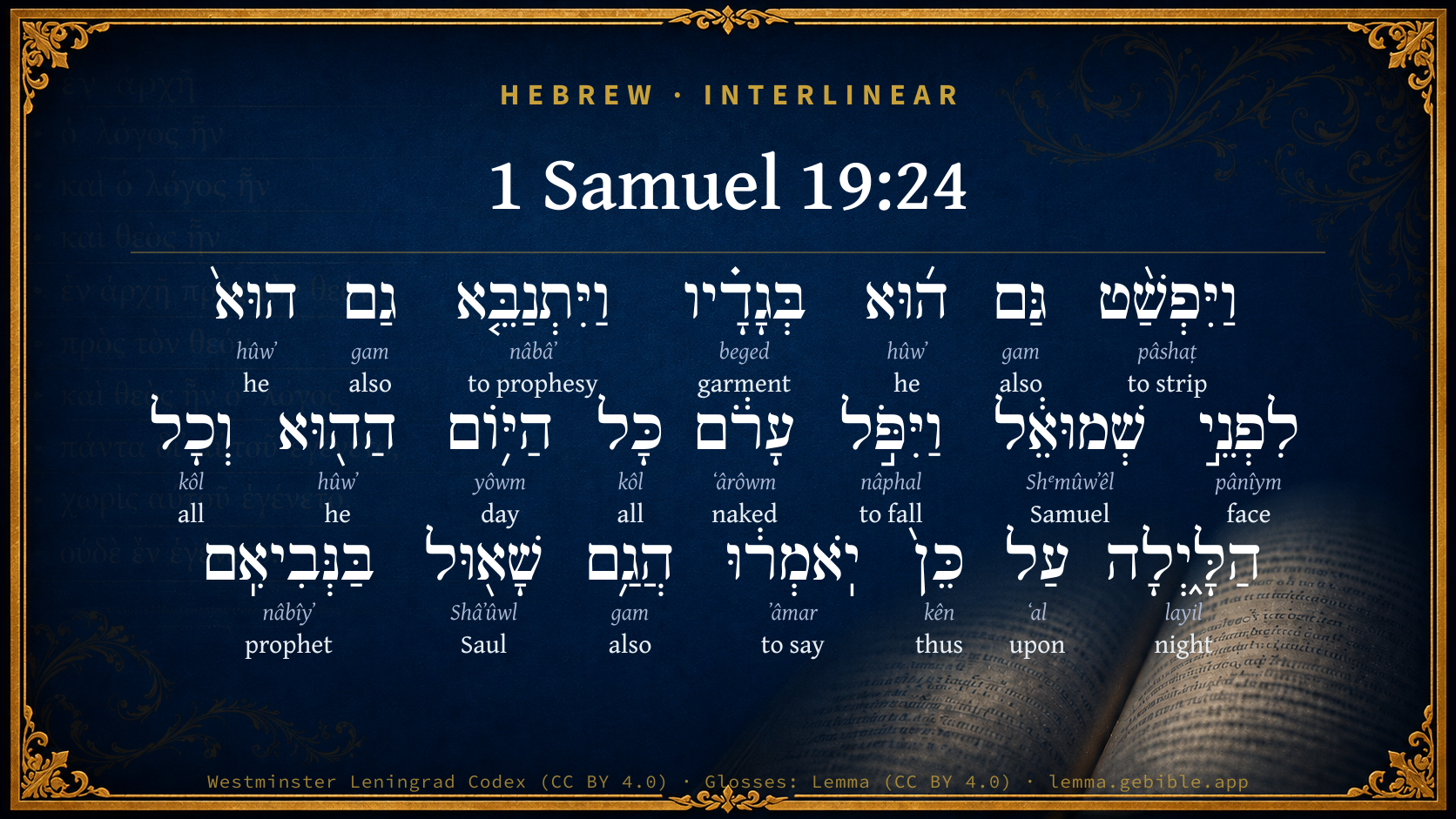
1 Samuel 19:24

Hebrew (Westminster Leningrad Codex) 1 Samuel 19:24 appears in the Hebrew Old Testament. The text above is from the Westminster Leningrad Codex. Each word links to its Strong’s number, a concise gloss, and parsing drawn from the Open Scriptures Hebrew Bible morphology. Click any word for its full Brown-Driver-Briggs (BDB) entry.
Download image
Cite this verse

1 Samuel 19:24 (World English Bible). Public Domain. Lemma interlinear Bible study tool, https://lemma.gebible.app/v/1-samuel/19/24.

Show BibTeX & RIS
BibTeX
RIS
English Translation
He also stripped off his clothes, and he also prophesied before Samuel, and lay down naked all that day and all that night. Therefore they say, "Is Saul also among the prophets?"
World English Bible · Public Domain
Download a study sheet

One document with this verse’s original text, its word-by-word gloss line, the meaning frame, cross-references with their text, attributed commentary, and full source and license credits — printable, and it pastes into notes with its structure intact.

This verse Autodidact and up

Study sheet (.html) Plain text (.txt)

A passage Seminary Student

Up to 50 verses in one chapter. A passage sheet keeps up to 6 commentary sources and 12 cross-references per verse, in the order this page ranks them, and says so on the sheet whenever that leaves anything out. Ask for a single verse and you get the Autodidact verse sheet above.

Everything on this page stays free to read, with no account — the sheet is a download of what is already on screen, not access to it.

Want to remove ads? Support Godless Engineer
Compare translations 3

The same verse in 3 English versions, stacked beneath the original-language interlinear above. Click any original word for its lexicon entry.

Each is an independent rendering of the whole verse — the interlinear is not word-aligned to these translations.

Highlighted words mark where these versions differ — a whole-verse word diff, not a word-by-word alignment.

  • World English Bible Public Domain
    He also stripped off his clothes, and he also prophesied before Samuel, and lay down naked all that day and all that night. Therefore they say, "Is Saul also among the prophets?"
  • King James Version Public Domain
    And he stripped off his clothes also, and prophesied before Samuel in like manner, and lay down naked all that day and all that night. Wherefore they say, Is Saul also among the prophets?
  • unfoldingWord Literal Text CC BY-SA 4.0
    And he also stripped off his clothes, and he also prophesied to the face of Samuel. And he lay naked all of that day and all of the night. Therefore they said, “ Saul also among the prophets?”

unfoldingWord Literal Text — © unfoldingWord, licensed CC BY-SA 4.0. Word-aligned USFM3 via Door43 (git.door43.org/unfoldingWord/en_ult).

Versions to compare (up to 4)

3 of 4 selected

Show all 18 translations

Every available English version of this verse, each an independent rendering of the whole verse.

  • World English Bible Public Domain
    He also stripped off his clothes, and he also prophesied before Samuel, and lay down naked all that day and all that night. Therefore they say, "Is Saul also among the prophets?"
  • Berean Standard Bible Public Domain
    Then Saul stripped off his robes and also prophesied before Samuel. And he collapsed and lay naked all that day and night. That is why it is said, “Is Saul also among the prophets?”
  • Majority Standard Bible Public Domain
    Then Saul stripped off his robes and also prophesied before Samuel. And he collapsed and lay naked all that day and night. That is why it is said, “Is Saul also among the prophets?”
  • King James Version Public Domain
    And he stripped off his clothes also, and prophesied before Samuel in like manner, and lay down naked all that day and all that night. Wherefore they say, Is Saul also among the prophets?
  • American Standard Version (1901) Public Domain
    And he also stripped off his clothes, and he also prophesied before Samuel, and lay down naked all that day and all that night. Wherefore they say, Is Saul also among the prophets?
  • Revised Version (1885) Public Domain
    And he also stripped off his clothes, and he also prophesied before Samuel, and lay down naked all that day and all that night. Wherefore they say, Is Saul also among the prophets?
  • Geneva Bible (1599) Public Domain
    And he stript off his clothes, and he prophesied also before Samuel, and fell downe naked all that day and all that night: therefore they say, Is Saul also among the Prophets?
  • Douay-Rheims (1899) Public Domain
    And he stripped himself also of his garments, and prophesied with the rest before Samuel, and lay down naked all that day and night. This gave occasion to a proverb: What! is Saul too among the prophets?
  • Young's Literal Translation Public Domain
    and he strippeth off -- he also -- his garments, and prophesieth -- he also -- before Samuel, and falleth down naked all that day and all the night; therefore they say, `Is Saul also among the prophets?'
  • Literal Standard Version CC BY-SA 4.0
    and he strips off—he also—his garments, and prophesies—he also—before Samuel, and falls down naked all that day and all the night; therefore they say, “Is Saul also among the prophets?”
  • Unlocked Literal Bible CC BY-SA 4.0
    He stripped off his clothes and also prophesied before Samuel. He lay naked all that day and all that night. This is why they ask, “Is Saul also among the prophets?”
  • unfoldingWord Literal Text CC BY-SA 4.0
    And he also stripped off his clothes, and he also prophesied to the face of Samuel. And he lay naked all of that day and all of the night. Therefore they said, “ Saul also among the prophets?”
  • Darby Bible Public Domain
    And he himself also stripped off his clothes, and prophesied, himself also, before Samuel, and lay down naked all that day and all that night. Wherefore they say, Is Saul also among the prophets?
  • World Messianic Bible Public Domain
    He also stripped off his clothes. He also prophesied before Samuel and lay down naked all that day and all that night. Therefore they say, “Is Saul also among the prophets?”
  • Webster's Bible Public Domain
    And he stripped off his clothes also, and prophesied before Samuel in like manner, and lay down naked all that day and all that night. Wherefore they say, Is Saul also among the prophets?
  • Free Bible Version CC BY-SA 4.0
    Then Saul also took off his clothes and he too prophesied in Samuel's presence. Then he fell down and lay there naked all that day and all that night. That's why it is said, “Is Saul one of the prophets too?”
  • Bible in Basic English Public Domain
    And he took off his clothing, acting like a prophet before Samuel, and falling down he was stretched out, without his clothing, all that day and all that night. This is the reason for the saying, Is even Saul among the prophets?
  • JPS Tanakh (1917) Public Domain
    And he also stripped off his clothes, and he also prophesied before Samuel, and lay down naked all that day and all that night. Wherefore they say: 'Is Saul also among the prophets?'

Literal Standard Version (2020), Covenant Press — licensed CC BY-SA 4.0. Text via the HelloAO Bible API (eBible.org). Unlocked Literal Bible (unfoldingWord) — licensed CC BY-SA 4.0. Text via the HelloAO Bible API (eBible.org). unfoldingWord Literal Text — © unfoldingWord, licensed CC BY-SA 4.0. Word-aligned USFM3 via Door43 (git.door43.org/unfoldingWord/en_ult). Free Bible Version, Dr. Jonathan Gallagher — licensed CC BY-SA 4.0. Text via the HelloAO Bible API (eBible.org).

Word by word

More ways to search: Search by grammar → Find every occurrence → Compare this word →

Practice this passage: Drill this verse → Learn its vocabulary →

עָרֹ֔ם
ʻârôwm
H6174
“naked”
Adjective, Adjective, Masculine, Singular, Absolute
Part of Speech
Adjective
Type
Adjective
Gender
Masculine
Number
Singular
State
Absolute
Full BDB Definition

Origin: from H6191 (in its original sense)

TWOT: 1588c

naked, bare
  1. וַיִּפְשַׁ֨ט pâshaṭ H6584 “and · to strip” Conjunction + Verb, Qal, Sequential Imperfect, 3rd Person, Masculine, Singular
  2. גַּם gam H1571 “also” Particle, Accusative
  3. ה֜וּא hûwʼ H1931 “he” Pronoun, Personal, 3rd Person, Masculine, Singular
  4. בְּגָדָ֗יו beged H899 “garments · his” Noun, Common, Masculine, Plural, Construct + Suffix, Personal, 3rd Person, Masculine, Singular
  5. וַיִּתְנַבֵּ֤א nâbâʼ H5012 “and · to prophesy” Conjunction + Verb, Hithpael, Sequential Imperfect, 3rd Person, Masculine, Singular
  6. גַם gam H1571 “also” Adverb
  7. הוּא֙ hûwʼ H1931 “he” Pronoun, Personal, 3rd Person, Masculine, Singular
  8. לִפְנֵ֣י pânîym H6440 “to/for · face(s) of” Preposition + Noun, Common, Both, Plural, Construct
  9. שְׁמוּאֵ֔ל Shᵉmûwʼêl H8050 “Samuel” Noun, Proper
  10. וַיִּפֹּ֣ל nâphal H5307 “and · to fall” Conjunction + Verb, Qal, Sequential Imperfect, 3rd Person, Masculine, Singular
  11. כָּל kôl H3605 “all of” Noun, Common, Masculine, Singular, Construct
  12. הַיּ֥וֹם yôwm H3117 “the · day” Particle, Definite Article + Noun, Common, Masculine, Singular, Absolute
  13. הַה֖וּא hûwʼ H1931 “the · he” Particle, Definite Article + Pronoun, Personal, 3rd Person, Masculine, Singular
  14. וְכָל kôl H3605 “and · all of” Conjunction + Noun, Common, Masculine, Singular, Construct
  15. הַלָּ֑יְלָה layil H3915 “the · night” Particle, Definite Article + Noun, Common, Masculine, Singular, Absolute
  16. עַל ʻal H5921 “upon” Preposition
  17. כֵּן֙ kên H3651 “thus” Particle, Demonstrative
  18. יֹֽאמְר֔וּ ʼâmar H559 “to say” Verb, Qal, Imperfect, 3rd Person, Masculine, Plural
  19. הֲגַ֥ם gam H1571 “also” Particle, Interrogative + Adverb
  20. שָׁא֖וּל Shâʼûwl H7586 “Saul” Noun, Proper
  21. בַּנְּבִיאִֽם nâbîyʼ H5030 “in/at the · prophets” Preposition, Determined + Noun, Common, Masculine, Plural, Absolute

About this verse

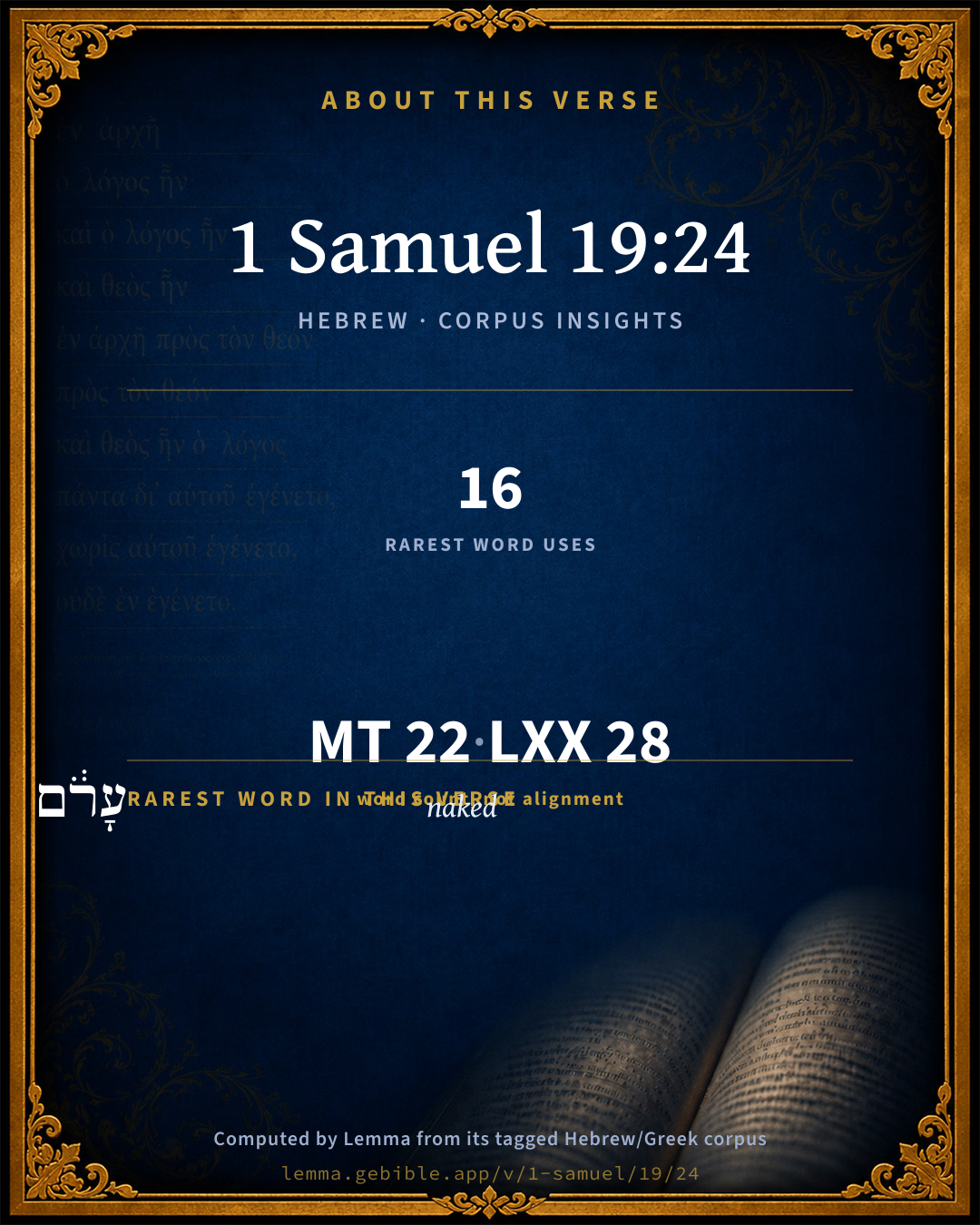
These counts appear in no published source. They are computed here, from the morphology-tagged text and Lemma’s own curated glosses. What Lemma adds →

22
words
17
distinct lemmas
Historical
section

Notable vocabulary

The rarest word here is עָרֹ֔ם naked H6174 — appearing just 16 times in the whole Hebrew Bible.

Shared distinctive vocabulary

עָרֹ֔ם naked H6174 occurs in 15 verses of the Hebrew Bible. Also found in:

Grammatical profile

  • 4 verbs
  • 9 nouns
  • 1 adjective
  • 3 pronouns
  • 1 preposition
  • 2 adverbs
  • 2 particles

Verb forms

  • וַיִּפְשַׁ֨ט Qal · Sequential Imperfect
  • וַיִּתְנַבֵּ֤א Hithpael · Sequential Imperfect
  • וַיִּפֹּ֣ל Qal · Sequential Imperfect
  • יֹֽאמְר֔וּ Qal · Imperfect

Repetition

Words recur within this verse — often emphatic in Hebrew:

Hebrew & Septuagint length

In English translation the verse runs 32 words from the Hebrew and 30 from the Septuagint (LXX English) — closely comparable.

A rough comparison of the two English renderings, which tokenize alike — not a word-level alignment.

Word counts can differ between the Hebrew and the Greek without any difference in meaning — e.g. the Hebrew direct-object marker אֵת has no separate Greek word, and Greek often adds the article ὁ.

In the original languages it is 22 Hebrew tokens and 28 Greek tokens — but the two are counted differently (Hebrew bundles its prefixes and suffixes into one token; the Greek is in lemma form), so that isn’t a like-for-like length.

Cross-references

7

Topical passages linked to 1 Samuel 19:24 in the Treasury of Scripture Knowledge — connected by theme and wording, ordered by reader-vote popularity; previews shown in the World English Bible.

  • 1 Samuel 10:10–12 When they came there to the hill, behold, a band of prophets met him; and the Spirit of God came mightily on him, and he prophesied among them.
  • 2 Samuel 6:20 Then David returned to bless his household. Michal the daughter of Saul came out to meet David, and said, How glorious was the king of Israel today, who uncovered himself today in the eyes of the handmaids of his servants, as one of the vain fellows shamelessly uncovers himself!
  • Isaiah 20:2 at that time Yahweh spoke by Isaiah the son of Amoz, saying, Go, and loose the sackcloth from off your loins, and put your shoe from off your foot. He did so, walking naked and barefoot.
  • Micah 1:8 For this I will lament and wail; I will go stripped and naked; I will howl like the jackals, And moan like the daughters of owls.
  • Numbers 24:4 He says, who hears the words of God, Who sees the vision of the Almighty, Falling down, and having his eyes open:
  • 2 Samuel 6:14 David danced before Yahweh with all his might; and David was girded with a linen ephod.
  • Acts 9:21 All who heard him were amazed, and said, "Isn't this he who in Jerusalem made havoc of those who called on this name? And he had come here intending to bring them bound before the chief priests!"

Cross-references courtesy of OpenBible.info (CC BY 4.0).

Hebrew and Greek witnesses Masoretic Hebrew ↔ Greek Septuagint

The same verse in the two great witnesses to the Old Testament, shown verse-for-verse.

These are two independent witnesses, not word-aligned to each other, and the Septuagint is shown in lemma (dictionary) form.

Hebrew 1 Samuel 19:24 Masoretic · Westminster Leningrad Codex

וַיִּפְשַׁ֨ט גַּם ה֜וּא בְּגָדָ֗יו וַיִּתְנַבֵּ֤א גַם הוּא֙ לִפְנֵ֣י שְׁמוּאֵ֔ל וַיִּפֹּ֣ל עָרֹ֔ם כָּל הַיּ֥וֹם הַה֖וּא וְכָל הַלָּ֑יְלָה עַל כֵּן֙ יֹֽאמְר֔וּ הֲגַ֥ם שָׁא֖וּל בַּנְּבִיאִֽם

He also stripped off his clothes, and he also prophesied before Samuel, and lay down naked all that day and all that night. Therefore they say, "Is Saul also among the prophets?"

World English Bible · Public Domain

Greek LXX 1 Samuel 19:24 Septuagint · lemma form

καί ἐκδύω ὁ ἱμάτιον αὐτός καί προφητεύω ἐνώπιον αὐτός καί πίπτω γυμνός ὅλος ὁ ἡμέρα ἐκεῖνος καί ὅλος ὁ νύξ διά οὗτος λέγω εἰ καί σαούλ ἐν προφήτης

And he took off his clothes, and prophesied before them; and lay down naked all that day and all that night: therefore they said, Is Saul also among the prophets?

LXX2012 (modern English Septuagint) · Public Domain

Hebrew: Westminster Leningrad Codex (CC BY 4.0). Greek: Septuagint (public domain); English from LXX2012 (modern English Septuagint) (Public Domain). How the Septuagint differs from the Hebrew →

Targum (Aramaic paraphrase)

1

The Targum is the ancient Jewish Aramaic paraphrase of the Hebrew Scriptures — an interpretive translation, not the Hebrew text itself. Onkelos (literal) and Pseudo-Jonathan (expansive) render the Torah, and Jonathan the Prophets. Coverage is partial: where no permissively-licensed English translation exists for a verse, only the Aramaic is shown. This is verse-level text, not a word-by-word alignment to the Hebrew.

  1. Targum Jonathan Prophets (Joshua–Malachi)
    וְאַשְׁלַח אַף הוּא לְבוּשׁוֹהִי וְשַׁבַּח אַף הוּא קֳדָם שְׁמוּאֵל וּנְפַל בִּרְשָׁן כָּל יוֹמָא הַהוּא וְכָל לֵילְיָא עַל כֵּן יֵימְרוּן הֲאַף שָׁאוּל בְּסַפְרַיָא:

    (no public-domain English translation for this verse)

    Targum Jonathan — Aramaic: “Mikraot Gedolot” (public domain). English: “Sefaria Community Translation” (CC0 1.0 (public-domain dedication)); “London "Chaldee Paraphrase," 1871” (public domain). Text via Sefaria.

Commentary

Notes on 1 Samuel 19:24 from classic Christian and Jewish commentators (each source and its license shown beneath its notes). The classic Christian expositions comment on the surrounding passage and are grouped to its opening verse, so a note may address several verses; the Jewish commentaries on the Tanakh (Rashi and others) are per-verse, so they appear only where the commentator wrote on this verse.

Lemma curates 59 commentaries, every one of them public domain or Creative Commons licensed, each selected and text-cleaned for this edition rather than reprinted as found. About our sources →

Jamieson, Fausset & Brown

Robert Jamieson, A. R. Fausset & David Brown

SAUL PROPHESIES. (Sa1 19:24)

lay down naked--that is, divested of his armor and outer robes--in a state of trance. Thus God, in making the wrath of man to praise Him, preserved the lives of all the prophets, frustrated all the purposes of Saul, and preserved the life of His servant.

Next: 1 Samuel Chapter 20

Jamieson, Fausset & Brown — Commentary Critical and Explanatory on the Whole Bible (1871) — public domain (CC PDM 1.0). Text via the HelloAO Bible API.

Trapp's Complete Commentary

John Trapp

1Sa 19:24 And he stripped off his clothes also, and prophesied before Samuel in like manner, and lay down naked all that day and all that night. Wherefore they say, [Is] Saul also among the prophets?

Ver. 24. And he stripped off his clothes also,] i.e., His upper garments, or arms, as his messengers had done before. {Isa 20:2 Mic 1:8}

And prophesied before Samuel.] The same God which did at first put an awe of man upon the fiercest creatures, hath stamped in the cruellest hearts a reverent respect to his own image in his ministers: so as even they that hate them, do yet honour them.

And lay down.] Cecidit. The Vulgate hath it cecinit; he fell into a trance or ecstasy, forgetting the cause of his coming thither. "Whilst that I withal escape," singeth David. {Psa 141:10}

Is Saul also among the prophets?] This was now spoken in a jeer. What! Is the bloody tyrant so tied up and manacled, in spite of all his malice and madness? It is well surely.

John Trapp, A Commentary or Exposition upon All the Books of the Old and New Testament (1647–1656) — public domain. Text from a community e-Sword module.

The Biblical Illustrator

Joseph S. Exell

1Sa_19:24

And he stripped off his clothes also, and prophesied before Samuel.

Religious enthusiasm, true and false

This passage brings before us three very remarkable men--Samuel, and Saul, and David. And this passage speaks to me of religious consolation and religious excitement. Now I ask you to observe that in the case of David there is no record of any agitation or excitement. It would have been little wonderful if he, fleeing for his life, had been overcome with emotion when he found himself with Samuel and with the servants of God, in safeguard. It was the servants of Saul that became excited, and then it was Saul himself showed religious frenzy. The son of Kish was one exceedingly sensitive to the influences of music and song. When his fit of mania came upon him the voice and harp of David wonderfully soothed and even melted him. We read at an earlier period, before he came into possession of the kingdom, that he met a company of prophets, and he too joined them. Years had passed, and now he was a worse man that he was at that day. His character had sorely deteriorated, but through that very disorder of his mind he was in some respects more susceptible than ever to a sort of religious excitement. When he came to Naioth he was quite beyond himself; the spiritual electricity of the place was too much for him, and he fell into a sort of paroxysm of enthusiasm. But he was no prophet. You may be among the prophets, and join your voices among them, and yet be no prophet.

1. There is a religious excitation or excitement which may not have any moral quality or influence whateverse It is not affected; it is real. It is not insincere; it is sincere. I despise the man who would play a part and pretend to be religiously excited when he is not. He is too base a creature. But I mean a person who really is lifted up and carried along with a rush of sacred enthusiasm. He cries for mercy, and he sings loudly of salvation. When he was alone he could not pray at all. He was carried along with the prophets. He had a wonderful fervour, his emotions were all aglow, and his brain was excited with a sort of sacred ecstasy. Now, this happens all the more easily if a man has a constitution accessible to such influences. I do not say that all excitement is useless, but I say that there is an excitement that only amounts to this. God forbid that we should for a moment deny that there are cases in which people get real permanent good. But the excitement is only the accompaniment; it is not the change. Excitement wears itself out. Paroxysms and ecstasies pass away.

2. The second thing is this: the degree in which religious emotion overpowers the body is generally proportioned to the ignorance of the mind, or to its alienation or estrangement from God. David joined the company of these prophets without any excitement or frenzy. I do not read a word about his lying naked upon the ground for a day and a night. Why was that? Because David had more of the matter in him than Saul. There was no resistance in David, therefore his body was not overpowered. But Saul was in an evil mood. He had come down to Naioth in a very evil mood. Envy and murder were in his heart, and when this pure sacred impulse came upon him, it met with the strongest resistance. If this is right, and surely this is right, this case should teach those persons who have at various times made a great ado over prostrations and trances and long lastings as signs of the work of grace, to be somewhat more cautious in their utterances. These things occur almost always in the case of a morbid hysterical temperament, in which case they are only a sign of disease, not of health; or in the case of a very ignorant person who is overwhelmed with things of which he has no intelligent conception; or in cases where there has been a very awful estrangement from God, and the Word of His grace finds an obstruction. There is a sympathy between the body and the spirit. They suffer together, they rejoice together. The body is not overpowered because the spirit of the man is open to the teachings of the Spirit of God. Mark you, it is Saul, not David, that cast off his garments in his excitement, and that threw himself in fanatical exhaustion upon the ground, if you reflect now and consider this, that this Bible is a collection of Eastern books, and remember that the East has always been the home of strange religious extravagance, do not you recognise a new proof of the Divine wisdom that pervades this Bible, that it is really inspired of the Holy Ghost in its well-balanced sobriety of mind? The Lord Jesus, Whom the Bible sets forth as the Holy One, harmless, undefiled, separate from sinners--Jesus Whom the Bible calls us to admire and love and follow, is full of the grandest enthusiasm. God was with Him. If ever there was a man full of Spirit it was the Man Christ Jesus. He was filled with the Holy Ghost, and went everywhere led by the Spirit, and at the same time full of sweet self-possession, full of meekness and wisdom, and so answered all questions on the spur of the moment in the wisest possible manner, and set forth perfectly the cause of righteousness. The Bible teaches us, and especially to be calm and fervent, fervent and calm. (Donald Fraser, D. D.)

.

The Biblical Illustrator, edited by Joseph S. Exell (c. 1880s–1900s) — public domain. Text from a community e-Sword module.

Joseph Benson's Commentary

1Sa 19:24. And he stripped off his clothes also — His royal robes. Perhaps this was intended to signify the taking away of his kingdom from him; and lay down — Hebrew, fell down, upon the earth; for his mind being in an ecstasy, he had not the use of his senses; God so ordering it, that David might have an opportunity to escape; naked — That is, stripped of his upper garments, as the word naked is often used; and it is here repeated to signify how long he lay in that posture. Day and night — So God kept him as it were in chains, till David was got out of his reach. Is Saul also among the prophets? — The same proverb which was used before is here revived, as an evidence of God’s wonderful care over David; he made Saul, in some sort, a prophet, that he might make David a king.

Joseph Benson's Commentary on the Old and New Testaments (1811–1818) — public domain. Text from a community e-Sword module.

Tyndale Open Study Notes

Tyndale Open Resources

19:24 When Saul tore off his clothes and lay naked, he unwittingly acted out his true spiritual condition of having been stripped of the kingship (13:14; 15:10-11, 23; see “Prophetic Sign Acts” Theme Note). • Is even Saul a prophet? In 1 Sam 10:9-13, Saul was rising as God’s chosen king; here, he is descending under the weight of God’s rejection.

Tyndale Open Study Notes — © Tyndale Open Resources, licensed CC BY-SA 4.0. Text via the HelloAO Bible API.

Geneva Bible (1599)

Geneva Bible translators

His kingly apparel.

He humbled himself as others did.

Geneva Bible (1599) marginal notes — public domain. Text via Bolls.life.

Adam Clarke's Commentary

Verse 24. He stripped off his clothes] Threw off his royal robes or military dress, retaining only his tunic; and continued so all that day and all that night, uniting with the sons of the prophets in prayers, singing praises, and other religious exercises, which were unusual to kings and warriors; and this gave rise to the saying, Is Saul also among the prophets? By bringing both him and his men thus under a Divine influence, God prevented them from injuring the person of David. 1Sa 10:6, c. and see my sermon on The Christian Prophet and his Work.

Adam Clarke's Commentary on the Bible (1810–1826) — public domain. Text from a community e-Sword/MySword module.

Ellicott's Commentary for English Readers

(24) And he stripped off his clothes also, and prophesied before Samuel in like manner.—This was certainly not the first time that Saul had experienced a similar influence of the Spirit of God. We are told (1Sa_10:10) that directly after his anointing by Samuel, he met a company of prophets, who were prophesying at Gibeah, and that “the Spirit of God came upon him, and he prophesied among them.” On that occasion he had been changed into another man. What was the meaning of the outpouring upon the faithless king now? The Chaldee, according to Raschi’s explanation, says he was mad. Is it not, however, better to explain the incident by understanding that once more the pitiful Spirit pleaded with the man whom the Lord had chosen to be His anointed? But, alas! when the moment of strange excitement was over, the blessed pleading was forgotten. Is not this a matter of every-day experience?

And lay down naked.—Not necessarily without any clothes, for under the tunic there was worn by men of the upper ranks certainly a fine-woven shirt of linen or cotton. Lyranus explains the words “stripped off his clothes” as simply denoting that he threw off his upper garment, “his royal robe.”

Is Saul also among the prophets?—The same thing having taken place before (see 1Sa_10:12), this saying gained currency among the people. There seemed something strange to men in one so self-willed and disobedient as was Saul receiving, as it seemed to the by-standers, the Divine and much coveted gift. “Many,” says St. Augustine, “are the gifts of God which are possessed by evil men. Evil men have often great talents, great skill, great wealth. . . . The gift of prophesy is a great gift, but it was possessed by Saul. Saul, an evil king, prophesied at the very time he was persecuting holy David. Let not, therefore, men boast if they have God’s gifts; those gifts will profit them nothing without charity (1Co_13:1-2). But let them think of the fearful account they must one day give to God, if they use not holy things holily.”—St. Augustine, in Psalms 103, quoted by Wordsworth.

A Bible Commentary for English Readers, edited by Charles John Ellicott (1878–1897) — public domain. Text from a community e-Sword module.

The Cambridge Bible for Schools and Colleges

gen. ed. J. J. S. Perowne

24. naked] Not literally naked, but stripped of his outer garment.

Is Saul also among the prophets?] The origin of the proverb is related in 1Sa_10:11. It now received a fresh exemplification. This burst of prophetic inspiration was a startling reminder to Saul of that former occasion when the Spirit of God came upon him to fit him for that office in which he had failed so sadly. See Maurice, Prophets and Kings, p. 17 ff.

The Cambridge Bible for Schools and Colleges (gen. ed. J. J. S. Perowne; Cambridge University Press, 1878–1918) — public domain. Text from a community e-Sword module.

John Gill's Exposition

And he stripped off his clothes also,.... Not all his clothes, but his upper garments, as men in such circumstances used to do, as the prophets sometimes did, and as it seems his messengers had done; according to Jarchi, R. Isaiah, and others (n), he stripped himself of his royal robes, and put on the habit of the scholars, the disciples, and sons of the prophets:

and prophesied before Samuel in like manner, as the messengers had done, singing such like songs, or foretelling such like things as they did; he and they speaking not of themselves, but as they were moved by the Holy Spirit of prophecy; for such gifts have sometimes been bestowed on men that were destitute of the grace of God, as Balaam, Caiaphas, and others:

and lay down: or "fell down" (o), as persons in an ecstasy or trance: and lay

naked all that day, and all that night; not entirely naked, both without his upper garment or royal robes, or else his armour; so an unarmed man is said to be naked, though otherwise he has his clothes on: thus Gelon having conquered the Carthaginians, and made himself master of all Sicily, went into the forum "naked" (i.e. unarmed), and declared he would restore the government to the citizens, wherefore a naked statue for him was erected in the temple of Juno (p); so Quinctius Cincinnatus was found ploughing naked (q), who cannot be supposed to be without any clothes on him. Jarchi, from Menachem, reports, that he had heard from an Arabian, that the word the Targum makes use of for "naked", signifies, in the Arabic language, one that is furious or mad, as persons in an ecstasy, or under a prophetic spirit, sometimes seemed to be; now Saul was kept and held in such circumstances a whole day and night, that David might have an opportunity of making his escape, and getting at such a distance from him that he could not overtake him:

wherefore they say, is Saul also among the prophets? this became a common saying, a proverbial expression, at least was now revived and observed with admiration; that Saul, who had behaved himself in so ill a manner, as an enemy to so good a man, should be found among the prophets of the Lord, and prophesying as they did.

(n) Vid. Hieron. Trad. Heb. in lib. Reg. fol. 76. G. (o) "et cecidit", V. L. Pagninus, Montanus, "et corruit", Vatablus. (p) Aelian. Var. Hist. l. 6. c. 11. (q) Aurel. Victor. de Vir. Illustr. c. 20.

Next: 1 Samuel Chapter 20

John Gill's Exposition of the Whole Bible (1746–1763) — public domain (CC PDM 1.0). Text via the HelloAO Bible API.

Albert Barnes' Notes on the Bible

Naked - i. e., without his robe and other outer garments, but only the shirt. Compare the marginal references.

The whole history affords another instance of the protection of God vouchsafed to His servants, which forms so frequent a topic of the Psalms of David.

Albert Barnes' Notes on the Bible (1834–1885) — public domain. Text from a community e-Sword/MySword module.

Haydock's Catholic Bible Commentary

Naked. Divested of his regal ornaments, (Tirinus) though not in an indecent posture. People are said to be undressed, when they have not such clothes on as might be expected. Hesiod and Virgil say, Nudus ara, sere nudus; hiems ignava colono. "Plough and sow naked; choose a fine season for work, and rest in winter." (Haydock) See Micheas i. 8., and 2 Kings vi. 20. --- Yet some assert (Calmet) that Saul was entirely undressed, as some pretended prophets and slaves go in the hot countries, Isaias xx. 1. We are not to judge of the indecency of such behaviour from our own manners. Some copies read cecinit, (Calmet) and the Douay Bible has "and sang naked." (Haydock) --- Saul had not the gift of prophecy, like holy men, but only like Balaam’s ass, for a time. (St. Augustine ad Simp. ii. 1.) (Worthington) --- Prophets. This is something wonderful. (Menochius) --- The proverb was now confirmed, chap. x. 11. (Calmet)

George Leo Haydock (1774–1849), Haydock's Catholic Family Bible and Commentary, 1859 edition — public domain. Excludes Psalms (Douay-Rheims chapter numbering differs from Protestant) and Deuterocanonical books (Catholic canon only).

Matthew Poole's English Annotations

His clothes, to wit, his military or royal garments; which he did, either that he might suit himself and his habit to the rest of the company; or because his mind being altogether taken up with Divine things, he did not understand or heed what he did.

Also: this implies that the messengers which he sent, who probably were military persons, had done so before him.

Prophesied before Samuel: this doth not contradict 1Sa 15:35, where it is said that Samuel came no more to see Saul; for here Saul goes to Samuel, and that not with design to see him, but to surprise David.

In like manner; as the rest of the prophets there did.

Lay down, Heb. fell, to wit, down upon the earth; for his mind being in an ecstasy, he had not the use of his senses or motion, as he Num 24:4; God so ordering it, that David might have an opportunity to escape.

Naked, i.e. stripped of his upper garments, as was said before, and as the word naked is oft used, as Isa 20:2; Mic 1:8. See also 2Sa 6:20; Joh 21:7. And it is here repeated to signify how long he lay in that posture.

All that day and all that night; so God kept him as it were in chains, till David was got out of. his reach.

Is Saul also among the prophets? The same proverb which was taken up upon a like occasion, 1Sa 10:12, is here remembered and revived upon this new occasion, as an evidence of God’s wonderful care over David; he made Saul in some sort a prophet, that he might make David a king.

Matthew Poole's English Annotations on the Holy Bible (1683–1685) — public domain. Text from a community e-Sword/MySword module.

Whedon's Commentary on the Bible

Daniel D. Whedon

24. He stripped off his clothes — That is, his outer raiment; his royal and military vesture.

Lay down naked — Not in a state of utter nudity, but divested of his upper garments, as just stated. Compare Isa_20:2; Mic_1:8; Mar_14:52; Joh_21:7.

All that day and all that night — From ten to twenty hours. And when he recovered again his consciousness and self-possession he probably returned to his home at once, without any further attempt at that time to capture David. God thus indicated to Saul that in seeking to destroy David he was fighting against the divine Power — a Power that holds the hearts of all men in subjection, and can turn them whithersoever he will. This remarkable scene served to revive the proverb that originated with a former somewhat similar occasion (1Sa_10:12) — Is Saul also among the prophets?

The profoundly mysterious and interesting subject or the prophesying and catalepsy of Saul and his messengers is one of the physical and psychological problems connected with religion that has been the subject of extensive speculation. We regard this whole matter of Saul’s prophesying and falling down under the power of the Spirit as an ancient instance of substantially the same marvellous religious phenomena which the Christian Church has so often witnessed in modern times. The extensive religious revivals in the Western States fifty years ago were attended with hundreds of such phenomena, commonly called “the jerks.” In the great awakening in New England in Edwards’s day similar scenes were of frequent occurrence, and also in the British Isles during the ministry of Wesley, and earlier. They seem to have been always more or less common during seasons of great religions excitement, and to have a peculiar affinity for a certain class of minds. Persons, like Saul, of quick and powerful emotions, and given to sudden changes of feeling, have been the readiest subjects of this mysterious affection. But not only have pious and devoted persons, but wicked and blasphemous opposers of the truth, been seized upon by this strange influence. Some, in attempting to disturb religious meetings, and while yet, like Saul, beyond the bounds of the company of worshippers, and hastening on to intended acts of violence, have been seized by an unseen power, and held in subjection to it in spite of all their efforts to regain their self control. Some have remained in such a state for nearly a week at a time. See facts and references in Stevens’ History of Methodism, vol. ii, p. 425.

What the precise nature of Saul’s prophesying on this occasion was we are not informed. In one of the seasons of his madness, and when possessed by a demon, his prophesying seems to have been prompted by the evil spirit, and to have consisted of impassioned cries and incoherent ravings. See 1Sa_18:10, and note. But when he first prophesied at Gibeah, (1Sa_10:10,) his exercises, like those of the band of prophets whom he met, seem to have been the ecstatic utterance of prayer and praise to God. So, on this occasion, it was the Spirit of God that made him prophesy; and it is therefore probable that his utterances now, like the later ones recorded 1Sa_24:17-20; 1Sa_26:21; 1Sa_26:25, were confessions of his own sins, and predictions of David’s ultimate triumph.

We have space only to suggest that an explanation of these mysterious phenomena may be brought out in the scientific elaboration of the following propositions: All human beings have a common sympathetic nature, universally pervaded by a subtile and mysterious medium of influence, by means of which mind is brought in rapport with mind and heart with heart. This influence becomes intensely active in an assembly of persons where all hearts and minds are highly electrified by one common all-absorbing thought and state of feeling, and in such cases it may pass beyond the bounds of the assembly and make itself powerfully felt at a distance. It furnishes the psychical basis on which demoniacal possessions are possible, and also by which the Holy Spirit holds personal intercourse with man. By it these different external agencies will affect the different persons in different degrees of power, according to their different organism and temperament. But any attempt at a scientific explanation, which assumes all the phenomena to be merely physical, and not also psychical, must fail, as well as any explanation that denies that the Spirit of God may have often been exerted in their production; for this mysterious medium of influence seems to be the psychological basis both of divine and demoniacal possession.

Daniel D. Whedon (gen. ed.), Commentary on the Old and New Testaments (1874–1909) — public domain. Text from a community e-Sword module.

John Wesley's Explanatory Notes

Lay down - Hebrew. fell, down upon the earth; for his mind being in an extasy, he had not the use of his senses. God so ordering it, that David might have an opportunity to escape. Naked - That is, stript of his upper garments, as the word naked is often used; and it is here repeated to signify how long he lay in that posture. Day and night - So God kept him as it were in chains, 'till David was got out of his reach. Is Saul - The same proverb which was used before, is here revived, as an evidence of God's wonderful care over David; he made Saul in some sort a prophet, that he mightst make David a king.

John Wesley, Explanatory Notes Upon the Whole Bible (1754–1765) — public domain. Text via the GEBible commentary corpus.

Rashi

Rabbi Shlomo Yitzchaki (Rashi)

He too removed his garments. His royal garments, to put on his students' garments.

He fell down stripped. Targum Yonoson renders וּנְפַל בִּרְשַׁן 'and he fell naked.' And in the name of R. Menachem, who heard from an Arab, בִּרְשָׁן in Arabic [means] insane.

Rashi on the Tanakh — English translations: “The Judaica Press complete Tanach with Rashi, translated by A. J. Rosenberg” (CC BY 4.0); “Pentateuch with Rashi's commentary by M. Rosenbaum and A.M. Silbermann, 1929-1934” (public domain); “The Metsudah Tanach series, Lakewood, N.J” (CC BY 4.0); and “The Book of Joshua, Metsudah Publications, 1997” (CC BY 4.0). Text via Sefaria.

Lesson kit

Teaching starters — assembled from the data on this page, not authored interpretation. Every prompt links to the verse data it draws on. Edit before teaching.

1 Samuel, in the Historical, opens this verse with 22 words (17 distinct Hebrew lemmas). Its most distinctive word is ʻârôwm (“naked”). A historical commentator’s framing appears above. Read the whole chapter for the surrounding context.

Discussion questions

  1. The word ʻârôwm carries the sense “naked.” How does it shape the verse?
  2. Genesis 2:25 shares the word «naked» with this verse. How do the two illuminate each other?
  3. “also” occurs 3× in this one verse. What is the effect of the repetition?
  4. The translations on this page render this verse differently — a whole-verse word diff, not a word-by-word alignment. What might account for the different wordings?
  5. The verb «וַיִּפְשַׁ֨ט» is Qal Sequential Imperfect. How does its form color the action?
  6. Reading how Jamieson, Fausset & Brown and Trapp's Complete Commentary read this verse, where do the two commentators agree and where do they part?

Things to notice

Reading settings

Reading text

Shown beneath each verse's original-language words.

Old Testament
Old Testament edition

Read the OT as the Masoretic Hebrew (MT) or the Greek Septuagint (LXX).

English shown for the Greek Septuagint (in the Hebrew ↔ Greek comparison).

Comparing translations? Open the Compare panel on any verse page to stack up to four side by side.