
1 Samuel 20:41

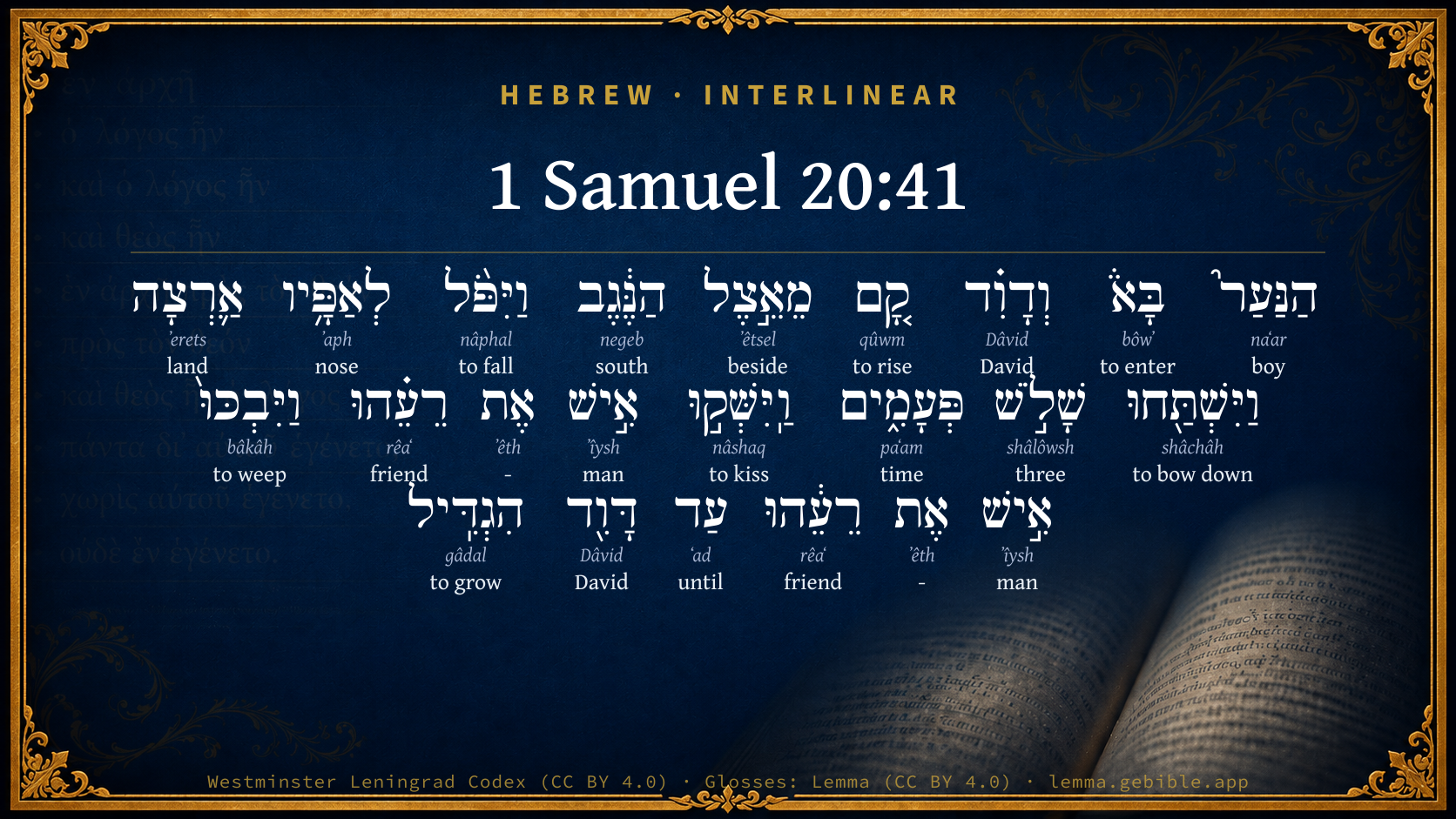
Hebrew (Westminster Leningrad Codex) 1 Samuel 20:41 appears in the Hebrew Old Testament. The text above is from the Westminster Leningrad Codex. Each word links to its Strong’s number, a concise gloss, and parsing drawn from the Open Scriptures Hebrew Bible morphology. Click any word for its full Brown-Driver-Briggs (BDB) entry.
Download image
Cite this verse

1 Samuel 20:41 (World English Bible). Public Domain. Lemma interlinear Bible study tool, https://lemma.gebible.app/v/1-samuel/20/41.

Show BibTeX & RIS
BibTeX
RIS
English Translation
As soon as the boy was gone, David arose out of [a place] toward the South, and fell on his face to the ground, and bowed himself three times: and they kissed one another, and wept one with another, until David exceeded.
World English Bible · Public Domain
Download a study sheet

One document with this verse’s original text, its word-by-word gloss line, the meaning frame, cross-references with their text, attributed commentary, and full source and license credits — printable, and it pastes into notes with its structure intact.

This verse Autodidact and up

Study sheet (.html) Plain text (.txt)

A passage Seminary Student

Up to 50 verses in one chapter. A passage sheet keeps up to 6 commentary sources and 12 cross-references per verse, in the order this page ranks them, and says so on the sheet whenever that leaves anything out. Ask for a single verse and you get the Autodidact verse sheet above.

Everything on this page stays free to read, with no account — the sheet is a download of what is already on screen, not access to it.

Want to remove ads? Support Godless Engineer
Compare translations 3

The same verse in 3 English versions, stacked beneath the original-language interlinear above. Click any original word for its lexicon entry.

Each is an independent rendering of the whole verse — the interlinear is not word-aligned to these translations.

Highlighted words mark where these versions differ — a whole-verse word diff, not a word-by-word alignment.

  • World English Bible Public Domain
    As soon as the boy was gone, David arose out of [a place] toward the South, and fell on his face to the ground, and bowed himself three times: and they kissed one another, and wept one with another, until David exceeded.
  • King James Version Public Domain
    And as soon as the lad was gone, David arose out of a place toward the south, and fell on his face to the ground, and bowed himself three times: and they kissed one another, and wept one with another, until David exceeded.
  • unfoldingWord Literal Text CC BY-SA 4.0
    The boy went, and David arose from beside the south, and he fell on his nostrils to the ground, and he prostrated himself three times. And they kissed, a man with his companion. And they wept, a man with his companion, until David made great.

unfoldingWord Literal Text — © unfoldingWord, licensed CC BY-SA 4.0. Word-aligned USFM3 via Door43 (git.door43.org/unfoldingWord/en_ult).

Versions to compare (up to 4)

3 of 4 selected

Show all 18 translations

Every available English version of this verse, each an independent rendering of the whole verse.

  • World English Bible Public Domain
    As soon as the boy was gone, David arose out of [a place] toward the South, and fell on his face to the ground, and bowed himself three times: and they kissed one another, and wept one with another, until David exceeded.
  • Berean Standard Bible Public Domain
    When the young man had gone, David got up from the south side of the stone, fell facedown, and bowed three times. Then he and Jonathan kissed each other and wept together—though David wept more.
  • Majority Standard Bible Public Domain
    When the young man had gone, David got up from the south side of the stone, fell facedown, and bowed three times. Then he and Jonathan kissed each other and wept together—though David wept more.
  • King James Version Public Domain
    And as soon as the lad was gone, David arose out of a place toward the south, and fell on his face to the ground, and bowed himself three times: and they kissed one another, and wept one with another, until David exceeded.
  • American Standard Version (1901) Public Domain
    And as soon as the lad was gone, David arose out of `a place' toward the South, and fell on his face to the ground, and bowed himself three times: and they kissed one another, and wept one with another, until David exceeded.
  • Revised Version (1885) Public Domain
    And as soon as the lad was gone, David arose out of a place toward the South, and fell on his face to the ground, and bowed himself three times: and they kissed one another, and wept one with another, until David exceeded.
  • Geneva Bible (1599) Public Domain
    Assoone as the boy was gone, Dauid arose out of a place that was towarde the South, and fel on his face to the ground, and bowed him selfe three times: and they kissed one another, and wept both twaine, till Dauid exceeded.
  • Douay-Rheims (1899) Public Domain
    And when the boy was gone, David rose out of his place, which was towards the south, and falling on his face to the ground, adored thrice: and kissing one another, they wept together, but David more.
  • Young's Literal Translation Public Domain
    The youth hath gone, and David hath risen from Ezel, at the south, and falleth on his face to the earth, and boweth himself three times, and they kiss one another, and they weep one with another, till David exerted himself;
  • Literal Standard Version CC BY-SA 4.0
    The youth has gone, and David has risen from Ezel, at the south, and falls on his face to the earth, and bows himself three times, and they kiss one another, and they weep with one another, until David exerted himself;
  • Unlocked Literal Bible CC BY-SA 4.0
    As soon as the young man was gone, David stood up from behind the mound, lay facedown on the ground, and bowed himself three times. They kissed one another and wept together, with David weeping the more.
  • unfoldingWord Literal Text CC BY-SA 4.0
    The boy went, and David arose from beside the south, and he fell on his nostrils to the ground, and he prostrated himself three times. And they kissed, a man with his companion. And they wept, a man with his companion, until David made great.
  • Darby Bible Public Domain
    The lad went, and David arose from the side of the south, and fell on his face to the ground, and bowed himself three times; and they kissed one another, and wept one with another, until David exceeded.
  • World Messianic Bible Public Domain
    As soon as the boy was gone, David arose out of the south, and fell on his face to the ground, and bowed himself three times. They kissed one another and wept with one another, and David wept the most.
  • Webster's Bible Public Domain
    And as soon as the lad was gone, David arose out of a place towards the south, and fell on his face to the ground, and bowed himself three times: and they kissed one another, and wept one with another, until David exceeded.
  • Free Bible Version CC BY-SA 4.0
    After the boy had gone, David got up from beside the pile of stones, fell facedown to the ground, and bowed three times. Then he and Jonathan kissed each other and cried together as friends, though David cried the hardest.
  • Bible in Basic English Public Domain
    And when the boy had gone, David came from his secret place by the hill, and falling to the earth went down on his face three times: and they gave one another a kiss, weeping together, till David's grief was the greater.
  • JPS Tanakh (1917) Public Domain
    And as soon as the lad was gone, David arose out of a place toward the South, and fell on his face to the ground, and bowed down three times; and they kissed one another, and wept one with another, until David exceeded.

Literal Standard Version (2020), Covenant Press — licensed CC BY-SA 4.0. Text via the HelloAO Bible API (eBible.org). Unlocked Literal Bible (unfoldingWord) — licensed CC BY-SA 4.0. Text via the HelloAO Bible API (eBible.org). unfoldingWord Literal Text — © unfoldingWord, licensed CC BY-SA 4.0. Word-aligned USFM3 via Door43 (git.door43.org/unfoldingWord/en_ult). Free Bible Version, Dr. Jonathan Gallagher — licensed CC BY-SA 4.0. Text via the HelloAO Bible API (eBible.org).

Word by word

More ways to search: Search by grammar → Find every occurrence → Compare this word →

Practice this passage: Drill this verse → Learn its vocabulary →

וַֽיִּשְּׁק֣וּ
nâshaq
H5401
“and · to kiss”
Conjunction + Verb, Qal, Sequential Imperfect, 3rd Person, Masculine, Plural
Part of Speech
Conjunction + Verb
Stem
Qal
Form
Sequential Imperfect
Person
3rd Person
Gender
Masculine
Number
Plural
Full BDB Definition

Origin: a primitive root [identical with H5400 , through the idea of fastening up

TWOT: 1435 , 1436

to put together, kiss - (Qal) to kiss - (Piel) to kiss - (Hiphil) to touch gently - to handle, be equipped with - (Qal) to be equipped
  1. הַנַּעַר֮ naʻar H5288 “the · boy” Particle, Definite Article + Noun, Common, Masculine, Singular, Absolute
  2. בָּא֒ bôwʼ H935 “to enter” Verb, Qal, Perfect, 3rd Person, Masculine, Singular
  3. וְדָוִ֗ד Dâvid H1732 “and · David” Conjunction + Noun, Proper
  4. קָ֚ם qûwm H6965 “to rise” Verb, Qal, Perfect, 3rd Person, Masculine, Singular
  5. מֵאֵ֣צֶל ʼêtsel H681 “from · beside” Preposition + Preposition
  6. הַנֶּ֔גֶב negeb H5045 “the · south” Particle, Definite Article + Noun, Common, Masculine, Singular, Absolute
  7. וַיִּפֹּ֨ל nâphal H5307 “and · to fall” Conjunction + Verb, Qal, Sequential Imperfect, 3rd Person, Masculine, Singular
  8. לְאַפָּ֥יו ʼaph H639 “to/for · nostrils · his” Preposition + Noun, Common, Masculine, Dual, Construct + Suffix, Personal, 3rd Person, Masculine, Singular
  9. אַ֛רְצָה ʼerets H776 “land · toward” Noun, Common, Both, Singular, Absolute + Suffix, Demonstrative
  10. וַיִּשְׁתַּ֖חוּ shâchâh H7812 “and · to bow down” Conjunction + Verb, Hithpael, Sequential Imperfect, 3rd Person, Masculine, Singular
  11. שָׁלֹ֣שׁ shâlôwsh H7969 “three” Adjective, Cardinal number, Feminine, Singular, Absolute
  12. פְּעָמִ֑ים paʻam H6471 “times” Noun, Common, Feminine, Plural, Absolute
  13. אִ֣ישׁ ʼîysh H376 “man” Noun, Common, Masculine, Singular, Absolute
  14. אֶת ʼêth H853 “-” Particle, Direct Object
  15. רֵעֵ֗הוּ rêaʻ H7453 “friend · his” Noun, Common, Masculine, Singular, Construct + Suffix, Personal, 3rd Person, Masculine, Singular
  16. וַיִּבְכּוּ֙ bâkâh H1058 “and · to weep” Conjunction + Verb, Qal, Sequential Imperfect, 3rd Person, Masculine, Plural
  17. אִ֣ישׁ ʼîysh H376 “man” Noun, Common, Masculine, Singular, Absolute
  18. אֶת ʼêth H853 “-” Particle, Direct Object
  19. רֵעֵ֔הוּ rêaʻ H7453 “friend · his” Noun, Common, Masculine, Singular, Construct + Suffix, Personal, 3rd Person, Masculine, Singular
  20. עַד ʻad H5704 “until” Preposition
  21. דָּוִ֖ד Dâvid H1732 “David” Noun, Proper
  22. הִגְדִּֽיל gâdal H1431 “to grow” Verb, Hiphil, Perfect, 3rd Person, Masculine, Singular

About this verse

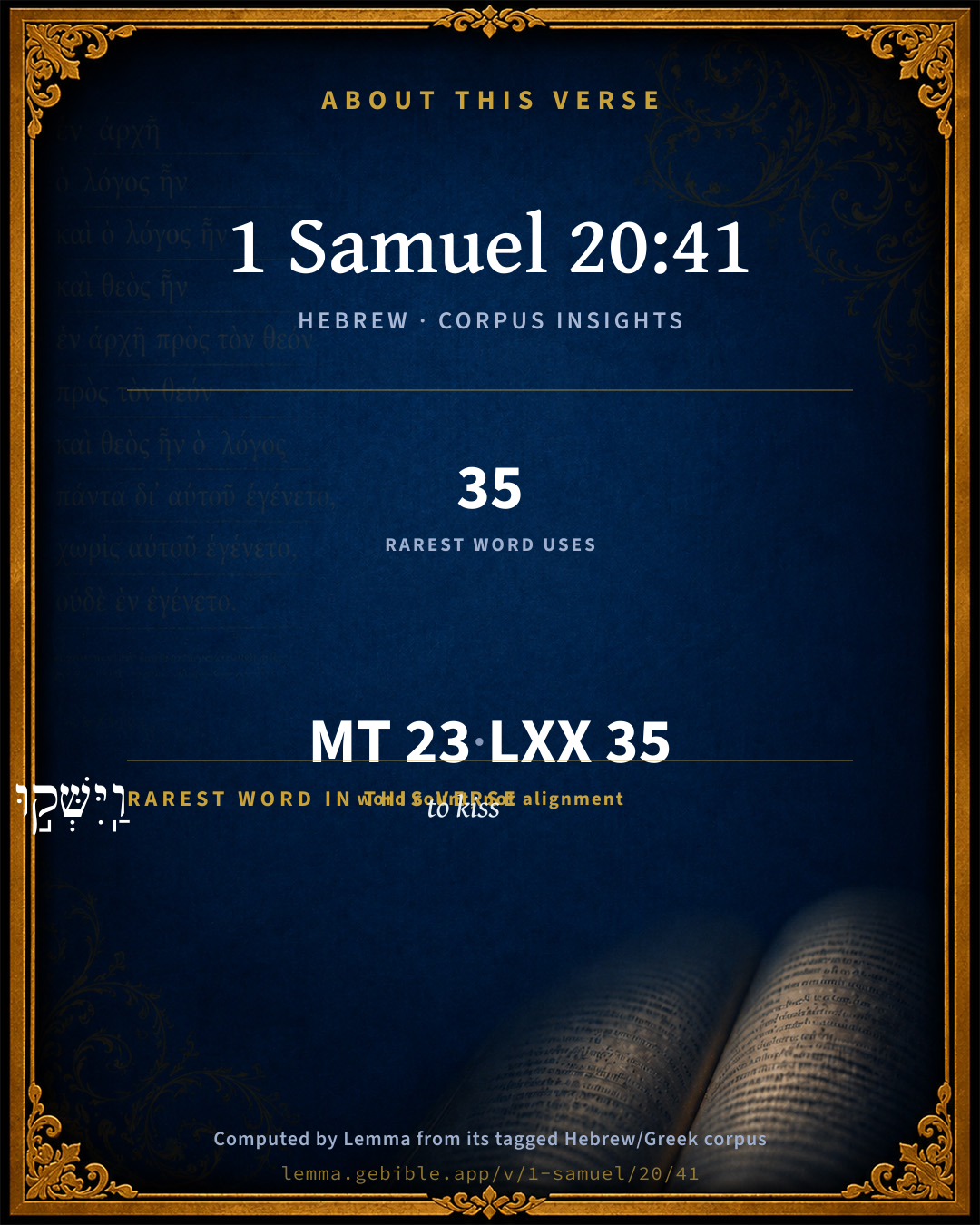
These counts appear in no published source. They are computed here, from the morphology-tagged text and Lemma’s own curated glosses. What Lemma adds →

23
words
19
distinct lemmas
Historical
section

Shared distinctive vocabulary

וַֽיִּשְּׁק֣וּ to kiss H5401 occurs in 35 verses of the Hebrew Bible. Also found in:

Grammatical profile

  • 7 verbs
  • 11 nouns
  • 1 adjective
  • 2 prepositions
  • 2 particles

Verb forms

  • בָּא֒ Qal · Perfect
  • קָ֚ם Qal · Perfect
  • וַיִּפֹּ֨ל Qal · Sequential Imperfect
  • וַיִּשְׁתַּ֖חוּ Hithpael · Sequential Imperfect
  • וַֽיִּשְּׁק֣וּ Qal · Sequential Imperfect
  • וַיִּבְכּוּ֙ Qal · Sequential Imperfect
  • הִגְדִּֽיל Hiphil · Perfect

Repetition

Words recur within this verse — often emphatic in Hebrew:

  • וְדָוִ֗ד David H1732 ×2
  • אִ֣ישׁ man H376 ×2
  • רֵעֵ֗הוּ friend H7453 ×2

Hebrew & Septuagint length

In English translation the verse runs 42 words from the Hebrew and 38 from the Septuagint (LXX English) — closely comparable.

A rough comparison of the two English renderings, which tokenize alike — not a word-level alignment.

Word counts can differ between the Hebrew and the Greek without any difference in meaning — e.g. the Hebrew direct-object marker אֵת has no separate Greek word, and Greek often adds the article ὁ.

In the original languages it is 23 Hebrew tokens and 35 Greek tokens — but the two are counted differently (Hebrew bundles its prefixes and suffixes into one token; the Greek is in lemma form), so that isn’t a like-for-like length.

Cross-references

11

Topical passages linked to 1 Samuel 20:41 in the Treasury of Scripture Knowledge — connected by theme and wording, ordered by reader-vote popularity; previews shown in the World English Bible.

  • Genesis 29:11 Jacob kissed Rachel, and lifted up his voice, and wept.
  • 1 Samuel 18:3 Then Jonathan and David made a covenant, because he loved him as his own soul.
  • Genesis 29:13 It happened, when Laban heard the news of Jacob, his sister's son, that he ran to meet Jacob, and embraced him, and kissed him, and brought him to his house. Jacob told Laban all these things.
  • Genesis 43:28 They said, "Your servant, our father, is well. He is still alive." They bowed the head, and did homage.
  • Genesis 45:15 He kissed all his brothers, and wept on them. After that his brothers talked with him.
  • 1 Samuel 10:1 Then Samuel took the vial of oil, and poured it on his head, and kissed him, and said, Isn't it that Yahweh has anointed you to be prince over his inheritance?
  • 1 Samuel 25:23 When Abigail saw David, she hurried, and alighted from her donkey, and fell before David on her face, and bowed herself to the ground.
  • 2 Samuel 1:26 I am distressed for you, my brother Jonathan: Very pleasant have you been to me: Your love to me was wonderful, Passing the love of women.
  • 2 Samuel 9:6 Mephibosheth, the son of Jonathan, the son of Saul, came to David, and fell on his face, and did obeisance. David said, Mephibosheth. He answered, Behold, your servant!
  • 2 Samuel 19:39 All the people went over the Jordan, and the king went over: and the king kissed Barzillai, and blessed him; and he returned to his own place.
  • Acts 20:37 They all wept a lot, and fell on Paul's neck and kissed him,

Cross-references courtesy of OpenBible.info (CC BY 4.0).

Hebrew and Greek witnesses Masoretic Hebrew ↔ Greek Septuagint

The same verse in the two great witnesses to the Old Testament, shown verse-for-verse.

These are two independent witnesses, not word-aligned to each other, and the Septuagint is shown in lemma (dictionary) form.

Hebrew 1 Samuel 20:41 Masoretic · Westminster Leningrad Codex

הַנַּעַר֮ בָּא֒ וְדָוִ֗ד קָ֚ם מֵאֵ֣צֶל הַנֶּ֔גֶב וַיִּפֹּ֨ל לְאַפָּ֥יו אַ֛רְצָה וַיִּשְׁתַּ֖חוּ שָׁלֹ֣שׁ פְּעָמִ֑ים וַֽיִּשְּׁק֣וּ אִ֣ישׁ אֶת רֵעֵ֗הוּ וַיִּבְכּוּ֙ אִ֣ישׁ אֶת רֵעֵ֔הוּ עַד דָּוִ֖ד הִגְדִּֽיל

As soon as the boy was gone, David arose out of [a place] toward the South, and fell on his face to the ground, and bowed himself three times: and they kissed one another, and wept one with another, until David exceeded.

World English Bible · Public Domain

Greek LXX 1 Samuel 20:41 Septuagint · lemma form

καί ὡς εἰςἔρχομαι ὁ παιδάριον καί δαυίδ ἀναἵστημι ἀπό ὁ εργαβ καί πίπτω ἐπί πρόσωπον αὐτός καί προςκυνέω αὐτός τρεῖς καί καταφιλέω ἕκαστος ὁ πλησίον αὐτός καί κλαίω ἕκαστος ὁ πλησίον αὐτός ἕως συντέλεια μέγας

And when the lad went in, then David arose from the south, and fell upon his face, and did obeisance to him three times, and they kissed each other, and wept for each other, for a great while.

LXX2012 (modern English Septuagint) · Public Domain

On this verse, Ellicott's Commentary for English Readers discusses the Septuagint’s reading. Read the note in Commentary ↓

Hebrew: Westminster Leningrad Codex (CC BY 4.0). Greek: Septuagint (public domain); English from LXX2012 (modern English Septuagint) (Public Domain). How the Septuagint differs from the Hebrew →

Targum (Aramaic paraphrase)

1

The Targum is the ancient Jewish Aramaic paraphrase of the Hebrew Scriptures — an interpretive translation, not the Hebrew text itself. Onkelos (literal) and Pseudo-Jonathan (expansive) render the Torah, and Jonathan the Prophets. Coverage is partial: where no permissively-licensed English translation exists for a verse, only the Aramaic is shown. This is verse-level text, not a word-by-word alignment to the Hebrew.

  1. Targum Jonathan Prophets (Joshua–Malachi)
    עוּלֵימָא אָתָא וְדָוִד קָם מִסְטַר אֶבֶן אָתָא דְלָקֳבֵיל דָרוֹמָא וּנְפַל עַל אַפּוֹהִי עַל אַרְעָא וּסְגִיד תְּלַת זִמְנִין וּנְשִׁיקוּ גְבַר יַת חַבְרֵיהּ וּבְכוּ גְבַר עִם חַבְרֵיהּ עַד דְדָוִד אַסְגִי:

    (no public-domain English translation for this verse)

    Targum Jonathan — Aramaic: “Mikraot Gedolot” (public domain). English: “Sefaria Community Translation” (CC0 1.0 (public-domain dedication)); “London "Chaldee Paraphrase," 1871” (public domain). Text via Sefaria.

Commentary

Notes on 1 Samuel 20:41 from classic Christian and Jewish commentators (each source and its license shown beneath its notes). The classic Christian expositions comment on the surrounding passage and are grouped to its opening verse, so a note may address several verses; the Jewish commentaries on the Tanakh (Rashi and others) are per-verse, so they appear only where the commentator wrote on this verse.

Lemma curates 59 commentaries, every one of them public domain or Creative Commons licensed, each selected and text-cleaned for this edition rather than reprinted as found. About our sources →

Jamieson, Fausset & Brown

Robert Jamieson, A. R. Fausset & David Brown

JONATHAN AND DAVID LOVINGLY PART. (Sa1 20:41-42)

David . . . fell on his face to the ground, and bowed three times--a token of homage to the prince's rank; but on a close approach, every other consideration was sunk in the full flow of the purest brotherly affection.

Jamieson, Fausset & Brown — Commentary Critical and Explanatory on the Whole Bible (1871) — public domain (CC PDM 1.0). Text via the HelloAO Bible API.

Trapp's Complete Commentary

John Trapp

1Sa 20:41 [And] as soon as the lad was gone, David arose out of [a place] toward the south, and fell on his face to the ground, and bowed himself three times: and they kissed one another, and wept one with another, until David exceeded.

Ver. 41. David arose out of a place.] When now they saw the coast was clear, these two famous friends met and melted one over another.

Until David exceeded.] Aγαθοι δ αριδακρυες ανδρες -

“ Et faciles motus mens generosa capit. ”

The better any one is, the more apt to weep. But David indeed had the greater reason in many regards.

John Trapp, A Commentary or Exposition upon All the Books of the Old and New Testament (1647–1656) — public domain. Text from a community e-Sword module.

Joseph Benson's Commentary

1Sa 20:41. And fell on his face to the ground, &c. — After three bows, he fell on his face; out of reverence to Jonathan, as the king’s son, and in tenderness to him, as his most generous friend. They kissed one another, and wept one with another — Nothing can be imagined more generous, and, at the same time, more soft and moving, than this meeting of these two friends. Jonathan seems, out of tenderness to David, to have suppressed some part of his grief. But David, who reflected that he was now taking his last leave of a friend who had often saved his life, and was now just come from speaking in his favour, at the imminent hazard of his own life, could not restrain himself. The thought of taking a farewell of so invaluable a friend, and, at the same time, of leaving all his comforts, even those of God’s sanctuary, was so bitter, that he could not bear it with moderation; and therefore is said to have exceeded. Perhaps his temper was more tender, and his passions stronger, than those of Jonathan; who, however, seems evidently to have done great violence to his feelings, and to have had no little difficulty so to restrain his grief as not to sink his friend too much, but to send him away with a calm confidence in God, and religious tranquillity and peace of mind.

Joseph Benson's Commentary on the Old and New Testaments (1811–1818) — public domain. Text from a community e-Sword module.

Tyndale Open Study Notes

Tyndale Open Resources

20:41 David bowed: Jonathan had the higher social rank, so David’s homage was fitting. • Both of them were in tears: For the first time, the record of the emotion between these two men shows mutuality (see 18:1, 3-4; 20:17).

Tyndale Open Study Notes — © Tyndale Open Resources, licensed CC BY-SA 4.0. Text via the HelloAO Bible API.

Geneva Bible (1599)

Geneva Bible translators

It seemeth that he had shot on the North side of the stone, lest the boy should have espied David.

Geneva Bible (1599) marginal notes — public domain. Text via Bolls.life.

Adam Clarke's Commentary

Verse 41. Until David exceeded.] David's distress must, in the nature of things, be the greatest. Besides his friend Jonathan, whom he was now about to lose for ever, he lost his wife, relatives, country; and, what was most afflictive, the altars of his God, and the ordinances of religion.

Saul saw David's growing popularity, and was convinced of his own maladministration. He did not humble himself before God, and therefore became a prey to envy, pride, jealousy, cruelty, and every other malevolent temper. From him David had every thing to fear, and therefore he thought it was safer to yield to the storm, than attempt to brave it; though he could have even raised a very powerful party in Israel, had he used the means which were so much in his power. But as he neither sought not affected the kingdom, he left it to the providence of God to bring him in by such means, at such a way, and in such a time, as was most suited to his godly wisdom. He that believeth shall not make haste: God's way and time are ever the best; and he who, even in God's way, runs before he is sent, runs at random; runs without light, and without Divine strength. Feeble, therefore, must be his own might, his own counsel, and his own wisdom: though he encompass himself with his own sparks yet this hath he at the Lord's hand - he shalt lie down in sorrow.

Adam Clarke's Commentary on the Bible (1810–1826) — public domain. Text from a community e-Sword/MySword module.

Ellicott's Commentary for English Readers

(41) David arose out of a place toward the south.—If the text be correct here, which is very doubtful, we must understand these words as signifying that as soon as David perceived that Jonathan was alone (as soon as the lad was gone), he rose from the south side of the rock, where he had been lying concealed. [The “arrow” sign would have been enough to have warned David; and had he not seen that Jonathan was alone and waiting for him, David would, from his place of hiding, have made his escape unseen.] The Chaldee here reads, “from the stone of the sign (or the stone Atha) which is on the south;” the LXX. (Vat. MS.), “from the Argab;” Alex. MS., “from sleep.” The different versions, more or less, have repeated the statement in 1Sa_20:19, failing altogether to understand the two Hebrew words mêêtzel hannegev, translated in our English Version, “out of a place toward the south.”

And fell on his face.—Josephus’ words, in his traditional account of the event, explain David’s reason for this. “He did obeisance, and called him the saviour of his life.”

Until David exceeded.—The expression is a strange one, and apparently signifies either simply that while Jonathan wept bitterly at the parting, David wept still more, or else that “David broke down,” that is, “was completely mastered by his grief.”—Dean Payne Smith. The LXX. translators here are quite unintelligible in their rendering, which represents David as weeping “until a (or the) great consummation.”

A Bible Commentary for English Readers, edited by Charles John Ellicott (1878–1897) — public domain. Text from a community e-Sword module.

The Cambridge Bible for Schools and Colleges

gen. ed. J. J. S. Perowne

41. out of a place toward the south] Lit. “from the side of the south,” i.e. from a hiding-place to the south of the stone Ezel. But the expression is anomalous, and it is best to adopt the Sept. reading, “from beside the heap of stones,” as in 1Sa_20:19.

fell on his face, &c.] As a token of reverence and loyalty to the king’s son. Cp. Gen_33:3; Gen_42:6. An Oriental when he meets a superior, kneels down and touches the ground with his forehead.

The Cambridge Bible for Schools and Colleges (gen. ed. J. J. S. Perowne; Cambridge University Press, 1878–1918) — public domain. Text from a community e-Sword module.

John Gill's Exposition

And as soon as the lad was gone,.... Which David could observe from his lurking place:

David arose out of a place toward the south; to the south of the field in which he was hid, or to the south of the stone Ezel, near which he was; and so the Targum,"and David arose from the side of the stone Atha, which was towards the south;''Jonathan shooting his arrows to the north of it, lest the lad should have discovered David when he ran for them: and fell on his face to the ground; in reverence of Jonathan, as the son of a king, and in respect to him as his friend, who had so faithfully served him, and was so concerned to save his life:

and bowed himself three times: this was before he fell prostrate on the ground. Abarbinel observes, that bowing three; times was fit and proper to be done to a king; once at the place from whence they first see him, the second time in the middle of the way to him, and the third time when come to him; but though this may have been a custom in more modern times, it is a question whether it obtained so early; however it is certain bowing was as ancient, and therefore Xenophon (z) is mistaken in ascribing it to Cyrus as the first introducer of this custom; and be it that he was the first that began it among the Persians, it was in use with others before, as this behaviour of David shows:

and they kissed one another; as friends about to part:

and wept one with another: as not knowing whether they should ever see each other's face any more:

until David exceeded; in weeping more than Jonathan; he having more to part with, not only him his dear friend, but his wife and family, and other dear friends and people of God, and especially the sanctuary and service of God, which of all things lay nearest his heart, and most distressed him; see Sa1 26:19; and many of his psalms on this occasion. Ben Gersom suggests that he wept more than was meet, through too much fear of Saul; but that seems not to be the case.

(z) Cyropaedia, l. 8. c. 23.

John Gill's Exposition of the Whole Bible (1746–1763) — public domain (CC PDM 1.0). Text via the HelloAO Bible API.

Albert Barnes' Notes on the Bible

A place toward the south - An unintelligible description; one expects a repetition of the description of David’s hiding-place in 1Sa 20:19. The Septuagint in both places has “argab,” a word meaning a “heap of stones.” If this be the true reading, David’s hiding-place was either a natural cavernous rock which was called “Argab,” or some ruin of an ancient building, equally suited for a hiding-place.

Bowed himself three times - In token, doubtless, of his unshaken loyalty to Jonathan as the son of his king, as well as his friend; and in acknowledgment of Jonathan’s power to kill him if he saw fit. (Compare Gen 33:3).

David exceeded - His affection for Jonathan, coupled with his sense of Saul’s injustice and his own injured innocence, fully accounts for his strong emotion.

Albert Barnes' Notes on the Bible (1834–1885) — public domain. Text from a community e-Sword/MySword module.

Haydock's Catholic Bible Commentary

Place. Protestants, "out of a place towards," &c. (Haydock) --- Chaldean, "from the side of the rock Asha;" (or Ezel, ver. 19,) though the name is written rather differently in Hebrew. But this was the place appointed. (Calmet) --- Septuagint, "from sleep,....and adored him,....and each bewailed his neighbour, to great perfection." (Haydock) --- More. Jonathan strove to comfort him, as he was leaving wife, friends, and all. (Menochius)

George Leo Haydock (1774–1849), Haydock's Catholic Family Bible and Commentary, 1859 edition — public domain. Excludes Psalms (Douay-Rheims chapter numbering differs from Protestant) and Deuterocanonical books (Catholic canon only).

Matthew Poole's English Annotations

Toward the south; in respect of the stone where David by appointment hid himself.

Until David exceeded; as well he might, because he was driven away, not only from his dear friend Jonathan, but also from his wife, and all his relations, and from the commonwealth of israel, and from the service of God; as he complains below, 1Sa 26:19.

Matthew Poole's English Annotations on the Holy Bible (1683–1685) — public domain. Text from a community e-Sword/MySword module.

Whedon's Commentary on the Bible

Daniel D. Whedon

41. Out of a place toward the south — Or, more literally, from the side of the south; that is, southwards from where Jonathan was standing.

Bowed himself three times — In token of his profound gratitude, obligation, and reverence.

Until David exceeded — Surpassed Jonathan in the exhibition of his grief, and wept aloud over his sorrows; for, says Bishop Patrick, he was now about to become an exile from his friends, his wife, his kindred, the people of God, and all the solemnities of sacred worship.

“This is the culminating point,” says Ewald, “in the mutual relations of the two friends, who furnish the eternal type of the perfection of noble friendship. In these last hours before their separation all the threads of their destinies, henceforth so widely different, are secretly woven together. As Jonathan here foresees, David afterwards obtains the kingdom; and, in accordance with his oath to his friend, he afterwards, when a powerful king, always spares the descendants of Jonathan, in grateful remembrance of his dearly loved friend, and never loses an opportunity of showing them kindness. We may well believe that when, in after years, David drew to his court the posterity of Jonathan, he often told them himself of these last events before their separation, with which no one but the two friends could be acquainted, and that our present narrative springs ultimately from this source.”

Daniel D. Whedon (gen. ed.), Commentary on the Old and New Testaments (1874–1909) — public domain. Text from a community e-Sword module.

The Pulpit Commentary

Ver. 41. (THE STONE EZEL.)

The parting of friends.

Friends sometimes part because they cease to esteem each other. They also sometimes part not in feeling, but only in space; not willingly, but under the constraint of a higher necessity; and their separation is one of the most painful trials of life. Such was the parting of Jonathan and David. "This is the culminating point in the mutual relations of the two friends who furnish the eternal type of the perfection of noble friendship; and, moreover, in these last hours before their separation, all the threads of their destinies, henceforth so widely different, are secretly woven together. It is also at this point, consequently, that the clearest anticipation of the whole subsequent history already shines through. As Jonathan here foresees, David afterwards obtains the kingdom; and, in accordance with his oath to his friend, he afterwards, when a powerful king, always spares the descendants of Jonathan, in grateful remembrance of his dearly loved friend, and never loses an opportunity of showing them kindness" (Ewald). In their parting we observe

I COURTESY. David "fell on his face to the ground, and bowed himself three times." He did so not merely in external and courtier like obeisance to the prince, but also in heartfelt esteem and homage to the friend, who had shown his fidelity in a great crisis, virtually renounced the prospect of a kingdom for his sake and in obedience to what he saw to be the Divine purpose, and was worthy of the highest honour. True courtesy

1. Has its seat in the heart, and expresses itself in appropriate speech and conduct in intercourse with others, according to the custom of the time and place and the relative position they occupy. The outward bearing of itself, is morally worthless. It may be superficial and hypocritical. Yet "courtesy of feeling is very much acquired and promoted by cultivating courtesy of manner. Gentleness of manner has some influence on gentleness of life.

2. Is the opposite of selfishness and pride (the chief causes of its absence); unsociableness, austerity, and moroseness; coldness, reserve, and neglect; contemptuous demeanour, rudeness, and undue familiarity. And it by no means implies obsequiousness or want of self-respect.

3. Consits of humility, benevolent regard for others, kindly consideration for their feelings even in little things, gentleness, and frankness.

4. Is attended with many advantages; commended by the examples recorded in the word of God, and enjoined by its precepts (Genesis Luk_7:44; Act_28:7; Philemon) "Whatsoever things are lovely," etc.. (Php_4:8) "Be courteous". (1Pe_3:8)

II TENDERNESS. "And they kissed one another, and wept with one another, until David exceeded" (LXX, "wept one with another with great lamentation"). The tenderness of their affection and grief was "wonderful." Something of the same tenderness

1. Is commonly possessed by men of a brave and noble type of character. "There is in David (as there is said to be in all great geniuses) a feminine as well as a masculine vein; a passionate tenderness, a keen sensibility, a vast capacity of sympathy, sadness, and suffering which makes him truly a type of the Man of sorrows" (Kingsley).

2. Is revealed in them by special circumstances, and is in such circumstances worthy of them.

3. Is shown in sympathy with the trouble of others, rather than in grief occasioned by the deprivation of their friendship and aid. The loss which David and Jonathan were each about to suffer by the separation was great; but they were chiefly affected by the thought of the trouble which awaited each other: the one to become an outlaw and to be pursued with relentless malice; the other to bear the frowns of his royal father, and witness his ruinous career, without any consolation but that derived from the prospect of a better time under the rule of his chosen friend.

4 . Appears in the restraint which is put upon the indulgence of personal feeling, from concern for others" welfare. The interview might not be prolonged. There was danger in delay. And Jonathan hastened the departure of his friend, saying, "Go in peace." Equal tenderness appears in none save those whose hearts are softened and pervaded by Divine grace, (Act_20:37, 38 21:13) or in "the Friend of sinners.

III PIETY. "Go in peace, forasmuch," etc. Their souls were "knit" to God before they were knit to each other; the one was the cause of the other; their covenant was made "in the name of Jehovah," and he would still be with them when they parted. The piety which is possessed in common alleviates and sanctifies the grief occasioned by the separation of friends. It appears in

1. The fellowship which is held with the eternal Friend and abides amidst all earthly changes.

2. Submission to his sovereign will, which appoints the lot of each and all. (Act_21:13)

1. Faith in his overruling power and goodness, according to which "all things work together for good the welfare of his people, the establishment of his kingdom.

2. The wish and prayer for his continued presence and blessing. In himparted friends may still meet, continue of "one heart and one soul," and obtain by their prayers invaluable benefits for one another.

IV HOPEFULNESS. They did not part without the hope of meeting again in this life (which was fulfilled , 1Sa_23:16) and doubtless also in the eternal home to which God gathers his people. "Let it be considered what a melancholy thing any friendship would be that should be destined to expire with all its pleasures and advantages at death. That is the worthy and happy friendship, and that alone, where the parties are zealously preparing and have a good hope to meet in a nobler scene" (J. Foster). The friendship which is formed and cherished in God is not dissolved by death, but is renewed in "a life beyond life," and perpetuated forever.

As for my friends, they are not lost; The several vessels of thy fleet, Though parted now, by tempest tossed, Shall safely in the haven meet. D.

The Pulpit Commentary (1880–1919), ed. H.D.M. Spence-Jones & Joseph S. Exell — public domain. Text from a community e-Sword module.

unfoldingWord translationNotes

Door43 World Missions Community

the mound

It seems that David had hidden behind a pile of earth or stones.

lay facedown on the ground, and bowed himself three times.

David bowed before Jonathan, who was still the King's son, worthy of such respect. Also, this was the last time David met with Jonathan.

May Yahweh be between you and me

Possible meanings are 1) "Yahweh is a witness between you and me" or "Yahweh will be watching how we treat each other" or 2) "May Yahweh be a witness between you and me" or "May Yahweh watch how we treat each other." See how you translated this in 1 Samuel 20:23.

translationWords

David

bow

kiss

peace

oath

name

Yahweh

descend

eternity

unfoldingWord translationNotes — © Distant Shores Media and the Door43 World Missions Community, licensed CC BY-SA 4.0. Source: git.door43.org/Door43/en_tn.

Rashi

Rabbi Shlomo Yitzchaki (Rashi)

From near the southern side. [Targum renders,] 'from the side of the landmark stone which was toward the south.'

Until Dovid exceeded. I.e., he cried more.

Rashi on the Tanakh — English translations: “The Judaica Press complete Tanach with Rashi, translated by A. J. Rosenberg” (CC BY 4.0); “Pentateuch with Rashi's commentary by M. Rosenbaum and A.M. Silbermann, 1929-1934” (public domain); “The Metsudah Tanach series, Lakewood, N.J” (CC BY 4.0); and “The Book of Joshua, Metsudah Publications, 1997” (CC BY 4.0). Text via Sefaria.

Lesson kit

Teaching starters — assembled from the data on this page, not authored interpretation. Every prompt links to the verse data it draws on. Edit before teaching.

1 Samuel, in the Historical, opens this verse with 23 words (19 distinct Hebrew lemmas). Its most distinctive word is nâshaq (“to kiss”). A historical commentator’s framing appears above. Read the whole chapter for the surrounding context.

Discussion questions

  1. What does “to kiss” (nâshaq) contribute to the verse as a whole?
  2. How does Genesis 27:26, which shares the word «to kiss», read alongside this verse?
  3. What does the repetition of “David” (2× in this one verse) do in this verse?
  4. These translations render this verse differently. What is at stake in choosing one wording over another?
  5. «בָּא֒» is a Qal Perfect verb. How does that grammatical form shape the action described?
  6. Compare how Jamieson, Fausset & Brown and Trapp's Complete Commentary read this verse. Where do they agree or differ?

Things to notice

Reading settings

Reading text

Shown beneath each verse's original-language words.

Old Testament
Old Testament edition

Read the OT as the Masoretic Hebrew (MT) or the Greek Septuagint (LXX).

English shown for the Greek Septuagint (in the Hebrew ↔ Greek comparison).

Comparing translations? Open the Compare panel on any verse page to stack up to four side by side.