
Numbers 5:27

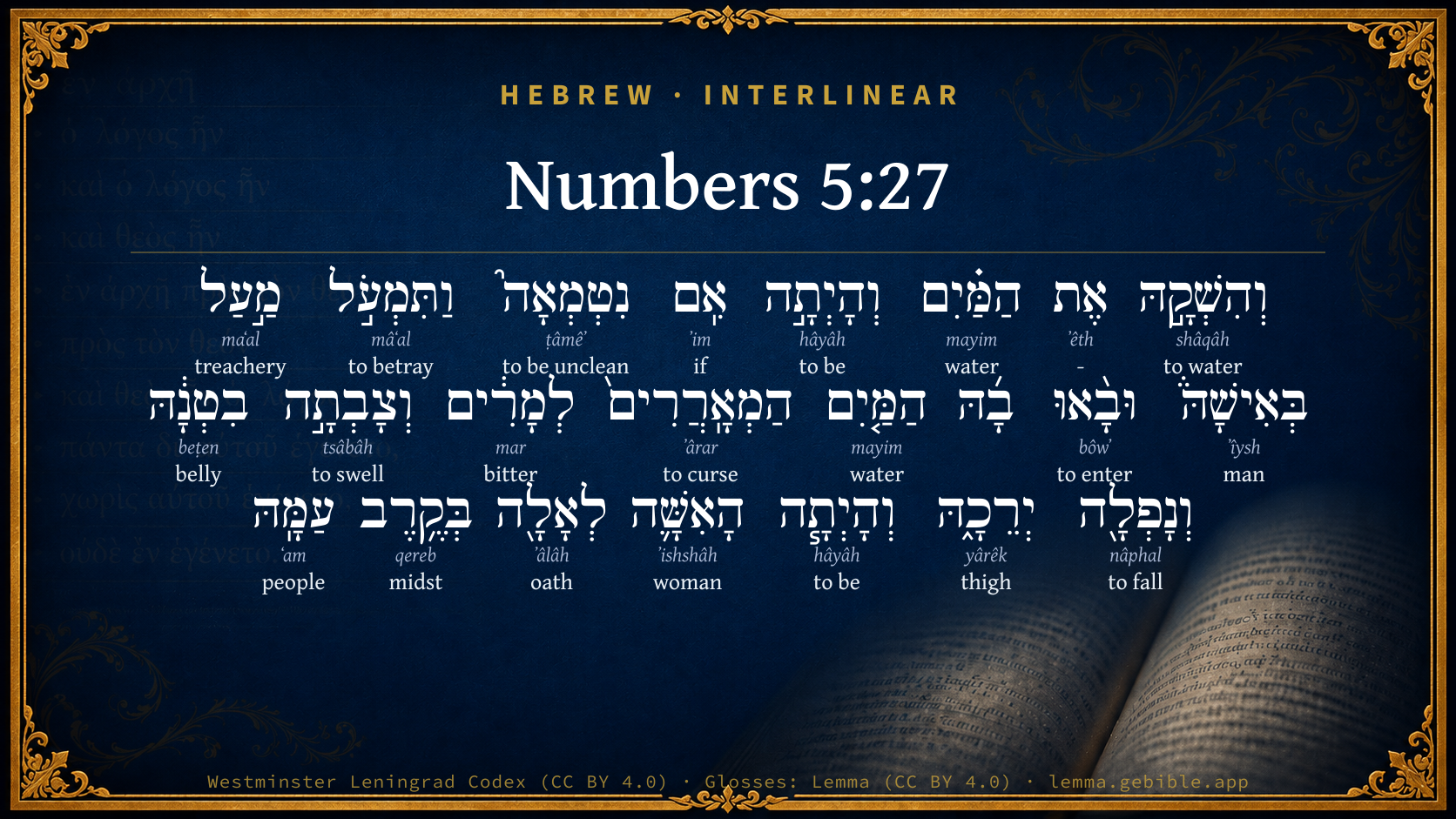
Hebrew (Westminster Leningrad Codex) Numbers 5:27 appears in the Hebrew Old Testament. The text above is from the Westminster Leningrad Codex. Each word links to its Strong’s number, a concise gloss, and parsing drawn from the Open Scriptures Hebrew Bible morphology. Click any word for its full Brown-Driver-Briggs (BDB) entry.
Download image
Cite this verse

Numbers 5:27 (World English Bible). Public Domain. Lemma interlinear Bible study tool, https://lemma.gebible.app/v/numbers/5/27.

Show BibTeX & RIS
BibTeX
RIS
English Translation
When he has made her drink the water, then it shall happen, if she is defiled, and has committed a trespass against her husband, that the water that causes the curse will enter into her and become bitter, and her body will swell, and her thigh will fall away: and the woman will be a curse among her people.
World English Bible · Public Domain
Download a study sheet

One document with this verse’s original text, its word-by-word gloss line, the meaning frame, cross-references with their text, attributed commentary, and full source and license credits — printable, and it pastes into notes with its structure intact.

This verse Autodidact and up

Study sheet (.html) Plain text (.txt)

A passage Seminary Student

Up to 50 verses in one chapter. A passage sheet keeps up to 6 commentary sources and 12 cross-references per verse, in the order this page ranks them, and says so on the sheet whenever that leaves anything out. Ask for a single verse and you get the Autodidact verse sheet above.

Everything on this page stays free to read, with no account — the sheet is a download of what is already on screen, not access to it.

Want to remove ads? Support Godless Engineer
Compare translations 3

The same verse in 3 English versions, stacked beneath the original-language interlinear above. Click any original word for its lexicon entry.

Each is an independent rendering of the whole verse — the interlinear is not word-aligned to these translations.

Highlighted words mark where these versions differ — a whole-verse word diff, not a word-by-word alignment.

  • World English Bible Public Domain
    When he has made her drink the water, then it shall happen, if she is defiled, and has committed a trespass against her husband, that the water that causes the curse will enter into her and become bitter, and her body will swell, and her thigh will fall away: and the woman will be a curse among her people.
  • King James Version Public Domain
    And when he hath made her to drink the water, then it shall come to pass, that, if she be defiled, and have done trespass against her husband, that the water that causeth the curse shall enter into her, and become bitter, and her belly shall swell, and her thigh shall rot: and the woman shall be a curse among her people.
  • unfoldingWord Literal Text CC BY-SA 4.0
    And he shall make her drink the water. And it will happen, if she was made unclean and was unfaithful unfaithfulness against her husband, then the water that brings a curse to bitterness will go in her, and her belly will swell and her thigh will fall, and the woman will become a curse in the midst of her people.

unfoldingWord Literal Text — © unfoldingWord, licensed CC BY-SA 4.0. Word-aligned USFM3 via Door43 (git.door43.org/unfoldingWord/en_ult).

Versions to compare (up to 4)

3 of 4 selected

Show all 18 translations

Every available English version of this verse, each an independent rendering of the whole verse.

  • World English Bible Public Domain
    When he has made her drink the water, then it shall happen, if she is defiled, and has committed a trespass against her husband, that the water that causes the curse will enter into her and become bitter, and her body will swell, and her thigh will fall away: and the woman will be a curse among her people.
  • Berean Standard Bible Public Domain
    When he has made her drink the water, if she has defiled herself and been unfaithful to her husband, then the water that brings a curse will enter her and cause bitter suffering; her belly will swell, her thigh will shrivel, and she will become accursed among her people.
  • Majority Standard Bible Public Domain
    When he has made her drink the water, if she has defiled herself and been unfaithful to her husband, then the water that brings a curse will enter her and cause bitter suffering; her belly will swell, her thigh will shrivel, and she will become accursed among her people.
  • King James Version Public Domain
    And when he hath made her to drink the water, then it shall come to pass, that, if she be defiled, and have done trespass against her husband, that the water that causeth the curse shall enter into her, and become bitter, and her belly shall swell, and her thigh shall rot: and the woman shall be a curse among her people.
  • American Standard Version (1901) Public Domain
    And when he hath made her drink the water, then it shall come to pass, if she be defiled, and have committed a trespass against her husband, that the water that causeth the curse shall enter into her `and become' bitter, and her body shall swell, and her thigh shall fall away: and the woman shall be a curse among her people.
  • Revised Version (1885) Public Domain
    And when he hath made her drink the water, then it shall come to pass, if she be defiled, and have committed a trespass against her husband, that the water that causeth the curse shall enter into her and become bitter, and her belly shall swell, and her thigh shall fall away: and the woman shall be a curse among her people.
  • Geneva Bible (1599) Public Domain
    When yee haue made her drinke the water, (if she bee defiled and haue trespassed against her husband) then shall the cursed water, turned into bitternesse, enter into her, and her belly shall swell, and her thigh shall rot, and the woman shall be accursed among her people.
  • Douay-Rheims (1899) Public Domain
    And when she hath drunk them, if she be defiled, and having despised her husband be guilty of adultery, the malediction shall go through her, and her belly swelling, her thigh shall rot: and the woman shall be a curse, and an example to all the people.
  • Young's Literal Translation Public Domain
    yea, he hath caused her to drink the water, and it hath come to pass, if she hath been defiled, and doth commit a trespass against her husband, that the waters which cause the curse have gone into her for bitter things, and her belly hath swelled, and her thigh hath fallen, and the woman hath become an execration in the midst of her people.
  • Literal Standard Version CC BY-SA 4.0
    indeed, he has caused her to drink the water, and it has come to pass, if she has been defiled and commits a trespass against her husband, that the waters which cause the curse have gone into her for bitter things, and her belly has swelled, and her thigh has fallen, and the woman has become an execration in the midst of her people.
  • Unlocked Literal Bible CC BY-SA 4.0
    When he gives her the water to drink, if she is defiled because she has committed a sin against her husband, then the water that brings the curse will enter her and become bitter. Her abdomen will swell and her thigh will waste away. The woman will be cursed among her people.
  • unfoldingWord Literal Text CC BY-SA 4.0
    And he shall make her drink the water. And it will happen, if she was made unclean and was unfaithful unfaithfulness against her husband, then the water that brings a curse to bitterness will go in her, and her belly will swell and her thigh will fall, and the woman will become a curse in the midst of her people.
  • Darby Bible Public Domain
    And when he hath made her to drink the water, then it shall come to pass, if she have been defiled, and have committed unfaithfulness against her husband, that the water that bringeth the curse shall enter into her, for bitterness, and her belly shall swell, and her thigh shall shrink; and the woman shall become a curse among her people.
  • World Messianic Bible Public Domain
    When he has made her drink the water, then it shall happen, if she is defiled and has committed a trespass against her husband, that the water that causes the curse will enter into her and become bitter, and her body will swell, and her thigh will fall away; and the woman will be a curse among her people.
  • Webster's Bible Public Domain
    And when he hath made her to drink the water, then it shall come to pass, that, if she is defiled, and hath done trespass against her husband, that the water that causeth the curse shall enter into her, and become bitter, and her belly shall swell, and her thigh shall perish: and the woman shall be a curse among her people.
  • Free Bible Version CC BY-SA 4.0
    After he has made her drink the water, if she has made herself unclean and has been unfaithful to her husband, then the water that curses will cause her bitter pain. Her belly will swell up and her thighs will shrink. She will become a cursed woman among her people.
  • Bible in Basic English Public Domain
    And it will be that if the woman has become unclean, sinning against her husband, when she has taken the bitter water it will go into her body, causing disease of the stomach and wasting of the legs, and she will be a curse among her people.
  • JPS Tanakh (1917) Public Domain
    And when he hath made her drink the water, then it shall come to pass, if she be defiled, and have acted unfaithfully against her husband, that the water that causeth the curse shall enter into her and become bitter, and her belly shall swell, and her thigh shall fall away; and the woman shall be a curse among her people.

Literal Standard Version (2020), Covenant Press — licensed CC BY-SA 4.0. Text via the HelloAO Bible API (eBible.org). Unlocked Literal Bible (unfoldingWord) — licensed CC BY-SA 4.0. Text via the HelloAO Bible API (eBible.org). unfoldingWord Literal Text — © unfoldingWord, licensed CC BY-SA 4.0. Word-aligned USFM3 via Door43 (git.door43.org/unfoldingWord/en_ult). Free Bible Version, Dr. Jonathan Gallagher — licensed CC BY-SA 4.0. Text via the HelloAO Bible API (eBible.org).

Word by word

More ways to search: Search by grammar → Find every occurrence → Compare this word →

Practice this passage: Drill this verse → Learn its vocabulary →

וְצָבְתָ֣ה
tsâbâh
H6638
“and · to swell”
Conjunction + Verb, Qal, Sequential Perfect, 3rd Person, Feminine, Singular
Part of Speech
Conjunction + Verb
Stem
Qal
Form
Sequential Perfect
Person
3rd Person
Gender
Feminine
Number
Singular
Full BDB Definition

Origin: a primitive root

TWOT: 1868

to swell, swell up - (Qal) to swell (of adulteress' belly) - (Hiphil) to cause to swell (of adulteress' belly)
  1. וְהִשְׁקָ֣הּ shâqâh H8248 “and · to water · her” Conjunction + Verb, Hiphil, Sequential Perfect, 3rd Person, Masculine, Singular + Suffix, Personal, 3rd Person, Feminine, Singular
  2. אֶת ʼêth H853 “-” Particle, Direct Object
  3. הַמַּ֗יִם mayim H4325 “the · water(s)” Particle, Definite Article + Noun, Common, Masculine, Plural, Absolute
  4. וְהָיְתָ֣ה hâyâh H1961 “and · to be” Conjunction + Verb, Qal, Sequential Perfect, 3rd Person, Feminine, Singular
  5. אִֽם ʼim H518 “if” Conjunction
  6. נִטְמְאָה֮ ṭâmêʼ H2930 “to be unclean” Verb, Niphal, Perfect, 3rd Person, Feminine, Singular
  7. וַתִּמְעֹ֣ל mâʻal H4603 “and · to betray” Conjunction + Verb, Qal, Sequential Imperfect, 3rd Person, Feminine, Singular
  8. מַ֣עַל maʻal H4604 “treachery” Noun, Common, Masculine, Singular, Absolute
  9. בְּאִישָׁהּ֒ ʼîysh H376 “in/at · man · her” Preposition + Noun, Common, Masculine, Singular, Construct + Suffix, Personal, 3rd Person, Feminine, Singular
  10. וּבָ֨אוּ bôwʼ H935 “and · to enter” Conjunction + Verb, Qal, Sequential Perfect, 3rd Person, Common, Plural
  11. הַמַּ֤יִם mayim H4325 “the · water(s)” Particle, Definite Article + Noun, Common, Masculine, Plural, Absolute
  12. הַמְאָֽרֲרִים֙ ʼârar H779 “the · cursing” Particle, Definite Article + Verb, Piel, Participle Active, Masculine, Plural, Absolute
  13. לְמָרִ֔ים mar H4751 “to/for · bitter” Preposition + Adjective, Adjective, Masculine, Plural, Absolute
  14. בִטְנָ֔הּ beṭen H990 “belly · her” Noun, Common, Feminine, Singular, Construct + Suffix, Personal, 3rd Person, Feminine, Singular
  15. וְנָפְלָ֖ה nâphal H5307 “and · to fall” Conjunction + Verb, Qal, Sequential Perfect, 3rd Person, Feminine, Singular
  16. יְרֵכָ֑הּ yârêk H3409 “thigh · her” Noun, Common, Feminine, Singular, Construct + Suffix, Personal, 3rd Person, Feminine, Singular
  17. וְהָיְתָ֧ה hâyâh H1961 “and · to be” Conjunction + Verb, Qal, Sequential Perfect, 3rd Person, Feminine, Singular
  18. הָאִשָּׁ֛ה ʼishshâh H802 “the · woman” Particle, Definite Article + Noun, Common, Feminine, Singular, Absolute
  19. לְאָלָ֖ה ʼâlâh H423 “to/for · oath” Preposition + Noun, Common, Feminine, Singular, Absolute
  20. בְּקֶ֥רֶב qereb H7130 “in/at · midst of” Preposition + Noun, Common, Masculine, Singular, Construct
  21. עַמָּֽהּ ʻam H5971 “people · her” Noun, Common, Masculine, Singular, Construct + Suffix, Personal, 3rd Person, Feminine, Singular

About this verse

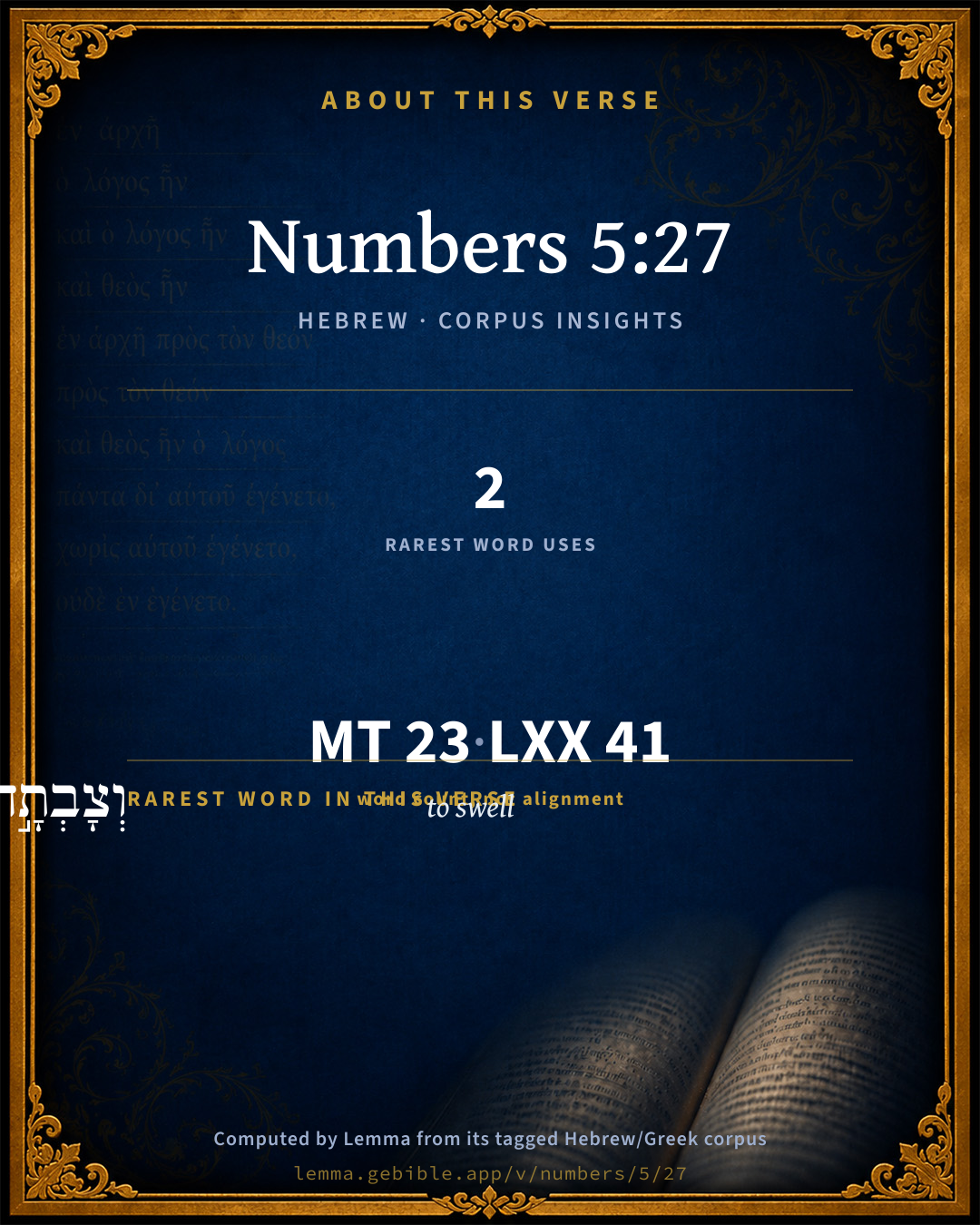
These counts appear in no published source. They are computed here, from the morphology-tagged text and Lemma’s own curated glosses. What Lemma adds →

23
words
20
distinct lemmas
Pentateuch
section

Notable vocabulary

The rarest word here is וְצָבְתָ֣ה to swell H6638 — appearing just 2 times in the whole Hebrew Bible.

Shared distinctive vocabulary

וְצָבְתָ֣ה to swell H6638 occurs in 2 verses of the Hebrew Bible. Also found in:

Grammatical profile

  • 9 verbs
  • 10 nouns
  • 1 adjective
  • 1 preposition
  • 1 conjunction
  • 1 particle

Verb forms

  • וְהִשְׁקָ֣הּ Hiphil · Sequential Perfect
  • וְהָיְתָ֣ה Qal · Sequential Perfect
  • נִטְמְאָה֮ Niphal · Perfect
  • וַתִּמְעֹ֣ל Qal · Sequential Imperfect
  • וּבָ֨אוּ Qal · Sequential Perfect
  • הַמְאָֽרֲרִים֙ Piel · Participle Active
  • וְצָבְתָ֣ה Qal · Sequential Perfect
  • וְנָפְלָ֖ה Qal · Sequential Perfect
  • וְהָיְתָ֧ה Qal · Sequential Perfect

Repetition

Words recur within this verse — often emphatic in Hebrew:

  • הַמַּ֗יִם water H4325 ×2
  • וְהָיְתָ֣ה to be H1961 ×2

Hebrew & Septuagint length

In English translation the verse runs 59 words from the Hebrew and 59 from the Septuagint (LXX English) — the same length.

A rough comparison of the two English renderings, which tokenize alike — not a word-level alignment.

Word counts can differ between the Hebrew and the Greek without any difference in meaning — e.g. the Hebrew direct-object marker אֵת has no separate Greek word, and Greek often adds the article ὁ.

In the original languages it is 23 Hebrew tokens and 41 Greek tokens — but the two are counted differently (Hebrew bundles its prefixes and suffixes into one token; the Greek is in lemma form), so that isn’t a like-for-like length.

Cross-references

16

Topical passages linked to Numbers 5:27 in the Treasury of Scripture Knowledge — connected by theme and wording, ordered by reader-vote popularity; previews shown in the World English Bible.

  • Jeremiah 29:18 I will pursue after them with the sword, with the famine, and with the pestilence, and will deliver them to be tossed back and forth among all the kingdoms of the earth, to be an object of horror, and an astonishment, and a hissing, and a reproach, among all the nations where I have driven them;
  • Jeremiah 42:18 For thus says Yahweh of Hosts, the God of Israel: As my anger and my wrath has been poured forth on the inhabitants of Jerusalem, so shall my wrath be poured forth on you, when you shall enter into Egypt; and you shall be an object of horror, and an astonishment, and a curse, and a reproach; and you shall see this place no more.
  • Zechariah 8:13 It shall come to pass that, as you were a curse among the nations, house of Judah and house of Israel, so will I save you, and you shall be a blessing. Don't be afraid. Let your hands be strong."
  • Deuteronomy 28:37 You shall become an astonishment, a proverb, and a byword, among all the peoples where Yahweh shall lead you away.
  • Isaiah 65:15 You shall leave your name for a curse to my chosen; and the Lord Yahweh will kill you; and he will call his servants by another name:
  • Jeremiah 24:9 I will even give them up to be tossed back and forth among all the kingdoms of the earth for evil; to be a reproach and a proverb, a taunt and a curse, in all places where I shall drive them.
  • Jeremiah 29:22 and of them shall be taken up a curse by all the captives of Judah who are in Babylon, saying, Yahweh make you like Zedekiah and like Ahab, whom the king of Babylon roasted in the fire;
  • Jeremiah 44:12 I will take the remnant of Judah, that have set their faces to go into the land of Egypt to sojourn there, and they shall all be consumed; in the land of Egypt shall they fall; they shall be consumed by the sword and by the famine; they shall die, from the least even to the greatest, by the sword and by the famine; and they shall be an object of horror, [and] an astonishment, and a curse, and a reproach.
  • Numbers 5:20 But if you have gone astray, being under your husband, and if you are defiled, and some man has lain with you besides your husband:'
  • Psalms 83:9–11 Do to them as you did to Midian, As to Sisera, as to Jabin, at the river Kishon;
  • Proverbs 5:4–11 But in the end she is as bitter as wormwood, And as sharp as a two-edged sword.
  • Ecclesiastes 7:26 I find more bitter than death the woman whose heart is snares and traps, whose hands are chains. Whoever pleases God shall escape from her; but the sinner will be ensnared by her.
  • Romans 6:21 What fruit then did you have at that time in the things of which you are now ashamed? For the end of those things is death.
  • 2 Corinthians 2:16 to the one a stench from death to death; to the other a sweet aroma from life to life. Who is sufficient for these things?
  • Hebrews 10:26–30 For if we sin willfully after we have received the knowledge of the truth, there remains no more a sacrifice for sins,
  • 2 Peter 2:10 but chiefly those who walk after the flesh in the lust of defilement, and despise authority. Daring, self-willed, they are not afraid to speak evil of dignitaries;

Cross-references courtesy of OpenBible.info (CC BY 4.0).

Hebrew and Greek witnesses Masoretic Hebrew ↔ Greek Septuagint

The same verse in the two great witnesses to the Old Testament, shown verse-for-verse.

These are two independent witnesses, not word-aligned to each other, and the Septuagint is shown in lemma (dictionary) form.

Hebrew Numbers 5:27 Masoretic · Westminster Leningrad Codex

וְהִשְׁקָ֣הּ אֶת הַמַּ֗יִם וְהָיְתָ֣ה אִֽם נִטְמְאָה֮ וַתִּמְעֹ֣ל מַ֣עַל בְּאִישָׁהּ֒ וּבָ֨אוּ בָ֜הּ הַמַּ֤יִם הַמְאָֽרֲרִים֙ לְמָרִ֔ים וְצָבְתָ֣ה בִטְנָ֔הּ וְנָפְלָ֖ה יְרֵכָ֑הּ וְהָיְתָ֧ה הָאִשָּׁ֛ה לְאָלָ֖ה בְּקֶ֥רֶב עַמָּֽהּ

When he has made her drink the water, then it shall happen, if she is defiled, and has committed a trespass against her husband, that the water that causes the curse will enter into her and become bitter, and her body will swell, and her thigh will fall away: and the woman will be a curse among her people.

World English Bible · Public Domain

Greek LXX Numbers 5:27 Septuagint · lemma form

καί εἰμί ἐάν εἰμί μιαίνω καί λήθη λανθάνω ὁ ἀνήρ αὐτός καί εἰςἔρχομαι εἰς αὐτός ὁ ὕδωρ ὁ ἐλεγμός ὁ ἐπι καταἀράομαι καί πρήθω ὁ κοιλία καί διαπίπτω ὁ μηρός αὐτός καί εἰμί ὁ γυνή εἰς ἀρά ἐν ὁ λαός αὐτός

And it shall come to pass, if she be defiled, and have altogether escaped the notice of her husband, then the water of the conviction that brings the curse shall enter into her; and she shall swell in her belly, and her thigh shall rot, and the woman shall be for a curse in the midst of her people.

LXX2012 (modern English Septuagint) · Public Domain

Hebrew: Westminster Leningrad Codex (CC BY 4.0). Greek: Septuagint (public domain); English from LXX2012 (modern English Septuagint) (Public Domain). How the Septuagint differs from the Hebrew →

Targum (Aramaic paraphrase)

2

The Targum is the ancient Jewish Aramaic paraphrase of the Hebrew Scriptures — an interpretive translation, not the Hebrew text itself. Onkelos (literal) and Pseudo-Jonathan (expansive) render the Torah, and Jonathan the Prophets. Coverage is partial: where no permissively-licensed English translation exists for a verse, only the Aramaic is shown. This is verse-level text, not a word-by-word alignment to the Hebrew.

  1. Targum Onkelos Torah (Genesis–Deuteronomy)
    וְיַשְׁקִנָהּ יָת מַיָא וּתְהֵי אִם אִסְתָּאָבַת וְשַׁקָרַת שְׁקָר בְּבַעֲלַהּ וְיֵעֲלוּן בַּה מַיָא מְלַטְטַיָא לִמְרִירוּ וְיִפְּחוּן מְעָהָא וְתִתְמְסֵי יַרְכַהּ וּתְהֵי אִתְּתָא לִלְוַט בְּגוֹ עַמָהּ

    (no public-domain English translation for this verse)

    Targum Onkelos — Aramaic: “Onkelos Genesis” (public domain); “Onkelos Exodus” (public domain); “Onkelos Leviticus” (public domain); “Onkelos Numbers” (public domain); “Onkelos Deuteronomy” (public domain). English: “Sefaria Community Translation” (CC0 1.0 (public-domain dedication)); “J.W. Etheridge. The Targums of Onkelos and Jonathan Ben Uzziel on the Pentateuch. London: Longmans, Green, 1862” (public domain). Text via Sefaria.

  2. Targum Pseudo-Jonathan Torah (Genesis–Deuteronomy)
    וְיַשְׁקִינָהּ יַת מַיָא וִיהֵי אִין אִסְתְּאָבַת בְּתַשְׁמִישׁ דְעָרִיס וְשַׁקְרַת שְׁקָר בְּבַעֲלָהּ וְיֵעָלוּן בָּהּ מַיָא בְּדוּקַיָא לִלְוָט וּתְנָפַח כְּרֵיסָהּ וְתִתְמְסֵי יַרְכָּהּ וּתְהֵי אִתְּתָא לִלְוָטָא בְּגוֹ בְּנֵי עַמָהּ בְּרַם לְגִיוֹרָא בַּדְקִין מַיָא בְּדוּקַיָא הָאִינוּן בְּכָל אַתְרָא דְהוּא תַּמָן

    And when he hath caused her to drink the water, it will be that if she hath been defiled by adultery, and hath acted with wrongness against her husband, those proving waters will enter into her with a curse, and her belly will swell, and her thigh become corrupt, and the woman will be an execration among the children of her people. The adulterer as well will be detected by these waters of probation, in whatever place he may be.

    Targum Pseudo-Jonathan — Aramaic: “Targum Jonathan on Genesis” (public domain); “Targum Jonathan on Exodus” (public domain); “Targum Jonathan on Leviticus” (public domain); “Targum Jonathan on Numbers” (public domain); “Targum Jonathan on Deuteronomy” (public domain). English: “The Targum of Jonathan ben Uzziel, trans. J. W. Etheridge, London, 1862” (public domain). Text via Sefaria.

Commentary

Notes on Numbers 5:27 from classic Christian and Jewish commentators (each source and its license shown beneath its notes). The classic Christian expositions comment on the surrounding passage and are grouped to its opening verse, so a note may address several verses; the Jewish commentaries on the Tanakh (Rashi and others) are per-verse, so they appear only where the commentator wrote on this verse.

Lemma curates 59 commentaries, every one of them public domain or Creative Commons licensed, each selected and text-cleaned for this edition rather than reprinted as found. About our sources →

Trapp's Complete Commentary

John Trapp

Num 5:27 And when he hath made her to drink the water, then it shall come to pass, [that], if she be defiled, and have done trespass against her husband, that the water that causeth the curse shall enter into her, [and become] bitter, and her belly shall swell, and her thigh shall rot: and the woman shall be a curse among her people.

Ver. 27. And her belly shall swell.] This was a usual miracle among the Jews; and showed that their religion was of God.

John Trapp, A Commentary or Exposition upon All the Books of the Old and New Testament (1647–1656) — public domain. Text from a community e-Sword module.

Joseph Benson's Commentary

Num 5:27. The water shall enter into her — These effects, the Jews tell us, presently followed; for she grew pale, and her eyes were ready to start out of her head, so that they cried out, Carry her away, lest she defile the court of the temple, by dying there. But if what has just been observed from the Jewish writers be true, that, upon confessing her guilt, the woman was only divorced and condemned to lose her dowry, it is probable there were not many instances wherein this miraculous judgment was inflicted; for it is hardly to be supposed that any woman, conscious of her guilt, would, by asserting her innocence thus solemnly, in defiance of the Almighty, venture upon the hazard of sudden and immediate death, with all the miserable circumstances here described, rather than confess and gain time to repent. And the woman shall be a curse among her people — Such woful effects shall the before-mentioned bitter draught produce, that she shall become a perfect proverb of a curse and wretchedness in the mouths of all her neighbours.

Joseph Benson's Commentary on the Old and New Testaments (1811–1818) — public domain. Text from a community e-Sword module.

John Gill's Exposition

And when he hath made her to drink the water,.... For, as before observed, and here by Jarchi again, if she says I will not drink it, after the roll is blotted out, they oblige her, and make her drink it whether she will or not, unless she says I am defiled:

then it shall come to pass, that if she be defiled, and have done trespass against her husband; or has committed adultery:

that the water that causeth the curse shall enter into her, and become bitter; the water drank by her, and having the curses scraped into it, shall enter into her, and operate and produce bitter and dreadful effects:

and her belly shall swell, and her thigh shall rot; not through any natural virtue in the water, or what is put into it, either the dust of the floor of the tabernacle, or the scrapings of the parchment roll, these could have no physical influence to produce such effects; but they must be ascribed to a supernatural cause, the power and curse of God attending this draught. A certain Jewish writer (b) says, though very falsely, that the priest put poison into the water, which produced such effects; but then, how could an innocent woman escape the effects of it? that must be allowed to be miraculous and supernatural, was it so; but there is no manner of reason to believe that anything of this kind was put into it, The Jews say (c), as soon, or before she had made an end of drinking: the water, the effects appeared; her face turned pale immediately, her eyes bolted out, and she was filled with veins, her body swelled, and they called out, Cast her out, cast her out, that she may not defile the court. And the text seems to intimate, as if the operation was immediate; yea, moreover, they say (d), that as the waters searched her, so they searched him (the adulterer), because it is said twice, "shall enter, shall enter"; and that the same effects appeared in him as in her, but in neither, unless the husband was innocent; for if he was not pure from the same sin himself, the waters would not search his wife (e) hence they say (f), when adulterers increased (under the second temple) the bitter waters ceased, according to Hos 4:14; see Mat 12:39. This practice has been imitated by the Heathens; the river Rhine, according to Julian the emperor (g), tried the legitimacy of children; and so lakes have been used for the trial of perjury and unchastity, as the Stygian lake for perjury, and another of the same name near Ephesus for unchastity; into which, if persons suspected of adultery descended, having the form of an oath hanging about their necks, if they were pure, the waters stood unmoved, but if corrupt, they swelled up to their necks, and covered the tablet on which the oath was written (h). The priestesses of a certain deity being obliged to live a single life, were tried by drinking bullocks' blood, upon which, if false to their oath and corrupt, they immediately died, as Pausanias (i) relates; and Macrobius (k) speaks of some lakes in Sicily, the inhabitants called the Cups, to which recourse was had when persons were suspected of any ill, and where an oath was taken of them; if the person swore truly, he departed unhurt, but if falsely, he immediately lost his life in the lake. Philostratus (l) relates of a water near Tyana, a city in Cappadocia, sacred to Jupiter, which the inhabitants call Asbamaea, which to those that kept their oaths was placid and sweet, but to perjured persons the reverse; it affected their eyes, hands, and feet, and seized them with dropsies and consumptions; nor could they depart from the water, but remained by it, mourning their sad case, and confessing their perjury: but what comes nearest to this usage of the Jews is a custom at marriages among the savages at Cape Breton (m): at a marriage feast, two dishes of meat are brought to the bridegroom and bride in two "ouragans" (basins made of the bark of a tree), and the president of the feast addresses himself to the bride thus,"and thou that art upon the point of entering into a respectable state, know, that the nourishment thou art going to take forebodes the greatest calamities to thee, if thy heart is capable of harbouring any ill design against thy husband, or against thy nation: shouldest thou ever be led astray by the caresses of a stranger; or shouldest thou betray thy husband, and thy country, the victuals contained in this "ouragan" will have the effects of a slow poison, with which thou wilt be tainted from this very instant; but if, on the other hand, thou remainest faithful to thy husband, and to thy country, if thou wilt never insult the one for his defect, nor give a description of the other to the enemy, thou wilt find this nourishment both agreeable and wholesome.''Now if these relations can be credited, then much more this of the bitter waters, for though there was something wonderful and supernatural in them, yet nothing incredible:

and the woman shall be a curse among her people: the time she lives; but then all this while she was looked upon as an accursed person, and despised and shunned by all.

(b) R. Samuel Tzartzah, Mekor Chayim, fol. 91. 3. (c) Misn. Sotah, c. 3. sect. 4. (d) Ibid. c. 5. sect. 1. (e) T. Bab. Sotah, fol. 28. 1. Gersom in loc. (f) Misn. Sotah, c. 2. sect. 9. (g) Orat. 2. p. 151. Ep. 16. p. 131. (h) Vid. Salden. Otia, l. 1. Exercitat. 6. sect. 24. (i) Achaica, sive, l. 7. p. 450. (k) Saturnal. l. 5. c. 19. (l) Vita Apollonii, l. 1. c. 4. (m) Genuine Letters and Memoirs relating to the Isle of Cape Breton, &c.

John Gill's Exposition of the Whole Bible (1746–1763) — public domain (CC PDM 1.0). Text via the HelloAO Bible API.

Haydock's Catholic Bible Commentary

CHAPTER V.

Through her. Hebrew, "into her," exerting all their efficacy.

George Leo Haydock (1774–1849), Haydock's Catholic Family Bible and Commentary, 1859 edition — public domain. Excludes Psalms (Douay-Rheims chapter numbering differs from Protestant) and Deuterocanonical books (Catholic canon only).

The Pulpit Commentary

Shall enter into her, and become bitter. Rather, "as bitter," or "as bitterness," i.e. as producing bitter sufferings. Shall be a curse, i.e., shall be used as an example in the imprecations of the people.

The Pulpit Commentary (1880–1919), ed. H.D.M. Spence-Jones & Joseph S. Exell — public domain. Text from a community e-Sword module.

unfoldingWord translationNotes

Door43 World Missions Community

if she is defiled because she has committed

This can be written in active form. AT: "if she has defined herself by committing" (See: Active or Passive)

committed a sin

Here the "sin" refers specifically to committing adultery. The meaning of this statement can be made clear. AT: "committed adultery" (See: Assumed Knowledge and Implicit Information)

Her abdomen will swell and her thigh will waste away

Possible meanings are 1) that the woman will become unable to have children or 2) that the woman's pregnancy will end too early and the baby will die. Here the word "thigh" is a polite way of referring to the woman's womb or her private parts. (See: Euphemism) See how you translated these concepts in Numbers 5:21.

The woman will be cursed among her people

This can be stated in active form. AT: "Her people will curse her" (See: Active or Passive)

is not defiled

This can be stated in active form. AT: "has not defiled herself" (See: Active or Passive)

if she is clean

Here "being innocent" is spoken of as "being clean." (See: Metaphor)

then she must be free

Possible meanings are 1) "then she will not be cursed" or 2) "then she is free from guilt." (See: Assumed Knowledge and Implicit Information)

conceive children

"become pregnant"

translationWords

defile

sin

clean

unfoldingWord translationNotes — © Distant Shores Media and the Door43 World Missions Community, licensed CC BY-SA 4.0. Source: git.door43.org/Door43/en_tn.

Rashi

Rabbi Shlomo Yitzchaki (Rashi)

והשקה את המים AND HE SHALL MAKE HER DRINK THE WATER — This statement made after Scripture has just said (v. 26) “and afterwards he shall make the woman drink the waters” (see Siphre) is intended to include the case that if she says, “I will not drink” after the scroll on which the Holy Name was written had been blotted out, they pour it into her and make her drink the water against her will — except if she adds: “I have been defiled” [when, of course, no further test is necessary] (Sotah 19b).

וצבתה בטנה AND HER BELLY SHALL SWELL, [AND HER THIGH SHALL WASTE] — Although when uttering the curse (v. 21) he (the priest) mentioned the thigh first, for the reason given by Rashi in his comment there, the water tested her (i.e., affected her) only according to the manner it passed into her body (i.e., it affected the belly first since it first entered that part of her body and then the thigh) (Sotah 9b).

והיתה האשה לאלה AND THE WOMAN SHALL BE AN EXECRATION — This means, as I have already explained (v. 21), that everyone shall curse by mention of her name.

בקרב עמה [AND THE WOMAN SHALL BE AN EXECRATION] AMONG HER PEOPLE — This is stressed: "among her people” — because there is a difference between a person who is brought to disgrace in a place where he is well known and a person who is brought to disgrace in a place where he is unknown.

Rashi on the Tanakh — English translations: “The Judaica Press complete Tanach with Rashi, translated by A. J. Rosenberg” (CC BY 4.0); “Pentateuch with Rashi's commentary by M. Rosenbaum and A.M. Silbermann, 1929-1934” (public domain); “The Metsudah Tanach series, Lakewood, N.J” (CC BY 4.0); and “The Book of Joshua, Metsudah Publications, 1997” (CC BY 4.0). Text via Sefaria.

Lesson kit

Teaching starters — assembled from the data on this page, not authored interpretation. Every prompt links to the verse data it draws on. Edit before teaching.

Numbers, in the Pentateuch, opens this verse with 23 words (20 distinct Hebrew lemmas). Its most distinctive word is tsâbâh (“to swell”). A historical commentator’s framing appears above. Read the whole chapter for the surrounding context.

Discussion questions

  1. The word tsâbâh carries the sense “to swell.” How does it shape the verse?
  2. Numbers 5:22 shares the word «to swell» with this verse. How do the two illuminate each other?
  3. “water” occurs 2× in this one verse. What is the effect of the repetition?
  4. These translations render this verse differently. What is at stake in choosing one wording over another?
  5. The verb «וְהִשְׁקָ֣הּ» is Hiphil Sequential Perfect. How does its form color the action?
  6. Reading how Trapp's Complete Commentary and Joseph Benson's Commentary read this verse, where do the two commentators agree and where do they part?

Things to notice

Reading settings

Reading text

Shown beneath each verse's original-language words.

Old Testament
Old Testament edition

Read the OT as the Masoretic Hebrew (MT) or the Greek Septuagint (LXX).

English shown for the Greek Septuagint (in the Hebrew ↔ Greek comparison).

Comparing translations? Open the Compare panel on any verse page to stack up to four side by side.