
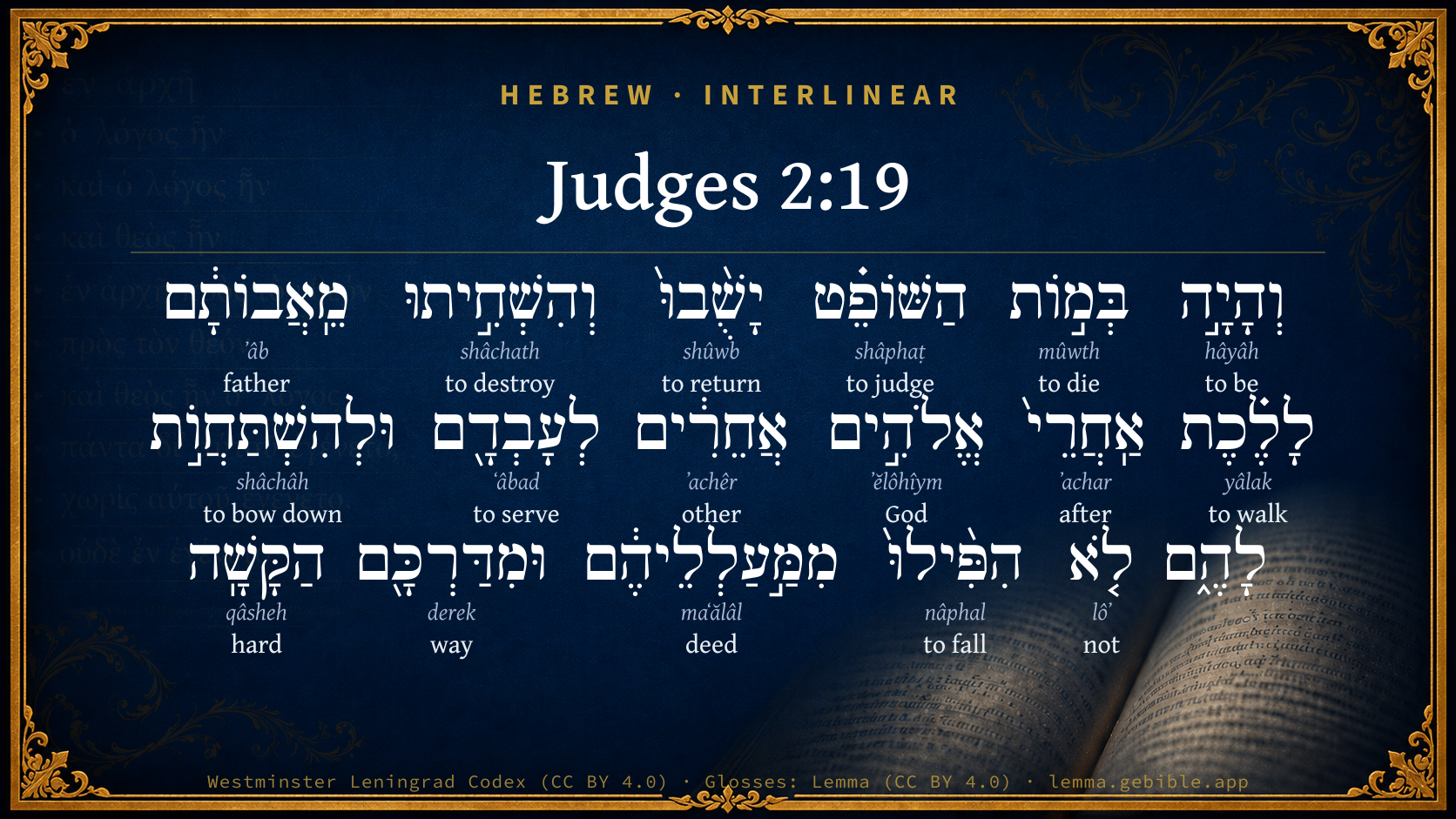
Judges 2:19

Hebrew (Westminster Leningrad Codex) Judges 2:19 appears in the Hebrew Old Testament. The text above is from the Westminster Leningrad Codex. Each word links to its Strong’s number, a concise gloss, and parsing drawn from the Open Scriptures Hebrew Bible morphology. Click any word for its full Brown-Driver-Briggs (BDB) entry.
Download image
Cite this verse

Judges 2:19 (World English Bible). Public Domain. Lemma interlinear Bible study tool, https://lemma.gebible.app/v/judges/2/19.

Show BibTeX & RIS
BibTeX
RIS
English Translation
But it happened, when the judge was dead, that they turned back, and dealt more corruptly than their fathers, in following other gods to serve them, and to bow down to them; they didn't cease from their doings, nor from their stubborn way.
World English Bible · Public Domain
Download a study sheet

One document with this verse’s original text, its word-by-word gloss line, the meaning frame, cross-references with their text, attributed commentary, and full source and license credits — printable, and it pastes into notes with its structure intact.

This verse Autodidact and up

Study sheet (.html) Plain text (.txt)

A passage Seminary Student

Up to 50 verses in one chapter. A passage sheet keeps up to 6 commentary sources and 12 cross-references per verse, in the order this page ranks them, and says so on the sheet whenever that leaves anything out. Ask for a single verse and you get the Autodidact verse sheet above.

Everything on this page stays free to read, with no account — the sheet is a download of what is already on screen, not access to it.

Want to remove ads? Support Godless Engineer
Compare translations 3

The same verse in 3 English versions, stacked beneath the original-language interlinear above. Click any original word for its lexicon entry.

Each is an independent rendering of the whole verse — the interlinear is not word-aligned to these translations.

Highlighted words mark where these versions differ — a whole-verse word diff, not a word-by-word alignment.

  • World English Bible Public Domain
    But it happened, when the judge was dead, that they turned back, and dealt more corruptly than their fathers, in following other gods to serve them, and to bow down to them; they didn't cease from their doings, nor from their stubborn way.
  • King James Version Public Domain
    And it came to pass, when the judge was dead, that they returned, and corrupted themselves more than their fathers, in following other gods to serve them, and to bow down unto them; they ceased not from their own doings, nor from their stubborn way.
  • unfoldingWord Literal Text CC BY-SA 4.0
    But it happened, at the death of the judge, they turned and acted corruptly more than their fathers, to walk after other gods, to serve them, and to bow down to them. They did not drop of their deeds or of their stubborn ways.

unfoldingWord Literal Text — © unfoldingWord, licensed CC BY-SA 4.0. Word-aligned USFM3 via Door43 (git.door43.org/unfoldingWord/en_ult).

Versions to compare (up to 4)

3 of 4 selected

Show all 18 translations

Every available English version of this verse, each an independent rendering of the whole verse.

  • World English Bible Public Domain
    But it happened, when the judge was dead, that they turned back, and dealt more corruptly than their fathers, in following other gods to serve them, and to bow down to them; they didn't cease from their doings, nor from their stubborn way.
  • Berean Standard Bible Public Domain
    But when the judge died, the Israelites became even more corrupt than their fathers, going after other gods to serve them and bow down to them. They would not give up their evil practices and stubborn ways.
  • Majority Standard Bible Public Domain
    But when the judge died, the Israelites became even more corrupt than their fathers, going after other gods to serve them and bow down to them. They would not give up their evil practices and stubborn ways.
  • King James Version Public Domain
    And it came to pass, when the judge was dead, that they returned, and corrupted themselves more than their fathers, in following other gods to serve them, and to bow down unto them; they ceased not from their own doings, nor from their stubborn way.
  • American Standard Version (1901) Public Domain
    But it came to pass, when the judge was dead, that they turned back, and dealt more corruptly than their fathers, in following other gods to serve them, and to bow down unto them; they ceased not from their doings, nor from their stubborn way.
  • Revised Version (1885) Public Domain
    But it came to pass, when the judge was dead, that they turned back, and dealt more corruptly than their fathers, in following other gods to serve them, and to bow down unto them; they ceased not from their doings, nor from their stubborn way.
  • Geneva Bible (1599) Public Domain
    Yet when the Iudge was dead, they returned, and did worse then their fathers, in following other gods to serue them and worshippe them: they ceased not from their owne inuentions, nor from their rebellious way.
  • Douay-Rheims (1899) Public Domain
    But after the judge was dead, they returned, and did much worse things than their fathers had done, following strange gods, serving them and adoring them. They left not their own inventions, and the stubborn way, by which they were accustomed to walk.
  • Young's Literal Translation Public Domain
    And it hath come to pass, at the death of the judge -- they turn back and have done corruptly above their fathers, to go after other gods, to serve them, and to bow themselves to them; they have not fallen from their doings, and from their stiff way.
  • Literal Standard Version CC BY-SA 4.0
    And it has come to pass, when the judge dies—they turn back and have done corruptly above their fathers, to go after other gods, to serve them, and to bow themselves to them; they have not fallen from their doings, and from their stiff way.
  • Unlocked Literal Bible CC BY-SA 4.0
    But when the judge died, they would turn away and do things that were even more corrupt than their fathers had done. They would go after other gods to serve them and worship them. They refused to give up any of their evil practices or their stubborn ways.
  • unfoldingWord Literal Text CC BY-SA 4.0
    But it happened, at the death of the judge, they turned and acted corruptly more than their fathers, to walk after other gods, to serve them, and to bow down to them. They did not drop of their deeds or of their stubborn ways.
  • Darby Bible Public Domain
    But whenever the judge died, they turned back and behaved worse than their fathers, going after other gods, serving them and bowing down to them; they did not drop any of their practices or their stubborn ways.
  • World Messianic Bible Public Domain
    But when the judge was dead, they turned back, and dealt more corruptly than their fathers in following other gods to serve them and to bow down to them. They didn’t cease what they were doing, or give up their stubborn ways.
  • Webster's Bible Public Domain
    And it came to pass, when the judge was dead, that they returned, and corrupted themselves more than their fathers, in following other gods to serve them, and to bow down to them; they ceased not from their own doings, nor from their stubborn way.
  • Free Bible Version CC BY-SA 4.0
    But when the judge died, the people relapsed, and did worse things even than their forefathers, following other gods and worshiping them. They refused to give up what they were doing and held to their stubborn ways.
  • Bible in Basic English Public Domain
    But whenever the judge was dead, they went back and did more evil than their fathers, going after other gods, to be their servants and their worshippers; giving up nothing of their sins and their hard-hearted ways.
  • JPS Tanakh (1917) Public Domain
    But it came to pass, when the judge was dead, that they turned back, and dealt more corruptly than their fathers, in following other gods to serve them, and to worship them; they left nothing undone of their practices, nor of their stubborn way.

Literal Standard Version (2020), Covenant Press — licensed CC BY-SA 4.0. Text via the HelloAO Bible API (eBible.org). Unlocked Literal Bible (unfoldingWord) — licensed CC BY-SA 4.0. Text via the HelloAO Bible API (eBible.org). unfoldingWord Literal Text — © unfoldingWord, licensed CC BY-SA 4.0. Word-aligned USFM3 via Door43 (git.door43.org/unfoldingWord/en_ult). Free Bible Version, Dr. Jonathan Gallagher — licensed CC BY-SA 4.0. Text via the HelloAO Bible API (eBible.org).

Word by word

More ways to search: Search by grammar → Find every occurrence → Compare this word →

Practice this passage: Drill this verse → Learn its vocabulary →

הַקָּשָֽׁה
qâsheh
H7186
“the · hard”
Particle, Definite Article + Adjective, Adjective, Feminine, Singular, Absolute
Part of Speech
Particle + Adjective
Type
Adjective
Gender
Feminine
Number
Singular
State
Absolute
Full BDB Definition

Origin: from H7185

TWOT: 2085a

hard, cruel, severe, obstinate - hard, difficult - severe - fierce, intense, vehement - stubborn, stiff of neck, stiff-necked - rigorous (of battle)
  1. וְהָיָ֣ה hâyâh H1961 “and · to be” Conjunction + Verb, Qal, Sequential Perfect, 3rd Person, Masculine, Singular
  2. בְּמ֣וֹת mûwth H4191 “in/at · death of” Preposition + Noun, Common, Masculine, Singular, Construct
  3. הַשּׁוֹפֵ֗ט shâphaṭ H8199 “the · judging” Particle, Definite Article + Verb, Qal, Participle Active, Masculine, Singular, Absolute
  4. יָשֻׁ֨בוּ֙ shûwb H7725 “to return” Verb, Qal, Imperfect, 3rd Person, Masculine, Plural
  5. וְהִשְׁחִ֣יתוּ shâchath H7843 “and · to destroy” Conjunction + Verb, Hiphil, Sequential Perfect, 3rd Person, Common, Plural
  6. מֵֽאֲבוֹתָ֔ם ʼâb H1 “from · fathers · their” Preposition + Noun, Common, Masculine, Plural, Construct + Suffix, Personal, 3rd Person, Masculine, Plural
  7. לָלֶ֗כֶת yâlak H3212 “to walk” Preposition + Verb, Qal, Infinitive Construct
  8. אַֽחֲרֵי֙ ʼachar H310 “after” Preposition
  9. אֱלֹהִ֣ים ʼĕlôhîym H430 “God(s)” Noun, Common, Masculine, Plural, Absolute
  10. אֲחֵרִ֔ים ʼachêr H312 “other” Adjective, Adjective, Masculine, Plural, Absolute
  11. לְעָבְדָ֖ם ʻâbad H5647 “to serve · them” Preposition + Verb, Qal, Infinitive Construct + Suffix, Personal, 3rd Person, Masculine, Plural
  12. וּלְהִשְׁתַּחֲוֺ֣ת shâchâh H7812 “and · to bow down” Conjunction + Preposition + Verb, Hishtaphel, Infinitive Construct
  13. לֹ֤א lôʼ H3808 “not” Particle, Negative
  14. הִפִּ֨ילוּ֙ nâphal H5307 “to fall” Verb, Hiphil, Perfect, 3rd Person, Common, Plural
  15. מִמַּ֣עַלְלֵיהֶ֔ם maʻălâl H4611 “from · deeds · their” Preposition + Noun, Common, Masculine, Plural, Construct + Suffix, Personal, 3rd Person, Masculine, Plural
  16. וּמִדַּרְכָּ֖ם derek H1870 “and · from · way · their” Conjunction + Preposition + Noun, Common, Both, Singular, Construct + Suffix, Personal, 3rd Person, Masculine, Plural

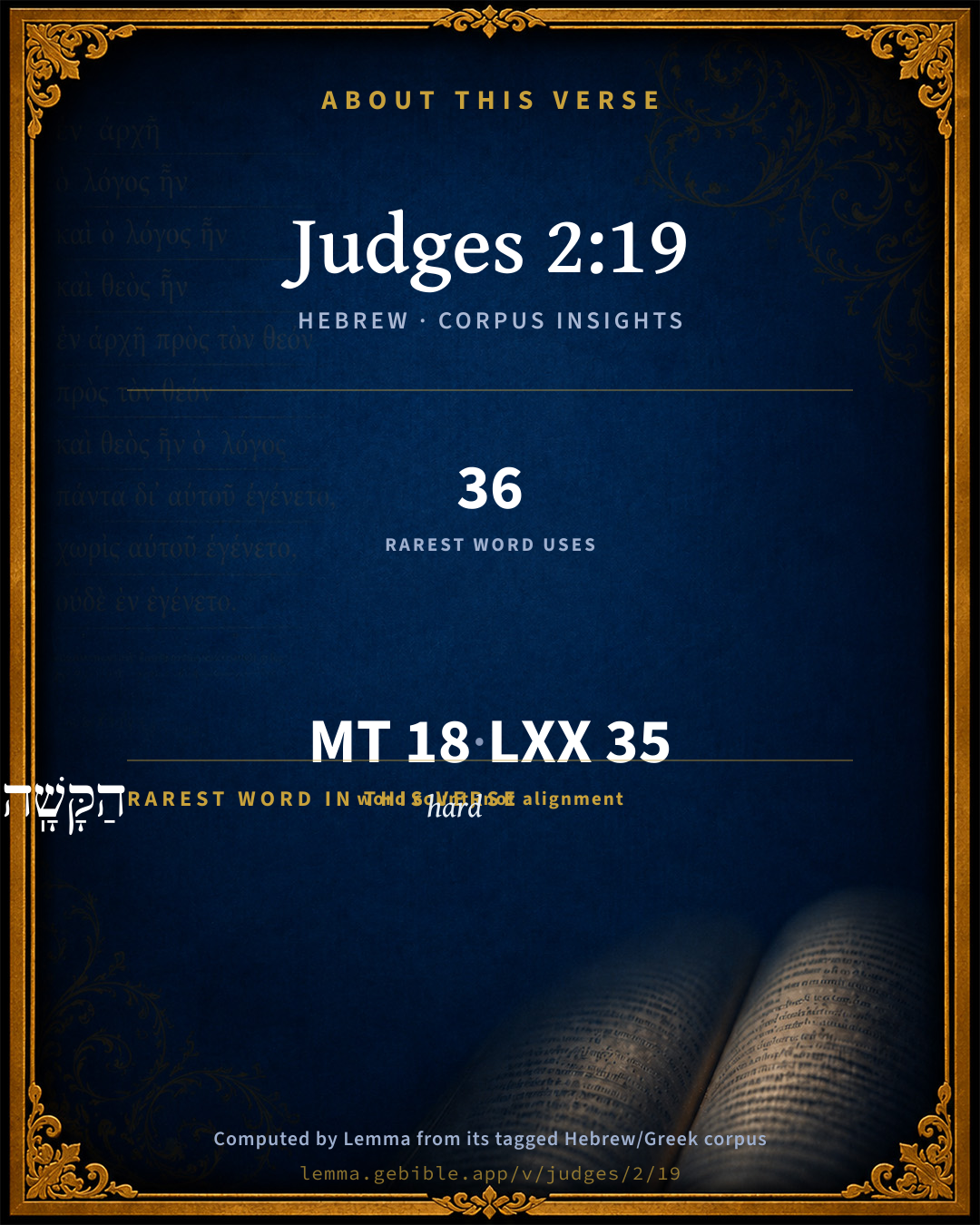
About this verse

These counts appear in no published source. They are computed here, from the morphology-tagged text and Lemma’s own curated glosses. What Lemma adds →

18
words
17
distinct lemmas
Historical
section

Shared distinctive vocabulary

הַקָּשָֽׁה hard H7186 occurs in 36 verses of the Hebrew Bible. Also found in:

Grammatical profile

  • 8 verbs
  • 5 nouns
  • 2 adjectives
  • 2 prepositions
  • 1 particle

Verb forms

  • וְהָיָ֣ה Qal · Sequential Perfect
  • הַשּׁוֹפֵ֗ט Qal · Participle Active
  • יָשֻׁ֨בוּ֙ Qal · Imperfect
  • וְהִשְׁחִ֣יתוּ Hiphil · Sequential Perfect
  • לָלֶ֗כֶת Qal · Infinitive Construct
  • לְעָבְדָ֖ם Qal · Infinitive Construct
  • וּלְהִשְׁתַּחֲוֺ֣ת Hishtaphel · Infinitive Construct
  • הִפִּ֨ילוּ֙ Hiphil · Perfect

Hebrew & Septuagint length

In English translation the verse runs 43 words from the Hebrew and 42 from the Septuagint (LXX English) — closely comparable.

A rough comparison of the two English renderings, which tokenize alike — not a word-level alignment.

Word counts can differ between the Hebrew and the Greek without any difference in meaning — e.g. the Hebrew direct-object marker אֵת has no separate Greek word, and Greek often adds the article ὁ.

In the original languages it is 18 Hebrew tokens and 35 Greek tokens — but the two are counted differently (Hebrew bundles its prefixes and suffixes into one token; the Greek is in lemma form), so that isn’t a like-for-like length.

Cross-references

12

Topical passages linked to Judges 2:19 in the Treasury of Scripture Knowledge — connected by theme and wording, ordered by reader-vote popularity; previews shown in the World English Bible.

  • Judges 8:33 It happened, as soon as Gideon was dead, that the children of Israel turned again, and played the prostitute after the Baals, and made Baal Berith their god.
  • Judges 4:1 The children of Israel again did that which was evil in the sight of Yahweh, when Ehud was dead.
  • Judges 3:11–12 The land had rest forty years. Othniel the son of Kenaz died.
  • 2 Chronicles 24:17–18 Now after the death of Jehoiada came the princes of Judah, and made obeisance to the king. Then the king listened to them.
  • Matthew 23:32 Fill up, then, the measure of your fathers.
  • Jeremiah 23:17 They say continually to those who despise me, Yahweh has said, You shall have peace; and to everyone who walks in the stubbornness of his own heart they say, No evil shall come on you.
  • Joshua 24:31 Israel served Yahweh all the days of Joshua, and all the days of the elders who outlived Joshua, and had known all the work of Yahweh, that he had worked for Israel.
  • Judges 2:7 The people served Yahweh all the days of Joshua, and all the days of the elders who outlived Joshua, who had seen all the great work of Yahweh that he had worked for Israel.
  • 1 Samuel 15:23 For rebellion is as the sin of witchcraft, and stubbornness is as idolatry and teraphim. Because you have rejected the word of Yahweh, he has also rejected you from being king.
  • Psalms 78:8 And might not be as their fathers, A stubborn and rebellious generation, A generation that didn't make their hearts loyal, Whose spirit was not steadfast with God.
  • Jeremiah 3:17 At that time they shall call Jerusalem the throne of Yahweh; and all the nations shall be gathered to it, to the name of Yahweh, to Jerusalem: neither shall they walk any more after the stubbornness of their evil heart.
  • Jeremiah 16:12 and you have done evil more than your fathers; for, behold, you walk every one after the stubbornness of his evil heart, so that you don't listen to me:

Cross-references courtesy of OpenBible.info (CC BY 4.0).

Hebrew and Greek witnesses Masoretic Hebrew ↔ Greek Septuagint

The same verse in the two great witnesses to the Old Testament, shown verse-for-verse.

These are two independent witnesses, not word-aligned to each other, and the Septuagint is shown in lemma (dictionary) form.

Hebrew Judges 2:19 Masoretic · Westminster Leningrad Codex

וְהָיָ֣ה בְּמ֣וֹת הַשּׁוֹפֵ֗ט יָשֻׁ֨בוּ֙ וְהִשְׁחִ֣יתוּ מֵֽאֲבוֹתָ֔ם לָלֶ֗כֶת אַֽחֲרֵי֙ אֱלֹהִ֣ים אֲחֵרִ֔ים לְעָבְדָ֖ם וּלְהִשְׁתַּחֲוֺ֣ת לָהֶ֑ם לֹ֤א הִפִּ֨ילוּ֙ מִמַּ֣עַלְלֵיהֶ֔ם וּמִדַּרְכָּ֖ם הַקָּשָֽׁה

But it happened, when the judge was dead, that they turned back, and dealt more corruptly than their fathers, in following other gods to serve them, and to bow down to them; they didn't cease from their doings, nor from their stubborn way.

World English Bible · Public Domain

Greek LXX Judges 2:19 Septuagint · lemma form

καί γίγνομαι ὡς ἀποθνήσκω ὁ κριτής καί ἀποστρέφω καί πάλιν διαφθείρω ὑπέρ ὁ πατήρ αὐτός πορεύομαι ὀπίσω θεός ἕτερος λατρεύω αὐτός καί προςκυνέω αὐτός οὐ ἀποῥίπτω ὁ ἐπιτήδευμα αὐτός καί ὁ ὁδός αὐτός ὁ σκληρός

And it came to pass when the judge died, that they went back, and again corrupted themselves worse than their fathers to go after other gods to serve them and to worship them: they abandoned not their devices nor their stubborn ways.

LXX2012 (modern English Septuagint) · Public Domain

On this verse, Haydock's Catholic Bible Commentary discusses the Septuagint’s reading. Read the note in Commentary ↓

Hebrew: Westminster Leningrad Codex (CC BY 4.0). Greek: Septuagint (public domain); English from LXX2012 (modern English Septuagint) (Public Domain). How the Septuagint differs from the Hebrew →

Targum (Aramaic paraphrase)

1

The Targum is the ancient Jewish Aramaic paraphrase of the Hebrew Scriptures — an interpretive translation, not the Hebrew text itself. Onkelos (literal) and Pseudo-Jonathan (expansive) render the Torah, and Jonathan the Prophets. Coverage is partial: where no permissively-licensed English translation exists for a verse, only the Aramaic is shown. This is verse-level text, not a word-by-word alignment to the Hebrew.

  1. Targum Jonathan Prophets (Joshua–Malachi)
    וַהֲוָה כַּד מָאִית נְגִידָא תַּיְבִין וּמְחַבְּלִין מֵאֲבָהַתְהוֹן לִמְהַךְ בָּתַר טַעֲוַת עַמְמַיָא לְמִפְלַחְהֶן וּלְמִסְגַד לָהֶן לָא שַׁבְקִין מֵעוֹבְדֵיהוֹן בִּישַׁיָא וּמֵאוֹרְחַתְהוֹן מְקַלְקְלָתָא:

    (no public-domain English translation for this verse)

    Targum Jonathan — Aramaic: “Mikraot Gedolot” (public domain). English: “Sefaria Community Translation” (CC0 1.0 (public-domain dedication)); “London "Chaldee Paraphrase," 1871” (public domain). Text via Sefaria.

Commentary

Notes on Judges 2:19 from classic Christian and Jewish commentators (each source and its license shown beneath its notes). The classic Christian expositions comment on the surrounding passage and are grouped to its opening verse, so a note may address several verses; the Jewish commentaries on the Tanakh (Rashi and others) are per-verse, so they appear only where the commentator wrote on this verse.

Lemma curates 59 commentaries, every one of them public domain or Creative Commons licensed, each selected and text-cleaned for this edition rather than reprinted as found. About our sources →

Trapp's Complete Commentary

John Trapp

Jdg 2:19 And it came to pass, when the judge was dead, [that] they returned, and corrupted [themselves] more than their fathers, in following other gods to serve them, and to bow down unto them; they ceased not from their own doings, nor from their stubborn way.

Ver. 19. More than their fathers.] See on Jdg 2:10, and observe the danger of relapse in religion. See Mat 12:43.

Nor from their stubborn way.] Heb., Hard, rough way; such are all the ways of wickedness: whereas God’s ways are plain and pleasant. {Pro 3:17; Pro 3:23} Christ’s yoke is easy, and his burden light. {Mat 11:29}

John Trapp, A Commentary or Exposition upon All the Books of the Old and New Testament (1647–1656) — public domain. Text from a community e-Sword module.

Geneva Bible (1599)

Geneva Bible translators

Hebrew, corrupt themselves.

Geneva Bible (1599) marginal notes — public domain. Text via Bolls.life.

Adam Clarke's Commentary

Verse 19. When the judge was dead] It appears that in general the office of the judge was for life.

Their stubborn way.] Their hard or difficult way. Most sinners go through great tribulation, in order to get to eternal perdition; they would have had less pain in their way to heaven.

Adam Clarke's Commentary on the Bible (1810–1826) — public domain. Text from a community e-Sword/MySword module.

Ellicott's Commentary for English Readers

(19) They ceased not from their own doings.—Literally, as in the margin, “they let nothing fall of their deeds.”

Stubborn.—They are called “stiff-necked” in Exo_32:9; Deu_10:16; Act_7:51. The prophets and sacred writers are always careful to impress upon the Jews that they are chosen by God’s free grace to work out His purpose, and that their selection for this service was in no sense due to any merits of their own (Isa_65:2; Psa_81:11-12; Mat_23:37; Act_7:51). It is to be noted that in the Bible there is none of the extravagant national self-satisfaction which defaces so much of the Talmud.

A Bible Commentary for English Readers, edited by Charles John Ellicott (1878–1897) — public domain. Text from a community e-Sword module.

The Cambridge Bible for Schools and Colleges

gen. ed. J. J. S. Perowne

19. when the judge was dead … they turned back] e.g. Jdg_4:1, Jdg_8:33; the whole period is a continual repetition of apostasy, subjugation, the cry for help, the deliverance—such is the Dtc. editor’s reading of the history; see note at the beginning of this section. As in Jdg_2:18, the tenses denote repeated acts; it used to come to pass, they used to turn back and deal corruptly.

than their fathers] i.e. their predecessors in the age of the Judges, not the godly fathers of Jdg_2:10; Jdg_2:17; Jdg_2:22.

they ceased not from their doings] Joshua could say before he died that not one of Jehovah’s good promises had failed of fulfilment (Jos_23:14 D); the compiler bitterly remarks that Jehovah’s ungrateful people had let no kind of iniquity fail of performance. The same phraseology (‘bad doings,’ ‘way’) is used by Jer_4:18; Jer_7:3; Jer_7:5; Jer_18:11.

The Cambridge Bible for Schools and Colleges (gen. ed. J. J. S. Perowne; Cambridge University Press, 1878–1918) — public domain. Text from a community e-Sword module.

John Gill's Exposition

And it came to pass, when the judge was dead,.... Any one of them, the first and so all succeeding ones:

that they returned; to their evil ways and idolatrous practices, from which they reformed, and for which they showed outward repentance during the life of the judge; but he dying, they returned again to them:

and corrupted themselves more than their fathers; in Egypt and in the wilderness; or rather than their fathers that lived in the generation after the death of Joshua; and so in every generation that lived before a judge was raised up to deliver them out of the evils brought upon them; the children of those in every age successively grew worse than their fathers:

in following other gods to serve them, and to bow down unto them; not content with the idols their fathers served, they sought after and found out others, and were more constant and frequent in their worship and service of them, and increased their sacrifices and acts of devotion to them:

they ceased not from their own doings; or, "did not let them fall" (b); but retained them, and continued in the practice of them, being what they were naturally inclined unto and delighted in:

nor from their stubborn way; which they were bent upon, and determined to continue in: or "their hard way" (c); which their hard hearts had chosen, and they obstinately persisted in, being obdurate and stiffnecked; and which, in the issue, they would find hard, troublesome, and distressing to them, though at present soft and agreeable, and in which they went on smoothly; but in time would find it rough and rugged, offensive, stumbling, and ruinous; or it may signify a hard beaten path, a broad road which multitudes trod in, as is the way of sin.

(b) "non Cadere faciebant", Pagninus, Montanus, Vatablus, Drusius. (c) "de via sua dura", Pagninus, Montanus, Tigurine version, Drusius.

John Gill's Exposition of the Whole Bible (1746–1763) — public domain (CC PDM 1.0). Text via the HelloAO Bible API.

Haydock's Catholic Bible Commentary

And did. Hebrew, "and corrupted themselves." Septuagint, "were more depraved than," &c. --- By which, &c., is put instead of the Hebrew, "their stubborn (or hard) (Haydock) Chaldean, ’corrupt’ way." This hard and rough path denotes the labours which the wicked have to encounter, in the pursuit of pleasure, as they themselves confess. We wearied ourselves in the way of iniquity....and have walked through hard ways, Wisdom v. 7. (Calmet) --- Though the life of the libertine seem delightful, it draws on the most serious evils and provokes the anger of God. (Menochius)

George Leo Haydock (1774–1849), Haydock's Catholic Family Bible and Commentary, 1859 edition — public domain. Excludes Psalms (Douay-Rheims chapter numbering differs from Protestant) and Deuterocanonical books (Catholic canon only).

Matthew Poole's English Annotations

They returned to their former, and usual, and natural, though interrupted course.

More than their fathers, in Egypt or in the wilderness.

From their own doings, i.e. from their evil practices, which he calls their own partly because they were agreeable to their own natures, which in all mankind are deeply and universally corrupted, Gen 6:5; 8:21; and partly because they were familiar and customary to them. Compare Isa 58:13; 66:3; Eze 36:32; Act 14:16; Jdg 1:16.

Their stubborn way, Heb. hard way; so he calls their way of wickedness, either because it proceeded from a hard heart, and was managed with a hard and stiff neck; or to signify, that although it seemed at first very soft, and easy, and pleasant, yet they would certainly, and did constantly, find that it was hard, and difficult, and troublesome to them, as a hard way is to the traveller.

Matthew Poole's English Annotations on the Holy Bible (1683–1685) — public domain. Text from a community e-Sword/MySword module.

Whedon's Commentary on the Bible

Daniel D. Whedon

19. When the judge was dead — A God-fearing ruler can, by his example and authority, arrest the moral degeneracy of a nation. The removal of such a ruler, whether by death or otherwise, is often the disastrous turning-point in a nation’s history.

More than their fathers — A disobedient and corrupt nation, when the fear of God has been completely thrown off, gravitates towards ruin with an ever-accelerating velocity.

Daniel D. Whedon (gen. ed.), Commentary on the Old and New Testaments (1874–1909) — public domain. Text from a community e-Sword module.

John Wesley's Explanatory Notes

Returned - To their former, and usual course. Their fathers - In Egypt, or in the wilderness. Their own doings - That is, from their evil practices, which he calls their own, because they were agreeable to their own natures, which in all mankind are deeply and universally corrupted, and because they were familiar and customary to them.

John Wesley, Explanatory Notes Upon the Whole Bible (1754–1765) — public domain. Text via the GEBible commentary corpus.

Rashi

Rabbi Shlomo Yitzchaki (Rashi)

They fell nothing short. They omitted nothing deserving of the reproach inherent in everything that befell them.

Rashi on the Tanakh — English translations: “The Judaica Press complete Tanach with Rashi, translated by A. J. Rosenberg” (CC BY 4.0); “Pentateuch with Rashi's commentary by M. Rosenbaum and A.M. Silbermann, 1929-1934” (public domain); “The Metsudah Tanach series, Lakewood, N.J” (CC BY 4.0); and “The Book of Joshua, Metsudah Publications, 1997” (CC BY 4.0). Text via Sefaria.

Lesson kit

Teaching starters — assembled from the data on this page, not authored interpretation. Every prompt links to the verse data it draws on. Edit before teaching.

Judges, in the Historical, opens this verse with 18 words (17 distinct Hebrew lemmas). Its most distinctive word is qâsheh (“hard”). A historical commentator’s framing appears above. Read the whole chapter for the surrounding context.

Discussion questions

  1. How does “hard” (qâsheh) shape what this verse is saying?
  2. Genesis 42:7 shares the word «hard» with this verse. How do the two illuminate each other?
  3. The translations on this page render this verse differently — a whole-verse word diff, not a word-by-word alignment. What might account for the different wordings?
  4. The verb «וְהָיָ֣ה» is Qal Sequential Perfect. How does its form color the action?
  5. Reading how Trapp's Complete Commentary and Geneva Bible (1599) read this verse, where do the two commentators agree and where do they part?

Things to notice

Reading settings

Reading text

Shown beneath each verse's original-language words.

Old Testament
Old Testament edition

Read the OT as the Masoretic Hebrew (MT) or the Greek Septuagint (LXX).

English shown for the Greek Septuagint (in the Hebrew ↔ Greek comparison).

Comparing translations? Open the Compare panel on any verse page to stack up to four side by side.