2 Samuel 11:17

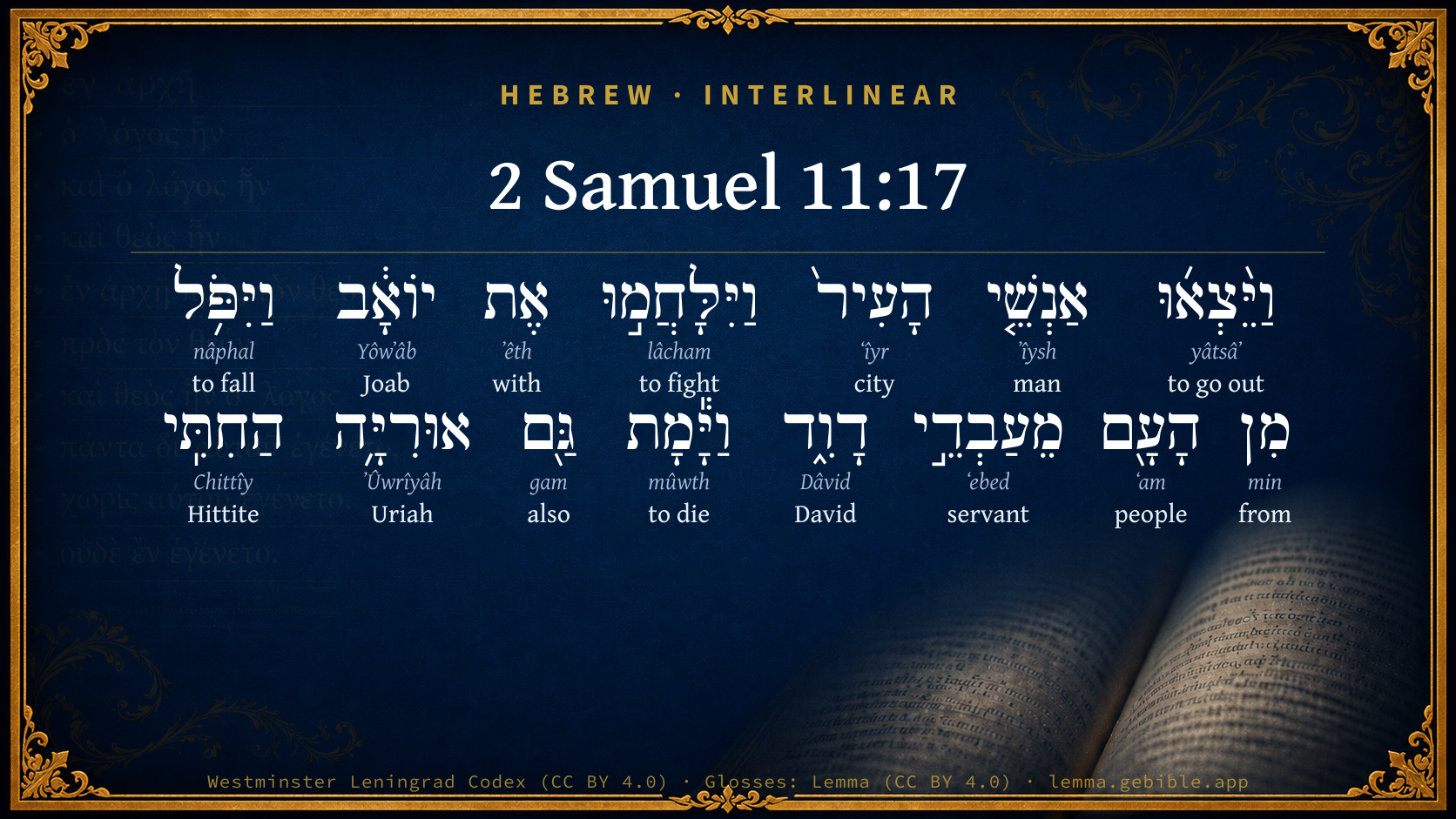
Hebrew (Westminster Leningrad Codex) 2 Samuel 11:17 appears in the Hebrew Old Testament. The text above is from the Westminster Leningrad Codex. Each word links to its Strong’s number, a concise gloss, and parsing drawn from the Open Scriptures Hebrew Bible morphology. Click any word for its full Brown-Driver-Briggs (BDB) entry.
Download image
Cite this verse

2 Samuel 11:17 (World English Bible). Public Domain. Lemma interlinear Bible study tool, https://lemma.gebible.app/v/2-samuel/11/17.

Show BibTeX & RIS
BibTeX
RIS
English Translation
The men of the city went out, and fought with Joab: and there fell some of the people, even of the servants of David; and Uriah the Hittite died also.
World English Bible · Public Domain
Download a study sheet

One document with this verse’s original text, its word-by-word gloss line, the meaning frame, cross-references with their text, attributed commentary, and full source and license credits — printable, and it pastes into notes with its structure intact.

This verse Autodidact and up

Study sheet (.html) Plain text (.txt)

A passage Seminary Student

Up to 50 verses in one chapter. A passage sheet keeps up to 6 commentary sources and 12 cross-references per verse, in the order this page ranks them, and says so on the sheet whenever that leaves anything out. Ask for a single verse and you get the Autodidact verse sheet above.

Everything on this page stays free to read, with no account — the sheet is a download of what is already on screen, not access to it.

Want to remove ads? Support Godless Engineer
Compare translations 3

The same verse in 3 English versions, stacked beneath the original-language interlinear above. Click any original word for its lexicon entry.

Each is an independent rendering of the whole verse — the interlinear is not word-aligned to these translations.

Highlighted words mark where these versions differ — a whole-verse word diff, not a word-by-word alignment.

  • World English Bible Public Domain
    The men of the city went out, and fought with Joab: and there fell some of the people, even of the servants of David; and Uriah the Hittite died also.
  • King James Version Public Domain
    And the men of the city went out, and fought with Joab: and there fell some of the people of the servants of David; and Uriah the Hittite died also.
  • unfoldingWord Literal Text CC BY-SA 4.0
    And the men of the city came out, and they fought with Joab, and some of the people from the servants of David fell. And Uriah the Hittite also died.

unfoldingWord Literal Text — © unfoldingWord, licensed CC BY-SA 4.0. Word-aligned USFM3 via Door43 (git.door43.org/unfoldingWord/en_ult).

Versions to compare (up to 4)

3 of 4 selected

Show all 18 translations

Every available English version of this verse, each an independent rendering of the whole verse.

  • World English Bible Public Domain
    The men of the city went out, and fought with Joab: and there fell some of the people, even of the servants of David; and Uriah the Hittite died also.
  • Berean Standard Bible Public Domain
    And when the men of the city came out and fought against Joab, some of David’s servants fell, and Uriah the Hittite also died.
  • Majority Standard Bible Public Domain
    And when the men of the city came out and fought against Joab, some of David’s servants fell, and Uriah the Hittite also died.
  • King James Version Public Domain
    And the men of the city went out, and fought with Joab: and there fell some of the people of the servants of David; and Uriah the Hittite died also.
  • American Standard Version (1901) Public Domain
    And the men of the city went out, and fought with Joab: and there fell some of the people, even of the servants of David; and Uriah the Hittite died also.
  • Revised Version (1885) Public Domain
    And the men of the city went out, and fought with Joab: and there fell some of the people, even of the servants of David; and Uriah the Hittite died also.
  • Geneva Bible (1599) Public Domain
    And the men of the citie came out, and fought with Ioab: and there fell of the people of the seruants of Dauid, and Vriah the Hittite also dyed.
  • Douay-Rheims (1899) Public Domain
    And the men coming out of the city, fought against Joab, and there fell some of the people of the servants of David, and Urias the Hethite was killed also.
  • Young's Literal Translation Public Domain
    and the men of the city go out and fight with Joab, and there fall `some' of the people, of the servants of David; and there dieth also Uriah the Hittite.
  • Literal Standard Version CC BY-SA 4.0
    and the men of the city go out and fight with Joab, and [some] of the people, from the servants of David, fall; and Uriah the Hittite also dies.
  • Unlocked Literal Bible CC BY-SA 4.0
    When the men of the city went out and fought against Joab's army, some of the soldiers of David fell, and Uriah the Hittite was also killed there.
  • unfoldingWord Literal Text CC BY-SA 4.0
    And the men of the city came out, and they fought with Joab, and some of the people from the servants of David fell. And Uriah the Hittite also died.
  • Darby Bible Public Domain
    And the men of the city went out and fought with Joab; and there fell some of the people, of the servants of David; and Urijah the Hittite died also.
  • World Messianic Bible Public Domain
    The men of the city went out and fought with Joab. Some of the people fell, even of David’s servants; and Uriah the Hittite died also.
  • Webster's Bible Public Domain
    And the men of the city went out, and fought with Joab: and there fell some of the people of the servants of David; and Uriah the Hittite died also.
  • Free Bible Version CC BY-SA 4.0
    When the town's defenders came out and attacked Joab, some of David's men were killed, including Uriah the Hittite.
  • Bible in Basic English Public Domain
    And the men of the town went out and had a fight with Joab: and a number of David's men came to their death in the fight, and with them Uriah the Hittite.
  • JPS Tanakh (1917) Public Domain
    And the men of the city went out, and fought with Joab; and there fell some of the people, even of the servants of David; and Uriah the Hittite died also.

Literal Standard Version (2020), Covenant Press — licensed CC BY-SA 4.0. Text via the HelloAO Bible API (eBible.org). Unlocked Literal Bible (unfoldingWord) — licensed CC BY-SA 4.0. Text via the HelloAO Bible API (eBible.org). unfoldingWord Literal Text — © unfoldingWord, licensed CC BY-SA 4.0. Word-aligned USFM3 via Door43 (git.door43.org/unfoldingWord/en_ult). Free Bible Version, Dr. Jonathan Gallagher — licensed CC BY-SA 4.0. Text via the HelloAO Bible API (eBible.org).

Word by word

More ways to search: Search by grammar → Find every occurrence → Compare this word →

Practice this passage: Drill this verse → Learn its vocabulary →

אוּרִיָּ֥ה
ʼÛwrîyâh
H223
“Uriah”
Noun, Proper
Part of Speech
Noun
Type
Proper
Full BDB Definition

Origin: from H217 and H3050

TWOT: None

Uriah or Urijah = "Jehovah (Yahweh) is my light (flame)" - Hittite husband of Bathsheba - a priest who built king Ahaz' heathen altar - a priest who rebuilt Jerusalem's wall - a prophet slain by Jehoiakim
  1. וַיֵּ֨צְא֜וּ yâtsâʼ H3318 “and · to go out” Conjunction + Verb, Qal, Sequential Imperfect, 3rd Person, Masculine, Plural
  2. אַנְשֵׁ֤י ʼîysh H376 “men of” Noun, Common, Masculine, Plural, Construct
  3. הָעִיר֙ ʻîyr H5892 “the · city” Particle, Definite Article + Noun, Common, Feminine, Singular, Absolute
  4. וַיִּלָּחֲמ֣וּ lâcham H3898 “and · to fight” Conjunction + Verb, Niphal, Sequential Imperfect, 3rd Person, Masculine, Plural
  5. אֶת ʼêth H854 “with” Preposition
  6. יוֹאָ֔ב Yôwʼâb H3097 “Joab” Noun, Proper
  7. וַיִּפֹּ֥ל nâphal H5307 “and · to fall” Conjunction + Verb, Qal, Sequential Imperfect, 3rd Person, Masculine, Singular
  8. מִן min H4480 “from” Preposition
  9. הָעָ֖ם ʻam H5971 “the · people” Particle, Definite Article + Noun, Common, Masculine, Singular, Absolute
  10. מֵעַבְדֵ֣י ʻebed H5650 “from · servants of” Preposition + Noun, Common, Masculine, Plural, Construct
  11. דָוִ֑ד Dâvid H1732 “David” Noun, Proper
  12. וַיָּ֕מָת mûwth H4191 “and · to die” Conjunction + Verb, Qal, Sequential Imperfect, 3rd Person, Masculine, Singular
  13. גַּ֖ם gam H1571 “also” Particle, Accusative
  14. הַחִתִּֽי Chittîy H2850 “the · Hittite” Particle, Definite Article + Noun, Gentilic, Masculine, Singular, Absolute

About this verse

These counts appear in no published source. They are computed here, from the morphology-tagged text and Lemma’s own curated glosses. What Lemma adds →

15
words
15
distinct lemmas
Historical
section

Shared distinctive vocabulary

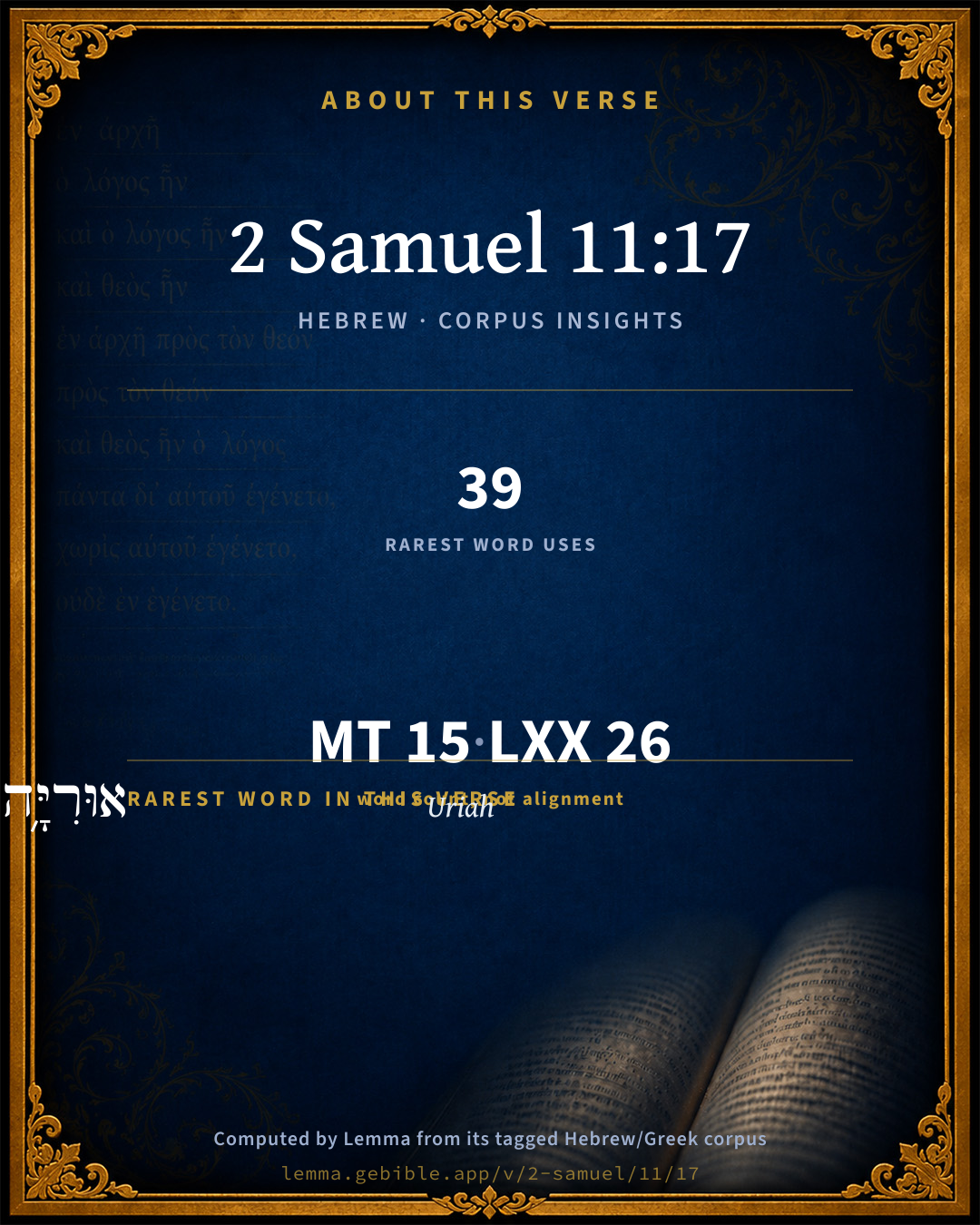
אוּרִיָּ֥ה Uriah H223 occurs in 33 verses of the Hebrew Bible. Also found in:

Grammatical profile

  • 4 verbs
  • 8 nouns
  • 2 prepositions
  • 1 particle

Verb forms

  • וַיֵּ֨צְא֜וּ Qal · Sequential Imperfect
  • וַיִּלָּחֲמ֣וּ Niphal · Sequential Imperfect
  • וַיִּפֹּ֥ל Qal · Sequential Imperfect
  • וַיָּ֕מָת Qal · Sequential Imperfect

Hebrew & Septuagint length

In English translation the verse runs 30 words from the Hebrew and 29 from the Septuagint (LXX English) — closely comparable.

A rough comparison of the two English renderings, which tokenize alike — not a word-level alignment.

Word counts can differ between the Hebrew and the Greek without any difference in meaning — e.g. the Hebrew direct-object marker אֵת has no separate Greek word, and Greek often adds the article ὁ.

In the original languages it is 15 Hebrew tokens and 26 Greek tokens — but the two are counted differently (Hebrew bundles its prefixes and suffixes into one token; the Greek is in lemma form), so that isn’t a like-for-like length.

Cross-references

2

Topical passages linked to 2 Samuel 11:17 in the Treasury of Scripture Knowledge — connected by theme and wording, ordered by reader-vote popularity; previews shown in the World English Bible.

  • 2 Samuel 12:9 Why have you despised the word of Yahweh, to do that which is evil in his sight? You have struck Uriah the Hittite with the sword, and have taken his wife to be your wife, and have slain him with the sword of the children of Ammon.
  • Psalms 51:14 Deliver me from bloodguiltiness, O God, the God of my salvation. My tongue shall sing aloud of your righteousness.

Cross-references courtesy of OpenBible.info (CC BY 4.0).

Hebrew and Greek witnesses Masoretic Hebrew ↔ Greek Septuagint

The same verse in the two great witnesses to the Old Testament, shown verse-for-verse.

These are two independent witnesses, not word-aligned to each other, and the Septuagint is shown in lemma (dictionary) form.

Hebrew 2 Samuel 11:17 Masoretic · Westminster Leningrad Codex

וַיֵּ֨צְא֜וּ אַנְשֵׁ֤י הָעִיר֙ וַיִּלָּחֲמ֣וּ אֶת יוֹאָ֔ב וַיִּפֹּ֥ל מִן הָעָ֖ם מֵעַבְדֵ֣י דָוִ֑ד וַיָּ֕מָת גַּ֖ם אוּרִיָּ֥ה הַחִתִּֽי

The men of the city went out, and fought with Joab: and there fell some of the people, even of the servants of David; and Uriah the Hittite died also.

World English Bible · Public Domain

Greek LXX 2 Samuel 11:17 Septuagint · lemma form

καί ἐκἔρχομαι ὁ ἀνήρ ὁ πόλις καί πολεμέω μετά ιωαβ καί πίπτω ἐκ ὁ λαός ἐκ ὁ δοῦλος δαυίδ καί ἀποθνήσκω καί γέ ουριας ὁ χετταῖος

And the men of the city went out, and fought with Joab: and some of the people of the servants of David fell, and Urias the Chettite died also.

LXX2012 (modern English Septuagint) · Public Domain

Hebrew: Westminster Leningrad Codex (CC BY 4.0). Greek: Septuagint (public domain); English from LXX2012 (modern English Septuagint) (Public Domain). How the Septuagint differs from the Hebrew →

Targum (Aramaic paraphrase)

1

The Targum is the ancient Jewish Aramaic paraphrase of the Hebrew Scriptures — an interpretive translation, not the Hebrew text itself. Onkelos (literal) and Pseudo-Jonathan (expansive) render the Torah, and Jonathan the Prophets. Coverage is partial: where no permissively-licensed English translation exists for a verse, only the Aramaic is shown. This is verse-level text, not a word-by-word alignment to the Hebrew.

  1. Targum Jonathan Prophets (Joshua–Malachi)
    וּנְפַקוּ אֱנָשֵׁי קַרְתָּא וְאַגִיחוּ קְרָבָא עִם יוֹאָב וְאִתְקְטֵיל מֵעַמָא מֵעַבְדֵי דָוִד וּמִית אַף אוּרִיָה חִתָּאָה:

    (no public-domain English translation for this verse)

    Targum Jonathan — Aramaic: “Mikraot Gedolot” (public domain). English: “Sefaria Community Translation” (CC0 1.0 (public-domain dedication)); “London "Chaldee Paraphrase," 1871” (public domain). Text via Sefaria.

Commentary

Notes on 2 Samuel 11:17 from classic Christian and Jewish commentators (each source and its license shown beneath its notes). The classic Christian expositions comment on the surrounding passage and are grouped to its opening verse, so a note may address several verses; the Jewish commentaries on the Tanakh (Rashi and others) are per-verse, so they appear only where the commentator wrote on this verse.

Lemma curates 59 commentaries, every one of them public domain or Creative Commons licensed, each selected and text-cleaned for this edition rather than reprinted as found. About our sources →

Trapp's Complete Commentary

John Trapp

2Sa 11:17 And the men of the city went out, and fought with Joab: and there fell [some] of the people of the servants of David; and Uriah the Hittite died also.

Ver. 17. And Uriah the Hittite died also.] Unjustly in respect of David and Joab, who were ipso facto children of death; but justly in respect of God; for Uriah owed a death to him, and he might call for it how and when he pleased.

John Trapp, A Commentary or Exposition upon All the Books of the Old and New Testament (1647–1656) — public domain. Text from a community e-Sword module.

Adam Clarke's Commentary

Verse 17. Uriah the Hitite died also.] He was led to the attack of a place defended by valiant men; and in the heat of the assault, Joab and his men retired from this brave soldier, who cheerfully gave up his life for his king and his country.

Adam Clarke's Commentary on the Bible (1810–1826) — public domain. Text from a community e-Sword/MySword module.

The Cambridge Bible for Schools and Colleges

gen. ed. J. J. S. Perowne

17. went out] Made a sally, in which, as the messenger describes (2Sa_11:23-24), the men of Israel imprudently pursued the enemy till they were within shot of the archers on the wall, and suffered considerable loss.

The Cambridge Bible for Schools and Colleges (gen. ed. J. J. S. Perowne; Cambridge University Press, 1878–1918) — public domain. Text from a community e-Sword module.

John Gill's Exposition

And the men of the city went out,.... Made a sally out, as Joab expected they would, when they appeared before them at that part of the city where valiant men were:

and fought with Joab; at least with part of his army posted with Uriah:

and there fell some of the people of the servants of David: which made David's sin the more heinous, that several lives were lost through the stratagem he devised to procure the death of Uriah; who could not be placed in a dangerous post alone, and therefore others must be sacrificed with him, as were:

and Uriah the Hittite died also; which was the thing aimed at, and the end to be answered by this scheme.

John Gill's Exposition of the Whole Bible (1746–1763) — public domain (CC PDM 1.0). Text via the HelloAO Bible API.

Albert Barnes' Notes on the Bible

The men of the city went out - i. e. they made a sally and attacked the troops which were blockading the city on that side, chiefly to entice them to pursue them, and so come within shot of the archers who lined the wall 2Sa 11:20, 2Sa 11:24.

There fell some of the people ... - They, too, as well as the brave and faithful Uriah, were victims of David’s cruel artifice.

Albert Barnes' Notes on the Bible (1834–1885) — public domain. Text from a community e-Sword/MySword module.

Haydock's Catholic Bible Commentary

Also. Hence David prays with reason; Deliver me from blood (sanguinibus) of many slain. He was answerable for all (Cajetan)

George Leo Haydock (1774–1849), Haydock's Catholic Family Bible and Commentary, 1859 edition — public domain. Excludes Psalms (Douay-Rheims chapter numbering differs from Protestant) and Deuterocanonical books (Catholic canon only).

Whedon's Commentary on the Bible

Daniel D. Whedon

17. There fell some of the people of… David — More, probably, than was designed or desired, so that David’s army sustained considerable loss.

Daniel D. Whedon (gen. ed.), Commentary on the Old and New Testaments (1874–1909) — public domain. Text from a community e-Sword module.

Lesson kit

Teaching starters — assembled from the data on this page, not authored interpretation. Every prompt links to the verse data it draws on. Edit before teaching.

2 Samuel, in the Historical, opens this verse with 15 words (15 distinct Hebrew lemmas). Its most distinctive word is ʼÛwrîyâh (“Uriah”). A historical commentator’s framing appears above. Read the whole chapter for the surrounding context.

Discussion questions

  1. How does “Uriah” (ʼÛwrîyâh) shape what this verse is saying?
  2. How does 2 Samuel 11:3, which shares the word «Uriah», read alongside this verse?
  3. The translations on this page render this verse differently — a whole-verse word diff, not a word-by-word alignment. What might account for the different wordings?
  4. «וַיֵּ֨צְא֜וּ» is a Qal Sequential Imperfect verb. How does that grammatical form shape the action described?
  5. Compare how Trapp's Complete Commentary and Adam Clarke's Commentary read this verse. Where do they agree or differ?

Things to notice

Reading settings

Reading text

Shown beneath each verse's original-language words.

Old Testament
Old Testament edition

Read the OT as the Masoretic Hebrew (MT) or the Greek Septuagint (LXX).

English shown for the Greek Septuagint (in the Hebrew ↔ Greek comparison).

Comparing translations? Open the Compare panel on any verse page to stack up to four side by side.