
2 Kings 7:4

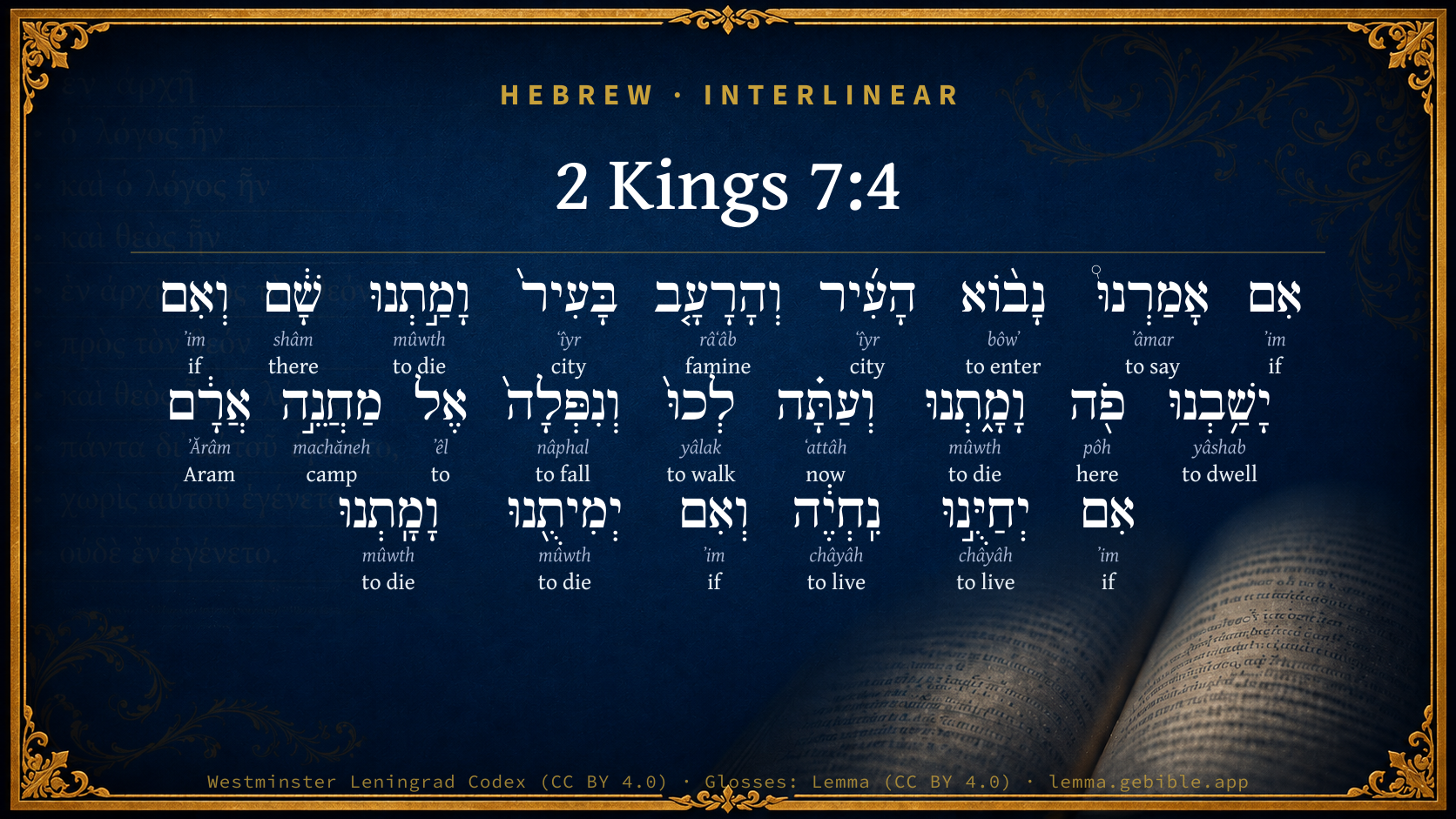
Hebrew (Westminster Leningrad Codex) 2 Kings 7:4 appears in the Hebrew Old Testament. The text above is from the Westminster Leningrad Codex. Each word links to its Strong’s number, a concise gloss, and parsing drawn from the Open Scriptures Hebrew Bible morphology. Click any word for its full Brown-Driver-Briggs (BDB) entry.
Download image
Cite this verse

2 Kings 7:4 (World English Bible). Public Domain. Lemma interlinear Bible study tool, https://lemma.gebible.app/v/2-kings/7/4.

Show BibTeX & RIS
BibTeX
RIS
English Translation
If we say, We will enter into the city, then the famine is in the city, and we shall die there; and if we sit still here, we die also. Now therefore come, and let us fall to the host of the Syrians: if they save us alive, we shall live; and if they kill us, we shall but die.
World English Bible · Public Domain
Download a study sheet

One document with this verse’s original text, its word-by-word gloss line, the meaning frame, cross-references with their text, attributed commentary, and full source and license credits — printable, and it pastes into notes with its structure intact.

This verse Autodidact and up

Study sheet (.html) Plain text (.txt)

A passage Seminary Student

Up to 50 verses in one chapter. A passage sheet keeps up to 6 commentary sources and 12 cross-references per verse, in the order this page ranks them, and says so on the sheet whenever that leaves anything out. Ask for a single verse and you get the Autodidact verse sheet above.

Everything on this page stays free to read, with no account — the sheet is a download of what is already on screen, not access to it.

Want to remove ads? Support Godless Engineer
Compare translations 3

The same verse in 3 English versions, stacked beneath the original-language interlinear above. Click any original word for its lexicon entry.

Each is an independent rendering of the whole verse — the interlinear is not word-aligned to these translations.

Highlighted words mark where these versions differ — a whole-verse word diff, not a word-by-word alignment.

  • World English Bible Public Domain
    If we say, We will enter into the city, then the famine is in the city, and we shall die there; and if we sit still here, we die also. Now therefore come, and let us fall to the host of the Syrians: if they save us alive, we shall live; and if they kill us, we shall but die.
  • King James Version Public Domain
    If we say, We will enter into the city, then the famine is in the city, and we shall die there: and if we sit still here, we die also. Now therefore come, and let us fall unto the host of the Syrians: if they save us alive, we shall live; and if they kill us, we shall but die.
  • unfoldingWord Literal Text CC BY-SA 4.0
    If we say, ‘We will enter the city,’ then famine in the city, and we will die there. But if we sit here, then we will die. And now, come, let us fall to the camp of Aram. If they let us live, we will live. And if they kill us, then we will die.”

unfoldingWord Literal Text — © unfoldingWord, licensed CC BY-SA 4.0. Word-aligned USFM3 via Door43 (git.door43.org/unfoldingWord/en_ult).

Versions to compare (up to 4)

3 of 4 selected

Show all 18 translations

Every available English version of this verse, each an independent rendering of the whole verse.

  • World English Bible Public Domain
    If we say, We will enter into the city, then the famine is in the city, and we shall die there; and if we sit still here, we die also. Now therefore come, and let us fall to the host of the Syrians: if they save us alive, we shall live; and if they kill us, we shall but die.
  • Berean Standard Bible Public Domain
    If we say, ‘Let us go into the city,’ we will die there from the famine in the city; but if we sit here, we will also die. So come now, let us go over to the camp of the Arameans. If they let us live, we will live; if they kill us, we will die.”
  • Majority Standard Bible Public Domain
    If we say, ‘Let us go into the city,’ we will die there from the famine in the city; but if we sit here, we will also die. So come now, let us go over to the camp of the Arameans. If they let us live, we will live; if they kill us, we will die.”
  • King James Version Public Domain
    If we say, We will enter into the city, then the famine is in the city, and we shall die there: and if we sit still here, we die also. Now therefore come, and let us fall unto the host of the Syrians: if they save us alive, we shall live; and if they kill us, we shall but die.
  • American Standard Version (1901) Public Domain
    If we say, We will enter into the city, then the famine is in the city, and we shall die there; and if we sit still here, we die also. Now therefore come, and let us fall unto the host of the Syrians: if they save us alive, we shall live; and if they kill us, we shall but die.
  • Revised Version (1885) Public Domain
    If we say, We will enter into the city, then the famine is in the city, and we shall die there: and if we sit still here, we die also. Now therefore come, and let us fall unto the host of the Syrians: if they save us alive, we shall live; and if they kill us, we shall but die.
  • Geneva Bible (1599) Public Domain
    If we say, We will enter into the citie, the famine is in the citie, and we shall die there: and if we sit here, we dye also. Nowe therefore come, and let vs fall into the campe of the Aramites: if they saue our liues, we shall liue: and if they kill vs, we are but dead.
  • Douay-Rheims (1899) Public Domain
    If we will enter into the city, we shall die with the famine: and if we will remain here, we must also die: come, therefore, and let us run over to the camp of the Syrians. If they spare us, we shall live: but if they kill us, we shall but die.
  • Young's Literal Translation Public Domain
    if we have said, We go in to the city, then the famine `is' in the city, and we have died there; and if we have sat here, then we have died; and now, come and we fall unto the camp of Aram; if they keep us alive, we live, and if they put us to death -- we have died.'
  • Literal Standard Version CC BY-SA 4.0
    If we have said, We go into the city, then the famine [is] in the city and we have died there; and if we have sat here, then we have died; and now, come and we go down to the camp of Aram; if they keep us alive, we live, and if they put us to death—we have died.”
  • Unlocked Literal Bible CC BY-SA 4.0
    If we say that we should go into the city, then the famine is in the city, and we will die there. But if we still sit here, we will still die. Now then, come, let us go to the army of the Arameans. If they keep us alive, we will live, and if they kill us, we will only die.”
  • unfoldingWord Literal Text CC BY-SA 4.0
    If we say, ‘We will enter the city,’ then famine in the city, and we will die there. But if we sit here, then we will die. And now, come, let us fall to the camp of Aram. If they let us live, we will live. And if they kill us, then we will die.”
  • Darby Bible Public Domain
    If we say, Let us enter into the city, the famine is in the city, and we shall die there; and if we abide here, we shall die. And now come, let us fall away to the camp of the Syrians: if they save us alive, we shall live; and if they put us to death, we shall but die.
  • World Messianic Bible Public Domain
    If we say, ‘We will enter into the city,’ then the famine is in the city, and we will die there. If we sit still here, we also die. Now therefore come, and let’s surrender to the army of the Syrians. If they save us alive, we will live; and if they kill us, we will only die.”
  • Webster's Bible Public Domain
    If we say, We will enter into the city, then the famine is in the city, and we shall die there: and if we sit still here, we die also. Now therefore come, and let us fall to the army of the Syrians: if they save us alive, we shall live; and if they kill us, we shall but die.
  • Free Bible Version CC BY-SA 4.0
    If we say, ‘Let's go into the city,’ we'll die because of the famine there; but if we go on sitting here, we'll die too. So come on, let's go to the camp of the Arameans and surrender to them. If they let us live, we'll live; if they kill us, we'll die.”
  • Bible in Basic English Public Domain
    If we say, We will go into the town, there is no food in the town, and we will come to our end there; and if we go on waiting here, death will come to us. Come then, let us give ourselves up to the army of Aram: if they let us go on living, then life will be ours; and if they put us to death, then death will be ours.
  • JPS Tanakh (1917) Public Domain
    If we say: We will enter into the city, then the famine is in the city, and we shall die there; and if we sit still here, we die also. Now therefore come, and let us fall unto the host of the Arameans; if they save us alive, we shall live; and if they kill us, we shall but die.'

Literal Standard Version (2020), Covenant Press — licensed CC BY-SA 4.0. Text via the HelloAO Bible API (eBible.org). Unlocked Literal Bible (unfoldingWord) — licensed CC BY-SA 4.0. Text via the HelloAO Bible API (eBible.org). unfoldingWord Literal Text — © unfoldingWord, licensed CC BY-SA 4.0. Word-aligned USFM3 via Door43 (git.door43.org/unfoldingWord/en_ult). Free Bible Version, Dr. Jonathan Gallagher — licensed CC BY-SA 4.0. Text via the HelloAO Bible API (eBible.org).

Word by word

More ways to search: Search by grammar → Find every occurrence → Compare this word →

Practice this passage: Drill this verse → Learn its vocabulary →

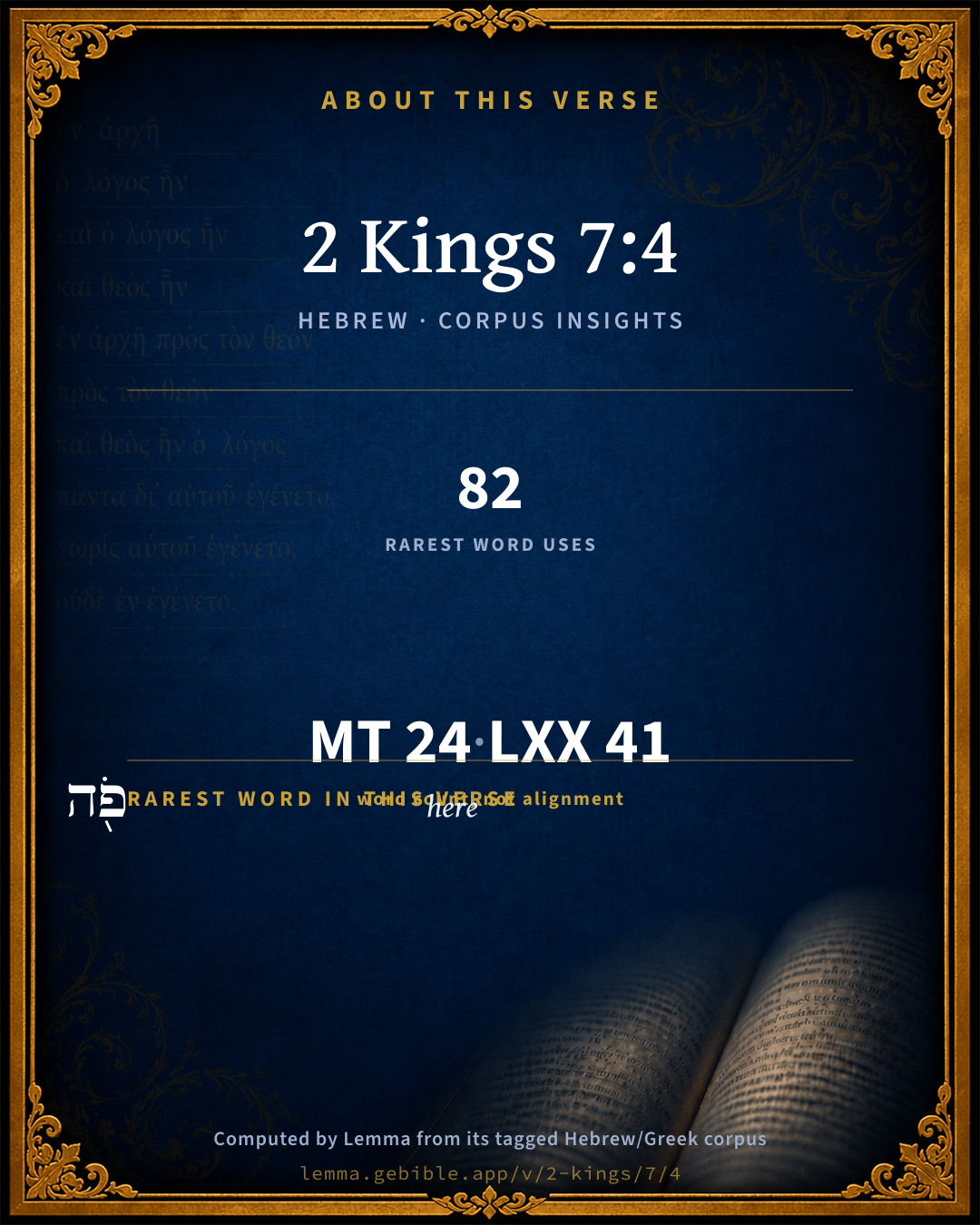
פֹ֖ה
pôh
H6311
“here”
Adverb
Part of Speech
Adverb
Full BDB Definition

Origin: probably from a primitive inseparable particle "p" (of demonstrative force) and H1931

TWOT: 1739

here, from here, hither - here - hither
  1. אִם ʼim H518 “if” Conjunction
  2. אָמַרְנוּ֩ ʼâmar H559 “to say” Verb, Qal, Perfect, 1st Person, Common, Plural
  3. נָב֨וֹא bôwʼ H935 “to enter” Verb, Qal, Imperfect, 1st Person, Common, Plural
  4. הָעִ֜יר ʻîyr H5892 “the · city” Particle, Definite Article + Noun, Common, Feminine, Singular, Absolute
  5. וְהָרָעָ֤ב râʻâb H7458 “and · the · famine” Conjunction + Particle, Definite Article + Noun, Common, Masculine, Singular, Absolute
  6. בָּעִיר֙ ʻîyr H5892 “in/at the · city” Preposition, Determined + Noun, Common, Feminine, Singular, Absolute
  7. וָמַ֣תְנוּ mûwth H4191 “and · to die” Conjunction + Verb, Qal, Sequential Perfect, 1st Person, Common, Plural
  8. שָׁ֔ם shâm H8033 “there” Adverb
  9. וְאִם ʼim H518 “and · if” Conjunction + Conjunction
  10. יָשַׁ֥בְנוּ yâshab H3427 “to dwell” Verb, Qal, Perfect, 1st Person, Common, Plural
  11. וָמָ֑תְנוּ mûwth H4191 “and · to die” Conjunction + Verb, Qal, Sequential Perfect, 1st Person, Common, Plural
  12. וְעַתָּ֗ה ʻattâh H6258 “and · now” Conjunction + Adverb
  13. לְכוּ֙ yâlak H3212 “walk” Verb, Qal, Imperative, 2nd Person, Masculine, Plural
  14. וְנִפְּלָה֙ nâphal H5307 “and · to fall” Conjunction + Verb, Qal, Cohortative, 1st Person, Common, Plural
  15. אֶל ʼêl H413 “to” Preposition
  16. מַחֲנֵ֣ה machăneh H4264 “camp of” Noun, Common, Both, Singular, Construct
  17. אֲרָ֔ם ʼĂrâm H758 “Aram” Noun, Proper
  18. אִם ʼim H518 “if” Conjunction
  19. יְחַיֻּ֣נוּ châyâh H2421 “to live · us” Verb, Piel, Imperfect, 3rd Person, Masculine, Plural + Suffix, Personal, 1st Person, Common, Plural
  20. נִֽחְיֶ֔ה châyâh H2421 “to live” Verb, Qal, Imperfect, 1st Person, Common, Plural
  21. וְאִם ʼim H518 “and · if” Conjunction + Conjunction
  22. יְמִיתֻ֖נוּ mûwth H4191 “to die · us” Verb, Hiphil, Imperfect, 3rd Person, Masculine, Plural + Suffix, Personal, 1st Person, Common, Plural
  23. וָמָֽתְנוּ mûwth H4191 “and · to die” Conjunction + Verb, Qal, Sequential Perfect, 1st Person, Common, Plural

About this verse

These counts appear in no published source. They are computed here, from the morphology-tagged text and Lemma’s own curated glosses. What Lemma adds →

24
words
16
distinct lemmas
Historical
section

Grammatical profile

  • 11 verbs
  • 5 nouns
  • 1 preposition
  • 4 conjunctions
  • 3 adverbs

Verb forms

  • אָמַרְנוּ֩ Qal · Perfect
  • נָב֨וֹא Qal · Imperfect
  • וָמַ֣תְנוּ Qal · Sequential Perfect
  • יָשַׁ֥בְנוּ Qal · Perfect
  • וָמָ֑תְנוּ Qal · Sequential Perfect
  • לְכוּ֙ Qal · Imperative
  • וְנִפְּלָה֙ Qal · Cohortative
  • יְחַיֻּ֣נוּ Piel · Imperfect
  • נִֽחְיֶ֔ה Qal · Imperfect
  • יְמִיתֻ֖נוּ Hiphil · Imperfect
  • וָמָֽתְנוּ Qal · Sequential Perfect

Repetition

Words recur within this verse — often emphatic in Hebrew:

  • וָמַ֣תְנוּ to die H4191 ×4
  • הָעִ֜יר city H5892 ×2
  • יְחַיֻּ֣נוּ to live H2421 ×2
  • אִם if H518 ×4

Hebrew & Septuagint length

In English translation the verse runs 60 words from the Hebrew and 67 from the Septuagint (LXX English) — closely comparable.

A rough comparison of the two English renderings, which tokenize alike — not a word-level alignment.

Word counts can differ between the Hebrew and the Greek without any difference in meaning — e.g. the Hebrew direct-object marker אֵת has no separate Greek word, and Greek often adds the article ὁ.

In the original languages it is 24 Hebrew tokens and 41 Greek tokens — but the two are counted differently (Hebrew bundles its prefixes and suffixes into one token; the Greek is in lemma form), so that isn’t a like-for-like length.

Cross-references

9

Topical passages linked to 2 Kings 7:4 in the Treasury of Scripture Knowledge — connected by theme and wording, ordered by reader-vote popularity; previews shown in the World English Bible.

  • Jeremiah 14:18 If I go forth into the field, then, behold, the slain with the sword! and if I enter into the city, then, behold, those who are sick with famine! for both the prophet and the priest go about in the land, and have no knowledge.
  • 2 Samuel 14:14 For we must needs die, and are as water split on the ground, which can't be gathered up again; neither does God take away life, but devises means, that he who is banished not be an outcast from him.
  • Esther 4:16 Go, gather together all the Jews who are present in Shushan, and fast you for me, and neither eat nor drink three days, night or day: I also and my maidens will fast in like manner; and so will I go in to the king, which is not according to the law: and if I perish, I perish.
  • Jonah 3:9 Who knows whether God will not turn and repent, and turn away from his fierce anger, so that we might not perish?"
  • Luke 15:17–19 But when he came to himself he said, 'How many hired servants of my father's have bread enough to spare, and I'm dying with hunger!
  • Jeremiah 8:14 Why do we sit still? assemble yourselves, and let us enter into the fortified cities, and let us be silent there; for Yahweh our God has put us to silence, and given us water of gall to drink, because we have sinned against Yahweh.
  • Jeremiah 37:13–14 When he was in the gate of Benjamin, a captain of the guard was there, whose name was Irijah, the son of Shelemiah, the son of Hananiah; and he laid hold on Jeremiah the prophet, saying, You are falling away to the Chaldeans.
  • Hebrews 9:27 Inasmuch as it is appointed for men to die once, and after this, judgment,
  • 1 Chronicles 12:19 Of Manasseh also there fell away some to David, when he came with the Philistines against Saul to battle: but they didn't help them; for the lords of the Philistines sent him away after consultation, saying, He will fall away to his master Saul to the jeopardy of our heads.

Cross-references courtesy of OpenBible.info (CC BY 4.0).

Hebrew and Greek witnesses Masoretic Hebrew ↔ Greek Septuagint

The same verse in the two great witnesses to the Old Testament, shown verse-for-verse.

These are two independent witnesses, not word-aligned to each other, and the Septuagint is shown in lemma (dictionary) form.

Hebrew 2 Kings 7:4 Masoretic · Westminster Leningrad Codex

אִם אָמַרְנוּ֩ נָב֨וֹא הָעִ֜יר וְהָרָעָ֤ב בָּעִיר֙ וָמַ֣תְנוּ שָׁ֔ם וְאִם יָשַׁ֥בְנוּ פֹ֖ה וָמָ֑תְנוּ וְעַתָּ֗ה לְכוּ֙ וְנִפְּלָה֙ אֶל מַחֲנֵ֣ה אֲרָ֔ם אִם יְחַיֻּ֣נוּ נִֽחְיֶ֔ה וְאִם יְמִיתֻ֖נוּ וָמָֽתְנוּ

If we say, We will enter into the city, then the famine is in the city, and we shall die there; and if we sit still here, we die also. Now therefore come, and let us fall to the host of the Syrians: if they save us alive, we shall live; and if they kill us, we shall but die.

World English Bible · Public Domain

Greek LXX 2 Kings 7:4 Septuagint · lemma form

ἐάν εἶπον εἰςἔρχομαι εἰς ὁ πόλις καί ὁ λιμός ἐν ὁ πόλις καί ἀποθνήσκω ἐκεῖ καί ἐάν καταἵζω ὧδε καί ἀποθνήσκω καί νῦν δεῦτε καί ἐνπίπτω εἰς ὁ παρεμβολή συρία ἐάν ζωογονέω ἐγώ καί ζάω καί ἐάν θανατόω ἐγώ καί ἀποθνήσκω

If we should say, Let us go into the city, then there is famine in the city, and we shall die there: and if we sit here, then we shall die. Now then come, and let us fall upon the camp of the Syrians: if they should take us alive, then we shall live; and if they should put us to death, then we shall only die.

LXX2012 (modern English Septuagint) · Public Domain

Hebrew: Westminster Leningrad Codex (CC BY 4.0). Greek: Septuagint (public domain); English from LXX2012 (modern English Septuagint) (Public Domain). How the Septuagint differs from the Hebrew →

Targum (Aramaic paraphrase)

1

The Targum is the ancient Jewish Aramaic paraphrase of the Hebrew Scriptures — an interpretive translation, not the Hebrew text itself. Onkelos (literal) and Pseudo-Jonathan (expansive) render the Torah, and Jonathan the Prophets. Coverage is partial: where no permissively-licensed English translation exists for a verse, only the Aramaic is shown. This is verse-level text, not a word-by-word alignment to the Hebrew.

  1. Targum Jonathan Prophets (Joshua–Malachi)
    אִם נֵימַר נֵיעוֹל לְקַרְתָּא וְכַפְנָא בְקַרְתָּא וּנְמוּת תַּמָן וְאִם נִתֵיב הָכָא וּנְמוּת וּכְעַן אֱתוֹ וְנִשְׁתְּמַע לְמַשִׁרְיַת אֲרָם אִם יְחַיוּנָנָא וְנֵחִי אִם יִקְטְלוּנָנָא וְנִתְקַטֵיל:

    (no public-domain English translation for this verse)

    Targum Jonathan — Aramaic: “Mikraot Gedolot” (public domain). English: “Sefaria Community Translation” (CC0 1.0 (public-domain dedication)); “London "Chaldee Paraphrase," 1871” (public domain). Text via Sefaria.

Commentary

Notes on 2 Kings 7:4 from classic Christian and Jewish commentators (each source and its license shown beneath its notes). The classic Christian expositions comment on the surrounding passage and are grouped to its opening verse, so a note may address several verses; the Jewish commentaries on the Tanakh (Rashi and others) are per-verse, so they appear only where the commentator wrote on this verse.

Lemma curates 59 commentaries, every one of them public domain or Creative Commons licensed, each selected and text-cleaned for this edition rather than reprinted as found. About our sources →

Trapp's Complete Commentary

John Trapp

2Ki 7:4 If we say, We will enter into the city, then the famine [is] in the city, and we shall die there: and if we sit still here, we die also. Now therefore come, and let us fall unto the host of the Syrians: if they save us alive, we shall live; and if they kill us, we shall but die.

Ver. 4. Let us fall unto the host of the Syrians.] This they ought not to have done - because hereby occasion might be given to those idolaters to insult and blaspheme the true God, as not able to provide for his servants, - but to have died rather in the place.

If they kill us.] Extreme famine had made them desperate: as it had those in this nation, about the year 700, who joined hand in hand, forty or fifty in a company, throwing themselves headlong into the sea. {a}

“ Hic rogo, non furor est, ne moriare, mori? ”

{a} Godw., Catal., 465.

John Trapp, A Commentary or Exposition upon All the Books of the Old and New Testament (1647–1656) — public domain. Text from a community e-Sword module.

Ellicott's Commentary for English Readers

(4) Fall unto—i.e., desert, go over to.

If they save us alive.—And give us food, for pity’s sake.

We shall but die.—As we shall if we stop here, or if we go into the city. (The “but” is not in the Hebrew.)

A Bible Commentary for English Readers, edited by Charles John Ellicott (1878–1897) — public domain. Text from a community e-Sword module.

The Cambridge Bible for Schools and Colleges

gen. ed. J. J. S. Perowne

4. let us fall unto the host of the Syrians] These wrecks of humanity use the language which would be used by hale men who were deserting one side for another. Cf. 1Sa_29:3; 2Ki_25:11. The expression ‘fall away’ for ‘desert’ is common in English also. Cf. Shaks. Antony and Cleopatra, iv. 6. 17, ‘Canidius and the rest that fell away’.

we shall but die] Josephus makes them say they will be well rid of their lives, εὐθανατήσοντες.

The Cambridge Bible for Schools and Colleges (gen. ed. J. J. S. Perowne; Cambridge University Press, 1878–1918) — public domain. Text from a community e-Sword module.

John Gill's Exposition

If we say we will enter into the city,.... Contrary to the law which forbid them:

then the famine is in the city, and we shall die there; not being able to obtain food to preserve life:

and if we sit here, we die also; having nothing to eat to support nature:

now therefore let us come, and fall unto the host of the Syrians; put ourselves into their hands, and lie at their mercy:

if they save us alive, we shall live; if they do not put us to death, but give us bread to eat, our lives will be preserved:

and if they kill us, we shall but die; which we must inevitably do, whether we stay here, or go into the city.

John Gill's Exposition of the Whole Bible (1746–1763) — public domain (CC PDM 1.0). Text via the HelloAO Bible API.

The Pulpit Commentary

If we say, We will enter into the city, then the famine is in the city, and we shall die there. The lepers were certainly not at liberty to enter the city when they pleased; but perhaps they might have managed, in one way or another, to return within the walls. They ask themselves, however, "Cut bone?" What will he the use of it? The famine is inside the town no less than outside. If they entered the city, by hook or by crook, it would only be to "die there" And if we sit still here, we die also; rather, if we remain here, or, if we dwell here. Lepers, excluded from a city, are in the habit of building themselves huts near the gateways. "The lepers of Jerusalem, at the present day, have their tents by the side of the Zion gate" (Keil, ad loc.). If the leprous men remained where they were, death stared them in the face equally. Now therefore come, and let us fall unto the host of the Syrians. Let us, i.e. , fall away from our own side, desert them, and go over to the enemy. (comp. 2Ki_25:11; Jer_37:13, 14 39:9 52:15) If they save us alive, we shall live; and if they kill us, we shall but die; i.e. we cannot be worse off than we are, even if they kill us; while it may be that they will be more merciful, and let us live.

Vers. 4-11. Afflictions may alienate men from God instead of bringing them dear to him.

This truth is remarkably exemplified in the conduct and reasonings of the lepers. Here are four poor men, severely afflicted by a malady which was reckoned to come, more directly than most others, from God"s hand, whom we should have expected to find humbled and softened by it, more God-fearing, more tender and compassionate towards their fellow-men, than the generality. But the reverse is the case with them. Instead of submitting themselves to God in their wretchedness, and hanging upon him, and looking to him for succor, they are sunk in a dull discontent, well nigh reckless and desperate. It is scarcely possible that they had not heard how Elisha preached a miraculous deliverance, and urged the king not to surrender the city, but wait for Jehovah". (2Ki_6:33) Yet of deliverance they have not the slightest expectation; they are as unbelieving as the proud lord" of the court; if they remain with their countrymen, they hold that they must certainly die. So they resolve not to remain, but to go over to the enemy. No feeling of shame restrains them it does not seem even to occur to them that there is any disgrace in desertion. They are impelled by motives which are purely egoistic what is their best chance? Whether their countrymen will be damaged by its becoming known that they have now no food for their lepers, they either do not inquire or they do not care. What weighs with them is that, if they go over, they may possibly save their wretched lives; if they do not, they have, they think, no chance at all. It may be said that "self-preservation is the first law of nature;" but not self-preservation at all costs. Death is preferable to dishonor. The lepers take their departure, and reach the Syrian comp. Hero an extraordinary surprise befalls them; the camp, which they had expected to be full of Syrian soldiery, is empty there is not a man left in it (ver. 5). All its wealth, all its stores, are open to the first comer. How do the lepers act under these strange circumstances? Again in a purely selfish spirit. That they should fall upon the food, and eat and drink" (ver. 8), was natural, and no one will blame them so far, though it would have been nobler to have at once hurried back, and proclaimed the glad tidings to the famished city. But, having satiated their appetites, they are not content. Covetousness is stirred up by what meets their gaze, and they must proceed to enrich themselves by carrying off and securing a quantity of objects in silver and gold (ver. 8). When doubt begins to stir in their minds as to the propriety of this proceeding, it is not conscience that awakens, or regard for their fellow-citizens that moves them, but mere consideration for their own interests we tarry till the morning light, we shall find punishment" (marginal rendering). Thus, from first to last, the lepers are an example of mean and groveling selfishness such selfishness as poverty too often engenders, as misfortune intensifies, and to which the sense of belonging to a despised class lends a peculiar bitterness. Their calamities have in no way brought the lepers near to God, or induced them to cast their care upon him, but have hardened and brutalized them. We may learn from this

I THAT, THOUGH AFFLICTIONS ARE SENT FOR OUR GOOD, WE SHALL GET NO GOOD FROM THEM UNLESS WE RECEIVE THEM IN A RIGHT SPIRIT i.e. submissively, resignedly, even gratefully, as intended to benefit us.

II THAT, IF WE EXTRACT NOT FROM THEM THE SWEET USES FOR WHICH THEY WERE MEANT, WE SHALL BE APT TO GET FROM THEM IRREPARABLE HARM the irreparable harm of a lowering of our moral tone, and an alienation of our souls from their Creator.

The Pulpit Commentary (1880–1919), ed. H.D.M. Spence-Jones & Joseph S. Exell — public domain. Text from a community e-Sword module.

Lesson kit

Teaching starters — assembled from the data on this page, not authored interpretation. Every prompt links to the verse data it draws on. Edit before teaching.

2 Kings, in the Historical, opens this verse with 24 words (16 distinct Hebrew lemmas). Its most distinctive word is pôh (“here”). A historical commentator’s framing appears above. Read the whole chapter for the surrounding context.

Discussion questions

  1. What does “here” (pôh) contribute to the verse as a whole?
  2. How does Jeremiah 14:18, which shares this passage’s theme, read alongside this verse?
  3. What does the repetition of “to die” (4× in this one verse) do in this verse?
  4. These translations render this verse differently. What is at stake in choosing one wording over another?
  5. «אָמַרְנוּ֩» is a Qal Perfect verb. How does that grammatical form shape the action described?
  6. Compare how Trapp's Complete Commentary and Ellicott's Commentary for English Readers read this verse. Where do they agree or differ?

Things to notice

Reading settings

Reading text

Shown beneath each verse's original-language words.

Old Testament
Old Testament edition

Read the OT as the Masoretic Hebrew (MT) or the Greek Septuagint (LXX).

English shown for the Greek Septuagint (in the Hebrew ↔ Greek comparison).

Comparing translations? Open the Compare panel on any verse page to stack up to four side by side.