
Ezekiel 13:14

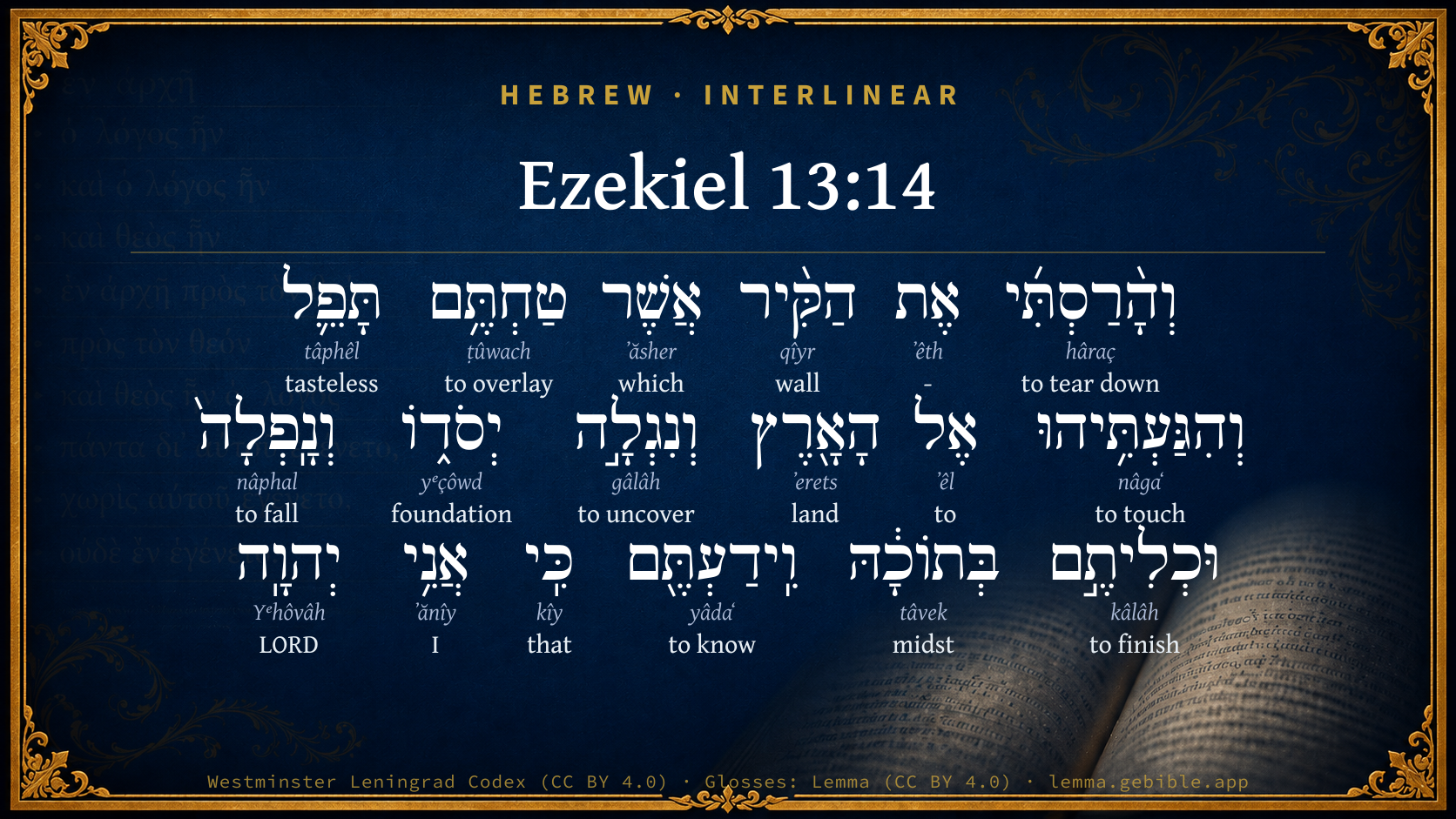
Hebrew (Westminster Leningrad Codex) Ezekiel 13:14 appears in the Hebrew Old Testament. The text above is from the Westminster Leningrad Codex. Each word links to its Strong’s number, a concise gloss, and parsing drawn from the Open Scriptures Hebrew Bible morphology. Click any word for its full Brown-Driver-Briggs (BDB) entry.
Download image
Cite this verse

Ezekiel 13:14 (World English Bible). Public Domain. Lemma interlinear Bible study tool, https://lemma.gebible.app/v/ezekiel/13/14.

Show BibTeX & RIS
BibTeX
RIS
English Translation
So will I break down the wall that you have daubed with whitewash, and bring it down to the ground, so that the foundation of it shall be uncovered; and it shall fall, and you shall be consumed in the midst of it: and you shall know that I am Yahweh.
World English Bible · Public Domain
Download a study sheet

One document with this verse’s original text, its word-by-word gloss line, the meaning frame, cross-references with their text, attributed commentary, and full source and license credits — printable, and it pastes into notes with its structure intact.

This verse Autodidact and up

Study sheet (.html) Plain text (.txt)

A passage Seminary Student

Up to 50 verses in one chapter. A passage sheet keeps up to 6 commentary sources and 12 cross-references per verse, in the order this page ranks them, and says so on the sheet whenever that leaves anything out. Ask for a single verse and you get the Autodidact verse sheet above.

Everything on this page stays free to read, with no account — the sheet is a download of what is already on screen, not access to it.

Want to remove ads? Support Godless Engineer
Compare translations 3

The same verse in 3 English versions, stacked beneath the original-language interlinear above. Click any original word for its lexicon entry.

Each is an independent rendering of the whole verse — the interlinear is not word-aligned to these translations.

Highlighted words mark where these versions differ — a whole-verse word diff, not a word-by-word alignment.

  • World English Bible Public Domain
    So will I break down the wall that you have daubed with whitewash, and bring it down to the ground, so that the foundation of it shall be uncovered; and it shall fall, and you shall be consumed in the midst of it: and you shall know that I am Yahweh.
  • King James Version Public Domain
    So will I break down the wall that ye have daubed with untempered morter, and bring it down to the ground, so that the foundation thereof shall be discovered, and it shall fall, and ye shall be consumed in the midst thereof: and ye shall know that I am the LORD.
  • unfoldingWord Literal Text CC BY-SA 4.0
    For I will tear down the wall that you have covered with whitewash, and I will demolish it to the ground and lay bare its foundations. So it will fall, and you will be annihilated in the middle of it all. Then you will know that I am Yahweh.

unfoldingWord Literal Text — © unfoldingWord, licensed CC BY-SA 4.0. Word-aligned USFM3 via Door43 (git.door43.org/unfoldingWord/en_ult).

Versions to compare (up to 4)

3 of 4 selected

Show all 18 translations

Every available English version of this verse, each an independent rendering of the whole verse.

  • World English Bible Public Domain
    So will I break down the wall that you have daubed with whitewash, and bring it down to the ground, so that the foundation of it shall be uncovered; and it shall fall, and you shall be consumed in the midst of it: and you shall know that I am Yahweh.
  • Berean Standard Bible Public Domain
    I will tear down the wall you whitewashed and level it to the ground, so that its foundation is exposed. The city will fall, and you will be destroyed within it. Then you will know that I am the LORD.
  • Majority Standard Bible Public Domain
    I will tear down the wall you whitewashed and level it to the ground, so that its foundation is exposed. The city will fall, and you will be destroyed within it. Then you will know that I am the LORD.
  • King James Version Public Domain
    So will I break down the wall that ye have daubed with untempered morter, and bring it down to the ground, so that the foundation thereof shall be discovered, and it shall fall, and ye shall be consumed in the midst thereof: and ye shall know that I am the LORD.
  • American Standard Version (1901) Public Domain
    So will I break down the wall that ye have daubed with untempered `mortar', and bring it down to the ground, so that the foundation thereof shall be uncovered; and it shall fall, and ye shall be consumed in the midst thereof: and ye shall know that I am Jehovah.
  • Revised Version (1885) Public Domain
    So will I break down the wall that ye have daubed with untempered mortar, and bring it down to the ground, so that the foundation thereof shall be discovered: and it shall fall, and ye shall be consumed in the midst thereof; and ye shall know that I am the LORD.
  • Geneva Bible (1599) Public Domain
    So I wil destroy the wall that ye haue daubed with vntempered morter, and bring it downe to the ground, so that the fundation thereof shalbe discouered, and it shall fal, and ye shalbe consumed in the middes thereof, and ye shall know, that I am the Lord.
  • Douay-Rheims (1899) Public Domain
    And I will break down the wall that you have daubed with untempered mortar: and I will make it even with the ground, and the foundation thereof shall be laid bare: and it shall fall, and shall be consumed in the midst thereof: and you shall know that I am the Lord.
  • Young's Literal Translation Public Domain
    And I have broken down the wall that ye daubed with chalk, And have caused it to come unto the earth, And revealed hath been its foundation, And it hath fallen, And ye have been consumed in its midst, And ye have known that I `am' Jehovah.
  • Literal Standard Version CC BY-SA 4.0
    And I have broken down the wall that you coated with chalk, || And have caused it to come to the earth, || And its foundation has been revealed, || And it has fallen, || And you have been consumed in its midst, || And you have known that I [am] YHWH.
  • Unlocked Literal Bible CC BY-SA 4.0
    For I will tear down the wall that you have covered with whitewash, and I will demolish it to the ground and lay bare its foundations. So it will fall, and you will be annihilated in the middle of it all. Then you will know that I am Yahweh.
  • unfoldingWord Literal Text CC BY-SA 4.0
    For I will tear down the wall that you have covered with whitewash, and I will demolish it to the ground and lay bare its foundations. So it will fall, and you will be annihilated in the middle of it all. Then you will know that I am Yahweh.
  • Darby Bible Public Domain
    And I will break down the wall that ye have daubed with untempered [mortar], and bring it down to the ground, so that the foundation thereof shall be discovered; and it shall fall, and ye shall be destroyed in the midst thereof; and ye shall know that I [am] Jehovah.
  • World Messianic Bible Public Domain
    So I will break down the wall that you have plastered with whitewash, and bring it down to the ground, so that its foundation will be uncovered. It will fall, and you will be consumed in the middle of it. Then you will know that I am the LORD.
  • Webster's Bible Public Domain
    So will I break down the wall that ye have daubed with untempered mortar, and bring it down to the ground, so that its foundation shall be made bare, and it shall fall, and ye shall be consumed in the midst of it: and ye shall know that I am the LORD.
  • Free Bible Version CC BY-SA 4.0
    I will demolish the wall you whitewashed, knocking it to the ground to reveal its foundations. The city is going to fall, and you're going to be destroyed with it. Then you will know that I am the Lord.
  • Bible in Basic English Public Domain
    So I will let the wall, which you were covering with whitewash, be broken down; I will have it levelled to the earth so that its base is uncovered: it will come down, and destruction will come on you with it; and it will be clear to you that I am the Lord.
  • JPS Tanakh (1917) Public Domain
    So will I break down the wall that ye have daubed with whited plaster, and bring it down to the ground, so that the foundation thereof shall be uncovered; and it shall fall, and ye shall be consumed in the midst thereof; and ye shall know that I am the LORD.

Literal Standard Version (2020), Covenant Press — licensed CC BY-SA 4.0. Text via the HelloAO Bible API (eBible.org). Unlocked Literal Bible (unfoldingWord) — licensed CC BY-SA 4.0. Text via the HelloAO Bible API (eBible.org). unfoldingWord Literal Text — © unfoldingWord, licensed CC BY-SA 4.0. Word-aligned USFM3 via Door43 (git.door43.org/unfoldingWord/en_ult). Free Bible Version, Dr. Jonathan Gallagher — licensed CC BY-SA 4.0. Text via the HelloAO Bible API (eBible.org).

Word by word

More ways to search: Search by grammar → Find every occurrence → Compare this word →

Practice this passage: Drill this verse → Learn its vocabulary →

תָּפֵ֛ל
tâphêl
H8602
“tasteless”
Noun, Common, Masculine, Singular, Absolute
Part of Speech
Noun
Type
Common
Gender
Masculine
Number
Singular
State
Absolute
Full BDB Definition

Origin: from an unused root meaning to smear

TWOT: 2534a , 2535a

foolish, insipid (adjective) - (BDB) tasteless, unseasoned (adjective) - whitewash (noun masculine) - meaning uncertain
  1. וְהָ֨רַסְתִּ֜י hâraç H2040 “and · to tear down” Conjunction + Verb, Qal, Sequential Perfect, 1st Person, Common, Singular
  2. אֶת ʼêth H853 “-” Particle, Direct Object
  3. הַקִּ֨יר qîyr H7023 “the · wall” Particle, Definite Article + Noun, Common, Masculine, Singular, Absolute
  4. אֲשֶׁר ʼăsher H834 “which” Particle, Relative
  5. טַחְתֶּ֥ם ṭûwach H2902 “to overlay” Verb, Qal, Perfect, 2nd Person, Masculine, Plural
  6. וְהִגַּעְתִּ֥יהוּ nâgaʻ H5060 “and · to touch · him” Conjunction + Verb, Hiphil, Sequential Perfect, 1st Person, Common, Singular + Suffix, Personal, 3rd Person, Masculine, Singular
  7. אֶל ʼêl H413 “to” Preposition
  8. הָאָ֖רֶץ ʼerets H776 “the · land” Particle, Definite Article + Noun, Common, Both, Singular, Absolute
  9. וְנִגְלָ֣ה gâlâh H1540 “and · to uncover” Conjunction + Verb, Niphal, Sequential Perfect, 3rd Person, Masculine, Singular
  10. יְסֹד֑וֹ yᵉçôwd H3247 “foundation · his” Noun, Common, Masculine, Singular, Construct + Suffix, Personal, 3rd Person, Masculine, Singular
  11. וְנָֽפְלָה֙ nâphal H5307 “and · to fall” Conjunction + Verb, Qal, Sequential Perfect, 3rd Person, Feminine, Singular
  12. וּכְלִיתֶ֣ם kâlâh H3615 “and · to finish” Conjunction + Verb, Qal, Sequential Perfect, 2nd Person, Masculine, Plural
  13. בְּתוֹכָ֔הּ tâvek H8432 “in/at · midst · her” Preposition + Noun, Common, Masculine, Singular, Construct + Suffix, Personal, 3rd Person, Feminine, Singular
  14. וִֽידַעְתֶּ֖ם yâdaʻ H3045 “and · to know” Conjunction + Verb, Qal, Sequential Perfect, 2nd Person, Masculine, Plural
  15. כִּֽי kîy H3588 “that” Conjunction
  16. אֲנִ֥י ʼănîy H589 “I” Pronoun, Personal, 1st Person, Common, Singular
  17. יְהוָֽה Yᵉhôvâh H3068 “LORD” Noun, Proper

About this verse

These counts appear in no published source. They are computed here, from the morphology-tagged text and Lemma’s own curated glosses. What Lemma adds →

18
words
18
distinct lemmas
Prophets
section

Notable vocabulary

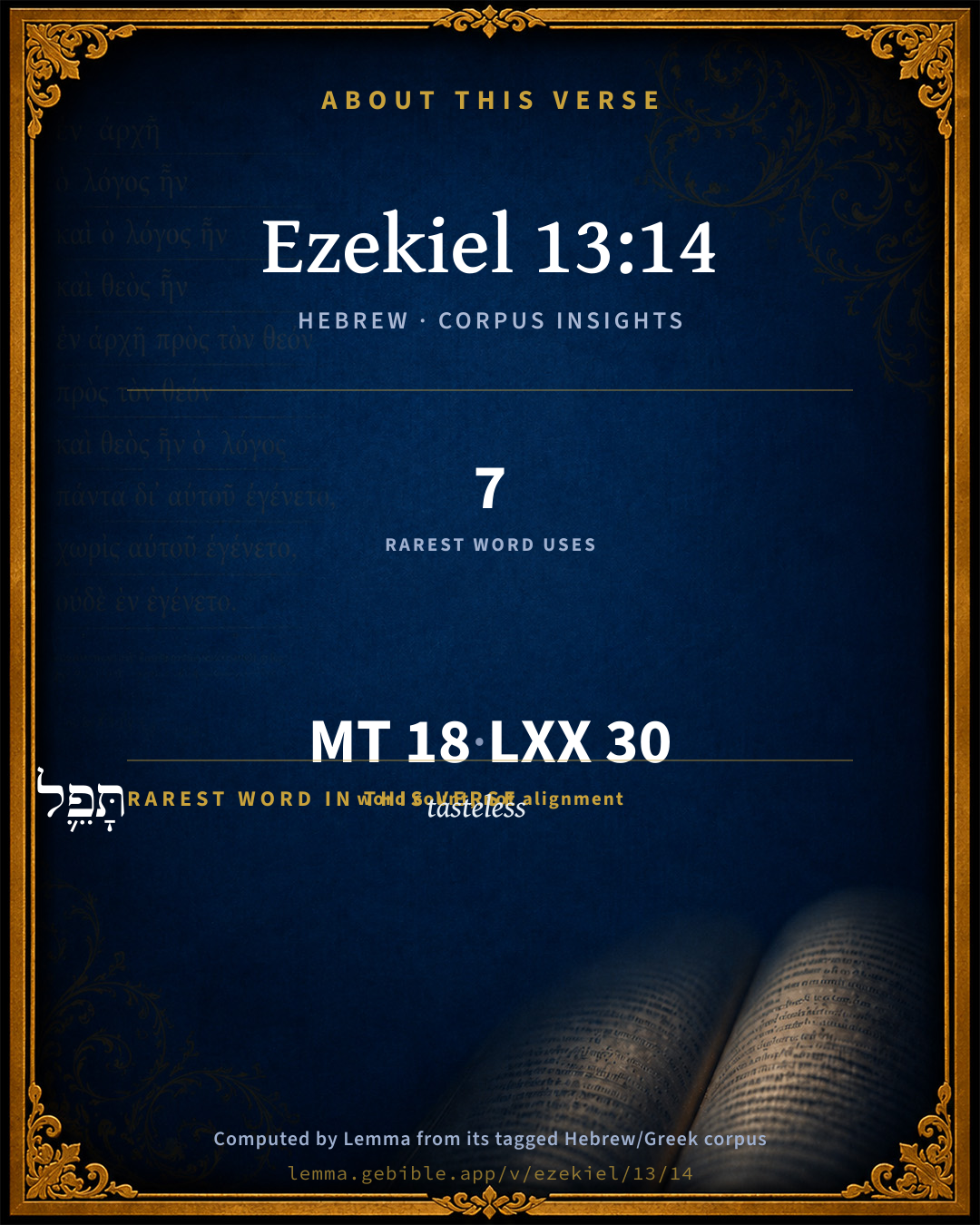
The rarest word here is תָּפֵ֛ל tasteless H8602 — appearing just 7 times in the whole Hebrew Bible.

Shared distinctive vocabulary

תָּפֵ֛ל tasteless H8602 occurs in 7 verses of the Hebrew Bible. Also found in:

Grammatical profile

  • 7 verbs
  • 6 nouns
  • 1 pronoun
  • 1 preposition
  • 1 conjunction
  • 2 particles

Verb forms

  • וְהָ֨רַסְתִּ֜י Qal · Sequential Perfect
  • טַחְתֶּ֥ם Qal · Perfect
  • וְהִגַּעְתִּ֥יהוּ Hiphil · Sequential Perfect
  • וְנִגְלָ֣ה Niphal · Sequential Perfect
  • וְנָֽפְלָה֙ Qal · Sequential Perfect
  • וּכְלִיתֶ֣ם Qal · Sequential Perfect
  • וִֽידַעְתֶּ֖ם Qal · Sequential Perfect

Hebrew & Septuagint length

In English translation the verse runs 51 words from the Hebrew and 49 from the Septuagint (LXX English) — closely comparable.

A rough comparison of the two English renderings, which tokenize alike — not a word-level alignment.

Word counts can differ between the Hebrew and the Greek without any difference in meaning — e.g. the Hebrew direct-object marker אֵת has no separate Greek word, and Greek often adds the article ὁ.

In the original languages it is 18 Hebrew tokens and 30 Greek tokens — but the two are counted differently (Hebrew bundles its prefixes and suffixes into one token; the Greek is in lemma form), so that isn’t a like-for-like length.

Cross-references

14

Topical passages linked to Ezekiel 13:14 in the Treasury of Scripture Knowledge — connected by theme and wording, ordered by reader-vote popularity; previews shown in the World English Bible.

  • Jeremiah 6:15 Were they ashamed when they had committed abomination? nay, they were not at all ashamed, neither could they blush: therefore they shall fall among those who fall; at the time that I visit them they shall be cast down, says Yahweh.
  • Jeremiah 14:15 Therefore thus says Yahweh concerning the prophets who prophesy in my name, and I didn't send them, yet they say, Sword and famine shall not be in this land: By sword and famine shall those prophets be consumed.
  • Micah 1:6 Therefore I will make Samaria like a rubble heap of the field, Like places for planting vineyards; And I will pour down its stones into the valley, And I will uncover its foundations.
  • Ezekiel 13:9 My hand shall be against the prophets who see false visions, and who divine lies: they shall not be in the council of my people, neither shall they be written in the writing of the house of Israel, neither shall they enter into the land of Israel; and you shall know that I am the Lord Yahweh.
  • Ezekiel 13:23 Therefore you shall no more see false visions, nor practice divination. I will deliver my people out of your hand; and you shall know that I am Yahweh.
  • Habakkuk 3:13 You went forth for the salvation of your people, For the salvation of your anointed. You crushed the head of the land of wickedness. You stripped them head to foot. Selah.
  • Psalms 11:3 If the foundations are destroyed, What can the righteous do?
  • Jeremiah 8:12 Were they ashamed when they had committed abomination? nay, they were not at all ashamed, neither could they blush: therefore shall they fall among those who fall; in the time of their visitation they shall be cast down, says Yahweh.
  • Jeremiah 23:15 Therefore thus says Yahweh of Hosts concerning the prophets: Behold, I will feed them with wormwood, and make them drink the water of gall; for from the prophets of Jerusalem is ungodliness gone forth into all the land.
  • Ezekiel 13:21 Your kerchiefs also will I tear, and deliver my people out of your hand, and they shall be no more in your hand to be hunted; and you shall know that I am Yahweh.
  • Ezekiel 14:8 and I will set my face against that man, and will make him an astonishment, for a sign and a proverb, and I will cut him off from the midst of my people; and you shall know that I am Yahweh.
  • Matthew 7:26–27 Everyone who hears these words of mine, and doesn't do them will be like a foolish man, who built his house on the sand.
  • Luke 6:49 But he who hears, and doesn't do, is like a man who built a house on the earth without a foundation, against which the stream broke, and immediately it fell, and the ruin of that house was great."
  • 1 Corinthians 3:11–15 For no one can lay any other foundation than that which has been laid, which is Jesus Christ.

Cross-references courtesy of OpenBible.info (CC BY 4.0).

Hebrew and Greek witnesses Masoretic Hebrew ↔ Greek Septuagint

The same verse in the two great witnesses to the Old Testament, shown verse-for-verse.

These are two independent witnesses, not word-aligned to each other, and the Septuagint is shown in lemma (dictionary) form.

Hebrew Ezekiel 13:14 Masoretic · Westminster Leningrad Codex

וְהָ֨רַסְתִּ֜י אֶת הַקִּ֨יר אֲשֶׁר טַחְתֶּ֥ם תָּפֵ֛ל וְהִגַּעְתִּ֥יהוּ אֶל הָאָ֖רֶץ וְנִגְלָ֣ה יְסֹד֑וֹ וְנָֽפְלָה֙ וּכְלִיתֶ֣ם בְּתוֹכָ֔הּ וִֽידַעְתֶּ֖ם כִּֽי אֲנִ֥י יְהוָֽה

So will I break down the wall that you have daubed with whitewash, and bring it down to the ground, so that the foundation of it shall be uncovered; and it shall fall, and you shall be consumed in the midst of it: and you shall know that I am Yahweh.

World English Bible · Public Domain

Greek LXX Ezekiel 13:14 Septuagint · lemma form

καί κατασκάπτω ὁ τοῖχος ὅς ἀλείφω καί πίπτω καί τίθημι αὐτός ἐπί ὁ γῆ καί ἀποκαλύπτω ὁ θεμέλιον αὐτός καί πίπτω καί συντελέω μετά ἔλεγχος καί ἐπιγιγνώσκω διότι ἐγώ κύριος

And I will break down the wall which you⌃ have plastered, and it shall fall; and I will lay it on the ground, and its foundations shall be revealed, and it shall fall; and you⌃ shall be consumed with rebukes: and you⌃ shall know that I am the Lord.

LXX2012 (modern English Septuagint) · Public Domain

On this verse, Haydock's Catholic Bible Commentary discusses the Septuagint’s reading. Read the note in Commentary ↓

Hebrew: Westminster Leningrad Codex (CC BY 4.0). Greek: Septuagint (public domain); English from LXX2012 (modern English Septuagint) (Public Domain). How the Septuagint differs from the Hebrew →

Targum (Aramaic paraphrase)

1

The Targum is the ancient Jewish Aramaic paraphrase of the Hebrew Scriptures — an interpretive translation, not the Hebrew text itself. Onkelos (literal) and Pseudo-Jonathan (expansive) render the Torah, and Jonathan the Prophets. Coverage is partial: where no permissively-licensed English translation exists for a verse, only the Aramaic is shown. This is verse-level text, not a word-by-word alignment to the Hebrew.

  1. Targum Jonathan Prophets (Joshua–Malachi)
    וְאַפְגַר יַת קַרְתָּא דְאִתְנַבֵּיתוּן בָּהּ נְבוּאַן דִשְׁקַר וְאֶרְמִינָהּ לְאַרְעָא וְיִתְגְלוּן אוּשָׁהָא וְתַפֵּל וְתִשְׁתֵּיצוּן בְּגַוָהּ וְתֵידְעוּן אֲרֵי אֲנָא יְיָ:

    (no public-domain English translation for this verse)

    Targum Jonathan — Aramaic: “Mikraot Gedolot” (public domain). English: “Sefaria Community Translation” (CC0 1.0 (public-domain dedication)); “London "Chaldee Paraphrase," 1871” (public domain). Text via Sefaria.

Commentary

Notes on Ezekiel 13:14 from classic Christian and Jewish commentators (each source and its license shown beneath its notes). The classic Christian expositions comment on the surrounding passage and are grouped to its opening verse, so a note may address several verses; the Jewish commentaries on the Tanakh (Rashi and others) are per-verse, so they appear only where the commentator wrote on this verse.

Lemma curates 59 commentaries, every one of them public domain or Creative Commons licensed, each selected and text-cleaned for this edition rather than reprinted as found. About our sources →

Trapp's Complete Commentary

John Trapp

Eze 13:14 So will I break down the wall that ye have daubed with untempered [morter], and bring it down to the ground, so that the foundation thereof shall be discovered, and it shall fall, and ye shall be consumed in the midst thereof: and ye shall know that I [am] the LORD.

Ver. 14. So that the foundation thereof shall be discovered.] So that all men shall see your falsehoods. See 2Ti 3:9 Rev 17:16. The old whore is first made naked and then desolate. Mr Philpot, martyr, dealt plainly by the Popish prelates in open convocation when he said to them, Before God ye are all bare arsed. God hath detected you, &c. {a}

And ye shall be consumed.] See on Eze 13:12.

{a} Acts and Mon.

John Trapp, A Commentary or Exposition upon All the Books of the Old and New Testament (1647–1656) — public domain. Text from a community e-Sword module.

Jamieson, Fausset & Brown

Robert Jamieson, A. R. Fausset & David Brown

The repetition of the same threat (see on Eze 13:11) is to awaken the people out of their dream of safety by the certainty of the event.

foundation--As the "wall" represents the security of the nation, so the "foundation" is Jerusalem, on the fortifications of which they rested their confidence. GROTIUS makes the "foundation" refer to the false principles on which they rested; Eze 13:16 supports the former view.

Jamieson, Fausset & Brown — Commentary Critical and Explanatory on the Whole Bible (1871) — public domain (CC PDM 1.0). Text via the HelloAO Bible API.

John Calvin's Commentaries

This verse ought to be united with the other: God says, I will throw down the wall. For the false prophets had acquired so much favor, that their boasting was as much esteemed as an oracle. Hence the people were persuaded that what even these impostors dreamt was uttered by God. Since, therefore, they had so bound men’s minds to themselves, the Prophet was obliged to inveigh vehemently against those impostures, since he would not have succeeded by simple language. This language, indeed, may seem superfluous; but if any one considers how greatly these miserable exiles were deluded by the false prophets, he will easily acknowledge that God does not repeat the same thing so often in vain: as in this place he brings forward nothing new; but he so inculcates what we have already seen as to confirm it. I will pull down, therefore, the wall which you have daubed with untempered mortar, and I will lay it low on the ground, and its foundation shall be uncovered, or discovered. Here the Prophet signifies that God would so lay bare the fallacies of those who had deceived the people with vain hopes, that no disguise should remain for them, but their disgrace should be plain to every one. Now, such was the shamelessness of these impostors, that if they were convicted on one point, yet they did not desist on that account, but took credit to themselves if anything turned out more fortunately than they could expect, as if they had not prophesied in vain, while a single thing came true. Since, therefore, the impious so turned their backs when God detected their folly, the Prophet adds, that the false prophets would have nothing left, because God will not only overthrow whatever they seemed to build, but he will uncover even the foundations, so that the people may understand that there was not a scruple or the least particle of truth in them.

And it shall fall, and you shall be consumed in the midst of it. He had just said that it should be ruinously consumed: hailstones, he said, should fall to consume it; by which word he understood that the final slaughter should be so severe that no hope should be left. For as long as Jerusalem stood, the Israelites always look forward to a return. But when they saw the kingdom not only weakened, but utterly destroyed, the temple overthrown, and the city ruined, whenever they heard of their dreadful dispersion, not the slightest remnant of hope survived. Now this consumption is transferred to the false prophets. As that consumption was final, and without a gleam of hope, ye shall be consumed, says he, in the midst of it, and ye shall know that I am Jehovah. He does not inculcate this particular so often in vain; but he inveighs with indignation against the wicked audacity of the false prophets, who dared so petulantly to oppose themselves to the true servants of God, and to assume his name, and to trifle with him like children. Such is the prodigious madness of mortals who dare to set themselves against God: for this reason, he says, they shall at length perceive with whom they have to do. It follows —

John Calvin's Commentaries (1540-1563) — public domain. Text from the Calvin Translation Society English edition (1840s-50s) via the Christian Classics Ethereal Library (ccel.org). Calvin's coverage is partial (roughly two-thirds of the Bible); uncommented books and verses are honest gaps, never fabricated. The 19th-century editor's footnotes and remarks are omitted so the notes are faithfully Calvin's own voice.

The Cambridge Bible for Schools and Colleges

gen. ed. J. J. S. Perowne

14. shall be discovered] i.e. uncovered, laid bare. The prophets shall be destroyed in the ruins of the wall (Amo_9:1). The figure tends in these words to be replaced by the reality, namely, Jerusalem and its downfall.

The Cambridge Bible for Schools and Colleges (gen. ed. J. J. S. Perowne; Cambridge University Press, 1878–1918) — public domain. Text from a community e-Sword module.

John Gill's Exposition

To wit, the prophets of Israel, which prophesy concerning Jerusalem,.... This explains who are meant by those that daubed with untempered mortar:

and which see visions of peace for her; not in reality, but in pretence; they boasted that they had visions and revelations from the Lord, and assured the people they should enjoy great peace and prosperity; but these, as they are before called, were vain visions and lying divinations: there seems to be in this an allusion to the name of Jerusalem, which, according to some, signifies,

"they shall see peace:''

and there is no peace, saith the Lord God; not to the wicked; nor to the inhabitants of Jerusalem, who listened to the false prophets; nor to the false prophets themselves.

John Gill's Exposition of the Whole Bible (1746–1763) — public domain (CC PDM 1.0). Text via the HelloAO Bible API.

Haydock's Catholic Bible Commentary

You. Literally, "it." But Hebrew and Septuagint have, "ye." (Haydock) --- The wall and the inhabitants shall perish. (Calmet)

George Leo Haydock (1774–1849), Haydock's Catholic Family Bible and Commentary, 1859 edition — public domain. Excludes Psalms (Douay-Rheims chapter numbering differs from Protestant) and Deuterocanonical books (Catholic canon only).

Matthew Poole's English Annotations

This verse with very little variation repeats the same dreadful procedure of God against this people, and these false prophets, and their false, ill-grounded confidences. And this repeating these things is to give us to know the certainty of the thing, the terror wherewith God will do it, and the stupidity of the Jews bewitched by the flatteries of their false prophets.

I will break down the wall; pull it down stone by stone; level it with the ground. The unsoundness of the foundation, whatever it may seem to be,

shall be discovered to every one that will look on it, and this to the utter shame of the builders.

And ye, who deceive and are deceived by it, shall perish in the midst thereof. So all that hearkened to these false prophets, rebelled against Nebuchadnezzar, fortified the city, and obstinately stood it out, fell with the ruins of the city, and perished, and then felt the stroke of God’s hand, and truth of his prophet.

Matthew Poole's English Annotations on the Holy Bible (1683–1685) — public domain. Text from a community e-Sword/MySword module.

Whedon's Commentary on the Bible

Daniel D. Whedon

14. So will I break down the wall — Although it was the Chaldeans who swept like a flood or a windstorm over Judea, and whose blows fell like hailstones, yet these were but the agents of Jehovah. It was not because the walls of the city were fragile, but because the God of the city did not protect it, that it fell before its enemies.

Daniel D. Whedon (gen. ed.), Commentary on the Old and New Testaments (1874–1909) — public domain. Text from a community e-Sword module.

John Wesley's Explanatory Notes

Ye shall know - Those that deceived others, will in the end be found to have deceived themselves. And no doom will be more fearful, than that of unfaithful ministers.

John Wesley, Explanatory Notes Upon the Whole Bible (1754–1765) — public domain. Text via the GEBible commentary corpus.

Rashi

Rabbi Shlomo Yitzchaki (Rashi)

the wall That is Jerusalem.

Rashi on the Tanakh — English translations: “The Judaica Press complete Tanach with Rashi, translated by A. J. Rosenberg” (CC BY 4.0); “Pentateuch with Rashi's commentary by M. Rosenbaum and A.M. Silbermann, 1929-1934” (public domain); “The Metsudah Tanach series, Lakewood, N.J” (CC BY 4.0); and “The Book of Joshua, Metsudah Publications, 1997” (CC BY 4.0). Text via Sefaria.

Lesson kit

Teaching starters — assembled from the data on this page, not authored interpretation. Every prompt links to the verse data it draws on. Edit before teaching.

Ezekiel, in the Prophets, opens this verse with 18 words (18 distinct Hebrew lemmas). Its most distinctive word is tâphêl (“tasteless”). A historical commentator’s framing appears above. Read the whole chapter for the surrounding context.

Discussion questions

  1. How does “tasteless” (tâphêl) shape what this verse is saying?
  2. Job 6:6 shares the word «tasteless» with this verse. How do the two illuminate each other?
  3. These translations render this verse differently. What is at stake in choosing one wording over another?
  4. The verb «וְהָ֨רַסְתִּ֜י» is Qal Sequential Perfect. How does its form color the action?
  5. Reading how Trapp's Complete Commentary and Jamieson, Fausset & Brown read this verse, where do the two commentators agree and where do they part?

Things to notice

Reading settings

Reading text

Shown beneath each verse's original-language words.

Old Testament
Old Testament edition

Read the OT as the Masoretic Hebrew (MT) or the Greek Septuagint (LXX).

English shown for the Greek Septuagint (in the Hebrew ↔ Greek comparison).

Comparing translations? Open the Compare panel on any verse page to stack up to four side by side.