1 Kings 18:39

Hebrew (Westminster Leningrad Codex) 1 Kings 18:39 appears in the Hebrew Old Testament. The text above is from the Westminster Leningrad Codex. Each word links to its Strong’s number, a concise gloss, and parsing drawn from the Open Scriptures Hebrew Bible morphology. Click any word for its full Brown-Driver-Briggs (BDB) entry.
Download image
Cite this verse

1 Kings 18:39 (World English Bible). Public Domain. Lemma interlinear Bible study tool, https://lemma.gebible.app/v/1-kings/18/39.

Show BibTeX & RIS
BibTeX
RIS
English Translation
When all the people saw it, they fell on their faces: and they said, Yahweh, he is God; Yahweh, he is God.
World English Bible · Public Domain
Download a study sheet

One document with this verse’s original text, its word-by-word gloss line, the meaning frame, cross-references with their text, attributed commentary, and full source and license credits — printable, and it pastes into notes with its structure intact.

This verse Autodidact and up

Study sheet (.html) Plain text (.txt)

A passage Seminary Student

Up to 50 verses in one chapter. A passage sheet keeps up to 6 commentary sources and 12 cross-references per verse, in the order this page ranks them, and says so on the sheet whenever that leaves anything out. Ask for a single verse and you get the Autodidact verse sheet above.

Everything on this page stays free to read, with no account — the sheet is a download of what is already on screen, not access to it.

Want to remove ads? Support Godless Engineer
Compare translations 3

The same verse in 3 English versions, stacked beneath the original-language interlinear above. Click any original word for its lexicon entry.

Each is an independent rendering of the whole verse — the interlinear is not word-aligned to these translations.

Highlighted words mark where these versions differ — a whole-verse word diff, not a word-by-word alignment.

  • World English Bible Public Domain
    When all the people saw it, they fell on their faces: and they said, Yahweh, he is God; Yahweh, he is God.
  • King James Version Public Domain
    And when all the people saw it, they fell on their faces: and they said, The LORD, he is the God; the LORD, he is the God.
  • unfoldingWord Literal Text CC BY-SA 4.0
    And all of the people saw, and they fell on their faces. And they said, “Yahweh, he God! Yahweh, he God!”

unfoldingWord Literal Text — © unfoldingWord, licensed CC BY-SA 4.0. Word-aligned USFM3 via Door43 (git.door43.org/unfoldingWord/en_ult).

Versions to compare (up to 4)

3 of 4 selected

Show all 18 translations

Every available English version of this verse, each an independent rendering of the whole verse.

  • World English Bible Public Domain
    When all the people saw it, they fell on their faces: and they said, Yahweh, he is God; Yahweh, he is God.
  • Berean Standard Bible Public Domain
    When all the people saw this, they fell facedown and said, “The LORD, He is God! The LORD, He is God!”
  • Majority Standard Bible Public Domain
    When all the people saw this, they fell facedown and said, “The LORD, He is God! The LORD, He is God!”
  • King James Version Public Domain
    And when all the people saw it, they fell on their faces: and they said, The LORD, he is the God; the LORD, he is the God.
  • American Standard Version (1901) Public Domain
    And when all the people saw it, they fell on their faces: and they said, Jehovah, he is God; Jehovah, he is God.
  • Revised Version (1885) Public Domain
    And when all the people saw it, they fell on their faces: and they said, The LORD, he is God; the LORD, he is God.
  • Geneva Bible (1599) Public Domain
    And when all the people sawe it, they fell on their faces, and saide, The Lord is God, the Lord is God.
  • Douay-Rheims (1899) Public Domain
    And when all the people saw this, they fell on their faces, and they said: The Lord he is God, the Lord he is God.
  • Young's Literal Translation Public Domain
    And all the people see, and fall on their faces, and say, `Jehovah, He `is' the God, Jehovah, He `is' the God.'
  • Literal Standard Version CC BY-SA 4.0
    And all the people see, and fall on their faces, and say, “YHWH, He [is] the God! YHWH, He [is] the God!”
  • Unlocked Literal Bible CC BY-SA 4.0
    When all the people saw this, they lay facedown on the ground and said, “Yahweh, he is God! Yahweh, he is God!”
  • unfoldingWord Literal Text CC BY-SA 4.0
    And all of the people saw, and they fell on their faces. And they said, “Yahweh, he God! Yahweh, he God!”
  • Darby Bible Public Domain
    And all the people saw [it], and they fell on their faces and said, Jehovah, he is God! Jehovah, he is God!
  • World Messianic Bible Public Domain
    When all the people saw it, they fell on their faces. They said, “The LORD, he is God! The LORD, he is God!”
  • Webster's Bible Public Domain
    And when all the people saw it, they fell on their faces: and they said, The LORD, he is the God; the LORD, he is the God.
  • Free Bible Version CC BY-SA 4.0
    When all the people saw this, they fell facedown on the ground and shouted, “The Lord, he is God! The Lord, he is God!”
  • Bible in Basic English Public Domain
    And when the people saw it, they all went down on their faces, and said, The Lord, he is God, the Lord, he is God.
  • JPS Tanakh (1917) Public Domain
    And when all the people saw it, they fell on their faces; and they said: 'The LORD, He is God; the LORD, He is God.'

Literal Standard Version (2020), Covenant Press — licensed CC BY-SA 4.0. Text via the HelloAO Bible API (eBible.org). Unlocked Literal Bible (unfoldingWord) — licensed CC BY-SA 4.0. Text via the HelloAO Bible API (eBible.org). unfoldingWord Literal Text — © unfoldingWord, licensed CC BY-SA 4.0. Word-aligned USFM3 via Door43 (git.door43.org/unfoldingWord/en_ult). Free Bible Version, Dr. Jonathan Gallagher — licensed CC BY-SA 4.0. Text via the HelloAO Bible API (eBible.org).

Word by word

More ways to search: Search by grammar → Find every occurrence → Compare this word →

Practice this passage: Drill this verse → Learn its vocabulary →

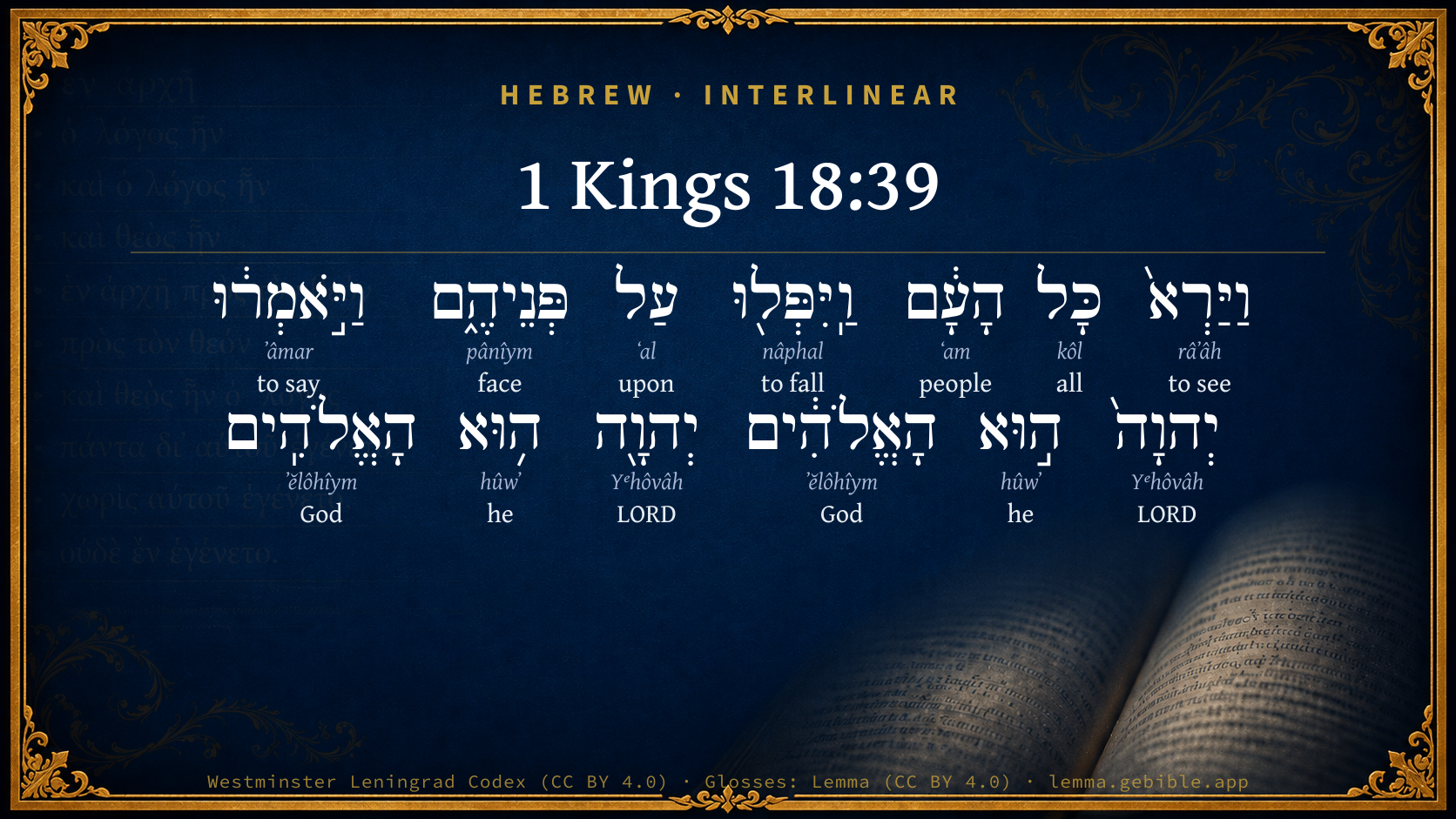
וַֽיִּפְּל֖וּ
nâphal
H5307
“and · to fall”
Conjunction + Verb, Qal, Sequential Imperfect, 3rd Person, Masculine, Plural
Part of Speech
Conjunction + Verb
Stem
Qal
Form
Sequential Imperfect
Person
3rd Person
Gender
Masculine
Number
Plural
Full BDB Definition

Origin: a primitive root

TWOT: 1392

to fall, lie, be cast down, fail - (Qal) - to fall - to fall (of violent death) - to fall prostrate, prostrate oneself before - to fall upon, attack, desert, fall away to, go away to, fall into the hand of - to fall short, fail, fall out, turn out, result - to settle, waste away, be offered, be inferior to - to lie, lie prostrate - (Hiphil) - to cause to fall, fell, throw down, knock out, lay prostrate - to overthrow - to make the lot fall, assign by lot, apportion by lot - to let drop, cause to fail (figuratively) - to cause to fall - (Hithpael) - to throw or prostrate oneself, throw oneself upon - to lie prostrate, prostrate oneself - (Pilel) to fall

  1. וַיַּרְא֙ râʼâh H7200 “and · to see” Conjunction + Verb, Qal, Sequential Imperfect, 3rd Person, Masculine, Singular
  2. כָּל kôl H3605 “all of” Noun, Common, Masculine, Singular, Construct
  3. הָעָ֔ם ʻam H5971 “the · people” Particle, Definite Article + Noun, Common, Masculine, Singular, Absolute
  4. עַל ʻal H5921 “upon” Preposition
  5. פְּנֵיהֶ֑ם pânîym H6440 “face(s) · their” Noun, Common, Both, Plural, Construct + Suffix, Personal, 3rd Person, Masculine, Plural
  6. וַיֹּ֣אמְר֔וּ ʼâmar H559 “and · to say” Conjunction + Verb, Qal, Sequential Imperfect, 3rd Person, Masculine, Plural
  7. יְהוָה֙ Yᵉhôvâh H3068 “LORD” Noun, Proper
  8. ה֣וּא hûwʼ H1931 “he” Pronoun, Personal, 3rd Person, Masculine, Singular
  9. הָאֱלֹהִ֔ים ʼĕlôhîym H430 “the · God(s)” Particle, Definite Article + Noun, Common, Masculine, Plural, Absolute
  10. יְהוָ֖ה Yᵉhôvâh H3068 “LORD” Noun, Proper
  11. ה֥וּא hûwʼ H1931 “he” Pronoun, Personal, 3rd Person, Masculine, Singular
  12. הָאֱלֹהִֽים ʼĕlôhîym H430 “the · God(s)” Particle, Definite Article + Noun, Common, Masculine, Plural, Absolute

About this verse

These counts appear in no published source. They are computed here, from the morphology-tagged text and Lemma’s own curated glosses. What Lemma adds →

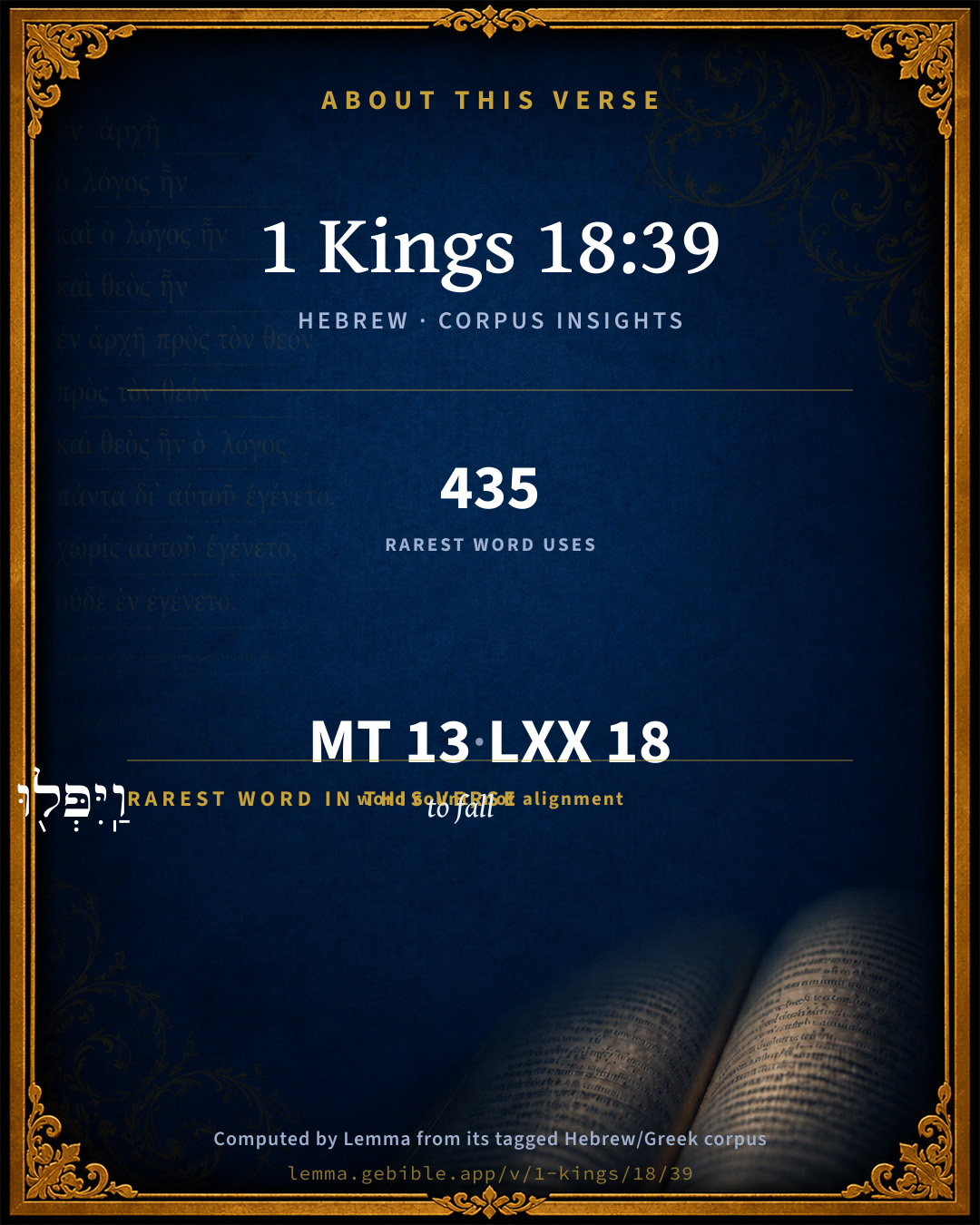
13
words
10
distinct lemmas
Historical
section

Grammatical profile

  • 3 verbs
  • 7 nouns
  • 2 pronouns
  • 1 preposition

Verb forms

  • וַיַּרְא֙ Qal · Sequential Imperfect
  • וַֽיִּפְּל֖וּ Qal · Sequential Imperfect
  • וַיֹּ֣אמְר֔וּ Qal · Sequential Imperfect

Repetition

Words recur within this verse — often emphatic in Hebrew:

  • יְהוָה֙ LORD H3068 ×2
  • הָאֱלֹהִ֔ים God H430 ×2
  • ה֣וּא he H1931 ×2

Hebrew & Septuagint length

In English translation the verse runs 22 words from the Hebrew and 18 from the Septuagint (LXX English) — closely comparable.

A rough comparison of the two English renderings, which tokenize alike — not a word-level alignment.

Word counts can differ between the Hebrew and the Greek without any difference in meaning — e.g. the Hebrew direct-object marker אֵת has no separate Greek word, and Greek often adds the article ὁ.

In the original languages it is 13 Hebrew tokens and 18 Greek tokens — but the two are counted differently (Hebrew bundles its prefixes and suffixes into one token; the Greek is in lemma form), so that isn’t a like-for-like length.

Cross-references

8

Topical passages linked to 1 Kings 18:39 in the Treasury of Scripture Knowledge — connected by theme and wording, ordered by reader-vote popularity; previews shown in the World English Bible.

  • 1 Kings 18:24 You call on the name of your god, and I will call on the name of Yahweh; and the God who answers by fire, let him be God." All the people answered, "It is well said."
  • 2 Chronicles 7:3 All the children of Israel looked on, when the fire came down, and the glory of Yahweh was on the house; and they bowed themselves with their faces to the ground on the pavement, and worshiped, and gave thanks to Yahweh, [saying], For he is good; for his loving kindness endures for ever.
  • 1 Kings 18:21 Elijah came near to all the people, and said, "How long will you waver between the two sides? If Yahweh is God, follow him; but if Baal, then follow him." The people answered him not a word.
  • Judges 13:20 For it happened, when the flame went up toward the sky from off the altar, that the angel of Yahweh ascended in the flame of the altar: and Manoah and his wife looked on; and they fell on their faces to the ground.
  • 1 Chronicles 21:16 David lifted up his eyes, and saw the angel of Yahweh standing between earth and the sky, having a drawn sword in his hand stretched out over Jerusalem. Then David and the elders, clothed in sackcloth, fell on their faces.
  • John 5:35 He was the burning and shining lamp, and you were willing to rejoice for a while in his light.
  • Acts 2:37 Now when they heard this, they were cut to the heart, and said to Peter and the rest of the apostles, "Brothers, what shall we do?"
  • Acts 4:16 saying, "What shall we do to these men? Because indeed a notable miracle has been done through them, as can be plainly seen by all who dwell in Jerusalem, and we can't deny it.

Cross-references courtesy of OpenBible.info (CC BY 4.0).

Hebrew and Greek witnesses Masoretic Hebrew ↔ Greek Septuagint

The same verse in the two great witnesses to the Old Testament, shown verse-for-verse.

These are two independent witnesses, not word-aligned to each other, and the Septuagint is shown in lemma (dictionary) form.

Hebrew 1 Kings 18:39 Masoretic · Westminster Leningrad Codex

וַיַּרְא֙ כָּל הָעָ֔ם וַֽיִּפְּל֖וּ עַל פְּנֵיהֶ֑ם וַיֹּ֣אמְר֔וּ יְהוָה֙ ה֣וּא הָאֱלֹהִ֔ים יְהוָ֖ה ה֥וּא הָאֱלֹהִֽים

When all the people saw it, they fell on their faces: and they said, Yahweh, he is God; Yahweh, he is God.

World English Bible · Public Domain

Greek LXX 1 Kings 18:39 Septuagint · lemma form

καί πίπτω πᾶς ὁ λαός ἐπί πρόσωπον αὐτός καί εἶπον ἀληθῶς κύριος εἰμί ὁ θεός αὐτός ὁ θεός

And all the people fell upon their faces, and said, Truly the Lord is God; he is God.

LXX2012 (modern English Septuagint) · Public Domain

On this verse, The Cambridge Bible for Schools and Colleges discusses the Septuagint’s reading. Read the note in Commentary ↓

Hebrew: Westminster Leningrad Codex (CC BY 4.0). Greek: Septuagint (public domain); English from LXX2012 (modern English Septuagint) (Public Domain). How the Septuagint differs from the Hebrew →

Targum (Aramaic paraphrase)

1

The Targum is the ancient Jewish Aramaic paraphrase of the Hebrew Scriptures — an interpretive translation, not the Hebrew text itself. Onkelos (literal) and Pseudo-Jonathan (expansive) render the Torah, and Jonathan the Prophets. Coverage is partial: where no permissively-licensed English translation exists for a verse, only the Aramaic is shown. This is verse-level text, not a word-by-word alignment to the Hebrew.

  1. Targum Jonathan Prophets (Joshua–Malachi)
    וַחֲזוֹ כָל עַמָא וּנְפַלוּ עַל אֲפֵּיהוֹן וַאֲמַרוּ יְיָ הוּא אֱלֹהִים יְיָ הוּא אֱלֹהִים:

    (no public-domain English translation for this verse)

    Targum Jonathan — Aramaic: “Mikraot Gedolot” (public domain). English: “Sefaria Community Translation” (CC0 1.0 (public-domain dedication)); “London "Chaldee Paraphrase," 1871” (public domain). Text via Sefaria.

Commentary

Notes on 1 Kings 18:39 from classic Christian and Jewish commentators (each source and its license shown beneath its notes). The classic Christian expositions comment on the surrounding passage and are grouped to its opening verse, so a note may address several verses; the Jewish commentaries on the Tanakh (Rashi and others) are per-verse, so they appear only where the commentator wrote on this verse.

Lemma curates 59 commentaries, every one of them public domain or Creative Commons licensed, each selected and text-cleaned for this edition rather than reprinted as found. About our sources →

Trapp's Complete Commentary

John Trapp

1Ki 18:39 And when all the people saw [it], they fell on their faces: and they said, The LORD, he [is] the God; the LORD, he [is] the God.

Ver. 39. The Lord, he is the God.] This was to give God a testimonial; this was to "set to their seals that God was true." {Joh 3:33}

John Trapp, A Commentary or Exposition upon All the Books of the Old and New Testament (1647–1656) — public domain. Text from a community e-Sword module.

The Biblical Illustrator

Joseph S. Exell

1Ki_18:39

All the people . . . said, The Lord, He is the God.

Christianity acknowledged supreme

In the Introduction to his Analogy of Religion, Bishop Butler says: It has come to pass--I know not how--that Christianity is discovered to be victorious. Why, that was nearly two hundred years ago! I wonder how many books have been written against the Bible since then, and handed up, one after the other, to the cobwebs of the upper shelves in the library, while the old Book still lies before us, saying with a conscious sense of superiority to all the other books--

Books may come and books may go,

But I go on for ever.

A reformers temporary successes

There was a time, towards the close of the fifteenth century, when the devoted monk and martyr, Savonarola, seemed to have set up the kingdom of Christ in his beloved city of Florence. How he remodelled the Republican government; how he tamed the mischievous boys of the city; how at his bidding the people kindled in the great Piazza, during the Carnival of 1496, the strange Bonfire of Vanities; how the watchword of Florence became, Viva Gesu Cristo, nostro Re--Long live Jesus Christ, our King: there are few histories like it. It was an Italian theocracy. It was a day of heaven on the earth. So much joy was there in all hearts, one of the chroniclers tells us, that the glory of Paradise seemed to have descended to this lower world. The pity is that the Golden Age of Florence was so transient and brief-lived. (Sunday School Teacher.)

The Biblical Illustrator, edited by Joseph S. Exell (c. 1880s–1900s) — public domain. Text from a community e-Sword module.

Joseph Benson's Commentary

1Ki 18:39. When all the people saw it, they fell on their faces — In acknowledgment and adoration of the true God; and all, as one man, cried out, Jehovah, he is the God — He alone; and Baal is a senseless idol. And they repeated the words to signify their abundant satisfaction, and assurance of the truth of their assertion. And some, we may hope, had their hearts so turned back as to be determined that he should be their God, and that they would serve him only, Jos 24:24. But it is certain the generality of them were convinced only, not converted; they yielded to the truth of God, that he is the God, but consented not to his covenant that he should be their God. Blessed are they, who have not seen what they saw, and yet have believed, and been influenced more than they that saw it.

Joseph Benson's Commentary on the Old and New Testaments (1811–1818) — public domain. Text from a community e-Sword module.

Adam Clarke's Commentary

Verse 39. Fell on their faces] Struck with awe and reverence at the sight of this incontestable miracle.

And they said] We should translate the words thus: JEHOVAH, He is the God! JEHOVAH, He is the God! Baal is not the God; Jehovah alone is the God of Israel.

As our term Lord is very equivocal, we should every where insert the original word יהוה, which we should write Yeve or Yeheveh, or Yahvah or Yehueh, or, according to the points, Yehovah.

Adam Clarke's Commentary on the Bible (1810–1826) — public domain. Text from a community e-Sword/MySword module.

Ellicott's Commentary for English Readers

(39) They fell on their faces.—Exactly as in Lev_9:24, at the inauguration of the sacrifices of the new Tabernacle by the fire from heaven, with the characteristic addition of the cry, “Jehovah; He, and He only, is God.”

A Bible Commentary for English Readers, edited by Charles John Ellicott (1878–1897) — public domain. Text from a community e-Sword module.

The Cambridge Bible for Schools and Colleges

gen. ed. J. J. S. Perowne

39. And when all the people saw it, they fell] The LXX. simply says ‘And all the people fell.’ Josephus describes the reaction thus, ‘They fell upon the ground and worshipped the one God, calling Him most mighty and true, while the others were but names devised by wrong and senseless opinion.’

The Cambridge Bible for Schools and Colleges (gen. ed. J. J. S. Perowne; Cambridge University Press, 1878–1918) — public domain. Text from a community e-Sword module.

John Gill's Exposition

And Elijah said unto Ahab, get thee up,.... From the brook and valley where the execution of the prophets had been made; either up to his chariot, or to the tent or pavilion erected on the side of the mount, where the whole scene of things was transacted;

eat and drink; which he had no leisure for all the day, from the time of the morning sacrifice to the evening sacrifice, which was taken up in attending to the issue of the several sacrifices; but now he is bid to eat and refresh himself, and that in token of joy and gladness, as became him, both for the honour of the true God, which had been abundantly confirmed, and for the near approach of rain, of which he assures him:

for there is a sound of abundance of rain; the wind perhaps began to rise, and blow pretty briskly, which was a sign of it (f); besides, according to the Tyrian annals (g), there were loud claps of thunder at this time, at least when the heavens became very black, as in Kg1 18:45.

(f) "Fit fragor, hinc densi----nimbi", Ovid. Metamorph. l. 1. Fab. 8. v. 269. (g) Apud Joseph, Antiqu. l. 8. c. 13. sect. 2.

John Gill's Exposition of the Whole Bible (1746–1763) — public domain (CC PDM 1.0). Text via the HelloAO Bible API.

Albert Barnes' Notes on the Bible

The Lord, he is the God - The people thus pronounced the matter to be clearly and certainly decided. Baal was overthrown; he was proved to be no god at all. The Lord Yahweh, He, and He alone, is God. Him would they henceforth acknowledge, and no other.

Albert Barnes' Notes on the Bible (1834–1885) — public domain. Text from a community e-Sword/MySword module.

Matthew Poole's English Annotations

They fell on their faces, in way of acknowledgment and adoration of the true God.

He is the God; he alone; and Baal is a dull and senseless idol. And they double the words, to note their abundant satisfaction and assurance of the truth of their assertion.

Matthew Poole's English Annotations on the Holy Bible (1683–1685) — public domain. Text from a community e-Sword/MySword module.

Whedon's Commentary on the Bible

Daniel D. Whedon

39. Fell on their faces — Overwhelmed with the convincing display of Divine power and glory.

The Lord, he is the God — Better, Jehovah, he is the God! The God; that is, the only God, for Baal had failed to prove himself a god at all.

Daniel D. Whedon (gen. ed.), Commentary on the Old and New Testaments (1874–1909) — public domain. Text from a community e-Sword module.

The Pulpit Commentary

And when all the people saw it, they fell on their faces As Lev_9:24; 2Ch_7:3; cf. Num_22:31; Jos_5:14; :Rev_11:16. They recognized in the fire, that is to say, the token of the Divine Presence and they said, The Lord Jehovah. The connexion of this verse with the three verses preceding is obscured by our translation, he is the God; the Lord, he is the God. The echo of ver. 24. The Hebrew words are the same. Stanley remarks that it is as if (by a slight inversion) they turned "the name of the prophet himself into a war-cry, "Eli-Jah-hu.

The Pulpit Commentary (1880–1919), ed. H.D.M. Spence-Jones & Joseph S. Exell — public domain. Text from a community e-Sword module.

John Wesley's Explanatory Notes

They fell - In acknowledgment of the true God. He is God - He alone; and Baal is a senseless idol. And they double the words, to note their abundant satisfaction and assurance of the truth of their assertion.

John Wesley, Explanatory Notes Upon the Whole Bible (1754–1765) — public domain. Text via the GEBible commentary corpus.

Rashi

Rabbi Shlomo Yitzchaki (Rashi)

Adonoy He is God. And the Baal is not God.

Rashi on the Tanakh — English translations: “The Judaica Press complete Tanach with Rashi, translated by A. J. Rosenberg” (CC BY 4.0); “Pentateuch with Rashi's commentary by M. Rosenbaum and A.M. Silbermann, 1929-1934” (public domain); “The Metsudah Tanach series, Lakewood, N.J” (CC BY 4.0); and “The Book of Joshua, Metsudah Publications, 1997” (CC BY 4.0). Text via Sefaria.

Lesson kit

Teaching starters — assembled from the data on this page, not authored interpretation. Every prompt links to the verse data it draws on. Edit before teaching.

1 Kings, in the Historical, opens this verse with 13 words (10 distinct Hebrew lemmas). Its most distinctive word is nâphal (“to fall”). A historical commentator’s framing appears above. Read the whole chapter for the surrounding context.

Discussion questions

  1. The word nâphal carries the sense “to fall.” How does it shape the verse?
  2. 1 Kings 18:24 shares this passage’s theme. How do the two illuminate each other?
  3. “LORD” occurs 2× in this one verse. What is the effect of the repetition?
  4. These translations render this verse differently; the difference is in the English rendering, not the original. What questions does that raise?
  5. The verb «וַיַּרְא֙» is Qal Sequential Imperfect. How does its form color the action?
  6. Reading how Trapp's Complete Commentary and The Biblical Illustrator read this verse, where do the two commentators agree and where do they part?

Things to notice

Reading settings

Reading text

Shown beneath each verse's original-language words.

Old Testament
Old Testament edition

Read the OT as the Masoretic Hebrew (MT) or the Greek Septuagint (LXX).

English shown for the Greek Septuagint (in the Hebrew ↔ Greek comparison).

Comparing translations? Open the Compare panel on any verse page to stack up to four side by side.